
Sclerotherapy Market Report 2026
Global Outlook – By Type (Liquid Sclerotherapy, Foam Sclerotherapy, Ultrasound-Guided Sclerotherapy ), By Agents (Detergents, Chemical Irritants, Osmotic Agents ), By Application (Varicose Veins, Spider Veins, Hemorrhoids ), By End-User (Hospitals, Ambulatory Surgical Centers, Specialty Clinics, Other End-Users) - Market Size, Trends, Strategies, and Forecast to 2030
Sclerotherapy Market Overview
• Sclerotherapy market size has reached to $1.21 billion in 2025 • Expected to grow to $1.65 billion in 2030 at a compound annual growth rate (CAGR) of 6.2% • Growth Driver: Rising Prevalence Of Varicose And Spider Veins Driving Market Growth Through Effective Treatment Solutions • Market Trend: Advancing Patient Care Through Strategic Collaborations In Vein Treatment • North America was the largest region in 2025 and Asia-Pacific is the fastest growing region.What Is Covered Under Sclerotherapy Market?
Sclerotherapy is a minimally invasive medical procedure used to treat varicose and spider veins by injecting a concentrated solution (sclerosant) directly into the affected vessels. The sclerosant irritates the vein’s lining, causing it to collapse and scar and eventually be reabsorbed by the body. Over time, treated veins fade from view, and blood flow is redirected through healthier vessels. The main types of sclerotherapy are liquid sclerotherapy, foam sclerotherapy, and ultrasound-guided sclerotherapy. Liquid sclerotherapy involves the injection of a solution directly into affected veins and is used to treat varicose and spider veins. The procedure utilizes various agents, including detergents, chemical irritants, and osmotic agents. These are used for various applications such as varicose veins, spider veins, and hemorrhoids and also by various end users such as hospitals, ambulatory surgical centers, specialty clinics, and others.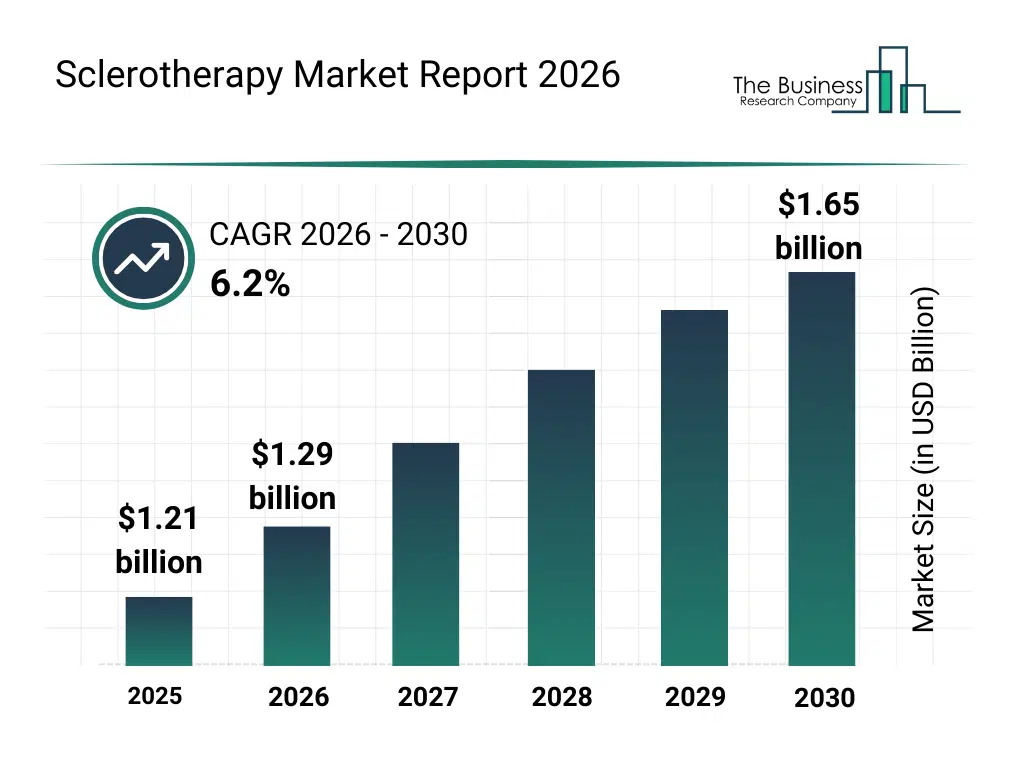
What Is The Sclerotherapy Market Size and Share 2026?
The sclerotherapy market size has grown strongly in recent years. It will grow from $1.21 billion in 2025 to $1.29 billion in 2026 at a compound annual growth rate (CAGR) of 6.4%. The growth in the historic period can be attributed to limited treatment awareness, conventional sclerosing agents, low cosmetic procedure adoption, regulatory limitations, high treatment costs.What Is The Sclerotherapy Market Growth Forecast?
The sclerotherapy market size is expected to see strong growth in the next few years. It will grow to $1.65 billion in 2030 at a compound annual growth rate (CAGR) of 6.2%. The growth in the forecast period can be attributed to development of safer sclerosants, advanced delivery techniques, growth of aesthetic clinics, medical tourism expansion, insurance coverage improvement. Major trends in the forecast period include minimally invasive procedures, advanced foam sclerosants, combination therapies, outpatient treatment growth, rising medical tourism.
Global Sclerotherapy Market Segmentation
1) By Type: Liquid Sclerotherapy, Foam Sclerotherapy, Ultrasound-Guided Sclerotherapy 2) By Agents: Detergents, Chemical Irritants, Osmotic Agents 3) By Application: Varicose Veins, Spider Veins, Hemorrhoids 4) By End-User: Hospitals, Ambulatory Surgical Centers, Specialty Clinics, Other End-Users Subsegments: 1) By Liquid Sclerotherapy: Polidocanol-based, Sodium Tetradecyl Sulfate (STS)-based, Hypertonic Saline-based 2) By Foam Sclerotherapy: Polidocanol Foam, STS Foam, Air-based Foam 3) By Ultrasound-Guided Sclerotherapy: Foam-guided, Liquid-guided, Combination TherapiesWhat Are The Drivers Of The Sclerotherapy Market?
The rising prevalence of varicose veins and spider veins is expected to propel the growth of the sclerotherapy market going forward. Varicose veins and spider veins refer to enlarged, twisted, or damaged veins often visible under the skin caused by poor blood flow, in the legs. The rise of prevalence of varicose veins and spider veins is due to the people spending more time sitting or standing for long periods, often linked to modern work habits. Sclerotherapy helps the prevalence of varicose veins and spider veins by allowing targeted injection of a solution that seals off damaged veins, improving blood flow and appearance. For instance, in January 2024, according to the National Center for Biotechnology Information, a US-Based health information organization, in Brazil, 47.6% of the population had varicose veins (VVs), with a higher prevalence among non-pregnant women at 50.9%, compared to 37.9% in men. Therefore, the rising prevalence of varicose veins and spider veins is going to drive the growth of sclerotherapy industry. The rise in healthcare expenditure is expected to propel the growth of sclerotherapy market going forward. Healthcare expenditure is the overall spending on medical services, treatments, and health-related resources within a country or system. Rising healthcare expenditures are largely driven by the increasing costs of advanced medical technologies, which, while improving diagnosis and treatment, require significant investment in development, equipment, and specialized personnel. Healthcare expenditure supports sclerotherapy by funding access to specialized treatments, medical staff, and advanced equipment. For instance, in May 2024, according to the Office for National Statistics, a UK-based government department, reported that in 2024, the UK's healthcare expenditure reached approximately $421.32 billion (£317 billion), reflecting a 6.5% increase compared to 2023. Therefore, the rise in healthcare expenditure is going to drive the growth of sclerotherapy industry.Key Players In The Global Sclerotherapy Market
Major companies operating in the sclerotherapy market are Bayer AG, Sanofi S.A., Abbott Laboratories, Novartis AG, Medtronic plc, Boston Scientific Corporation, Olympus Corporation, Smith And Nephew plc, Teleflex Incorporated, Cook Medical, Merz Pharma GmbH And Co KGaA, AngioDynamics Inc, Bioniche Pharma Group Ltd, Omega Pharmaceuticals Pvt Ltd, Endo Flex, Kreussler, Vascular Solutions Inc, BTG International Ltd, Boston Biomedical Inc, Cardinal Health Inc, Terumo Corporation, B Braun Melsungen AG, BD Bard, MedAlliance SA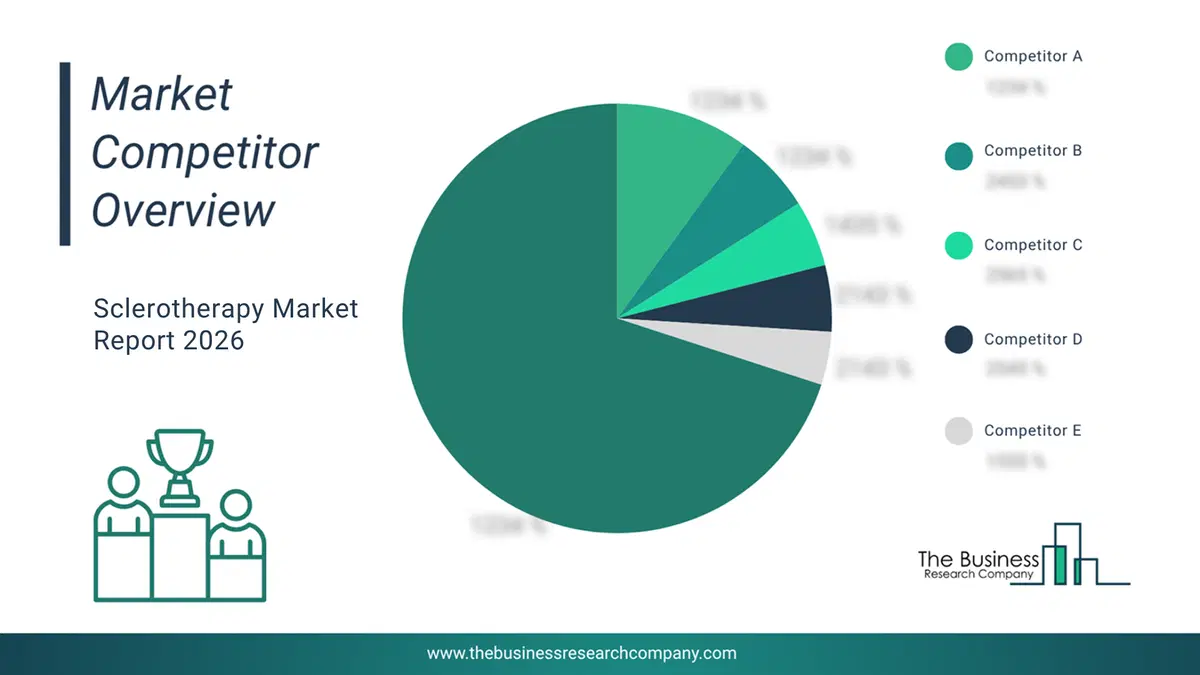
This chart is for illustrative purposes; the full report includes a detailed competitor analysis and comprehensive overview of the top 10 companies in the market.
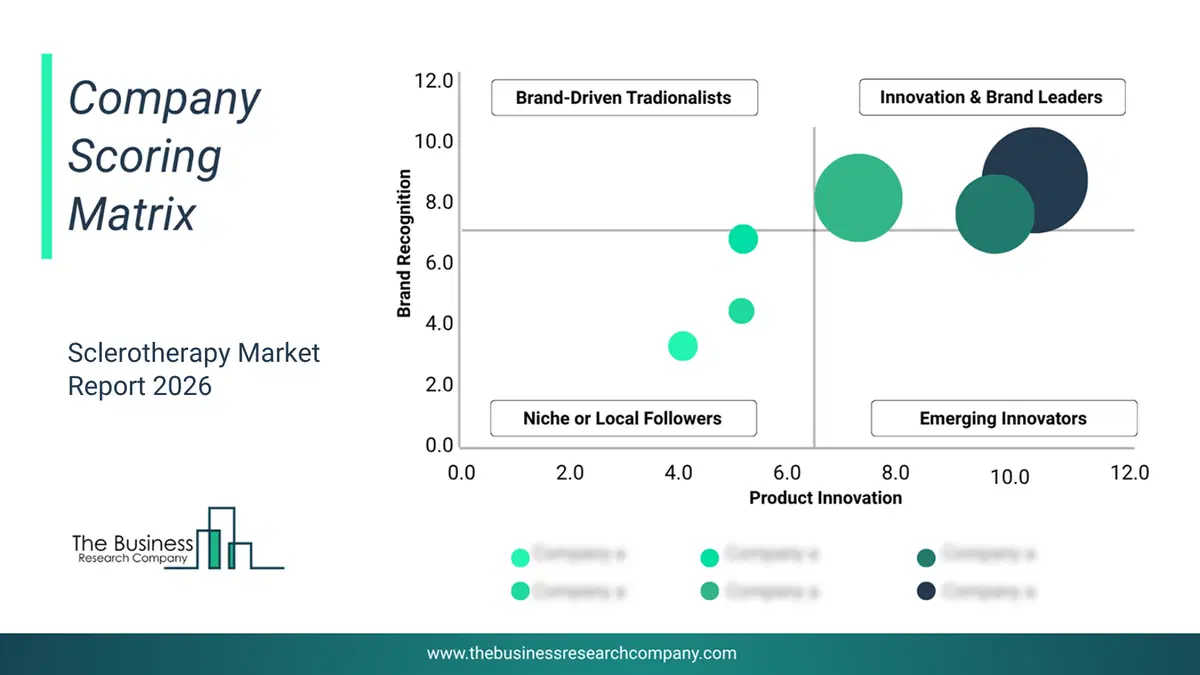
This chart maps companies by product innovation and brand strength, with bubble size indicating relative revenue, helping identify market leaders, challengers, and niche players. This is an illustrative chart; the full report provides a complete and accurate competitive analysis.
Global Sclerotherapy Market Trends and Insights
Major companies operating in the sclerotherapy market are focusing on strategic partnership, to enhance their research capabilities, expand product offerings, and strengthen their market presence through shared expertise and global distribution networks. Advanced minimally invasive treatments for varicose veins refer to modern procedures such as sclerotherapy, laser therapy, and radiofrequency ablation that effectively close or remove damaged veins with minimal pain, quick recovery, and reduced risk of complications. For instance, in February 2025, Aakash Healthcare, an India-Based specialty hospital, partnered with Medtronic plc, a US-based healthcare company launched specialized vein clinic, a clinic which offers advanced, minimally invasive treatments for varicose veins and other vein-related conditions, ensuring faster recovery and long-term health benefits for patients. Additionally, it also offers enhanced personalized treatment plans, and post-treatment care, ensuring a comprehensive approach to vein health and overall well-being.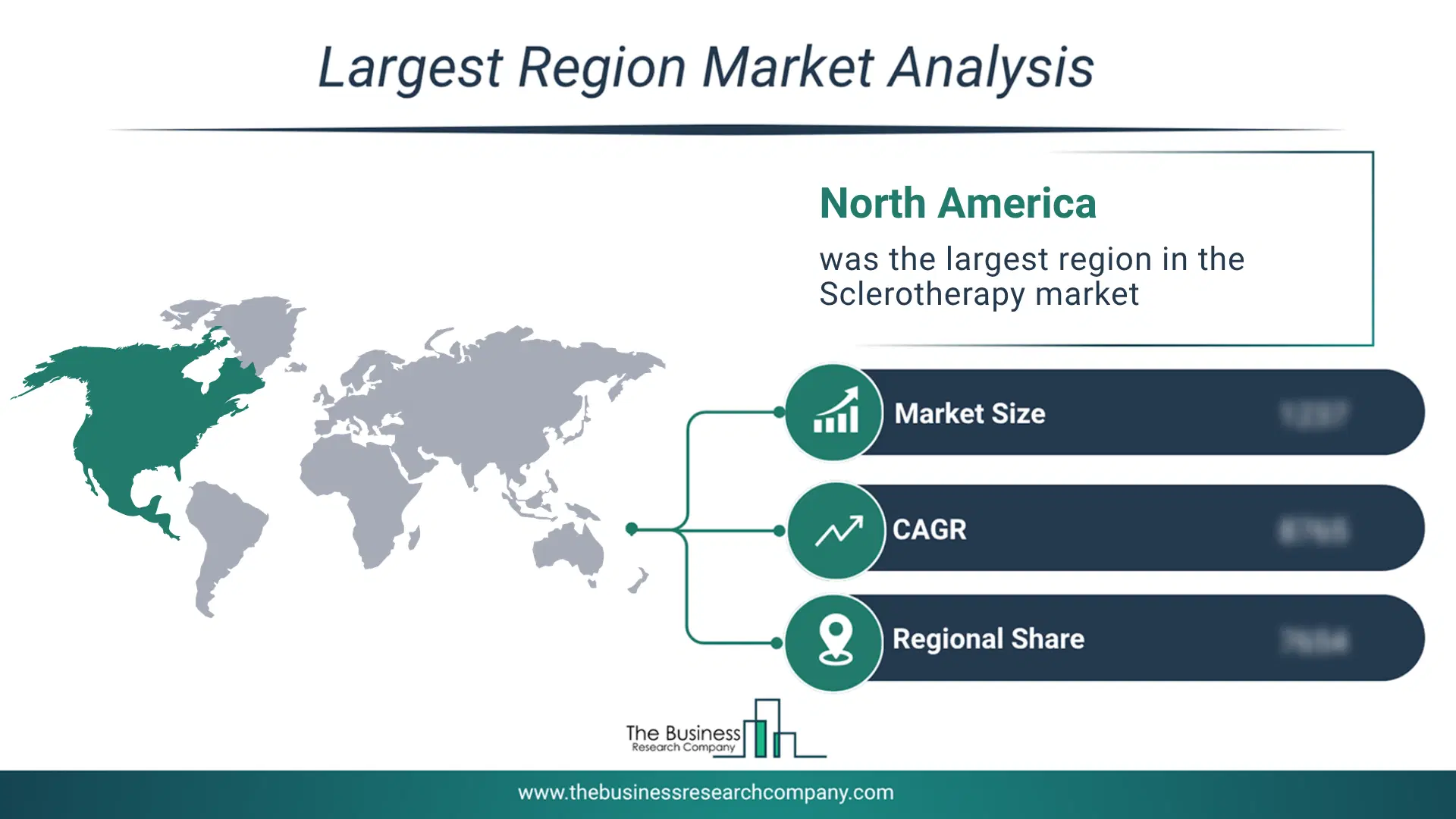
Regional Outlook
North America was the largest region in the sclerotherapy market in 2025. Asia-Pacific is expected to be the fastest-growing region in the forecast period. The regions covered in this market report are Asia-Pacific, South East Asia, Western Europe, Eastern Europe, North America, South America, Middle East, Africa. The countries covered in this market report are Australia, Brazil, China, France, Germany, India, Indonesia, Japan, Taiwan, Russia, South Korea, UK, USA, Canada, Italy, Spain.What Defines the Sclerotherapy Market?
The sclerotherapy market consists of revenues earned by entities by providing services such as spider vein removal, cosmetic vein treatment. The market value includes the value of related goods sold by the service provider or included within the service offering. The sclerotherapy market also includes sales of polidocanol asclera, hypertonic saline, sodium tetradecyl sulfate. Values in this market are ‘factory gate’ values, that is the value of goods sold by the manufacturers or creators of the goods, whether to other entities (including downstream manufacturers, wholesalers, distributors and retailers) or directly to end customers. The value of goods in this market includes related services sold by the creators of the goods.How is Market Value Defined and Measured?
The market value is defined as the revenues that enterprises gain from the sale of goods and/or services within the specified market and geography through sales, grants, or donations in terms of the currency (in USD unless otherwise specified). The revenues for a specified geography are consumption values that are revenues generated by organizations in the specified geography within the market, irrespective of where they are produced. It does not include revenues from resales along the supply chain, either further along the supply chain or as part of other products.
This chart presents market attractiveness based on a quantitative evaluation of growth, competition, strategic alignment, and risk, offering a clear view of opportunity areas for decision-making. This chart is for illustrative purposes; the full report contains the complete analysis.

This chart highlights the Total Addressable Market (TAM) by estimating the maximum revenue opportunity using an assumption-driven approach, supporting strategic planning and opportunity sizing across markets. The chart is illustrative; the full report provides a more comprehensive analysis.
What Key Data and Analysis Are Included in the Sclerotherapy Market Report 2026?
The sclerotherapy market research report is one of a series of new reports from The Business Research Company that provides market statistics, including industry global market size, regional shares, competitors with the market share, detailed market segments, market trends and opportunities, and any further data you may need to thrive in the sclerotherapy industry. The market research report delivers a complete perspective of everything you need, with an in-depth analysis of the current and future state of the industry.Sclerotherapy Market Report Forecast Analysis
| Report Attribute | Details |
|---|---|
| Market Size Value In 2026 | $1.29 billion |
| Revenue Forecast In 2030 | $1.65 billion |
| Growth Rate | CAGR of 6.2% from 2026 to 2030 |
| Base Year For Estimation | 2025 |
| Actual Estimates/Historical Data | 2020-2025 |
| Forecast Period | 2026 - 2030 |
| Market Representation | Revenue in USD Billion and CAGR from 2026 to 2030 |
| Segments Covered | Type, Agents, Application, End-User |
| Regional Scope | Asia-Pacific, Western Europe, Eastern Europe, North America, South America, Middle East, Africa |
| Country Scope | The countries covered in the report are Australia, Brazil, China, France, Germany, India, Indonesia, Japan, Taiwan, Russia, South Korea, UK, USA, Canada, Italy, Spain |
| Key Companies Profiled | Bayer AG, Sanofi S.A., Abbott Laboratories, Novartis AG, Medtronic plc, Boston Scientific Corporation, Olympus Corporation, Smith And Nephew plc, Teleflex Incorporated, Cook Medical, Merz Pharma GmbH And Co KGaA, AngioDynamics Inc, Bioniche Pharma Group Ltd, Omega Pharmaceuticals Pvt Ltd, Endo Flex, Kreussler, Vascular Solutions Inc, BTG International Ltd, Boston Biomedical Inc, Cardinal Health Inc, Terumo Corporation, B Braun Melsungen AG, BD Bard, MedAlliance SA |
| Customization Scope | Request for Customization |
| Pricing And Purchase Options | Explore Purchase Options |