
Seismic Protection Device Market Report 2026
Global Outlook – By Type (Base Isolators, Dampers, Seismic Braces, Control Systems, Other Types), By Technology (Passive Systems, Active Systems, Hybrid Systems, Smart Systems, Other Technologies), By Material (Rubber, Steel, Composite Materials, Concrete, Other Materials), By Application (Residential Buildings, Commercial Buildings, Industrial Facilities, Bridges, Utilities And Infrastructure), By End-User (Government And Public Sector, Construction Companies, Engineering Firms, Insurance Companies, Academic And Research Institutions) – Market Size, Trends, Strategies, and Forecast to 2030
Seismic Protection Device Market Overview
• Seismic Protection Device market size has reached to $3.07 billion in 2025 • Expected to grow to $4.22 billion in 2030 at a compound annual growth rate (CAGR) of 6.5% • Growth Driver: Rising Frequency Of Natural Disasters Driving Growth Of The Market Due To Increasing Climate-Related Hazards • Market Trend: Advancements In Structural Safety Technologies For Earthquake-Resilient Buildings • North America was the largest region and fastest growing region.What Is Covered Under Seismic Protection Device Market?
A seismic protection device is a system or equipment designed to protect structures from earthquake forces by absorbing, dissipating, or isolating seismic energy. It helps reduce damage to buildings, bridges, and infrastructure, enhancing safety and structural resilience during earthquakes. The main types of seismic protection devices are base isolators, dampers, seismic braces, control systems, and others. Base isolators are devices designed to decouple a structure from ground motion, reducing the energy transferred during an earthquake. These devices utilize technologies that are passive systems, active systems, hybrid systems, smart systems, and others and are made from materials such as rubber, steel, composite materials, concrete, and others. They are applied across residential buildings, commercial buildings, industrial facilities, bridges, and utilities and infrastructure, serving end-users including the government and public sector, construction companies, engineering firms, insurance companies, and academic and research institutions.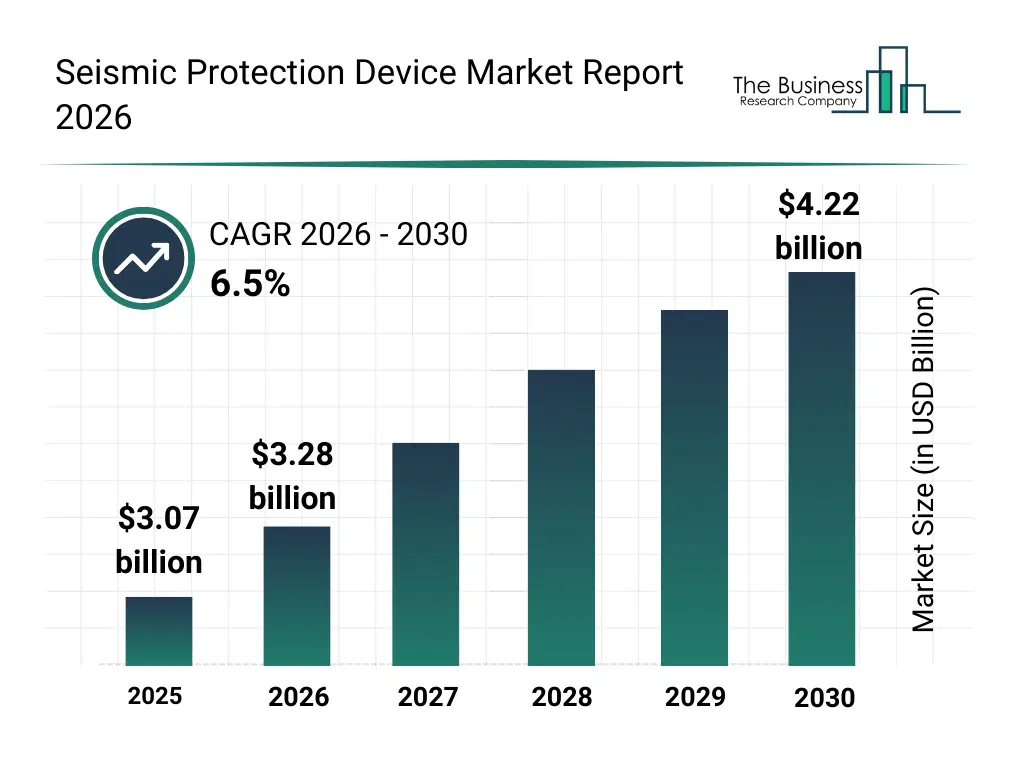
What Is The Seismic Protection Device Market Size and Share 2026?
The seismic protection device market size has grown strongly in recent years. It will grow from $3.07 billion in 2025 to $3.28 billion in 2026 at a compound annual growth rate (CAGR) of 6.7%. The growth in the historic period can be attributed to rising regulatory requirements for earthquake safety, increasing adoption of seismic protection solutions, reliance on advanced damping technologies, growth in commercial and residential construction in seismic zones, expansion of government-funded infrastructure projects.What Is The Seismic Protection Device Market Growth Forecast?
The seismic protection device market size is expected to see strong growth in the next few years. It will grow to $4.22 billion in 2030 at a compound annual growth rate (CAGR) of 6.5%. The growth in the forecast period can be attributed to increasing deployment of hybrid and smart seismic devices, rising adoption of modular base isolators, development of advanced monitoring and control systems, expansion in industrial and critical infrastructure protection, growth in research and innovation in seismic safety. Major trends in the forecast period include deployment of advanced seismic protection systems, integration of smart monitoring and control devices, adoption of hybrid and active seismic technologies, expansion of modular base isolators and dampers, implementation of connected structural safety solutions.
Global Seismic Protection Device Market Segmentation
1) By Type: Base Isolators, Dampers, Seismic Braces, Control Systems, Other Types 2) By Technology: Passive Systems, Active Systems, Hybrid Systems, Smart Systems, Other Technologies 3) By Material: Rubber, Steel, Composite Materials, Concrete, Other Materials 4) By Application: Residential Buildings, Commercial Buildings, Industrial Facilities, Bridges, Utilities And Infrastructure 5) By End-User: Government And Public Sector, Construction Companies, Engineering Firms, Insurance Companies, Academic And Research Institutions Subsegments: 1) By Base Isolators: Lead Rubber Bearings, High-Damping Rubber Bearings, Sliding Bearings 2) By Dampers: Viscous Dampers, Friction Dampers, Hysteretic Dampers 3) By Seismic Braces: Steel Braces, Buckling-Restrained Braces, Moment-Resisting Frames 4) By Control Systems: Active Control Systems, Semi-Active Control Systems, Passive Control Systems 5) By Other Types: Expansion Joints, Energy Dissipation Devices, Seismic SensorsWhat Is The Driver Of The Seismic Protection Device Market?
The rising instances of natural disasters are expected to propel the growth of the seismic protection device market going forward. Natural disasters are sudden natural events that cause widespread damage and threaten human life. Increasing natural disasters are largely due to climate change, as it intensifies extreme weather events and disrupts natural systems. Seismic protection devices help reduce damage during earthquakes by absorbing and dissipating seismic energy, protecting buildings and infrastructure. For instance, in January 2024, according to climate.gov, a US-based official website of the National Oceanic and Atmospheric Administration, in 2023, the United States faced 28 distinct weather and climate-related disasters, each causing damages exceeding $1 billion. Therefore, the rising instances of natural disasters are driving the growth of the seismic protection device industry.What Is The Driver Of The Seismic Protection Device Market?
The increasing infrastructure investments are expected to propel the growth of the seismic protection device market going forward. Infrastructure investments refer to spending on the development and improvement of essential facilities such as transportation, energy, and communication systems that support economic growth and public welfare. Increasing infrastructure investments are driven by rapid urbanization, as growing cities require expanded transportation, housing, and utility networks to accommodate rising populations and ensure sustainable development. Infrastructure investments facilitate the advancement of seismic protection devices by enabling the construction and modernization of buildings and infrastructure that incorporate advanced systems designed to enhance structural resilience and mitigate earthquake-induced damage. For instance, the Office for National Statistics, a UK-based government department, reported that in 2023, infrastructure investment reached $17.25 billion (£13.8 billion) in constant prices, reflecting a 3.9% increase compared to 2022. Therefore, the increasing infrastructure investments are driving the growth of the seismic protection device industry.Key Players In The Global Seismic Protection Device Market
Major companies operating in the seismic protection device market are Mitsubishi Heavy Industries Ltd., Bridgestone Corporation, Kawasaki Heavy Industries, Sika AG, THK Co. Ltd., SWCC Showa Holdings Co. Ltd., OILES CORPORATION, Mageba AG, Maurer SE, GERB Schwingungsisolierungen GmbH & Co. KG, Fip Industriale SpA, Taylor Devices Inc., Earthquake Protection Systems Inc., Dynamic Isolation Systems Inc., Kawakin Core-Tech Co. Ltd., Tozen Corporation, Okabe Co. Ltd., Damptech Inc., EM-KE Seismic Isolation Systems Ltd., Yokohama Rubber Co. Ltd.
This chart is for illustrative purposes; the full report includes a detailed competitor analysis and comprehensive overview of the top 10 companies in the market.
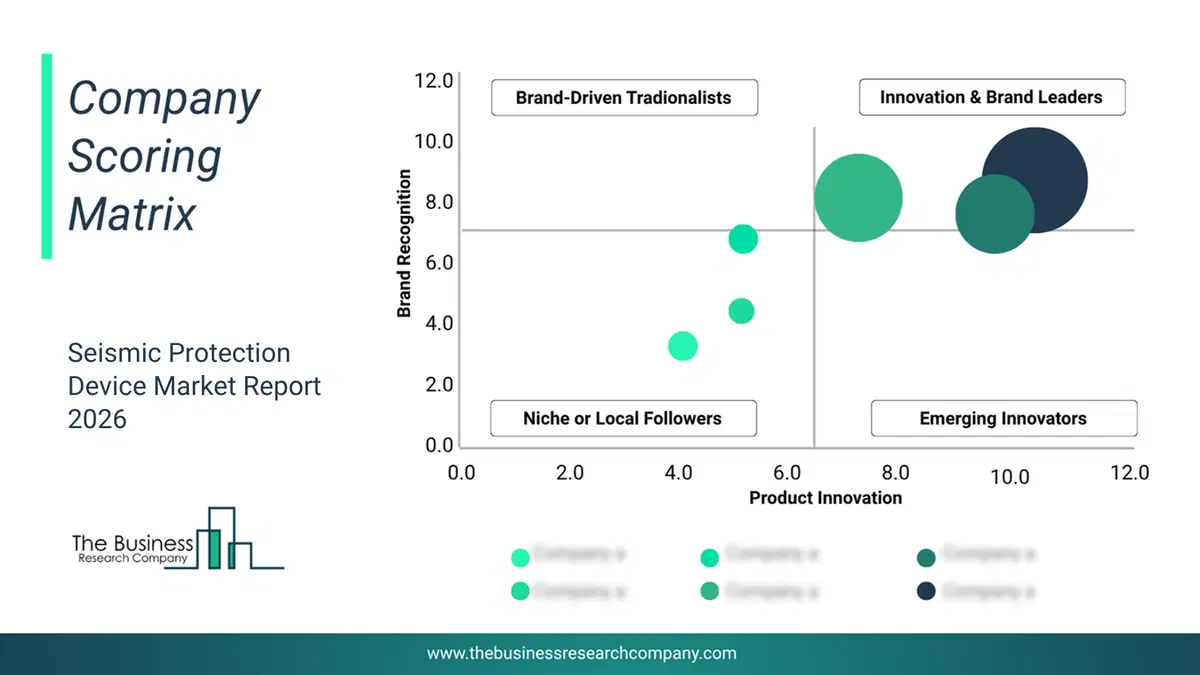
This chart maps companies by product innovation and brand strength, with bubble size indicating relative revenue, helping identify market leaders, challengers, and niche players. This is an illustrative chart; the full report provides a complete and accurate competitive analysis.
Global Seismic Protection Device Market Trends and Insights
Major companies operating in the seismic protection device market are focusing on developing technological advancements, such as seismic expansion joint systems, to enhance structural resilience and ensure building safety during seismic events. Seismic expansion joint systems refer to structural components designed to absorb movement and displacement between building sections during an earthquake, preventing damage and maintaining the integrity of the structure. For instance, in September 2025, Balco, a US-based manufacturing company, launched a QuakeSpan line, designed for large seismic and base-isolated structures such as hospitals, airports, high-rises, and government facilities. It is designed for wide joint gaps and multi-directional movement to protect large buildings during earthquakes. It integrates fire and weather protection in a single, code-compliant system, ensuring safety and building performance. It helps critical facilities remain functional and safe, reducing repair costs and supporting regulatory compliance.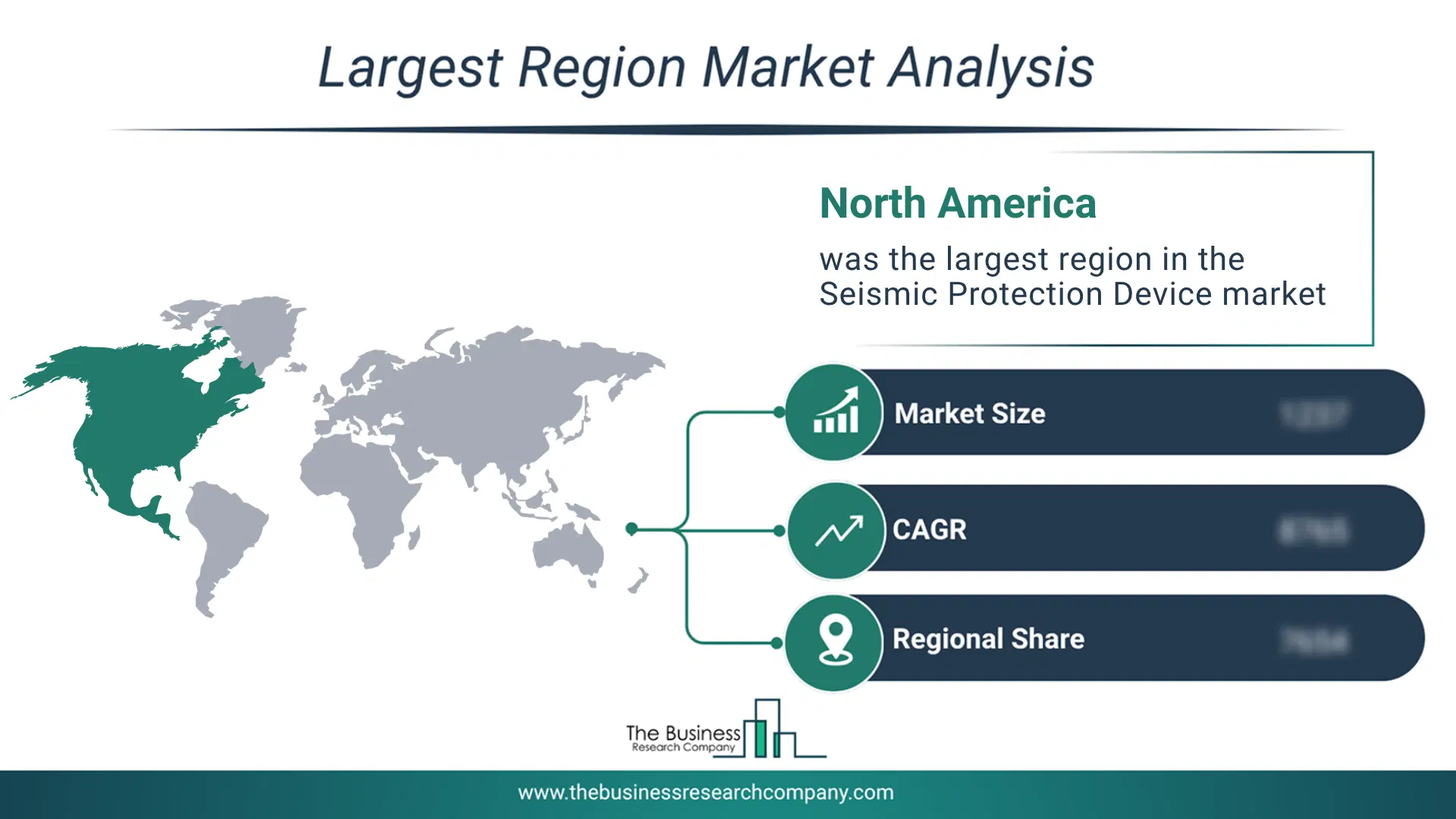
Regional Insights
North America was the largest region in the seismic protection device market in 2025. Asia-Pacific is expected to be the fastest-growing region in the forecast period. The regions covered in this market report are Asia-Pacific, South East Asia, Western Europe, Eastern Europe, North America, South America, Middle East, Africa. The countries covered in this market report are Australia, Brazil, China, France, Germany, India, Indonesia, Japan, Taiwan, Russia, South Korea, UK, USA, Canada, Italy, Spain.What Defines the Seismic Protection Device Market?
The seismic protection device market consists of sales of shock transmission units, tuned mass dampers, and seismic bearings. Values in this market are ‘factory gate’ values, that is, the value of goods sold by the manufacturers or creators of the goods, whether to other entities (including downstream manufacturers, wholesalers, distributors, and retailers) or directly to end customers. The value of goods in this market includes related services sold by their creators.How is Market Value Defined and Measured?
The market value is defined as the revenues that enterprises gain from the sale of goods and/or services within the specified market and geography through sales, grants, or donations in terms of the currency (in USD unless otherwise specified). The revenues for a specified geography are consumption values that are revenues generated by organizations in the specified geography within the market, irrespective of where they are produced. It does not include revenues from resales along the supply chain, either further along the supply chain or as part of other products.
This chart presents market attractiveness based on a quantitative evaluation of growth, competition, strategic alignment, and risk, offering a clear view of opportunity areas for decision-making. This chart is for illustrative purposes; the full report contains the complete analysis.

This chart highlights the Total Addressable Market (TAM) by estimating the maximum revenue opportunity using an assumption-driven approach, supporting strategic planning and opportunity sizing across markets. The chart is illustrative; the full report provides a more comprehensive analysis.
What Key Data and Analysis Are Included in theSeismic Protection Device Market Report 2026?
The seismic protection device market research report is one of a series of new reports from The Business Research Company that provides market statistics, including industry global market size, regional shares, competitors with the market share, detailed market segments, market trends and opportunities, and any further data you may need to thrive in the seismic protection device industry. The market research report delivers a complete perspective of everything you need, with an in-depth analysis of the current and future state of the industry.Seismic Protection Device Market Report Forecast Analysis
| Report Attribute | Details |
|---|---|
| Market Size Value In 2026 | $3.28 billion |
| Revenue Forecast In 2030 | $4.22 billion |
| Growth Rate | CAGR of 6.7% from 2026 to 2030 |
| Base Year For Estimation | 2025 |
| Actual Estimates/Historical Data | 2020-2025 |
| Forecast Period | 2026 - 2030 |
| Market Representation | Revenue in USD Billion and CAGR from 2026 to 2030 |
| Segments Covered | Type, Technology, Material, Application, End-User |
| Regional Scope | Asia-Pacific, Western Europe, Eastern Europe, North America, South America, Middle East, Africa |
| Country Scope | The countries covered in this market report are Australia, Brazil, China, France, Germany, India, Indonesia, Japan, Taiwan, Russia, South Korea, UK, USA, Canada, Italy, Spain |
| Key Companies Profiled | Mitsubishi Heavy Industries Ltd., Bridgestone Corporation, Kawasaki Heavy Industries, Sika AG, THK Co. Ltd., SWCC Showa Holdings Co. Ltd., OILES CORPORATION, Mageba AG, Maurer SE, GERB Schwingungsisolierungen GmbH & Co. KG, Fip Industriale SpA, Taylor Devices Inc., Earthquake Protection Systems Inc., Dynamic Isolation Systems Inc., Kawakin Core-Tech Co. Ltd., Tozen Corporation, Okabe Co. Ltd., Damptech Inc., EM-KE Seismic Isolation Systems Ltd., Yokohama Rubber Co. Ltd. |
| Customization Scope | Request for Customization |
| Pricing And Purchase Options | Explore Purchase Options |