
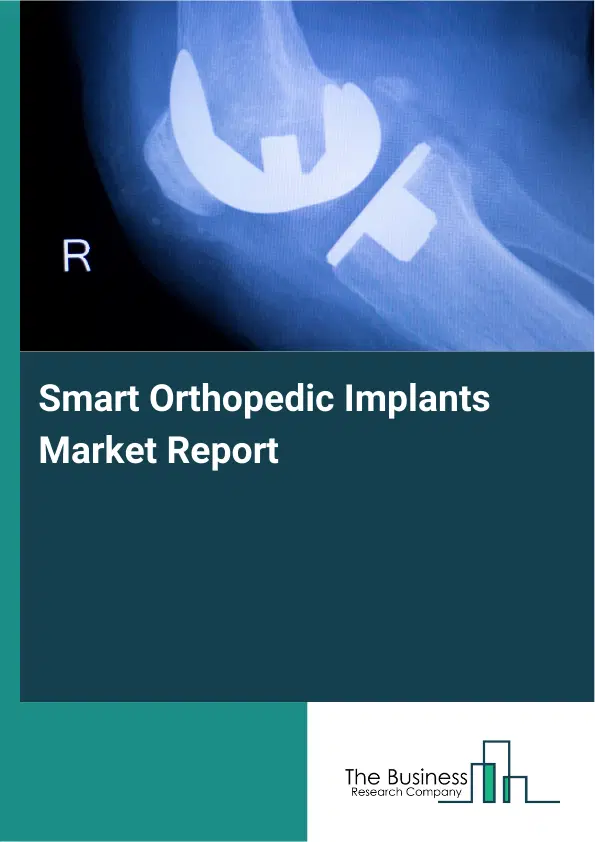
Smart Orthopedic Implants Market Report 2026
Global Outlook – By Type Of Implant (Smart Knee Implants, Smart Hip Implants, Smart Spine Implants, Smart Shoulder Implants, Smart Ankle Implants), By Material (Ceramic Implants, Metallic Implants, Polymeric Implants), By Technology Integration (Data Analytics And Artificial Intelligence Integration, Microelectronic Sensors, Telemedicine Capabilities), By Application (Fracture Fixation, Joint Replacement, Osteotomy, Spinal Fusion), By End-Use (Ambulatory Surgical Centers, Hospitals, Specialty Clinics, Other End-Uses) – Market Size, Trends, Strategies, and Forecast to 2030
Smart Orthopedic Implants Market Overview
• Smart Orthopedic Implants market size has reached to $25.92 billion in 2025 • Expected to grow to $33.36 billion in 2030 at a compound annual growth rate (CAGR) of 5.1% • Growth Driver: Rising Prevalence Of Musculoskeletal Disorders Fueling The Growth Of Market Due To Increasing Chronic Pain And Disability • Market Trend: Strategic Partnerships Drive Innovation In Smart Orthopedic Implant Technologies • North America was the largest region in 2025 and Asia-Pacific is the fastest growing region.What Is Covered Under Smart Orthopedic Implants Market?
Smart orthopedic implants are high-tech medical devices equipped with sensors and communication systems that actively monitor and transmit data from inside the body. They deliver real-time information on factors such as load, pressure, temperature, and healing progress. These implants aim to improve recovery outcomes, detect complications early, and personalize rehabilitation to enhance overall care quality. The main types of smart orthopedic implants are smart knee implants, smart hip implants, smart spine implants, smart shoulder implants, and smart ankle implants. Smart knee implants are sensor-enabled prosthetics that capture real-time data on movement and load to enhance alignment, enable remote monitoring, and support postoperative recovery. It is made up of different materials, such as ceramic implants, metallic implants, and polymeric implants with several technology integrations, including data analytics and artificial intelligence integration, microelectronic sensors, telemedicine capabilities, and wearable technology. It is applicable in various applications such as fracture fixation, joint replacement, osteotomy, and spinal fusion,and is used by several end-users, including ambulatory surgical centers, hospitals, specialty clinics, and others.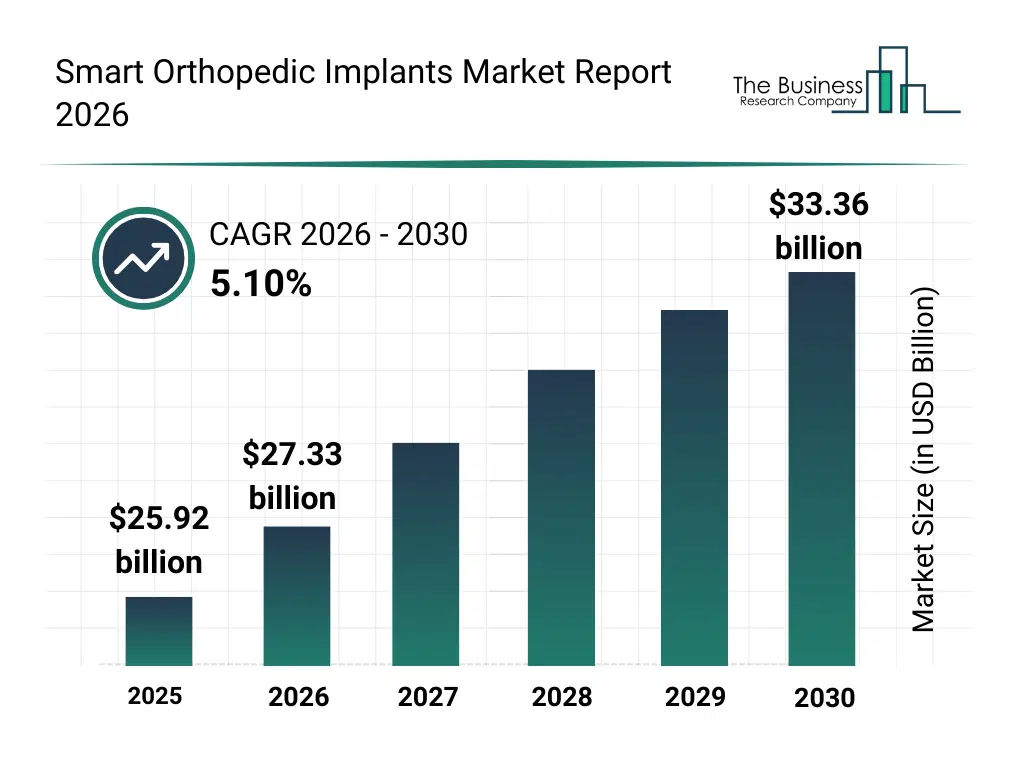
What Is The Smart Orthopedic Implants Market Size and Share 2026?
The smart orthopedic implants market size has grown strongly in recent years. It will grow from $25.92 billion in 2025 to $27.33 billion in 2026 at a compound annual growth rate (CAGR) of 5.4%. The growth in the historic period can be attributed to rising incidence of orthopedic disorders, limited early diagnosis methods, conventional implant monitoring, high post-operative complications, increasing awareness about joint replacement.What Is The Smart Orthopedic Implants Market Growth Forecast?
The smart orthopedic implants market size is expected to see strong growth in the next few years. It will grow to $33.36 billion in 2030 at a compound annual growth rate (CAGR) of 5.1%. The growth in the forecast period can be attributed to growing adoption of smart implants, advancements in implantable sensors, integration of ai in orthopedic care, demand for personalized medicine, increasing geriatric population. Major trends in the forecast period include remote patient monitoring, predictive orthopedic analytics, personalized rehabilitation programs, early complication detection, minimally invasive implant solutions.
Global Smart Orthopedic Implants Market Segmentation
1) By Type Of Implant: Smart Knee Implants, Smart Hip Implants, Smart Spine Implants, Smart Shoulder Implants, Smart Ankle Implants 2) By Material: Ceramic Implants, Metallic Implants, Polymeric Implants 3) By Technology Integration: Data Analytics And Artificial Intelligence Integration, Microelectronic Sensors, Telemedicine Capabilities 4) By Application: Fracture Fixation, Joint Replacement, Osteotomy, Spinal Fusion 5) By End-Use: Ambulatory Surgical Centers, Hospitals, Specialty Clinics, Other End-Uses Subsegments: 1) By Smart Knee Implants: Total Knee Replacement, Partial Knee Replacement, Unicompartmental Knee Implants, Revision Knee Implants 2) By Smart Hip Implants: Total Hip Replacement, Partial Hip Replacement, Hip Resurfacing Implants, Revision Hip Implants 3) By Smart Spine Implants: Cervical Spine Implants, Thoracolumbar Spine Implants, Interbody Fusion Devices, Pedicle Screw Systems 4) By Smart Shoulder Implants: Total Shoulder Replacement, Reverse Shoulder Replacement, Partial Shoulder Replacement, Revision Shoulder Implants 5) By Smart Ankle Implants: Total Ankle Replacement, Ankle Fusion Implants, Revision Ankle Implants, Ankle Fracture Fixation DevicesWhat Is The Driver Of The Smart Orthopedic Implants Market?
The rising prevalence of musculoskeletal disorders is expected to propel the growth of the smart orthopedic implants market going forward. Musculoskeletal disorders are conditions affecting bones, muscles, joints, tendons, and ligaments, often resulting in chronic pain, limited mobility, and long-term disability. The increase in these disorders is due to aging populations, sedentary lifestyles, and the growing burden of chronic noncommunicable diseases. Smart orthopedic implants support this trend by providing real-time biomechanical feedback, early-warning alerts, and enhanced postoperative monitoring, which improve patient outcomes and reduce the risk of revision surgeries. For instance, in January 2024, according to the Office for Health Improvement and Disparities, a UK-based government department, in 2023, 18.4% of people aged 16 and over reported having a long-term musculoskeletal condition, up slightly from 17.6% in 2022. These conditions were reported less frequently by males (15.8%) compared with females (20.9%). Therefore, the rising prevalence of musculoskeletal disorders is driving the growth of the smart orthopedic implants industry.Key Players In The Global Smart Orthopedic Implants Market
Major companies operating in the smart orthopedic implants market are Johnson And Johnson, Medtronic plc, Stryker Corporation, Zimmer Biomet Holdings Inc, Enovis Corporation, Orthofix Medical Inc, Exactech Inc, Xenco Medical LLC, Heraeus Medical GmbH, Intelligent Implants GmbH, Statera Medical Inc, SpineGuard SA, BoneTag Technologies, DirectSync Surgical Inc, AK Medical Holdings Limited, Mathys Ltd, Smith And Nephew plc, Globus Medical Inc, NuVasive Inc, Alphatec Spine Inc, Life Spine Inc, restor3d Inc
This chart is for illustrative purposes; the full report includes a detailed competitor analysis and comprehensive overview of the top 10 companies in the market.
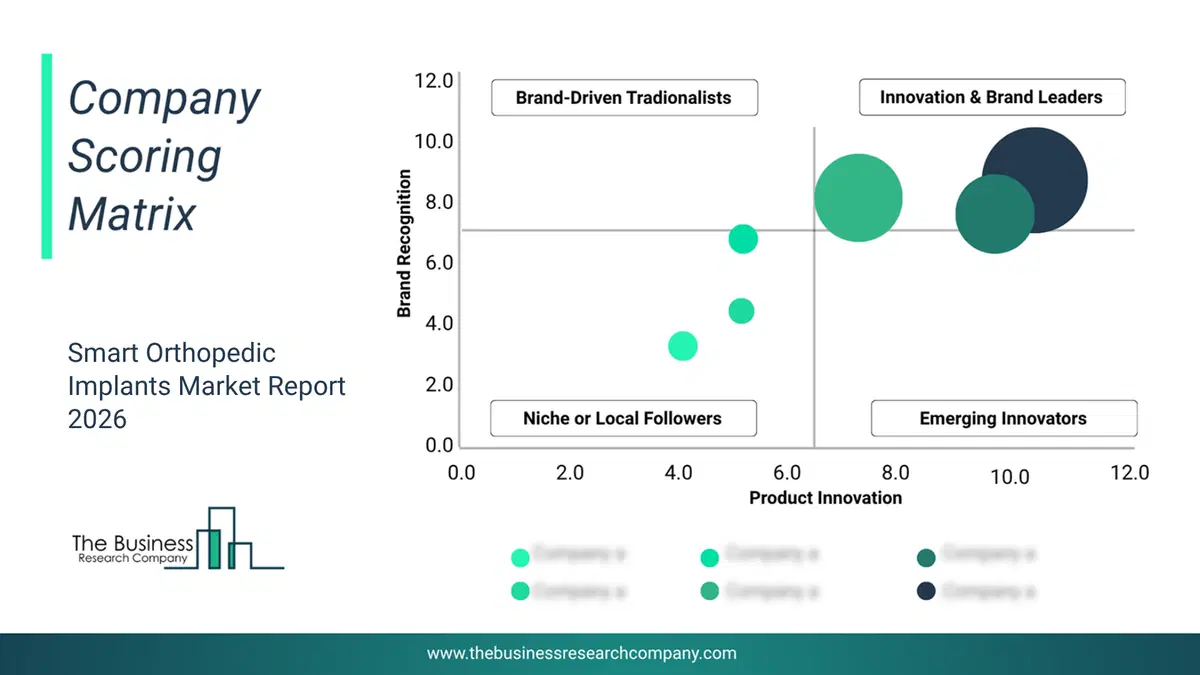
This chart maps companies by product innovation and brand strength, with bubble size indicating relative revenue, helping identify market leaders, challengers, and niche players. This is an illustrative chart; the full report provides a complete and accurate competitive analysis.
Global Smart Orthopedic Implants Market Trends and Insights
Major companies operating in the smart orthopedic implants market are focusing on developing strategic partnerships to expand their global reach in delivering advanced patient care solutions. A strategic partnership is a structured collaboration between two or more organizations aimed at combining their strengths to achieve mutual long-term objectives. It allows them to share resources, knowledge, and innovation while remaining independent entities. For instance, in June 2025, NanoHive Medical LLC, a US-based 3D-printed spinal implant company, collaborated with DirectSync Surgical, a US-based manufacturer of human-powered smart implants, to develop Hive Soft Titanium spinal interbody fusion, a smart spine implant. This collaboration aims to integrate bone-stimulating and remote monitoring sensor technology into NanoHive’s proprietary 3D-printed spinal fusion devices, leveraging their unique rhombic dodecahedron lattice to effectively transfer energy from the piezoelectric sensors. This is an innovation to enhance patient care through improved data collection, bone stimulation, and connectivity with advanced surgical technologies and AI.What Are Latest Mergers And Acquisitions In The Smart Orthopedic Implants Market?
In February 2024, Exactech Inc., a US-based medical device company, partnered with Statera Medical Inc. to empower precision in shoulder surgery. With this partnership, Exactech and Statera Medical aim to co-develop the world’s first smart reverse shoulder implant by integrating Statera’s Goldilocks smart implant technology into Exactech’s Equinoxe platform, enabling surgeons to objectively measure joint tension and optimize implant selection for improved mobility, stability, and patient outcomes. Statera Medical Inc. is a Canada-based manufacturer of smart orthopedic implants.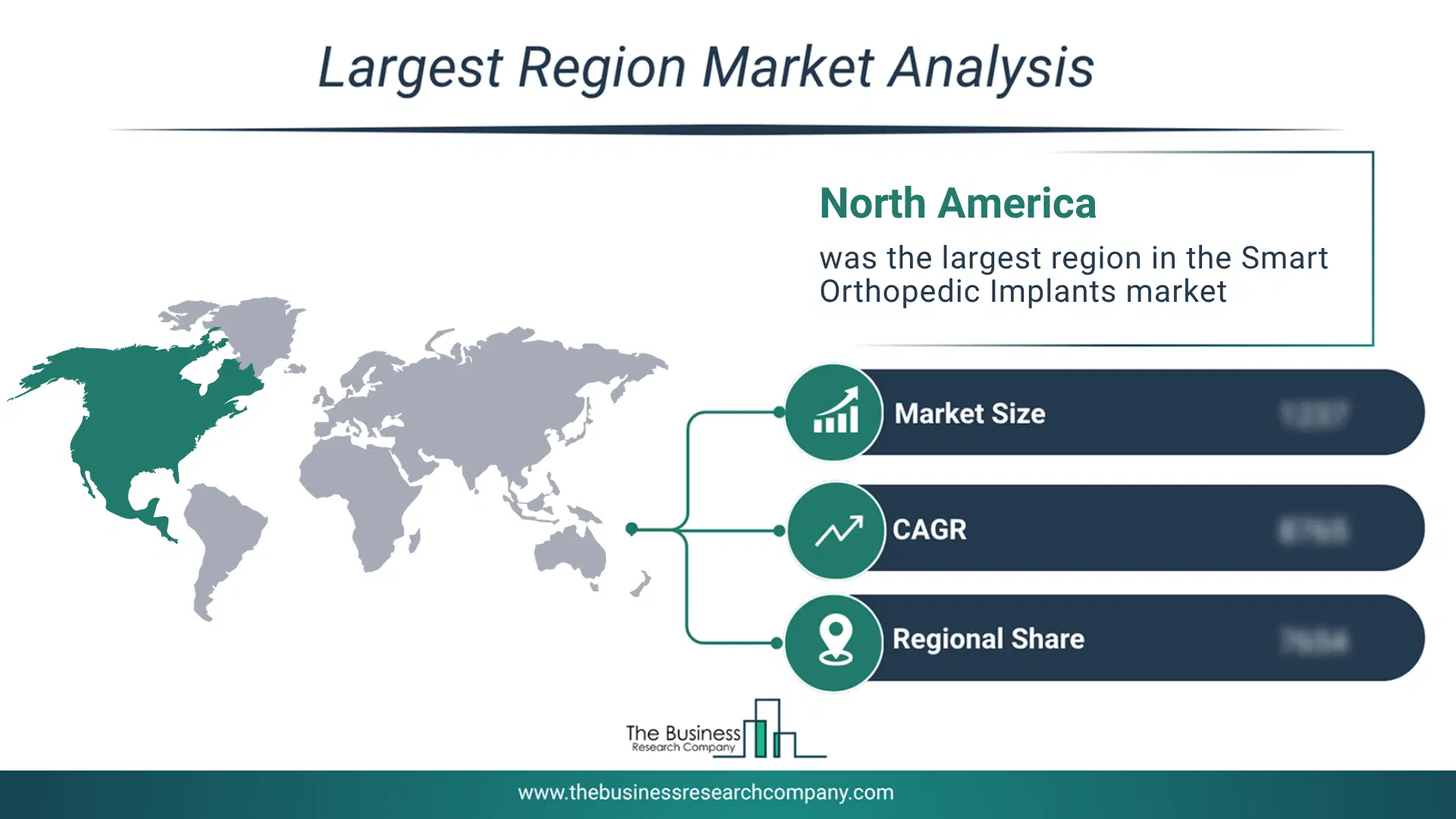
Regional Outlook
North America was the largest region in the smart orthopedic implants market in 2025. Asia-Pacific is expected to be the fastest-growing region in the forecast period. The regions covered in this market report are Asia-Pacific, South East Asia, Western Europe, Eastern Europe, North America, South America, Middle East, Africa. The countries covered in this market report are Australia, Brazil, China, France, Germany, India, Indonesia, Japan, Taiwan, Russia, South Korea, UK, USA, Canada, Italy, SpainWhat Defines the Smart Orthopedic Implants Market?
The smart orthopedic implants market consists of revenues earned by entities by providing services such as real-time data monitoring, postoperative recovery tracking, remote patient management, implant performance analytics, and early complication detection. The market value includes the value of related goods sold by the service provider or included within the service offering. The smart orthopedic implants market also includes sales of smart elbow implants, smart finger joint implants, smart foot implants, smart hand implants, and smart jaw implants. Values in this market are ‘factory gate’ values, that is, the value of goods sold by the manufacturers or creators of the goods, whether to other entities (including downstream manufacturers, wholesalers, distributors, and retailers) or directly to end customers. The value of goods in this market includes related services sold by the creators of the goods.How is Market Value Defined and Measured?
The market value is defined as the revenues that enterprises gain from the sale of goods and/or services within the specified market and geography through sales, grants, or donations in terms of the currency (in USD unless otherwise specified). The revenues for a specified geography are consumption values that are revenues generated by organizations in the specified geography within the market, irrespective of where they are produced. It does not include revenues from resales along the supply chain, either further along the supply chain or as part of other products.
This chart presents market attractiveness based on a quantitative evaluation of growth, competition, strategic alignment, and risk, offering a clear view of opportunity areas for decision-making. This chart is for illustrative purposes; the full report contains the complete analysis.

This chart highlights the Total Addressable Market (TAM) by estimating the maximum revenue opportunity using an assumption-driven approach, supporting strategic planning and opportunity sizing across markets. The chart is illustrative; the full report provides a more comprehensive analysis.
What Key Data and Analysis Are Included in the Smart Orthopedic Implants Market Report 2026?
The smart orthopedic implants market research report is one of a series of new reports from The Business Research Company that provides market statistics, including industry global market size, regional shares, competitors with the market share, detailed market segments, market trends and opportunities, and any further data you may need to thrive in the smart orthopedic implants industry. The market research report delivers a complete perspective of everything you need, with an in-depth analysis of the current and future state of the industry.Smart Orthopedic Implants Market Report Forecast Analysis
| Report Attribute | Details |
|---|---|
| Market Size Value In 2026 | $27.33 billion |
| Revenue Forecast In 2030 | $33.36 billion |
| Growth Rate | CAGR of 5.1% from 2026 to 2030 |
| Base Year For Estimation | 2025 |
| Actual Estimates/Historical Data | 2020-2025 |
| Forecast Period | 2026 - 2030 |
| Market Representation | Revenue in USD Billion and CAGR from 2026 to 2030 |
| Segments Covered | Type Of Implant, Material, Technology Integration, Application, End-Use |
| Regional Scope | Asia-Pacific, Western Europe, Eastern Europe, North America, South America, Middle East, Africa |
| Country Scope | The countries covered in the report are Australia, Brazil, China, France, Germany, India, Indonesia, Japan, Taiwan, Russia, South Korea, UK, USA, Canada, Italy, Spain. |
| Key Companies Profiled | Johnson And Johnson, Medtronic plc, Stryker Corporation, Zimmer Biomet Holdings Inc, Enovis Corporation, Orthofix Medical Inc, Exactech Inc, Xenco Medical LLC, Heraeus Medical GmbH, Intelligent Implants GmbH, Statera Medical Inc, SpineGuard SA, BoneTag Technologies, DirectSync Surgical Inc, AK Medical Holdings Limited, Mathys Ltd, Smith And Nephew plc, Globus Medical Inc, NuVasive Inc, Alphatec Spine Inc, Life Spine Inc, restor3d Inc |
| Customization Scope | Request for Customization |
| Pricing And Purchase Options | Explore Purchase Options |