
Space Ground Station Equipment Market Report 2026
Global Outlook – By Type ( Consumer Equipment, Network Equipment), By Satellite Communication Service ( Fixed Satellite Services, Mobile Satellite Services), By Application ( Communication, Earth Observation, Navigation), By End User ( Consumer, Government And Military, Commercial, Enterprise) – Market Size, Trends, Strategies, and Forecast to 2030
Space Ground Station Equipment Market Overview
• Space Ground Station Equipment market size has reached to $10.82 billion in 2025 • Expected to grow to $16.93 billion in 2030 at a compound annual growth rate (CAGR) of 9.5% • Growth Driver: Surging Demand For Satellite Communication Networks Fuels Space Ground Station Equipment Market • Market Trend: Advancements In The Next Generation Of Satellite Systems • North America was the largest region in 2025 and Asia-Pacific is the fastest growing region.Market Gains By 2030 – Top Opportunities By Segment
Market Gain identifies the most promising market opportunities by highlighting the segments or products expected to generate the highest incremental revenue growth over the next five years.
What Is Covered Under Space Ground Station Equipment Market?
Space ground station equipment is an essential piece of technology that enables access to space. The ground station equipment is an essential component of the end-to-end science data return, which contains all ground-based equipment needed to gather and distribute data from the satellite to the user. The main types of space ground station equipment are consumer equipment and network equipment. Consumer equipment is a piece of electronic equipment designed for regular use, usually at home. Space ground station equipment for consumer equipment refers to the equipment used to establish a connection between consumer devices and satellite communication networks. The various satellite communication services include fixed satellite services and mobile satellite services that are applied in communication, earth observation, and navigation. The end-users are consumer, government and military, commercial, and enterprise.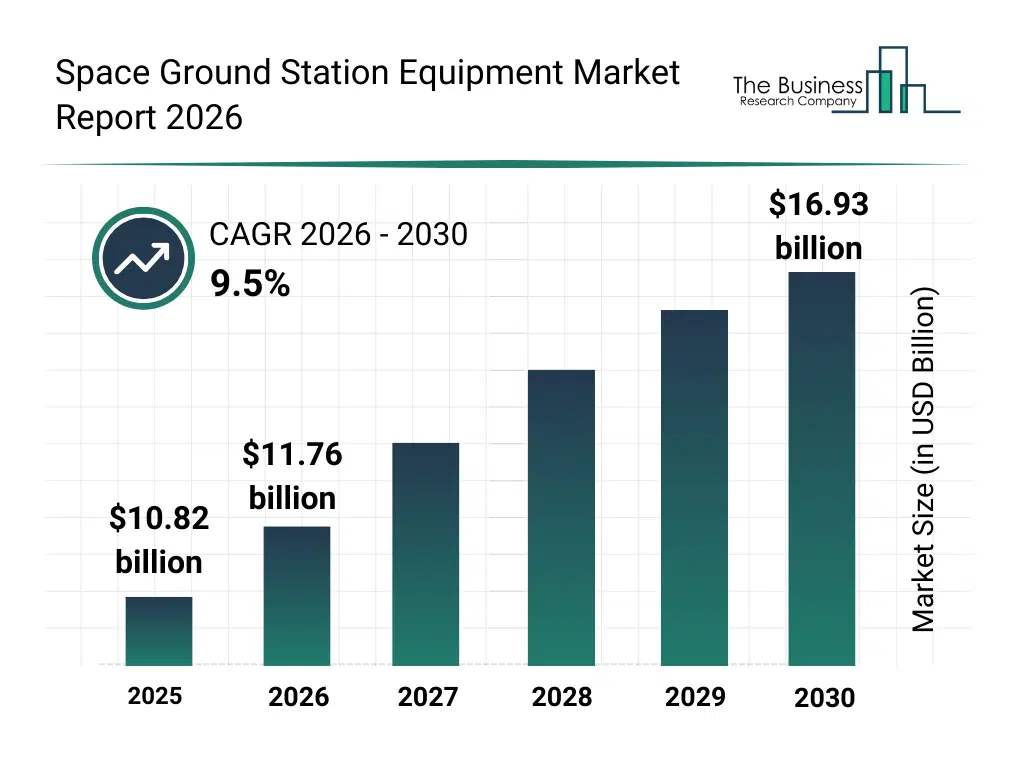
What Is The Space Ground Station Equipment Market Size 2026 And Growth Rate?
The space ground station equipment market size has grown strongly in recent years. It will grow from $10.82 billion in 2025 to $11.76 billion in 2026 at a compound annual growth rate (CAGR) of 8.7%. The growth in the historic period can be attributed to early adoption in satellite communication, reliance on traditional RF ground equipment, growing demand for earth observation data, expansion of government space programs, development of basic tracking and telemetry systems.What Is The Space Ground Station Equipment Market Growth Forecast?
The space ground station equipment market size is expected to see strong growth in the next few years. It will grow to $16.93 billion in 2030 at a compound annual growth rate (CAGR) of 9.5%. The growth in the forecast period can be attributed to rising deployment of commercial satellites, increasing adoption of cloud-based data relay platforms, growth in space defense communication needs, expansion of low-earth-orbit satellite networks, development of high-throughput digital ground stations. Major trends in the forecast period include adoption of AI-assisted satellite data processing, integration of IoT-enabled ground communication networks, advancement of cloud-based space data distribution systems, expansion of robotics-supported ground station operations, development of digital twin technologies for ground infrastructure.
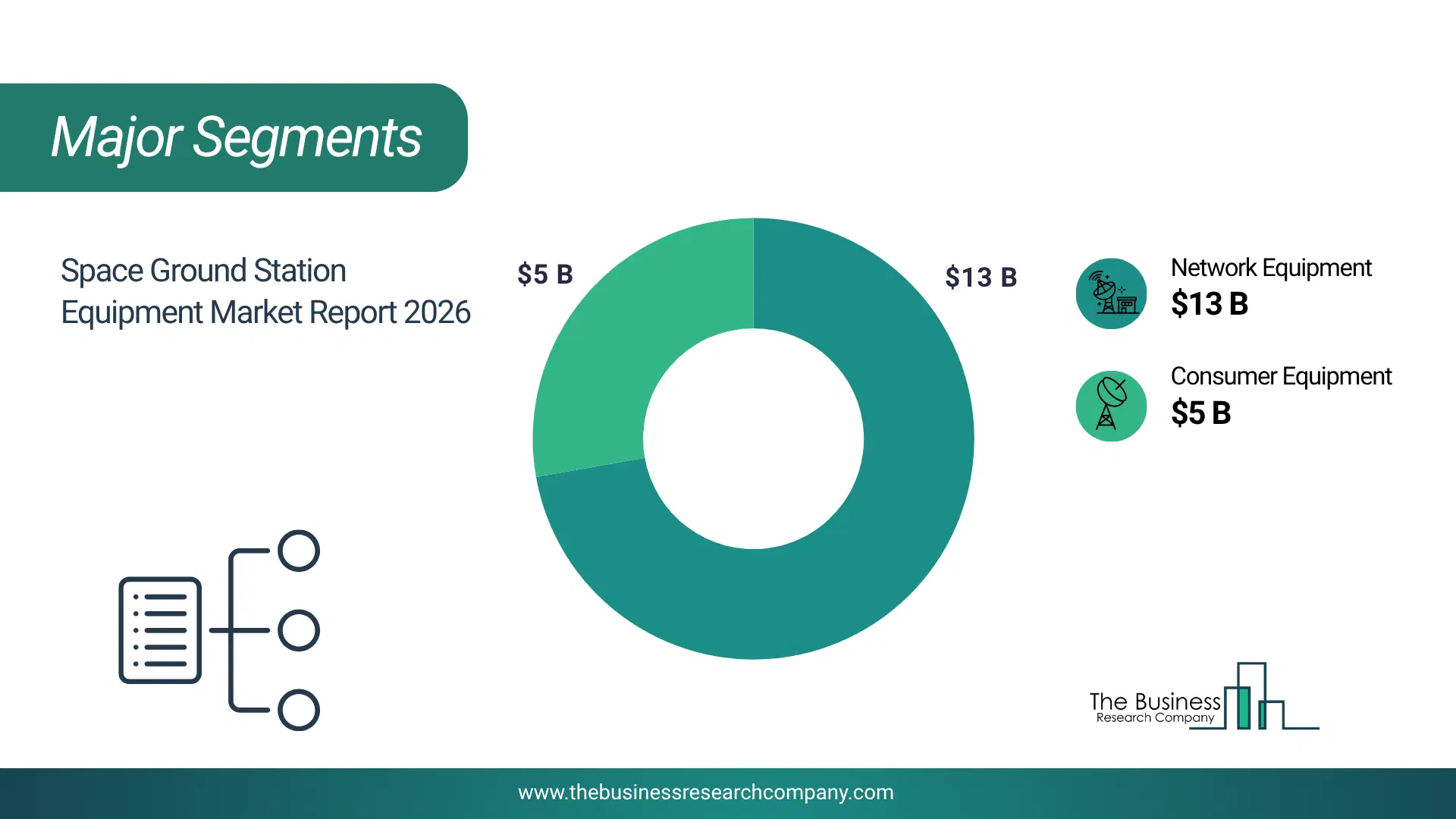
Global Space Ground Station Equipment Market Segmentation
1) By Type: Consumer Equipment, Network Equipment 2) By Satellite Communication Service: Fixed Satellite Services, Mobile Satellite Services 3) By Application: Communication, Earth Observation, Navigation 4) By End User: Consumer, Government And Military, Commercial, Enterprise Subsegments: 1) By Consumer Equipment: Satellite Dish Antennas, Set-Top Boxes, Terminals 2) By Network Equipment: Modems, Routers, Switches, Baseband Units, Amplifiers, Signal Processors The top segments in the space ground station equipment market will be: • Communication will reach $10258.04 Million by 2030. • Fixed Satellite Services will reach $9817.64 Million by 2030. • Network Equipment will reach $8798.1 Million by 2030. • Consumer will reach $7054.26 Million by 2030. • Consumer Equipment will reach $7100.18 Million by 2030.What Is The Driver Of The Space Ground Station Equipment Market?
The increasing demand for satellite communication networks is expected to propel the growth of the space ground station equipment market going forward. The satellite communication network is a man-made satellite network that sends information via a transponder by opening a channel between a transmitter and a receiver at various Earth points. This allows a ground station to monitor a satellite's location and manage its propulsion, thermal, and other systems. Hence, the increasing demand for satellite communication networks contributes to the growth of space ground station equipment. For instance, in July 2023, according to Pixalytics Ltd., a UK-based earth observation company, there were 11330 individual satellites orbiting the Earth at the end of June 2023, a whopping 37.94% increase since January 2022. Therefore, the increasing demand for satellite communication networks is driving the growth of the space ground station equipment industry.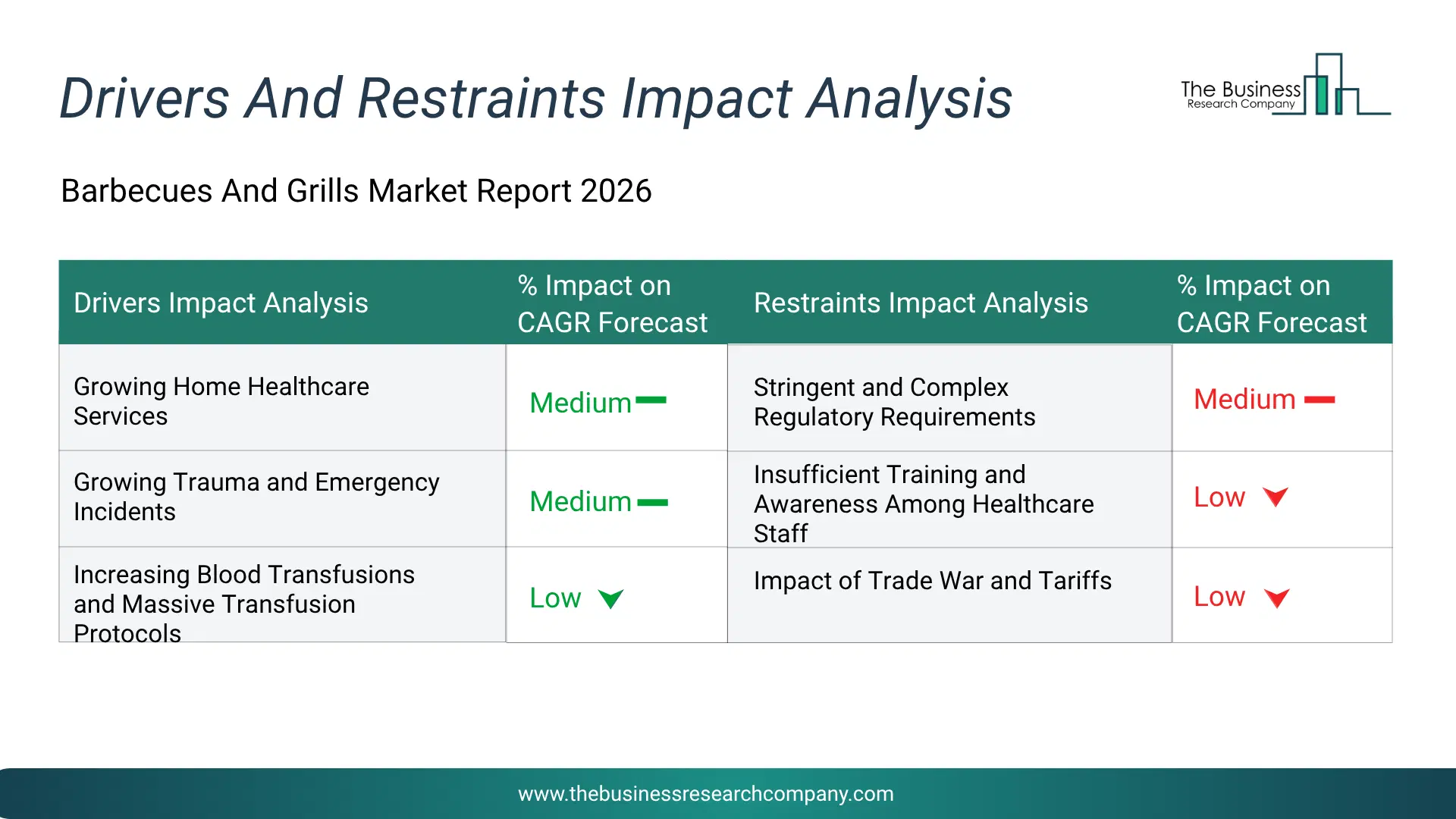
Infographic Chart Showing Key Market Drivers Analysis And Restraints For Space Ground Station Equipment Market
The chart presents an impact analysis of key drivers and restraints, quantifying their relative influence on the market's growth rate and helping assess the balance between growth enablers and limiting factors. This chart offers a high-level perspective; the full report contains more detailed insights.
How Will The Drivers Impact Growth In The Global Space Ground Station Equipment Market?
• Rapid Growth of Low Earth Orbit (LEO) Satellite Constellations (Medium) – During the forecast period, the rapid growth of low earth orbit (leo) satellite constellations is expected to propel the growth of the space ground station equipment market. as governments and commercial operators accelerate the deployment of large leo satellite networks to deliver broadband connectivity, navigation services, and real-time earth observation data, the number of active satellites in low earth orbit continues to rise, which increases the need for continuous communication and control. the expansion of constellation-based services raises operational demands on ground infrastructure, as operators require frequent contact windows, precise tracking, and high-capacity data downlinks to manage large fleets in fast-moving orbits. this trend increases reliance on scalable ground station networks that support high revisit rates and multi-satellite operations across global locations. government-linked records showing thousands of satellites launched for constellation purposes and long-term projections for tens of thousands more satellites reinforce the scale of this expansion and its infrastructure implications. as a result, space ground station equipment providers are expanding antenna networks, improving automation, and strengthening data handling capabilities to support constellation operators and to sustain growth in the global space ground station equipment market. as a result, rapid growth of low earth orbit (leo) satellite constellations is anticipated to contributing to a is 2.0% annual growth in the market. • Rising Government Funding for Space Infrastructure Development (Medium) – During the forecast period, the rising government funding for space infrastructure development is expected to propel the growth of the space ground station equipment market. as governments expand national space budgets, strengthen civil and defense space programs, and prioritize strategic autonomy in satellite capabilities, the scale of publicly funded satellite missions, research programs, and orbital infrastructure continues to grow, leading to higher requirements for reliable ground-based communication and control systems. expanding national space initiatives increase the number of satellites in operation and raise mission complexity, which drives demand for advanced antennas, telemetry, tracking and command systems, and integrated data handling infrastructure across government and agency-operated networks. as a result, space ground station equipment providers are increasing system capabilities, upgrading network resilience, and supporting multi-mission operations to align with long-term public space investments and to sustain growth in the global space ground station equipment market. consequently, the rising government funding for space infrastructure development is projected to contributing to a 1.6% annual growth in the market. • Surge in Deployment of Satellite-Connected IoT Devices (Low) – During the forecast period, the surge in deployment of satellite-connected iot devices is driving increased demand for space ground station equipment. as enterprises and public agencies expand remote monitoring, asset tracking, and digital operations in areas without reliable terrestrial coverage, they increase reliance on satellite-enabled iot connectivity to ensure continuous data exchange across distributed locations. expanding satellite iot adoption raises the volume of machine-to-machine communications and increases the need for persistent, low-latency links, which elevates demand for robust ground-based reception, processing, and network management capabilities. growing iot traffic via satellite networks increases signal throughput requirements and encourages operators to expand antenna capacity, upgrade rf systems, and strengthen data handling infrastructure across ground station networks. as a result, space ground station equipment providers enhance network scalability, improve coverage coordination, and support higher device densities to align with expanding satellite iot ecosystems and to sustain growth in the global space ground station equipment market. therefore, the surge in deployment of satellite-connected iot devices is projected to contributing to a 0.8% annual growth in the market. • Rising Investments in Deep Space Exploration Missions (Low) – During the forecast period, the rising investments in deep space exploration missions accelerating the adoption of space ground station equipment. as national space agencies increase funding for lunar, mars, and deep space programs, they expand mission complexity, mission duration, and communication distances, which increases the need for robust and reliable ground-based communication systems. deep space missions require continuous telemetry, tracking, and command support across vast distances, which raises technical demands on antenna sensitivity, signal processing, and network coordination. nasa’s fy 2025 budget allocation of $7.8 billion for artemis program activities signals sustained financial commitment to lunar return missions and mars preparation, which reflects stronger investment levels than in prior years. confirmed progress toward the artemis ii crewed lunar mission targeted for 2026 further indicates an active pipeline of deep space missions that require long-term ground support planning. these developments increase operational reliance on advanced ground stations that can manage deep space links, high data volumes, and precise navigation support. as a result, space ground station equipment providers are strengthening deep space communication capabilities and expanding global ground networks to support exploration missions and to sustain growth in the global space ground station equipment market. the rising investments in deep space exploration missions growth contribution during the forecast period in 2025 is 0.5%.How Will The Restraints Impact Growth In The Global Space Ground Station Equipment Market?
• Long Approval and Deployment Timelines (Medium) – During the forecast period, the long approval and deployment timelines remains a significant barrier to market expansion. lengthy regulatory approval cycles, extensive spectrum coordination requirements with national and international authorities, and cross-border compliance complexities are prolonging the authorization and commissioning of new ground stations and upgrades, placing pressure on satellite network operators, service providers, and infrastructure investors to extend planning horizons and defer rollout schedules. the slow pace of securing construction permits and final system validations increases holding costs, ties up capital in uncompleted sites, and discourages high-velocity entry by emerging operators in both developed and developing regions. these approval and deployment scheduling constraints, compounded by varied national regulatory frameworks and a lack of harmonized international procedures, intensify market friction and delay broader adoption of ground segment equipment across civil, commercial, and defense segments. growth affected by long approval and deployment timelines during the forecast period in 2025 is -2.0%. • Site Availability and Geographic Coverage Limits (Medium) – During the forecast period, the site availability and geographic coverage limits a significant barrier to market expansion. a finite number of optimal locations for ground station installations, driven by factors such as radio-quiet zones, land use restrictions, and uneven global distribution of infrastructure, can hinder the establishment of a comprehensive network capable of supporting expanding satellite constellations and diverse mission requirements. geographic coverage limitations can result in increased gaps in connectivity, higher dependency on third-party ground networks, and longer data latency for operators seeking global reach. these coverage and availability challenges, coupled with regulatory hurdles and spectrum coordination needs that vary across jurisdictions, may temper demand for additional ground station deployments, impede scaling strategies for ground infrastructure networks, and slow the pace at which comprehensive, reliable space-to-earth communication is achieved. growth affected by site availability and geographic coverage limits during the forecast period in 2025 is -1.0%. • Impact of Trade War and Tariffs (Low) – During the forecast period, the trade war and tariffs remains a significant barrier to market expansion. escalating import duties on critical components such as antennas, rf modules, amplifiers, and signal processors are driving up procurement costs for ground station hardware, placing financial pressure on satellite operators, government agencies, and ground service providers, which in turn slows investment in new antenna farms and infrastructure upgrades. this tariff-driven inflation, combined with extended supply chain timelines and the need to restructure sourcing strategies to avoid high duties, intensifies budget constraints and weakens demand forecasts across civil, commercial, and military customer segments. as a result, equipment manufacturers, system integrators, and end-users may face constrained expansion, deferred orders for new ground station builds, and more cautious procurement approaches during the forecast period. growth affected by trade war and tariffs during the forecast period in 2025 is -0.3%Key Players In The Global Space Ground Station Equipment Market
Major companies operating in the space ground station equipment market are EchoStar Corporation, AAC Clyde Space, Comtech Telecommunication Corporation, Analog Devices Inc., GomSpace, Infostellar Inc., Inmarsat Global Limited, Kongsberg Satellite Services AS, Marlink Gmbh, Swedish Space Corporation, Thales Group, Viasat Inc., Gilat Satellite Networks, Harris Corporation, Kratos Defense & Security Solutions Inc., VT iDirect Inc., Advantech Wireless Technologies Inc., Norsat International Inc., Terrasat Communications Inc., Iridium Communications Inc., Orbcomm Inc., Globalstar Inc., Speedcast International Limited, Northrop Grumman Corporation, L3Harris Technologies Inc., General Dynamics Corporation, Raytheon Technologies Corporation, Lockheed Martin Corporation, Space Exploration Technologies Corp., Hughes Network Systems LLC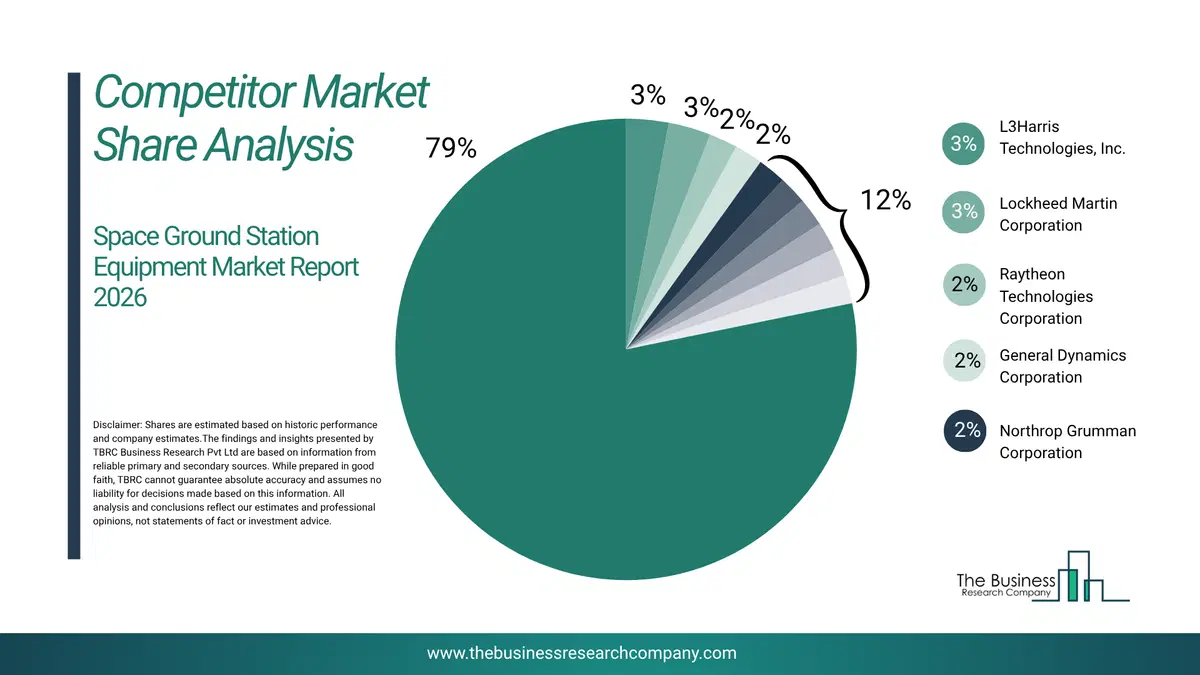
This chart is for illustrative purposes; the full report includes a detailed competitor analysis and comprehensive overview of the top 10 companies in the market.
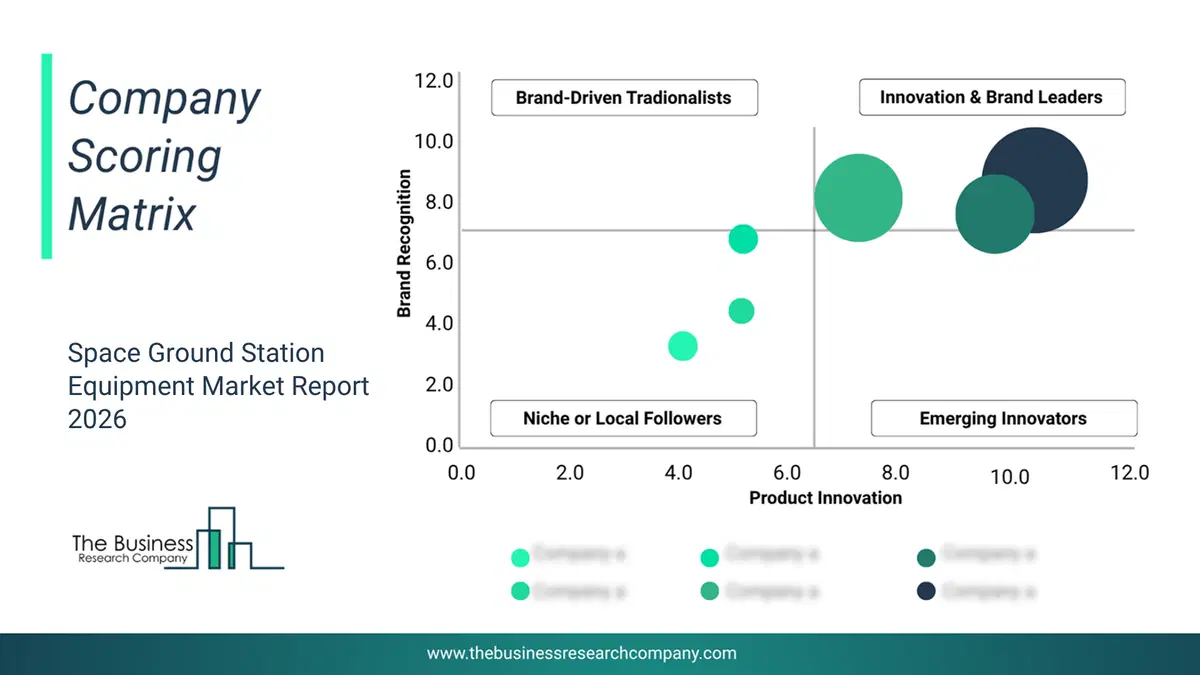
This chart maps companies by product innovation and brand strength, with bubble size indicating relative revenue, helping identify market leaders, challengers, and niche players. This is an illustrative chart; the full report provides a complete and accurate competitive analysis.
Global Space Ground Station Equipment Market Trends and Insights
Major companies operating in the space ground station equipment market are focusing on innovative product launches, such as advanced satellite systems, to expand their reach and demonstrate a commitment to technology and reliability. Advanced satellite systems are designed to enhance Earth observation capabilities and provide critical data for various applications, including environmental monitoring and urban planning. For instance, in September 2024, Airbus, a Netherlands-based aeronautics and space company, successfully launched the Sentinel-2C satellite, a significant advancement in the space ground station equipment industry. This satellite is part of the European Space Agency's Copernicus program, designed to provide high-resolution optical imagery for land monitoring and management. By integrating cutting-edge technology and advanced imaging capabilities, Sensor-2C enhances the ability of ground stations to receive, process, and analyze satellite data, ensuring timely and accurate information for a wide range of users, including government agencies and researchers.What Are Latest Mergers And Acquisitions In The Space Ground Station Equipment Market?
In September 2024, Redwire, a US-based company specializing in space infrastructure and technology acquired Hera Systems for an undisclosed amount. Through this acquisition, Redwire aimed to enhance its capabilities in satellite data services and expand its offerings in the commercial space sector. Hera Systems is a US-based company known for its advanced Earth observation technology and innovative satellite imagery solutions.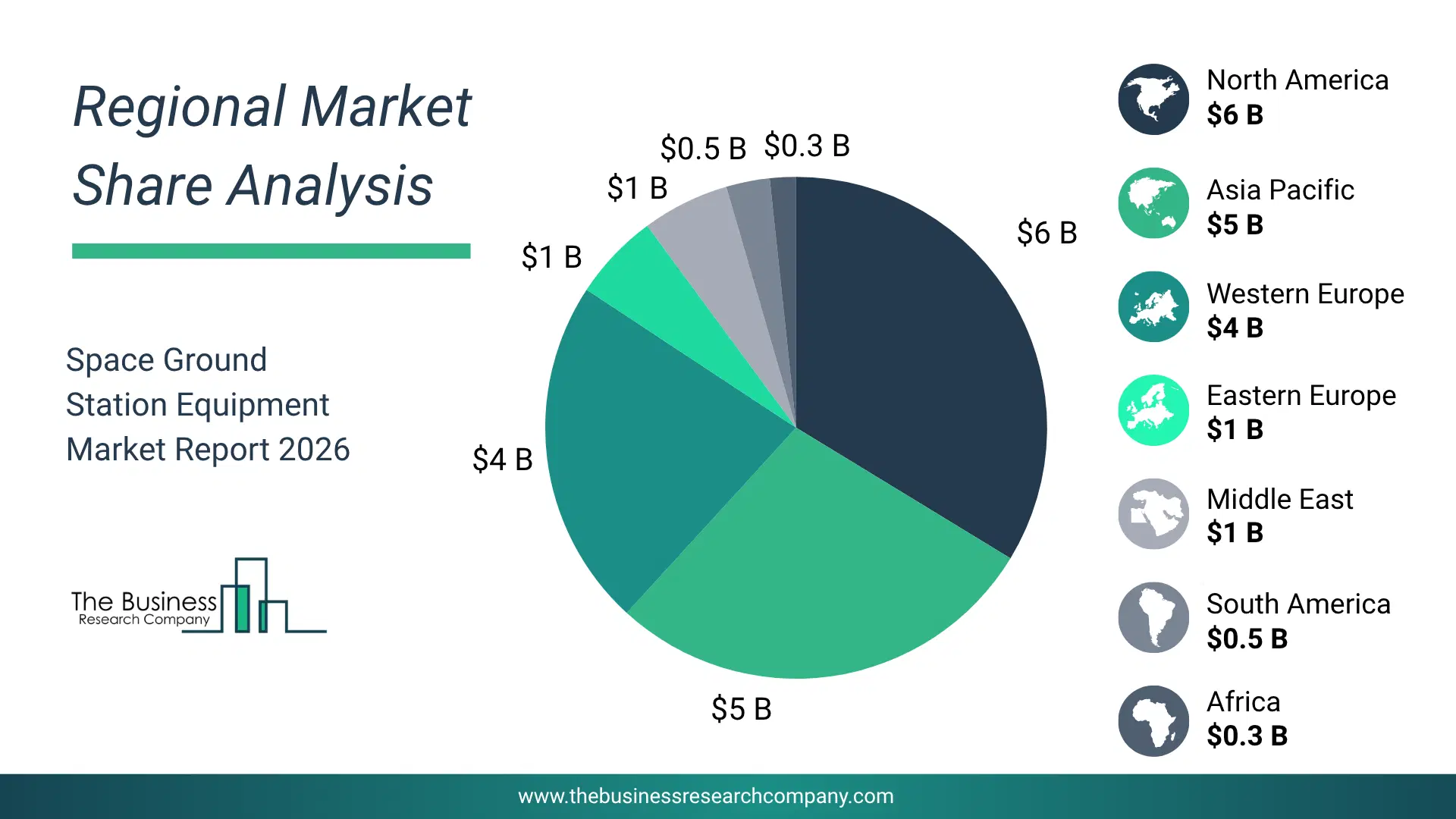
Regional Outlook
North America was the largest region in the space ground station equipment market in 2025.Asia-Pacific is expected to be the fastest-growing region in the global space ground station equipment market report during the forecast period. The regions covered in this market report are Asia-Pacific, South East Asia, Western Europe, Eastern Europe, North America, South America, Middle East, Africa. The countries covered in this market report are Australia, Brazil, China, France, Germany, India, Indonesia, Japan, Taiwan, Russia, South Korea, UK, USA, Canada, Italy, Spain.What Defines the Space Ground Station Equipment Market?
The space ground station equipment market includes revenues earned by entities by allowing data to be sent and received from Earth via satellites, developing and maintaining satellite infrastructure. The market value includes the value of related goods sold by the service provider or included within the service offering. The space ground station equipment market also includes sales of a waveguide, receiver, feed horn, and reception antenna, UHF/VHF antennas, telemetry receivers, transceivers. Values in this market are ‘factory gate’ values, that is the value of goods sold by the manufacturers or creators of the goods, whether to other entities (including downstream manufacturers, wholesalers, distributors, and retailers) or directly to end customers. The value of goods in this market includes related services sold by the creators of the goods.How is Market Value Defined and Measured?
The market value is defined as the revenues that enterprises gain from the sale of goods and/or services within the specified market and geography through sales, grants, or donations in terms of the currency (in USD unless otherwise specified). The revenues for a specified geography are consumption values that are revenues generated by organizations in the specified geography within the market, irrespective of where they are produced. It does not include revenues from resales along the supply chain, either further along the supply chain or as part of other products.
This chart presents market attractiveness based on a quantitative evaluation of growth, competition, strategic alignment, and risk, offering a clear view of opportunity areas for decision-making. This chart is for illustrative purposes; the full report contains the complete analysis.

This chart highlights the Total Addressable Market (TAM) by estimating the maximum revenue opportunity using an assumption-driven approach, supporting strategic planning and opportunity sizing across markets. The chart is illustrative; the full report provides a more comprehensive analysis.
What Key Data and Analysis Are Included in the Space Ground Station Equipment Market Report 2026?
The space ground station equipment market research report is one of a series of new reports from The Business Research Company that provides market statistics, including industry global market size, regional shares, competitors with the market share, detailed market segments, market trends and opportunities, and any further data you may need to thrive in the space ground station equipment industry. The market research report delivers a complete perspective of everything you need, with an in-depth analysis of the current and future state of the industry.Space Ground Station Equipment Market Report 2026 Market Report Forecast Analysis
| Report Attribute | Details |
|---|---|
| Market Size Value In 2026 | $11.76 billion |
| Revenue Forecast In 2030 | $16.93 billion |
| Growth Rate | CAGR of 8.7% from 2026 to 2030 |
| Base Year For Estimation | 2025 |
| Actual Estimates/Historical Data | 2020-2025 |
| Forecast Period | 2026 - 2030 - 2035 |
| Market Representation | Revenue in USD Billion and CAGR from 2026 to 2030 |
| Segments Covered | Type, Satellite Communication Service, Application, End User |
| Regional Scope | Asia-Pacific, Western Europe, Eastern Europe, North America, South America, Middle East, Africa |
| Country Scope | The countries covered in the report are Australia, Brazil, China, France, Germany, India, Indonesia, Japan, Taiwan, Russia, South Korea, UK, USA, Canada, Italy, Spain. |
| Key Companies Profiled | EchoStar Corporation, AAC Clyde Space, Comtech Telecommunication Corporation, Analog Devices Inc., GomSpace, Infostellar Inc., Inmarsat Global Limited, Kongsberg Satellite Services AS, Marlink Gmbh, Swedish Space Corporation, Thales Group, Viasat Inc., Gilat Satellite Networks, Harris Corporation, Kratos Defense & Security Solutions Inc., VT iDirect Inc., Advantech Wireless Technologies Inc., Norsat International Inc., Terrasat Communications Inc., Iridium Communications Inc., Orbcomm Inc., Globalstar Inc., Speedcast International Limited, Northrop Grumman Corporation, L3Harris Technologies Inc., General Dynamics Corporation, Raytheon Technologies Corporation, Lockheed Martin Corporation, Space Exploration Technologies Corp., Hughes Network Systems LLC |
| Customization Scope | Request for Customization |
| Pricing And Purchase Options | Explore Purchase Options |