
Space On-board Computing Platform Market Report 2026
Global Outlook – By Platform (Nano Satellite, MicroSatellite, Small Satellite, Medium Satellite, Large Satellite, Spacecraft), By Technology (Cots, Non-Cots), By Orbit (Low Earth Orbit (LEO), Medium Earth Orbit (MEO), Geostationary Earth Orbit (GEO)), By Communication Frequency (S-Band, X-Band, C-Band, K-Band, Other Communication Frequencies), By Application (Communication, Earth Observation, Navigation, Meteorology, Other Applications) – Market Size, Trends, Strategies, and Forecast to 2030
Space On-board Computing Platform Market Overview
• Space On-board Computing Platform market size has reached to $1.63 billion in 2025 • Expected to grow to $3.11 billion in 2030 at a compound annual growth rate (CAGR) of 13.7% • Growth Driver: Elevating Space-On-Board Computing With The Surge In Space Exploration Missions • Market Trend: Strategic Partnership For AI-Powered Edge Computing In Space • North America was the largest region in 2025 and Asia-Pacific is the fastest growing region.Market Gains By 2030 – Top Opportunities By Segment
Market Gain identifies the most promising market opportunities by highlighting the segments or products expected to generate the highest incremental revenue growth over the next five years.
What Is Covered Under Space On-board Computing Platform Market?
The space on-board computing platform is the key core of the spacecraft avionics used for collection, analysis, and processing of data gathered by satellite on-board to provide an exact map of the earth's surface. The space on-board computing platform collects data through various applications and provides mapping and navigation across the globe. The main platforms for space onboard computing platforms are nanosatellites, microsatellites, small satellites, medium satellites, large satellites, and spacecraft. The nano-satellites are smaller satellites that carry the same functions as a normal satellite but with weights of less than 10 kilograms, which makes it easy to carry out various missions such as interplanetary, navigation, and others due to their smaller size. The various technologies involved are cots and non-cots. The different orbits include low earth orbit (LEO), medium earth orbit (MREO), and geostationary earth orbit (GEO) that involve several communication modes such as s-band, x-band, c-band, k-band, and others. The various applications include communication, earth observation, navigation, meteorology, and others.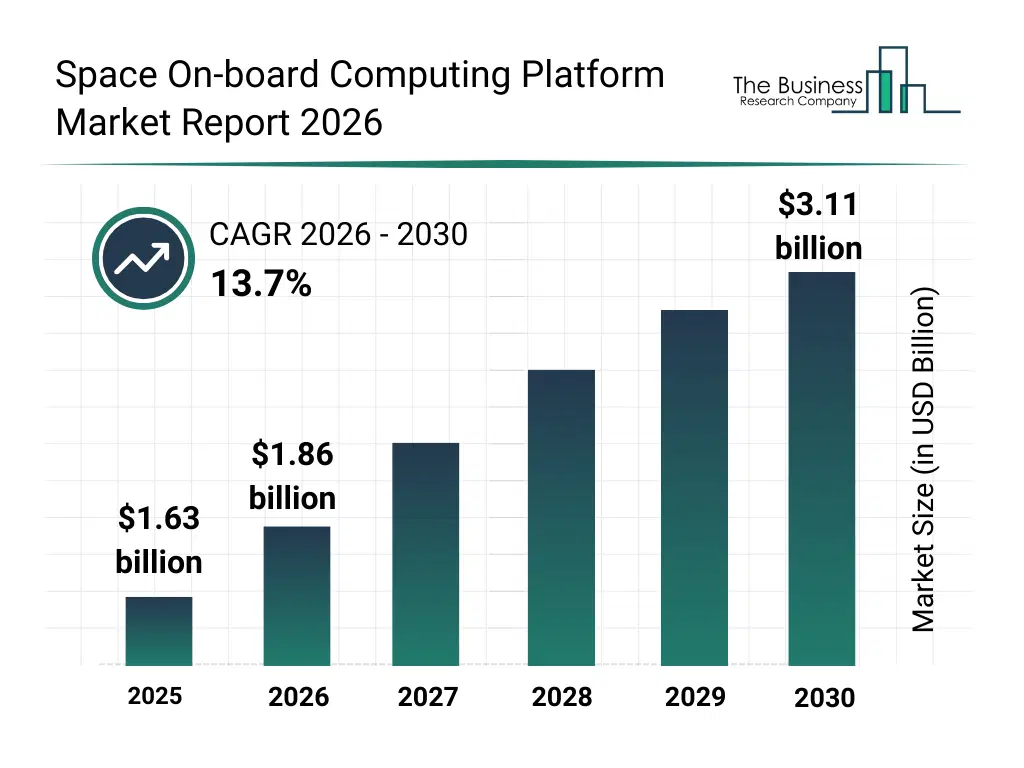
What Is The Space On-board Computing Platform Market Size and Share 2026?
The space on-board computing platform market size has grown rapidly in recent years. It will grow from $1.63 billion in 2025 to $1.86 billion in 2026 at a compound annual growth rate (CAGR) of 14.1%. The growth in the historic period can be attributed to expansion of earth observation satellite missions, growth of satellite-based navigation services, increasing demand for onboard data processing, adoption of cots-based space electronics, rising investments in space exploration programs.What Is The Space On-board Computing Platform Market Growth Forecast?
The space on-board computing platform market size is expected to see rapid growth in the next few years. It will grow to $3.11 billion in 2030 at a compound annual growth rate (CAGR) of 13.7%. The growth in the forecast period can be attributed to increasing deployment of low earth orbit satellite constellations, rising demand for autonomous satellite operations, expansion of real-time space data analytics, growing focus on edge computing in space systems, increasing investments in next-generation spacecraft avionics. Major trends in the forecast period include increasing adoption of ai-enabled onboard data processing, rising deployment of high-performance space processors, growing use of radiation-hardened computing platforms, expansion of modular satellite computing architectures, enhanced focus on real-time in-orbit analytics.
Global Space On-board Computing Platform Market Segmentation
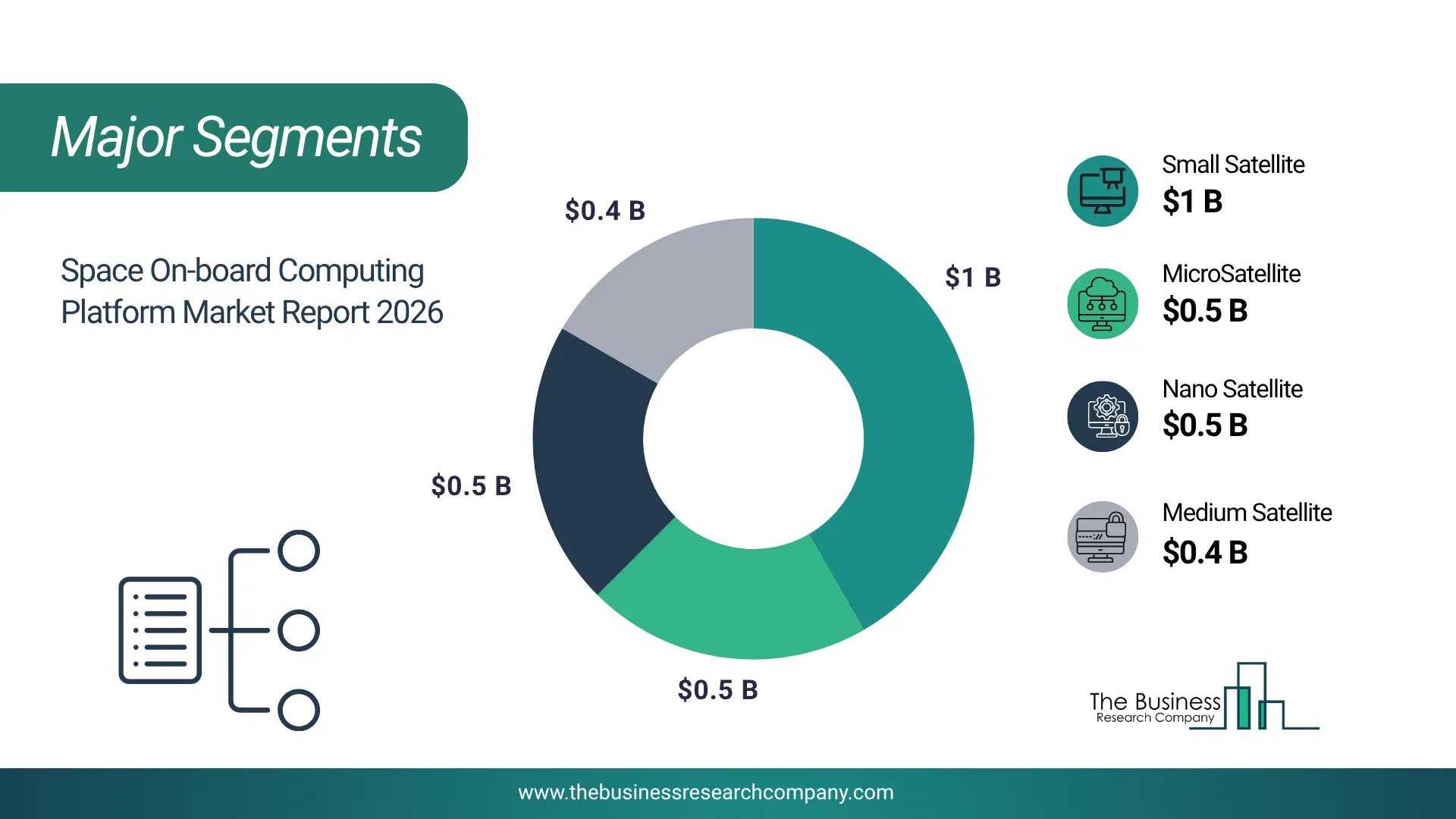
1) By Platform: Nano Satellite, MicroSatellite, Small Satellite, Medium Satellite, Large Satellite, Spacecraft 2) By Technology: Cots, Non-Cots 3) By Orbit: Low Earth Orbit (LEO), Medium Earth Orbit (MEO), Geostationary Earth Orbit (GEO) 4) By Communication Frequency: S-Band, X-Band, C-Band, K-Band, Other Communication Frequencies 5) By Application: Communication, Earth Observation, Navigation, Meteorology, Other Applications Subsegments: 1) By Nano Satellite: 1U CubeSats, 3U CubeSats, Other Nano Satellites 2) By Microsatellite: 10-100 Kg Satellites, Specialized Microsatellites 3) By Small Satellite: 100-500 Kg Satellites, Small Science Satellites 4) By Medium Satellite: 500-2,000 Kg Satellites, Medium Communication Satellites 5) By Large Satellite: Over 2,000 Kg Satellites, Large Earth Observation Satellites 6) By Spacecraft: Manned Spacecraft, Unmanned Spacecraft, Space Probes The top segments in the space on-board computing platform market will be: • Small Satellite will reach $0.91 Billion by 2030. • MicroSatellite will reach $0.48 Billion by 2030. • Nano Satellite will reach $0.45 Billion by 2030. • Medium Satellite will reach $0.39 Billion by 2030. • Large Satellite will reach $0.34 Billion by 2030.What Is The Driver Of The Space On-board Computing Platform Market?
The rise in space exploration missions is expected to propel the growth of the space-on-board computing platform market going forward. Space on-board computing platforms are commonly used in a number of space exploration missions due to their capabilities of gathering information using various applications, data storing, analyzing, and distributing the collected data to provide mapping and navigation in earth and space exploration missions. Additionally, space on-board computing is capable of allowing the applications to adapt to new situations or needs and rapidly deploy new updates or algorithms to existing systems for image analysis in space explorations or missions. For instance, in November 2023, according to data published by the United Nations Office for Outer Space Affairs (UNOOSA), a part of the United Nations promoting space-related activities and coordinating space-related policies and programs, it received over 2,050 satellite registrations in 2022, and so far in 2023, it has received 2,250 registrations, accounting for 35 percent of all satellites. Therefore, the rising number of space exploration missions is driving the space on-board computing platform industry growth.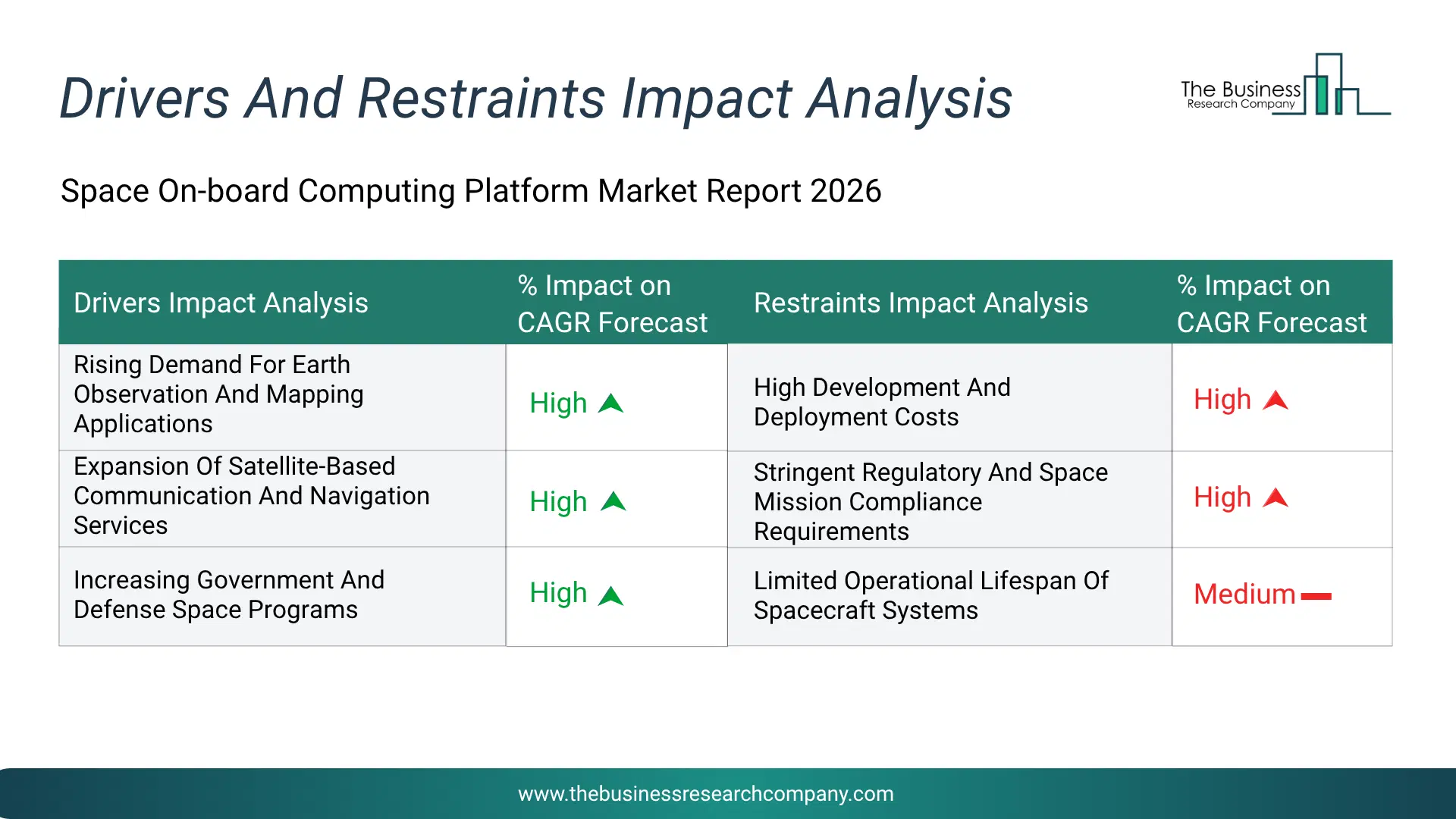
Infographic Chart Showing Key Market Drivers Analysis And Restraints For Space On-Board Computing Platform Market
The chart presents an impact analysis of key drivers and restraints, quantifying their relative influence on the market's growth rate and helping assess the balance between growth enablers and limiting factors. This chart offers a high-level perspective; the full report contains more detailed insights.
How Will The Drivers Impact Growth In The Global Space On-board Computing Platform Market?
• Rising Demand For Earth Observation And Mapping Applications (High) – During the forecast period, the rising demand for earth observation and mapping applications is expected to become a key growth driver for the space on-board computing platform market by 2030. Rising demand for earth observation and mapping applications is driving the growth of the space on-board computing platform market due to the increasing need for accurate geospatial intelligence, environmental monitoring, and terrain mapping. Governments, defense agencies, and commercial operators are investing in satellite missions to improve disaster management, urban planning, and resource monitoring capabilities. Space on-board computing platforms play a critical role in collecting and processing high-volume satellite data directly in orbit. The growing dependency on real-time navigation and mapping services across transportation, agriculture, and logistics sectors is further increasing deployment of advanced spacecraft avionics. • Expansion Of Satellite-Based Communication And Navigation Services (High) – During the forecast period, the expansion of satellite-based communication and navigation services is expected to emerge as a major factor driving the expansion of the space on-board computing platform market by 2030. Expansion of satellite-based communication and navigation services is contributing significantly to the demand for space on-board computing platforms as satellite operators require efficient processing systems for uninterrupted data handling and transmission. Growing adoption of satellite-enabled navigation services in aviation, maritime, defense, and commercial transportation sectors is increasing the requirement for reliable on-board computing infrastructure. Spacecraft avionics equipped with advanced processing capabilities help improve mission accuracy, communication efficiency, and positioning reliability. Rising investments in global navigation satellite systems and communication constellations are further strengthening market demand. • Increasing Government And Defense Space Programs (High) – During the forecast period, the increasing government and defense space programs is expected to act as a key growth catalyst for the space on-board computing platform market by 2030. Increasing government and defense space programs is accelerating the growth of the space on-board computing platform market due to rising investments in national security, surveillance, and strategic satellite missions. Defense organizations are increasingly deploying satellites for intelligence gathering, border monitoring, and secure communication operations, which require high-performance on-board data processing capabilities. Government space agencies are also expanding space exploration and earth observation programs to strengthen scientific research and national infrastructure development. The growing number of public sector satellite launches is creating substantial demand for advanced avionics systems capable of handling mission-critical operations.How Will The Restraints Impact Growth In The Global Space On-board Computing Platform Market?
• High Development And Deployment Costs (High) – During the forecast period, the high development and deployment costs is restraining the growth of the space on-board computing platform market due to the substantial capital investment required for spacecraft manufacturing, testing, launch operations, and integration of avionics systems. Space-qualified computing platforms require extensive validation and compliance procedures to ensure operational reliability in harsh space environments. The high financial burden associated with satellite deployment limits market participation, particularly for small and medium-sized enterprises. In addition, mission failures or launch delays can result in major financial losses for satellite operators and manufacturers. These cost-related challenges may reduce the pace of new project adoption across emerging economies. • Stringent Regulatory And Space Mission Compliance Requirements (High) – During the forecast period, the stringent regulatory and space mission compliance requirements is limiting market growth as manufacturers and satellite operators must comply with complex international standards related to satellite communication, frequency allocation, and spacecraft safety. Regulatory approvals for satellite launches and orbital operations often involve lengthy procedures and coordination with multiple government agencies. Compliance with export controls and defense-related restrictions also creates operational challenges for market participants engaged in international collaborations. These regulatory complexities can increase project timelines and operational costs for manufacturers. The presence of strict certification requirements may further slow product commercialization and deployment activities. • Limited Operational Lifespan Of Spacecraft Systems (High) – During the forecast period, the limited operational lifespan of spacecraft systems is restraining the market because satellites and associated on-board computing platforms are exposed to extreme radiation, temperature fluctuations, and harsh environmental conditions in space. Continuous exposure to these conditions can reduce system reliability and increase the risk of hardware degradation over time. The inability to conduct regular physical maintenance or repairs once satellites are deployed further increases operational risks for mission operators. Shorter operational lifespans may lead to frequent replacement requirements and additional expenditure for satellite operators. These challenges can negatively impact return on investment and reduce adoption rates among cost-sensitive organizations.Key Players In The Global Space On-board Computing Platform Market
Major companies operating in the space on-board computing platform market are BAE Systems plc; Thales Group; L3Harris Technologies Inc.; Lockheed Martin Corporation; Honeywell International Inc.; Raytheon Technologies Corporation; Northrop Grumman Corporation; Airbus SE; Ball Corporation; Cobham Gaisler AB; Leonardo S.p.A.; ST Engineering; Teledyne Technologies Inc.; MDA Corporation; Ramon Space; LMO Space; Space Micro Inc.; Blue Canyon Technologies; AAC Clyde Space; Astro Digital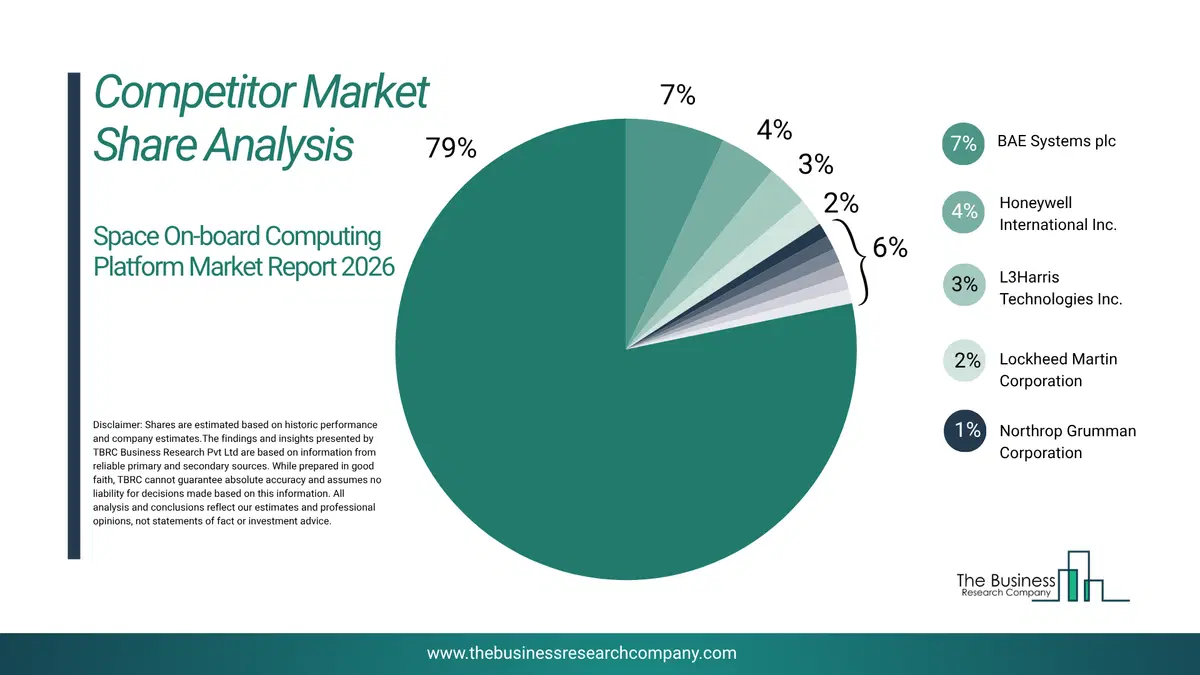
This chart is for illustrative purposes; the full report includes a detailed competitor analysis and comprehensive overview of the top 10 companies in the market.
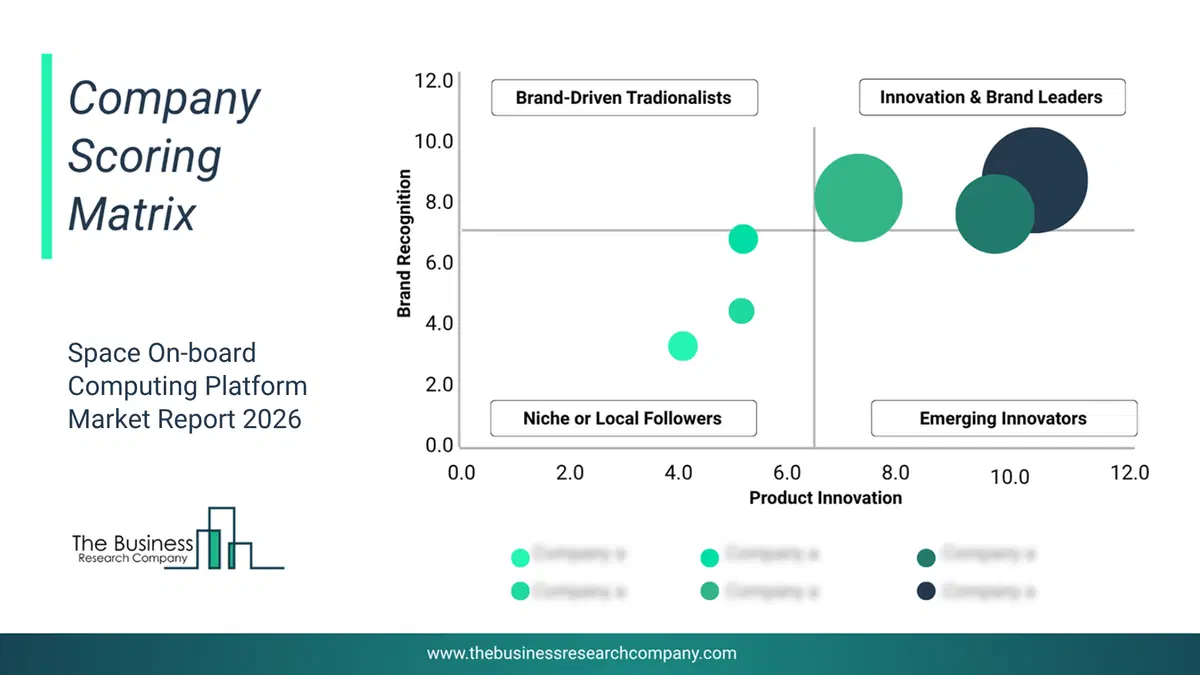
This chart maps companies by product innovation and brand strength, with bubble size indicating relative revenue, helping identify market leaders, challengers, and niche players. This is an illustrative chart; the full report provides a complete and accurate competitive analysis.
Global Space On-board Computing Platform Market Trends and Insights
Major companies operating in the space on-board computing platform market are adopting a strategic partnership approach to enhance technology integration and expand market reach. A strategic partnership typically refers to a collaborative relationship between two or more organizations where they combine their resources, expertise, and efforts to achieve common goals or objectives. For instance, in April 2024, Firefly Aerospace, a US-based aerospace company, partnered with Klepsydra Technologies, a Switzerland-based software company, to host an AI application on Firefly's Elytra vehicle, set to launch aboard the Alpha rocket later this year. Elytra, an edge computing platform, will process data in real-time on orbit, supporting various software applications. Klepsydra will use Elytra to test its AI navigation models for attitude determination, guidance, and control, as well as a cloud detection algorithm. This collaboration aims to showcase dynamic AI application switching and Klepsydra's AI as a-service solution.What Are Latest Mergers And Acquisitions In The Space On-board Computing Platform Market?
In April 2025, Voyager Technologies Inc., a US-based defense and space technology company, entered into an agreement to acquire LEOcloud, Inc. for an undisclosed amount. With this acquisition, Voyager Technologies aims to expand its space-based cloud infrastructure, integrate LEOcloud’s edge computing platform in low-Earth orbit, and enable scalable, secure computing solutions for commercial, government and defense applications in space. LEOcloud Inc. is a US-based provider of orbit-based cloud computing services designed for mission-critical workloads.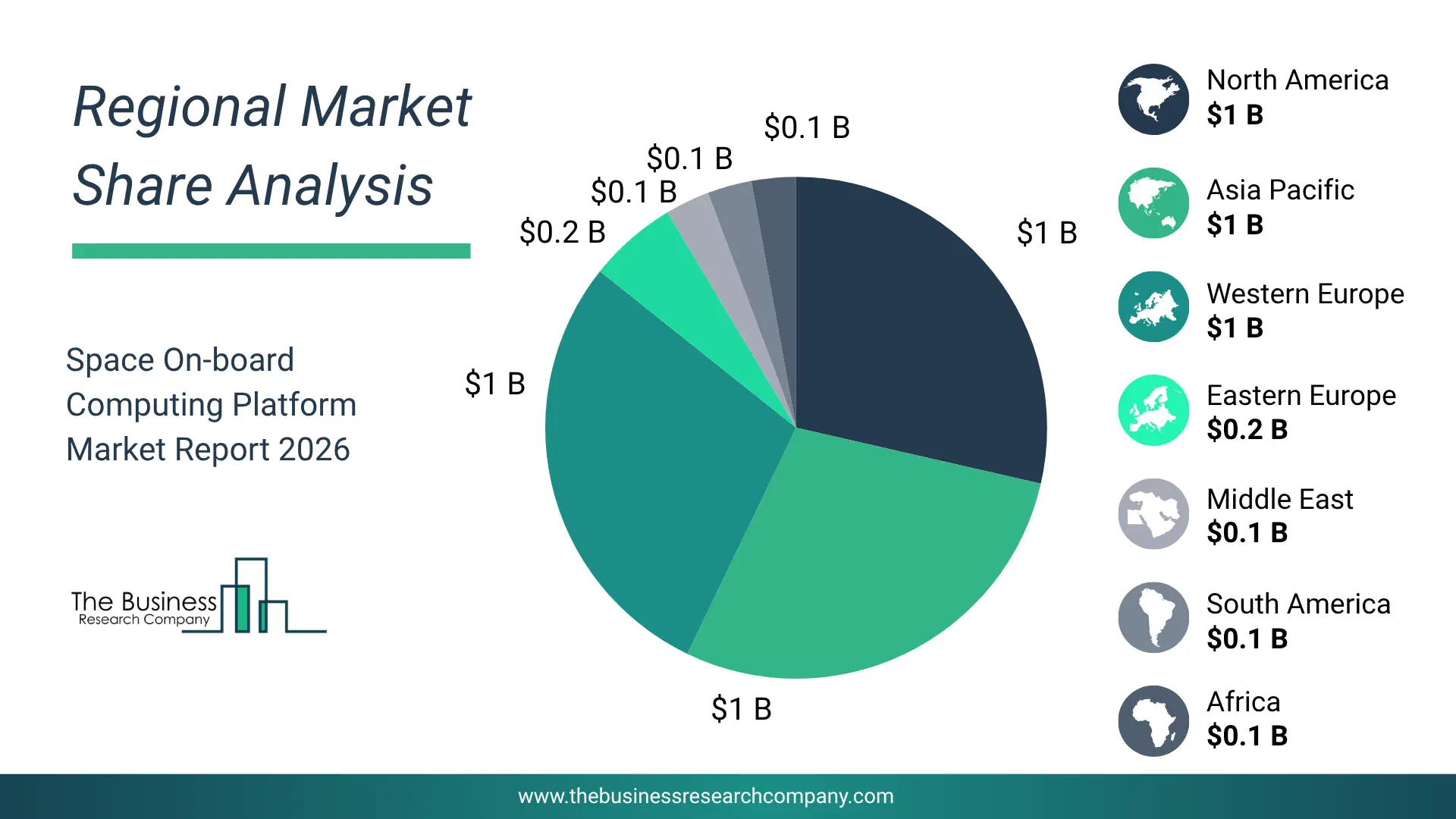
Regional Insights
North America was the largest region in the space on-board computing platform market in 2025. Asia-Pacific is expected to be the fastest-growing region in the forecast period. The regions covered in this market report are Asia-Pacific, South East Asia, Western Europe, Eastern Europe, North America, South America, Middle East, Africa. The countries covered in this market report are Australia, Brazil, China, France, Germany, India, Indonesia, Japan, Taiwan, Russia, South Korea, UK, USA, Canada, Italy, SpainWhat Defines the Space On-board Computing Platform Market?
The space on-board computing platform market consists of revenues earned by entities by providing space-on-board computing platform with frequency of UHF/VHF. Values in this market are ‘factory gate’ values, that is the value of goods sold by the manufacturers or creators of the goods, whether to other entities (including downstream manufacturers, wholesalers, distributors, and retailers) or directly to end customers. The value of goods in this market includes related services sold by the creators of the goods.How is Market Value Defined and Measured?
The market value is defined as the revenues that enterprises gain from the sale of goods and/or services within the specified market and geography through sales, grants, or donations in terms of the currency (in USD unless otherwise specified). The revenues for a specified geography are consumption values that are revenues generated by organizations in the specified geography within the market, irrespective of where they are produced. It does not include revenues from resales along the supply chain, either further along the supply chain or as part of other products.
This chart presents market attractiveness based on a quantitative evaluation of growth, competition, strategic alignment, and risk, offering a clear view of opportunity areas for decision-making. This chart is for illustrative purposes; the full report contains the complete analysis.

This chart highlights the Total Addressable Market (TAM) by estimating the maximum revenue opportunity using an assumption-driven approach, supporting strategic planning and opportunity sizing across markets. The chart is illustrative; the full report provides a more comprehensive analysis.
What Key Data and Analysis Are Included in the Space On-board Computing Platform Market Report 2026?
The space on-board computing platform market research report is one of a series of new reports from The Business Research Company that provides market statistics, including industry global market size, regional shares, competitors with the market share, detailed market segments, market trends and opportunities, and any further data you may need to thrive in the space on-board computing platform industry. The market research report delivers a complete perspective of everything you need, with an in-depth analysis of the current and future state of the industry.Space On-board Computing Platform Market Report Forecast Analysis
| Report Attribute | Details |
|---|---|
| Market Size Value In 2026 | $1.86 billion |
| Revenue Forecast In 2030 | $3.11 billion |
| Growth Rate | CAGR of 14.1% from 2026 to 2030 |
| Base Year For Estimation | 2025 |
| Actual Estimates/Historical Data | 2020-2025 |
| Forecast Period | 2026 - 2030 |
| Market Representation | Revenue in USD Billion and CAGR from 2026 to 2030 |
| Segments Covered | Platform, Technology, Orbit, Communication Frequency, Application |
| Regional Scope | Asia-Pacific, Western Europe, Eastern Europe, North America, South America, Middle East, Africa |
| Country Scope | The countries covered in the report are Australia, Brazil, China, France, Germany, India, Indonesia, Japan, Taiwan, Russia, South Korea, UK, USA, Canada, Italy, Spain. |
| Key Companies Profiled | BAE Systems plc; Thales Group; L3Harris Technologies Inc.; Lockheed Martin Corporation; Honeywell International Inc.; Raytheon Technologies Corporation; Northrop Grumman Corporation; Airbus SE; Ball Corporation; Cobham Gaisler AB; Leonardo S.p.A.; ST Engineering; Teledyne Technologies Inc.; MDA Corporation; Ramon Space; LMO Space; Space Micro Inc.; Blue Canyon Technologies; AAC Clyde Space; Astro Digital |
| Customization Scope | Request for Customization |
| Pricing And Purchase Options | Explore Purchase Options |