

Titanium Dioxide Nanomaterials Market Report 2026
Global Outlook – By Type (Rutile Nanoparticles, Anatase Nanoparticles, Combination Of Rutile And Anatase Nanoparticles, Nanowires And Nanotubes, Other Types), By Physical Form (Powder, Slurry, Liquid), By Process (Chloride, Sulfate), By Application (Personal Care Products, Textiles And Apparels, Paints And Coatings, Plastics, Medical Products And Devices, Paper And Ink Industry, Catalysts, Building, Construction, Other Applications) – Market Size, Trends, Strategies, and Forecast to 2030
Titanium Dioxide Nanomaterials Market Overview
• Titanium Dioxide Nanomaterials market size has reached to $23.22 billion in 2025 • Expected to grow to $31.74 billion in 2030 at a compound annual growth rate (CAGR) of 6.4% • Growth Driver: The Growing Paints And Coatings Industry Is Fueling The Growth Of The Market Due To Demand For High-Performance Surface Protection • Asia-Pacific was the largest region and fastest growing region.What Is Covered Under Titanium Dioxide Nanomaterials Market?
Titanium dioxide nanomaterials refer to ultra-fine particles of titanium dioxide that typically range in size from 1 to 100 nanometers and exhibit unique optical, catalytic, and antibacterial properties. These nanomaterials are widely used in applications such as sunscreens, paints, photocatalysis, and environmental purification due to their high surface area and enhanced reactivity. The main types of titanium dioxide nanomaterials are rutile nanoparticles, anatase nanoparticles, combinations of rutile and anatase nanoparticles, nanowires and nanotubes, and others. Rutile nanoparticles are stable titanium dioxide particles with strong UV-blocking and optical properties, ideal for sunscreens, coatings, and outdoor applications. It is available in several physical forms, including powder, slurry, and liquid, which contain different purities, including 5 percent, 7 percent, and 9 percent. It is synthesized by different processes, such as chloride and sulfate, for various applications, including personal care products, textiles and apparel, paints and coatings, plastics, medical products and devices, the paper and ink industry, catalysts, building, construction, and others.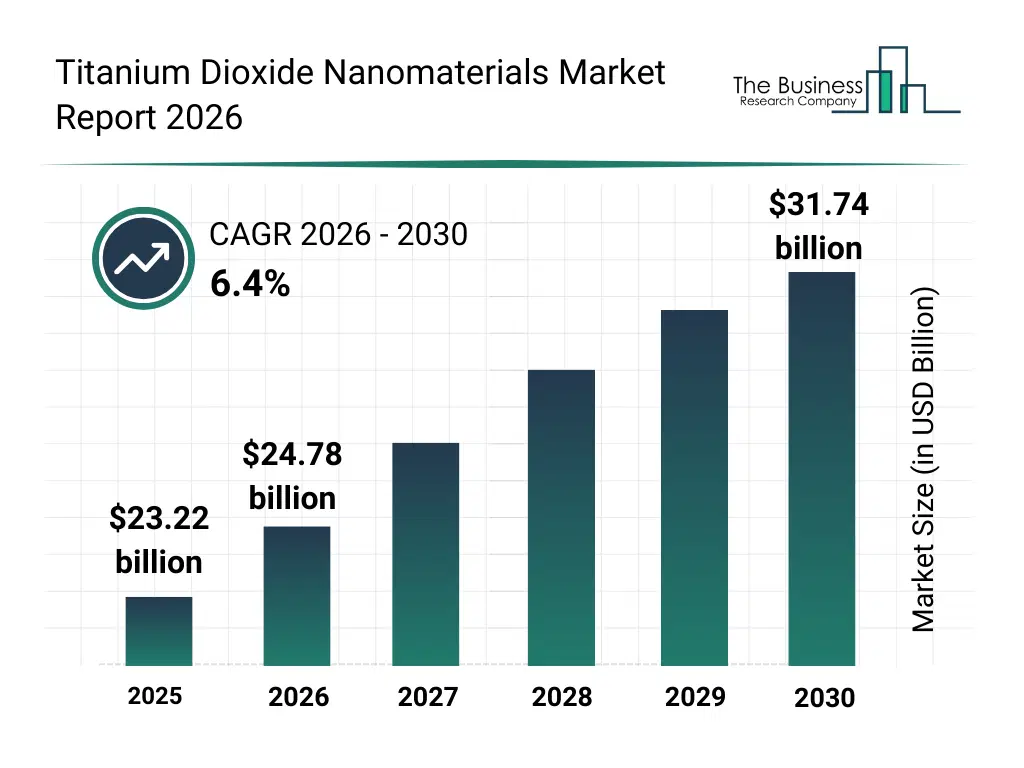
What Is The Titanium Dioxide Nanomaterials Market Size and Share 2026?
The titanium dioxide nanomaterials market size has grown strongly in recent years. It will grow from $23.22 billion in 2025 to $24.78 billion in 2026 at a compound annual growth rate (CAGR) of 6.7%. The growth in the historic period can be attributed to cosmetic industry growth, demand for UV protection materials, paint and coating expansion, photocatalysis research, construction material usage.What Is The Titanium Dioxide Nanomaterials Market Growth Forecast?
The titanium dioxide nanomaterials market size is expected to see strong growth in the next few years. It will grow to $31.74 billion in 2030 at a compound annual growth rate (CAGR) of 6.4%. The growth in the forecast period can be attributed to clean energy photocatalysis demand, antibacterial surface adoption, advanced medical devices, sustainable coating growth, nano material regulation clarity. Major trends in the forecast period include growing use in sunscreens and personal care, expansion of photocatalytic environmental applications, rising adoption in high performance coatings, increased demand from medical and antibacterial uses, focus on high purity nano titanium grades.
Global Titanium Dioxide Nanomaterials Market Segmentation
1) By Type: Rutile Nanoparticles, Anatase Nanoparticles, Combination Of Rutile And Anatase Nanoparticles, Nanowires And Nanotubes, Other Types 2) By Physical Form: Powder, Slurry, Liquid 3) By Process: Chloride, Sulfate 4) By Application: Personal Care Products, Textiles And Apparels, Paints And Coatings, Plastics, Medical Products And Devices, Paper And Ink Industry, Catalysts, Building, Construction, Other Applications Subsegments: 1) By Rutile Nanoparticles: Surface-Treated Rutile Nanoparticles, Uncoated Rutile Nanoparticles, Hydrophobic Rutile Nanoparticles, Ultraviolet (UV)-Resistant Rutile Grade, High-Purity Rutile For Optical Applications 2) By Anatase Nanoparticles: High Surface Area Anatase, Photocatalytic Grade Anatase, Cosmetic Grade Anatase, Anatase For Dye-Sensitized Solar Cells, Anatase For Antibacterial Coatings 3) By Combination Of Rutile And Anatase Nanoparticles: 70:30 Rutile Anatase Blends, 50:50 Mixed-Phase Nanoparticles, Synergistic Photocatalytic Mixtures, Co-Synthesized Hybrid Nanoparticles, Layered Rutile-Anatase Composites 4) By Nanowires And Nanotubes: Titanium Dioxide (TiO₂) Nanowires For Energy Storage, Self-Aligned Titanium Dioxide (TiO₂) Nanotube Arrays, Electrospun Titanium Dioxide (TiO₂) Nanofibers, Mesoporous Titanium Dioxide (TiO₂) Nanotubes, Doped Titanium Dioxide (TiO₂) Nanowires 5) By Other Types: Titanium Dioxide (TiO₂) Quantum Dots, Hollow Titanium Dioxide (TiO₂) Nanospheres, Doped Titanium Dioxide (TiO₂) Nanoparticles, Titanium Dioxide (TiO₂) Nanorods, Titanium Dioxide (TiO₂) NanosheetsWhat Are The Drivers Of The Titanium Dioxide Nanomaterials Market?
The growing paints and coatings industry is expected to propel the growth of the titanium dioxide nanomaterials market going forward. The paints and coatings industry refers to the sector that produces colored or protective finishes applied to surfaces to enhance durability and aesthetics. The paints and coatings industry is rising due to rapid construction and infrastructure development, as increasing urbanization fuels demand for new residential and commercial buildings. Titanium dioxide nanomaterials boost the performance of paints and coatings by offering excellent whiteness, opacity, and UV protection. They enhance durability and shield surfaces from fading and environmental damage. For instance, in May 2025, according to the Observatory of Economic Complexity, a US-based provider of detailed global trade data, in 2023, Australia exported $580 million worth of paints, dyes, and varnishes, making it the world’s 26th-largest exporter, while importing $791 million of the same products, ranking 30th and underscoring its greater reliance on foreign suppliers. Therefore, the growing paints and coatings industry is driving the growth of the titanium dioxide nanomaterials industry. The growing personal care and cosmetics industry is expected to propel the growth of the titanium dioxide nanomaterials market going forward. The personal care and cosmetics industry includes the production and sale of products used for enhancing appearance and hygiene, such as skincare, haircare, and makeup. The personal care and cosmetics industry is rising due to the increasing consumer focus on skincare, which is driven by heightened awareness of self-care and beauty routines, particularly among younger demographics. Titanium dioxide nanomaterials support the personal care and cosmetics industry by providing effective UV protection, improved transparency in formulations, and enhanced stability in products such as sunscreens, lotions, and makeup. For instance, in January 2024, according to Circana, LLC, a US-based research and technology company, the U.S. beauty industry sales grew by 14% year over year, reaching $31.7 billion in 2023. Therefore, the growing personal care and cosmetics industry is driving the growth of the titanium dioxide nanomaterials industry. The increasing demand in the construction industry is expected to propel the growth of the titanium dioxide nanomaterials market going forward. The construction industry refers to the sector involved in the planning, design, development, and building of infrastructure, residential, commercial, and industrial structures. The construction industry is increasing due to rapid urbanization, which drives demand for new infrastructure, housing, and commercial developments. Titanium dioxide nanomaterials help the construction industry by enhancing building materials with self-cleaning, UV-resistant, and antimicrobial properties, improving durability, and reducing maintenance needs. For instance, in November 2024, according to the Office for National Statistics, a UK-based government department, in 2023 construction new work output in Great Britain rose by 4.2% to a record high of £139,029 million ($171.10 billion), driven by growth in both private sector and public sector construction. Therefore, increasing demand in the construction industry is driving the growth of the titanium dioxide nanomaterials industry.Key Players In The Global Titanium Dioxide Nanomaterials Market
Major companies operating in the titanium dioxide nanomaterials market are BASF SE, Evonik Industries AG, Venator Materials plc, Cinkarna Celje d.d., Sisco Research Laboratories Pvt. Ltd., Titan Kogyo Ltd., Precheza a.s., American Elements, Reinste Nano Ventures Private Limited, PlasmaChem GmbH, ACS Material LLC, SkySpring Nanomaterials Inc., Nanochemazone Corporation, Nanografi Nano Technology Inc., Novarials Corporation, Nano Research Elements Inc., Nanoshel LLC, AdNano Technologies Pvt Ltd, Shilpa Enterprises, Hongwu International Group Ltd.
This chart is for illustrative purposes; the full report includes a detailed competitor analysis and comprehensive overview of the top 10 companies in the market.

This chart maps companies by product innovation and brand strength, with bubble size indicating relative revenue, helping identify market leaders, challengers, and niche players. This is an illustrative chart; the full report provides a complete and accurate competitive analysis.

Regional Insights
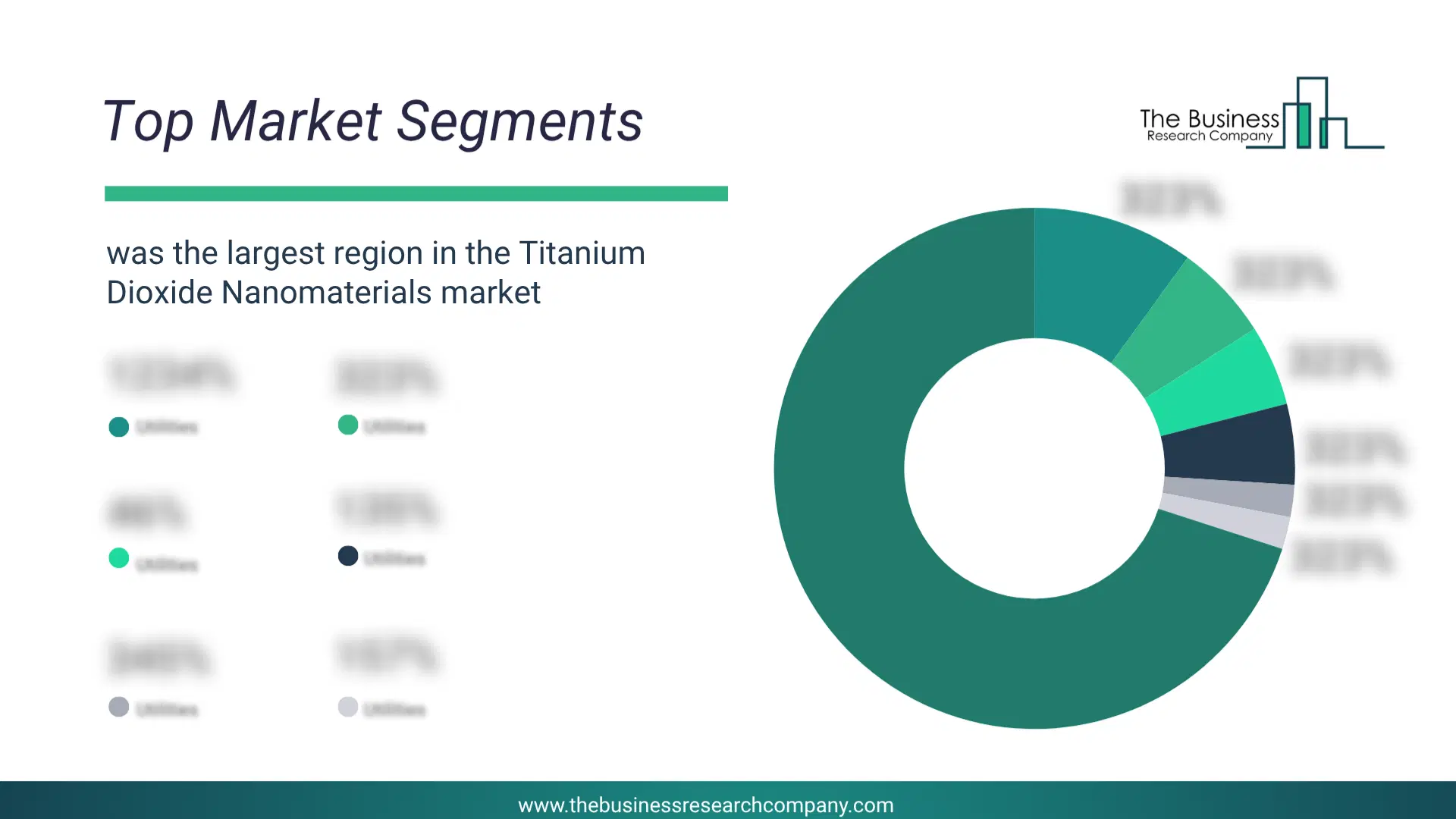
Asia-Pacific was the largest region in the titanium dioxide nanomaterials market in 2025. The regions covered in this market report are Asia-Pacific, South East Asia, Western Europe, Eastern Europe, North America, South America, Middle East, Africa The countries covered in this market report are Australia, Brazil, China, France, Germany, India, Indonesia, Japan, Taiwan, Russia, South Korea, UK, USA, Canada, Italy, SpainWhat Defines the Titanium Dioxide Nanomaterials Market?
The titanium dioxide nanomaterials market consists of sales of titanium dioxide nanospheres, mesoporous TiO₂ nanoparticles, titanium dioxide nanocomposites, TiO₂ quantum dots, and titanium dioxide nanorods. Values in this market are ‘factory gate’ values, that is, the value of goods sold by the manufacturers or creators of the goods, whether to other entities (including downstream manufacturers, wholesalers, distributors, and retailers) or directly to end customers. The value of goods in this market includes related services sold by the creators of the goods.How is Market Value Defined and Measured?
The market value is defined as the revenues that enterprises gain from the sale of goods and/or services within the specified market and geography through sales, grants, or donations in terms of the currency (in USD unless otherwise specified). The revenues for a specified geography are consumption values that are revenues generated by organizations in the specified geography within the market, irrespective of where they are produced. It does not include revenues from resales along the supply chain, either further along the supply chain or as part of other products.
This chart presents market attractiveness based on a quantitative evaluation of growth, competition, strategic alignment, and risk, offering a clear view of opportunity areas for decision-making. This chart is for illustrative purposes; the full report contains the complete analysis.

This chart highlights the Total Addressable Market (TAM) by estimating the maximum revenue opportunity using an assumption-driven approach, supporting strategic planning and opportunity sizing across markets. The chart is illustrative; the full report provides a more comprehensive analysis.
What Key Data and Analysis Are Included in the Titanium Dioxide Nanomaterials Market Report 2026?
The titanium dioxide nanomaterials market research report is one of a series of new reports from The Business Research Company that provides market statistics, including industry global market size, regional shares, competitors with the market share, detailed market segments, market trends and opportunities, and any further data you may need to thrive in the titanium dioxide nanomaterials industry. The market research report delivers a complete perspective of everything you need, with an in-depth analysis of the current and future state of the industry.Titanium Dioxide Nanomaterials Market Report Forecast Analysis
| Report Attribute | Details |
|---|---|
| Market Size Value In 2026 | $24.78 billion |
| Revenue Forecast In 2030 | $31.74 billion |
| Growth Rate | CAGR of 6.7% from 2026 to 2030 |
| Base Year For Estimation | 2025 |
| Actual Estimates/Historical Data | 2020-2025 |
| Forecast Period | 2026 - 2030 |
| Market Representation | Revenue in USD Billion and CAGR from 2026 to 2030 |
| Segments Covered | Type, Physical Form, Process, Application |
| Regional Scope | Asia-Pacific, Western Europe, Eastern Europe, North America, South America, Middle East, Africa |
| Country Scope | The countries covered in this market report are Australia, Brazil, China, France, Germany, India, Indonesia, Japan, Taiwan, Russia, South Korea, UK, USA, Canada, Italy, Spain |
| Key Companies Profiled | BASF SE, Evonik Industries AG, Venator Materials plc, Cinkarna Celje d.d., Sisco Research Laboratories Pvt. Ltd., Titan Kogyo Ltd., Precheza a.s., American Elements, Reinste Nano Ventures Private Limited, PlasmaChem GmbH, ACS Material LLC, SkySpring Nanomaterials Inc., Nanochemazone Corporation, Nanografi Nano Technology Inc., Novarials Corporation, Nano Research Elements Inc., Nanoshel LLC, AdNano Technologies Pvt Ltd, Shilpa Enterprises, Hongwu International Group Ltd. |
| Customization Scope | Request for Customization |
| Pricing And Purchase Options | Explore Purchase Options |