

Ultra-High Temperature Ceramics (UHTCs) Market Report 2026
Global Outlook – By Product Type (Silicon Carbide, Zirconium Diboride, Titanium Diboride), By Product Form (Powders, Bulk Components, Coatings, Fibers And Whiskers, Other Product Forms), By Manufacturing Technology (Hot Pressing And Sintering, Spark Plasma Sintering, Chemical Vapor Deposition, Additive Manufacturing Or Three-Dimensional Printing, Slip Casting And Cold Isostatic Pressing), By Application (Hypersonic And Aerospace Vehicles, Rocket And Missile Nozzles, Nose Cones And Leading Edges, Nuclear Reactors And Fuel Cladding, High-Temperature Furnace Linings, Cutting Tools And Industrial Machinery, Aerospace Brake Disks, Re-Entry Spacecraft Components), By End User Industry (Research And Academia) – Market Size, Trends, Strategies, and Forecast to 2030
Ultra-High Temperature Ceramics (UHTCs) Market Overview
• Ultra-High Temperature Ceramics (UHTCs) market size has reached to $1.13 billion in 2025 • Expected to grow to $1.7 billion in 2030 at a compound annual growth rate (CAGR) of 8.4% • Growth Driver: Increasing Defense Budgets Fueling The Growth Of The Market Due To Rising Geopolitical Tensions And Enhanced Military Expenditures • Market Trend: Advanced Heat-Resistant Coating Enhances Oxidation Protection • North America was the largest region in 2025 and Asia-Pacific is the fastest growing region.What Is Covered Under Ultra-High Temperature Ceramics (UHTCs) Market?
Ultra-high temperature ceramics (UHTCs) are specialized ceramic materials that can endure extremely high temperatures while retaining their strength and structural integrity. They possess outstanding resistance to thermal shock, oxidation, and degradation, allowing them to perform reliably in conditions that would damage most conventional materials. The main product types of ultra-high temperature ceramics (UHTCs) are silicon carbide, zirconium diboride, and titanium diboride. Silicon carbide is a highly durable ceramic material known for its excellent thermal conductivity, resistance to oxidation, and ability to withstand extreme wear and high temperatures without losing structural integrity. These are available in various forms such as powders, bulk components, coatings, fibers and whiskers, and others, and utilize several manufacturing technologies such as hot pressing and sintering, spark plasma sintering, chemical vapor deposition, additive manufacturing or three-dimensional printing, and slip casting and cold isostatic pressing. These ceramics find applications in hypersonic and aerospace vehicles, rocket and missile nozzles, nose cones and leading edges, nuclear reactors and fuel cladding, high-temperature furnace linings, cutting tools and industrial machinery, aerospace brake disks, and re-entry spacecraft components, serving end-user industries such as aerospace and defense, energy and nuclear, automotive, industrial processing, and research and academia.
What Is The Ultra-High Temperature Ceramics (UHTCs) Market Size and Share 2026?
The ultra-high temperature ceramics (uhtcs) market size has grown strongly in recent years. It will grow from $1.13 billion in 2025 to $1.23 billion in 2026 at a compound annual growth rate (CAGR) of 8.8%. The growth in the historic period can be attributed to aerospace material innovation, high temperature furnace demand, defense research funding, ceramic processing advancements, industrial machining needs.What Is The Ultra-High Temperature Ceramics (UHTCs) Market Growth Forecast?
The ultra-high temperature ceramics (uhtcs) market size is expected to see strong growth in the next few years. It will grow to $1.7 billion in 2030 at a compound annual growth rate (CAGR) of 8.4%. The growth in the forecast period can be attributed to hypersonic weapon development, space exploration programs, nuclear energy investments, extreme environment materials demand, advanced propulsion systems. Major trends in the forecast period include rising use in hypersonic vehicles, growing demand for thermal shock resistance, expansion in aerospace defense applications, advancements in spark plasma sintering, increased focus on additive manufacturing.
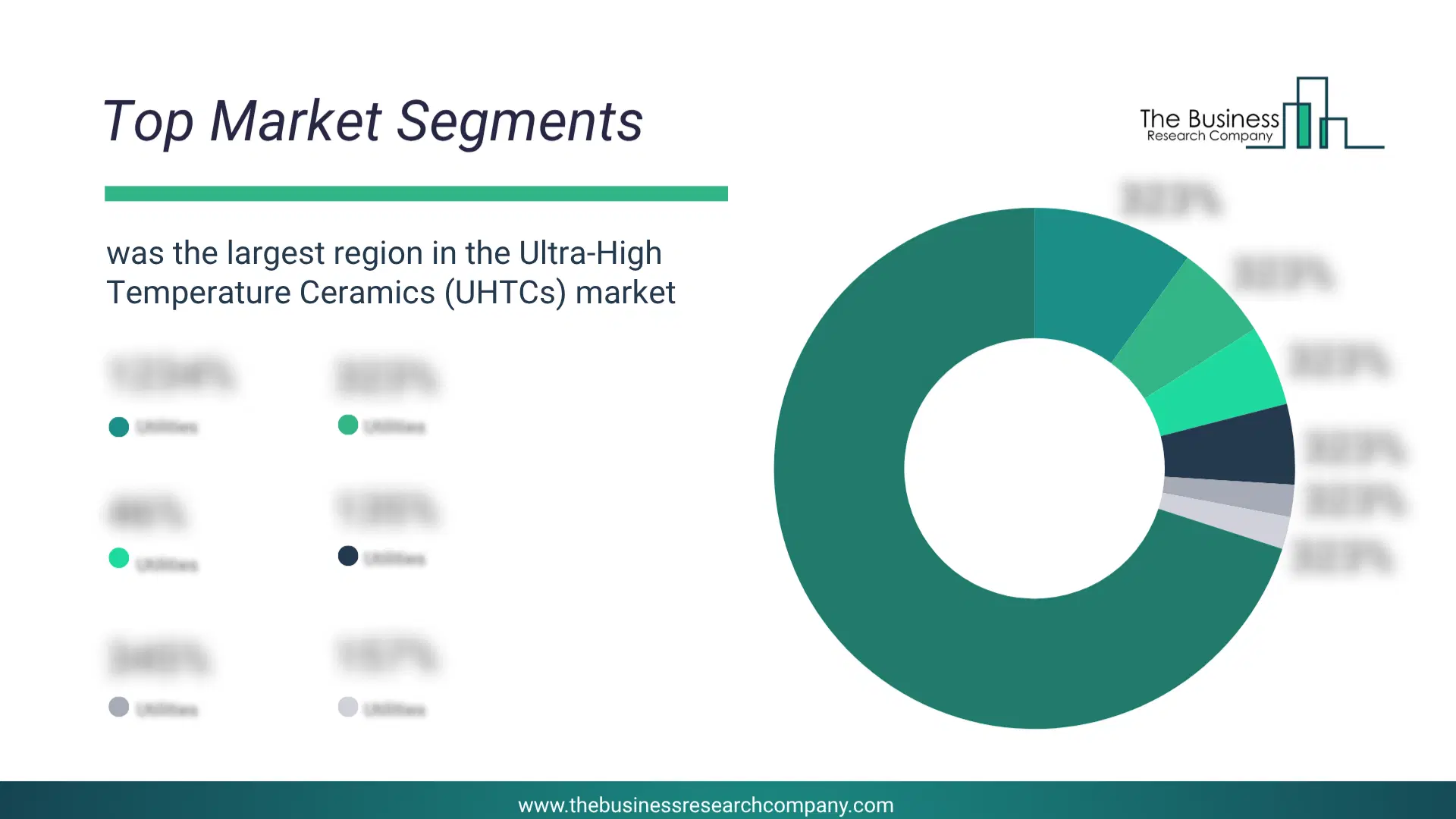
Global Ultra-High Temperature Ceramics (UHTCs) Market Segmentation
1) By Product Type: Silicon Carbide, Zirconium Diboride, Titanium Diboride 2) By Product Form: Powders, Bulk Components, Coatings, Fibers And Whiskers, Other Product Forms 3) By Manufacturing Technology: Hot Pressing And Sintering, Spark Plasma Sintering, Chemical Vapor Deposition, Additive Manufacturing Or Three-Dimensional Printing, Slip Casting And Cold Isostatic Pressing 4) By Application: Hypersonic And Aerospace Vehicles, Rocket And Missile Nozzles, Nose Cones And Leading Edges, Nuclear Reactors And Fuel Cladding, High-Temperature Furnace Linings, Cutting Tools And Industrial Machinery, Aerospace Brake Disks, Re-Entry Spacecraft Components 5) By End User Industry: Aerospace And Defense, Energy And Nuclear, Industrial Processing, Research And Academia Subsegments: 1) By Silicon Carbide: Alpha Silicon Carbide, Beta Silicon Carbide, Hexagonal Silicon Carbide 2) By Zirconium Diboride: Monolithic Zirconium Diboride, Composite Zirconium Diboride 3) By Titanium Diboride: Monolithic Titanium Diboride, Composite Titanium DiborideWhat Are The Drivers Of The Ultra-High Temperature Ceramics (UHTCs) Market?
The increasing defense budgets are expected to propel the growth of the ultra-high temperature ceramics (UHTCs) market going forward. Defense budgets refer to the financial resources allocated by a government to fund its military operations, personnel, equipment, and defense infrastructure. The increasing defense budgets are driven by rising geopolitical tensions due to escalating conflicts and regional security challenges worldwide. Ultra-high temperature ceramics (UHTCs) strengthen defense capabilities by providing materials that withstand extreme heat, making them ideal for aerospace, missile, and military applications. They enhance equipment durability by offering exceptional thermal and oxidation resistance, improving operational performance in high-temperature environments. For instance, in April 2024, according to the Stockholm International Peace Research Institute (SIPRI), a Sweden-based non-government organization, global military spending reached $2.443 trillion, marking a 6.8% increase compared to 2022. Therefore, the increasing defense budgets are driving the growth of the ultra-high temperature ceramics (UHTCs) industry. The increasing investments in space exploration are expected to propel the growth of the ultra-high temperature ceramics (UHTCs) market going forward. Space exploration is the discovery and study of outer space through the use of spacecraft, satellites, and advanced technology. The increasing investments in space exploration are rising due to the growing demand for advanced satellite-based communication and data services, as they enable faster, more reliable communication. Investments in space exploration enhance ultra-high temperature ceramics (UHTCs) by driving demand for materials that can withstand extreme conditions, making them essential for aerospace applications. They promote innovation in material composition and performance, improving reliability and safety in spacecraft and reentry vehicles. For instance, in January 2025, according to the Space Foundation, a US-based nonprofit organization, the international government spending on space programs reached $125 billion in 2023, an 11% increase compared to 2022. Therefore, the increasing investments in space exploration are driving the growth of the ultra-high temperature ceramics (UHTCs) industry.Key Players In The Global Ultra-High Temperature Ceramics (UHTCs) Market
Major companies operating in the ultra-high temperature ceramics (uhtcs) market are UBE Corporation, Saint-Gobain SA, Kyocera Corporation, Mitsubishi Materials Corporation, Tosoh Corporation, Elkem ASA, Ibiden Co. Ltd., Denka Company Limited, Schunk Group, Morgan Advanced Materials Plc, SGL Carbon, Mersen S.A., Carborundum Universal Limited, Snam Abrasives Pvt. Ltd., Navarro SiC S.A., Blasch Precision Ceramics Inc., Precision Ceramics, Rauschert GmbH, BNZ Materials Inc., Unifrax, Dynamic Ceramic, Pyrotek Inc., Adl Insulflex Inc., Cellaris Ltd.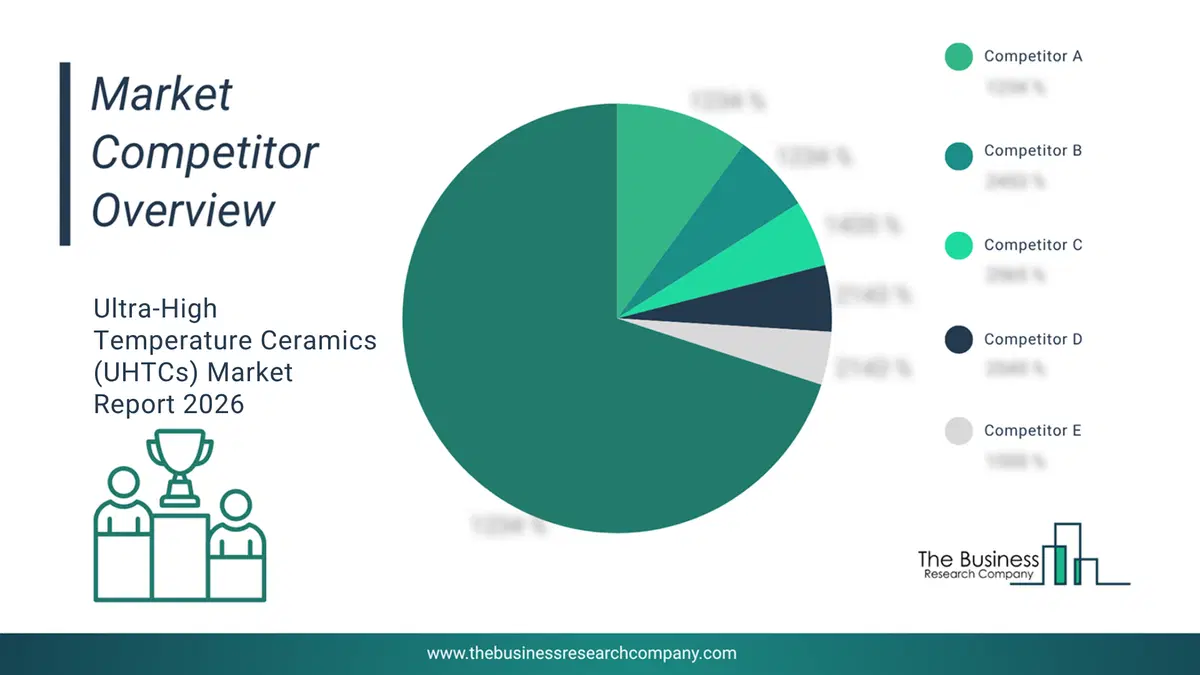
This chart is for illustrative purposes; the full report includes a detailed competitor analysis and comprehensive overview of the top 10 companies in the market.
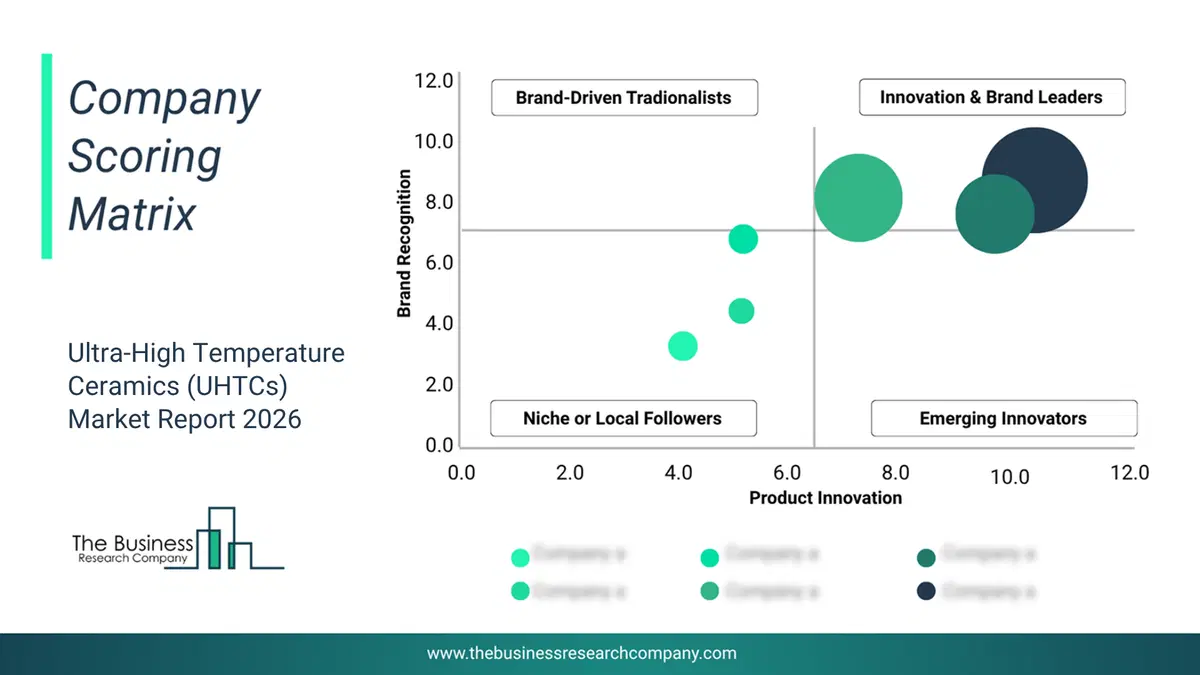
This chart maps companies by product innovation and brand strength, with bubble size indicating relative revenue, helping identify market leaders, challengers, and niche players. This is an illustrative chart; the full report provides a complete and accurate competitive analysis.
Global Ultra-High Temperature Ceramics (UHTCs) Market Trends and Insights
Major companies operating in the ultra-high temperature ceramics (UHTCs) market are focusing on developing advanced solutions, such as heat-resistant coatings, to enhance oxidation resistance and extend material performance in extreme thermal environments. Heat-resistant coatings are protective materials applied to surfaces to shield them from damage or deterioration caused by exposure to elevated temperatures. For instance, in February 2024, Mitsubishi Chemical Group Corporation, a Japan-based chemical company, launched a carbon fiber-based 1,500°C heat-resistant ceramic matrix composite (C/SiC). The product uses pitch-based carbon fibers combined with a ceramic matrix, and its surface is treated with an oxygen transmission barrier to withstand degradation in air. It demonstrated no strength loss after being exposed to 1,500°C for one hour, indicating that it can withstand the heat resistance of 1,600°C for 800 seconds. This composite is designed for applications such as heat shields of reusable space transportation systems and other aerospace platforms requiring extreme thermal durability.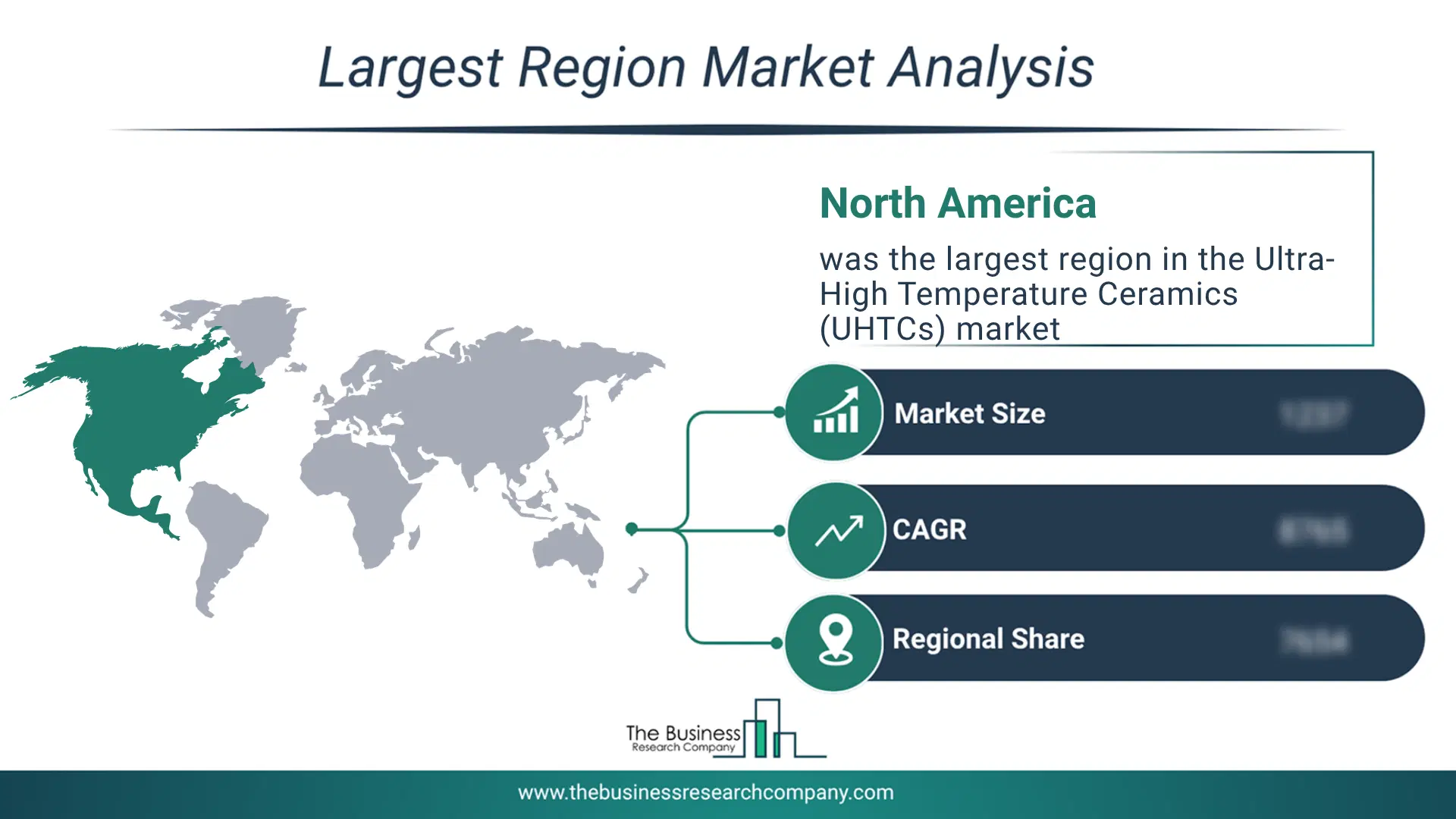
Regional Insights
North America was the largest region in the ultra-high temperature ceramics (UHTCs) market in 2025. Asia-Pacific is expected to be the fastest-growing region in the forecast period. The regions covered in this market report are Asia-Pacific, South East Asia, Western Europe, Eastern Europe, North America, South America, Middle East, Africa The countries covered in this market report are Australia, Brazil, China, France, Germany, India, Indonesia, Japan, Taiwan, Russia, South Korea, UK, USA, Canada, Italy, SpainWhat Defines the Ultra-High Temperature Ceramics (UHTCs) Market?
The ultra-high temperature ceramics (UHTCs) market consists of sales of hafnium carbide ceramics, hafnium diboride ceramics, tantalum carbide ceramics, and tantalum hafnium carbide ceramics. Values in this market are ‘factory gate’ values, that is the value of goods sold by the manufacturers or creators of the goods, whether to other entities (including downstream manufacturers, wholesalers, distributors and retailers) or directly to end customers. The value of goods in this market includes related services sold by the creators of the goods.How is Market Value Defined and Measured?
The market value is defined as the revenues that enterprises gain from the sale of goods and/or services within the specified market and geography through sales, grants, or donations in terms of the currency (in USD unless otherwise specified). The revenues for a specified geography are consumption values that are revenues generated by organizations in the specified geography within the market, irrespective of where they are produced. It does not include revenues from resales along the supply chain, either further along the supply chain or as part of other products.
This chart presents market attractiveness based on a quantitative evaluation of growth, competition, strategic alignment, and risk, offering a clear view of opportunity areas for decision-making. This chart is for illustrative purposes; the full report contains the complete analysis.

This chart highlights the Total Addressable Market (TAM) by estimating the maximum revenue opportunity using an assumption-driven approach, supporting strategic planning and opportunity sizing across markets. The chart is illustrative; the full report provides a more comprehensive analysis.
What Key Data and Analysis Are Included in the Ultra-High Temperature Ceramics (UHTCs) Market Report 2026?
The ultra-high temperature ceramics (uhtcs) market research report is one of a series of new reports from The Business Research Company that provides market statistics, including industry global market size, regional shares, competitors with the market share, detailed market segments, market trends and opportunities, and any further data you may need to thrive in the ultra-high temperature ceramics (uhtcs) industry. The market research report delivers a complete perspective of everything you need, with an in-depth analysis of the current and future state of the industry.Ultra High Temperature Ceramics UHTCs Market Report Forecast Analysis
| Report Attribute | Details |
|---|---|
| Market Size Value In 2026 | $1.23 billion |
| Revenue Forecast In 2030 | $1.7 billion |
| Growth Rate | CAGR of 8.8% from 2026 to 2030 |
| Base Year For Estimation | 2025 |
| Actual Estimates/Historical Data | 2020-2025 |
| Forecast Period | 2026 - 2030 |
| Market Representation | Revenue in USD Billion and CAGR from 2026 to 2030 |
| Segments Covered | Product Type, Product Form, Manufacturing Technology, Application, End User Industry |
| Regional Scope | Asia-Pacific, Western Europe, Eastern Europe, North America, South America, Middle East, Africa |
| Country Scope | The countries covered in this market report are Australia, Brazil, China, France, Germany, India, Indonesia, Japan, Taiwan, Russia, South Korea, UK, USA, Canada, Italy, Spain |
| Key Companies Profiled | UBE Corporation, Saint-Gobain SA, Kyocera Corporation, Mitsubishi Materials Corporation, Tosoh Corporation, Elkem ASA, Ibiden Co. Ltd., Denka Company Limited, Schunk Group, Morgan Advanced Materials Plc, SGL Carbon, Mersen S.A., Carborundum Universal Limited, Snam Abrasives Pvt. Ltd., Navarro SiC S.A., Blasch Precision Ceramics Inc., Precision Ceramics, Rauschert GmbH, BNZ Materials Inc., Unifrax, Dynamic Ceramic, Pyrotek Inc., Adl Insulflex Inc., Cellaris Ltd. |
| Customization Scope | Request for Customization |
| Pricing And Purchase Options | Explore Purchase Options |