
Unmanned Stores Market Report 2026
Global Outlook – By Store Type (Fully Automated, Semi-Automated Self-Service Kiosks), By Payment Mode (Cashless, Cash), By Offering (Solution, Services), By Deployment (Indoor, Outdoor), By End-User Industry Application (Hospitality And Restaurant, Health And Pharmaceutical, Fast-Moving Consumer Goods, Other End User Industry Applications) – Market Size, Trends, Strategies, and Forecast to 2030
Unmanned Stores Market Overview
• Unmanned Stores market size has reached to $82.56 billion in 2025 • Expected to grow to $252.29 billion in 2030 at a compound annual growth rate (CAGR) of 25% • Growth Driver: E-commerce Propel Growth Of The Unmanned Store Market • Market Trend: Advancing Retail Automation Through Checkout-Free Store Innovations • North America was the largest region in 2025.Market Gains By 2030 – Top Opportunities By Segment
Market Gain identifies the most promising market opportunities by highlighting the segments or products expected to generate the highest incremental revenue growth over the next five years.
What Is Covered Under Unmanned Stores Market?
Unmanned stores, or automated or cashier-less stores, refer to retail establishments that operate without traditional human cashiers or checkout counters. These stores typically use advanced technologies such as computer vision, sensors, and artificial intelligence to track items selected by customers and automatically charge them through digital payment systems. The main types of unmanned stores are fully automated and semi-automated self-service kiosks. Fully automated refers to systems that utilize advanced technologies such as RFID, sensors, cloud computing, and IoT to manage inventory, track purchases, and facilitate seamless transactions without human intervention. The payment modes include cashless and cash and the offering types involve solutions and services. The type of deployment includes indoor and outdoor and is used for different end-user industry applications such as hospitality and restaurant, health and pharmaceutical, fast-moving consumer goods, and other end-user industry applications.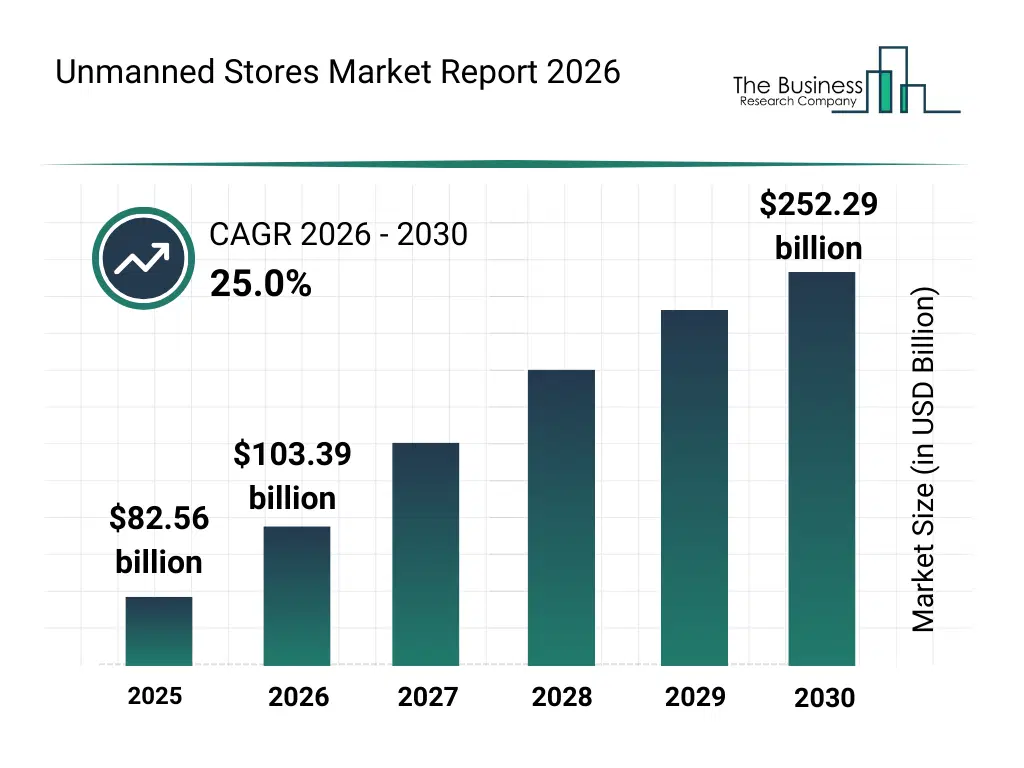
What Is The Unmanned Stores Market Size and Share 2026?
The unmanned stores market size has grown exponentially in recent years. It will grow from $82.56 billion in 2025 to $103.39 billion in 2026 at a compound annual growth rate (CAGR) of 25.2%. The growth in the historic period can be attributed to rising labor costs in retail, growing urbanization, adoption of digital payment methods, increasing demand for convenience, early adoption of retail automation.What Is The Unmanned Stores Market Growth Forecast?
The unmanned stores market size is expected to see exponential growth in the next few years. It will grow to $252.29 billion in 2030 at a compound annual growth rate (CAGR) of 25.0%. The growth in the forecast period can be attributed to expansion of e-grocery and retail chains, integration of ai and computer vision, growth in smart infrastructure, rising consumer preference for seamless shopping, adoption of omni-channel retail strategies. Major trends in the forecast period include contactless shopping experience, real-time inventory tracking, personalized customer engagement, mobile payment integration, smart shelf & product analytics.
Global Unmanned Stores Market Segmentation
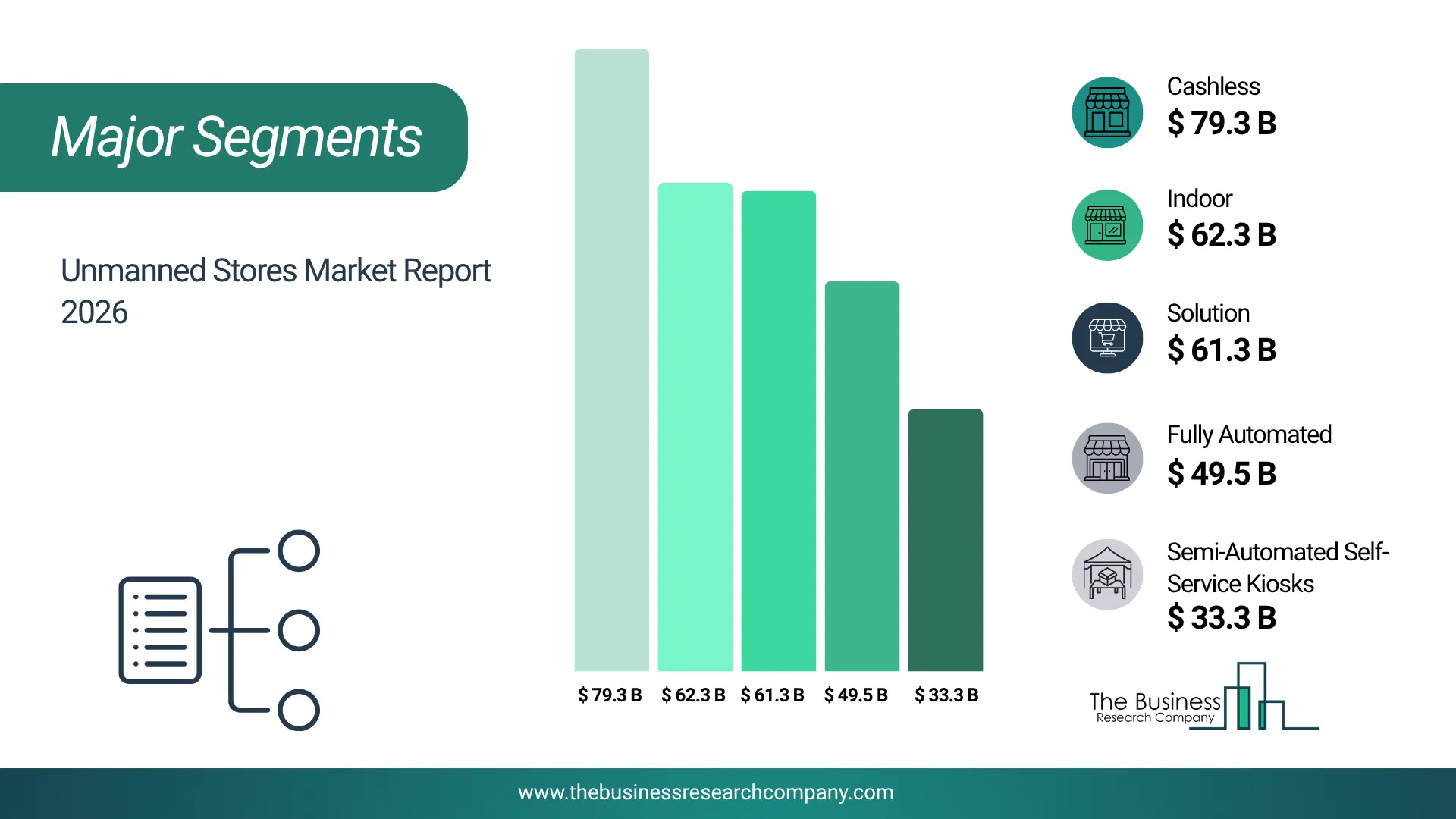
1) By Store Type: Fully Automated, Semi-Automated Self-Service Kiosks 2) By Payment Mode: Cashless, Cash 3) By Offering: Solution, Services 4) By Deployment: Indoor, Outdoor 5) By End-User Industry Application: Hospitality And Restaurant, Health And Pharmaceutical, Fast-Moving Consumer Goods, Other End User Industry Applications Subsegments: 1) By Fully Automated: Smart Vending Machines, Autonomous Retail Stores, Automated Checkout Systems, RFID-Based Stores, AI-Driven Automated Inventory Management 2) By Semi-Automated Self-Service Kiosks: Self-Checkout Kiosks, Self-Order Kiosks, Digital Price Tag Kiosks, Interactive Product Information Kiosks, Self-Help Kiosks The top segments in the unmanned stores market will be: • Cashless will reach $79394.12 Million by 2025. • Indoor will reach $62399.59 Million by 2025. • Solution will reach $61392.54 Million by 2025. • Fully Automated will reach $49544.29 Million by 2025. • Semi-Automated Self-Service Kiosks will reach $33387.11 Million by 2025.What Is The Driver Of The Unmanned Stores Market?
The increasing popularity of e-commerce is expected to propel the growth of the unmanned stores market going forward. E-commerce, or electronic commerce, refers to the buying and selling of goods or services using the internet or other electronic means. The popularity of e-commerce is rising due to its convenience, wide product selection, and the ability to shop from anywhere at any time. E-commerce drives the development of unmanned stores by fostering consumer expectations for seamless, automated, and convenient shopping experiences. For instance, in May 2024, according to the United States Census Bureau, a US-based government agency, in the first quarter of 2024, U.S. retail e-commerce sales totaled $289.2 billion, showing a 2.1% increase from the fourth quarter of 2023. During the same period, total retail sales increased by 1.5%. E-commerce sales in the first quarter of 2024 constituted 15.9% of total retail sales. Therefore, the increasing popularity of e-commerce is driving the growth of the unmanned stores industry.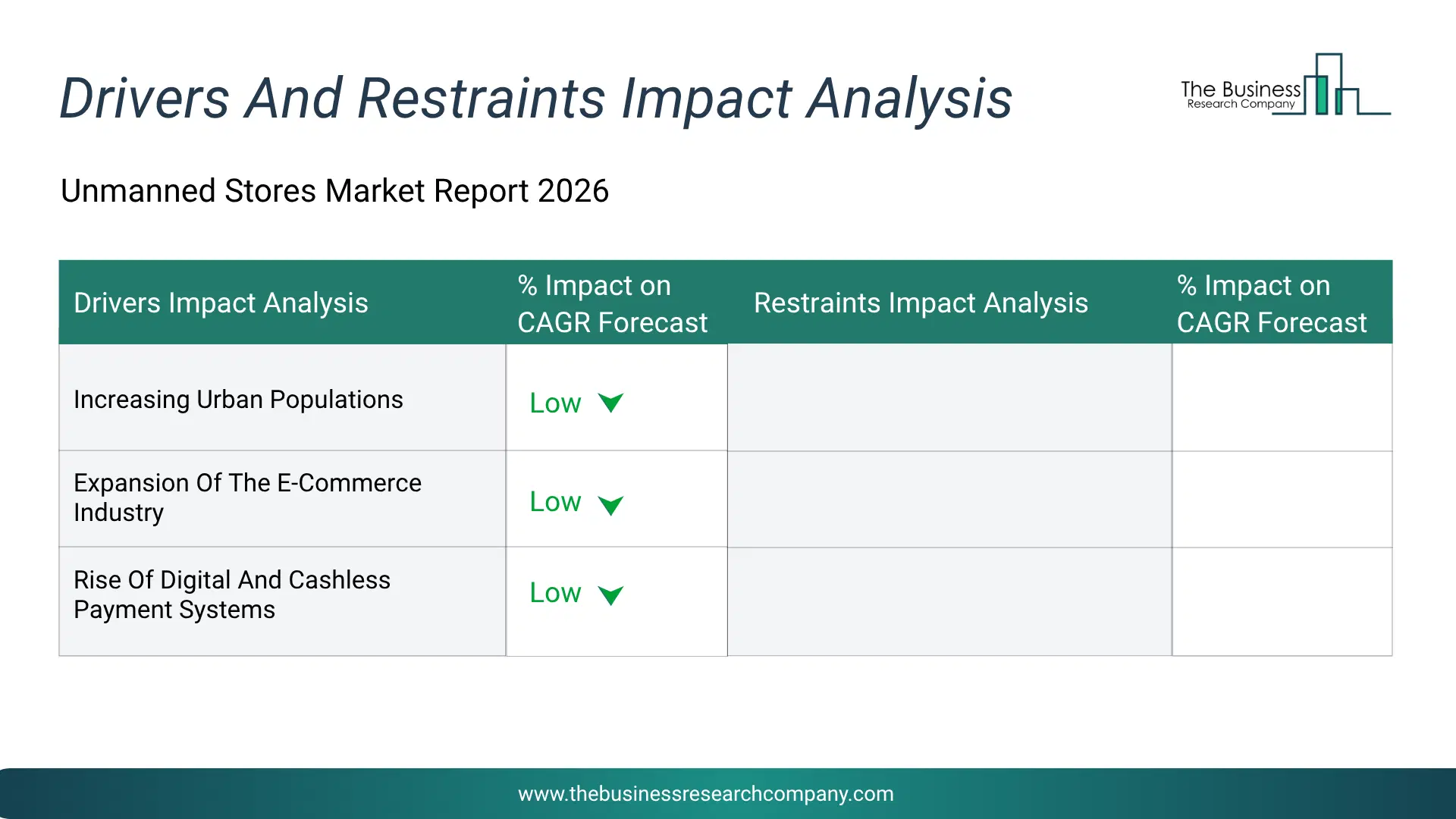
Infographic Chart Showing Key Market Drivers Analysis And Restraints For Unmanned Stores Market
The chart presents an impact analysis of key drivers and restraints, quantifying their relative influence on the market's growth rate and helping assess the balance between growth enablers and limiting factors. This chart offers a high-level perspective; the full report contains more detailed insights.
How Will The Drivers Impact Growth In The Global Unmanned Stores Market?
• Increasing Urban Populations (Low) – The increasing urban populations will become a key driver of growth in the unmanned stores market by 2030. As urban areas continue to grow, consumers seek faster, more flexible shopping options that fit their busy lifestyles. Unmanned stores offer 24/7 access, reduced wait times and minimal staff interaction, which align with the needs of time-constrained urban dwellers. Additionally, higher population densities make unmanned stores a cost-effective solution for retailers, as they can cater to larger customer bases without significant increases in operational costs. As a result, the increasing urban populations is anticipated to contributing to annual growth in the market. • Expansion Of The E-Commerce Industry (Low) – The expansion of the e-commerce industry will emerge as a major factor driving the expansion of the unmanned stores market by 2030. As consumers increasingly seek seamless, contactless shopping experiences, unmanned stores offer a convenient, 24/7 alternative that aligns with the growing preference for convenience and speed in online shopping. This shift towards automation in retail creates a natural synergy between e-commerce growth and the rise of self-service, tech-driven stores. As a result, the expansion of the e-commerce industry is anticipated to contributing to annual growth in the market. • Rise Of Digital And Cashless Payment Systems (Low) – The rise of digital and cashless payment systems will serve as a key growth catalyst for the unmanned stores market by 2030, These payment solutions eliminate the need for traditional checkout processes, aligning perfectly with the autonomous retail model. As consumers increasingly adopt mobile wallets, QR codes and contactless payment options, unmanned stores can offer faster, more convenient shopping experiences. This widespread acceptance of cashless payments enhances accessibility, boosts customer satisfaction and supports market expansion. As a result, the rise of digital and cashless payment systems is anticipated to contributing to annual growth in the market. • Increasing Consumer Demand For Convenience (Low) – The increasing consumer demand for convenience will become a significant driver contributing to the growth of the unmanned stores market by 2030 Modern consumers prioritize quick, hassle-free shopping, making unmanned stores highly appealing. These stores offer 24/7 access, faster checkouts and minimal interaction, catering to the growing demand for on-the-go solutions. Their cost-efficient operations further attract retailers, driving widespread adoption and market expansion. As a result, the increasing consumer demand for convenience is anticipated to contributing to annual growth in the market.How Will The Restraints Impact Growth In The Global Unmanned Stores Market?
• High Entry Fee Policies (Low) – High Entry Fee Policies will restrict the growth of the Unmanned Stores market during the forecast period. Unmanned store operators often charge high entry fees or require significant investments in technology and infrastructure. High entry costs create barriers for smaller retailers and entrepreneurs considering unmanned store models. Cost constraints can limit market participation and slow the adoption of unmanned retail solutions.Key Players In The Global Unmanned Stores Market
Major companies operating in the unmanned stores market are Amazon.com Inc., Alibaba Group Holding Limited, 7-Eleven Inc., Panasonic Holdings Corporation, Toshiba Corporation, Trigo Group, Scandit AG, Zippin, Delfi Technologies, Accel Robotics Corporation, Turck Vilant Systems Oy, AiFi Inc., Sensei LLC, SandStar, Wheelys, PIXEVIA, Grabango, MishiPay Ltd., Pick and GO, Cloudpick AI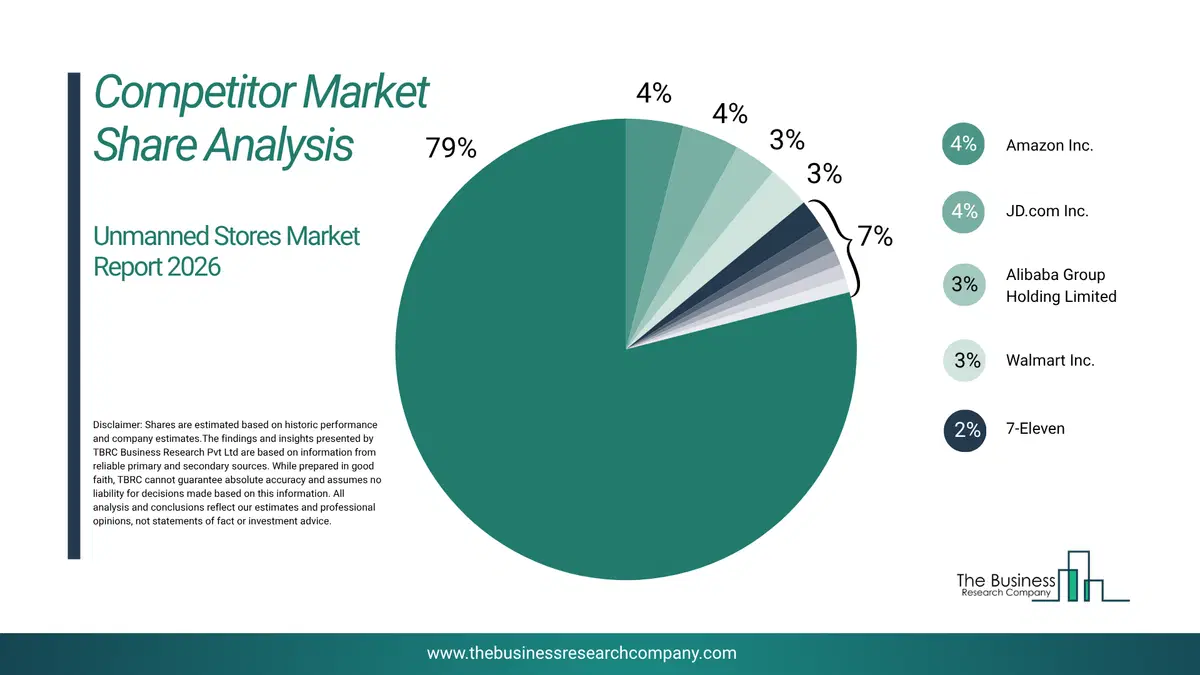
This chart is for illustrative purposes; the full report includes a detailed competitor analysis and comprehensive overview of the top 10 companies in the market.
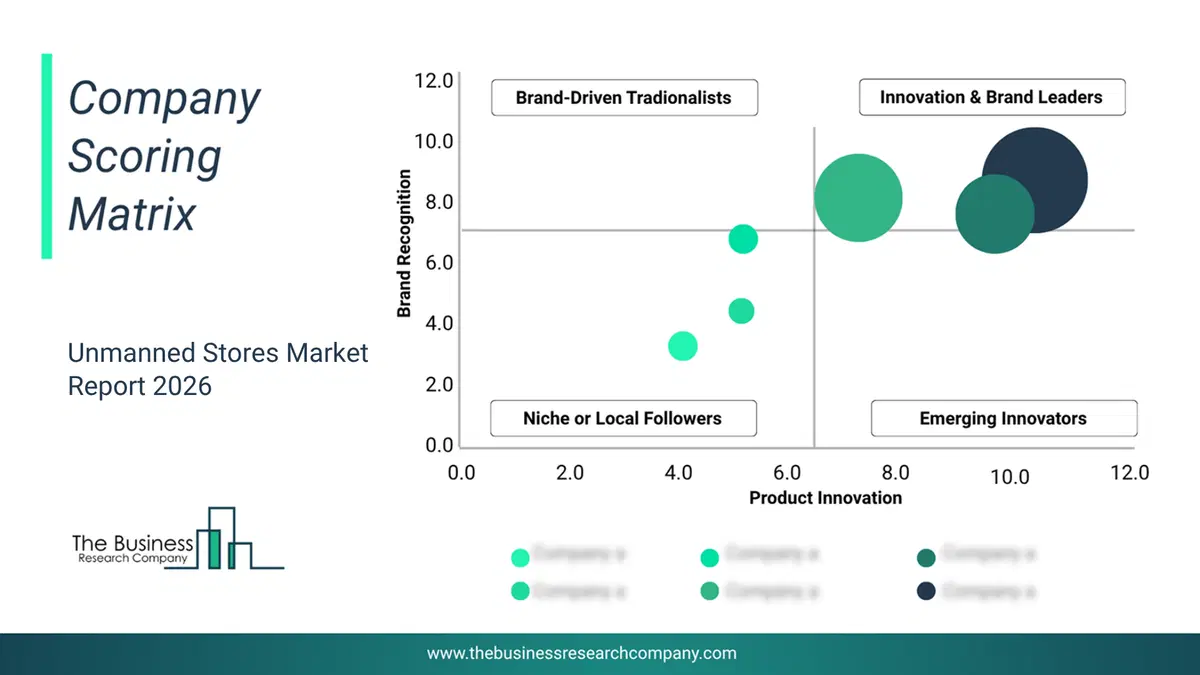
This chart maps companies by product innovation and brand strength, with bubble size indicating relative revenue, helping identify market leaders, challengers, and niche players. This is an illustrative chart; the full report provides a complete and accurate competitive analysis.
Global Unmanned Stores Market Trends and Insights
Major companies operating in the unmanned stores market are focusing on integrating advanced retail automation technologies such as artificial intelligence (AI)-powered cashierless checkout systems to enhance operational efficiency, speed, and labor optimization. AI-powered cashierless checkout systems are automated retail solutions that use computer vision, sensors, and artificial intelligence to identify products selected by shoppers and enable seamless payment without traditional cashiers, enabling capabilities such as real-time item recognition, automated billing, and frictionless customer exit. For instance, in November 2025, 7-Eleven, a Taiwan-based convenience retail company, unveiled an unmanned convenience store using AI-driven grab-and-go technology designed to allow customers to enter, pick up items, and leave without manual checkout, featuring computer vision cameras, automated product recognition, and cashless payment integration. This unmanned store improves checkout speed, reduces reliance on in-store staff, and enhances overall retail automation and customer convenience.What Are Latest Mergers And Acquisitions In The Unmanned Stores Market?
In May 2025, AiFi, a US-based retail automation and artificial intelligence technology company, partnered with Lori’s Gifts to expand the deployment of cashier-less retail solutions within hospital environments. With this collaboration, AiFi and Lori’s Gifts aim to integrate autonomous checkout technology into hospital retail locations to improve operational efficiency, enhance shopping convenience for hospital staff, patients, and visitors, and support scalable, low-staff retail models within healthcare facilities. Lori’s Gifts is a US-based healthcare retail company that specializes in operating hospital gift shops and convenience retail locations offering merchandise, snacks, and essential items for patients and visitors.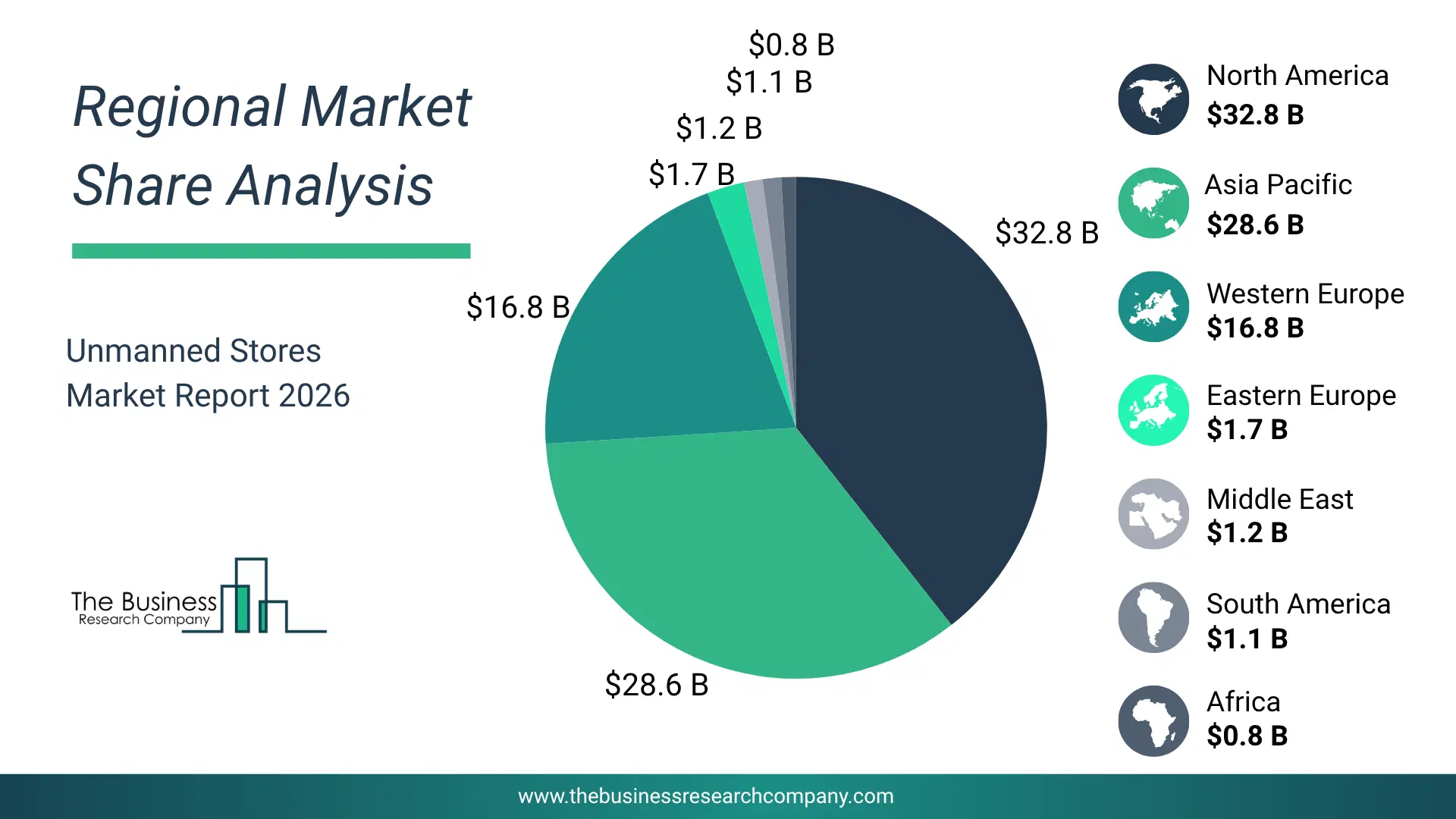
Regional Outlook
North America was the largest region in the unmanned stores market in 2025. The regions covered in this market report are Asia-Pacific, South East Asia, Western Europe, Eastern Europe, North America, South America, Middle East and Africa. The countries covered in this market report are Australia; Brazil; China; France; Germany; India; Indonesia; Japan; Taiwan; Russia; South Korea; UK; USA; Canada; Italy; Spain.What Defines the Unmanned Stores Market?
The unmanned stores market includes revenues earned by entities by providing services such as inventory management, customer analytics, and security systems. The market value includes the value of related goods sold by the service provider or included within the service offering. Only goods and services traded between entities or sold to end consumers are included.How is Market Value Defined and Measured?
The market value is defined as the revenues that enterprises gain from the sale of goods and/or services within the specified market and geography through sales, grants, or donations in terms of the currency (in USD unless otherwise specified). The revenues for a specified geography are consumption values that are revenues generated by organizations in the specified geography within the market, irrespective of where they are produced. It does not include revenues from resales along the supply chain, either further along the supply chain or as part of other products.
This chart presents market attractiveness based on a quantitative evaluation of growth, competition, strategic alignment, and risk, offering a clear view of opportunity areas for decision-making. This chart is for illustrative purposes; the full report contains the complete analysis.

This chart highlights the Total Addressable Market (TAM) by estimating the maximum revenue opportunity using an assumption-driven approach, supporting strategic planning and opportunity sizing across markets. The chart is illustrative; the full report provides a more comprehensive analysis.
What Key Data and Analysis Are Included in the Unmanned Stores Market Report 2026?
The unmanned stores market research report is one of a series of new reports from The Business Research Company that provides market statistics, including industry global market size, regional shares, competitors with the market share, detailed market segments, market trends and opportunities, and any further data you may need to thrive in the unmanned stores industry. The market research report delivers a complete perspective of everything you need, with an in-depth analysis of the current and future state of the industry.Unmanned Stores Market Report Forecast Analysis
| Report Attribute | Details |
|---|---|
| Market Size Value In 2026 | $103.39 billion |
| Revenue Forecast In 2030 | $252.29 billion |
| Growth Rate | CAGR of 25% from 2026 to 2030 |
| Base Year For Estimation | 2025 |
| Actual Estimates/Historical Data | 2020-2025 |
| Forecast Period | 2026 - 2030 |
| Market Representation | Revenue in USD Billion and CAGR from 2026 to 2030 |
| Segments Covered | Store Type, Payment Mode, Offering, Deployment, End-User Industry Application |
| Regional Scope | Asia-Pacific, Western Europe, Eastern Europe, North America, South America, Middle East, Africa |
| Country Scope | The countries covered in the report are Australia, Brazil, China, France, Germany, India, Indonesia, Japan, Taiwan, Russia, South Korea, UK, USA, Canada, Italy, Spain. |
| Key Companies Profiled | Amazon.com Inc., Alibaba Group Holding Limited, 7-Eleven Inc., Panasonic Holdings Corporation, Toshiba Corporation, Trigo Group, Scandit AG, Zippin, Delfi Technologies, Accel Robotics Corporation, Turck Vilant Systems Oy, AiFi Inc., Sensei LLC, SandStar, Wheelys, PIXEVIA, Grabango, MishiPay Ltd., Pick and GO, Cloudpick AI |
| Customization Scope | Request for Customization |
| Pricing And Purchase Options | Explore Purchase Options |