Contact Us
  Search
The Business Research Company Logo
Waste To Energy Market 2025
Published :May 2025
Pages :328
Format :PDF
Delivery Time :2-3 Business Days
Why 2-3 days? We update the report with the latest data and news before delivery. Let us know if you need us to expedite.
Report Price :$4,490.00

Waste To Energy Market 2025

By Waste Type (Municipal Solid Waste, Agriculture Waste, Other Waste Types), By Technology (Thermal, Biochemical, Other Technologies), By Application (Electricity, Transport Fuels, Combined Heat And Power (CHP), Heat), And By Region, Opportunities And Strategies – Global Forecast To 2035

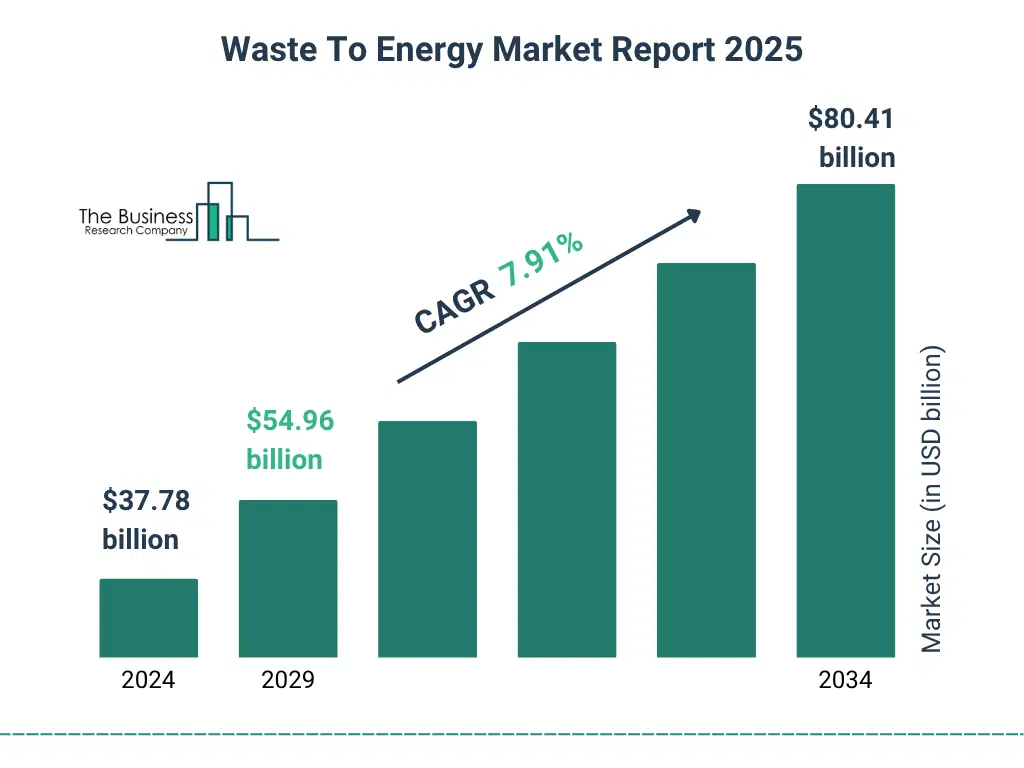
Waste To Energy Market Size and growth rate 2025 to 2029: Graph

Waste To Energy Market Definition

Waste-to-energy refers to the process of generating energy in the form of electricity or heat from the treatment of various types of waste. This market plays a crucial role in both waste management and energy production by converting non-recyclable waste materials into usable energy, thereby reducing landfill dependency and contributing to sustainable energy solutions. The waste to energy market consists of sales by entities (organizations, sole traders and partnerships) of waste to energy services that are used to process different waste streams, including municipal solid waste, agricultural waste, and other forms of waste, to extract energy through thermal or biochemical processes. The end-products, primarily electricity and heat, are utilized across industrial, commercial, and residential sectors.

Research Expert

Book your 30 minutes free consultation with our research experts

Waste To Energy Market Size

The global waste to energy market reached a value of nearly $37,779.14 million in 2024, having grown at a compound annual growth rate (CAGR) of 4.57% since 2019. The market is expected to grow from $37,779.14 million in 2024 to $54,956.40 million in 2029 at a rate of 7.78%. The market is then expected to grow at a CAGR of 7.91% from 2029 and reach $80,409.89 million in 2034. Growth in the historic period resulted from the increasing industrialization and favorable government initiatives. Factors that negatively affected growth in the historic period was high initial cost. Going forward, the shift towards renewable energy, rapid urbanization, increasing efficient waste management and growing waste generation will drive the growth. Factor that could hinder the growth of the waste to energy market in the future include economic downturns.

Waste To Energy Market Drivers

The key drivers of the waste to energy market include: Shift Towards Renewable Energy The shift towards renewable energy is expected to propel the growth of the WTE market during the forecast period. Governments and industries are increasingly exploring alternative energy sources to decrease reliance on fossil fuels. WTE offers a dependable and sustainable solution, as waste production is ongoing. The growing public awareness and demand for environmentally friendly alternatives are driving industries to embrace WTE technology. For example, in October 2024, according to the Renewables 2024 Global Overview published by the International Energy Agency (IEA), a France-based autonomous intergovernmental organization, renewable energy consumption across power, heat and transport sectors is forecast to grow nearly 60% between 2024 and 2030, increasing its share of final energy consumption from 13% in 2023 to nearly 20% by 2030. Renewable fuels, including bioenergy, hydrogen and e-fuels, contribute 15% of this growth, while solar thermal and geothermal account for 10%. Renewable electricity's share is expected to rise from 30% in 2023 to 46% in 2030, with global renewable electricity generation reaching over 17,000 TWh (terawatt hour) (60 exajoules (EJ)). Therefore, the shift towards renewable energy will drive the growth of the waste to energy market.

Waste To Energy Market Restraints

The key restraints on the waste to energy market include: Economic Downturns The economic downturns are expected to hinder the growth of the WTE market during the forecast period. During economic recessions, businesses, governments, and investors typically reduce capital expenditures, affecting long-term projects like WTE plants, which require significant upfront investment. This reduction in available funds can delay or even cancel such initiatives. Economic downturns also tend to lower industrial production, consumer spending, and overall activity, leading to a decrease in waste generation. As a result, WTE facilities may struggle with insufficient feedstock, potentially operating below capacity or facing profitability challenges. For example, in April 2024, according to UN Trade and Development (UNCTAD), a Switzerland-based specialized agency of the United Nations, global economic growth to decelerate to 2.6% in 2024, marginally surpassing the 2.5% threshold typically linked to economic recessions. Therefore, the economic downturns will restrain the growth of the WTE market.

Need data on a specific region in this market?

Opportunities And Recommendations In The Waste To Energy Market

Opportunities – The top opportunities in the waste to energy markets segmented by waste type will arise in the municipal solid waste segment, which will gain $8,657.88 million of global annual sales by 2029. The top opportunities in the waste to energy markets segmented by technology will arise in the thermal segment, which will gain $11,278.96 million of global annual sales by 2029. The top opportunities in the waste to energy markets segmented by application will arise in the electricity segment, which will gain $9,396.15 million of global annual sales by 2029. The waste to energy market size will gain the most in China at $3,436.55 million. Recommendations- To take advantage of the opportunities, The Business Research Company recommends the waste to energy companies to focus on advancing carbon capture technology, focus on expanding waste processing capacity, focus on expanding waste-to-energy initiatives for non-recyclable waste, focus on expanding renewable energy projects, focus on the other waste types segment, expand in emerging markets, continue to focus on developed markets, focus on expanding distribution through strategic partnerships, focus on competitive and scalable pricing models, focus on digital engagement, focus on industry-specific outreach and focus on targeting industrial and district heating consumers.
Chat with us