
3D Stacking Market Report 2026
Global Outlook – By Device Type ( Logic Integrated Circuits (ICs), Imaging And Optoelectronics, Memory Devices, Micro-Electro-Mechanical Systems (MEMS) Or Sensors, LEDs, Other Device Types), By Method ( Die-To-Die, Die-To-Wafer, Wafer-To-Wafer, Chip-To-Chip, Chip-To-Wafer), By Interconnecting Technology ( 3D Hybrid Bonding, 3D Through-Silicon Via (TSV), Monolithic 3D Integration), By End User ( Consumer Electronics, Medical Devices Or Healthcare, Manufacturing, Communications, Automotive, Other End Users) – Market Size, Trends, Strategies, and Forecast to 2030
3D Stacking Market Overview
• 3D Stacking market size has reached to $1.9 billion in 2025 • Expected to grow to $4.1 billion in 2030 at a compound annual growth rate (CAGR) of 16.6% • Growth Driver: Increasing LED Demand Driving The Market Growth Through Enhanced Efficiency And Integration • Market Trend: Advancements In ASIC Architecture For Enhanced AI And Blockchain Performance • Asia-Pacific was the largest region and fastest growing region.What Is Covered Under 3D Stacking Market?
3D stacking is an advanced semiconductor integration technique that involves vertically layering multiple silicon dies or chiplets with high-density interconnects to enhance performance, power efficiency, and functionality while reducing the form factor and latency in electronic devices. It is widely used in high-performance computing, artificial intelligence, memory technologies, advanced sensor systems, and next-generation consumer electronics to achieve higher processing speeds, improved energy efficiency, and enhanced data transfer capabilities. The main device types in 3D stacking are logic integrated circuits (ICs), imaging and optoelectronics, memory devices, micro-electro-mechanical systems (MEMS) or sensors, LEDs, and others. Logic integrated circuits (ICs) in 3D stacking are vertically interconnected semiconductor devices that enhance performance, power efficiency, and data transfer speeds by integrating multiple logic layers within a compact structure. This involves various methods such as die-to-die, die-to-wafer, wafer-to-wafer, chip-to-chip, and chip-to-wafer by interconnecting technologies including 3D hybrid bonding, 3D through-silicon via (TSV), and monolithic 3D integration, which are applied in end users, mainly consumer electronics, medical devices or healthcare, manufacturing, communications, automotive, and others.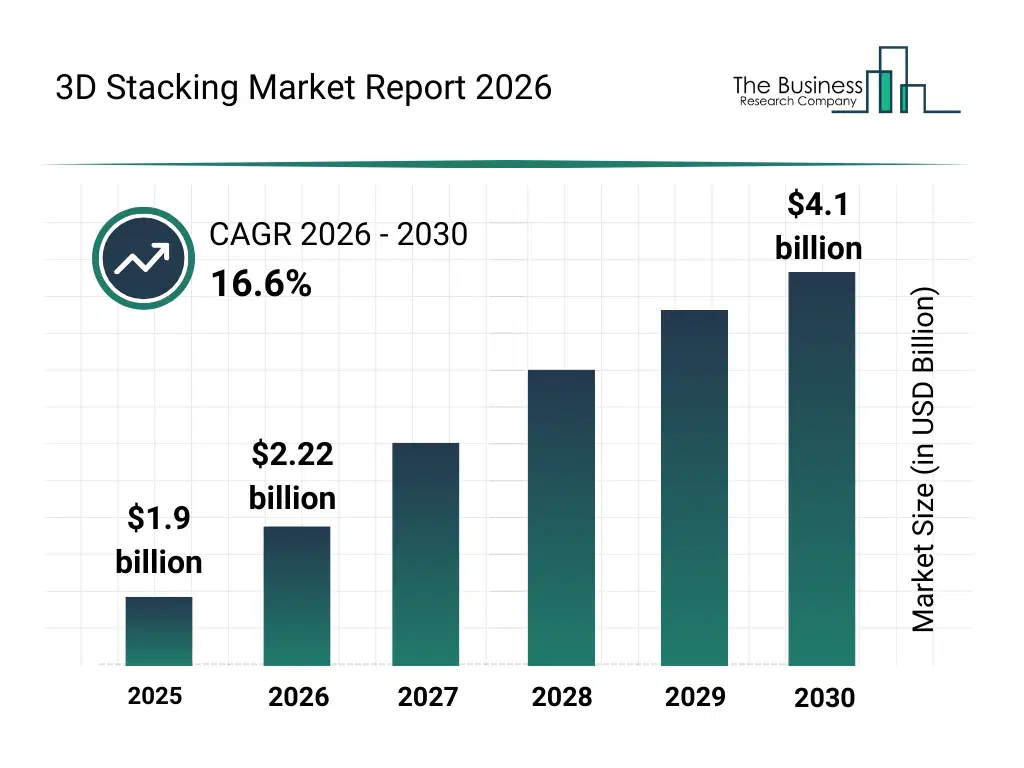
What Is The 3D Stacking Market Size 2026 And Growth Rate?
The 3D stacking market size has grown rapidly in recent years. It will grow from $1.9 billion in 2025 to $2.22 billion in 2026 at a compound annual growth rate (CAGR) of 16.7%. The growth in the historic period can be attributed to advancement in semiconductor lithography, rising demand for high-performance computing, growth of consumer electronics, improvements in interconnect technologies, increasing r&d investments in chip design.What Is The 3D Stacking Market Growth Forecast?
The 3D stacking market size is expected to see rapid growth in the next few years. It will grow to $4.1 billion in 2030 at a compound annual growth rate (CAGR) of 16.6%. The growth in the forecast period can be attributed to expansion of AI workloads, adoption of advanced memory technologies, growth in autonomous systems, increasing demand for wearable and smart devices, innovations in 3D hybrid bonding. Major trends in the forecast period include 3D stacking for high-performance computing, advanced memory integration, energy-efficient semiconductor design, miniaturization of consumer electronics, low-latency interconnect technologies.
Global 3D Stacking Market Segmentation
1) By Device Type: Logic Integrated Circuits (ICs), Imaging And Optoelectronics, Memory Devices, Micro-Electro-Mechanical Systems (MEMS) Or Sensors, LEDs, Other Device Types 2) By Method: Die-To-Die, Die-To-Wafer, Wafer-To-Wafer, Chip-To-Chip, Chip-To-Wafer 3) By Interconnecting Technology: 3D Hybrid Bonding, 3D Through-Silicon Via (TSV), Monolithic 3D Integration 4) By End User: Consumer Electronics, Medical Devices Or Healthcare, Manufacturing, Communications, Automotive, Other End Users Subsegments: 1) By Logic Integrated Circuits (ICs): Processors, Field-Programmable Gate Arrays (FPGAs), Application-Specific Integrated Circuits (ASICs), System-on-Chip (SoC) 2) By Imaging and Optoelectronics: CMOS Image Sensors, Infrared Sensors, Photodetectors, Optical Transceivers 3) By Memory Devices: Dynamic Random-Access Memory (DRAM), High-Bandwidth Memory (HBM), 3D NAND Flash, Resistive RAM (ReRAM) 4) By Micro-Electro-Mechanical Systems (MEMS) or Sensors: Accelerometers, Gyroscopes, Pressure Sensors, RF MEMS 5) By LEDs: Micro-LEDs, Mini-LEDs, Organic LEDs (OLEDs), Infrared LEDs 6) By Other Device Types: Radio Frequency (RF) Devices, Power Management ICs (PMICs), Analog And Mixed-Signal ICs, Photonic ICsWhat Is The Driver Of The 3D Stacking Market?
The increasing demand for LEDs is expected to propel the growth of the 3D stacking market going forward. LED refers to a light-emitting diode, a semiconductor device that emits light when an electric current passes through it. The demand for LEDs is increasing due to their energy efficiency, long lifespan, and environmental benefits compared to traditional lighting. 3D stacking enhances LED performance by enabling higher integration density, improving thermal management, reducing power consumption, and enhancing optical efficiency, making it essential for advanced lighting, display, and miniaturized electronic applications. For instance, in July 2023, according to the International Energy Agency, a France-based autonomous intergovernmental organization, the efficiency of new LEDs is steadily improving, reaching approximately 140 lm/W by 2030, around 30% higher than the 2022 average to align with the Net Zero Scenario. Therefore, the increasing demand for LEDs is driving the growth of the 3D stacking industry.Key Players In The Global 3D Stacking Market
Major companies operating in the 3D stacking market are Samsung Electronics Co. Ltd., Sony Group Corporation, Taiwan Semiconductor Manufacturing Company Ltd., Intel Corporation, International Business Machines Corporation, Qualcomm Technologies Inc., Broadcom Inc., Micron Technology Inc., Advanced Micro Devices Inc., ASML Holding N.V., ASE Technology Holding Co. Ltd., Toshiba Corporation, Texas Instruments Incorporated, Western Digital Technologies Inc., Infineon Technologies AG, Renesas Electronics Corporation, United Microelectronics Corporation, GlobalFoundries Inc., Amkor Technology Inc., JCET Group, Entegris Inc., Imec, Xperi Inc., Nano Labs Ltd., 3D Plus, Tezzaron.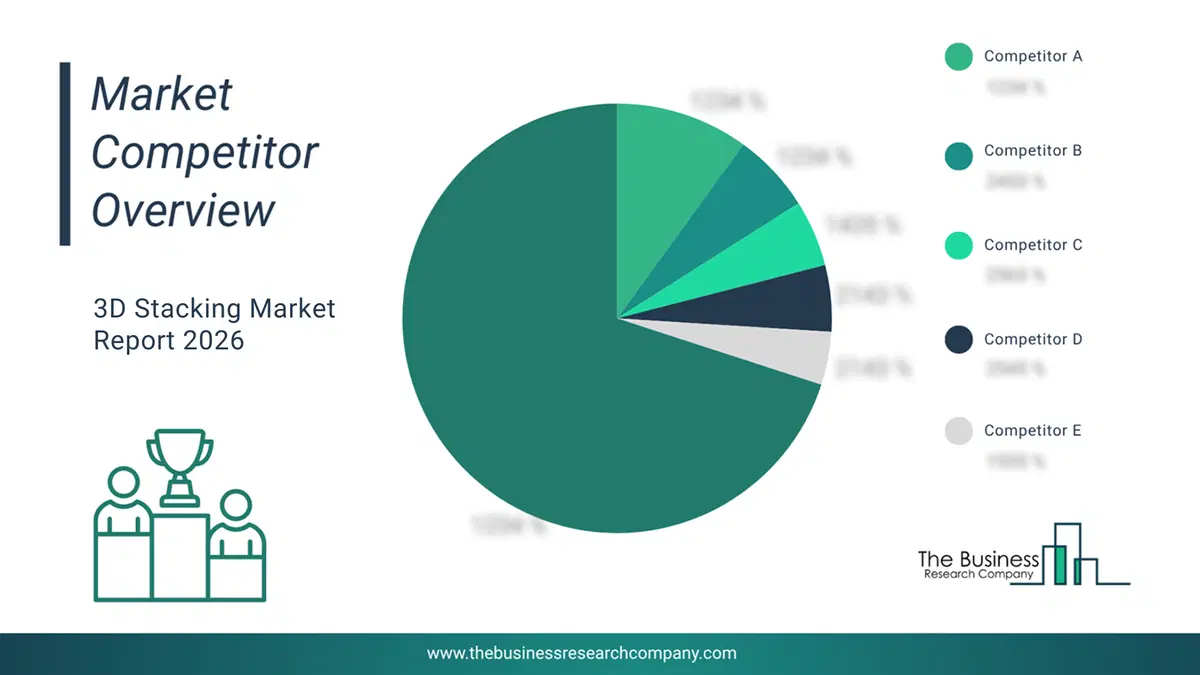
This chart is for illustrative purposes; the full report includes a detailed competitor analysis and comprehensive overview of the top 10 companies in the market.
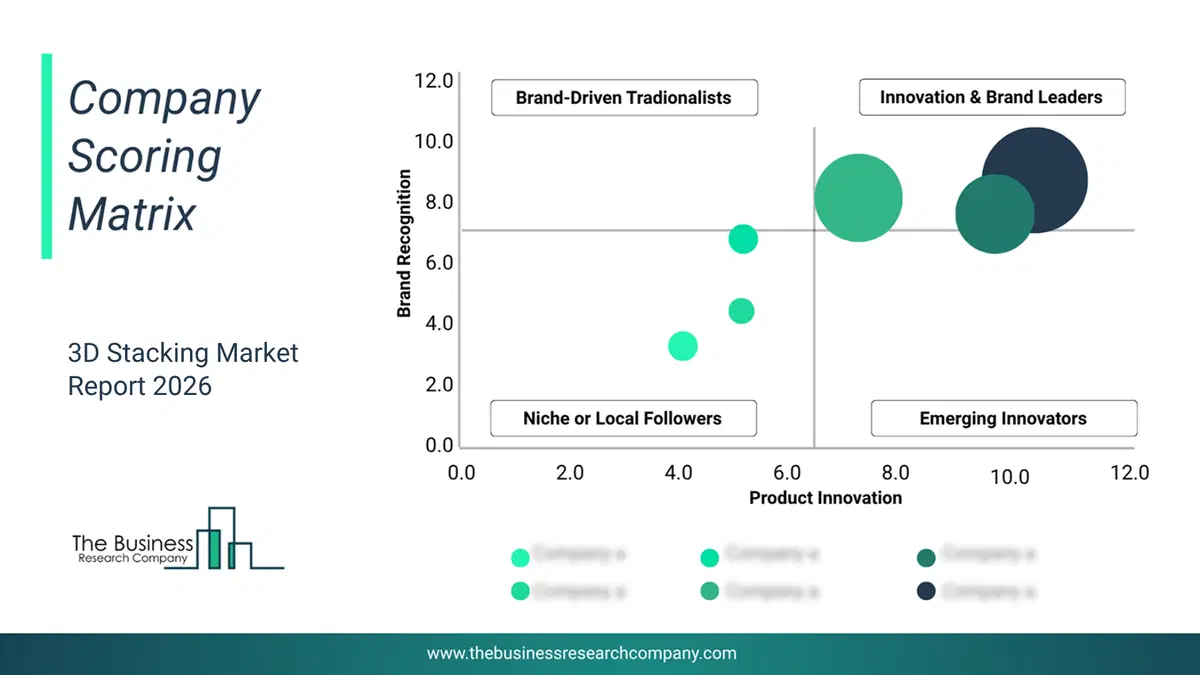
This chart maps companies by product innovation and brand strength, with bubble size indicating relative revenue, helping identify market leaders, challengers, and niche players. This is an illustrative chart; the full report provides a complete and accurate competitive analysis.
Global 3D Stacking Market Trends and Insights
Major companies operating in the 3D stacking market are focusing on technological advancements, such as 3D stacked application-specific integrated circuit (ASIC) architecture, to enhance power efficiency and high-bandwidth 3D memory integration. This architecture involves vertically integrating multiple ASIC layers, interconnected through-silicon vias (TSVs) or other methods, to improve performance, increase density, and lower power consumption compared to traditional two-dimensional (2D) designs. For instance, in December 2024, Nano Labs Ltd., a China-based integrated circuit design company, launched the FPU3.0, an ASIC architecture specifically designed to improve artificial intelligence (AI) inference and blockchain performance. By utilizing advanced 3D DRAM stacking technology, the FPU3.0 achieves a fivefold increase in power efficiency compared to its predecessor, the FPU2.0. This establishes a new standard for high-performance, energy-efficient ASICs. This breakthrough demonstrates the company’s strong commitment to research and development in cutting-edge technologies, aiming to drive innovation and promote broader adoption of AI and cryptocurrency applications.What Are Latest Mergers And Acquisitions In The 3D Stacking Market?
In October 2024, Merck KGaA, a Germany-based science and technology company, acquired Unity-SC for $161.79 million. This acquisition strengthens Merck’s semiconductor capabilities by integrating advanced metrology and inspection solutions, enhancing the quality, yield, and efficiency of next-generation chip manufacturing. This strategic move expands Merck’s expertise in optics and semiconductors, enabling high-performance AI, HPC, and HBM applications while positioning its Electronics business for future technological advancements. Unity-SC, a France-based company that specializes in semiconductor metrology and inspection technology, focuses on 3D stacking of chiplets in advanced packaging.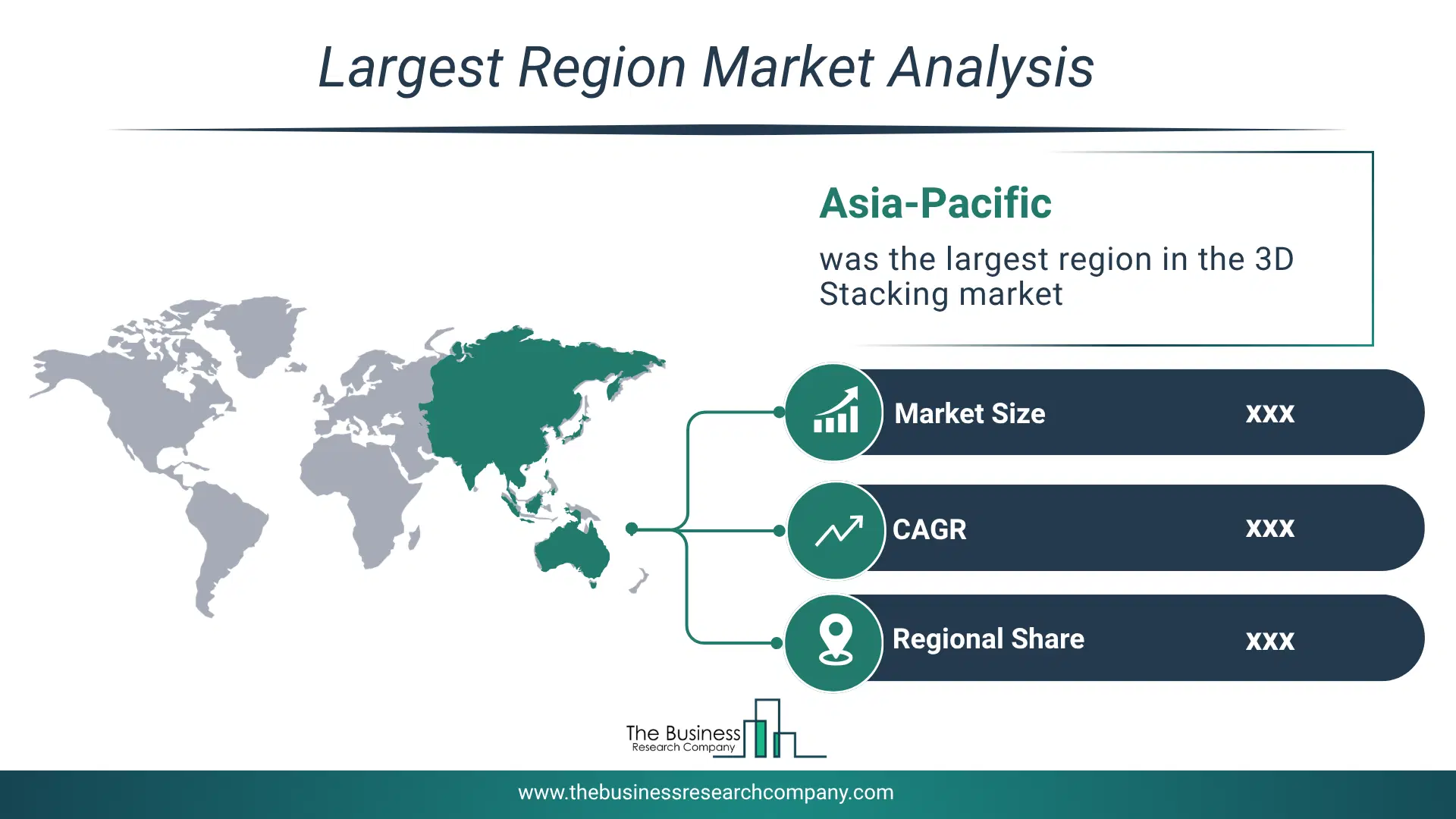
Regional Outlook
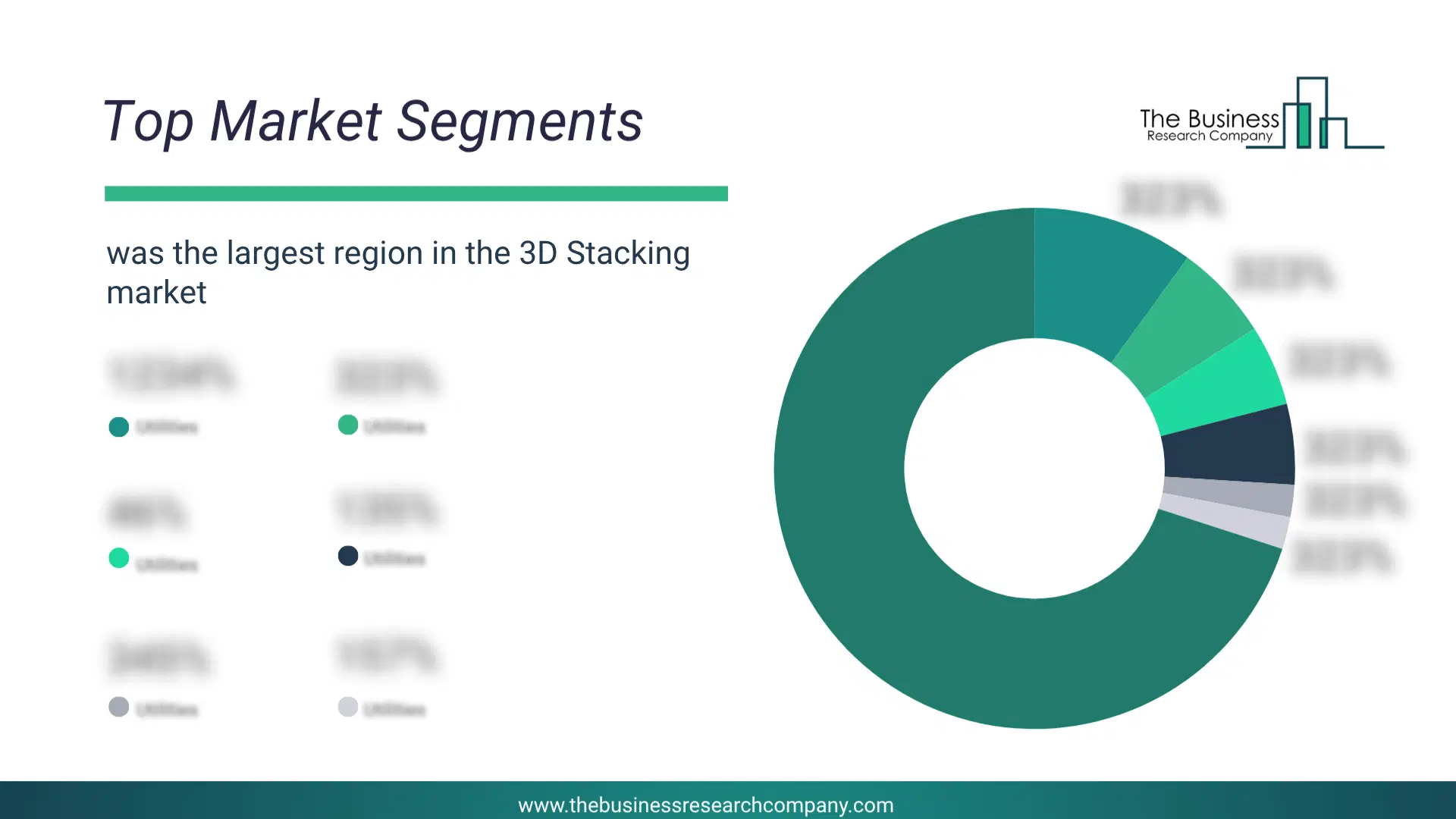
Asia-Pacific was the largest region in the 3D stacking market in 2025. Asia-Pacific is expected to be the fastest-growing region in the forecast period. The regions covered in this market report are Asia-Pacific, South East Asia, Western Europe, Eastern Europe, North America, South America, Middle East, Africa. The countries covered in this market report are Australia, Brazil, China, France, Germany, India, Indonesia, Japan, Taiwan, Russia, South Korea, UK, USA, Canada, Italy, Spain.What Defines the 3D Stacking Market?
The 3D stacking market consists of sales of stacked chips, memory modules, interposers, packaging materials, and semiconductor wafers. Values in this market are ‘factory gate’ values, that is the value of goods sold by the manufacturers or creators of the goods, whether to other entities (including downstream manufacturers, wholesalers, distributors and retailers) or directly to end customers. The value of goods in this market includes related services sold by the creators of the goods.How is Market Value Defined and Measured?
The market value is defined as the revenues that enterprises gain from the sale of goods and/or services within the specified market and geography through sales, grants, or donations in terms of the currency (in USD unless otherwise specified). The revenues for a specified geography are consumption values that are revenues generated by organizations in the specified geography within the market, irrespective of where they are produced. It does not include revenues from resales along the supply chain, either further along the supply chain or as part of other products.
This chart presents market attractiveness based on a quantitative evaluation of growth, competition, strategic alignment, and risk, offering a clear view of opportunity areas for decision-making. This chart is for illustrative purposes; the full report contains the complete analysis.

This chart highlights the Total Addressable Market (TAM) by estimating the maximum revenue opportunity using an assumption-driven approach, supporting strategic planning and opportunity sizing across markets. The chart is illustrative; the full report provides a more comprehensive analysis.
What Key Data and Analysis Are Included in the 3D Stacking Market Report 2026?
The 3d stacking market research report is one of a series of new reports from The Business Research Company that provides market statistics, including industry global market size, regional shares, competitors with the market share, detailed market segments, market trends and opportunities, and any further data you may need to thrive in the 3d stacking industry. The market research report delivers a complete perspective of everything you need, with an in-depth analysis of the current and future state of the industry.3D Stacking Market Report Forecast Analysis
| Report Attribute | Details |
|---|---|
| Market Size Value In 2026 | $2.22 billion |
| Revenue Forecast In 2030 | $4.1 billion |
| Growth Rate | CAGR of 16.6% from 2026 to 2030 |
| Base Year For Estimation | 2025 |
| Actual Estimates/Historical Data | 2020-2025 |
| Forecast Period | 2026 - 2030 |
| Market Representation | Revenue in USD Billion and CAGR from 2026 to 2030 |
| Segments Covered | Device Type, Method, Interconnecting Technology, End User |
| Regional Scope | Asia-Pacific, Western Europe, Eastern Europe, North America, South America, Middle East, Africa |
| Country Scope | The countries covered in the report are Australia, Brazil, China, France, Germany, India, Indonesia, Japan, Taiwan, Russia, South Korea, UK, USA, Canada, Italy, Spain. |
| Key Companies Profiled | Samsung Electronics Co. Ltd., Sony Group Corporation, Taiwan Semiconductor Manufacturing Company Ltd., Intel Corporation, International Business Machines Corporation, Qualcomm Technologies Inc., Broadcom Inc., Micron Technology Inc., Advanced Micro Devices Inc., ASML Holding N.V., ASE Technology Holding Co. Ltd., Toshiba Corporation, Texas Instruments Incorporated, Western Digital Technologies Inc., Infineon Technologies AG, Renesas Electronics Corporation, United Microelectronics Corporation, GlobalFoundries Inc., Amkor Technology Inc., JCET Group, Entegris Inc., Imec, Xperi Inc., Nano Labs Ltd., 3D Plus, Tezzaron. |
| Customization Scope | Request for Customization |
| Pricing And Purchase Options | Explore Purchase Options |