
Aerospace Electronics Market Report 2026
Global Outlook – By Product Type (Communication Systems, Navigation Systems, Flight Control Systems, Avionics, Power Management Systems), By Component (Sensors, Microcontrollers, Antennas, Display Systems, Computing Systems), By Application (Commercial Aviation, Military Aviation, Space Exploration, Unmanned Aerial Vehicles (UAVs)), By End-User (Original Equipment Manufacturer (OEM), Aftermarket) – Market Size, Trends, Strategies, and Forecast to 2030
Aerospace Electronics Market Overview
• Aerospace Electronics market size has reached to $101.05 billion in 2025 • Expected to grow to $149.95 billion in 2030 at a compound annual growth rate (CAGR) of 8.2% • Growth Driver: Rising Defense Investments Fueling The Growth Of The Market Due To Increasing Geopolitical Tensions And Demand For Advanced Military Capabilities • Market Trend: Lightweight Aerospace Enclosures Revolutionize Durability And Efficiency In Electronics Integration • North America was the largest region in 2025 and Asia-Pacific is the fastest growing region.What Is Covered Under Aerospace Electronics Market?
Aerospace electronics refers to the specialized category of electronic systems, components, and subsystems engineered to perform critical functions within aircraft, spacecraft, satellites, and other aerospace platforms, designed to meet stringent standards for reliability, performance, and environmental resilience under extreme operational conditions. These electronics are integral to mission success, supporting navigation, communication, control, monitoring, and data processing across both civil and defense aerospace sectors. The main product types in aerospace electronics are communication systems, navigation systems, flight control systems, avionics, and power management systems. Communication systems are integrated technologies that enable secure and reliable transmission of voice, data, and control signals between aircraft, satellites, and ground stations to support operational coordination and safety. This encompasses components such as sensors, microcontrollers, antennas, display systems, and computing systems used in applications including commercial aviation, military aviation, space exploration, and unmanned aerial vehicles (UAVs), provided by end users such as original equipment manufacturer (OEM) and aftermarket.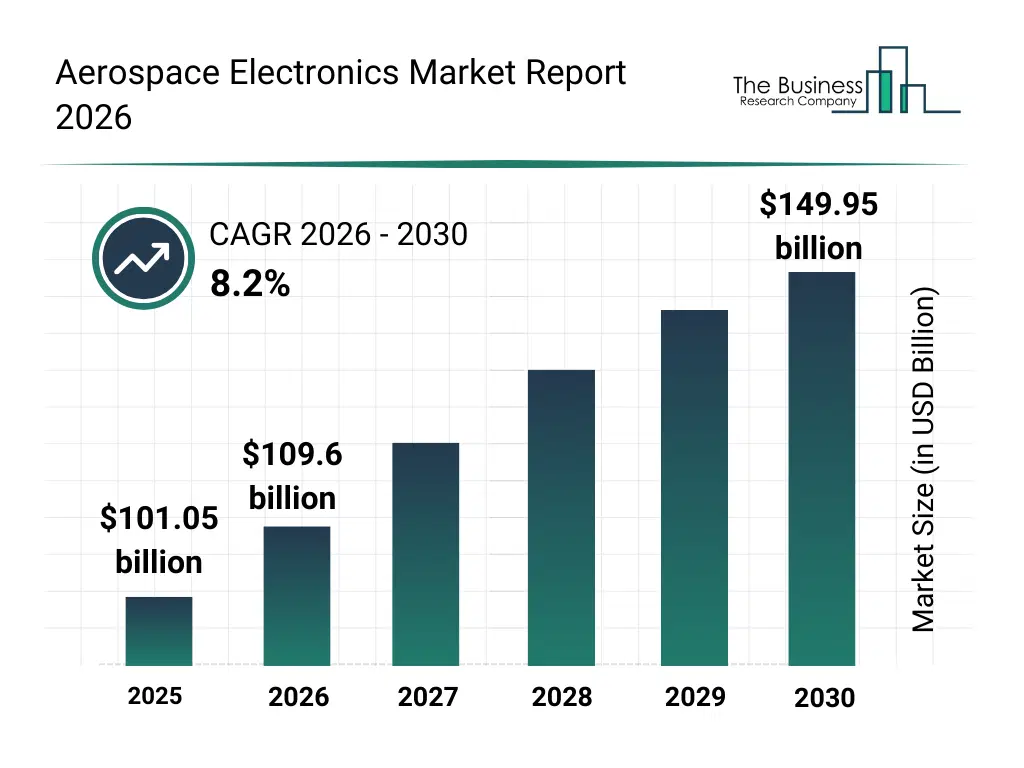
What Is The Aerospace Electronics Market Size and Share 2026?
The aerospace electronics market size has grown strongly in recent years. It will grow from $101.05 billion in 2025 to $109.6 billion in 2026 at a compound annual growth rate (CAGR) of 8.5%. The growth in the historic period can be attributed to increasing adoption of integrated modular avionics (IMA) in modern aircraft, development of aircraft health monitoring systems for predictive maintenance, rising demand for reliable mission computers and engine control electronics, implementation of advanced cockpit voice recorders and navigation displays, government and defense investment in high-performance aerospace electronic systems.What Is The Aerospace Electronics Market Growth Forecast?
The aerospace electronics market size is expected to see strong growth in the next few years. It will grow to $149.95 billion in 2030 at a compound annual growth rate (CAGR) of 8.2%. The growth in the forecast period can be attributed to growing integration of advanced actuation and control systems, expansion of electrical wiring interconnect systems (EWIS) for next-generation aircraft, rising demand for miniaturized and high-efficiency power supply units, adoption of smart and connected avionics for enhanced situational awareness, increasing procurement of aerospace electronics for unmanned and space-based platforms. Major trends in the forecast period include rising demand for integrated modular avionics (ima) architectures, increased adoption of advanced aircraft health monitoring electronics, growing need for miniaturized high-reliability aerospace components, expansion of mission-critical electronic subsystems in defense platforms, higher integration of power-efficient avionics for next-generation aircraft.
Global Aerospace Electronics Market Segmentation
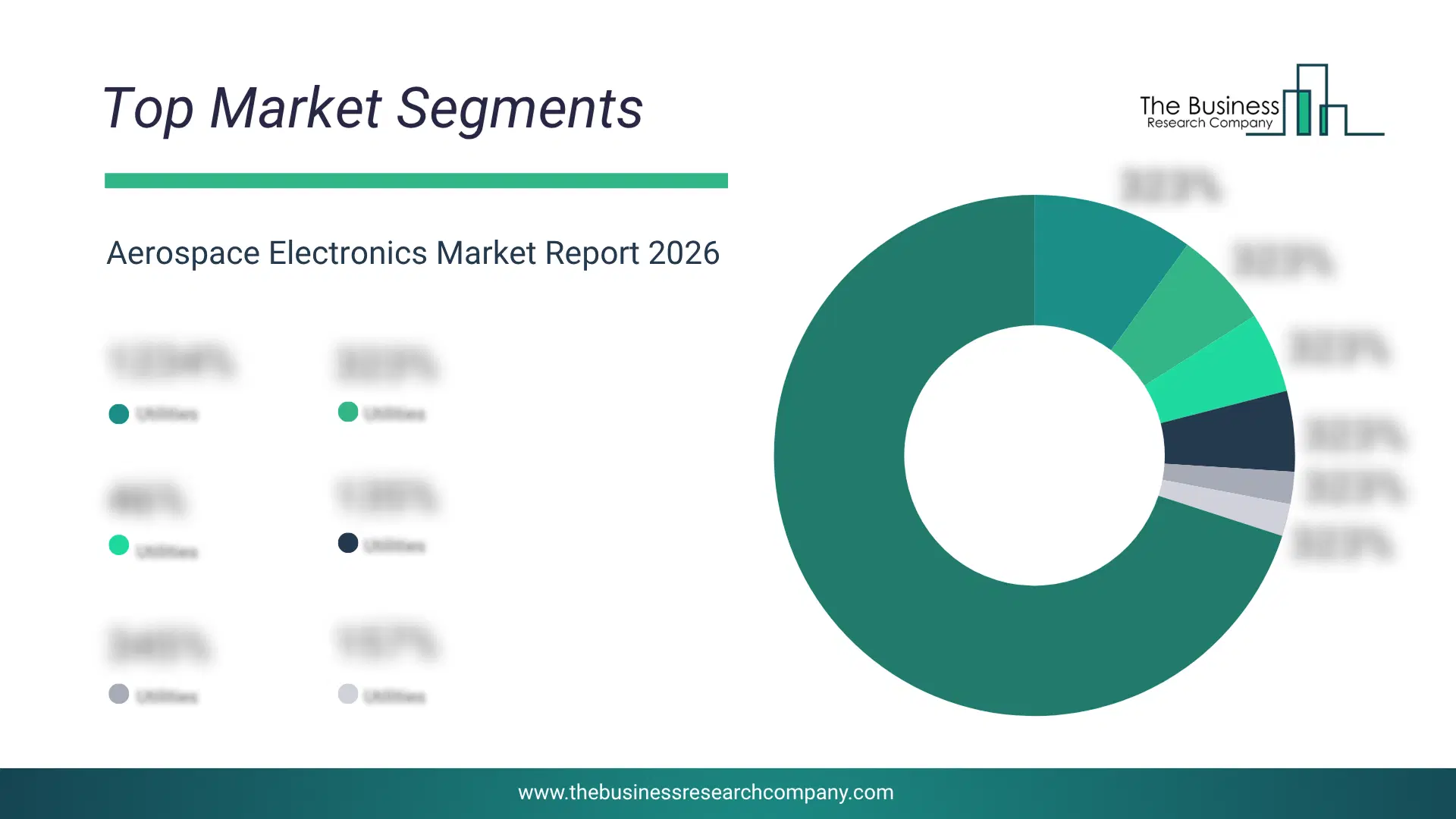
1) By Product Type: Communication Systems, Navigation Systems, Flight Control Systems, Avionics, Power Management Systems 2) By Component: Sensors, Microcontrollers, Antennas, Display Systems, Computing Systems 3) By Application: Commercial Aviation, Military Aviation, Space Exploration, Unmanned Aerial Vehicles (UAVs) 4) By End-User: Original Equipment Manufacturer (OEM), Aftermarket Subsegments: 1) By Communication Systems: Satellite Communication (SATCOM) Systems, VHF Or UHF Radio Systems, Data Link Communication Systems, Intercom Systems 2) By Navigation Systems: Global Positioning Systems (GPS), Inertial Navigation Systems (INS), Terrain Awareness And Warning Systems (TAWS), Automatic Direction Finders (ADF) 3) By Flight Control Systems: Fly-by-Wire (FBW) Systems, Autopilot Systems, Flight Management Systems (FMS), Automatic Flight Control Systems (AFCS) 4) By Avionics: Surveillance And Collision Avoidance Systems, Flight Data Recorders (FDR), Weather Radar Systems, Electronic Warfare Systems 5) By Power Management Systems: Power Distribution Units (PDU), Auxiliary Power Units (APU), Battery Management Systems (BMS), Power Conversion UnitsWhat Is Driver Of The Aerospace Electronics Market?
Rising investments in the defense sector are expected to propel the growth of the aerospace electronics market going forward. The defense sector refers to the industry and government organizations involved in the development, production, and support of military systems and services. Rising investments in the defense sector is due to increasing geopolitical tensions, as escalating threats from terrorism, cyberattacks, and regional conflicts compel countries to boost defense budgets for enhanced capabilities, and strategic deterrence. Aerospace electronics enhance the defense sector by enabling advanced communication, navigation, surveillance, and electronic warfare, thereby improving precision targeting, real-time data sharing, and overall mission effectiveness. For instance, in May 2025, according to the House of Commons Library, a UK-based research and information service, the UK’s defense expenditure is projected to grow from $62.16 billion (£53.9 billion) in 2023-24 to $65.61 billion (£56.9 billion) in 2024-25 and $68.96 billion( £59.8 billion) in 2025-26, reflecting an average annual real-terms increase of 2.4% over the period. Therefore, the rising investments in the defense sector are propelling the aerospace electronics industry.Key Players In The Global Aerospace Electronics Market
Major companies operating in the aerospace electronics market are RTX Corporation, The Boeing Company, Lockheed Martin, Airbus SE, Panasonic Holdings Corporation, General Dynamics Corporation, Northrop Grumman Corporation, Honeywell International Inc., GE Aerospace, BAE Systems, Safran S.A., Eaton Corporation, Thales Group, L3Harris Technologies Inc., Parker Hannifin Corporation, Leonardo S.p.A., Ametek Inc., Elbit Systems, Teledyne Technologies Incorporated, TransDigm Group Incorporated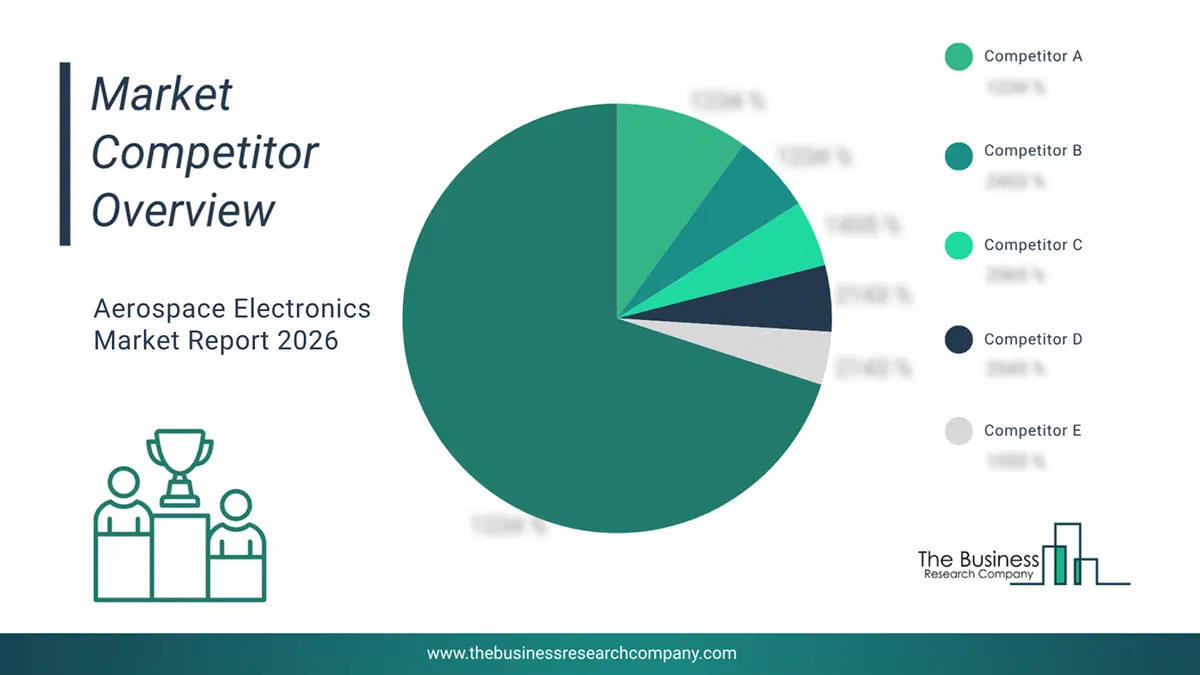
This chart is for illustrative purposes; the full report includes a detailed competitor analysis and comprehensive overview of the top 10 companies in the market.
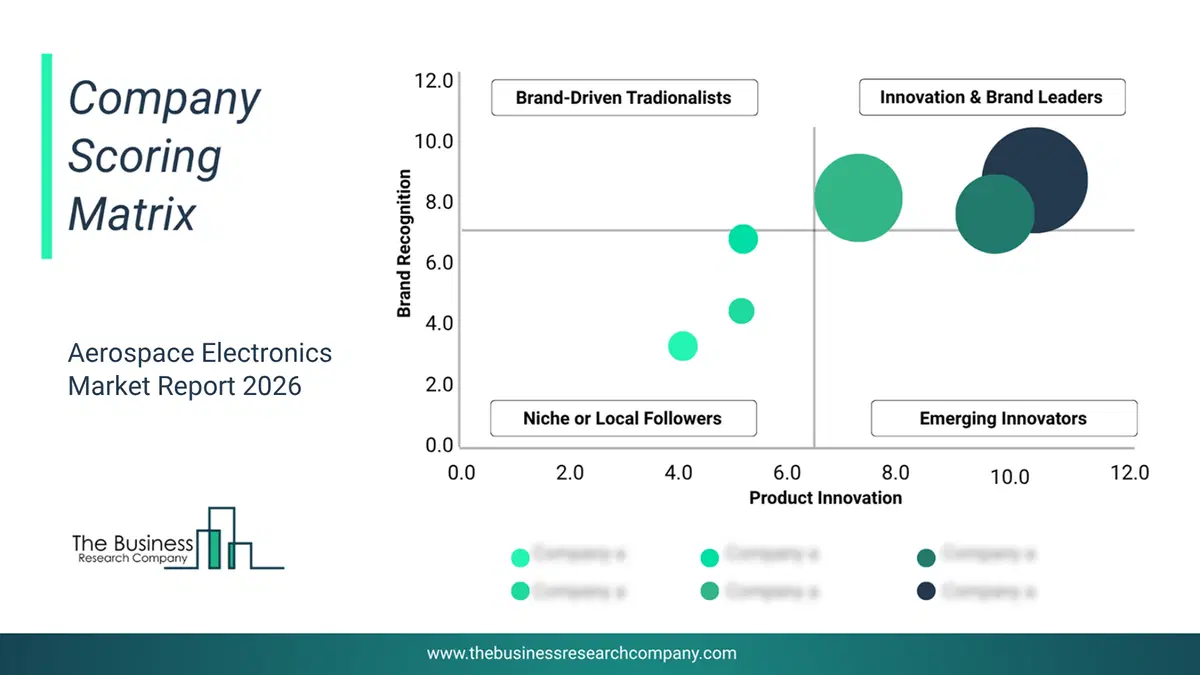
This chart maps companies by product innovation and brand strength, with bubble size indicating relative revenue, helping identify market leaders, challengers, and niche players. This is an illustrative chart; the full report provides a complete and accurate competitive analysis.
Global Aerospace Electronics Market Trends and Insights
Major companies operating in the aerospace electronics market are focusing on developing advanced products such as new hermetic packages to reduce weight and improve the durability of critical aerospace electronic systems in demanding environments. Hermetic packages refer to airtight enclosures used to protect electronic components from environmental factors such as moisture, gas, dust, and pressure. For instance, in September 2023, SCHOTT AG, a Germany-based multinational glass company, launched lightweight microelectronic packages specifically designed for the aerospace industry to meet the demanding requirements of aviation and space applications, where every gram of weight is critical for performance and cost efficiency. SCHOTT’s new lightweight microelectronic packages for aerospace achieve up to two-thirds less weight than traditional kovar-based packages by using aluminum as the primary material. Despite their reduced weight, these packages provide robust hermetic protection for sensitive avionics and electronics, ensuring long-term reliability in the demanding conditions of aerospace environments. They are highly versatile, suitable for a range of applications including microwave and RF packages, DC/DC converter packages, and hermetic sensor packages for both aircraft and satellites.What Are Latest Mergers And Acquisitions In The Aerospace Electronics Market? Sanlayan Acquired Dexcel To Boost India’s Aerospace Electronics Innovation
In March 2025, Sanlayan Technologies, an India-based defense electronics startup, acquired Dexcel Electronics Designs Pvt. Ltd. for an undisclosed amount. With this acquisition, Sanlayan Technologies aims to strengthen its capabilities in defense electronics and embedded systems by leveraging Dexcel Electronics Designs’ expertise in advanced electronic design and development. Dexcel Electronics Designs Pvt. Ltd. is an India-based company that manufactures aerospace electronics.
Regional Insights
North America was the largest region in the aerospace electronics market in 2025. Asia-Pacific is expected to be the fastest-growing region in the forecast period. The regions covered in the aerospace electronics market report are Asia-Pacific, South East Asia, Western Europe, Eastern Europe, North America, South America, Middle East, Africa. The countries covered in the aerospace electronics market report are Australia, Brazil, China, France, Germany, India, Indonesia, Japan, Taiwan, Russia, South Korea, UK, USA, Canada, Italy, SpainWhat Defines the Aerospace Electronics Market?
The aerospace electronics market consists of sales of integrated modular avionics (IMA), actuation systems, cockpit voice recorders (CVR), mission computers, aircraft health monitoring systems (AHMS), power supply units, electrical wiring interconnect systems (EWIS), navigation displays, and engine control electronics. Values in this market are ‘factory gate’ values, that is, the value of goods sold by the manufacturers or creators of the goods, whether to other entities (including downstream manufacturers, wholesalers, distributors, and retailers) or directly to end customers. The value of goods in this market includes related services sold by the creators of the goods.How is Market Value Defined and Measured?
The market value is defined as the revenues that enterprises gain from the sale of goods and/or services within the specified market and geography through sales, grants, or donations in terms of the currency (in USD unless otherwise specified). The revenues for a specified geography are consumption values that are revenues generated by organizations in the specified geography within the market, irrespective of where they are produced. It does not include revenues from resales along the supply chain, either further along the supply chain or as part of other products.
This chart presents market attractiveness based on a quantitative evaluation of growth, competition, strategic alignment, and risk, offering a clear view of opportunity areas for decision-making. This chart is for illustrative purposes; the full report contains the complete analysis.

This chart highlights the Total Addressable Market (TAM) by estimating the maximum revenue opportunity using an assumption-driven approach, supporting strategic planning and opportunity sizing across markets. The chart is illustrative; the full report provides a more comprehensive analysis.
What Key Data and Analysis Are Included in the Aerospace Electronics Market Report 2026?
The aerospace electronics market research report is one of a series of new reports from The Business Research Company that provides market statistics, including industry global market size, regional shares, competitors with the market share, detailed market segments, market trends and opportunities, and any further data you may need to thrive in the aerospace electronics industry. The market research report delivers a complete perspective of everything you need, with an in-depth analysis of the current and future state of the industry.Aerospace Electronics Market Report Forecast Analysis
| Report Attribute | Details |
|---|---|
| Market Size Value In 2026 | $109.6 billion |
| Revenue Forecast In 2030 | $149.95 billion |
| Growth Rate | CAGR of 8.2% from 2026 to 2030 |
| Base Year For Estimation | 2025 |
| Actual Estimates/Historical Data | 2020-2025 |
| Forecast Period | 2026 - 2030 |
| Market Representation | Revenue in USD Billion and CAGR from 2026 to 2030 |
| Segments Covered | Product Type, Component, Application, End-User |
| Regional Scope | Asia-Pacific, Western Europe, Eastern Europe, North America, South America, Middle East, Africa |
| Country Scope | The countries covered in the aerospace electronics market report are Australia, Brazil, China, France, Germany, India, Indonesia, Japan, Taiwan, Russia, South Korea, UK, USA, Canada, Italy, Spain |
| Key Companies Profiled | RTX Corporation, The Boeing Company, Lockheed Martin, Airbus SE, Panasonic Holdings Corporation, General Dynamics Corporation, Northrop Grumman Corporation, Honeywell International Inc., GE Aerospace, BAE Systems, Safran S.A., Eaton Corporation, Thales Group, L3Harris Technologies Inc., Parker Hannifin Corporation, Leonardo S.p.A., Ametek Inc., Elbit Systems, Teledyne Technologies Incorporated, TransDigm Group Incorporated |
| Customization Scope | Request for Customization |
| Pricing And Purchase Options | Explore Purchase Options |