
Aprotic Solvents Market Report 2026
Global Outlook – By Solvent Type (Polar Aprotic Solvents, Non-Polar Aprotic Solvents), By Source (Synthetic Aprotic Solvents, Bio-Based Aprotic Solvents), By Application (Pharmaceuticals and Biotechnology, Electronics and Semiconductor Manufacturing, Polymers and Plastics Processing, Oil and Gas Processing, Paints, Coatings, and Inks, Adhesives and Sealants, Agrochemicals, Other Applications) – Market Size, Trends, Strategies, and Forecast to 2030
Aprotic Solvents Market Overview
• Aprotic Solvents market size has reached to $20.41 billion in 2025 • Expected to grow to $23.25 billion in 2030 at a compound annual growth rate (CAGR) of 2.6% • Growth Driver: Increasing Infrastructural And Construction Activities • Market Trend: Focus On Expansion Of Production Capacity • Asia-Pacific was the largest region in 2025 and Asia-Pacific is the fastest growing region.What Is Covered Under Aprotic Solvents Market?
An aprotic solvent is a solvent with no hydrogen bonding, in which the proton is neither donated nor accepted (hydrogen). A solvent is a chemical compound in which a solute is dissolved. Solvents can be gaseous, solid, or liquid. The main types of aprotic solvents are n-methyl-2-pyrrolidone (NMP), toluene, benzene, acetone, and others. Benzene is a colorless volatile hydrocarbon or an organic chemical compound with the molecular formula C6H6 and is present in coal tar and petroleum. Their sources include synthetic and bio-based materials, which are used in applications such as oil and gas, plastics, pharmaceuticals, electronic equipment, paints and coatings, adhesives, and others.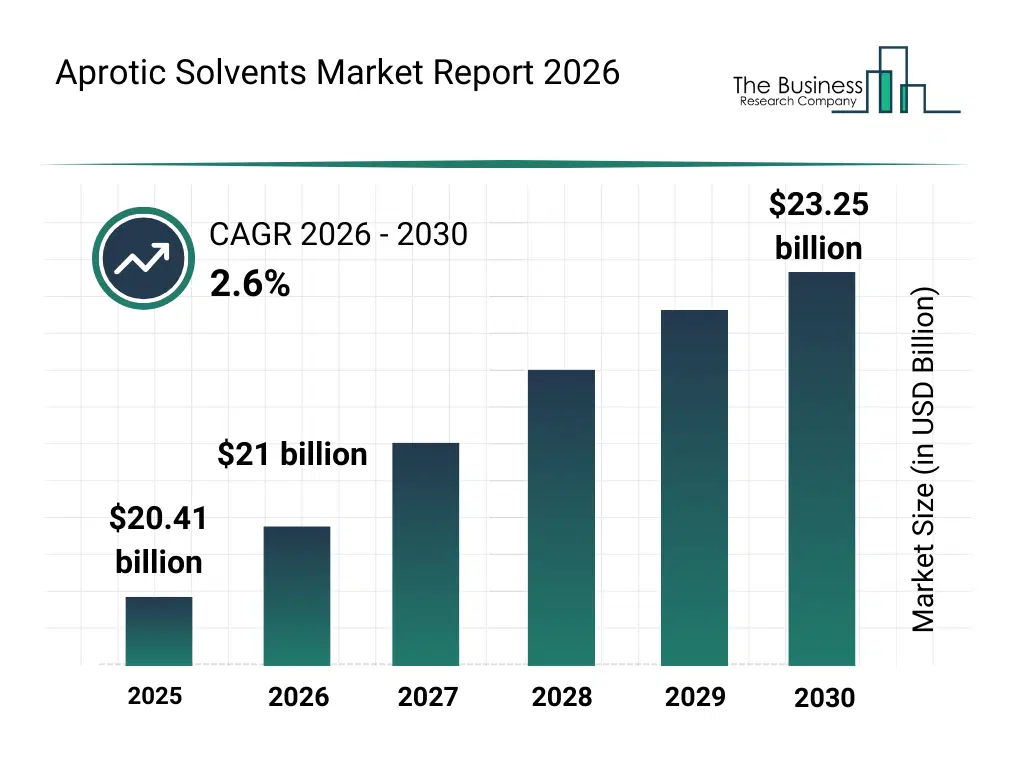
What Is The Aprotic Solvents Market Size and Share 2026?
The aprotic solvents market size has grown steadily in recent years. It will grow from $20.41 billion in 2025 to $21 billion in 2026 at a compound annual growth rate (CAGR) of 2.9%. The growth in the historic period can be attributed to expansion of chemical processing industries, growth in pharmaceutical manufacturing capacity, rising use in polymer and plastic production, increasing electronics fabrication activities, availability of synthetic solvent production technologies.What Is The Aprotic Solvents Market Growth Forecast?
The aprotic solvents market size is expected to see steady growth in the next few years. It will grow to $23.25 billion in 2030 at a compound annual growth rate (CAGR) of 2.6%. The growth in the forecast period can be attributed to increasing demand from battery and electronics industries, rising regulatory focus on safer solvent alternatives, expansion of bio-based chemical manufacturing, growing use in advanced material synthesis, increasing investments in specialty chemicals. Major trends in the forecast period include increasing adoption of high-purity aprotic solvents, rising demand from semiconductor manufacturing, growing use in pharmaceutical synthesis, expansion of bio-based aprotic solvents, enhanced focus on low-toxicity formulations.
Global Aprotic Solvents Market Segmentation
1) By Solvent Type: Polar Aprotic Solvents, Non-Polar Aprotic Solvents 2) By Source: Synthetic Aprotic Solvents, Bio-Based Aprotic Solvents 3) By Application: Pharmaceuticals and Biotechnology, Electronics and Semiconductor Manufacturing, Polymers and Plastics Processing, Oil and Gas Processing, Paints, Coatings, and Inks, Adhesives and Sealants, Agrochemicals, Other Applications Subsegments: 1) By Polar Aprotic Solvents: N-Methyl-2-Pyrrolidone (NMP), Dimethylformamide (DMF), Dimethyl Sulfoxide (DMSO), Acetonitrile, Propylene Carbonate 2) By Non-Polar Aprotic Solvents: Toluene, Xylene, Benzene, Hexane and Aliphatic HydrocarbonsWhat Is The Driver Of The Aprotic Solvents Market?
The growing infrastructural and construction activities are expected to boost the growth of the aprotic solvents market going forward. Infrastructural and construction activities are increasing due to rising population, economic growth, and rising urbanization. Aprotic solvents are used in adhesives and sealants, paints, and coatings to improve the adhesion between the polymer matrix and the fiber surface during construction. For instance, in March 2024, Ceramic World Web, an Italy-based website focused on technology for the ceramic and brick industries, reported that the construction sector in India grew by 13.3% in July-September 2023 compared to the same period in 2022 and by 7.9% from the previous quarter. Overall, there was a significant 24% rise in the launch of new residential projects. Therefore, the growing infrastructural and construction activities are driving the growth of the aprotic solvents industry.Key Players In The Global Aprotic Solvents Market
Major companies operating in the aprotic solvents market are BASF SE, Eastman Chemical Company, Royal Dutch Shell PLC, INEOS Chemicals Company, Celanese Corporation, DuPont de Nemours Inc., Asahi Kasei Corporation, Mitsubishi Chemical Corporation, Nanjing Jinlong Chemical Co. Ltd., CNPC Jilin Chemical Group Co. Ltd., China National Petroleum Corporation, Dow Inc., Mitsui Chemicals Inc., Gaylord Chemical Company LLC, Finar Limited, Honeywell International Inc., Solvay SA, Arkema SA, LyondellBasell Industries N.V., Sinopec Shanghai Petrochemical Company Limited, ExxonMobil Chemical Company, Chevron Phillips Chemical Company LLC, LG Chem Ltd., Sumitomo Chemical Co. Ltd., Toray Industries Inc., Ube Industries Ltd., Wacker Chemie AG
This chart is for illustrative purposes; the full report includes a detailed competitor analysis and comprehensive overview of the top 10 companies in the market.
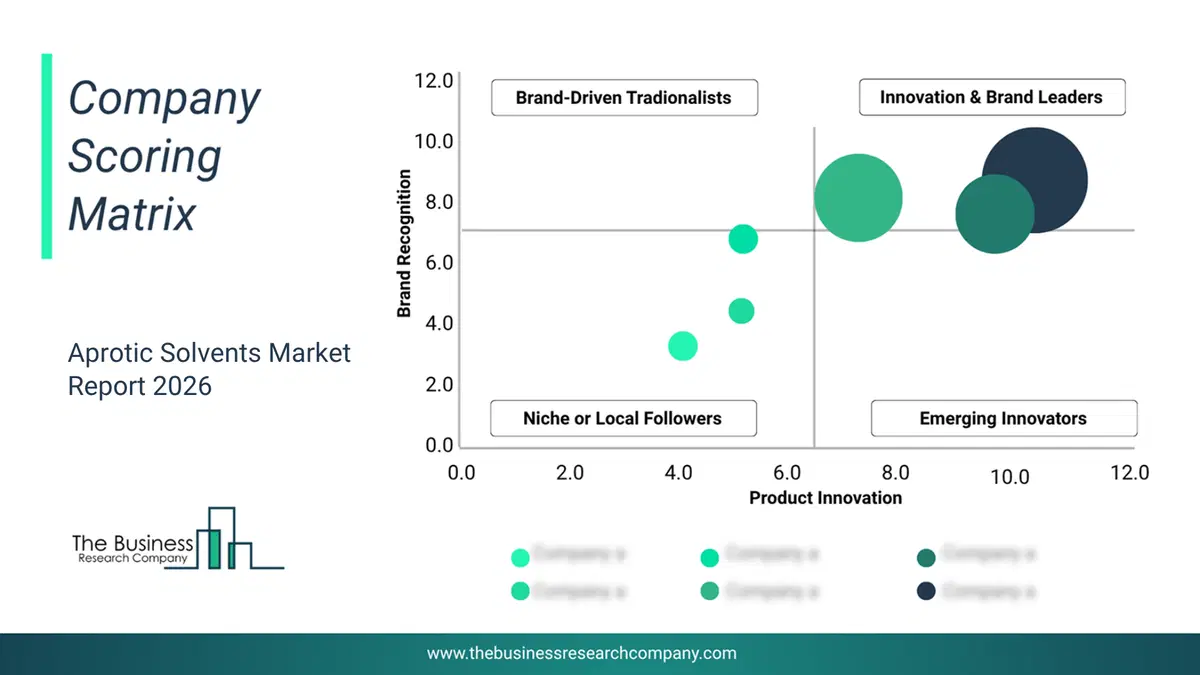
This chart maps companies by product innovation and brand strength, with bubble size indicating relative revenue, helping identify market leaders, challengers, and niche players. This is an illustrative chart; the full report provides a complete and accurate competitive analysis.
Global Aprotic Solvents Market Trends and Insights
Major companies operating in the aprotic solvent market are focusing on expanding production capacity to strengthen their product portfolio, meet growing demand, and enhance geographic presence. Expanding production capacity enables manufacturers to improve operational efficiency and support business growth. For instance, in August 2023, the Mitsubishi Chemical Group, a Japan-based chemicals corporation, decided to increase the γ-butyrolactone (GBL) production capacity of its Okayama Plant (Kurashiki City, Okayama Prefecture, Japan) by 2,000 tons/year. The expanded production is scheduled to start in July 2024. GBL is a high-purity solvent used as an electrolyte for capacitors and semiconductor parts cleaning solutions, and it also serves as a raw material for N-methyl-2-pyrrolidone (NMP), an aprotic solvent widely used in lithium-ion batteries and semiconductor cleaning solutions.What Are Latest Mergers And Acquisitions In The Aprotic Solvents Market?
In October 2025, ChemPoint LLC, a US-based provider of chemical distribution, digital solutions, and specialty product services, expanded its partnership with Eastman to enhance the sales, marketing, and distribution of TamiSolve NxG solvents across North America. Through this partnership expansion, ChemPoint aims to broaden its specialty solvent portfolio, increase market penetration, and promote safer, high-performance solvent alternatives. Eastman is a US-based provider of aprotic solvents.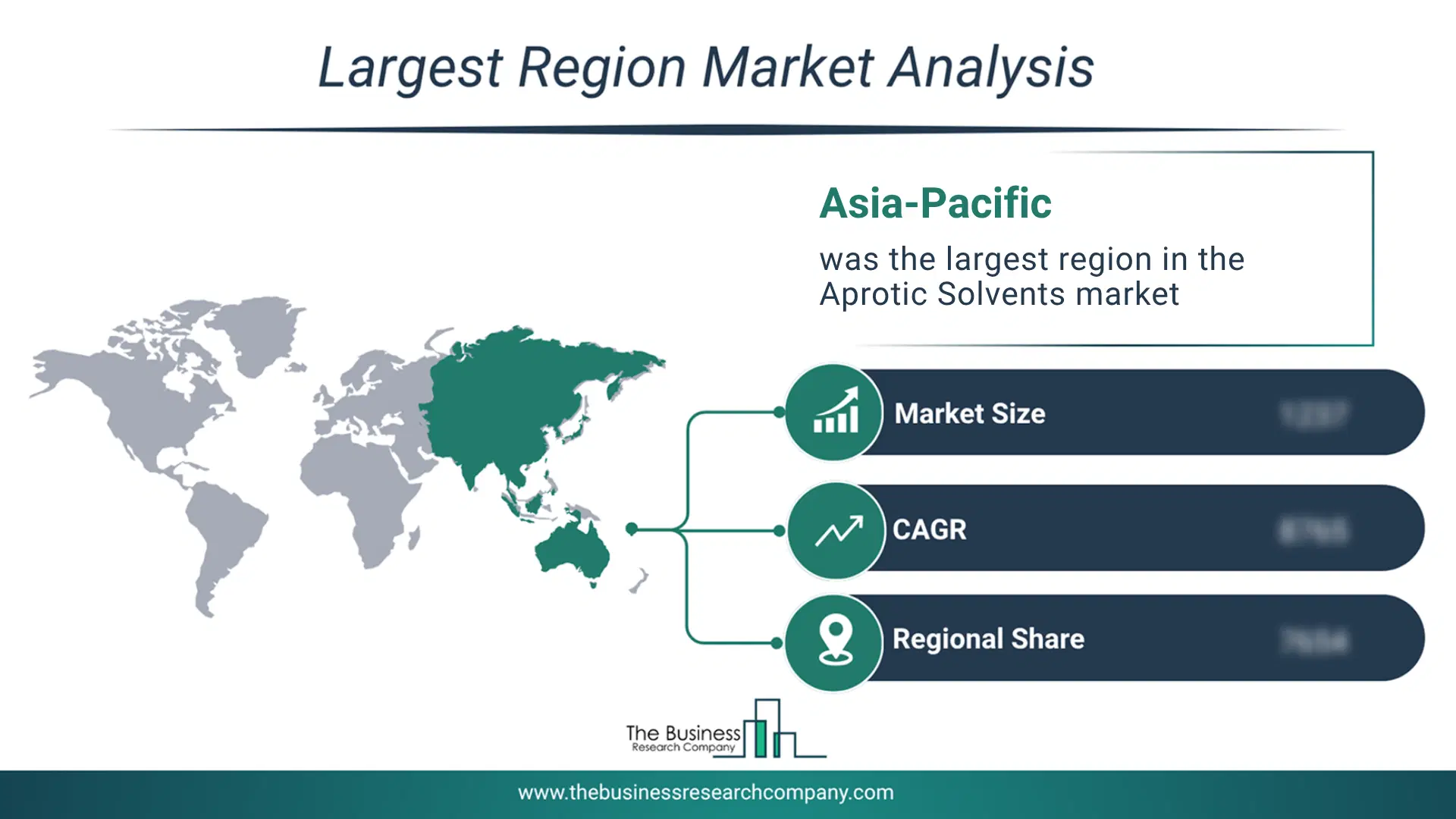
Regional Insights
Asia-Pacific was the largest region in the aprotic solvents market in 2025. The regions covered in this market report are Asia-Pacific, South East Asia, Western Europe, Eastern Europe, North America, South America, Middle East, Africa The countries covered in this market report are Australia, Brazil, China, France, Germany, India, Indonesia, Japan, Taiwan, Russia, South Korea, UK, USA, Canada, Italy, SpainWhat Defines the Aprotic Solvents Market?
The aprotic solvent market consists of sales of ethyl acetate and dimethyl sulfoxide. Values in this market are ‘factory gate’ values, that is, the value of goods sold by the manufacturers or creators of the goods, whether to other entities (including downstream manufacturers, wholesalers, distributors, and retailers) or directly to end customers. The value of goods in this market includes related services sold by the creators of the goods.How is Market Value Defined and Measured?
The market value is defined as the revenues that enterprises gain from the sale of goods and/or services within the specified market and geography through sales, grants, or donations in terms of the currency (in USD unless otherwise specified). The revenues for a specified geography are consumption values that are revenues generated by organizations in the specified geography within the market, irrespective of where they are produced. It does not include revenues from resales along the supply chain, either further along the supply chain or as part of other products.
This chart presents market attractiveness based on a quantitative evaluation of growth, competition, strategic alignment, and risk, offering a clear view of opportunity areas for decision-making. This chart is for illustrative purposes; the full report contains the complete analysis.

This chart highlights the Total Addressable Market (TAM) by estimating the maximum revenue opportunity using an assumption-driven approach, supporting strategic planning and opportunity sizing across markets. The chart is illustrative; the full report provides a more comprehensive analysis.
What Key Data and Analysis Are Included in the Aprotic Solvents Market Report 2026?
The aprotic solvents market research report is one of a series of new reports from The Business Research Company that provides market statistics, including industry global market size, regional shares, competitors with the market share, detailed market segments, market trends and opportunities, and any further data you may need to thrive in the aprotic solvents industry. The market research report delivers a complete perspective of everything you need, with an in-depth analysis of the current and future state of the industry.Aprotic Solvents Market Report Forecast Analysis
| Report Attribute | Details |
|---|---|
| Market Size Value In 2026 | $21 billion |
| Revenue Forecast In 2030 | $23.25 billion |
| Growth Rate | CAGR of 2.9% from 2026 to 2030 |
| Base Year For Estimation | 2025 |
| Actual Estimates/Historical Data | 2020-2025 |
| Forecast Period | 2026 - 2030 |
| Market Representation | Revenue in USD Billion and CAGR from 2026 to 2030 |
| Segments Covered | Solvent Type, Source, Application |
| Regional Scope | Asia-Pacific, Western Europe, Eastern Europe, North America, South America, Middle East, Africa |
| Country Scope | The countries covered in this market report are Australia, Brazil, China, France, Germany, India, Indonesia, Japan, Taiwan, Russia, South Korea, UK, USA, Canada, Italy, Spain |
| Key Companies Profiled | BASF SE, Eastman Chemical Company, Royal Dutch Shell PLC, INEOS Chemicals Company, Celanese Corporation, DuPont de Nemours Inc., Asahi Kasei Corporation, Mitsubishi Chemical Corporation, Nanjing Jinlong Chemical Co. Ltd., CNPC Jilin Chemical Group Co. Ltd., China National Petroleum Corporation, Dow Inc., Mitsui Chemicals Inc., Gaylord Chemical Company LLC, Finar Limited, Honeywell International Inc., Solvay SA, Arkema SA, LyondellBasell Industries N.V., Sinopec Shanghai Petrochemical Company Limited, ExxonMobil Chemical Company, Chevron Phillips Chemical Company LLC, LG Chem Ltd., Sumitomo Chemical Co. Ltd., Toray Industries Inc., Ube Industries Ltd., Wacker Chemie AG |
| Customization Scope | Request for Customization |
| Pricing And Purchase Options | Explore Purchase Options |