
Artificial intelligence (AI) In Home Automation Market Report 2026
Global Outlook – By Component (Hardware, Software, Services), By Technology (Machine Learning (ML), Natural Language Processing (NLP), Computer Vision, Other Technologies), By Application (Voice Assistants, Security And Surveillance, Energy Management, Predictive Maintenance, Other Applications) – Market Size, Trends, Strategies, and Forecast to 2030
Artificial intelligence (AI) In Home Automation Market Overview
• Artificial intelligence (AI) In Home Automation market size has reached to $26.64 billion in 2025 • Expected to grow to $97.05 billion in 2030 at a compound annual growth rate (CAGR) of 29.4% • Growth Driver: Rising Smart Home Device Adoption Fuels AI In Home Automation Market Growth • Market Trend: Generative AI Revolutionizes Smart Home Automation With Enhanced Personalization • North America was the largest region in 2025.Market Gains By 2030 – Top Opportunities By Segment
Market Gain identifies the most promising market opportunities by highlighting the segments or products expected to generate the highest incremental revenue growth over the next five years.
What Is Covered Under Artificial intelligence (AI) In Home Automation Market?
Artificial intelligence (AI) in home automation refers to the integration of AI technologies into smart home systems to create a more intelligent, responsive, and efficient living environment. AI enhances the capabilities of home automation by enabling devices to learn from user behavior, adapt to preferences, and make decisions autonomously. AI can provide suggestions for improving the efficiency of the home environment, such as recommending when to adjust thermostat settings for optimal comfort and energy savings. The main component types of artificial intelligence (AI) in home automation include hardware, software, and services. Hardware in AI home automation includes physical devices and equipment used to control and manage home automation systems that interact with AI systems to automate tasks and improve home management. The technology types are categorized into machine learning (ML), natural language processing (NLP), computer vision, and others for applications such as voice assistants, security and surveillance, energy management, predictive maintenance, and others.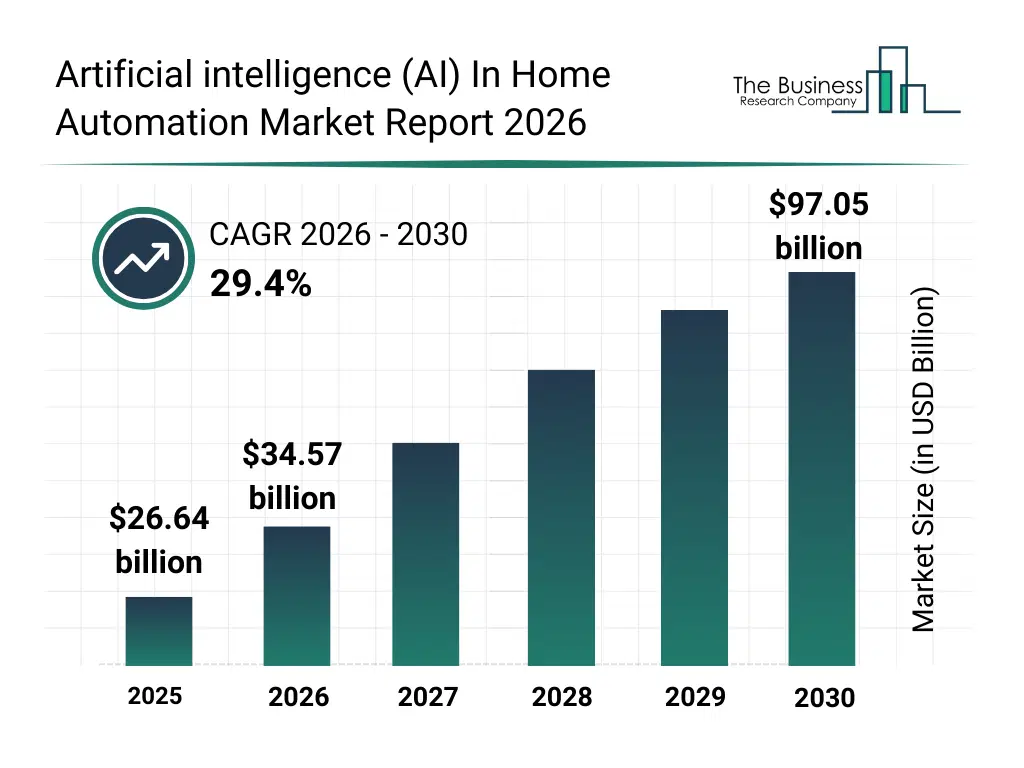
What Is The Artificial intelligence (AI) In Home Automation Market Size and Share 2026?
The artificial intelligence (AI) in home automation market size has grown exponentially in recent years. It will grow from $26.64 billion in 2025 to $34.57 billion in 2026 at a compound annual growth rate (CAGR) of 29.8%. The growth in the historic period can be attributed to growth of smart devices adoption, early use of voice assistants, rising residential internet penetration, consumer focus on convenience, increasing home security concerns.What Is The Artificial intelligence (AI) In Home Automation Market Growth Forecast?
The artificial intelligence (AI) in home automation market size is expected to see exponential growth in the next few years. It will grow to $97.05 billion in 2030 at a compound annual growth rate (CAGR) of 29.4%. The growth in the forecast period can be attributed to integration of AI with iot ecosystems, demand for energy efficient homes, rising smart city initiatives, advancements in edge computing, growing consumer awareness of smart living. Major trends in the forecast period include adaptive smart home systems, AI driven energy optimization, voice controlled home automation, predictive home maintenance, intelligent home security solutions.
Global Artificial intelligence (AI) In Home Automation Market Segmentation
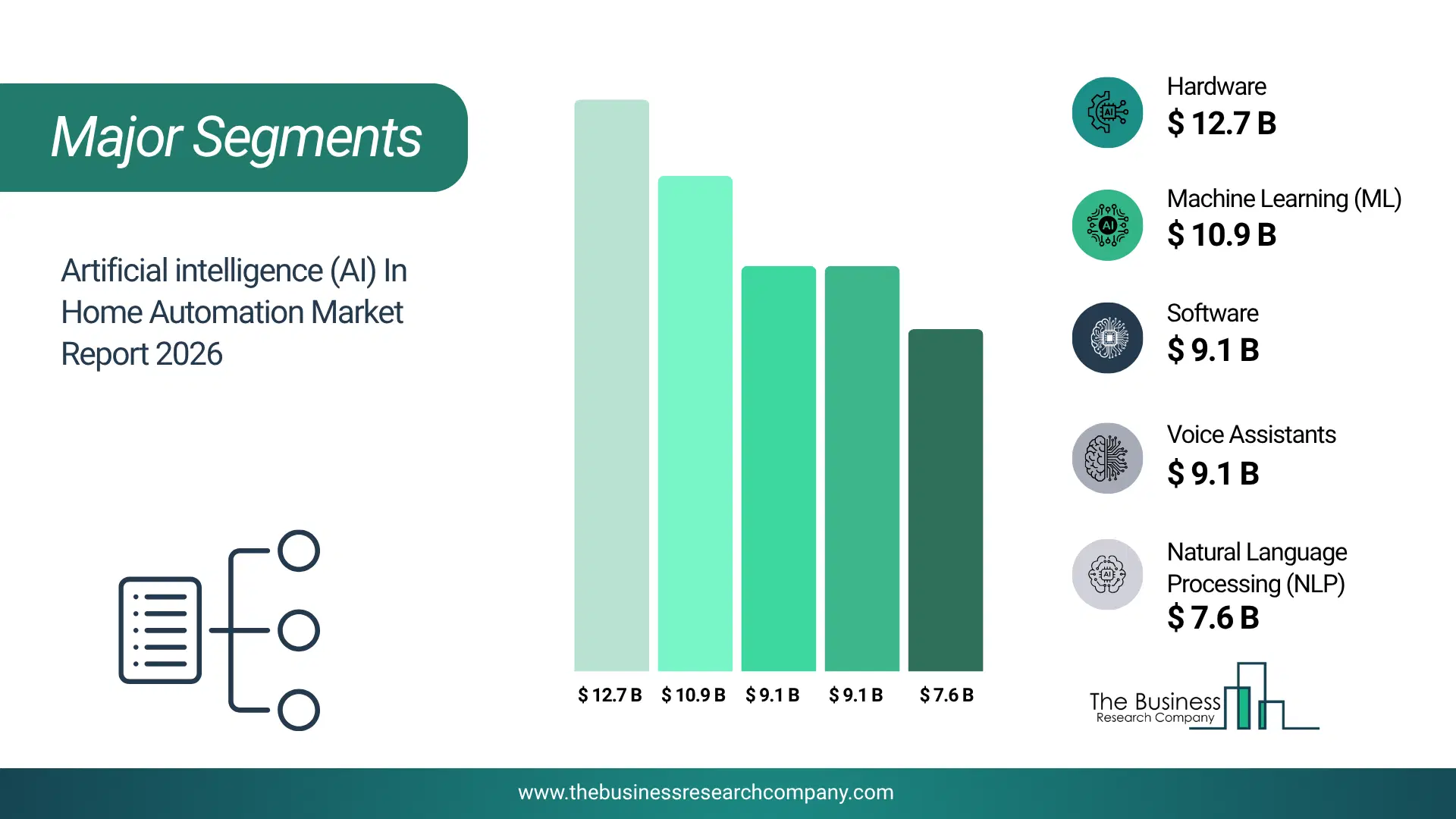
1) By Component: Hardware, Software, Services 2) By Technology: Machine Learning (ML), Natural Language Processing (NLP), Computer Vision, Other Technologies 3) By Application: Voice Assistants, Security And Surveillance, Energy Management, Predictive Maintenance, Other Applications Subsegments: 1) By Hardware: Smart Sensors (motion, temperature, humidity), Smart Thermostats, AI-Enabled Smart Speakers and Assistants, Smart Lighting Systems, AI-Based Home Security Cameras, Smart Appliances, Home Automation Hubs and Controllers 2) By Software: AI-Based Home Automation Platforms, Voice Recognition Software, Machine Learning Algorithms for Smart Homes, AI-Powered Home Energy Management Software, Predictive Maintenance Software, Home Automation Mobile Apps 3) By Services: AI Home Automation Integration Services, Cloud-Based AI Services for Smart Homes, Managed Services for Home Automation Systems, AI-Driven Security and Surveillance Services, AI Consultation and Customization Services, Technical Support and Maintenance Services The top segments in the artificial intelligence (ai) in home automation market will be: • Hardware will reach $12706.26 Million by 2025. • Machine Learning (ML) will reach $10927.7 Million by 2025. • Software will reach $9113.13 Million by 2025. • Voice Assistants will reach $9103.67 Million by 2025. • Natural Language Processing (NLP) will reach $7678.46 Million by 2025.What Is The Driver Of The Artificial intelligence (AI) In Home Automation Market?
The growing adoption of smart home devices is expected to propel the growth of AI in the home automation market going forward. Smart home devices are interconnected gadgets that automate and control various aspects of a home, such as lighting, temperature, and security, through remote access and intelligent technology. The growing adoption of smart home devices is driven by increased consumer demand for convenience, enhanced energy efficiency, and improved security features, combined with advancements in technology and affordability. AI home automation enhances the growing adoption of smart home devices by enabling more personalized, intuitive, and efficient control of home environments through advanced machine learning algorithms and predictive analytics. For instance, in August 2025, the Government Digital Service, a UK-based government agency, reported that by June 2025, almost 40 million smart and advanced meters had been installed in homes and small businesses across Great Britain, representing 69% of all meters, with 36 million (63%) functioning in smart mode. Therefore, the growing adoption of smart home devices drives the growth of artificial intelligence (AI) in home automation markets.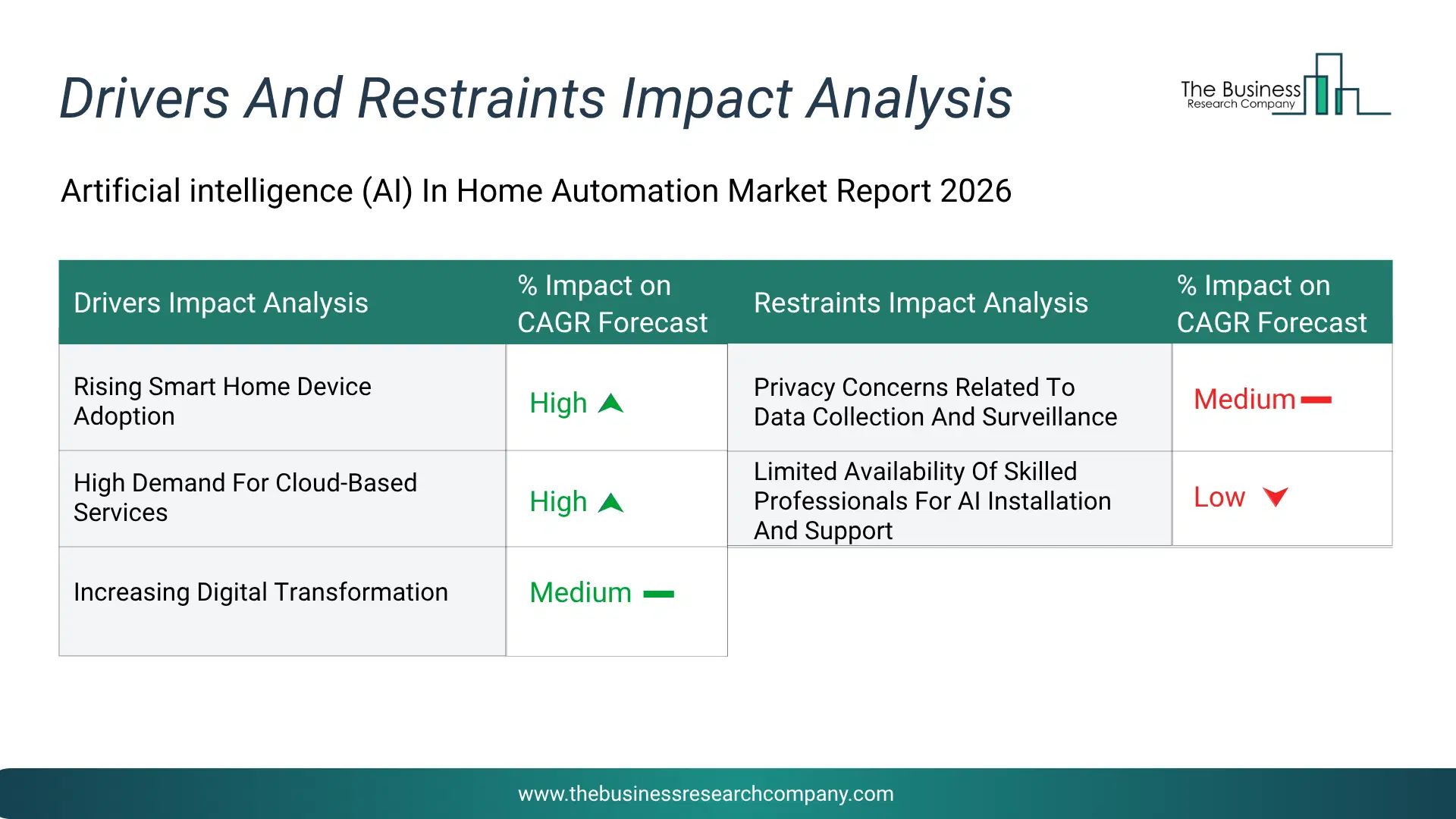
Infographic Chart Showing Key Market Drivers Analysis And Restraints For Artificial Intelligence (Ai) In Home Automation Market
The chart presents an impact analysis of key drivers and restraints, quantifying their relative influence on the market's growth rate and helping assess the balance between growth enablers and limiting factors. This chart offers a high-level perspective; the full report contains more detailed insights.
How Will The Drivers Impact Growth In The Global Artificial intelligence (AI) In Home Automation Market?
• Rising Smart Home Device Adoption (High) – The rising smart home device adoption will become a key driver of growth in the artificial intelligence (AI) in home automation market by 2030. The widespread adoption of smart home devices enhances AI in home automation by providing vast amounts of real-time data, enabling machine learning algorithms to improve personalization, efficiency, and predictive capabilities. This interconnected ecosystem allows AI to optimize energy usage, enhance security, and streamline daily tasks, creating a more seamless and intuitive user experience. As a result, rising smart home device adoption is anticipated to contributing to a 2.5% annual growth in the market. • High Demand For Cloud-Based Services (High) – The high demand for cloud-based services will become a key driver of growth in the artificial intelligence (AI) in home automation market by 2030. The growing demand for cloud-based services enhances AI in home automation by enabling faster data processing, seamless device integration, and remote access to smart home systems. This allows AI-driven automation to deliver real-time insights, improve decision-making, and continuously adapt to user preferences for a more efficient and intelligent home environment. As a result, high demand for cloud-based services is anticipated to contributing to a 2.0% annual growth in the market. • Increasing Digital Transformation (Medium) – The increasing digital transformation will serve as a key growth catalyst artificial intelligence (AI) in home automation market by 2030. Digital transformation accelerates AI in home automation by integrating advanced technologies like IoT, cloud computing, and big data analytics, enabling smarter decision-making and real-time automation. This enhances efficiency, personalization, and security in smart homes, creating a more responsive and intuitive living environment. Therefore, this increasing digital transformation is projected to supporting to a 1.0% annual growth in the market. • Growing Integration Of AI-Powered Chatbots (Low) – The growing integration of ai-powered chatbots will serve as a key growth catalyst for artificial intelligence (AI) in home automation market by 2030. The integration of AI-powered chatbots enhances home automation by enabling natural language interactions, allowing users to control smart devices seamlessly through voice or text commands. This improves user experience, streamlines automation processes, and enables AI to learn preferences over time for a more personalized and efficient smart home ecosystem. Therefore, this growing integration of ai-powered chatbots is projected to supporting to a 0.5% annual growth in the market.How Will The Restraints Impact Growth In The Global Artificial intelligence (AI) In Home Automation Market?
• Privacy Concerns Related To Data Collection And Surveillance (High) – Privacy Concerns Related To Data Collection And Surveillance will restrict the growth of the Artificial Intelligence (AI) In Home Automation market during the forecast period. AI-powered home automation systems collect extensive data on user behavior, preferences, and daily routines, raising significant privacy concerns. The potential for data misuse and surveillance creates reluctance among consumers to adopt smart home technologies. Privacy regulations and consumer skepticism about data security can slow market adoption and limit the growth of AI home automation solutions. • Limited Availability Of Skilled Professionals For AI Installation And Support (High) – Limited Availability Of Skilled Professionals For AI Installation And Support will restrict the growth of the Artificial Intelligence (AI) In Home Automation market during the forecast period. The installation and maintenance of AI home automation systems require specialized technical skills that are in short supply. Consumers may struggle to find qualified professionals for system setup, integration, and troubleshooting. This skill gap can lead to poor user experiences, support delays, and reduced adoption of AI home automation solutions.Key Players In The Global Artificial intelligence (AI) In Home Automation Market
Major companies operating in the artificial intelligence (AI) in home automation market are Amazon.com Inc., Apple Inc., Alphabet Inc., Samsung Electronics Co. Ltd., Microsoft Corporation, Siemens AG, Intel Corporation., International Business Machines Corporation, LG Corporation, Panasonic Corporation, Xiaomi Corporation, Schneider Electric SE, Honeywell International Inc., ABB Ltd, Nvidia Corporation., Johnson Controls International PLC, Legrand, ADT Inc., Vivint Smart Home Inc., iRobot Corporation, Sansiri PLC, Control4 Corporation, Qualisys AB, Mycroft AIInc., Josh.AI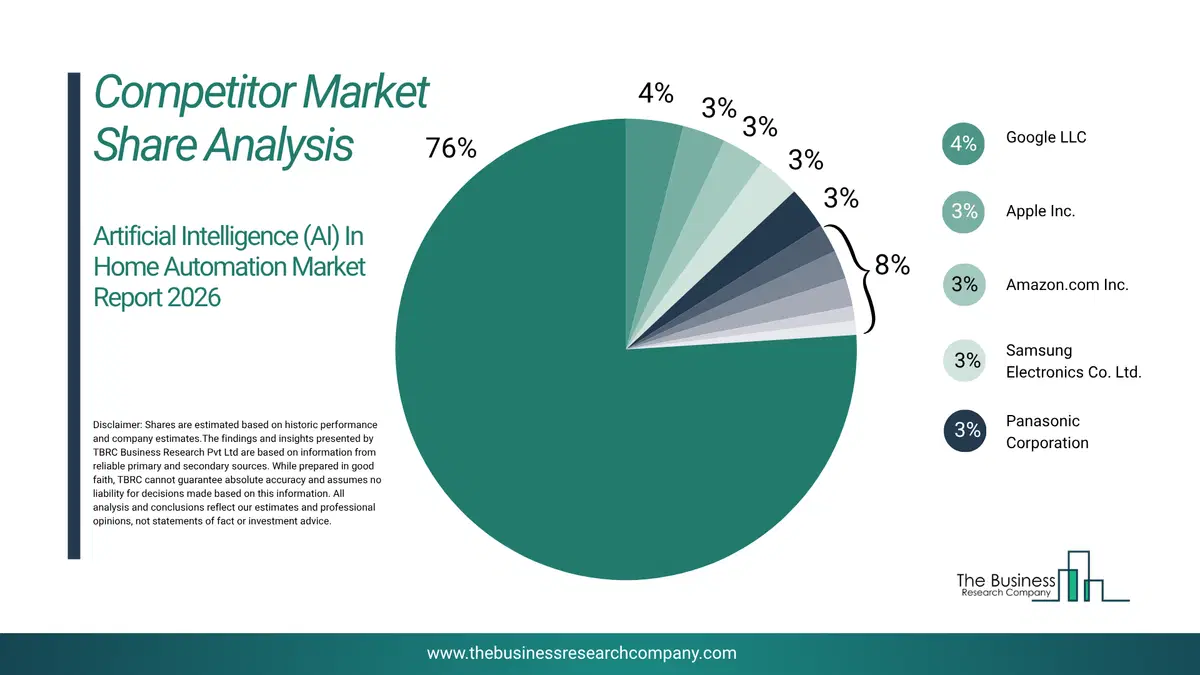
This chart is for illustrative purposes; the full report includes a detailed competitor analysis and comprehensive overview of the top 10 companies in the market.
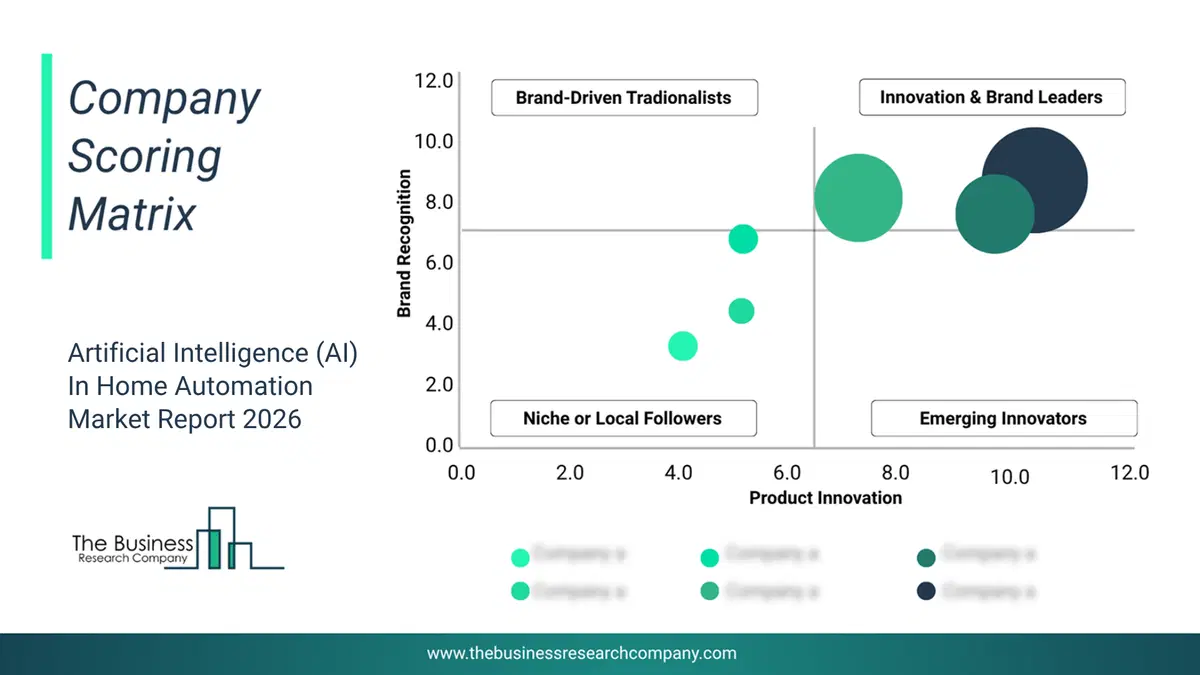
This chart maps companies by product innovation and brand strength, with bubble size indicating relative revenue, helping identify market leaders, challengers, and niche players. This is an illustrative chart; the full report provides a complete and accurate competitive analysis.
Global Artificial intelligence (AI) In Home Automation Market Trends and Insights
Major companies operating in the AI home automation market are integrating generative AI into consumer technology for enhanced personalization, such as generative AI-based home automation script generators, to create highly customized and adaptive home environments with extended market offerings. Generative AI-based smart home automation script generators automatically create customized scripts and routines for managing and optimizing smart home devices and systems. For instance, in November 2023, Google LLC, a US-based technology company, launched an innovative generative AI feature named “Help Me Script” in its script editor, designed to enhance smart home automation. This experimental tool enables users to create personalized automation scripts through natural language prompts, simplifying the process for individuals without coding expertise. This feature is available for a limited time and aims to empower users with advanced customization capabilities previously unattainable. Additionally, incorporating AI-driven automation, such as using camera events to trigger actions, points to a future where smart homes are increasingly proactive and responsive to user needs, further enhancing convenience and security.What Are Latest Mergers And Acquisitions In The Artificial intelligence (AI) In Home Automation Market?
In July 2024, LG Electronics Inc., a South Korea-based multinational conglomerate, acquired Athom B.V. for an undisclosed amount. This acquisition aims to bolster LG Electronics' position in the smart home automation sector by integrating Athom B.V.'s advanced home control technologies. LG seeks to leverage this integration to develop an AI-driven smart home ecosystem, enabling customers to interact with generative AI to manage appliances and IoT devices and create highly personalized environments tailored to their individual preferences. Athom B.V. is a Netherlands-based technology company specializing in AI-smart home automation solutions and innovative home control systems.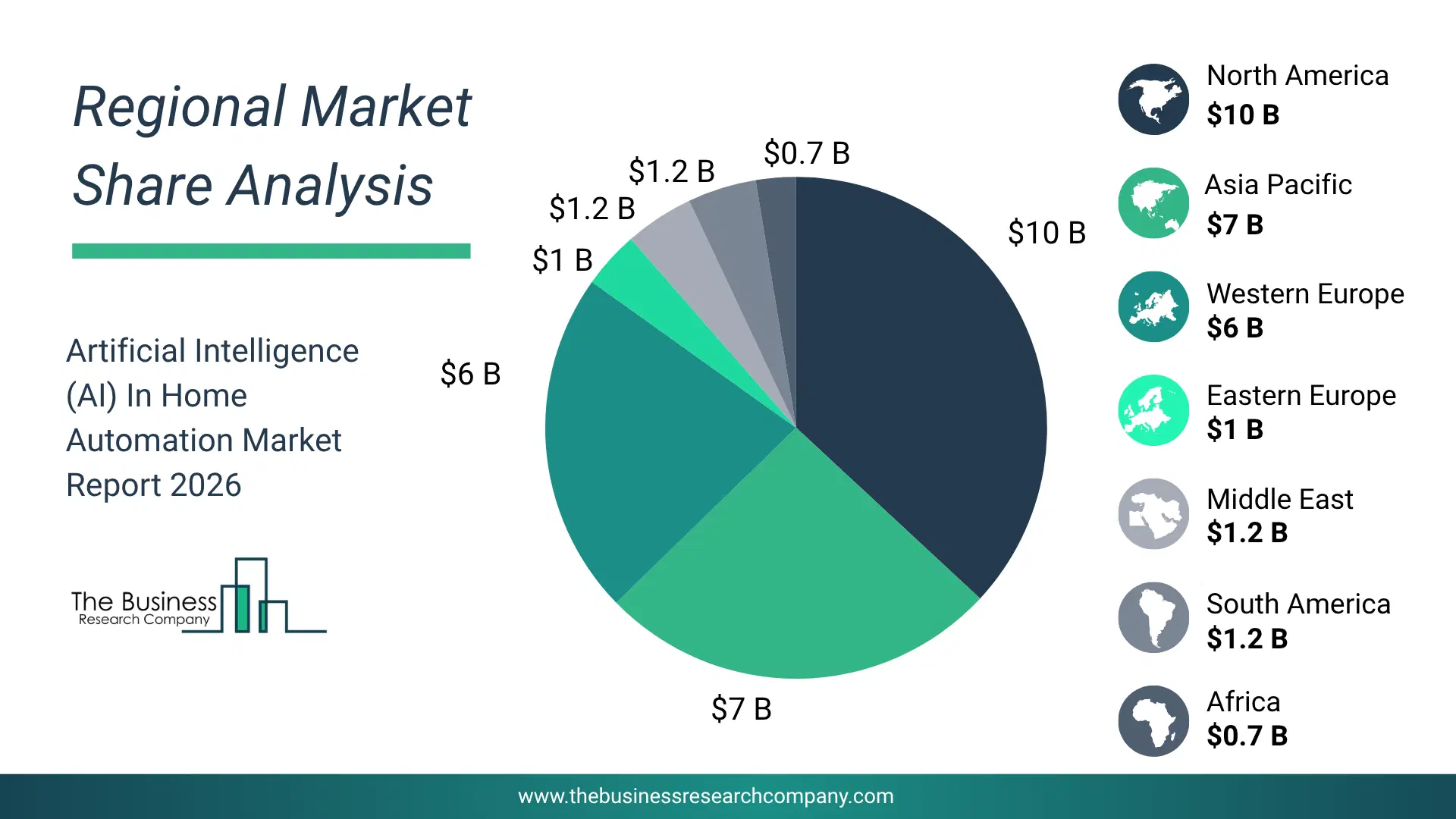
Regional Insights
North America was the largest region in the artificial intelligence (AI) in home automation market in 2025. The regions covered in this market report are Asia-Pacific, South East Asia, Western Europe, Eastern Europe, North America, South America, Middle East, Africa. The countries covered in this market report are Australia, Brazil, China, France, Germany, India, Indonesia, Japan, Taiwan, Russia, South Korea, UK, USA, Canada, Italy, Spain.What Defines the Artificial intelligence (AI) In Home Automation Market?
The artificial intelligence (AI) in home automation market consists of revenues earned by entities by providing services such as software solutions, cloud-based services, and support. The market value includes the value of related goods sold by the service provider or included within the service offering. artificial intelligence (AI) in home automation market also includes sales of smart speakers, thermostats, and security systems. Values in this market are ‘factory gate’ values, that is, the value of goods sold by the manufacturers or creators of the goods, whether to other entities (including downstream manufacturers, wholesalers, distributors, and retailers) or directly to end customers. The value of goods in this market includes related services sold by the creators of the goods.How is Market Value Defined and Measured?
The market value is defined as the revenues that enterprises gain from the sale of goods and/or services within the specified market and geography through sales, grants, or donations in terms of the currency (in USD unless otherwise specified). The revenues for a specified geography are consumption values that are revenues generated by organizations in the specified geography within the market, irrespective of where they are produced. It does not include revenues from resales along the supply chain, either further along the supply chain or as part of other products.
This chart presents market attractiveness based on a quantitative evaluation of growth, competition, strategic alignment, and risk, offering a clear view of opportunity areas for decision-making. This chart is for illustrative purposes; the full report contains the complete analysis.

This chart highlights the Total Addressable Market (TAM) by estimating the maximum revenue opportunity using an assumption-driven approach, supporting strategic planning and opportunity sizing across markets. The chart is illustrative; the full report provides a more comprehensive analysis.
What Key Data and Analysis Are Included in the Artificial intelligence (AI) In Home Automation Market Report 2026?
The artificial intelligence (ai) in home automation market research report is one of a series of new reports from The Business Research Company that provides market statistics, including industry global market size, regional shares, competitors with the market share, detailed market segments, market trends and opportunities, and any further data you may need to thrive in the artificial intelligence (ai) in home automation industry. The market research report delivers a complete perspective of everything you need, with an in-depth analysis of the current and future state of the industry.Artificial intelligence (AI) In Home Automation Market Report Forecast Analysis
| Report Attribute | Details |
|---|---|
| Market Size Value In 2026 | $34.57 billion |
| Revenue Forecast In 2030 | $97.05 billion |
| Growth Rate | CAGR of 29.8% from 2026 to 2030 |
| Base Year For Estimation | 2025 |
| Actual Estimates/Historical Data | 2020-2025 |
| Forecast Period | 2026 - 2030 |
| Market Representation | Revenue in USD Billion and CAGR from 2026 to 2030 |
| Segments Covered | Component, Technology, Application |
| Regional Scope | Asia-Pacific, Western Europe, Eastern Europe, North America, South America, Middle East, Africa |
| Country Scope | The countries covered in the report are Australia, Brazil, China, France, Germany, India, Indonesia, Japan, Taiwan, Russia, South Korea, UK, USA, Canada, Italy, Spain. |
| Key Companies Profiled | Amazon.com Inc., Apple Inc., Alphabet Inc., Samsung Electronics Co. Ltd., Microsoft Corporation, Siemens AG, Intel Corporation., International Business Machines Corporation, LG Corporation, Panasonic Corporation, Xiaomi Corporation, Schneider Electric SE, Honeywell International Inc., ABB Ltd, Nvidia Corporation., Johnson Controls International PLC, Legrand, ADT Inc., Vivint Smart Home Inc., iRobot Corporation, Sansiri PLC, Control4 Corporation, Qualisys AB, Mycroft AIInc., Josh.AI |
| Customization Scope | Request for Customization |
| Pricing And Purchase Options | Explore Purchase Options |