
Automotive Parts Feeders Market Report 2026
Global Outlook – By Feeder Type (Vibratory Bowl Feeders, Centrifugal Feeders, Step Feeders, Flexible Feeders, Linear Feeders, Escapement Feeders), By Automation Level (Manual Feeders, Semi-Automatic Feeders, Fully Automatic Feeders), By Technology (Mechanical Feeding Technology, Pneumatic Feeding Technology, Servo-Driven Feeding Technology, Vision-Guided Feeding Technology), By Application Area (Engine Assembly, Transmission Assembly, Chassis and Suspension Assembly, Interior Assembly, Electrical and Electronics Assembly, Body and Exterior Assembly) – Market Size, Trends, Strategies, and Forecast to 2030
Automotive Parts Feeders Market Overview
• Automotive Parts Feeders market size has reached to $4.19 billion in 2025 • Expected to grow to $5.72 billion in 2030 at a compound annual growth rate (CAGR) of 6.5% • Growth Driver: The Rising Adoption Of Electric Vehicles (EVs) Fueled The Automotive Parts Feeders Market Due To Increased Demand For Efficient Component Supply • Market Trend: ARS Automation Launches FlexiBowl 200 Compact And Flexible Robotic Feeder To Optimize Small Parts Handling • North America was the largest region in 2025 and Asia-Pacific is the fastest growing region.Market Gains By 2030 – Top Opportunities By Segment
Market Gain identifies the most promising market opportunities by highlighting the segments or products expected to generate the highest incremental revenue growth over the next five years.
What Is Covered Under Automotive Parts Feeders Market?
Automotive parts feeders are mechanical or automated devices designed to supply and position automotive components consistently and efficiently for assembly or manufacturing processes. These feeders improve production efficiency, reduce manual handling, and ensure precise, consistent placement of parts during vehicle assembly. The main types of automotive parts feeders are bumpers, grilles, spoilers, mirror covers, door handles, fender flares, mud flaps, side skirts, and window trims. Bumpers refer to protective components attached to the front and rear of a vehicle to absorb impact in minor collisions and enhance safety. These parts are manufactured using diverse materials such as plastic, aluminum, carbon fiber, stainless steel, rubber, and composite materials by leveraging advanced production technologies including injection molding, thermoforming, 3D printing, extrusion, and lamination. These parts find applications in passenger vehicles, commercial vehicles, electric vehicles, luxury vehicles, and off-road vehicles, catering to a broad spectrum of end users, including automotive manufacturers, repair shops, car enthusiasts, and fleet operators.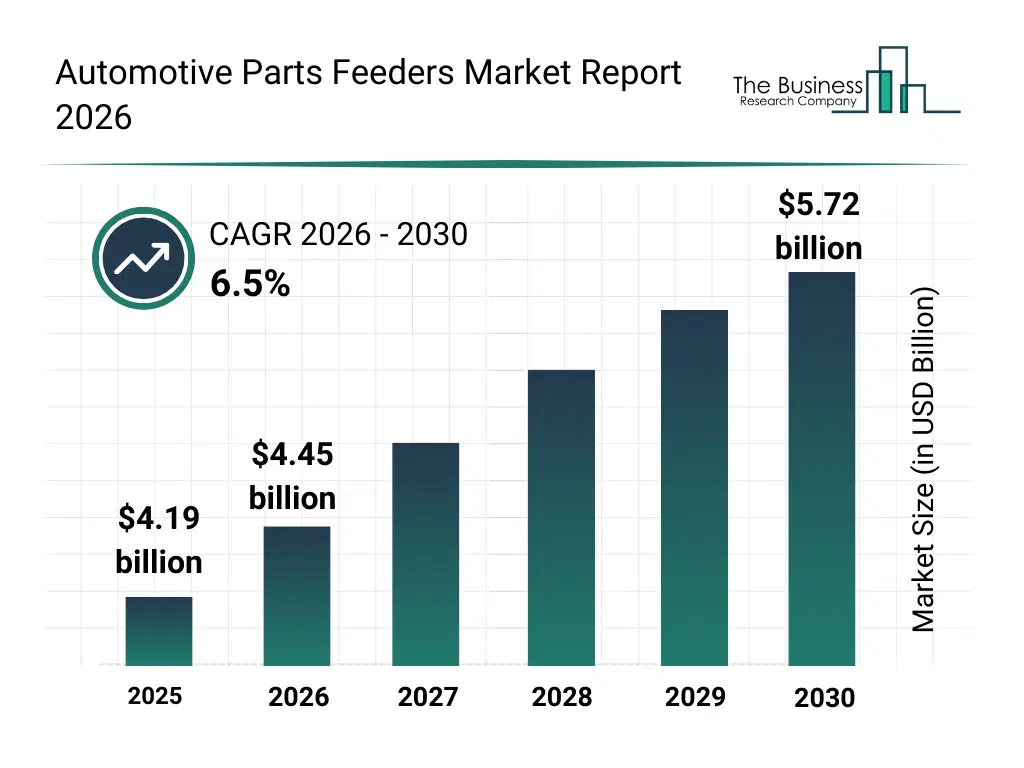
What Is The Automotive Parts Feeders Market Size and Share 2026?
The automotive parts feeders market size has grown strongly in recent years. It will grow from $4.19 billion in 2025 to $4.45 billion in 2026 at a compound annual growth rate (CAGR) of 6.2%. The growth in the historic period can be attributed to expansion of automotive manufacturing plants, increasing automation in vehicle assembly lines, rising demand for production efficiency, growth of modular manufacturing systems, availability of advanced feeder technologies.What Is The Automotive Parts Feeders Market Growth Forecast?
The automotive parts feeders market size is expected to see strong growth in the next few years. It will grow to $5.72 billion in 2030 at a compound annual growth rate (CAGR) of 6.5%. The growth in the forecast period can be attributed to increasing adoption of smart factories, rising electric vehicle production, growing integration of AI-based inspection systems, expansion of flexible manufacturing lines, increasing investments in automation upgrades. Major trends in the forecast period include integration of automated parts feeding systems, rising adoption of vision-guided feeders, growing use of flexible feeder designs, expansion of high-speed assembly line feeders, increased demand for precision component positioning.
Global Automotive Parts Feeders Market Segmentation
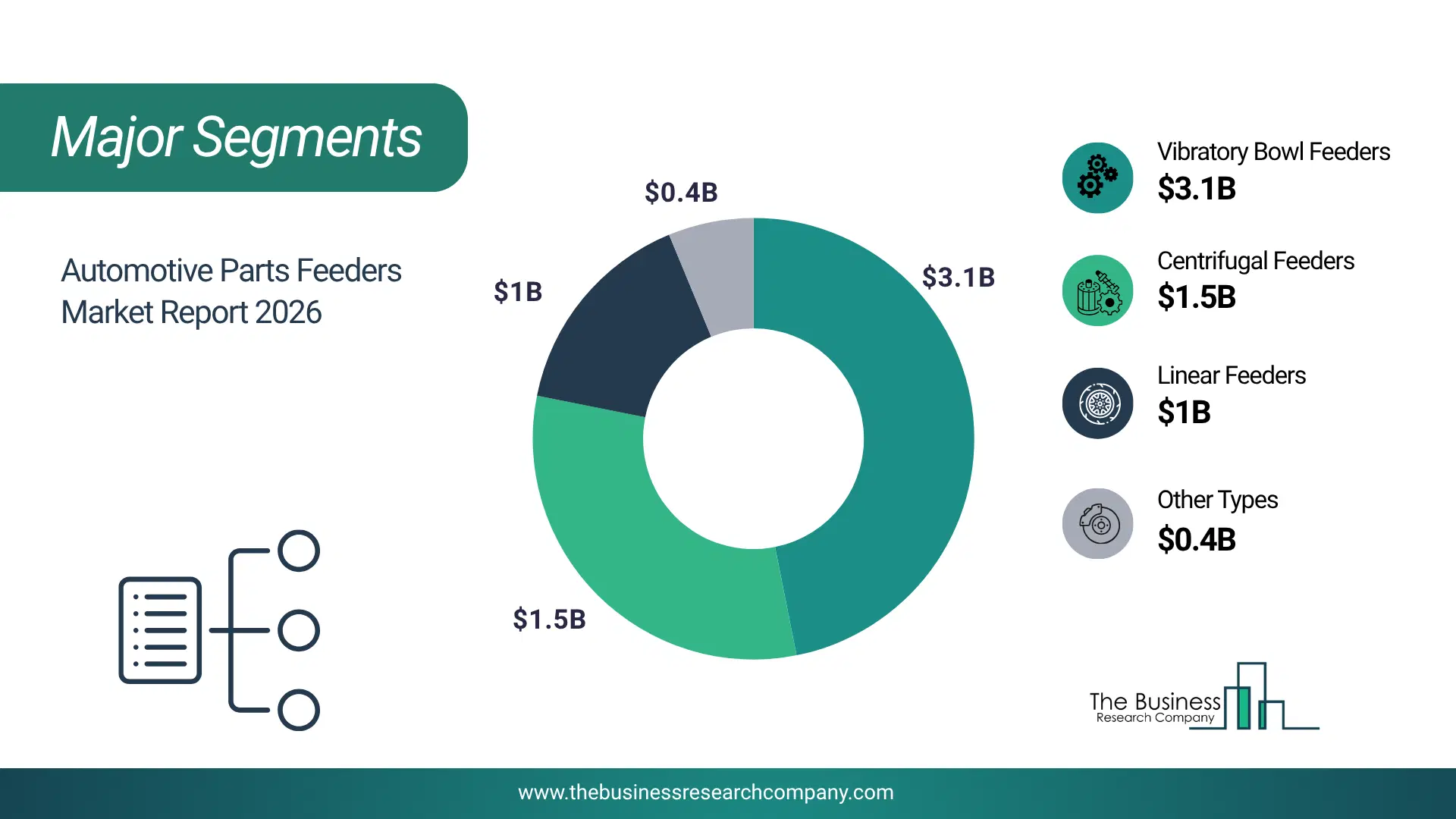
1) By Feeder Type: Vibratory Bowl Feeders, Centrifugal Feeders, Step Feeders, Flexible Feeders, Linear Feeders, Escapement Feeders 2) By Automation Level: Manual Feeders, Semi-Automatic Feeders, Fully Automatic Feeders 3) By Technology: Mechanical Feeding Technology, Pneumatic Feeding Technology, Servo-Driven Feeding Technology, Vision-Guided Feeding Technology 4) By Application Area: Engine Assembly, Transmission Assembly, Chassis and Suspension Assembly, Interior Assembly, Electrical and Electronics Assembly, Body and Exterior Assembly Subsegments: 1) By Vibratory Bowl Feeders: Inline Bowl Feeders, Tool-less Bowl Feeders, High-Speed Bowl Feeders 2) By Centrifugal Feeders: Rotary Disk Feeders, High-Throughput Centrifugal Feeders 3) By Step Feeders: Stair-Type Step Feeders, Noise-Reduced Step Feeders 4) By Flexible Feeders: Vision-Guided Flexible Feeders, Robotic-Integrated Flexible Feeders 5) By Linear Feeders: Single-Track Feeders, Multi-Track Feeders 6) By Escapement Feeders: Pneumatic Escapements, Servo-Driven Escapements The top segments in the automotive parts feeders market will be: • Vibratory Bowl Feeders will reach $3.03 billion by 2030. • Centrifugal Feeders will reach $1.42 billion by 2030. • Linear Feeders will reach $0.92 billion by 2030. • Other Types will reach $0.35 billion by 2030.What Is The Driver Of The Automotive Parts Feeders Market?
The rising adoption of electric vehicles (EVs) is expected to drive the growth in the automotive parts feeders market. The electric vehicles (EVs) refer to the production, purchase, and use of battery-electric and plug-in hybrid vehicles across the globe. The principal factor driving this growth is the shift toward sustainable and low-emission mobility, which compels manufacturers to expand EV production capacity, invest in advanced battery and charging technologies, and improve vehicle range, efficiency, and safety standards. Automotive parts feeders enable the precise, continuous, and automated supply of critical EV components, such as batteries, motors, and power electronics, thereby enhancing production efficiency and supporting the effective scaling of EV manufacturing systems. For instance, in May 2025, according to the data published by the International Energy Agency (IEA), a France-based intergovernmental organization, global electric car sales exceeded 17 million in 2024, increasing over 25% from 2023 with an additional 3.5 million vehicles sold. Therefore, the rising adoption of electric vehicles (EVs) is driving the growth of the automotive parts feeders industry.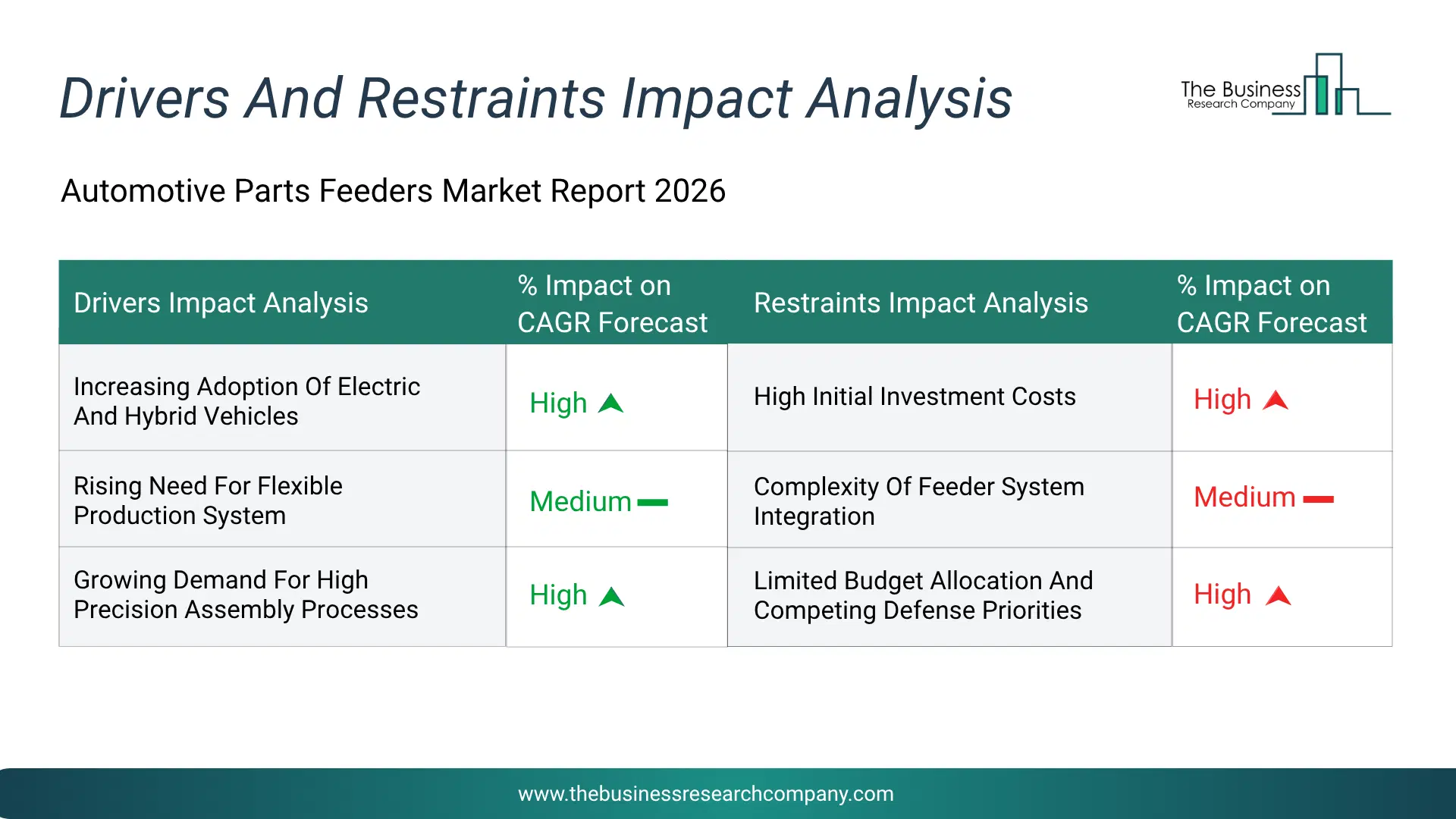
Infographic Chart Showing Key Market Drivers Analysis And Restraints For Automotive Parts Feeders Market
The chart presents an impact analysis of key drivers and restraints, quantifying their relative influence on the market's growth rate and helping assess the balance between growth enablers and limiting factors. This chart offers a high-level perspective; the full report contains more detailed insights.
How Will The Drivers Impact Growth In The Global Automotive Parts Feeders Market?
• Increasing Adoption Of Electric And Hybrid Vehicles (High) – During the forecast period, the increasing adoption of electric and hybrid vehicles is expected to become a key growth driver for the automotive parts feeders market by 2030. The expansion of ev and hybrid vehicle production is increasing demand for precision automotive components such as battery cells, wiring connectors, sensors, and lightweight fasteners. Compared to conventional vehicles, evs involve more complex assembly processes where consistency and accuracy are critical for safety and performance. Automated feeder systems enable efficient handling of small and delicate components while minimizing errors and production downtime. They also support large-scale manufacturing while maintaining strict quality standards. • Rising Need For Flexible Production System (Medium) – During the forecast period, the rising need for flexible production systems is expected to emerge as a major factor driving the expansion of the automotive parts feeders market by 2030. Automotive manufacturers are increasingly producing multiple vehicle models on shared assembly lines, requiring equipment that can adapt quickly to varying component sizes, shapes, and orientations. Automated feeders provide this flexibility by accommodating diverse parts with minimal changeover time and reduced manual intervention. This adaptability allows manufacturers to respond rapidly to shifting consumer preferences and shorter product life cycles. • Growing Demand For High Precision Assembly Processes (High) – During the forecast period, the growing demand for high-precision assembly processes is expected to act as a key growth catalyst for the automotive parts feeders market by 2030. Modern vehicles increasingly incorporate advanced electronics, safety systems, and lightweight components that require precise positioning during assembly. Even minor placement inaccuracies can affect vehicle performance or safety, making precision critical. Automated feeders ensure consistent orientation and accurate part delivery, reducing human error and enhancing overall assembly quality. They also help manufacturers comply with strict automotive reliability and durability standards.How Will The Restraints Impact Growth In The Global Automotive Parts Feeders Market?
• High Initial Investment Costs (High) – During the forecast period, the high initial investment costs act as a restraining factor for the automotive parts feeders market because advanced feeders require significant capital for purchase, installation, and integration with automated assembly lines. Small and medium-sized manufacturers often struggle to afford these systems, limiting adoption. Additionally, the cost of customization, maintenance, and operator training further adds to the financial burden. Many firms prefer manual or semi-automated alternatives to avoid heavy upfront expenses. This slows down market penetration, especially in developing regions where cost sensitivity is high. • Complexity Of Feeder System Integration (Medium) – During the forecast period, the integration of feeder systems in automotive manufacturing is often complex because it requires seamless compatibility with existing assembly lines, robotics, and control systems. Different parts feeders need customization to handle various component shapes, sizes, and materials, which increases engineering effort and setup time. Synchronizing feeders with high-speed automated processes also demands advanced programming and precision alignment. Any mismatch or malfunction can cause bottlenecks, downtime, or quality issues. • Limited Budget Allocation And Competing Defense Priorities (High) – During the forecast period, the limited budget allocation and competing defense priorities act as a restraining factor for the amphibious warfare ship market because naval procurement funds are often distributed across submarines, destroyers, aircraft carriers, and other critical defense assets. Amphibious warfare ships, while strategically important, may receive lower prioritization in defense spending cycles, especially in regions focusing on air defense or undersea capabilities. This leads to delayed procurement programs, reduced fleet expansion plans, and slower modernization initiatives. Additionally, economic constraints and shifting geopolitical priorities further influence funding decisions, limiting sustained investments in large amphibious platforms.Key Players In The Global Automotive Parts Feeders Market
Major companies operating in the automotive parts feeders market are ATS Automation Tooling Systems Inc., SPIROL International Corporation, Syntron Material Handling,LLC, Orientech Automation Solutions Inc., Lanco Integrated Inc., Performance Feeders Inc., Weber Schraubautomaten GmbH, Fuji Corporation, Service Engineering Inc., Deprag Schulz GmbH. CO. KG, TAD S.L., Flexfactory GmbH, FlexiBowl, RNA Automation Limited, Asyril SA, California Vibratory Feeders Inc., Cleveland Vibrator Company, Hoppmann Corporation, Fortville Feeders,Inc., Moorfeed Corporation, Vibromatic Co. Inc., CDS Manufacturing Inc., Vibratory Feeders Inc., Hoosier Feeder Company LLC, Podmores (Engineers) Ltd., Automation Devices Inc.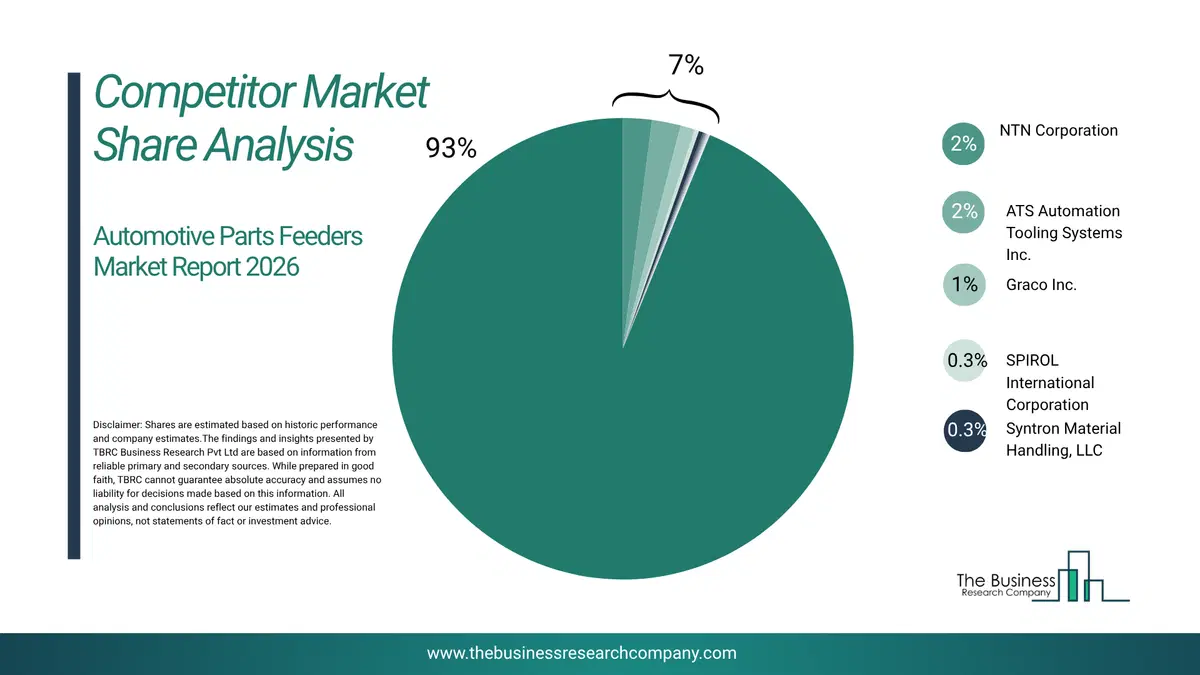
This chart is for illustrative purposes; the full report includes a detailed competitor analysis and comprehensive overview of the top 10 companies in the market.
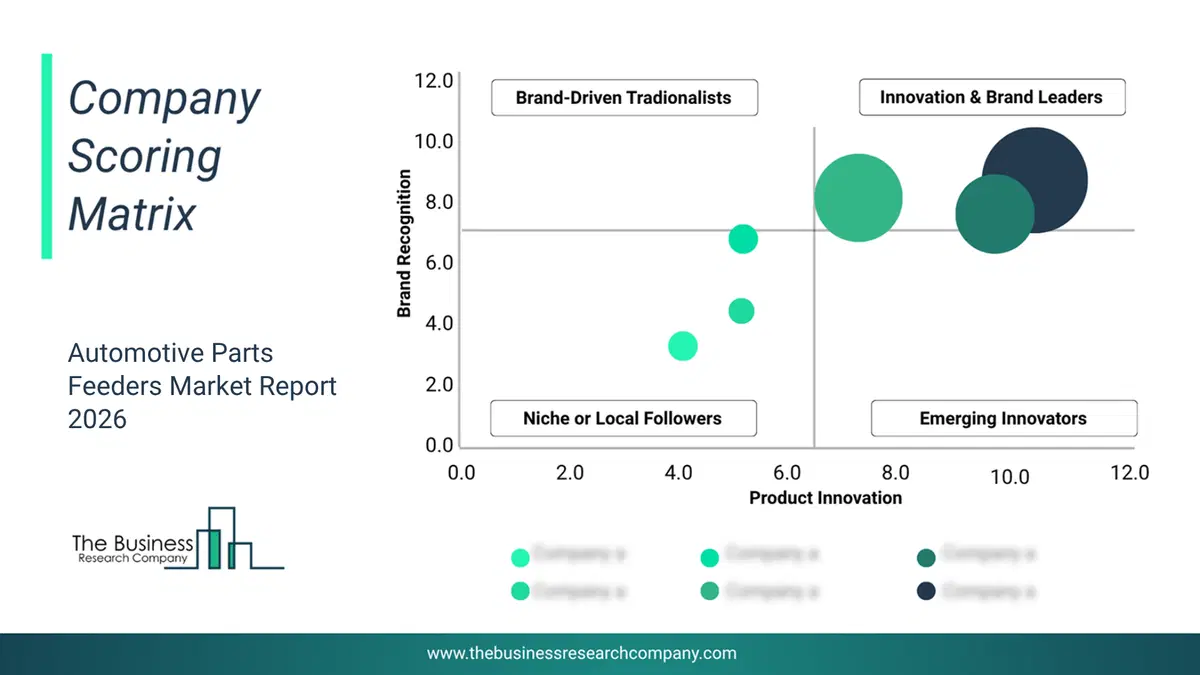
This chart maps companies by product innovation and brand strength, with bubble size indicating relative revenue, helping identify market leaders, challengers, and niche players. This is an illustrative chart; the full report provides a complete and accurate competitive analysis.
Global Automotive Parts Feeders Market Trends and Insights
Major companies operating in the automotive parts feeder market are introducing compact and flexible robotic feeding systems for handling small automotive components with high precision. Compact feeders are engineered to maximize workspace without compromising throughput or accuracy, making them suitable for dense and complex assembly lines. For instance, in September 2024, ARS Automation, an Italy-based company, launched the FlexiBowl 200, a compact parts feeder 25% shorter and 50% slimmer than previous models. This system provides high-throughput feeding of small components (1–10 mm) within a smaller footprint, enabling manufacturers to optimize workspace while maintaining precision and efficiency.What Are Latest Mergers And Acquisitions In The Automotive Parts Feeders Market?
In May 2025, Fanty Company Ltd., a China-based manufacturing company, partnered with Han's Laser Technology Industry Group Co. Ltd. to enhance their capabilities in precision laser-based manufacturing solutions for the automotive and industrial sectors. With this partnership aims to integrate advanced coil feeding and laser welding technologies to enhance precision, efficiency, and quality in automotive parts manufacturing, while expanding market opportunities through their combined strengths. Han's Laser Technology Industry Group Co. Ltd. is a China-based machine industry company that provides industrial laser equipment and intelligent manufacturing solutions.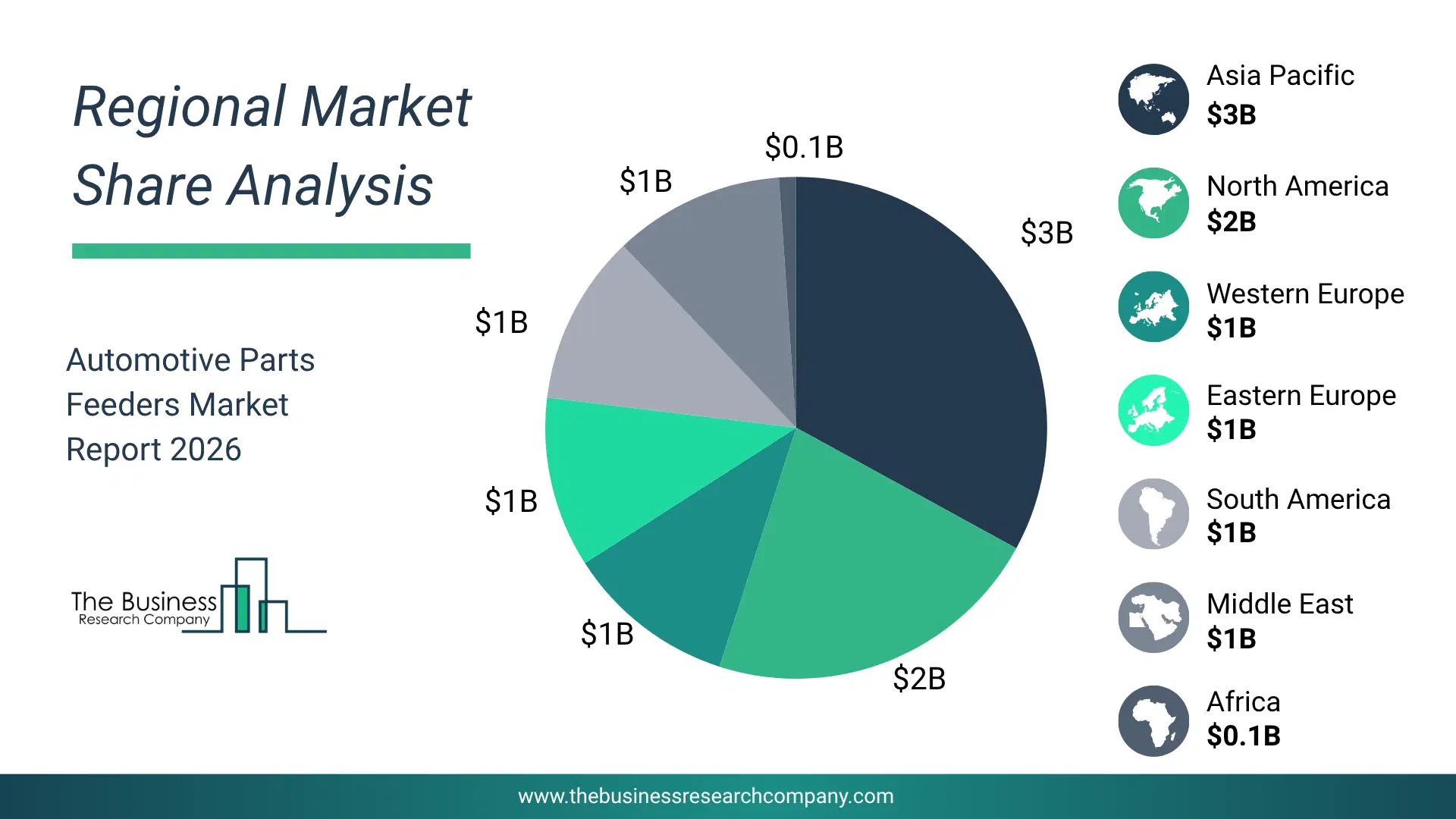
Regional Outlook
North America was the largest region in the automotive parts feeders market in 2025. Asia-Pacific is expected to be the fastest-growing region in the forecast period. The regions covered in this market report are Asia-Pacific, South East Asia, Western Europe, Eastern Europe, North America, South America, Middle East, Africa The countries covered in this market report are Australia, Brazil, China, France, Germany, India, Indonesia, Japan, Taiwan, Russia, South Korea, UK, USA, Canada, Italy, Spain.What Defines the Automotive Parts Feeders Market?
The automotive parts feeders market consists of sales of flexible feeders, custom automated feed systems, hopper feeders, magnetic feeders, and air feeders. Values in this market are ‘factory gate’ values, that is, the value of goods sold by the manufacturers or creators of the goods, whether to other entities (including downstream manufacturers, wholesalers, distributors, and retailers) or directly to end customers. The value of goods in this market includes related services sold by the creators of the goods.How is Market Value Defined and Measured?
The market value is defined as the revenues that enterprises gain from the sale of goods and/or services within the specified market and geography through sales, grants, or donations in terms of the currency (in USD unless otherwise specified). The revenues for a specified geography are consumption values that are revenues generated by organizations in the specified geography within the market, irrespective of where they are produced. It does not include revenues from resales along the supply chain, either further along the supply chain or as part of other products.
This chart presents market attractiveness based on a quantitative evaluation of growth, competition, strategic alignment, and risk, offering a clear view of opportunity areas for decision-making. This chart is for illustrative purposes; the full report contains the complete analysis.

This chart highlights the Total Addressable Market (TAM) by estimating the maximum revenue opportunity using an assumption-driven approach, supporting strategic planning and opportunity sizing across markets. The chart is illustrative; the full report provides a more comprehensive analysis.
What Key Data and Analysis Are Included in the Automotive Parts Feeders Market Report 2026?
The automotive parts feeders market research report is one of a series of new reports from The Business Research Company that provides market statistics, including industry global market size, regional shares, competitors with the market share, detailed market segments, market trends and opportunities, and any further data you may need to thrive in the automotive parts feeders industry. The market research report delivers a complete perspective of everything you need, with an in-depth analysis of the current and future state of the industry.Automotive Parts Feeders Market Report Forecast Analysis
| Report Attribute | Details |
|---|---|
| Market Size Value In 2026 | $4.45 billion |
| Revenue Forecast In 2030 | $5.72 billion |
| Growth Rate | CAGR of 6.5% from 2026 to 2030 |
| Base Year For Estimation | 2025 |
| Actual Estimates/Historical Data | 2020-2025 |
| Forecast Period | 2026 - 2030 |
| Market Representation | Revenue in USD Billion and CAGR from 2026 to 2030 |
| Segments Covered | Feeder Type, Automation Level, Technology, Application Area |
| Regional Scope | Asia-Pacific, Western Europe, Eastern Europe, North America, South America, Middle East, Africa |
| Country Scope | The countries covered in the report are Australia, Brazil, China, France, Germany, India, ... |
| Key Companies Profiled | ATS Automation Tooling Systems Inc., SPIROL International Corporation, Syntron Material Handling,LLC, Orientech Automation Solutions Inc., Lanco Integrated Inc., Performance Feeders Inc., Weber Schraubautomaten GmbH, Fuji Corporation, Service Engineering Inc., Deprag Schulz GmbH. CO. KG, TAD S.L., Flexfactory GmbH, FlexiBowl, RNA Automation Limited, Asyril SA, California Vibratory Feeders Inc., Cleveland Vibrator Company, Hoppmann Corporation, Fortville Feeders,Inc., Moorfeed Corporation, Vibromatic Co. Inc., CDS Manufacturing Inc., Vibratory Feeders Inc., Hoosier Feeder Company LLC, Podmores (Engineers) Ltd., Automation Devices Inc. |
| Customization Scope | Request for Customization |
| Pricing And Purchase Options | Explore Purchase Options |