
Autonomous Cargo Aircraft Market Report 2026
Global Outlook – By Aircraft Type (Fixed-Wing Autonomous Cargo Aircraft, Vertical Take-Off and Landing (VTOL) Autonomous Aircraft), By Payload Capacity (Small, Medium, Large), By Autonomy Level (Fully Autonomous, Remotely Piloted Aircraft, Semi-Autonomous), By Range (Short-Range, Medium-Range, Long-Range), By Application (E-commerce And Retail Logistics, Industrial And Offshore Logistics, Military And Defense, Humanitarian And Disaster Relief) – Market Size, Trends, Strategies, and Forecast to 2030
Autonomous Cargo Aircraft Market Overview
• Autonomous Cargo Aircraft market size has reached to $1.37 billion in 2025 • Expected to grow to $4.15 billion in 2030 at a compound annual growth rate (CAGR) of 24.6% • Growth Driver: Rising E-Commerce And On-Demand Logistics Fueling The Growth Of The Market Due To Demand For Faster Unmanned Deliveries • Market Trend: Next-Gen Autonomous Aircraft Enhances Range And Low-Visibility Performance • North America was the largest region in 2025.What Is Covered Under Autonomous Cargo Aircraft Market?
Autonomous cargo aircraft are unmanned aerial vehicles (UAVs) or drones designed to transport goods without a human pilot onboard. It uses advanced navigation systems, artificial intelligence, and sensors to operate independently or with minimal remote supervision. Its main purpose is to enhance logistics efficiency by enabling faster, cost-effective, and flexible cargo delivery, especially in remote or hard-to-reach areas. The main types of autonomous cargo aircraft are fixed-wing autonomous cargo aircraft and vertical take-off and landing (VTOL) autonomous aircraft. A fixed-wing autonomous cargo aircraft is an unmanned aerial vehicle that uses stationary wings for lift and operates without a human pilot to transport goods over medium to long distances. It comes in various payload capacities, including small, medium, and large. There are different levels of autonomy, such as fully autonomous, remotely piloted, and semi-autonomous. These aircraft also vary by range, including short-range, medium-range, and long-range, and are used in applications such as e-commerce and retail logistics, industrial and offshore logistics, military and defense, and humanitarian and disaster relief.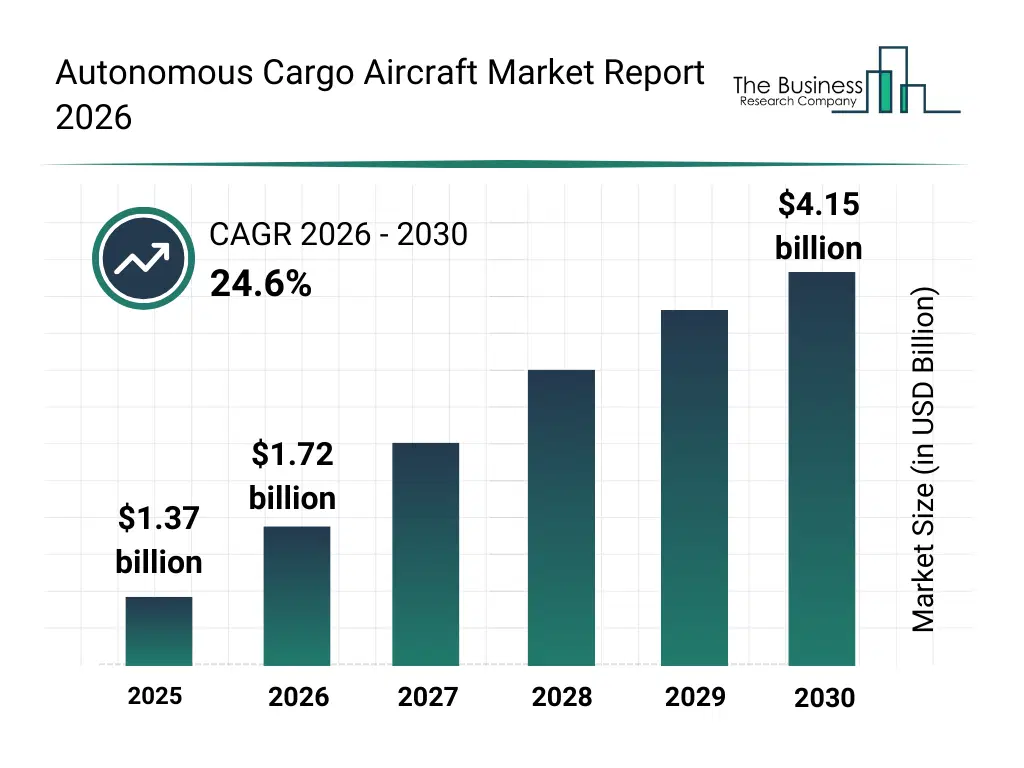
What Is The Autonomous Cargo Aircraft Market Size and Share 2026?
The autonomous cargo aircraft market size has grown exponentially in recent years. It will grow from $1.37 billion in 2025 to $1.72 billion in 2026 at a compound annual growth rate (CAGR) of 25.5%. The growth in the historic period can be attributed to development of early unmanned cargo drones for logistics testing, adoption of autonomous navigation and sensor technologies for flight control, deployment of urban air mobility (UAM) cargo vehicles for trial operations, integration of ground control stations (GCS) for remote monitoring, rising use of payload modules and detachable cargo pods for flexible transport.What Is The Autonomous Cargo Aircraft Market Growth Forecast?
The autonomous cargo aircraft market size is expected to see exponential growth in the next few years. It will grow to $4.15 billion in 2030 at a compound annual growth rate (CAGR) of 24.6%. The growth in the forecast period can be attributed to growing demand for autonomous cargo aircraft in last-mile delivery and cold chain logistics, expansion of disaster relief and humanitarian aid delivery services using UAVs, adoption of ai-driven route optimization and autonomous flight management, rising procurement of modular and scalable payload systems, focus on regulatory-compliant, long-range, and heavy-lift autonomous cargo platforms. Major trends in the forecast period include expansion of autonomous long-distance cargo delivery routes, rising adoption of unmanned aircraft for disaster relief logistics, growing demand for detachable cargo pods and modular payload systems, increased interest in hybrid fixed-wing–vtol cargo platforms, emergence of autonomous freight corridors in remote regions.
Global Autonomous Cargo Aircraft Market Segmentation
1) By Aircraft Type: Fixed-Wing Autonomous Cargo Aircraft, Vertical Take-Off and Landing (VTOL) Autonomous Aircraft 2) By Payload Capacity: Small, Medium, Large 3) By Autonomy Level: Fully Autonomous, Remotely Piloted Aircraft, Semi-Autonomous 4) By Range: Short-Range, Medium-Range, Long-Range 5) By Application: E-commerce And Retail Logistics, Industrial And Offshore Logistics, Military And Defense, Humanitarian And Disaster Relief Subsegments: 1) By Fixed-wing Autonomous Cargo Aircraft: Conventional Take-off and Landing (CTOL), Short Take-off and Landing (STOL), High-altitude Long Endurance (HALE), Medium-altitude Long Endurance (MALE) 2) By Vertical Take-Off and Landing (VTOL) Autonomous Aircraft: Multirotor, Tiltrotor, Tilt-wing, Lift + CruiseWhat Is Driver Of The Autonomous Cargo Aircraft Market?
The rising e-commerce and on-demand logistics are expected to propel the growth of the autonomous cargo aircraft market going forward. E-commerce and on-demand logistics refer to the digital buying and selling of goods paired with fast, flexible delivery services that fulfill consumer orders in real-time or within short timeframes. The increasing e-commerce and on-demand logistics are driven by growing consumer expectations for faster, more convenient delivery experiences. Autonomous cargo aircraft enhance e-commerce and on-demand logistics by enabling faster, unmanned deliveries over long distances. They improve supply chain efficiency by reducing transit times and operational costs, supporting timely and flexible order fulfillment. For instance, in February 2025, according to the United States Census Bureau, a US-based government agency, total e-commerce sales in 2024 reached $1,192.6 billion, marking an 8.1% increase compared to 2023. Therefore, the rising e-commerce and on-demand logistics are driving the growth of the autonomous cargo aircraft industry.Key Players In The Global Autonomous Cargo Aircraft Market
Major companies operating in the autonomous cargo aircraft market are The Boeing Company, Airbus SE, Northrop Grumman Corporation, BAE Systems plc, Textron Inc., Elbit Systems Ltd., Saab AB, Aerospace CH UAV Co. Ltd., Natilus Inc., Volocopter GmbH, Dronamics EAD, Reliable Robotics Corporation, Xwing Inc., Pyka Inc., Volansi Inc., Elroy Air Inc., EHang Holdings Limited, MightyFly Inc., Sabrewing Aircraft Company Inc., Air White Whale (Changsha) Technology Co. Ltd., Yitong UAV System Co. Ltd.
This chart is for illustrative purposes; the full report includes a detailed competitor analysis and comprehensive overview of the top 10 companies in the market.
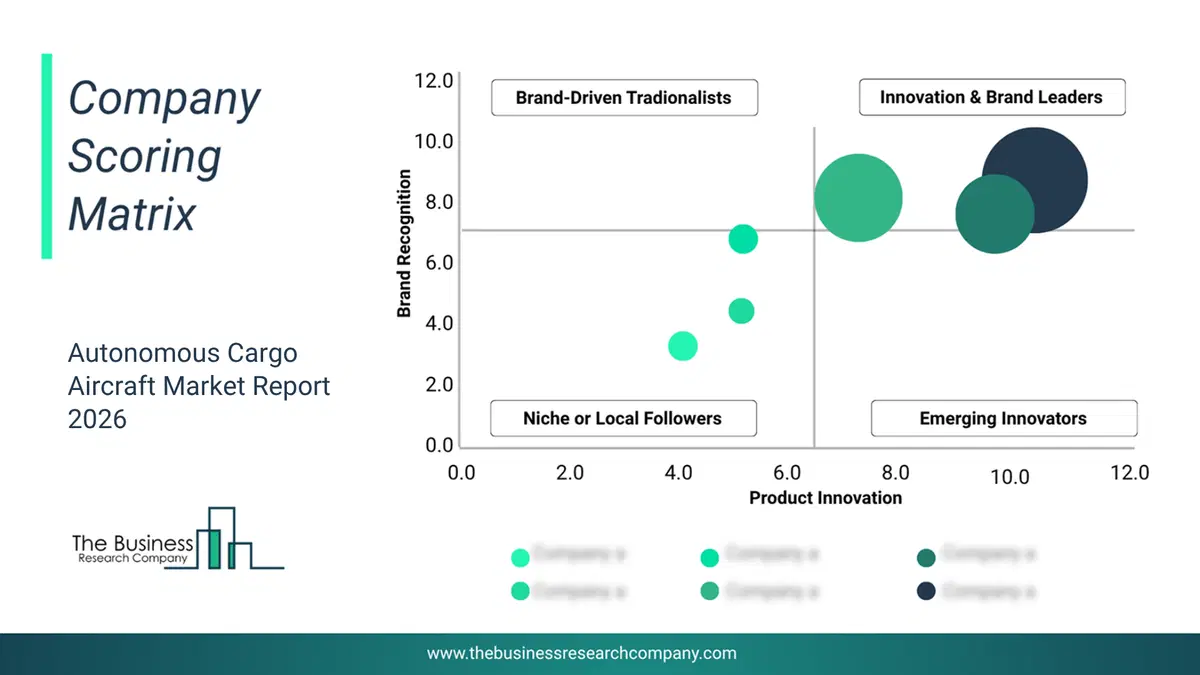
This chart maps companies by product innovation and brand strength, with bubble size indicating relative revenue, helping identify market leaders, challengers, and niche players. This is an illustrative chart; the full report provides a complete and accurate competitive analysis.
Global Autonomous Cargo Aircraft Market Trends and Insights
Major companies operating in the autonomous cargo aircraft market are focusing on technological advancements, such as heavy-lift cargo unmanned aerial vehicles (UAVs), to enhance payload capacity, extend range, and improve operational efficiency across logistics, defense, and humanitarian applications. Heavy-lift cargo UAVs are unmanned aerial vehicles designed to carry and transport large and heavy payloads over long distances without human pilots onboard. For instance, in January 2025, Windracers, a UK-based aerospace technology company, launched the ULTRA MK2, a next-generation autonomous cargo aircraft. It features a 10-meter wingspan and is powered by dual 50 hp Hirth F23 engines, doubling the power of the previous model, and carries up to 150 kg 50% more while reducing fuel cost per kilogram by half. ULTRA MK2 operates fully autonomously, even in low-visibility conditions such as night and fog, leveraging Windracers’ proprietary autopilot system.What Are Latest Mergers And Acquisitions In The Autonomous Cargo Aircraft Market? Joby Expands Autonomous Capabilities With Strategic Acquisition Of Xwing Division
In June 2024, Joby Aviation, a US-based aerospace company, acquired the autonomy division of Xwing Inc. for an undisclosed amount. With this acquisition, Joby aims to fast-track autonomous flight development by integrating Xwing’s Superpilot software and team, supporting both current defense contracts and future electric air taxi operations. Xwing Inc. is a US-based aerospace company specializing in autonomous cargo aircraft, using its Superpilot software to enable self-flying cargo operations.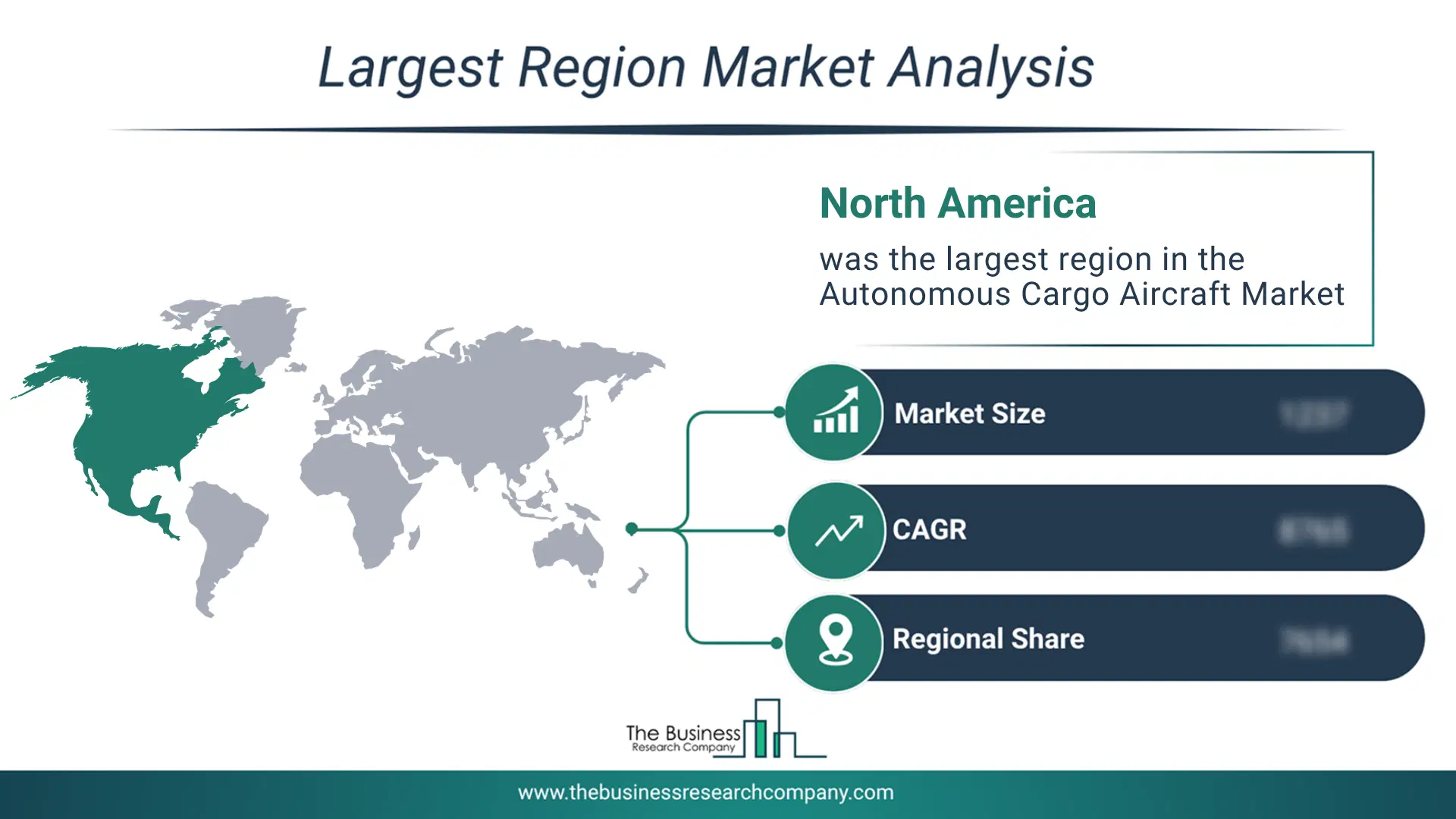
Regional Insights
North America was the largest region in the autonomous cargo aircraft market in 2025. Asia-Pacific is expected to be the fastest-growing region in the forecast period. The regions covered in this market report are Asia-Pacific, South East Asia, Western Europe, Eastern Europe, North America, South America, Middle East, Africa. The countries covered in this market report are Australia, Brazil, China, France, Germany, India, Indonesia, Japan, Taiwan, Russia, South Korea, UK, USA, Canada, Italy, SpainWhat Defines the Autonomous Cargo Aircraft Market?
The autonomous cargo aircraft market consists of revenues earned by entities by providing services such as autonomous freight delivery, cold chain logistics, disaster relief, and humanitarian aid delivery. The market value includes the value of related goods sold by the service provider or included within the service offering. The autonomous cargo aircraft market also includes sales of urban air mobility (UAM) cargo vehicles, autonomous ground control stations (GCS), and payload modules and detachable cargo pods. Values in this market are ‘factory gate’ values, that is, the value of goods sold by the manufacturers or creators of the goods, whether to other entities (including downstream manufacturers, wholesalers, distributors, and retailers) or directly to end customers. The value of goods in this market includes related services sold by the creators of the goods.How is Market Value Defined and Measured?
The market value is defined as the revenues that enterprises gain from the sale of goods and/or services within the specified market and geography through sales, grants, or donations in terms of the currency (in USD unless otherwise specified). The revenues for a specified geography are consumption values that are revenues generated by organizations in the specified geography within the market, irrespective of where they are produced. It does not include revenues from resales along the supply chain, either further along the supply chain or as part of other products.
This chart presents market attractiveness based on a quantitative evaluation of growth, competition, strategic alignment, and risk, offering a clear view of opportunity areas for decision-making. This chart is for illustrative purposes; the full report contains the complete analysis.

This chart highlights the Total Addressable Market (TAM) by estimating the maximum revenue opportunity using an assumption-driven approach, supporting strategic planning and opportunity sizing across markets. The chart is illustrative; the full report provides a more comprehensive analysis.
What Key Data and Analysis Are Included in the Autonomous Cargo Aircraft Market Report 2026?
The autonomous cargo aircraft market research report is one of a series of new reports from The Business Research Company that provides market statistics, including industry global market size, regional shares, competitors with the market share, detailed market segments, market trends and opportunities, and any further data you may need to thrive in the autonomous cargo aircraft industry. The market research report delivers a complete perspective of everything you need, with an in-depth analysis of the current and future state of the industry.Autonomous Cargo Aircraft Market Report Forecast Analysis
| Report Attribute | Details |
|---|---|
| Market Size Value In 2026 | $1.72 billion |
| Revenue Forecast In 2030 | $4.15 billion |
| Growth Rate | CAGR of 24.6% from 2026 to 2030 |
| Base Year For Estimation | 2025 |
| Actual Estimates/Historical Data | 2020-2025 |
| Forecast Period | 2026 - 2030 |
| Market Representation | Revenue in USD Billion and CAGR from 2026 to 2030 |
| Segments Covered | Aircraft Type, Payload Capacity, Autonomy Level, Range, Application |
| Regional Scope | Asia-Pacific, Western Europe, Eastern Europe, North America, South America, Middle East, Africa |
| Country Scope | The countries covered in the autonomous cargo aircraft market report are Australia, Brazil, China, France, Germany, India, Indonesia, Japan, Taiwan, Russia, South Korea, UK, USA, Canada, Italy, Spain |
| Key Companies Profiled | The Boeing Company, Airbus SE, Northrop Grumman Corporation, BAE Systems plc, Textron Inc., Elbit Systems Ltd., Saab AB, Aerospace CH UAV Co. Ltd., Natilus Inc., Volocopter GmbH, Dronamics EAD, Reliable Robotics Corporation, Xwing Inc., Pyka Inc., Volansi Inc., Elroy Air Inc., EHang Holdings Limited, MightyFly Inc., Sabrewing Aircraft Company Inc., Air White Whale (Changsha) Technology Co. Ltd., Yitong UAV System Co. Ltd. |
| Customization Scope | Request for Customization |
| Pricing And Purchase Options | Explore Purchase Options |