
Autonomous Ships Market Report 2026
Global Outlook – By Autonomy (Fully Autonomous, Remote Operations, Partial Autonomous ), By Propulsion Type (Fully Electric, Hybrid ), By End-User (Commercial, Defense ) – Market Size, Trends, Strategies, and Forecast to 2030
Autonomous Ships Market Overview
• Autonomous Ships market size has reached to $8.24 billion in 2025 • Expected to grow to $11.22 billion in 2030 at a compound annual growth rate (CAGR) of 6.5% • Growth Driver: The Role Of Autonomous Technology In Mitigating Marine Accidents And Financial Losses • Market Trend: AI-Powered Situational Awareness Technologies Advancing The Future Of Autonomous Maritime Navigation • Asia-Pacific was the largest region in 2025 and Western Europe is the fastest growing region.What Is Covered Under Autonomous Ships Market?
Autonomous ships are vessels that navigate and operate without direct human intervention, utilizing advanced technologies such as artificial intelligence, sensors, and automated systems to enhance safety, efficiency, and sustainability in maritime operations. The autonomy in the autonomous ship market is fully autonomous, remote operations, and partial autonomous. Partial autonomous ships refer to the ships that are safer than the others and are operated by artificial intelligence, which helps to avoid droning of the ship. The propulsion types involved are fully electric or hybrid. The various fuel types involved are carbon-neutral fuels, LNG, electricity, and heavy fuel oil/marine engine fuel. The end-users involved are commercial and defense.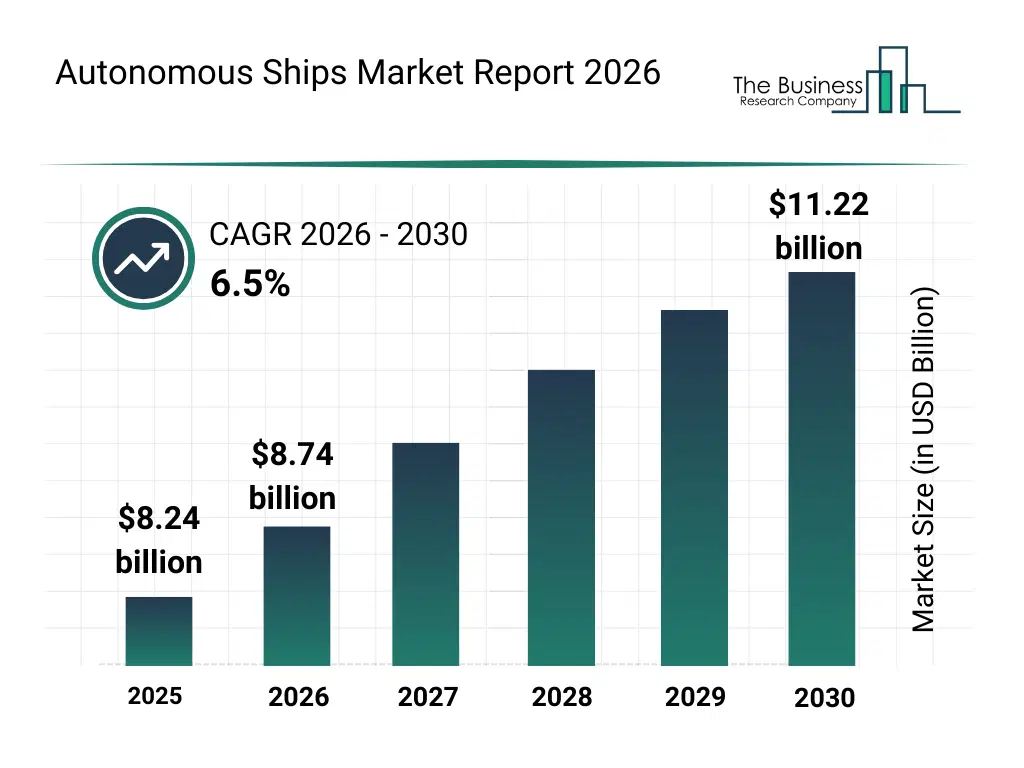
What Is The Autonomous Ships Market Size and Share 2026?
The autonomous ships market size has grown strongly in recent years. It will grow from $8.24 billion in 2025 to $8.74 billion in 2026 at a compound annual growth rate (CAGR) of 6.0%. The growth in the historic period can be attributed to shipping automation trials, maritime safety enhancement, fuel efficiency demand, early autonomous navigation systems, digital maritime operations.What Is The Autonomous Ships Market Growth Forecast?
The autonomous ships market size is expected to see strong growth in the next few years. It will grow to $11.22 billion in 2030 at a compound annual growth rate (CAGR) of 6.5%. The growth in the forecast period can be attributed to regulatory support for autonomous shipping, smart port infrastructure growth, decarbonization targets, AI-based maritime analytics, autonomous fleet optimization. Major trends in the forecast period include development of fully autonomous vessels, remote fleet operation adoption, integration of ai collision avoidance, growth of electric autonomous ships, expansion of smart ports.
Global Autonomous Ships Market Segmentation
1) By Autonomy: Fully Autonomous, Remote Operations, Partial Autonomous 2) By Propulsion Type: Fully Electric, Hybrid 3) By End-User: Commercial, Defense Subsegments: 1) By Fully Autonomous: Fully Automated Container Ships, Autonomous Bulk Carriers, Unmanned Surface Vessels (USVs) 2) By Remote Operations: Remotely Operated Cargo Ships, Remote-Controlled Ferries, Teleoperated Fishing Vessels 3) By Partial Autonomous: Assisted Navigation Ships, Autonomous Barges With Human Oversight, Semi-Autonomous YachtsWhat Is The Driver Of The Autonomous Ships Market?
Increasing marine accidents caused by human errors lead to high financial losses, which are predicted to act as a major driver for the growth of the autonomous ship market. Unmanned ships or autonomous technology apprehend accidents attributed to human errors and contribute to the higher potential of reducing onboard accidents. For instance, in July 2023, according to a report published by the Marine Accident Investigation Branch (MAIB), a UK-based government agency, almost 700 marine pilots conducted over 96,000 transfers using pilot ladders, resulting in more than 400 incidents. Of these, 25% were due to shackles instead of rolling hitches securing the side ropes, 23% were caused by poor material condition of the ladders, and 13% occurred because handhold stanchions were inadequate. Therefore, the use of autonomous ships to reduce the increasing number of accidents due to human error and financial losses is expected to drive the demand for the growth of the autonomous ships industry over the next few years.Key Players In The Global Autonomous Ships Market
Major companies operating in the autonomous ships market report include Mitsui E&S Holdings Co. Ltd., Siemens AG, General Electric Company, Hyundai Heavy Industries Co. Ltd., Northrop Grumman Corporation, Honeywell International Inc., ABB Ltd., BAE Systems plc, Nippon Yusen Kabushiki Kaisha, L3Harris Technologies Inc., Rolls-Royce Holding plc, L3 ASV Global Ltd., Wärtsilä Corporation, Wärtsilä Corporation Inc., Valmet Corporation, Daewoo Shipbuilding & Marine Engineering Co. Ltd., Kongsberg Gruppen AS, DNV GL AS, Fugro N.V., Vigor Industrial LLC, Rh Marine Ltd., Ocean GNS, ASV Global Limited, Praxis Automation Technology B.V., Automated Ships Ltd., SELSAN A.Ş., Autonomous Knight BV, Mapsea Corp. Ltd.
This chart is for illustrative purposes; the full report includes a detailed competitor analysis and comprehensive overview of the top 10 companies in the market.
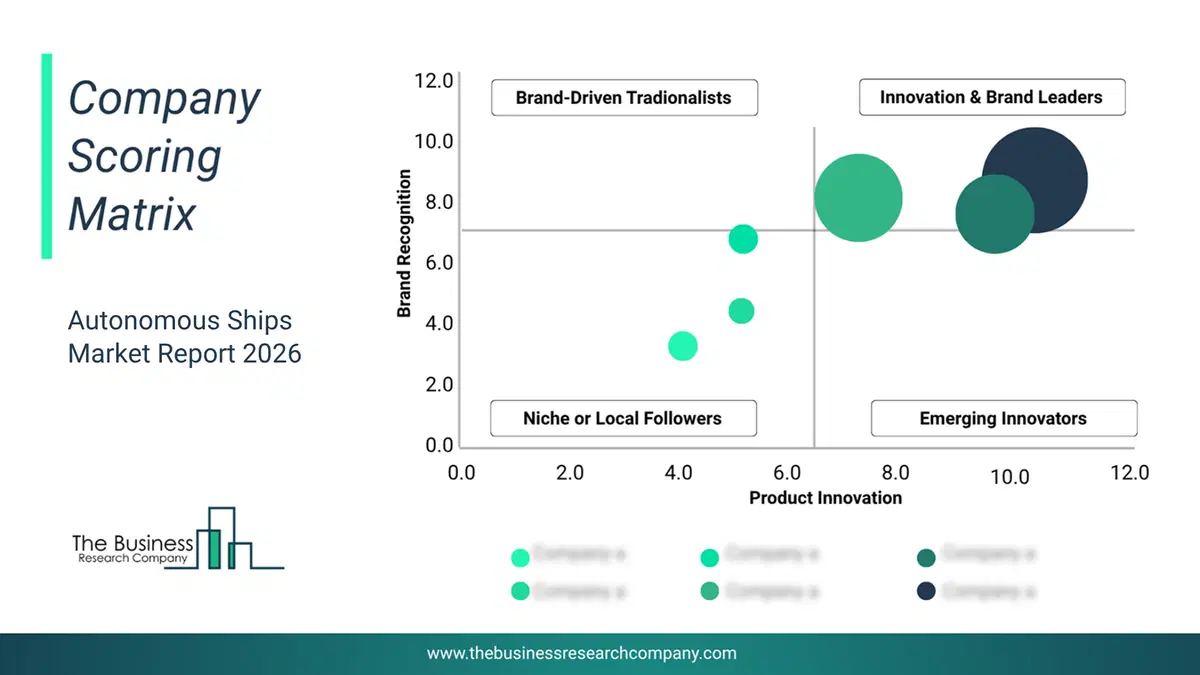
This chart maps companies by product innovation and brand strength, with bubble size indicating relative revenue, helping identify market leaders, challengers, and niche players. This is an illustrative chart; the full report provides a complete and accurate competitive analysis.
Global Autonomous Ships Market Trends and Insights
Major companies operating in the autonomous ships market are focusing on technological advancements, such as real‑time AI‑powered situational awareness and navigation systems, to meet the rising demand for safer, more efficient, and regulation‑compliant autonomous vessel operations. For instance, in September 2024, Seadronix, a South Korea–based developer of maritime AI and navigation solutions, launched NAVISS 2.0, an advanced “True‑AI” ship monitoring and navigation system at the SMM 2024 maritime trade fair. This system merges multiple onboard sensors (e.g. cameras, radar/LiDAR, possibly) to produce a seamless, 360-degree “around‑view” of the ship’s surroundings delivering a real‑time bird’s‑eye aerial view. NAVISS 2.0 leverages Seadronix’s proprietary VADAR (VaDA AI Detection and Ranging) technology that detects and classifies maritime objects (other vessels, obstacles, hazards), issues voice alerts and on‑screen pop-ups when collision risks emerge, and offers customizable viewing options to adapt to different vessels or navigation contexts. Compared with traditional navigation methods reliant solely on human watch‑standing, radar or AIS (Automatic Identification System) this AI‑driven solution reduces blind spots, minimizes human error, and enhances safety, especially in busy port approaches, congested waterways, or poor visibility conditions. The launch was described as a strategic response to rising demand for AI‑driven situational awareness to support autonomous navigation and align with forthcoming regulations such as the IMO maritime autonomous surface ships code (MASS Code).What Are Latest Mergers And Acquisitions In The Autonomous Ships Market?
In July 2023, Nabtesco Corporation, a Japan-based company, specializes in a variety of engineering solutions, including the manufacture of gearboxes, rotors, motors, and robotics, acquired Deep Sea Technologies, Inc. for an undisclosed amount. The acquisition allows for the integration of Deep Sea's advanced AI technologies, particularly its software platforms like Cassandra for vessel performance monitoring and Pythia for voyage optimization. These tools help shipping companies reduce fuel consumption and emissions, aligning with global sustainability goals. Deep Sea Technologies, Inc., a US-based company, specializes in engineering and manufacturing products and equipment for subsea oil and gas field development projects.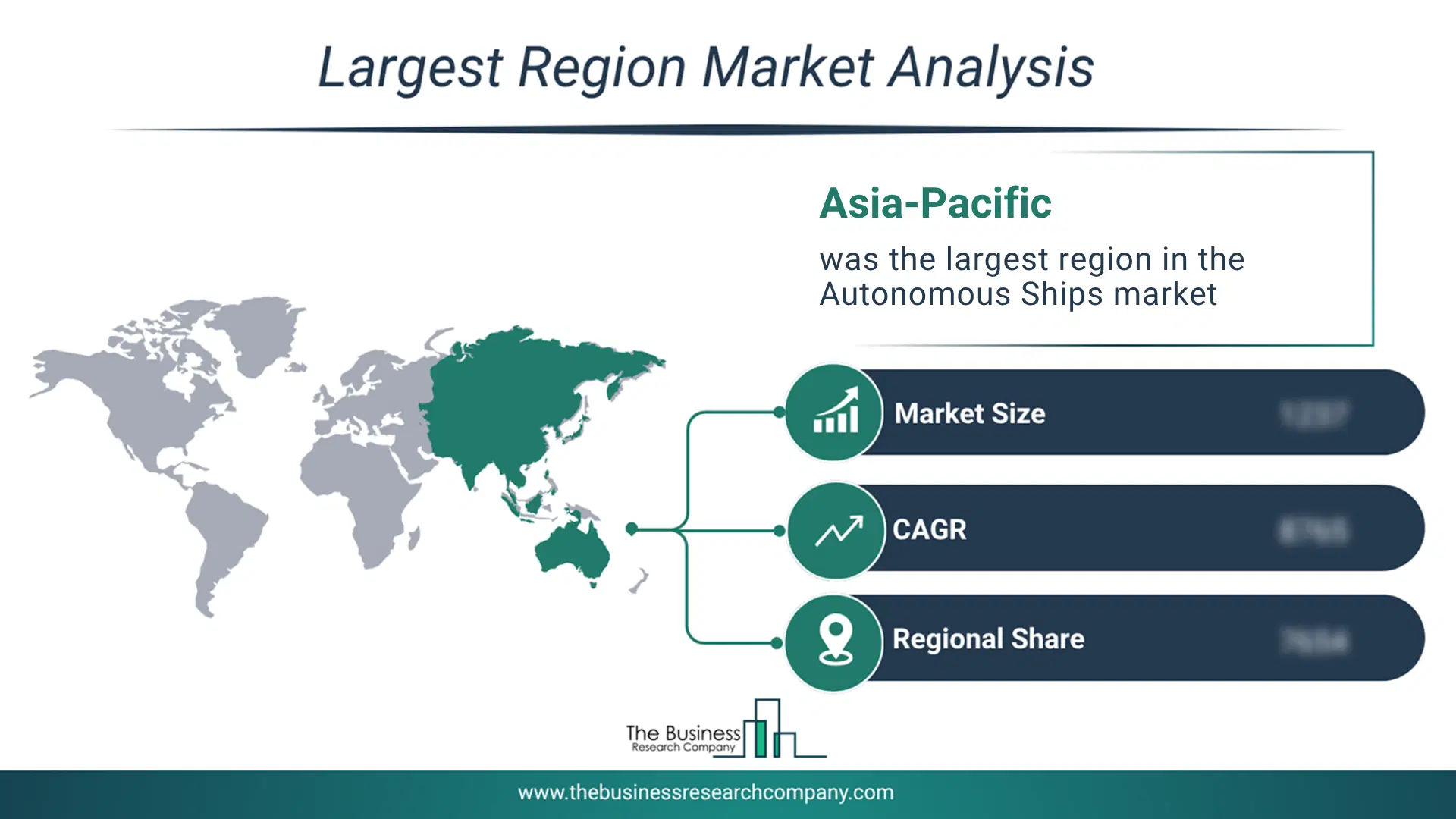
Regional Outlook
Asia-Pacific was the largest region in the autonomous ships market in 2025. Western Europe was the second largest region in the autonomous ships market share. The regions covered in this market report include Asia-Pacific, South East Asia, Western Europe, Eastern Europe, North America, South America, Middle East, Africa. The countries covered in this market report include Australia, Brazil, China, France, Germany, India, Indonesia, Japan, Taiwan, Russia, South Korea, UK, USA, Canada, Italy, SpainWhat Defines the Autonomous Ships Market?
The autonomous ship market consists of sales of autonomous container ships, maritime autonomous surface ships (MASS), and crewless vessels. Values in this market are factory gate values, that is the value of goods sold by the manufacturers or creators of the goods, whether to other entities (including downstream manufacturers, wholesalers, distributors, and retailers) or directly to end customers. The value of goods in this market includes related services sold by the creators of the goods.How is Market Value Defined and Measured?
The market value is defined as the revenues that enterprises gain from the sale of goods and/or services within the specified market and geography through sales, grants, or donations in terms of the currency (in USD unless otherwise specified). The revenues for a specified geography are consumption values that are revenues generated by organizations in the specified geography within the market, irrespective of where they are produced. It does not include revenues from resales along the supply chain, either further along the supply chain or as part of other products.
This chart presents market attractiveness based on a quantitative evaluation of growth, competition, strategic alignment, and risk, offering a clear view of opportunity areas for decision-making. This chart is for illustrative purposes; the full report contains the complete analysis.

This chart highlights the Total Addressable Market (TAM) by estimating the maximum revenue opportunity using an assumption-driven approach, supporting strategic planning and opportunity sizing across markets. The chart is illustrative; the full report provides a more comprehensive analysis.
What Key Data and Analysis Are Included in the Autonomous Ships Market Report 2026?
The autonomous ships market research report is one of a series of new reports from The Business Research Company that provides market statistics, including industry global market size, regional shares, competitors with the market share, detailed market segments, market trends and opportunities, and any further data you may need to thrive in the autonomous ships industry. The market research report delivers a complete perspective of everything you need, with an in-depth analysis of the current and future state of the industry.Autonomous Ships Market Report Forecast Analysis
| Report Attribute | Details |
|---|---|
| Market Size Value In 2026 | $8.74 billion |
| Revenue Forecast In 2030 | $11.22 billion |
| Growth Rate | CAGR of 6.0% from 2026 to 2030 |
| Base Year For Estimation | 2025 |
| Actual Estimates/Historical Data | 2020-2025 |
| Forecast Period | 2026 - 2030 - 2030 |
| Market Representation | Revenue in USD Billion and CAGR from 2026 to 2030 |
| Segments Covered | Autonomy, Propulsion Type, End-User |
| Regional Scope | Asia-Pacific, Western Europe, Eastern Europe, North America, South America, Middle East, Africa |
| Country Scope | The countries covered in the report are Australia, Brazil, China, France, Germany, India, Indonesia, Japan, Taiwan, Russia, South Korea, UK, USA, Canada, Italy, Spain. |
| Key Companies Profiled | Mitsui E&S Holdings Co. Ltd., Siemens AG, General Electric Company, Hyundai Heavy Industries Co. Ltd., Northrop Grumman Corporation, Honeywell International Inc., ABB Ltd., BAE Systems plc, Nippon Yusen Kabushiki Kaisha, L3Harris Technologies Inc., Rolls-Royce Holding plc, L3 ASV Global Ltd., Wärtsilä Corporation, Wärtsilä Corporation Inc., Valmet Corporation, Daewoo Shipbuilding & Marine Engineering Co. Ltd., Kongsberg Gruppen AS, DNV GL AS, Fugro N.V., Vigor Industrial LLC, Rh Marine Ltd., Ocean GNS, ASV Global Limited, Praxis Automation Technology B.V., Automated Ships Ltd., SELSAN A.Ş., Autonomous Knight BV, Mapsea Corp. Ltd. |
| Customization Scope | Request for Customization |
| Pricing And Purchase Options | Explore Purchase Options |