
Aviation IoT Market Report 2026
Global Outlook – By Component (Hardware, Software, Service ), By Connectivity Technology (Wi-Fi, Bluetooth, Cellular, Satellite Communication, LoraWAN ), By Application (Ground Operations, Passenger Experience, Aircraft Operations, Asset Management ), By End-Use (Airport, Airline Operators, Maintenance, Repair, And Operations (MRO), Aircraft Original Equipment Manufacturer (OEM)) – Market Size, Trends, Strategies, and Forecast to 2030
Aviation IoT Market Overview
• Aviation IoT market size has reached to $9.13 billion in 2025 • Expected to grow to $23.31 billion in 2030 at a compound annual growth rate (CAGR) of 20.6% • Growth Driver: Surge In Air Traffic Fueling The Growth Of The Market Due To Increasing Accessibility And Demand For Safer, Efficient Flight Operations • Market Trend: Onboard IoT Gateways Revolutionize Aviation With Real-Time Connectivity And Monitoring • North America was the largest region in 2025 and Asia-Pacific is the fastest growing region.What Is Covered Under Aviation IoT Market?
Aviation IoT refers to the integration of internet-connected sensors, devices, and systems within aircraft and aviation infrastructure to collect, transmit, and analyze data in real time. This technology enhances aircraft performance, improves maintenance efficiency, boosts safety, and streamlines operations. The main components in aviation IoT are hardware, software, and services. Hardware includes the physical devices installed on aircraft and within airport infrastructure that are responsible for collecting and transmitting data. These devices utilize a range of connectivity technologies such as Wi-Fi, Bluetooth, cellular networks, satellite communication, and LoRaWAN. These are used for various applications, including ground operations, passenger experience, aircraft operations, and asset management. It is utilized by the industries including airports, airline operators, maintenance, repair, and operations (MRO), and aircraft original equipment manufacturers (OEMs).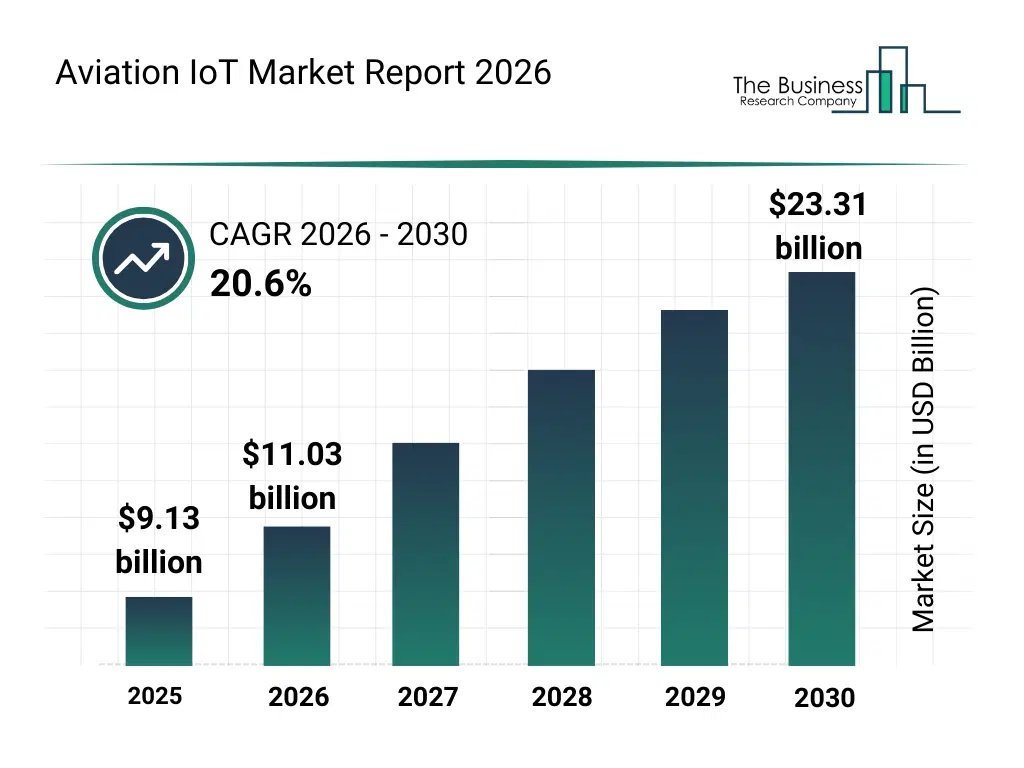
What Is The Aviation IoT Market Size and Share 2026?
The aviation iot market size has grown exponentially in recent years. It will grow from $9.13 billion in 2025 to $11.03 billion in 2026 at a compound annual growth rate (CAGR) of 20.8%. The growth in the historic period can be attributed to increasing adoption of sensors and actuators for real-time aircraft monitoring, deployment of predictive maintenance solutions to reduce downtime, integration of cloud-based analytics for operational insights, rising use of connected in-flight entertainment systems, implementation of baggage tracking and logistics solutions for improved passenger experience.What Is The Aviation IoT Market Growth Forecast?
The aviation iot market size is expected to see exponential growth in the next few years. It will grow to $23.31 billion in 2030 at a compound annual growth rate (CAGR) of 20.6%. The growth in the forecast period can be attributed to growing demand for AI-enabled aviation IoT platforms for predictive and prescriptive analytics, expansion of onboard data processing units for faster decision-making, rising adoption of integrated communication devices for connected aircraft operations, focus on end-to-end digital twin solutions for fleet optimization, increasing procurement for smart airports and fully connected airline ecosystems. Major trends in the forecast period include growth in real-time predictive maintenance capabilities, expansion of connected in-flight entertainment ecosystems, increased deployment of iot-enabled baggage tracking systems, rise in automated ground operations and smart airport solutions, greater adoption of onboard data processing and edge analytics.
Global Aviation IoT Market Segmentation
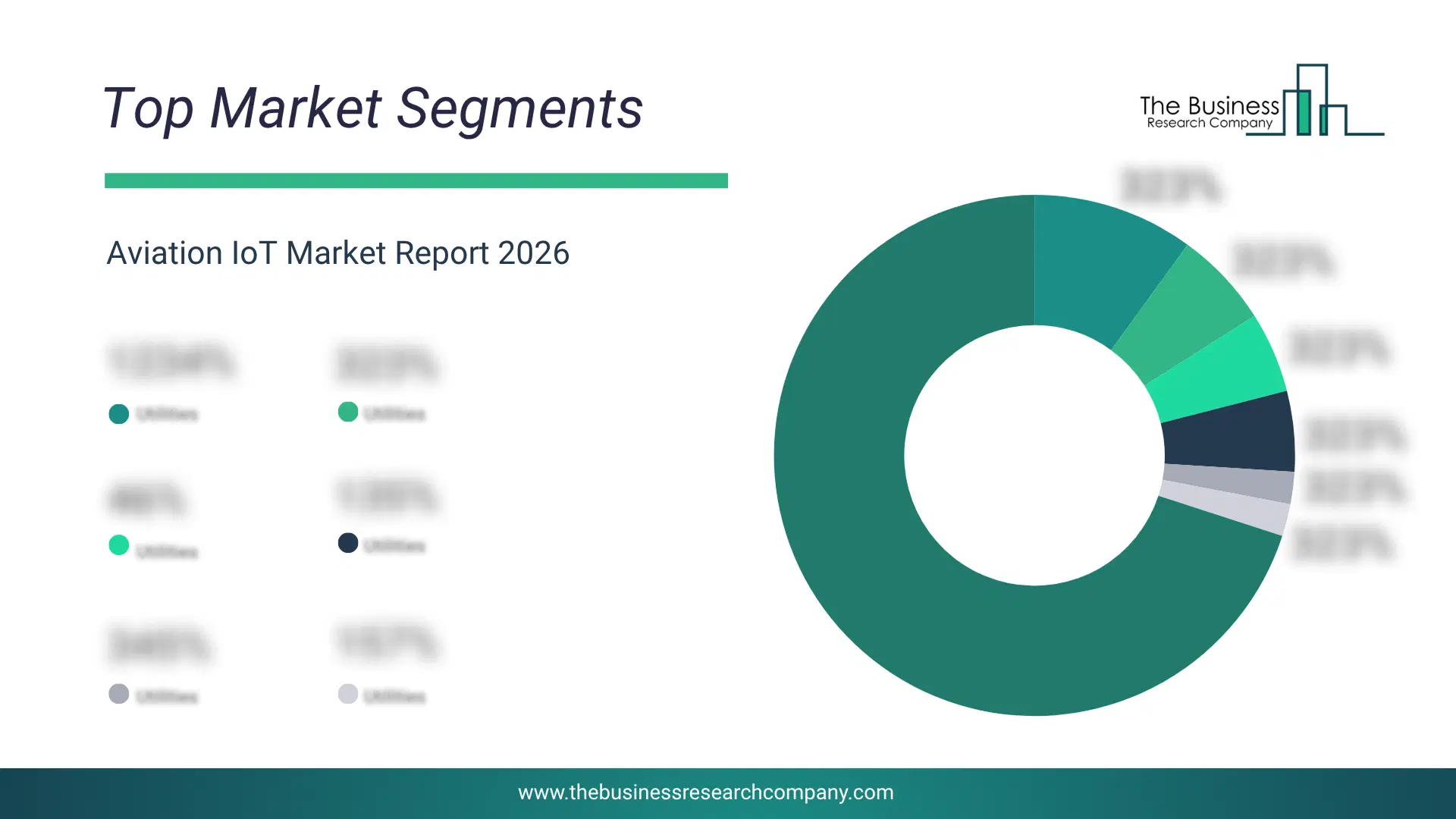
1) By Component: Hardware, Software, Service 2) By Connectivity Technology: Wi-Fi, Bluetooth, Cellular, Satellite Communication, LoraWAN 3) By Application: Ground Operations, Passenger Experience, Aircraft Operations, Asset Management 4) By End-Use: Airport, Airline Operators, Maintenance, Repair, And Operations (MRO), Aircraft Original Equipment Manufacturer (OEM) Subsegments: 1) By Hardware: Sensors, Actuators, Gateways, Edge Devices, IoT Modules, Communication Devices 2) By Software: Fleet Management, Predictive Maintenance, Passenger Management, Air Traffic Management, Analytics and Data Management, Security and Surveillance 3) By Service: Professional Services, Managed ServicesWhat Is Driver Of The Aviation IoT Market?
The rising air traffic is expected to propel the growth of the aviation IoT market going forward. Air traffic refers to the movement of aircraft within controlled airspace and at airports, managed to ensure safe and efficient flight operations. Air travel is becoming increasingly accessible to a broader population due to rising incomes and more competitive ticket pricing. Aviation IoT helps air traffic by improving flight operations, reducing delays, ensuring safety, and more efficient management of aircraft and airport systems. For instance, in December 2023, according to the Bureau of Transportation Statistics (BTS), a US-based government agency, U.S. airlines carried 78.7 million systemwide scheduled service passengers, marking a 9.5% increase compared to December 2022. This growth was observed across both domestic and international travel segments. Therefore, the rising air traffic is driving the growth of the aviation IoT industry.Key Players In The Global Aviation IoT Market
Major companies operating in the aviation iot market are Microsoft Corporation, Amazon Web Services (AWS), Siemens AG, Boeing Group, Airbus SE, International Business Machines Corporation, Cisco Systems Inc., Honeywell Aerospace Inc., GE Aerospace Inc., Safran S.A., Thales Group, Dassault Aviation SA, Bombardier, Tech Mahindra Ltd., Embraer, Viasat, Tata Communications Limited, SITA, Iridium Communications, Ramco Systems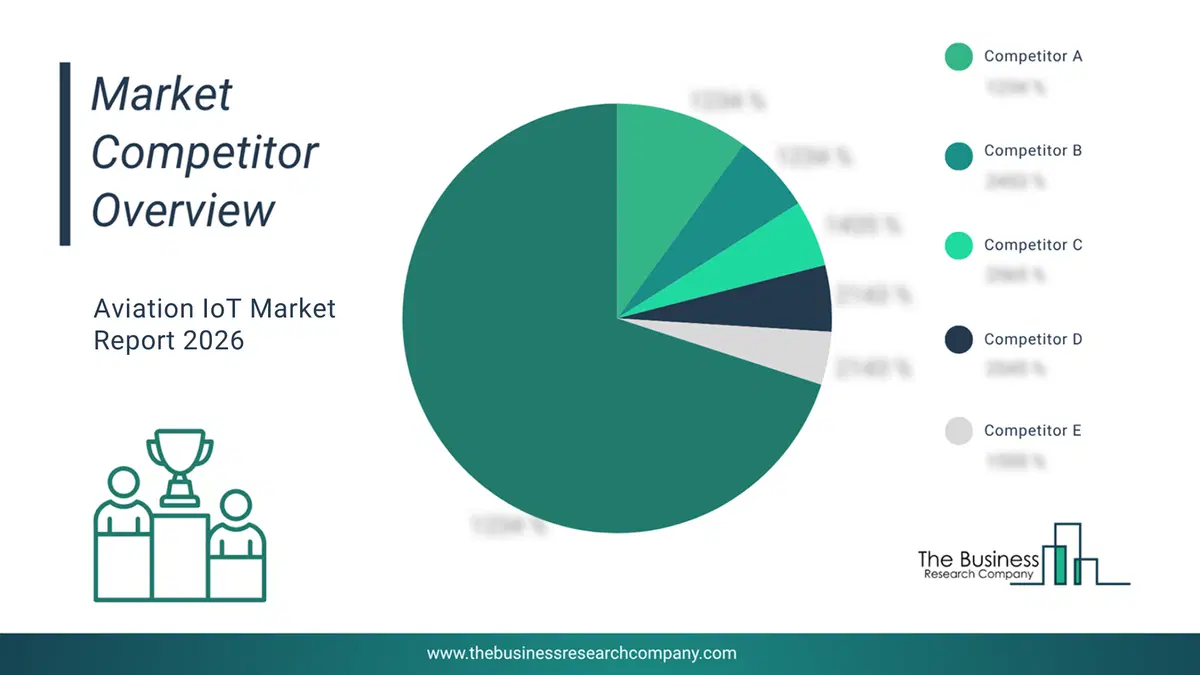
This chart is for illustrative purposes; the full report includes a detailed competitor analysis and comprehensive overview of the top 10 companies in the market.
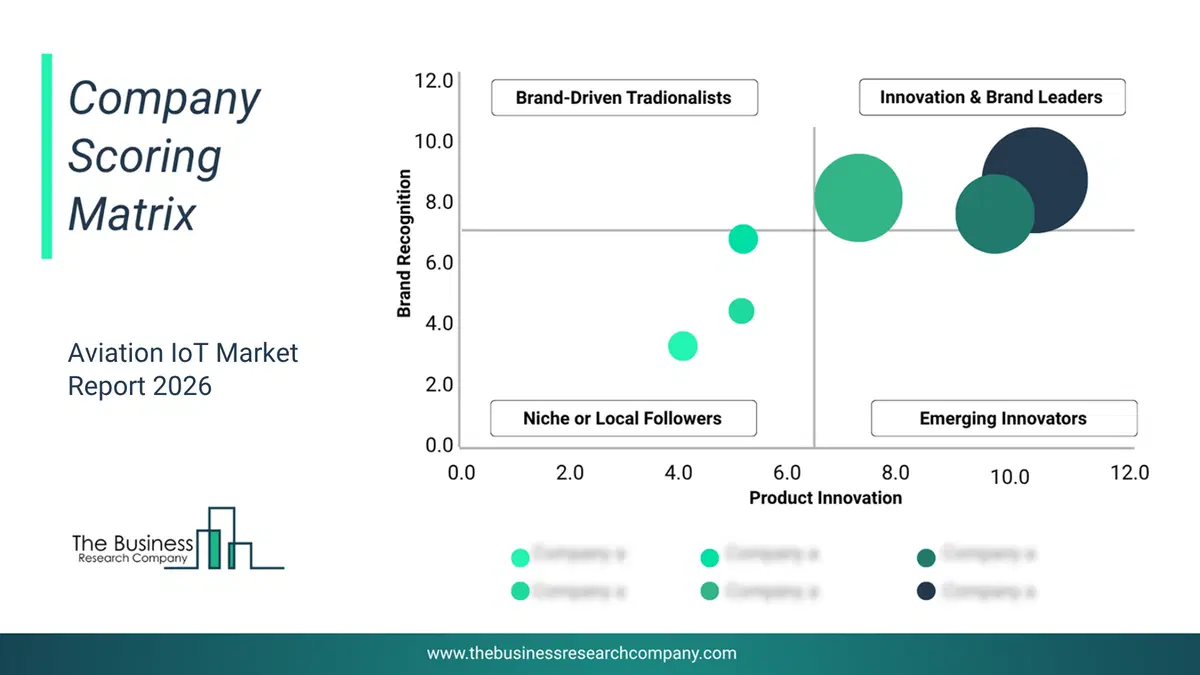
This chart maps companies by product innovation and brand strength, with bubble size indicating relative revenue, helping identify market leaders, challengers, and niche players. This is an illustrative chart; the full report provides a complete and accurate competitive analysis.
Global Aviation IoT Market Trends and Insights
Major companies operating in the aviation IoT market are focusing on developing IoT-enabled aircraft-installed gateway, to enable real-time data transmission between onboard systems and ground control, enhancing flight safety, operational efficiency, and predictive maintenance capabilities. An IoT-enabled aircraft-installed gateway is a smart onboard device that connects the aircraft's internal systems to external networks, allowing real-time data sharing between the plane and ground systems. For instance, in March 2024, OnAsset Intelligence Inc, a US-based technology company, launched SENTRY 600 FlightSafe device marks a major advancement in aviation IoT, transforming aircraft into connected hubs for real-time monitoring and asset tracking. The device enables continuous visibility into onboard environments and surrounding ground operations by connecting to Bluetooth sensors in cargo holds, cabins, and aircraft components such as ULDs and galley carts. It captures critical data on temperature, humidity, and asset location, even when aircraft are parked.What Are Latest Mergers And Acquisitions In The Aviation IoT Market? Honeywell And Lufthansa Technik Partner To Enhance Aircraft Maintenance With Smart Technology
In March 2023, Honeywell Inc., a US-based technology company, partnered with Lufthansa Technik to improve aircraft maintenance using smart technology. This partnership integrates Honeywell’s advanced maintenance analytics into the AVIATAR platform. It enhances predictive maintenance across multiple aircraft types, helping airlines reduce costs, avoid delays, and streamline operations. Lufthansa Technik AG is a Germany-based aircraft service company that offers aviation IoT.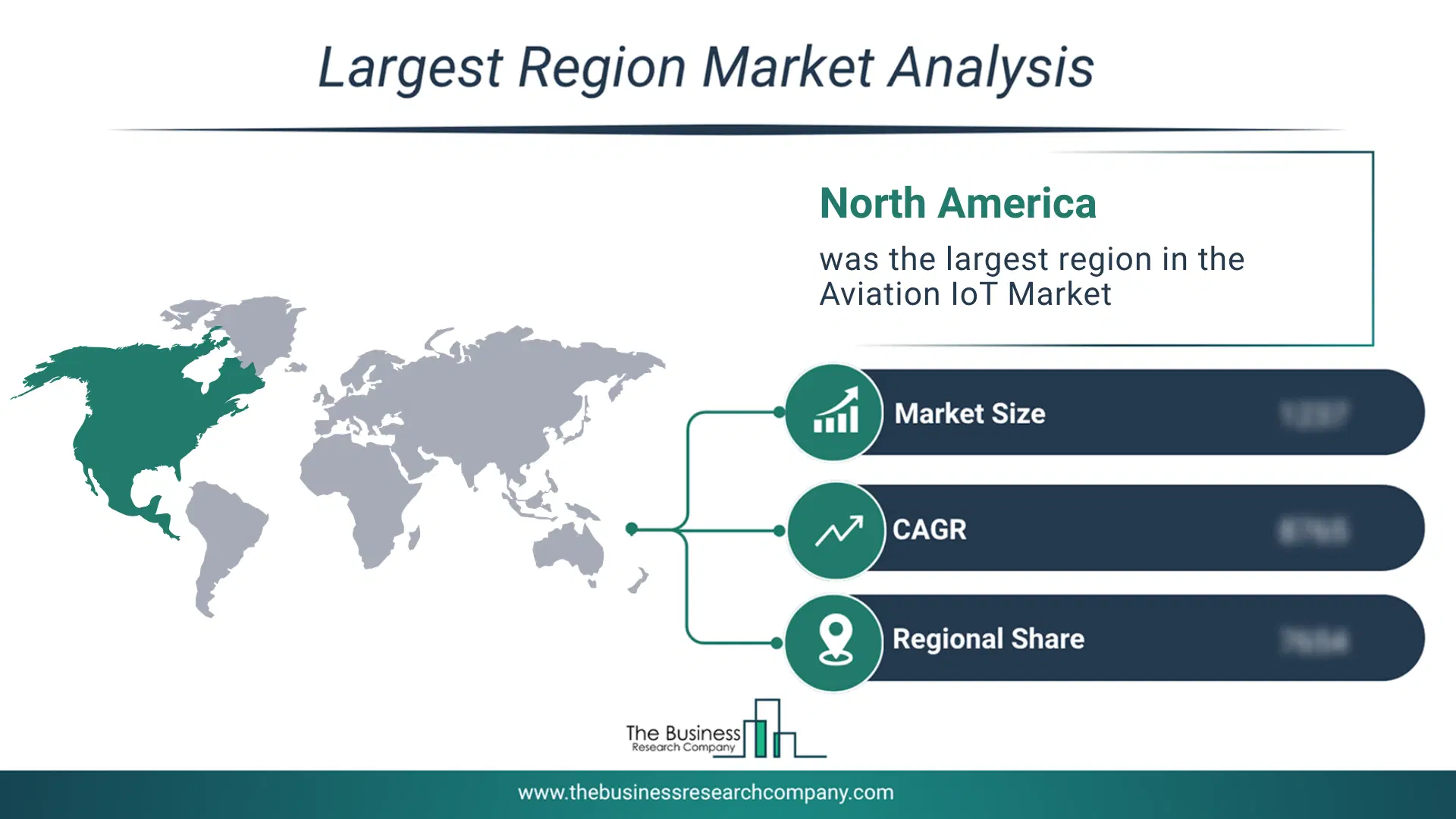
Regional Insights
North America was the largest region in the aviation IoT market in 20254. Asia-Pacific is expected to be the fastest-growing region in the forecast period. The regions covered in this market report are Asia-Pacific, South East Asia, Western Europe, Eastern Europe, North America, South America, Middle East, Africa. The countries covered in this market report are Australia, Brazil, China, France, Germany, India, Indonesia, Japan, Taiwan, Russia, South Korea, UK, USA, Canada, Italy, SpainWhat Defines the Aviation IoT Market?
The aviation IoT market consists of revenues earned by entities by providing services such as predictive maintenance, baggage tracking, logistics firms and connected in-flight entertainment. The market value includes the value of related goods sold by the service provider or included within the service offering. The aviation IoT market also includes sales of sensors, actuators, cloud-based analytics software, communication devices, and onboard data processing units. Values in this market are ‘factory gate’ values, that is, the value of goods sold by the manufacturers or creators of the goods, whether to other entities (including downstream manufacturers, wholesalers, distributors, and retailers) or directly to end customers. The value of goods in this market includes related services sold by the creators of the goods.How is Market Value Defined and Measured?
The market value is defined as the revenues that enterprises gain from the sale of goods and/or services within the specified market and geography through sales, grants, or donations in terms of the currency (in USD unless otherwise specified). The revenues for a specified geography are consumption values that are revenues generated by organizations in the specified geography within the market, irrespective of where they are produced. It does not include revenues from resales along the supply chain, either further along the supply chain or as part of other products.
This chart presents market attractiveness based on a quantitative evaluation of growth, competition, strategic alignment, and risk, offering a clear view of opportunity areas for decision-making. This chart is for illustrative purposes; the full report contains the complete analysis.

This chart highlights the Total Addressable Market (TAM) by estimating the maximum revenue opportunity using an assumption-driven approach, supporting strategic planning and opportunity sizing across markets. The chart is illustrative; the full report provides a more comprehensive analysis.
What Key Data and Analysis Are Included in the Aviation IoT Market Report 2026?
The aviation iot market research report is one of a series of new reports from The Business Research Company that provides market statistics, including industry global market size, regional shares, competitors with the market share, detailed market segments, market trends and opportunities, and any further data you may need to thrive in the aviation iot industry. The market research report delivers a complete perspective of everything you need, with an in-depth analysis of the current and future state of the industry.Aviation IoT Market Report Forecast Analysis
| Report Attribute | Details |
|---|---|
| Market Size Value In 2026 | $11.03 billion |
| Revenue Forecast In 2030 | $23.31 billion |
| Growth Rate | CAGR of 20.6% from 2026 to 2030 |
| Base Year For Estimation | 2025 |
| Actual Estimates/Historical Data | 2020-2025 |
| Forecast Period | 2026 - 2030 |
| Market Representation | Revenue in USD Billion and CAGR from 2026 to 2030 |
| Segments Covered | Component, Connectivity Technology, Application, End-Use |
| Regional Scope | Asia-Pacific, Western Europe, Eastern Europe, North America, South America, Middle East, Africa |
| Country Scope | The countries covered in the aviation iot market report are Australia, Brazil, China, France, Germany, India, Indonesia, Japan, Taiwan, Russia, South Korea, UK, USA, Canada, Italy, Spain |
| Key Companies Profiled | Microsoft Corporation, Amazon Web Services (AWS), Siemens AG, Boeing Group, Airbus SE, International Business Machines Corporation, Cisco Systems Inc., Honeywell Aerospace Inc., GE Aerospace Inc., Safran S.A., Thales Group, Dassault Aviation SA, Bombardier, Tech Mahindra Ltd., Embraer, Viasat, Tata Communications Limited, SITA, Iridium Communications, Ramco Systems |
| Customization Scope | Request for Customization |
| Pricing And Purchase Options | Explore Purchase Options |