
Baby Cereal Market Report 2026
Global Outlook – By Product Type (Rice Cereal, Oatmeal Cereal, Barley Cereal, Mixed Grain Cereal, Fruit-Based Cereal), By Form (Powder, Dry Mix, Pre-Mixed Liquid, Ready-To-Use), By Age Group (4 To 6 Months, 6 To 8 Months, 8 To 10 Months, 10 To 12 Months), By Organic Status (Organic, Conventional), By Application (Store-Based Retailing, Online Retailing) – Market Size, Trends, Strategies, and Forecast to 2030
Baby Cereal Market Overview
• Baby Cereal market size has reached to $17 billion in 2025 • Expected to grow to $21.66 billion in 2030 at a compound annual growth rate (CAGR) of 5% • Growth Driver: Rising Infant Population Fuels Market Growth With Increasing Demand For Baby Care Products And Services • Market Trend: Nestlé Introduces Cerelac Variants with Zero Refined Sugar In India • North America was the largest region in 2025 and Asia-Pacific is the fastest growing region.What Is Covered Under Baby Cereal Market?
Baby cereals refer to specially formulated food products designed for infants, typically made from grains like rice, oats, or barley, processed to be soft, easy to digest, and nutritionally balanced for young children. It is used for introducing solid foods to babies, usually around 4 to 6 months of age, offering essential nutrients such as iron, vitamins, and minerals to support growth and development during the early stages of life. The main product types of baby cereal include rice cereal, oatmeal cereal, barley cereal, mixed grain cereal, and fruit-based cereal. Rice cereal is often the first solid food introduced to infants due to its smooth texture and easy digestibility. The forms of baby cereal are powder, dry mix, pre-mixed liquid, and ready-to-use. The age groups for baby cereal are 4 to 6 months, 6 to 8 months, 8 to 10 months, and 10 to 12 months. The various organic statuses are organic and conventional. The primary applications for baby cereal are store-based retailing and online retailing.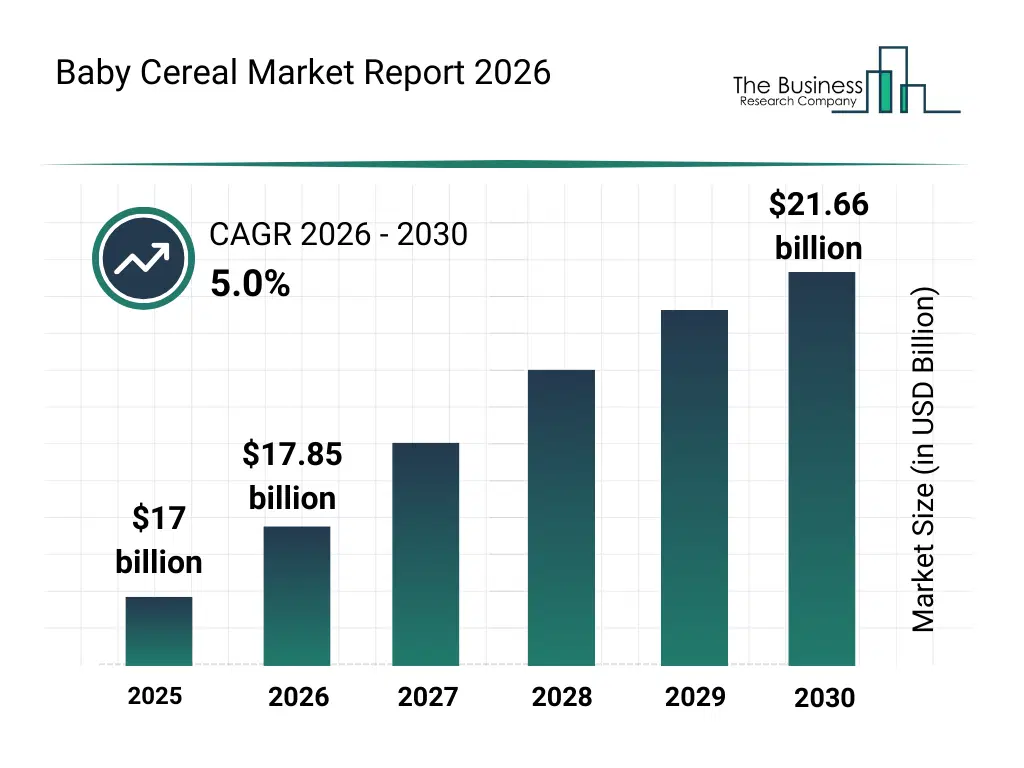
What Is The Baby Cereal Market Size and Share 2026?
The baby cereal market size has grown strongly in recent years. It will grow from $17 billion in 2025 to $17.85 billion in 2026 at a compound annual growth rate (CAGR) of 5.0%. The growth in the historic period can be attributed to rising birth rates in emerging markets, expansion of packaged infant food availability, increasing awareness of infant nutrition, growth of urban working parents, improved distribution of baby food products.What Is The Baby Cereal Market Growth Forecast?
The baby cereal market size is expected to see steady growth in the next few years. It will grow to $21.66 billion in 2030 at a compound annual growth rate (CAGR) of 5.0%. The growth in the forecast period can be attributed to increasing demand for organic baby nutrition, rising focus on early-life health outcomes, expansion of premium infant food categories, growth of e-commerce grocery platforms, increasing regulatory oversight on infant nutrition. Major trends in the forecast period include growing demand for organic and clean-label baby foods, rising preference for iron-fortified infant cereals, expansion of multigrain and functional formulations, increased focus on food safety and traceability, growth of online infant food retailing.
Global Baby Cereal Market Segmentation
1) By Product Type: Rice Cereal, Oatmeal Cereal, Barley Cereal, Mixed Grain Cereal, Fruit-Based Cereal 2) By Form: Powder, Dry Mix, Pre-Mixed Liquid, Ready-To-Use 3) By Age Group: 4 To 6 Months, 6 To 8 Months, 8 To 10 Months, 10 To 12 Months 4) By Organic Status: Organic, Conventional 5) By Application: Store-Based Retailing, Online Retailing Subsegments: 1) By Rice Cereal: Organic Rice Cereal, Fortified Rice Cereal, Gluten-Free Rice Cereal 2) By Oatmeal Cereal: Whole Grain Oatmeal Cereal, Iron-Fortified Oatmeal Cereal, Organic Oatmeal Cereal 3) By Barley Cereal: Multivitamin-Enriched Barley Cereal, Whole Grain Barley Cereal, Organic Barley Cereal 4) By Mixed Grain Cereal: Multigrain Cereal with Fruits, Fortified Multigrain Cereal, Organic Mixed Grain Cereal 5) By Fruit-Based Cereal: Apple-Based Cereal, Banana-Based Cereal, Berry Blend CerealWhat Is The Driver Of The Baby Cereal Market?
The increasing infant population is expected to propel the growth of the baby cereal market going forward. The infant population refers to the number of newborns or infants within a particular demographic or geographic area, normally ranging from birth to one year of age. The increasing infant population can be attributed to several factors, including higher birth rates, improved healthcare, and immigration, all of which contribute to a growing number of infants worldwide. Baby cereals play a crucial role in supporting the infant population by providing a nutritionally balanced and easily digestible introduction to solid foods, essential for healthy growth and development. For instance, in October 2024, according to the Office for National Statistics, a UK-based government agency, in 2023, England and Wales recorded 591,072 live births. Therefore, the increasing infant population is driving the growth of the baby cereal industry.Key Players In The Global Baby Cereal Market
Major companies operating in the baby cereal market are Nestlé S.A., Danone S.A., Royal FrieslandCampina N.V., DMK Deutsches Milchkontor GmbH, Hero Group, HiPP GmbH & Co. Vertrieb KG, Bellamy's Organic Pty. Ltd., Dana Dairy Group, Mead Johnson Nutrition, Organix Brands Limited, Kendal Nutricare Ltd., Danalac S.A., The Kraft Heinz Company, Bambino Foods, Holle Baby Food GmbH, Hain Celestial Group, Baby Gourmet Foods Inc., Nutrimed Healthcare, Nutrimed Healthcare Pvt. Ltd., Titus Health Tech Pvt. Ltd.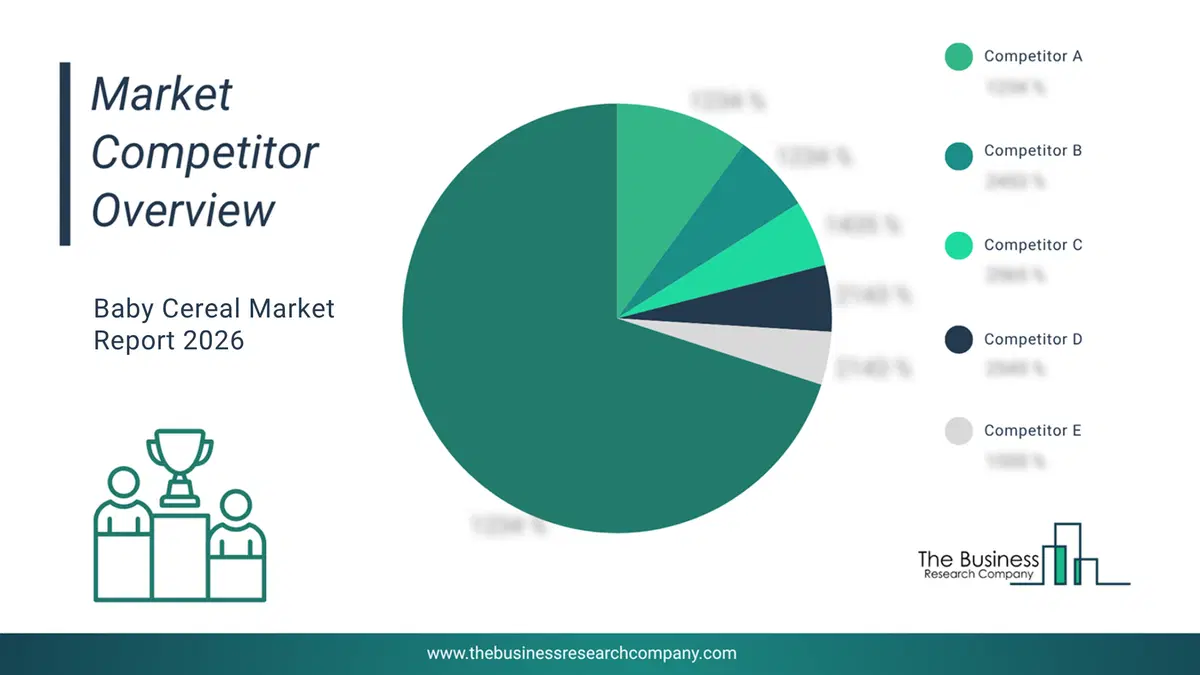
This chart is for illustrative purposes; the full report includes a detailed competitor analysis and comprehensive overview of the top 10 companies in the market.
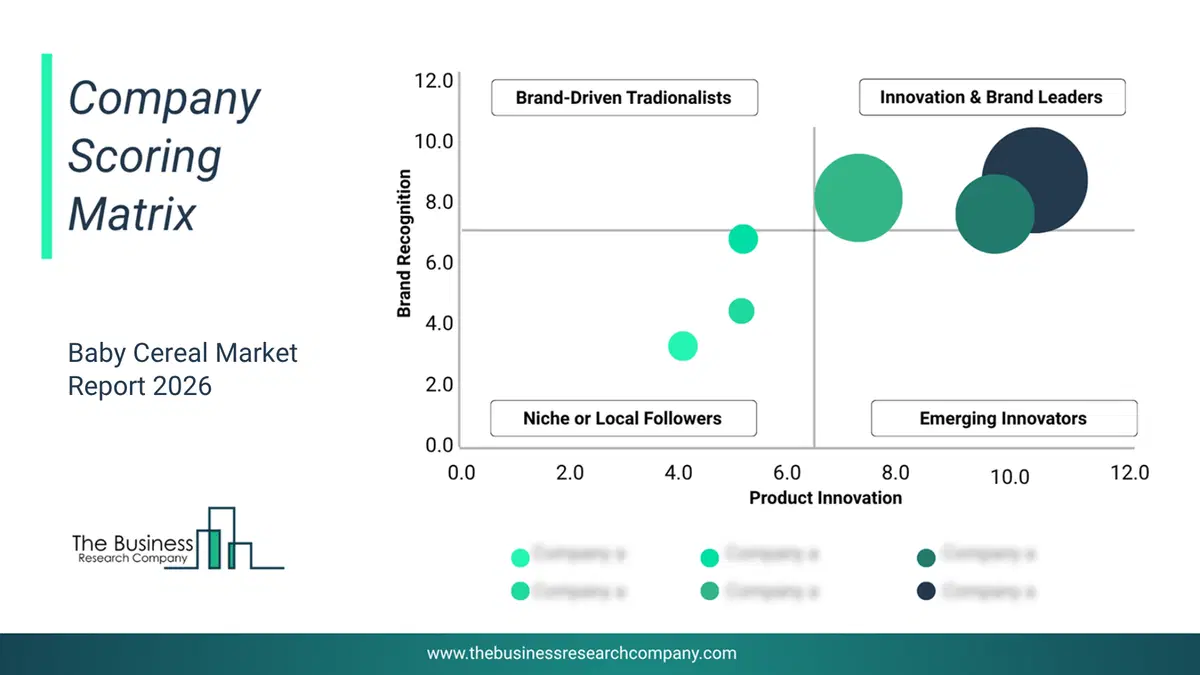
This chart maps companies by product innovation and brand strength, with bubble size indicating relative revenue, helping identify market leaders, challengers, and niche players. This is an illustrative chart; the full report provides a complete and accurate competitive analysis.
Global Baby Cereal Market Trends and Insights
Major companies operating in the baby cereal market are focused on developing innovative products, such as zero-refined-sugar food products, to cater to the growing demand for healthier, more natural options that support the nutritional needs of infants while promoting early-stage development. Zero refined sugar food products refer to food items that do not contain added refined sugars, such as white sugar, corn syrup, or high-fructose corn syrup. For instance, in October 2024, Nestlé S.A., a Switzerland-based food company, launched the Cerelac variants with zero refined sugar in the Indian market, addressing concerns over added sugar in baby food products. These new variants are designed to provide essential nutrients while promoting a more natural approach to infant nutrition. With no refined sugar, the product relies on natural ingredients like fruits for sweetness, ensuring a cleaner, healthier option for babies. The formulation retains all the important vitamins and minerals required for growth and development, while the brand's commitment to quality ensures that the food is easy to digest and safe for infants.What Are Latest Mergers And Acquisitions In The Baby Cereal Market?
In July 2023, Bobbie, a US-based organic infant formula company, acquired Nature’s One for an undisclosed amount. With this acquisition, Bobbie aims to strengthen its U.S. manufacturing capabilities, enhance supply chain resilience, and expand its market share while continuing to lead innovation in infant nutrition. Nature’s One LLC is a US-based company specializing in organic and natural products, including baby cereals and formulas.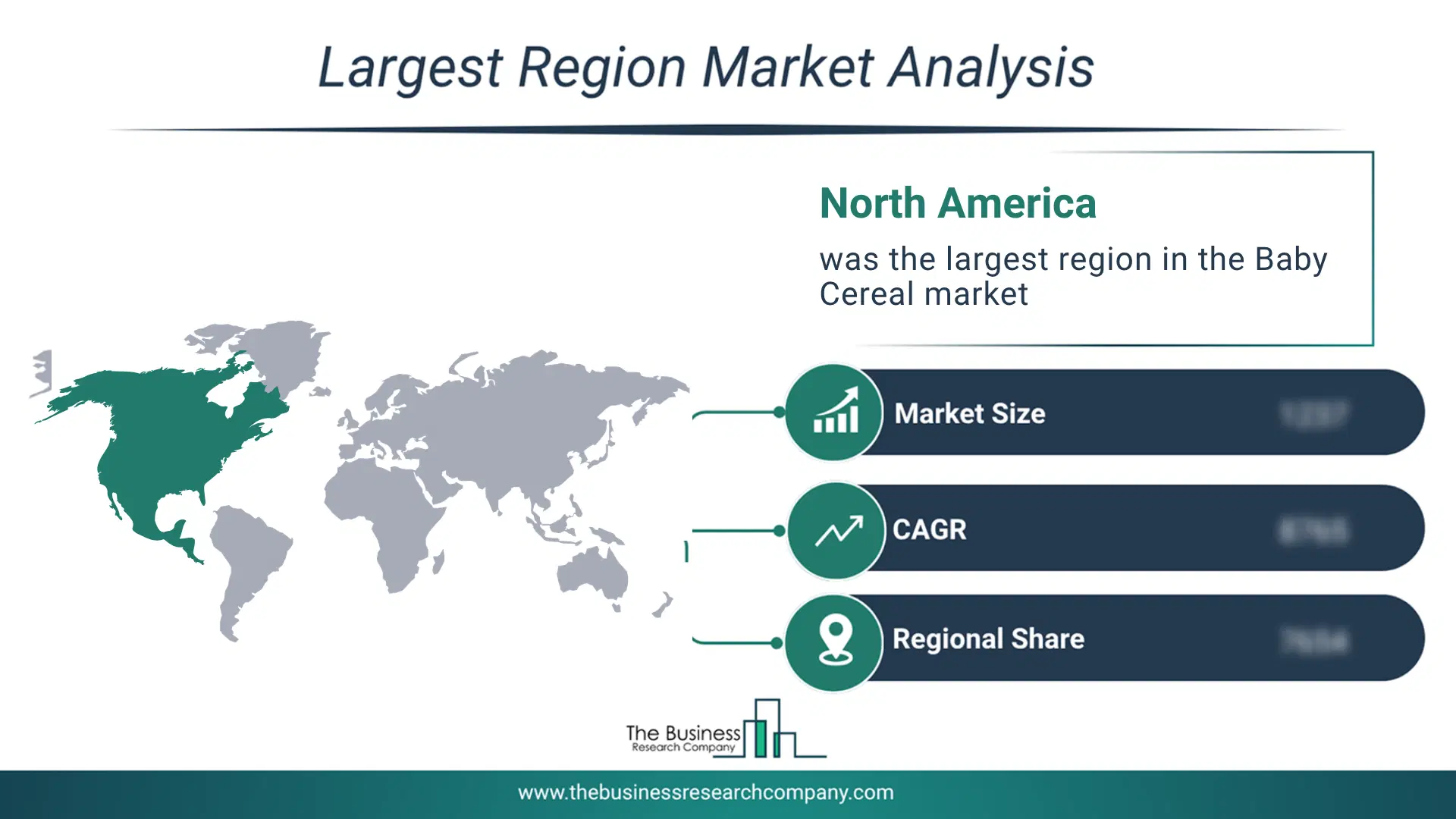
Regional Outlook
North America was the largest region in the baby cereal market in 2025. Asia-Pacific is expected to be the fastest-growing region in the forecast period. The regions covered in this market report are Asia-Pacific, South East Asia, Western Europe, Eastern Europe, North America, South America, Middle East and Africa. The countries covered in this market report are Australia, Brazil, China, France, Germany, India, Indonesia, Japan, Taiwan, Russia, South Korea, UK, USA, Italy, Spain, CanadaWhat Defines the Baby Cereal Market?
The baby cereal market consists of sales of flavored baby cereal, gluten-free baby cereal, and ready-to-eat baby cereal. Values in this market are ‘factory gate’ values, that is the value of goods sold by the manufacturers or creators of the goods, whether to other entities (including downstream manufacturers, wholesalers, distributors and retailers) or directly to end customers. The value of goods in this market includes related services sold by the creators of the goods.How is Market Value Defined and Measured?
The market value is defined as the revenues that enterprises gain from the sale of goods and/or services within the specified market and geography through sales, grants, or donations in terms of the currency (in USD unless otherwise specified). The revenues for a specified geography are consumption values that are revenues generated by organizations in the specified geography within the market, irrespective of where they are produced. It does not include revenues from resales along the supply chain, either further along the supply chain or as part of other products.
This chart presents market attractiveness based on a quantitative evaluation of growth, competition, strategic alignment, and risk, offering a clear view of opportunity areas for decision-making. This chart is for illustrative purposes; the full report contains the complete analysis.

This chart highlights the Total Addressable Market (TAM) by estimating the maximum revenue opportunity using an assumption-driven approach, supporting strategic planning and opportunity sizing across markets. The chart is illustrative; the full report provides a more comprehensive analysis.
What Key Data and Analysis Are Included in the Baby Cereal Market Report 2026?
The baby cereal market research report is one of a series of new reports from The Business Research Company that provides market statistics, including industry global market size, regional shares, competitors with the market share, detailed market segments, market trends and opportunities, and any further data you may need to thrive in the baby cereal industry. The market research report delivers a complete perspective of everything you need, with an in-depth analysis of the current and future state of the industry.Baby Cereal Market Report Forecast Analysis
| Report Attribute | Details |
|---|---|
| Market Size Value In 2026 | $17.85 billion |
| Revenue Forecast In 2030 | $21.66 billion |
| Growth Rate | CAGR of 5.0% from 2026 to 2030 |
| Base Year For Estimation | 2025 |
| Actual Estimates/Historical Data | 2020-2025 |
| Forecast Period | 2026 - 2030 |
| Market Representation | Revenue in USD Billion and CAGR from 2026 to 2030 |
| Segments Covered | Product Type, Form, Age Group, Organic Status, Application |
| Regional Scope | Asia-Pacific, Western Europe, Eastern Europe, North America, South America, Middle East, Africa |
| Country Scope | The countries covered in the report are Australia, Brazil, China, France, Germany, India, Indonesia, Japan, Taiwan, Russia, South Korea, UK, USA, Canada, Italy, Spain. |
| Key Companies Profiled | Nestlé S.A., Danone S.A., Royal FrieslandCampina N.V., DMK Deutsches Milchkontor GmbH, Hero Group, HiPP GmbH & Co. Vertrieb KG, Bellamy's Organic Pty. Ltd., Dana Dairy Group, Mead Johnson Nutrition, Organix Brands Limited, Kendal Nutricare Ltd., Danalac S.A., The Kraft Heinz Company, Bambino Foods, Holle Baby Food GmbH, Hain Celestial Group, Baby Gourmet Foods Inc., Nutrimed Healthcare, Nutrimed Healthcare Pvt. Ltd., Titus Health Tech Pvt. Ltd. |
| Customization Scope | Request for Customization |
| Pricing And Purchase Options | Explore Purchase Options |