
Battery Manufacturing Equipment Market Report 2026
Global Outlook – By Type (Lead Acid, Lithium Ion, Nickel Metal Hydride, Nickel Cadmium, Other Types), By Process (Electrode Manufacturing, Cell Assembly, Cell Finishing), By Application (Automotive Batteries, Industrial Batteries, Portable Batteries) – Market Size, Trends, Strategies, and Forecast to 2030
Battery Manufacturing Equipment Market Overview
• Battery Manufacturing Equipment market size has reached to $19.2 billion in 2025 • Expected to grow to $60.13 billion in 2030 at a compound annual growth rate (CAGR) of 25.8% • Growth Driver: Growing Demand For Electric Vehicles Fuels Expansion In The Battery Manufacturing Equipment Market • Market Trend: Strategic Partnerships Drive Growth And Innovation In The Battery Manufacturing Equipment Market • Asia-pacific was the largest region and fastest growing region.Market Gains By 2030 – Top Opportunities By Segment
Market Gain identifies the most promising market opportunities by highlighting the segments or products expected to generate the highest incremental revenue growth over the next five years.
What Is Covered Under Battery Manufacturing Equipment Market?
Battery manufacturing equipment refers to a type of machinery and tool that is used in the manufacturing and assembling of batteries. This machinery is specifically built to support the different operations involved in battery manufacture, including electrode setup, cell installation, electrolyte filling, cell sealing, and monitoring. The main types of battery manufacturing equipment are lead acid, lithium ion, nickel metal hydride, nickel-cadmium, and others. A lead acid battery refers to a type of battery that is rechargeable and operates on lead and sulfuric acid. To allow for a regulated chemical interaction, the lead is immersed in sulfuric acid. Lead acid batteries are beneficial to the battery manufacturing equipment market because battery manufacturing equipment tools such as hydrometers are used to prepare the electrolyte for the battery. The processes include electrode manufacturing, cell assembly, and cell finishing that are used in applications such as automotive batteries, industrial batteries, and portable batteries.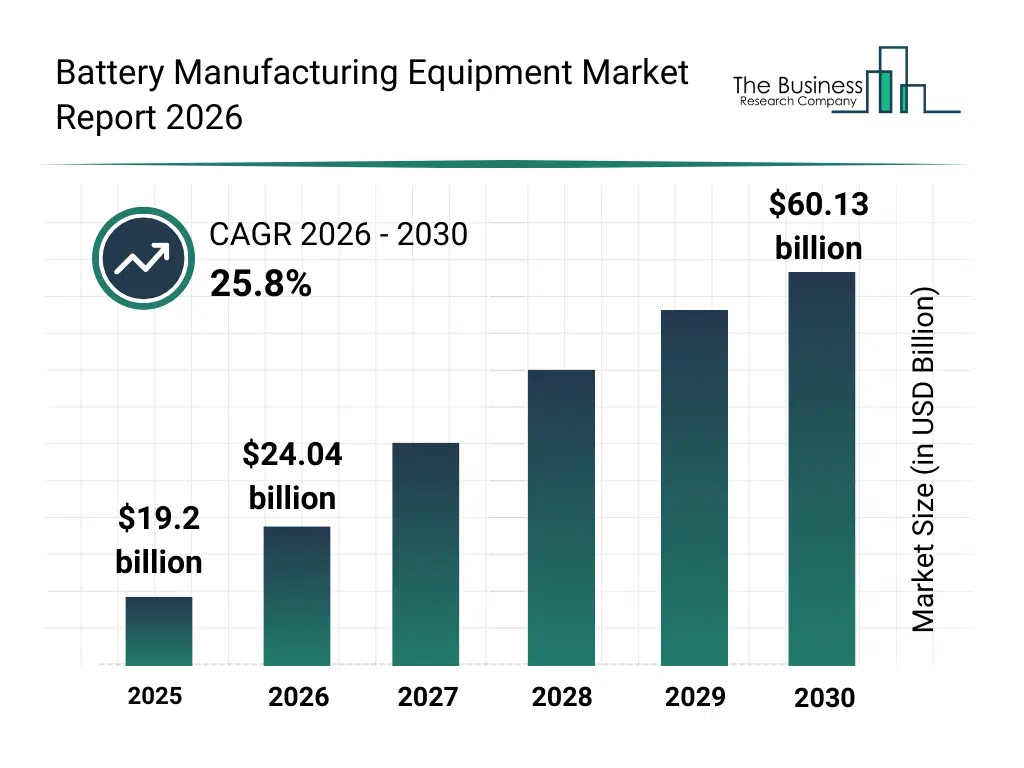
What Is The Battery Manufacturing Equipment Market Size and Share 2026?
The battery manufacturing equipment market size has grown exponentially in recent years. It will grow from $19.2 billion in 2025 to $24.04 billion in 2026 at a compound annual growth rate (CAGR) of 25.2%. The growth in the historic period can be attributed to expansion of consumer electronics battery demand, growth of automotive battery production, advancements in lithium-ion technology, industrial energy storage adoption, investments in manufacturing automation.What Is The Battery Manufacturing Equipment Market Growth Forecast?
The battery manufacturing equipment market size is expected to see exponential growth in the next few years. It will grow to $60.13 billion in 2030 at a compound annual growth rate (CAGR) of 25.8%. The growth in the forecast period can be attributed to rapid growth of electric vehicle production, expansion of gigafactory investments, demand for next-generation battery chemistries, focus on cost reduction per kWh, increasing emphasis on sustainable battery manufacturing. Major trends in the forecast period include increasing deployment of automated battery production lines, rising adoption of high-precision manufacturing equipment, growing demand for scalable cell assembly systems, expansion of advanced quality monitoring technologies, enhanced focus on manufacturing yield optimization.
Global Battery Manufacturing Equipment Market Segmentation
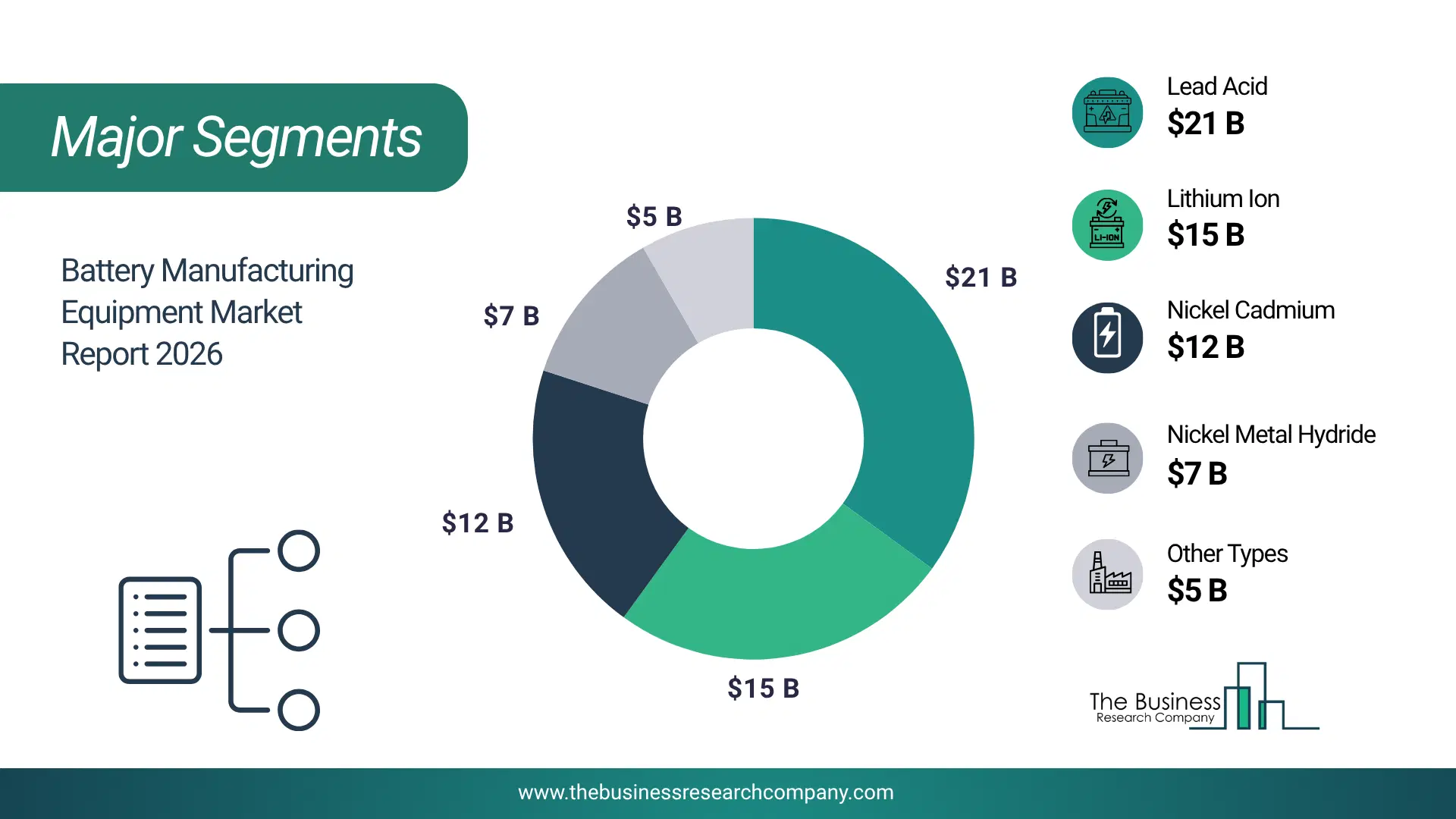
1) By Type: Lead Acid, Lithium Ion, Nickel Metal Hydride, Nickel Cadmium, Other Types 2) By Process: Electrode Manufacturing, Cell Assembly, Cell Finishing 3) By Application: Automotive Batteries, Industrial Batteries, Portable Batteries Subsegments: 1) By Lead Acid: Flooded Lead Acid, Absorbent Glass Mat (AGM), Gel Lead Acid 2) By Lithium Ion: Cylindrical Cells, Prismatic Cells, Pouch Cells 3) By Nickel Metal Hydride: NiMH Cylindrical Cells, NiMH Prismatic Cells 4) By Nickel Cadmium: NiCd Cylindrical Cells, NiCd Button Cells 5) By Other Types: Solid State Batteries, Flow Batteries, Zinc-Air Batteries The top segments in the battery manufacturing equipment market will be: • Lead Acid will reach $20.96 Billion by 2030. • Lithium Ion will reach $14.77 Billion by 2030. • Nickel Cadmium will reach $12.17 Billion by 2030. • Nickel Metal Hydride will reach $6.68 Billion by 2030. • Other Types will reach $4.93 Billion by 2030.What Is The Driver Of The Battery Manufacturing Equipment Market?
The growing demand for electric vehicles is expected to propel the growth of the battery manufacturing equipment market going forward. An electric vehicle refers to a type of vehicle that can be powered by an electric motor that draws electricity from a battery and is capable of being charged from an external source. Electric vehicles are beneficial to the battery manufacturing equipment market because they can only run on batteries. The expansion of battery manufacturing equipment is contingent upon the increasing demand for electric vehicles. For instance, in January 2024, according to a report published by Kelley Blue Book, a US-based Cox Automotive company, in 2023, a record 1.2 million car buyers in the United States chose electric vehicles, which accounted for 7.6% of the entire U.S. vehicle market, up from 5.9% in 2022. Therefore, the growing demand for electric vehicles is driving the growth of the battery manufacturing equipment industry.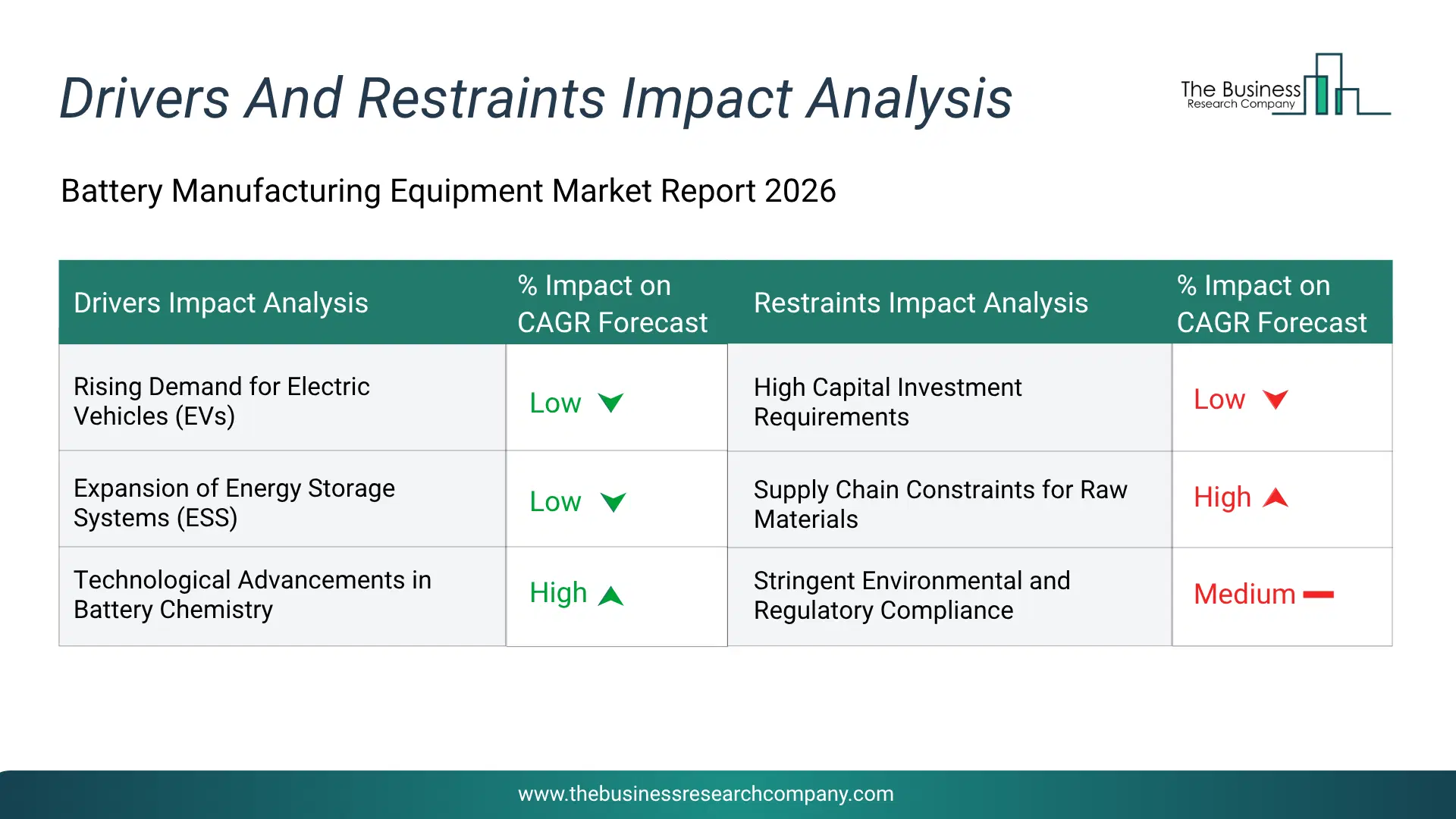
Infographic Chart Showing Key Market Drivers Analysis And Restraints For Battery Manufacturing Equipment Market
The chart presents an impact analysis of key drivers and restraints, quantifying their relative influence on the market's growth rate and helping assess the balance between growth enablers and limiting factors. This chart offers a high-level perspective; the full report contains more detailed insights.
How Will The Drivers Impact Growth In The Global Battery Manufacturing Equipment Market?
• Rising Demand for Electric Vehicles (EVs) (Low) – During the forecast period, the rising demand for electric vehicles (EVs) is expected to become a key growth driver for the battery manufacturing equipment market by 2030. The accelerating adoption of EVs across passenger and commercial segments is significantly increasing the need for high-volume battery production, driving investments in advanced manufacturing equipment. Automakers and battery producers are expanding giga-factory capacities to meet rising vehicle electrification targets, requiring efficient and scalable equipment for electrode production, cell assembly, and pack integration. Additionally, the shift toward high-energy-density batteries is further increasing the complexity and precision requirements of production systems. As EV demand continues to surge globally, equipment manufacturers are witnessing strong order pipelines. • Expansion of Energy Storage Systems (ESS) (Low) – During the forecast period, the expansion of energy storage systems (ESS) is expected to emerge as a major factor driving the growth of the battery manufacturing equipment market by 2030. Increasing deployment of renewable energy sources such as solar and wind is creating substantial demand for grid-scale and distributed energy storage solutions, thereby boosting battery production requirements. Utilities and energy providers are investing in large-scale battery installations to ensure grid stability and energy reliability, driving the need for advanced and automated manufacturing equipment. Furthermore, industrial and residential storage applications are expanding rapidly, contributing to diversified battery demand across multiple end-use sectors. This growing reliance on energy storage infrastructure is accelerating equipment adoption across regions. • Technological Advancements in Battery Chemistry (High) – During the forecast period, the technological advancements in battery chemistry are expected to act as a key growth catalyst for the battery manufacturing equipment market by 2030. Continuous innovation in battery technologies, including solid-state batteries, lithium iron phosphate (LFP), and next-generation high-nickel chemistries, is driving the need for specialized and flexible manufacturing equipment. These advancements require precise control over material handling, coating, and cell formation processes, encouraging manufacturers to upgrade existing production lines. Additionally, the development of safer, higher-capacity, and longer-life batteries is increasing the complexity of manufacturing operations, necessitating advanced automation and quality control systems. As battery chemistries evolve, equipment providers are focusing on adaptable and scalable solutions to meet diverse production requirements.How Will The Restraints Impact Growth In The Global Battery Manufacturing Equipment Market?
• High Capital Investment Requirements (Low) – During the forecast period, high capital investment requirements are significantly restricting the growth of the battery manufacturing equipment market. The substantial costs associated with advanced production lines, automation systems, and precision manufacturing equipment are creating entry barriers for new players and limiting expansion for small and mid-sized manufacturers. • Supply Chain Constraints for Raw Materials (Low) – During the forecast period, supply chain constraints for raw materials are significantly restricting the growth of the battery manufacturing equipment market. Limited availability and price volatility of critical materials such as lithium, cobalt, and nickel are disrupting production schedules, increasing costs, and impacting equipment deployment timelines. • Stringent Environmental and Regulatory Compliance (High) – During the forecast period, stringent environmental and regulatory compliance is significantly restricting the growth of the battery manufacturing equipment market. Increasing regulations on emissions, waste management, and sustainable manufacturing practices are raising compliance costs and requiring continuous upgrades in equipment design and production processes.Key Players In The Global Battery Manufacturing Equipment Market
Major companies operating in the battery manufacturing equipment market are Sony Energy Devices Corporation, BYD Co. Ltd., Panasonic Corporation, LG Chem Ltd., Johnson Controls International plc, Toshiba Corporation, Contemporary Amperex Technology Co. Ltd., Samsung SDI Co. Ltd., Wuxi Lead Intelligent Equipment Co. Ltd., Hitachi Chemical Co. Ltd., GS Yuasa Corporation, The Buhler Holding AG, Daiichi Jitsugyo Co. Ltd., Shenzhen Yinghe Technology Co Ltd., A123 Systems LLC, Duracell Inc., Manz AG, Eveready Industries India Ltd., Eagle Technologies Inc., MECO Incorporated, Wirtz Manufacturing Company Inc., Targray Technology International Inc., Sovema Group S.p.A., MESH Automation Inc., MAC Engineering & Equipment Company Inc., McAllister Mills Inc., Custom Electric Manufacturing Co. Inc., Xiamen Tmax Battery Equipments Limited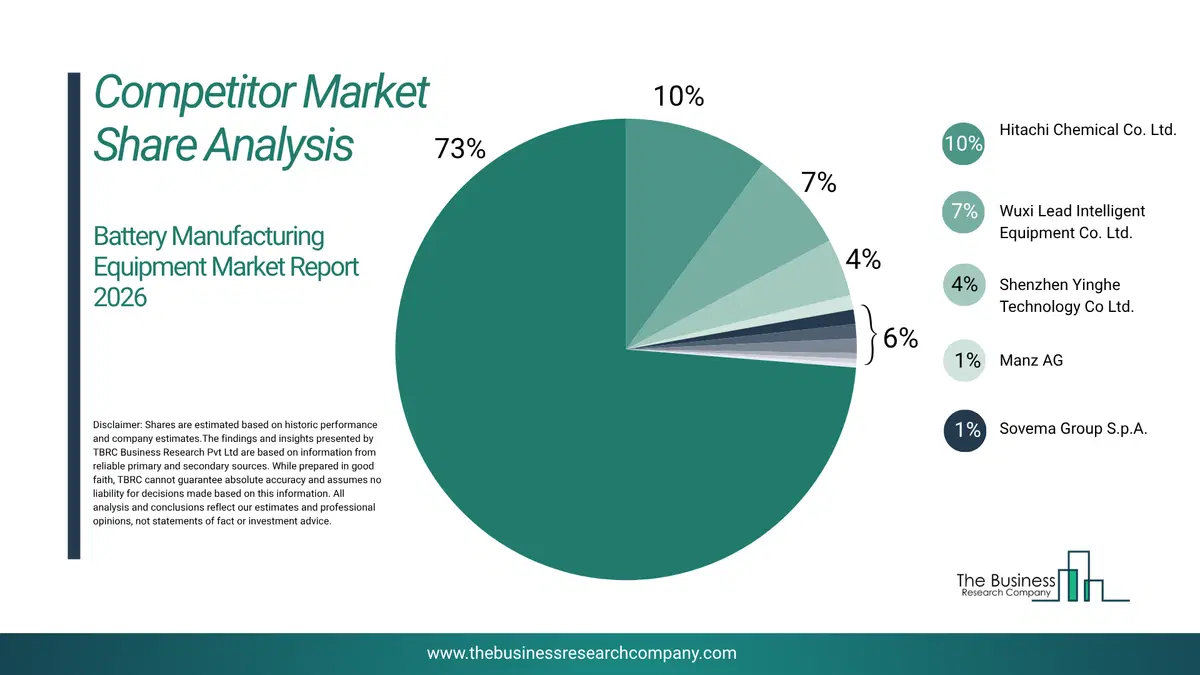
This chart is for illustrative purposes; the full report includes a detailed competitor analysis and comprehensive overview of the top 10 companies in the market.
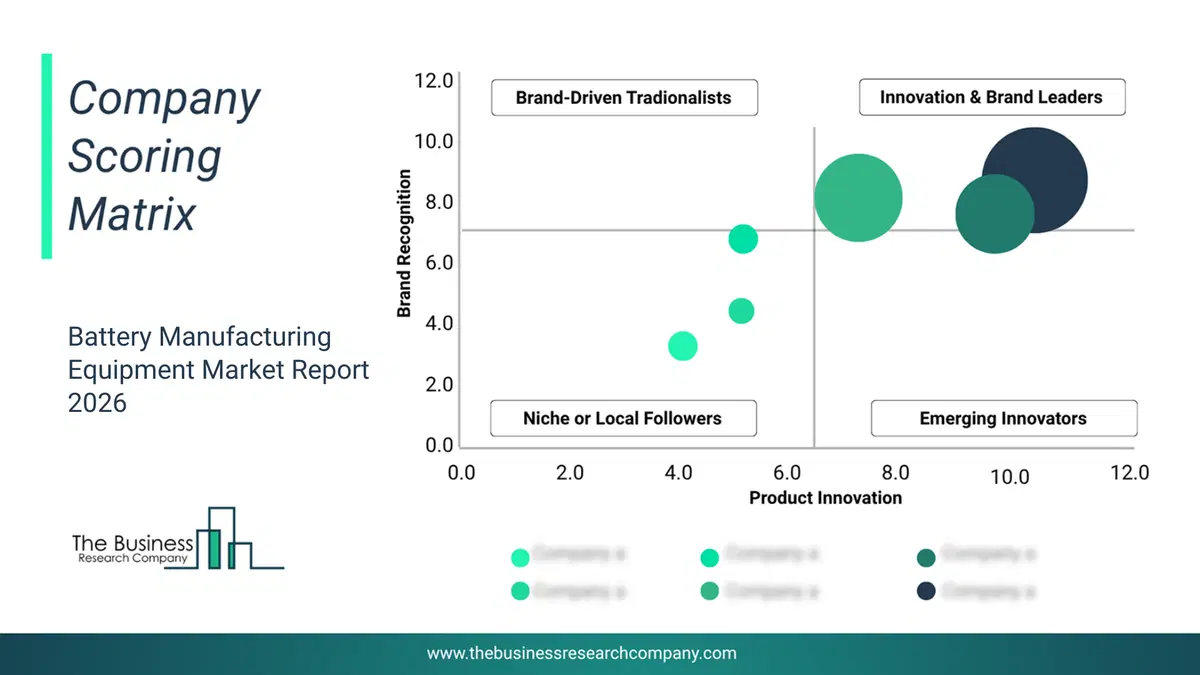
This chart maps companies by product innovation and brand strength, with bubble size indicating relative revenue, helping identify market leaders, challengers, and niche players. This is an illustrative chart; the full report provides a complete and accurate competitive analysis.
Global Battery Manufacturing Equipment Market Trends and Insights
Major companies operating in the battery manufacturing equipment market are focusing on strategic partnerships to sustain their position in the market. A strategic partnership refers to a collaborative arrangement between two or more entities, such as companies, organizations, or individuals, with the goal of achieving mutual benefits and shared objectives. For instance, in January 2023, Hanwha Group, a South Korean business conglomerate specializing in battery manufacturing equipment, and LG Energy Solution, a South Korean manufacturer of lithium-ion batteries for electric vehicles, mobility, IT, and energy storage systems, joined forces by signing a memorandum of understanding to invest together in establishing battery production facilities in the US. This collaboration aims to enhance the resilience of battery supply for the US. market, responding to the increasing demand for clean energy solutions. The partnership will extend beyond production facilities, with both companies planning to collaborate on energy storage systems designed for commercial, industrial, and utility markets. LG Energy Solution expressed optimism, stating that the partnership with Hanwha Group is anticipated to elevate the competitiveness of both companies in the battery-related business.What Are Latest Mergers And Acquisitions In The Battery Manufacturing Equipment Market?
In February 2025, Mullen Automotive, a US-based electric vehicle manufacturer, acquired additional battery-production equipment from Nikola Corporation for an undisclosed amount. Through this acquisition, Mullen aims to enhance its battery manufacturing capabilities by integrating Nikola’s high-volume battery chemistry production line, electrodynamic shaker system, and battery pack assembly and testing equipment into its Fullerton, California, facility. This acquisition supports Mullen’s strategy to produce its own battery packs and modules, including standard and solid-state polymer batteries. Nikola Corporation is a US-based mobility and energy solutions company.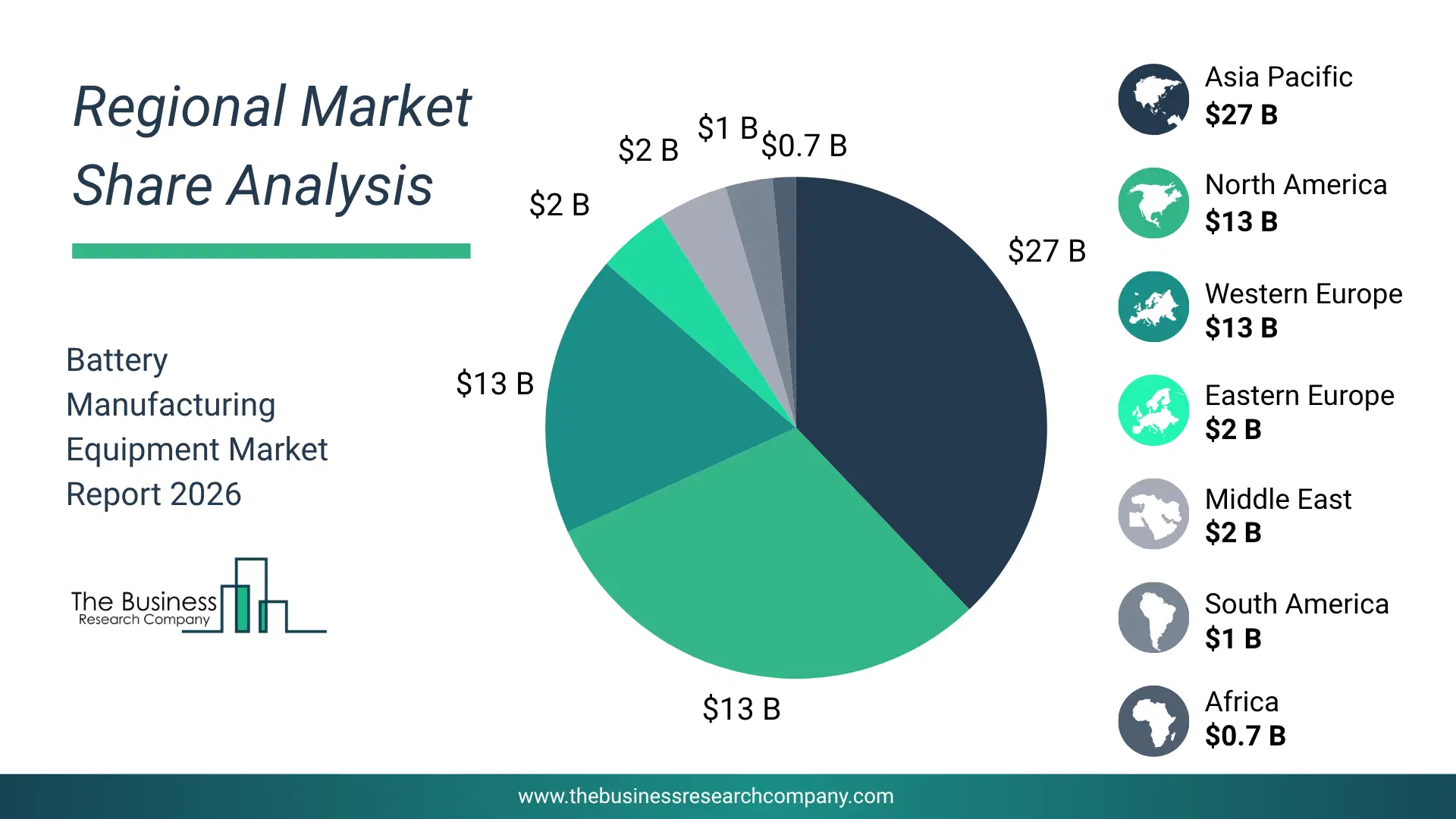
Regional Outlook
Asia-pacific was the largest region in the battery manufacturing equipment market in 2025. Asia-pacific is expected to be the fastest-growing region in the forecast period. The regions covered in this market report are Asia-Pacific, South East Asia, Western Europe, Eastern Europe, North America, South America, Middle East, Africa The countries covered in this market report are Australia, Brazil, China, France, Germany, India, Indonesia, Japan, Taiwan, Russia, South Korea, UK, USA, Canada, Italy, Spain.What Defines the Battery Manufacturing Equipment Market?
The battery manufacturing equipment market consists of sales of electrode coating machines, call assembly equipment, electrolyte filling machines, and cell sealing equipment. Values in this market are ‘factory gate’ values, that is the value of goods sold by the manufacturers or creators of the goods, whether to other entities (including downstream manufacturers, wholesalers, distributors, and retailers) or directly to end customers. The value of goods in this market includes related services sold by the creators of the goods.How is Market Value Defined and Measured?
The market value is defined as the revenues that enterprises gain from the sale of goods and/or services within the specified market and geography through sales, grants, or donations in terms of the currency (in USD unless otherwise specified). The revenues for a specified geography are consumption values that are revenues generated by organizations in the specified geography within the market, irrespective of where they are produced. It does not include revenues from resales along the supply chain, either further along the supply chain or as part of other products.
This chart presents market attractiveness based on a quantitative evaluation of growth, competition, strategic alignment, and risk, offering a clear view of opportunity areas for decision-making. This chart is for illustrative purposes; the full report contains the complete analysis.

This chart highlights the Total Addressable Market (TAM) by estimating the maximum revenue opportunity using an assumption-driven approach, supporting strategic planning and opportunity sizing across markets. The chart is illustrative; the full report provides a more comprehensive analysis.
What Key Data and Analysis Are Included in the Battery Manufacturing Equipment Market Report 2026?
The battery manufacturing equipment market research report is one of a series of new reports from The Business Research Company that provides market statistics, including industry global market size, regional shares, competitors with the market share, detailed market segments, market trends and opportunities, and any further data you may need to thrive in the battery manufacturing equipment industry. The market research report delivers a complete perspective of everything you need, with an in-depth analysis of the current and future state of the industry.Battery Manufacturing Equipment Market Report Forecast Analysis
| Report Attribute | Details |
|---|---|
| Market Size Value In 2026 | $24.04 billion |
| Revenue Forecast In 2030 | $60.13 billion |
| Growth Rate | CAGR of 25.2% from 2026 to 2030 |
| Base Year For Estimation | 2025 |
| Actual Estimates/Historical Data | 2020-2025 |
| Forecast Period | 2026 - 2030 |
| Market Representation | Revenue in USD Billion and CAGR from 2026 to 2030 |
| Segments Covered | Type, Process, Application |
| Regional Scope | Asia-Pacific, Western Europe, Eastern Europe, North America, South America, Middle East, Africa |
| Country Scope | The countries covered in the report are Australia, Brazil, China, France, Germany, India, Indonesia, Japan, Taiwan, Russia, South Korea, UK, USA, Canada, Italy, Spain. |
| Key Companies Profiled | Sony Energy Devices Corporation, BYD Co. Ltd., Panasonic Corporation, LG Chem Ltd., Johnson Controls International plc, Toshiba Corporation, Contemporary Amperex Technology Co. Ltd., Samsung SDI Co. Ltd., Wuxi Lead Intelligent Equipment Co. Ltd., Hitachi Chemical Co. Ltd., GS Yuasa Corporation, The Buhler Holding AG, Daiichi Jitsugyo Co. Ltd., Shenzhen Yinghe Technology Co Ltd., A123 Systems LLC, Duracell Inc., Manz AG, Eveready Industries India Ltd., Eagle Technologies Inc., MECO Incorporated, Wirtz Manufacturing Company Inc., Targray Technology International Inc., Sovema Group S.p.A., MESH Automation Inc., MAC Engineering & Equipment Company Inc., McAllister Mills Inc., Custom Electric Manufacturing Co. Inc., Xiamen Tmax Battery Equipments Limited |
| Customization Scope | Request for Customization |
| Pricing And Purchase Options | Explore Purchase Options |