
Blood Screening Market Report 2026
Global Outlook – By Product (Reagents And Kits, Instruments, Software And Services), By Technology (Nucleic Acid Testing, Enzyme-Linked Immunosorbent Assay (ELISA), Rapid Tests, Western Blot Assays, Next-Generation Sequencing (NGS)), By End User (Blood Banks, Diagnostic Centers And Pathology Labs, Hospitals, Clinics, Ambulatory Surgical Centers (ASCs)) - Market Size, Trends, Strategies, and Forecast to 2030
Blood Screening Market Overview
• Blood Screening market size has reached to $3.44 billion in 2025 • Expected to grow to $5.93 billion in 2030 at a compound annual growth rate (CAGR) of 11.5% • Growth Driver: Blood Screening Market Soars With Rising Prevalence Of Chronic Diseases • Market Trend: The Rise Of Liquid Biopsies For Early Cancer Detection • North America was the largest region in 2025.What Is Covered Under Blood Screening Market?
Blood screening refers to a method of screening blood, plasma, or blood components for transfusion or use in blood products. It is used to screen for antibodies or tumor markers, to seek for disease-causing substances or symptoms, or to evaluate treatment effectiveness. The main product of blood screening are reagents and kits, instruments, software, and services. Reagents refer to a substance or compound that can facilitate a reaction used in detecting or measuring a component or in preparing a product due to its chemical or biological activity, whereas kits are test kits that can be used in a lab setting or out in the field to find specific compounds in a sample. The technology included nucleic acid testing, enzyme-linked immunosorbent assay (ELISA), rapid tests, western blot assays and next-generation sequencing (NGS), and involves blood banks, diagnostic centers and pathology labs, hospitals, clinics and ambulatory surgical centers (ASCs).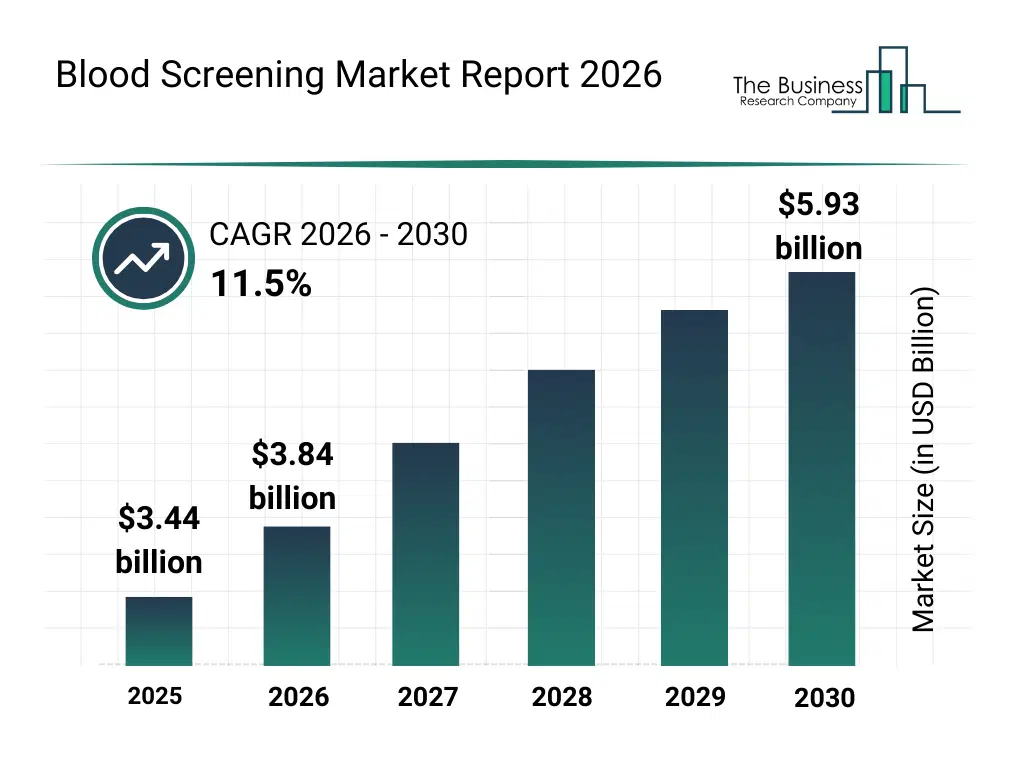
What Is The Blood Screening Market Size and Share 2026?
The blood screening market size has grown rapidly in recent years. It will grow from $3.44 billion in 2025 to $3.84 billion in 2026 at a compound annual growth rate (CAGR) of 11.6%. The growth in the historic period can be attributed to increasing regulatory screening requirements, expansion of blood donation volumes, rising prevalence of transfusion-transmitted infections, growth of centralized blood banks, adoption of elisa-based testing.What Is The Blood Screening Market Growth Forecast?
The blood screening market size is expected to see rapid growth in the next few years. It will grow to $5.93 billion in 2030 at a compound annual growth rate (CAGR) of 11.5%. The growth in the forecast period can be attributed to increasing investments in advanced screening technologies, rising demand for rapid and accurate diagnostics, expansion of molecular testing adoption, growing integration of ai-driven data analysis, increased focus on global blood safety standards. Major trends in the forecast period include increasing adoption of nucleic acid testing technologies, rising demand for high-throughput screening systems, growing use of automated blood screening instruments, expansion of software-integrated screening platforms, enhanced focus on transfusion safety.
Global Blood Screening Market Segmentation
1) By Product: Reagents And Kits, Instruments, Software And Services 2) By Technology: Nucleic Acid Testing, Enzyme-Linked Immunosorbent Assay (ELISA), Rapid Tests, Western Blot Assays, Next-Generation Sequencing (NGS) 3) By End User: Blood Banks, Diagnostic Centers And Pathology Labs, Hospitals, Clinics, Ambulatory Surgical Centers (ASCs) Subsegments: 1) By Reagents And Kits: Diagnostic Reagents, Testing Kits 2) By Instruments: Automated Analyzers, Manual Testing Equipment 3) By Software And Services: Laboratory Information Management Systems (LIMS), Data Analysis Software, Support And Consulting ServicesWhat Is The Driver Of The Blood Screening Market?
The increasing prevalence of chronic diseases is expected to propel the growth of the blood screening market. Chronic diseases refer to long-term conditions or illnesses that are typically manageable but not curable and require adjusting to both the therapy used to treat the condition and its demands. Blood screening carefully matches the compatibility between the donor's and recipient's blood types during transfusions. Blood transfusions are frequently necessary as part of medical treatments for a number of chronic diseases, including autoimmune diseases, hematological disorders, and cancers in all of their forms. For instance, in September 2023, according to the World Health Organization, a Switzerland-based specialized agency of the United Nations, there were 41 million deaths, which is 74% of those caused by non-communicable diseases (NCDs) or chronic diseases every year globally. Therefore, the increasing prevalence of chronic diseases is driving the growth of the blood screening industry.Key Players In The Global Blood Screening Market
Major companies operating in the blood screening market are Abbott Laboratories, Grifols S.A., Becton Dickinson and Company, F. Hoffmann-La Roche AG, bioMérieux S.A., Bio-Rad Laboratories Inc., Thermo Fisher Scientific Inc., Ortho Clinical Diagnostics Inc., Beckman Coulter Inc., Siemens Healthineers AG, DiaSorin S.p.A., Merck KGaA, PerkinElmer Inc., Bio-Techne Corporation, Roche Diagnostics GmbH, Danaher Corporation, Sysmex Corporation, GenMark Diagnostics Inc., QIAGEN N.V., Hologic Inc., Luminex Corporation, Trinity Biotech plc, Fujirebio Inc., OraSure Technologies Inc., Immunetics Inc., Cepheid Inc., Haemonetics Corporation, Verax Biomedical Inc.
This chart is for illustrative purposes; the full report includes a detailed competitor analysis and comprehensive overview of the top 10 companies in the market.
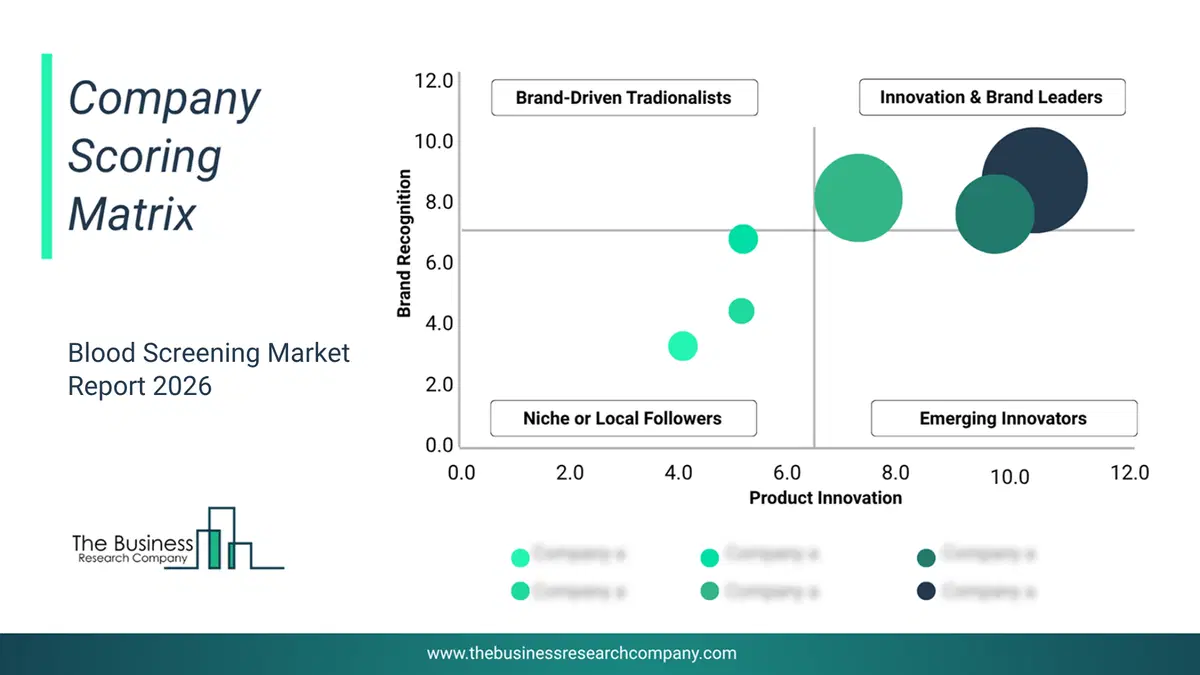
This chart maps companies by product innovation and brand strength, with bubble size indicating relative revenue, helping identify market leaders, challengers, and niche players. This is an illustrative chart; the full report provides a complete and accurate competitive analysis.
Global Blood Screening Market Trends and Insights
Major companies operating in the blood screening market are developing technologies such as liquid biopsy to enhance early cancer detection, improve treatment monitoring, and enable personalized medicine approaches. A liquid biopsy is a minimally invasive test that analyzes blood or other body fluids to detect cancer cells or genetic material from tumors. For instance, in November 2023, Guardant Health, Inc., a US-based biotechnology company, launched Shield blood-based screening tests. The Shield test analyzes cell-free DNA (cfDNA) in the bloodstream, which can indicate the presence of colorectal tumors or precancerous growths. It specifically looks for alterations in DNA fragments that are released into the blood from cancer cells.What Are Latest Mergers And Acquisitions In The Blood Screening Market?
In March 2023, Werfen, a Spain-based specialized in vitro diagnostics company, acquired Immucor, Inc. for an undisclosed amount. Through this acquisition, Werfen aims to expand its diagnostics portfolio by integrating Immucor’s transfusion and transplant product lines, strengthening its position in the blood-preparation and transfusion diagnostics market while broadening its global reach in specialized diagnostics. Immucor, Inc. is a U.S.-based transfusion and transplant diagnostics company known for its in vitro diagnostics solutions that facilitate patient-donor compatibility in blood transfusion and transplantation.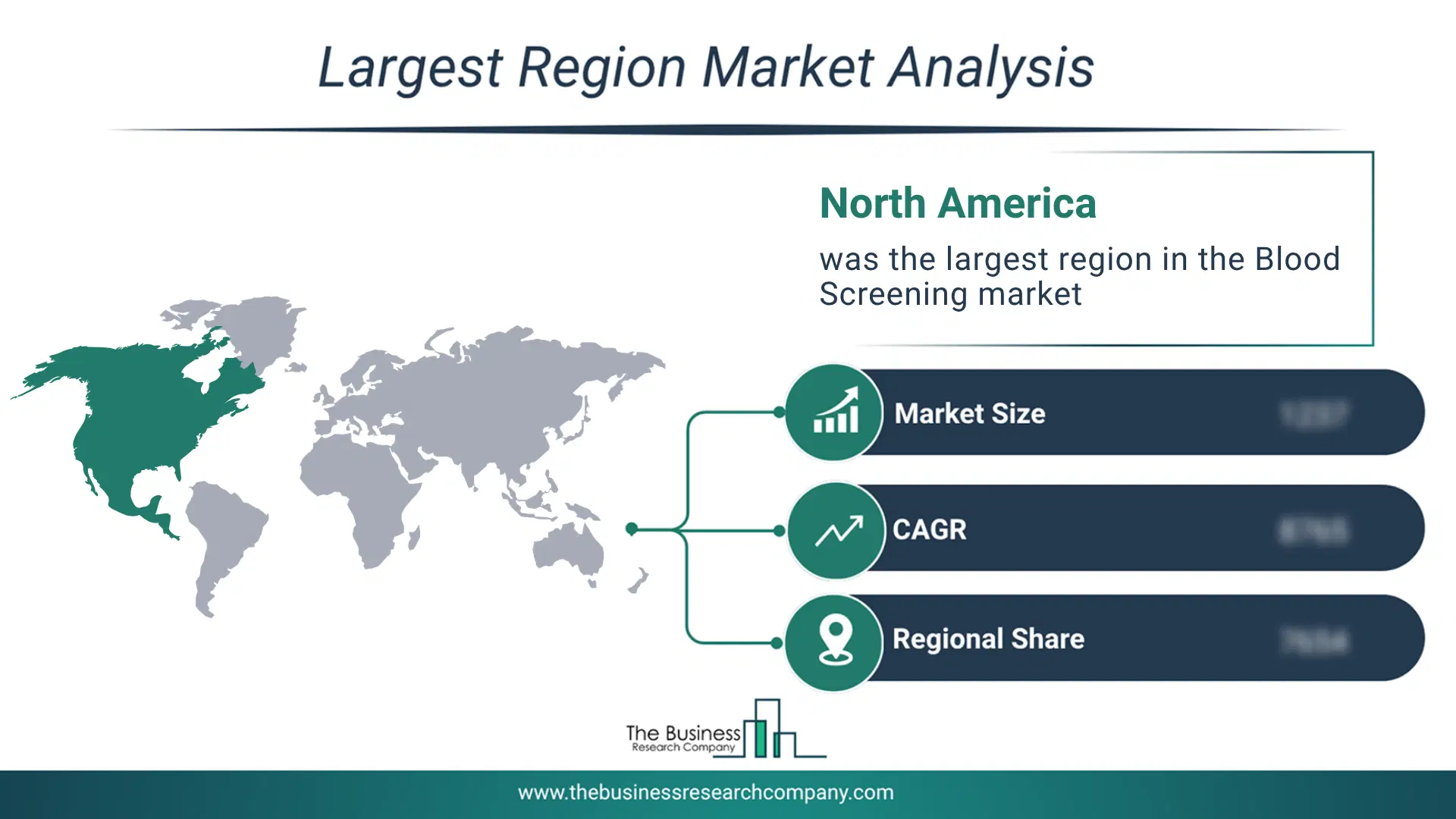
Regional Outlook
North America was the largest region in the blood screening market in 2025. The regions covered in this market report are Asia-Pacific, South East Asia, Western Europe, Eastern Europe, North America, South America, Middle East, Africa. The countries covered in this market report are Australia, Brazil, China, France, Germany, India, Indonesia, Japan, Taiwan, Russia, South Korea, UK, USA, Canada, Italy, Spain.What Defines the Blood Screening Market?
The blood screening market consists of revenues earned by entities by providing transcription mediated amplification (TMA) and real-time PCR. The market value includes the value of related goods sold by the service provider or included within the service offering. The blood screening market also includes sales of analyzers, photo colorimeter, flame photometer, hemoglobin meter, blood roller mixer, dry bath incubators, and differential blood counter. Values in this market are ‘factory gate’ values, that is the value of goods sold by the manufacturers or creators of the goods, whether to other entities (including downstream manufacturers, wholesalers, distributors and retailers) or directly to end customers. The value of goods in this market includes related services sold by the creators of the goods.How is Market Value Defined and Measured?
The market value is defined as the revenues that enterprises gain from the sale of goods and/or services within the specified market and geography through sales, grants, or donations in terms of the currency (in USD unless otherwise specified). The revenues for a specified geography are consumption values that are revenues generated by organizations in the specified geography within the market, irrespective of where they are produced. It does not include revenues from resales along the supply chain, either further along the supply chain or as part of other products.
This chart presents market attractiveness based on a quantitative evaluation of growth, competition, strategic alignment, and risk, offering a clear view of opportunity areas for decision-making. This chart is for illustrative purposes; the full report contains the complete analysis.

This chart highlights the Total Addressable Market (TAM) by estimating the maximum revenue opportunity using an assumption-driven approach, supporting strategic planning and opportunity sizing across markets. The chart is illustrative; the full report provides a more comprehensive analysis.
What Key Data and Analysis Are Included in the Blood Screening Market Report 2026?
The blood screening market research report is one of a series of new reports from The Business Research Company that provides market statistics, including industry global market size, regional shares, competitors with the market share, detailed market segments, market trends and opportunities, and any further data you may need to thrive in the blood screening industry. The market research report delivers a complete perspective of everything you need, with an in-depth analysis of the current and future state of the industry.Blood Screening Market Report Forecast Analysis
| Report Attribute | Details |
|---|---|
| Market Size Value In 2026 | $3.84 billion |
| Revenue Forecast In 2030 | $5.93 billion |
| Growth Rate | CAGR of 11.5% from 2026 to 2030 |
| Base Year For Estimation | 2025 |
| Actual Estimates/Historical Data | 2020-2025 |
| Forecast Period | 2026 - 2030 |
| Market Representation | Revenue in USD Billion and CAGR from 2026 to 2030 |
| Segments Covered | Product, Technology, End User |
| Regional Scope | Asia-Pacific, Western Europe, Eastern Europe, North America, South America, Middle East, Africa |
| Country Scope | The countries covered in the report are Australia, Brazil, China, France, Germany, India, Indonesia, Japan, Taiwan, Russia, South Korea, UK, USA, Canada, Italy, Spain |
| Key Companies Profiled | Abbott Laboratories, Grifols S.A., Becton Dickinson and Company, F. Hoffmann-La Roche AG, bioMérieux S.A., Bio-Rad Laboratories Inc., Thermo Fisher Scientific Inc., Ortho Clinical Diagnostics Inc., Beckman Coulter Inc., Siemens Healthineers AG, DiaSorin S.p.A., Merck KGaA, PerkinElmer Inc., Bio-Techne Corporation, Roche Diagnostics GmbH, Danaher Corporation, Sysmex Corporation, GenMark Diagnostics Inc., QIAGEN N.V., Hologic Inc., Luminex Corporation, Trinity Biotech plc, Fujirebio Inc., OraSure Technologies Inc., Immunetics Inc., Cepheid Inc., Haemonetics Corporation, Verax Biomedical Inc. |
| Customization Scope | Request for Customization |
| Pricing And Purchase Options | Explore Purchase Options |