
Carbon Financial Service (CFS) Market Report 2026
Global Outlook – By Service Type (Carbon Credit Trading, Carbon Footprint Management, Carbon Consulting, Other Service Types), By Project (Renewable Energy, Energy Efficiency, Forestry And Land Use, Waste Management, Industrial Processes, Carbon Capture And Storage), By Deployment Mode (On-Premises, Cloud), By Technology Platform (Carbon Accounting Software, Carbon Credit Trading Platforms, Blockchain-Based Carbon Solutions, Artificial Intelligence-Powered Carbon Analytics), By Industry Vertical (Energy And Utilities, Manufacturing, Transportation, Agriculture And Forestry, Real Estate And Construction, Information Technology, Healthcare, Retail And Consumer Goods, Other Industry Verticals) – Market Size, Trends, Strategies, and Forecast to 2030
Carbon Financial Service (CFS) Market Overview
• Carbon Financial Service (CFS) market size has reached to $5.98 billion in 2025 • Expected to grow to $11.15 billion in 2030 at a compound annual growth rate (CAGR) of 13.2% • Growth Driver: Rising Net-Zero Commitments Fueling The Growth Of The Market Due To Increasing Regulatory Pressure And Climate Targets • Market Trend: Adoption Of Advanced Technologies Enhancing Transparency And Efficiency • North America was the largest region in 2025 and Asia-Pacific is the fastest growing region.What Is Covered Under Carbon Financial Service (CFS) Market?
Carbon financial services (CFS) refer to financial solutions that enable businesses, governments, and individuals to manage, reduce, or offset their carbon emissions through market-based mechanisms. These services include carbon credit trading, financing for carbon offset projects, advisory on emissions reduction strategies, and compliance support for climate-related regulations. The main types of carbon financial services (CFS) include carbon credit trading, carbon footprint management, carbon consulting, and others. Carbon credit trading refers to the process of buying and selling carbon credits, permits that allow the holder to emit a certain amount of carbon dioxide or other greenhouse gases. The multiple projects involved are renewable energy, energy efficiency, forestry and land use, waste management, industrial processes, and carbon capture and storage. The various deployment modes include on-premises and cloud and are used for various technology platforms, including carbon accounting software, carbon credit trading platforms, blockchain-based carbon solutions, and artificial intelligence-powered carbon analytics, and cater to industry verticals such as energy and utilities, manufacturing, transportation, agriculture and forestry, real estate and construction, information technology, healthcare, retail and consumer goods, and others.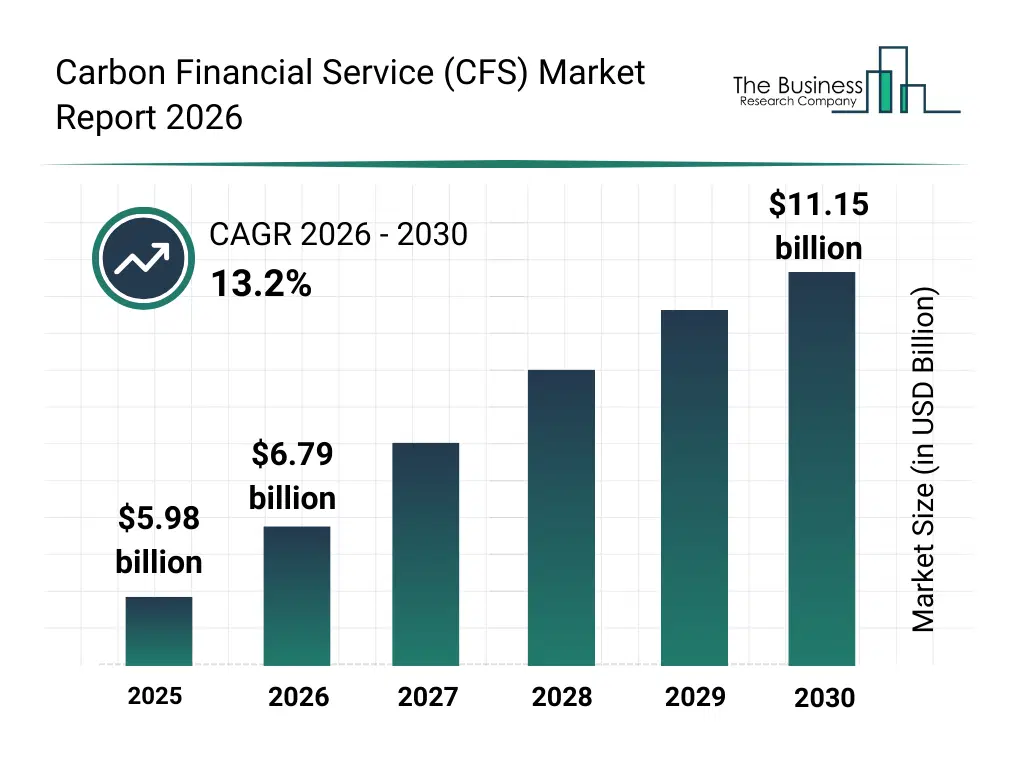
What Is The Carbon Financial Service (CFS) Market Size and Share 2026?
The carbon financial service (cfs) market size has grown rapidly in recent years. It will grow from $5.98 billion in 2025 to $6.79 billion in 2026 at a compound annual growth rate (CAGR) of 13.5%. The growth in the historic period can be attributed to increasing implementation of emissions regulations, expansion of voluntary carbon markets, growing corporate sustainability initiatives, early adoption of carbon offset mechanisms, rising awareness of climate risk management.What Is The Carbon Financial Service (CFS) Market Growth Forecast?
The carbon financial service (cfs) market size is expected to see rapid growth in the next few years. It will grow to $11.15 billion in 2030 at a compound annual growth rate (CAGR) of 13.2%. The growth in the forecast period can be attributed to increasing integration of ai-powered carbon analytics, expansion of global carbon trading schemes, rising demand for real-time emissions monitoring, growing investments in carbon capture financing, increasing adoption of digital carbon management platforms. Major trends in the forecast period include increasing adoption of carbon credit trading platforms, rising demand for carbon accounting and reporting services, growing use of blockchain in carbon markets, expansion of corporate net-zero commitments, enhanced focus on regulatory compliance and esg reporting.
Global Carbon Financial Service (CFS) Market Segmentation
1) By Service Type: Carbon Credit Trading, Carbon Footprint Management, Carbon Consulting, Other Service Types 2) By Project: Renewable Energy, Energy Efficiency, Forestry And Land Use, Waste Management, Industrial Processes, Carbon Capture And Storage 3) By Deployment Mode: On-Premises, Cloud 4) By Technology Platform: Carbon Accounting Software, Carbon Credit Trading Platforms, Blockchain-Based Carbon Solutions, Artificial Intelligence-Powered Carbon Analytics 5) By Industry Vertical: Energy And Utilities, Manufacturing, Transportation, Agriculture And Forestry, Real Estate And Construction, Information Technology, Healthcare, Retail And Consumer Goods, Other Industry Verticals Subsegments: 1) By Carbon Credit Trading: Compliance-Based Trading, Voluntary-Based Trading, Blockchain-Based Trading, Exchange-Traded Carbon Credits, Over-The-Counter (OTC) Trading 2) By Carbon Footprint Management: Emission Data Collection, Carbon Accounting And Reporting, Carbon Footprint Analysis, Software And Tools For Monitoring 3) By Carbon Consulting: Regulatory Compliance Advisory, Carbon Offset Strategy Development, Sustainability And Environmental, Social, And Governance (ESG) Reporting, Climate Risk Assessment, Carbon Neutrality And Net-Zero Planning 4) By Other Service Types: Verification And Validation Services, Third-Party Auditing, Training And Certification, Project Registration Services, Market Intelligence And ResearchWhat Is The Driver Of The Carbon Financial Service (CFS) Market?
The increasing demand to achieve net?zero emissions is expected to propel the growth of the carbon financial service (CFS) market going forward. Net-zero emissions refer to the balance between the amount of greenhouse gases emitted into the atmosphere and the amount removed. The increasing demand for net-zero emissions is driven by regulatory pressure, as governments increasingly mandate climate targets to meet international environmental agreements. Carbon financial services help achieve net-zero emissions by facilitating the financing, trading, and management of carbon credits that offset residual greenhouse gas emissions, supporting organizations in meeting their climate goals. For instance, in January 2024, according to a report published by the United Nations Environment Programme, a Kenya-based government organization, in September 2023, a total of 97 countries, representing 81% of global greenhouse gas emissions, have made net-zero pledges. Of these, 27 have enshrined their commitments into law, 54 have integrated them into official policies, and 16 have announced them publicly. This marks an increase from 88 countries last year, with 37% of all pledges targeting the year 2050. Therefore, the increasing demand to achieve net?zero emissions is driving the growth of the carbon financial service (CFS) industry.Key Players In The Global Carbon Financial Service (CFS) Market
Major companies operating in the carbon financial service (cfs) market are Trafigura Group Pte. Ltd., Vertis Environmental Finance Ltd., EKI Energy Services Limited, South Pole Holding AG, Aither CO2 S.p.A., 3Degrees Group Inc., First Climate Markets AG, Stankevicius International Limited, ClimeCo Corporation, Xpansiv Data Systems Inc., Aera Group S.A., Viridios Capital Pty Ltd., Ecosecurities Group Ltd., Climate Impact Partners Limited, EcoAct SAS, NativeEnergy Inc., Carbon Credit Capital LLC, GreenTrees LLC, TerraPass Inc., BeZero Carbon Ltd.
This chart is for illustrative purposes; the full report includes a detailed competitor analysis and comprehensive overview of the top 10 companies in the market.
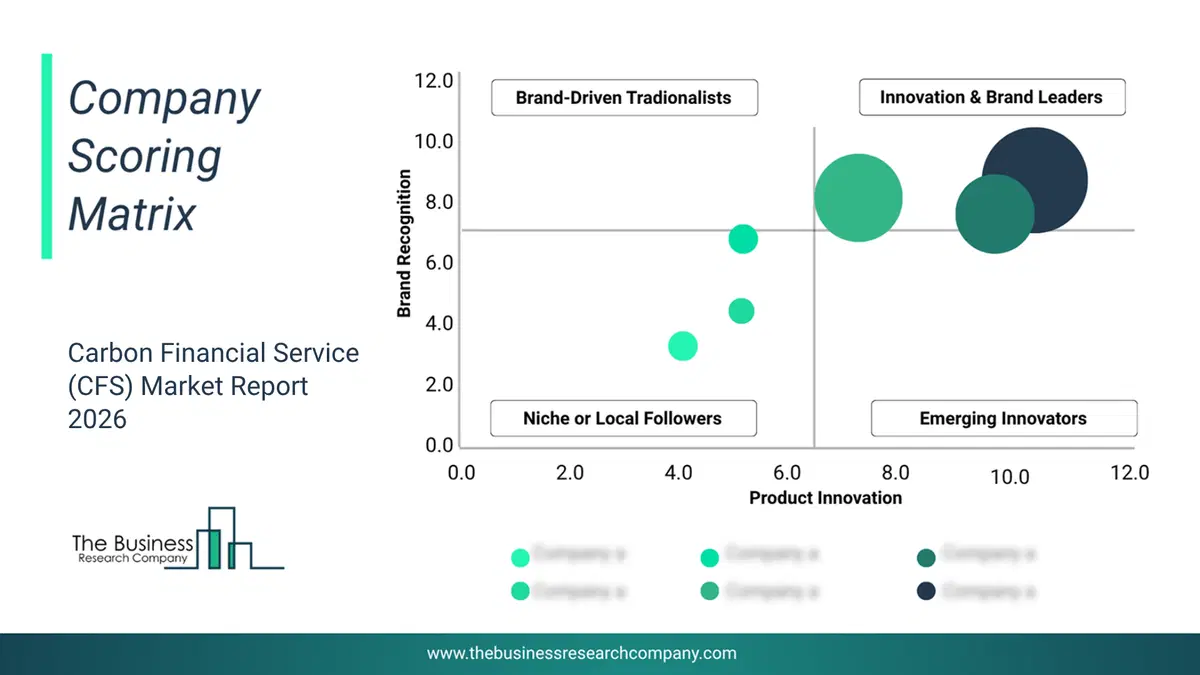
This chart maps companies by product innovation and brand strength, with bubble size indicating relative revenue, helping identify market leaders, challengers, and niche players. This is an illustrative chart; the full report provides a complete and accurate competitive analysis.
Global Carbon Financial Service (CFS) Market Trends and Insights
Major companies operating in the carbon financial service (CFS) market are focusing on developing advanced solutions, such as AI-driven carbon accounting platforms, to enhance accuracy in emissions tracking, streamline reporting processes, and support regulatory compliance. AI-driven carbon accounting platforms refer to advanced digital systems that use artificial intelligence and machine learning algorithms to automatically measure, track, analyze, and report greenhouse gas emissions across an organization’s operations. For instance, in August 2025, Compliance Kart Pvt. Ltd., an India-based environmental services firm, launched ENVR, a blockchain-powered voluntary carbon credit and I-REC trading platform. The platform offers unique features such as end-to-end digital transaction capabilities, enabling buyers and sellers to execute trades with ease, speed, and traceability. The company built ENVR with a strong focus on transparency, traceability, and security, integrating blockchain-based verification and real-time registry access. It supports multi-asset trading, allowing users to track, retire, or transfer environmental attributes seamlessly. The platform also ensures regulatory compliance and provides due diligence checks, making it suitable for corporates, project developers, and sustainability-focused investors. With user-friendly dashboards, customizable reporting, and ESG impact analytics, ENVR aims to simplify market access and enhance trust in the carbon and renewable energy markets.What Are Latest Mergers And Acquisitions In The Carbon Financial Service (CFS) Market?
In June 2025, Voluntary Carbon Market Company (VCM), a Saudi Arabia-based carbon credit company, partnered with ENOWA to deliver high-integrity carbon credits. With this partnership aims to deliver approximately 30 million tons of high-integrity carbon credits by 2030, aiming to support NEOM’s decarbonization goals, enable long-term climate finance, and enhance transparency and stability in the voluntary carbon market. ENOWA is a Saudi Arabia-based provider of carbon financial services (CFS).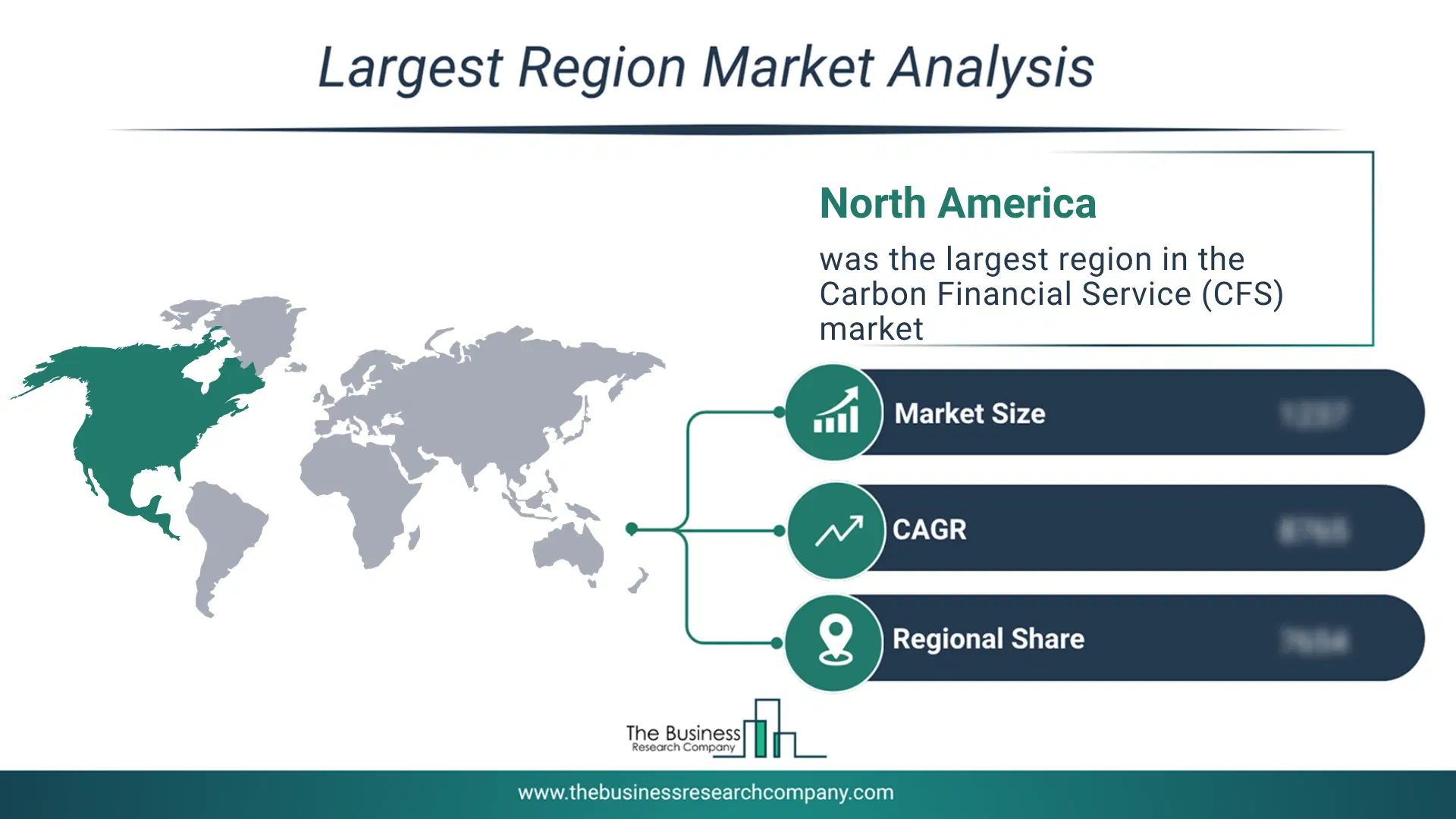
Regional Outlook
North America was the largest region in the carbon financial service (CFS) market in 2025. Asia-Pacific is expected to be the fastest-growing region in the forecast period. The regions covered in this market report are Asia-Pacific, South East Asia, Western Europe, Eastern Europe, North America, South America, Middle East, Africa. The countries covered in this market report are Australia, Brazil, China, France, Germany, India, Indonesia, Japan, Taiwan, Russia, South Korea, UK, USA, Canada, Italy, Spain.What Defines the Carbon Financial Service (CFS) Market?
The carbon financial service (CFS) market includes revenues earned by entities by providing services such as carbon offset project financing, regulatory compliance support, carbon asset valuation, and climate investment advisory. The market value includes the value of related goods sold by the service provider or included within the service offering. Only goods and services traded between entities or sold to end consumers are included.How is Market Value Defined and Measured?
The market value is defined as the revenues that enterprises gain from the sale of goods and/or services within the specified market and geography through sales, grants, or donations in terms of the currency (in USD unless otherwise specified). The revenues for a specified geography are consumption values that are revenues generated by organizations in the specified geography within the market, irrespective of where they are produced. It does not include revenues from resales along the supply chain, either further along the supply chain or as part of other products.
This chart presents market attractiveness based on a quantitative evaluation of growth, competition, strategic alignment, and risk, offering a clear view of opportunity areas for decision-making. This chart is for illustrative purposes; the full report contains the complete analysis.

This chart highlights the Total Addressable Market (TAM) by estimating the maximum revenue opportunity using an assumption-driven approach, supporting strategic planning and opportunity sizing across markets. The chart is illustrative; the full report provides a more comprehensive analysis.
What Key Data and Analysis Are Included in the Carbon Financial Service (CFS) Market Report 2026?
The carbon financial service (cfs) market research report is one of a series of new reports from The Business Research Company that provides market statistics, including Market Report 2026?global market size, regional shares, competitors with the market share, detailed market segments, market trends and opportunities, and any further data you may need to thrive in the carbon financial service (cfs) Market Report 2026? The market research report delivers a complete perspective of everything you need, with an in-depth analysis of the current and future state of the Market Report 2026?Carbon Financial Service (CFS) Market Report Forecast Analysis
| Report Attribute | Details |
|---|---|
| Market Size Value In 2026 | $6.79 billion |
| Revenue Forecast In 2030 | $11.15 billion |
| Growth Rate | CAGR of 4.5% from 2026 to 2030 |
| Base Year For Estimation | 2025 |
| Actual Estimates/Historical Data | 2020-2025 |
| Forecast Period | 2026 - 2030 |
| Market Representation | Revenue in USD Billion and CAGR from 2026 to 2030 |
| Segments Covered | Service Type, Project, Deployment Mode, Technology Platform, Industry Vertical |
| Regional Scope | Asia-Pacific, Western Europe, Eastern Europe, North America, South America, Middle East, Africa |
| Country Scope | The countries covered in the report are Australia, Brazil, China, France, Germany, India, Indonesia, Japan, Taiwan, Russia, South Korea, UK, USA, Canada, Italy, Spain. |
| Key Companies Profiled | Trafigura Group Pte. Ltd., Vertis Environmental Finance Ltd., EKI Energy Services Limited, South Pole Holding AG, Aither CO2 S.p.A., 3Degrees Group Inc., First Climate Markets AG, Stankevicius International Limited, ClimeCo Corporation, Xpansiv Data Systems Inc., Aera Group S.A., Viridios Capital Pty Ltd., Ecosecurities Group Ltd., Climate Impact Partners Limited, EcoAct SAS, NativeEnergy Inc., Carbon Credit Capital LLC, GreenTrees LLC, TerraPass Inc., BeZero Carbon Ltd. |
| Customization Scope | Request for Customization |
| Pricing And Purchase Options | Explore Purchase Options |