
Carbon Credit Market Report 2026
Global Outlook – By Type (Compliance, Voluntary), By Project Type (Avoidance Or Reduction Projects, Removal Or Sequestration Projects), By End-Use (Power, Energy, Aviation, Transportation, Buildings, Industrial, Other End-Uses) – Market Size, Trends, Strategies, and Forecast to 2030
Carbon Credit Market Overview
• Carbon Credit market size has reached to $642.74 billion in 2025 • Expected to grow to $1758.62 billion in 2030 at a compound annual growth rate (CAGR) of 22.3% • Growth Driver: Rising Transport Pollution Fuels The Carbon Credit Market • Market Trend: Carbon Credit Market Leaders Harness Blockchain Technology For Enhanced Customer Service • North America was the largest region in 2025.Market Gains By 2030 – Top Opportunities By Segment
Market Gain identifies the most promising market opportunities by highlighting the segments or products expected to generate the highest incremental revenue growth over the next five years.
What Is Covered Under Carbon Credit Market?
A carbon credit is a transferable voucher or authorization that signifies the entitlement to release one metric ton of carbon dioxide (CO2) or an equivalent quantity of other greenhouse gases (GHGs). These credits serve the purpose of mitigating greenhouse gas emissions by either diminishing emissions directly or by capturing and storing carbon dioxide. The overarching objective of carbon credits is to curtail the release of greenhouse gases into the atmosphere. The main types of carbon credits are compliance and voluntary. Compliance carbon credits are issued as part of government-mandated emissions reduction programs, often associated with cap-and-trade systems or emissions trading schemes. The project types are avoidance or reduction projects and removal or sequestration projects used in power, energy, aviation, transportation, buildings, industrial, and others.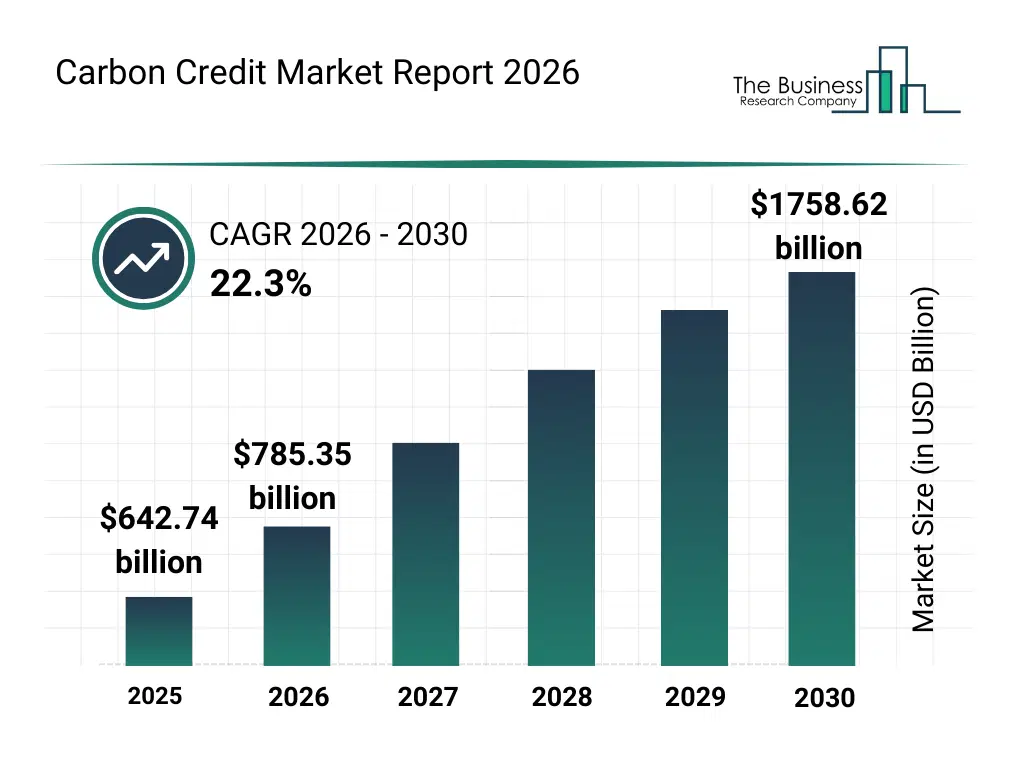
What Is The Carbon Credit Market Size and Share 2026?
The carbon credit market size has grown exponentially in recent years. It will grow from $642.74 billion in 2025 to $785.35 billion in 2026 at a compound annual growth rate (CAGR) of 22.2%. The growth in the historic period can be attributed to global environmental agreements, growing awareness on climate change, rise in voluntary offset mechanisms, increasing industrial emission concerns, early regulatory enforcement initiatives.What Is The Carbon Credit Market Growth Forecast?
The carbon credit market size is expected to see exponential growth in the next few years. It will grow to $1758.62 billion in 2030 at a compound annual growth rate (CAGR) of 22.3%. The growth in the forecast period can be attributed to tightening emission caps, expansion of national net-zero commitments, increasing participation from aviation and transportation sectors, growth in carbon removal and sequestration projects, rising investor interest in climate finance. Major trends in the forecast period include expansion of compliance carbon trading frameworks, rising corporate net-zero and offset adoption, increasing cross-border carbon credit trading, growing emphasis on market transparency and pricing integrity, strengthening global regulatory alignment and standardization.
Global Carbon Credit Market Segmentation
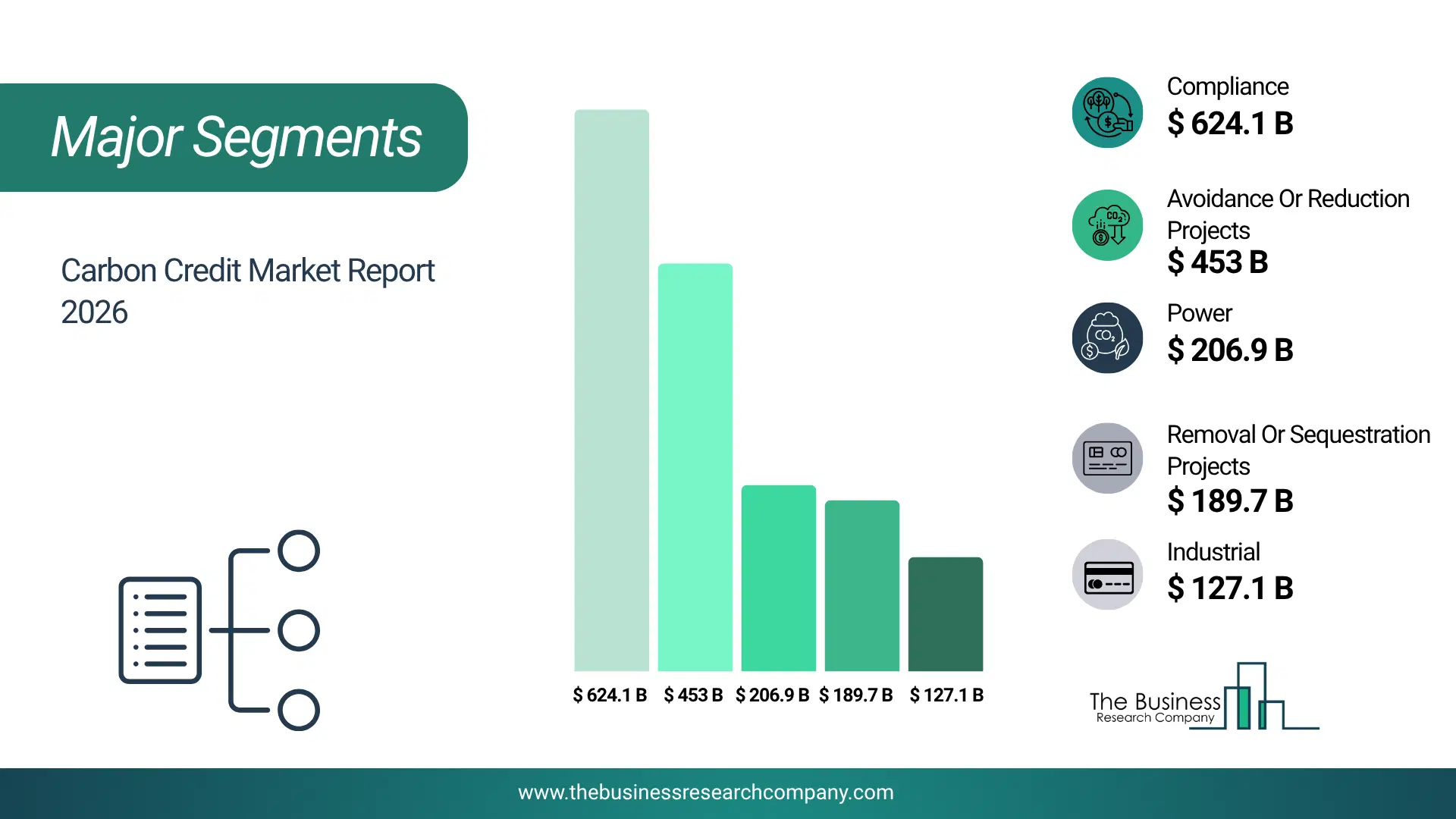
1) By Type: Compliance, Voluntary 2) By Project Type: Avoidance Or Reduction Projects, Removal Or Sequestration Projects 3) By End-Use: Power, Energy, Aviation, Transportation, Buildings, Industrial, Other End-Uses Subsegments: 1) By Compliance: Regulated Carbon Markets, Cap-And-Trade Programs 2) By Voluntary: Voluntary Carbon Markets, Project-Based Offsets The top segments in the carbon credit market will be: • Compliance will reach $624143.63 Million by 2025. • Avoidance Or Reduction Projects will reach $453013.45 Million by 2025. • Power will reach $206907.37 Million by 2025. • Removal Or Sequestration Projects will reach $189723.04 Million by 2025. • Industrial will reach $127167.83 Million by 2025.What Is The Driver Of The Carbon Credit Market?
Increasing transport pollution is expected to propel the growth of the carbon credit market going forward. Transport pollution refers to releasing harmful substances into the air, water, or soil due to transportation activities. Carbon credits can offset the carbon footprint of transportation activities, including freight transportation and personal vehicles. Carbon offsets can be used to invest in sustainable practices and technologies to improve freight transport efficiency. For instance, in May 2025, according to the United States Environmental Protection Agency, a US-based government agency, In 2023, about 66 million tons of pollutants were emitted into the atmosphere in the United States. Therefore, increasing transport pollution is driving the growth of the carbon credit industry.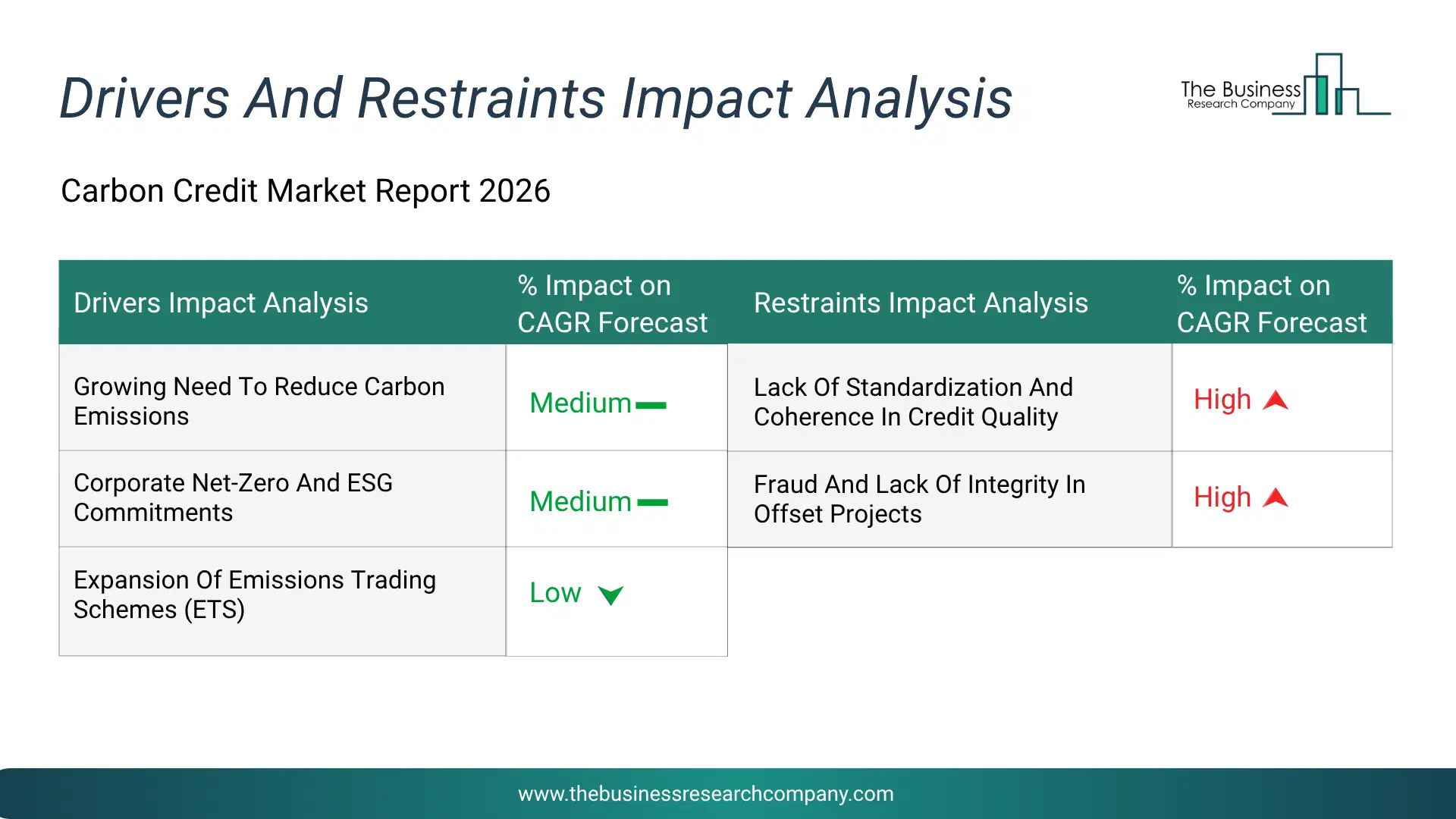
Infographic Chart Showing Key Market Drivers Analysis And Restraints For Carbon Credit Market
The chart presents an impact analysis of key drivers and restraints, quantifying their relative influence on the market's growth rate and helping assess the balance between growth enablers and limiting factors. This chart offers a high-level perspective; the full report contains more detailed insights.
How Will The Drivers Impact Growth In The Global Carbon Credit Market?
• Growing Need To Reduce Carbon Emissions (Medium) – The growing need to reduce carbon emissions will become a key driver of growth in the carbon credit market by 2030. Governments and industries worldwide are increasingly recognizing the urgency of mitigating climate change by curbing greenhouse gas emissions. This collective drive is reflected in the adoption of more ambitious climate targets. Such targets necessitate comprehensive strategies, including the utilization of carbon credits, to offset emissions that are challenging to eliminate entirely. As the demand for carbon credits rises, there is a corresponding emphasis on ensuring the credibility and effectiveness of offset projects. This trend is fostering innovation in carbon credit methodologies, promoting transparency, and encouraging investments in high-quality projects that deliver verifiable environmental benefits. Therefore, the evolving landscape of climate policy and the heightened focus on emission reductions are expected to significantly drive the growth of the carbon credit market. As a result, the growing need to reduce carbon emissions is anticipated to contributing to a 1.0% annual growth in the market. • Corporate Net-Zero And ESG Commitments (Medium) – The corporate net-zero and ESG commitments will emerge as a major factor driving the expansion of the carbon credit market by 2030. As companies increasingly set ambitious climate goals, they are seeking credible mechanisms to offset their emissions. Carbon credits offer a transparent and verifiable means to achieve these objectives. The rising emphasis on environmental, social, and governance (ESG) factors is driving businesses to integrate sustainability into their core strategies. This shift is not only enhancing corporate reputations but also aligning financial performance with long-term environmental stewardship. Consequently, the demand for high-quality carbon credits is expected to increase, thereby driving the growth of the carbon credit market. Consequently, the corporate net-zero and ESG commitments capabilities is projected to contributing to a 1.0% annual growth in the market. • Expansion Of Emissions Trading Schemes (ETS) (Low) – The expansion of emissions trading schemes (ETS) will serve as a key growth catalyst for the carbon credit market by 2030. As more countries adopt market-based approaches to regulate and price carbon emissions, ETS provide a structured mechanism for companies to comply with emission reduction targets while trading carbon credits. This approach encourages businesses to invest in sustainable practices and offset unavoidable emissions through credible carbon credit projects. With the increasing coverage of ETS across both developed and emerging economies, the demand for high-quality carbon credits is expected to rise, thereby driving the growth of the carbon credit market. Therefore, this expansion of emissions trading schemes (ETS) is projected to supporting to a 0.5% annual growth in the market.How Will The Restraints Impact Growth In The Global Carbon Credit Market?
• Lack Of Standardization And Coherence In Credit Quality (Medium) – Lack Of Standardization And Coherence In Credit Quality will restrict the growth of the Carbon Credit market during the forecast period. Carbon credits suffer from a lack of standardization and coherence in credit quality across different projects and verification standards. Quality concerns can affect buyer confidence and market pricing. Lack of standardization can limit market growth and create barriers to participation for quality credit providers. • Fraud And Lack Of Integrity In Offset Projects (Low) – Fraud And Lack Of Integrity In Offset Projects will restrict the growth of the Carbon Credit market during the forecast period. Concerns about fraud, double counting, and lack of integrity in offset projects affect carbon credit market credibility. Integrity issues can undermine buyer confidence and affect market growth. The risk of non-additionality and ineffective projects can limit the willingness of companies to invest in carbon credits.Key Players In The Global Carbon Credit Market
Major companies operating in the carbon credit market report are Sterling Planet Inc., EKI Energy Services Limited, South Pole Group AG, Base Carbon Inc., ClimatePartner Gmbh, Bluesource LLC, 3 Degrees Inc., Carbon Care Asia Limited, Cool Effect Inc., NativeEnergy Inc., Carbonbetter Inc., ClimeCo Corporation, Tasman Environmental Markets Pty Ltd., Carbon Credit Capital LLC, Carbonfund.org Foundation Inc., Clearsky Climate Solutions LLC, Climate Impact Partners LLC, ClimateTrade Inc., Climetrek Ltd., Finite Carbon Corporation, Forest Carbon Ltd., Moss Earth LLC, NatureOffice Gmbh, Terrapass Inc.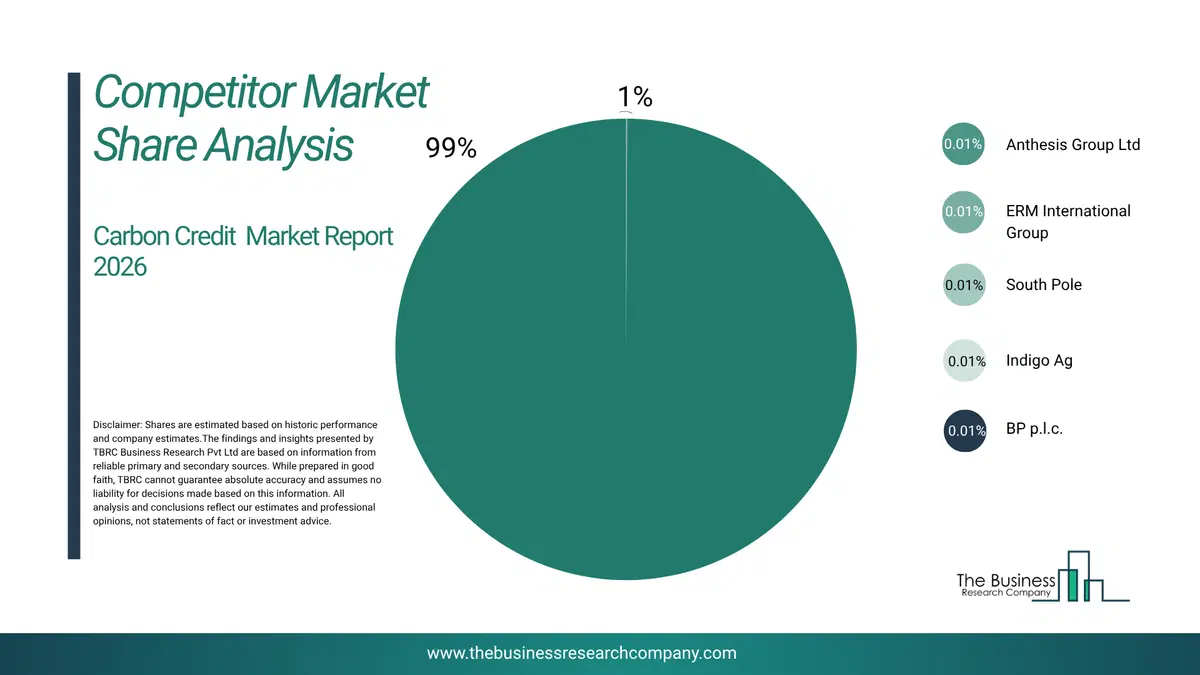
This chart is for illustrative purposes; the full report includes a detailed competitor analysis and comprehensive overview of the top 10 companies in the market.
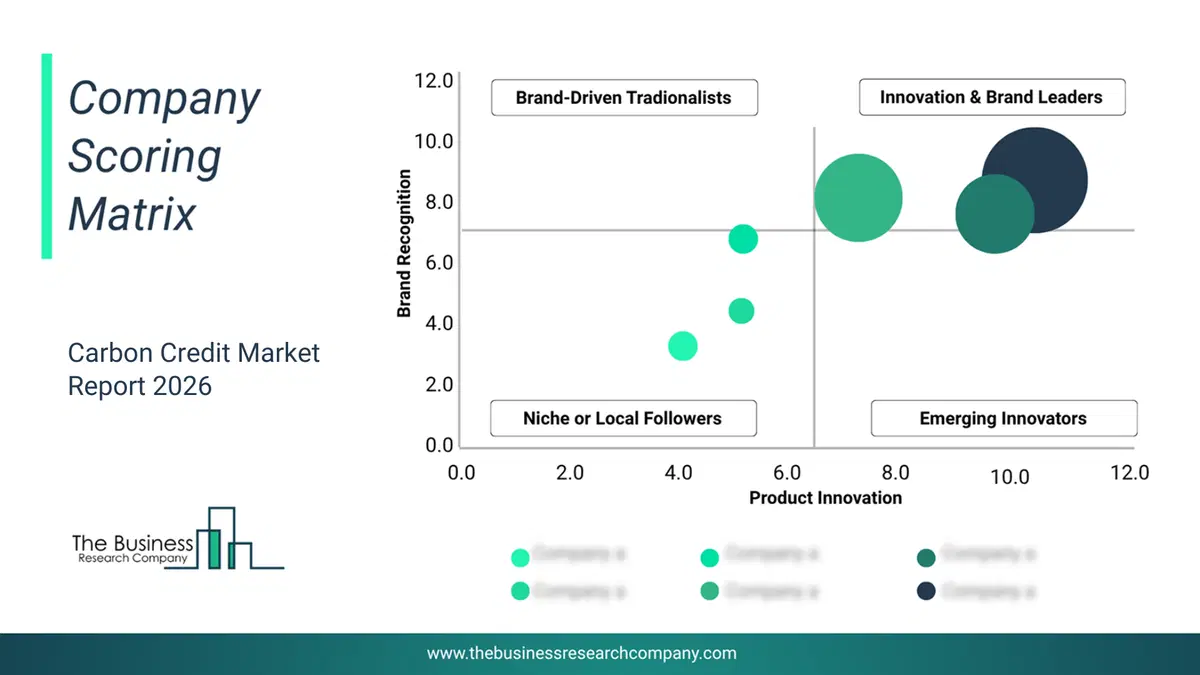
This chart maps companies by product innovation and brand strength, with bubble size indicating relative revenue, helping identify market leaders, challengers, and niche players. This is an illustrative chart; the full report provides a complete and accurate competitive analysis.
Global Carbon Credit Market Trends and Insights
Major companies operating in the carbon credit market focus on developing innovative solutions, such as blockchain-based solutions, to provide reliable customer service. A blockchain-based solution is a system that uses blockchain technology to solve a particular problem or improve an existing process. For instance, in May 2023, Ernst & Young Global Limited, a UK-based professional services provider, launched EY OpsChain ESG, a blockchain-based solution for emissions and carbon credit traceability through tokenization. The solution is developed on Ethereum, offering a verifiable view of CO2 emissions for enterprises struggling to accurately measure and track their carbon footprint. It provides transparency for consumers, business partners, and regulators, enabling better-informed decisions on environmental, social, and corporate governance (ESG). EY OpsChain ESG is built to InterWork Alliance for Carbon Emissions Tokens standards and enables enterprises to demonstrate the authenticity of carbon offsets used to reduce environmental impact. EY OpsChain ESG was created with the belief that blockchains may be used as a binding agent to connect corporate operations and global ecosystems across organizational boundaries.What Are Latest Mergers And Acquisitions In The Carbon Credit Market?
In November 2025, Carbon Direct Inc., a US-based carbon-management and advisory firm, acquired Pachama for an undisclosed amount. Through this acquisition, Carbon Direct aims to combine its scientific advisory capabilities with Pachama’s advanced digital MRV tools to deliver more transparent and scalable nature-based carbon credits. Pachama Inc. is a US-based leading carbon management company that provides and facilitates access to nature-based carbon credits.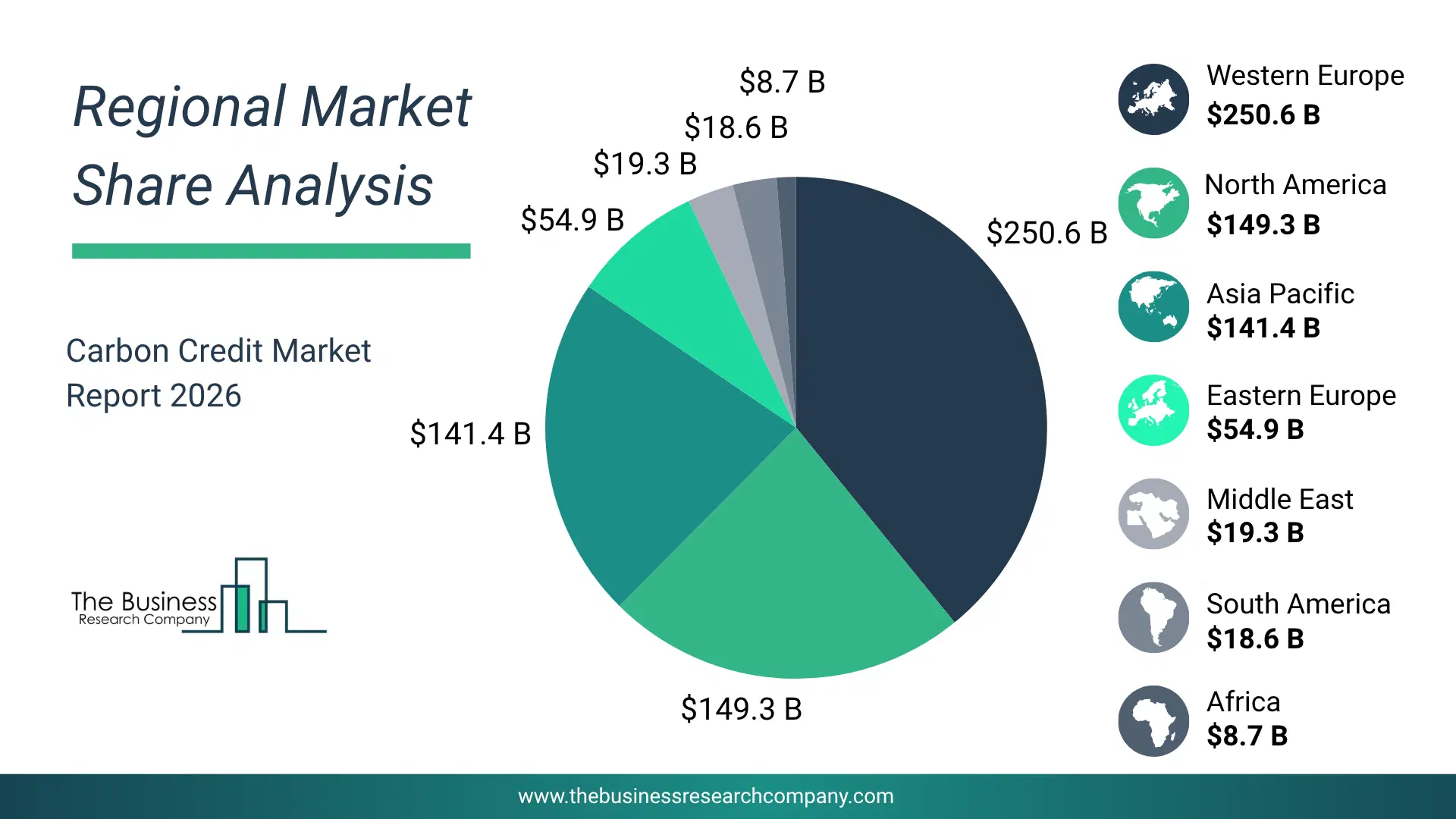
Regional Outlook
North America was the largest region in the carbon credit market in 2025. The regions covered in this market report are Asia-Pacific, South East Asia, Western Europe, Eastern Europe, North America, South America, Middle East, Africa. The countries covered in this market report are Australia, Brazil, China, France, Germany, India, Indonesia, Japan, Taiwan, Russia, South Korea, UK, USA, Canada, Italy, SpainWhat Defines the Carbon Credit Market?
The carbon credit market includes revenues earned by entities by providing nature-based projects and technology-based projects. The market value includes the value of related goods sold by the service provider or included within the service offering. Only goods and services traded between entities or sold to end consumers are included.How is Market Value Defined and Measured?
The market value is defined as the revenues that enterprises gain from the sale of goods and/or services within the specified market and geography through sales, grants, or donations in terms of the currency (in USD unless otherwise specified). The revenues for a specified geography are consumption values that are revenues generated by organizations in the specified geography within the market, irrespective of where they are produced. It does not include revenues from resales along the supply chain, either further along the supply chain or as part of other products.
This chart presents market attractiveness based on a quantitative evaluation of growth, competition, strategic alignment, and risk, offering a clear view of opportunity areas for decision-making. This chart is for illustrative purposes; the full report contains the complete analysis.

This chart highlights the Total Addressable Market (TAM) by estimating the maximum revenue opportunity using an assumption-driven approach, supporting strategic planning and opportunity sizing across markets. The chart is illustrative; the full report provides a more comprehensive analysis.
What Key Data and Analysis Are Included in the Carbon Credit Market Report 2026?
The carbon credit market research report is one of a series of new reports from The Business Research Company that provides market statistics, including industry global market size, regional shares, competitors with the market share, detailed market segments, market trends and opportunities, and any further data you may need to thrive in the carbon credit industry. The market research report delivers a complete perspective of everything you need, with an in-depth analysis of the current and future state of the industry.Carbon Credit Market Report Forecast Analysis
| Report Attribute | Details |
|---|---|
| Market Size Value In 2026 | $785.35 billion |
| Revenue Forecast In 2030 | $1758.62 billion |
| Growth Rate | CAGR of 22.2% from 2026 to 2030 |
| Base Year For Estimation | 2025 |
| Actual Estimates/Historical Data | 2020-2025 |
| Forecast Period | 2026 - 2030 |
| Market Representation | Revenue in USD Billion and CAGR from 2026 to 2030 |
| Segments Covered | Type, Project Type, End-Use |
| Regional Scope | Asia-Pacific, Western Europe, Eastern Europe, North America, South America, Middle East, Africa |
| Country Scope | The countries covered in the report are Australia, Brazil, China, France, Germany, India, Indonesia, Japan, Taiwan, Russia, South Korea, UK, USA, Canada, Italy, Spain. |
| Key Companies Profiled | Sterling Planet Inc., EKI Energy Services Limited, South Pole Group AG, Base Carbon Inc., ClimatePartner Gmbh, Bluesource LLC, 3 Degrees Inc., Carbon Care Asia Limited, Cool Effect Inc., NativeEnergy Inc., Carbonbetter Inc., ClimeCo Corporation, Tasman Environmental Markets Pty Ltd., Carbon Credit Capital LLC, Carbonfund.org Foundation Inc., Clearsky Climate Solutions LLC, Climate Impact Partners LLC, ClimateTrade Inc., Climetrek Ltd., Finite Carbon Corporation, Forest Carbon Ltd., Moss Earth LLC, NatureOffice Gmbh, Terrapass Inc. |
| Customization Scope | Request for Customization |
| Pricing And Purchase Options | Explore Purchase Options |