
Charge Card Market Report 2026
Global Outlook – By Type (Gold Card, Platinum Card, Plum Card, Business Gold Card, Business Platinum Card, Other Types), By Institution Type (Banking Institutions, Non-Banking Institutions), By End User (Retail, Corporate, Government Or Public Sector) – Market Size, Trends, Strategies, and Forecast to 2030
Charge Card Market Overview
• Charge Card market size has reached to $2.04 billion in 2025 • Expected to grow to $2.55 billion in 2030 at a compound annual growth rate (CAGR) of 5.7% • Growth Driver: Flexibility, Rewards, And Financial Discipline Is Driving Factors In The Charge Card Market • Market Trend: Innovative Solutions Enhanced Market Growth • Asia-Pacific was the largest region in 2025 and Western Europe is the fastest growing region.What Is Covered Under Charge Card Market?
Charge card refers to a payment card that allows users to make purchases without a preset spending limit, with the full balance required to be paid by the end of each billing cycle. It is used for facilitating short-term credit, managing cash flow, and making high-value transactions while avoiding long-term interest charges. The main types of charge cards are gold cards, platinum cards, plum cards, business gold cards, business platinum cards, and other charge cards. The gold charge card from American Express is an entry-level card and has the benefits of a credit card. The types of institutions involved are banking institutions and non-banking institutions. These are used by a variety of end-users, including retail, corporations, and the government or public sector.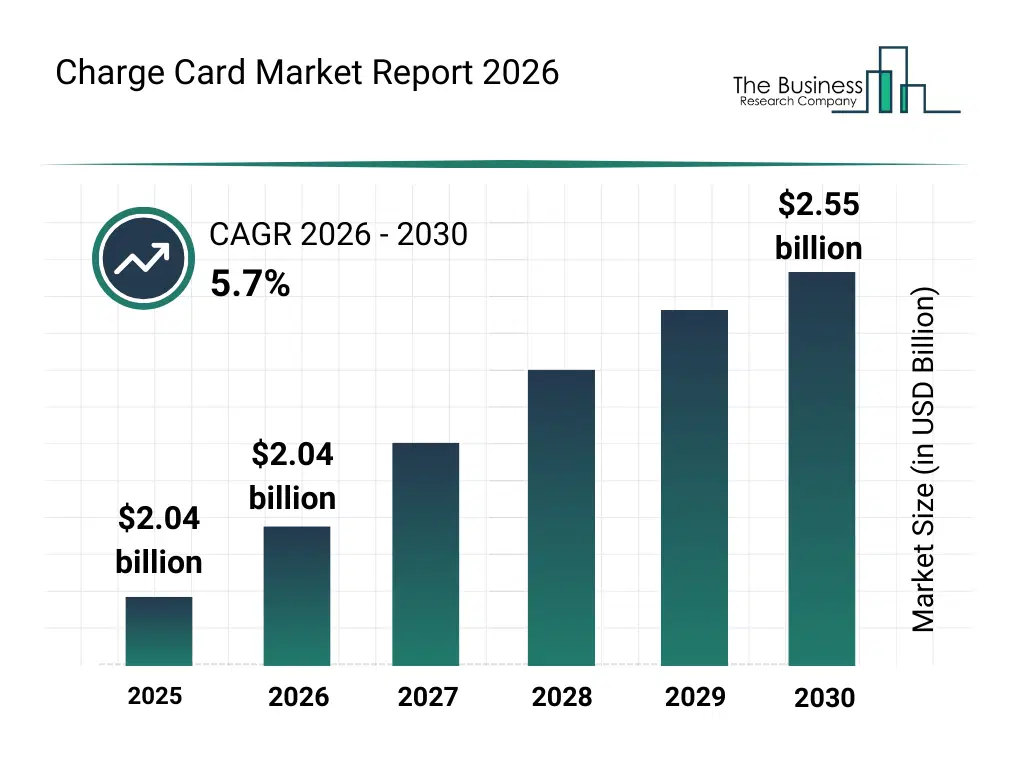
What Is The Charge Card Market Size and Share 2026?
The charge card market size has grown marginally in recent years. It will grow from $2.04 billion in 2025 to $2.04 billion in 2026 at a compound annual growth rate (CAGR) of 0.0%. The growth in the historic period can be attributed to increasing penetration of electronic payment systems, growth in corporate expense management needs, rising adoption of cashless transactions, expansion of global travel and business spending, improved banking infrastructure.What Is The Charge Card Market Growth Forecast?
The charge card market size is expected to see strong growth in the next few years. It will grow to $2.55 billion in 2030 at a compound annual growth rate (CAGR) of 5.7%. The growth in the forecast period can be attributed to increasing integration of ai-driven risk assessment, rising demand for real-time expense analytics, expansion of embedded finance solutions, growing preference for contactless and virtual cards, increasing focus on regulatory compliance and data security. Major trends in the forecast period include increasing adoption of corporate charge cards, rising demand for spend control and transparency, growing preference for rewards-based charge cards, expansion of digital-first charge card platforms, enhanced focus on fraud prevention and security.
Global Charge Card Market Segmentation
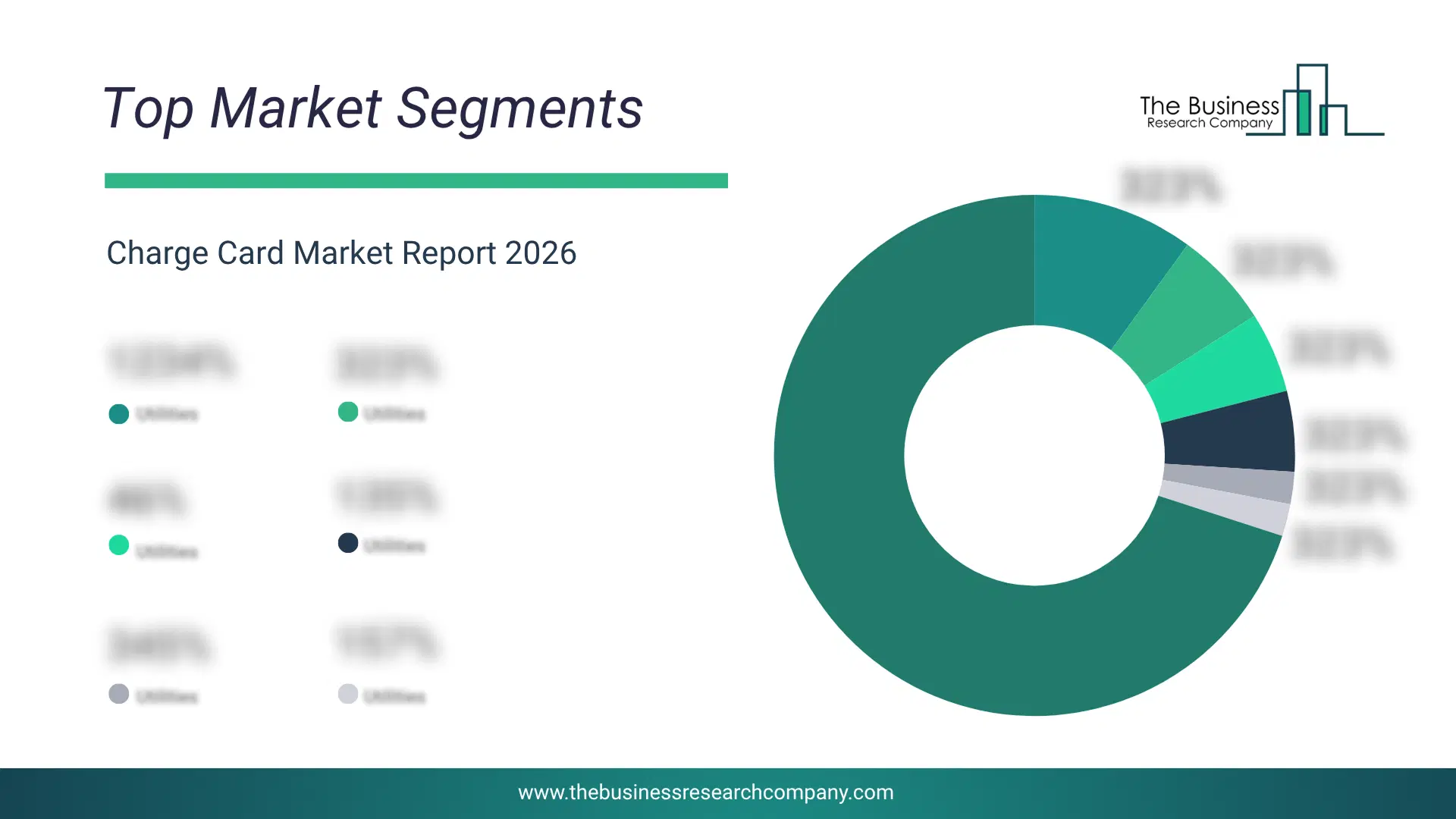
1) By Type: Gold Card, Platinum Card, Plum Card, Business Gold Card, Business Platinum Card, Other Types 2) By Institution Type: Banking Institutions, Non-Banking Institutions 3) By End User: Retail, Corporate, Government Or Public Sector Subsegments: 1) By Gold Card: Standard Gold Card, Premium Gold Card 2) By Platinum Card: Standard Platinum Card, Premium Platinum Card 3) By Plum Card: Standard Plum Card, Business Plum Card 4) By Business Gold Card: Small Business Gold Card, Corporate Business Gold Card 5) By Business Platinum Card: Small Business Platinum Card, Corporate Business Platinum Card 6) By Other Types: Secured Charge Card, Travel Charge Card, Rewards Charge CardWhat Are The Drivers Of The Charge Card Market?
The lack of a pre-set spending limit and greater flexibility in spending contributed to the growth of the charge card market. Charge cards offer financial flexibility with no pre-set spending limit on the purchase, which means more buying power. Additionally, charge cards offer premium rewards, maximize reward points based on spending patterns, and offer a variety of travel and purchase protections. For instance, American Express offers complimentary airport lounge access, hotel room upgrades, travel insurance, and much more. Customers will be able to improve their credit scores by using charge cards responsibly and paying on time every month. A charge card allows a customer to organize personal events, dining reservations, golf bookings, movie, and theatre ticket bookings, and enjoy exclusive rates and discounts with leading airlines. These factors boosted demand for charge card services, and this, in turn, drove the charge card market. However, having no pre-set spending limit does not mean unlimited spending. The purchasing power is adjusted based on the use of the card, payment history, credit record, financial resources, and other factors. This, in turn, will assist the customer in developing financial discipline in the charge card industry. The rise in consumer spending habits is expected to propel the growth of the charged card market going forward. Consumer spending habits refer to the patterns and behaviors exhibited by individuals or households when it comes to the allocation of their financial resources for the purchase of goods and services. Consumer spending habits influence the choice of payment methods, where they prefer using charged cards for most of their purchases as it offers convenience with rewards or cashback benefits. Others may prefer to use cash or debit cards. For instance, in October 2024, according to the U.S. Bureau of Economic Analysis (BEA), a U.S. government agency, Personal consumption expenditures (PCE) in US increased in all 50 states and the District of Columbia in 2023. The percent change ranged from 8.1 percent in Florida to 4.7 percent in Iowa. Nationally, current-dollar PCE increased 6.4 percent in 2023. Therefore, the increase in the demand for consumer spending habits is expected to drive the charged card market growth.Key Players In The Global Charge Card Market
Major companies operating in the charge card market are American Express, Diners Club International, Coutts and Co., Chase Bank, Barclays plc, JCB Co Ltd, The Hongkong and Shanghai Banking Corporation Limited, HDFC Bank Ltd, ICICI Bank Limited, SBI Cards and Payment Services Limited, Axis Bank Limited, UBS Group AG, Deutsche Bank AG, BNP Paribas, Santander Group, Royal Bank of Canada, Sumitomo Mitsui Card Company, China UnionPay, HSBC Holdings plc, Standard Chartered, TD Bank, National Australia Bank, Société Générale, ANZ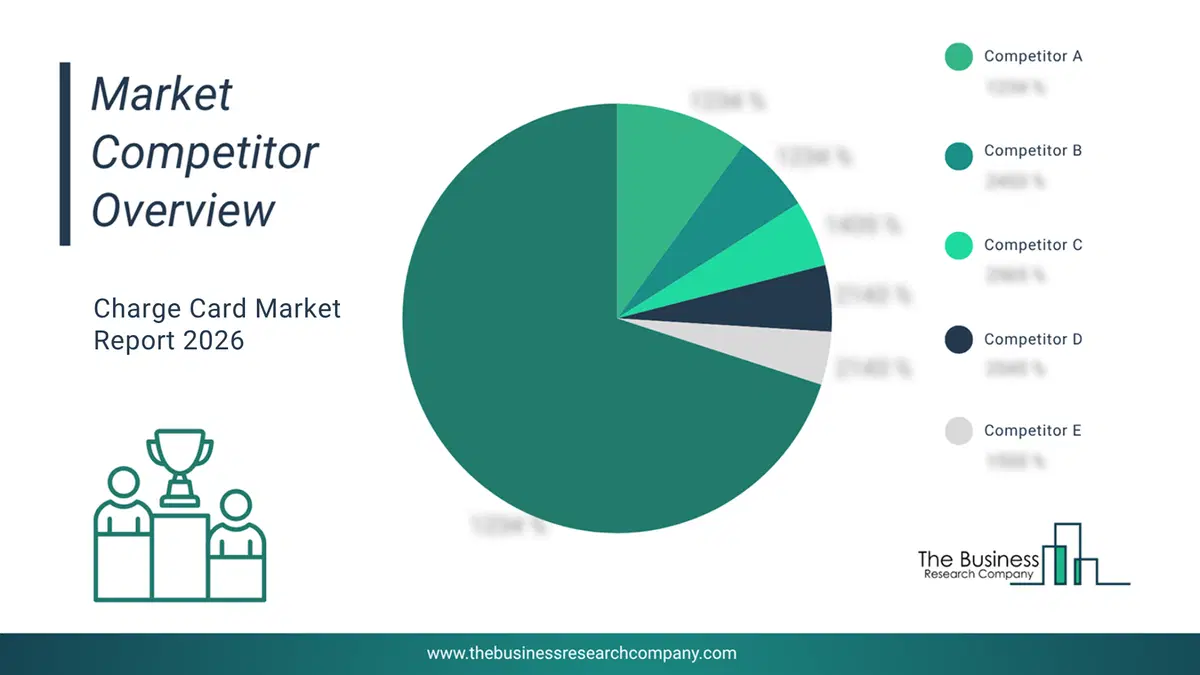
This chart is for illustrative purposes; the full report includes a detailed competitor analysis and comprehensive overview of the top 10 companies in the market.
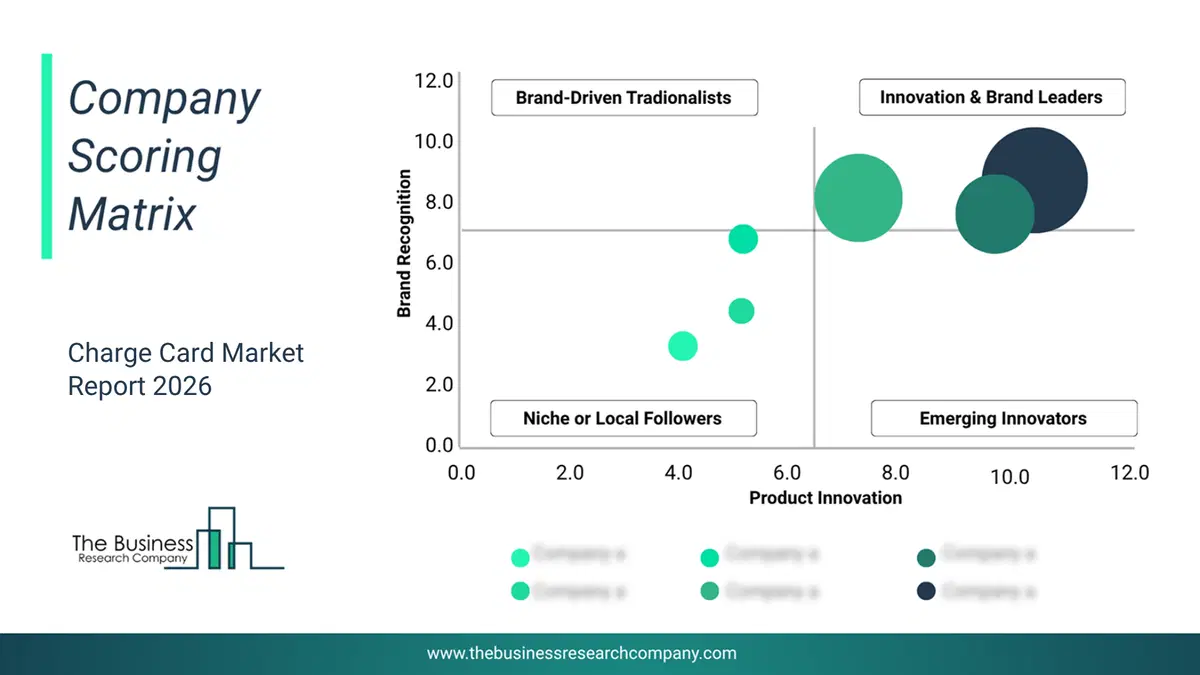
This chart maps companies by product innovation and brand strength, with bubble size indicating relative revenue, helping identify market leaders, challengers, and niche players. This is an illustrative chart; the full report provides a complete and accurate competitive analysis.
Global Charge Card Market Trends and Insights
Major companies operating in the charge card market are focused on developing charge cards for e-commerce, featuring an optimized user experience. A charge card for e-commerce is a financial product specifically designed for online businesses, allowing them to make purchases and manage expenses with flexible payment terms, often based on the company's performance, and without a preset spending limit. For instance, in March 2023, Parker, a US-based financial technology company, launched the first charge card specifically designed for e-commerce, announcing $157 million in funding, which includes $31.1 million in Series A venture funding led by Valar Ventures. The company achieved over $300 million in transaction volume at launch, with major brands such as Amour Vert, Italic, and SpikeBall adopting the service. Parker's unique underwriting approach allows flexible financing terms tailored to the needs of e-commerce businesses, and the funding will support expansion in product development, engineering, and market reach throughout 2023.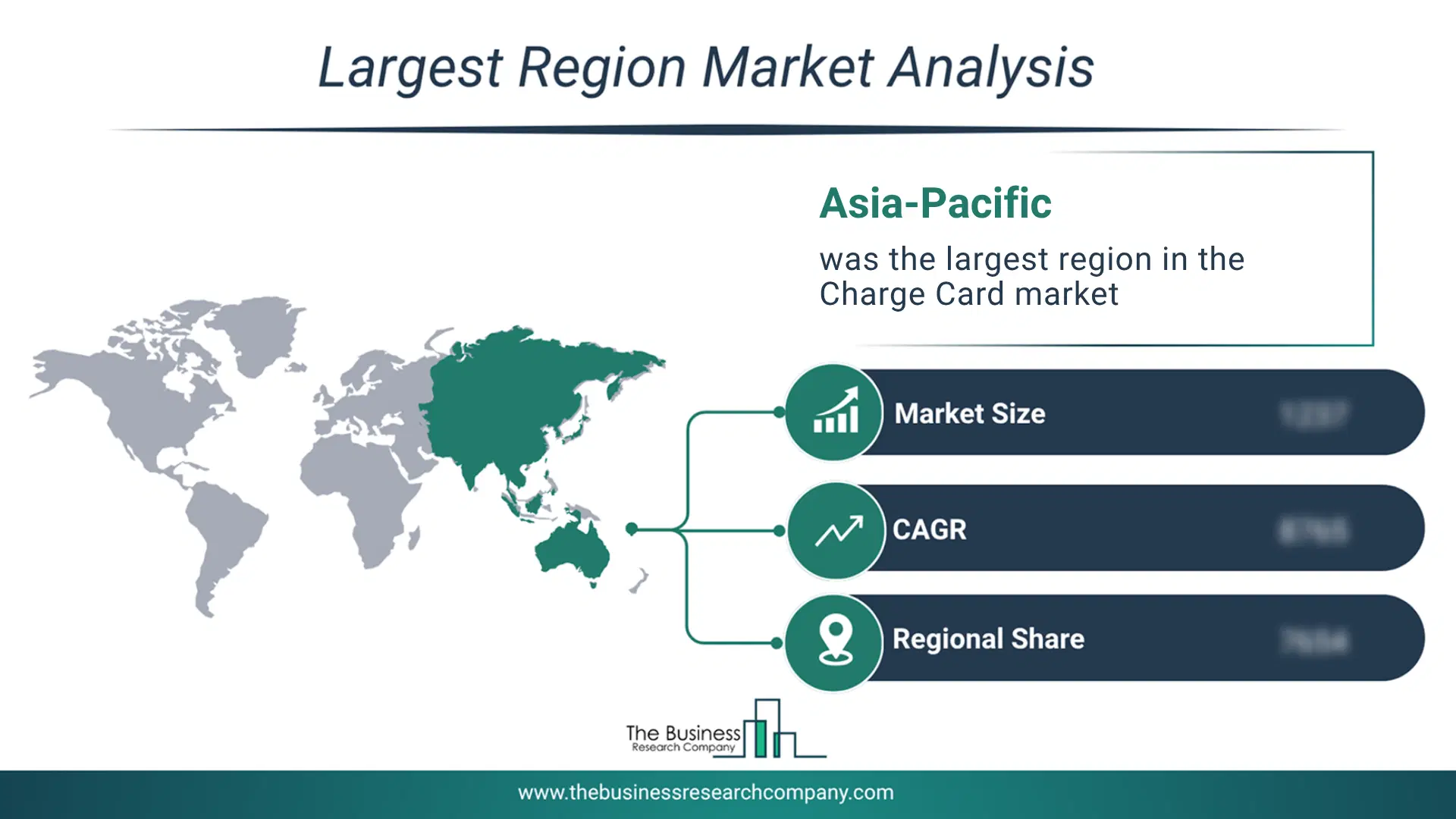
Regional Outlook
Asia-Pacific was the largest region in the charge card market in 2025. Western Europe was the second largest region in the charge card market. The regions covered in this market report are Asia-Pacific, South East Asia, Western Europe, Eastern Europe, North America, South America, Middle East, Africa. The countries covered in this market report are Australia, Brazil, China, France, Germany, India, Indonesia, Japan, Taiwan, Russia, South Korea, UK, USA, Canada, Italy, Spain.What Defines the Charge Card Market?
The charge card market consists of revenue by entities that are engaged in storing, processing, and transmitting charge card data. Charge cards are like credit cards, but do not have a pre-set credit limit. Cardholders are not charged any interest and are required to pay the outstanding balance in full upon receiving a statement. Revenue generated from the cards market include all processing and service fees levied by banks and financial institutions for processing card-based payments. The market value includes the value of related goods sold by the service provider or included within the service offering. Only goods and services traded between entities or sold to end consumers are included.How is Market Value Defined and Measured?
The market value is defined as the revenues that enterprises gain from the sale of goods and/or services within the specified market and geography through sales, grants, or donations in terms of the currency (in USD unless otherwise specified). The revenues for a specified geography are consumption values that are revenues generated by organizations in the specified geography within the market, irrespective of where they are produced. It does not include revenues from resales along the supply chain, either further along the supply chain or as part of other products.
This chart presents market attractiveness based on a quantitative evaluation of growth, competition, strategic alignment, and risk, offering a clear view of opportunity areas for decision-making. This chart is for illustrative purposes; the full report contains the complete analysis.

This chart highlights the Total Addressable Market (TAM) by estimating the maximum revenue opportunity using an assumption-driven approach, supporting strategic planning and opportunity sizing across markets. The chart is illustrative; the full report provides a more comprehensive analysis.
What Key Data and Analysis Are Included in the Charge Card Market Report 2026?
The charge card market research report is one of a series of new reports from The Business Research Company that provides market statistics, including Market Report 2026?global market size, regional shares, competitors with the market share, detailed market segments, market trends and opportunities, and any further data you may need to thrive in the charge card Market Report 2026? The market research report delivers a complete perspective of everything you need, with an in-depth analysis of the current and future state of the Market Report 2026?Charge Card Market Report Forecast Analysis
| Report Attribute | Details |
|---|---|
| Market Size Value In 2026 | $2.04 billion |
| Revenue Forecast In 2030 | $2.55 billion |
| Growth Rate | CAGR of 0.0% from 2026 to 2030 |
| Base Year For Estimation | 2025 |
| Actual Estimates/Historical Data | 2020-2025 |
| Forecast Period | 2026 - 2030 |
| Market Representation | Revenue in USD Billion and CAGR from 2026 to 2030 |
| Segments Covered | Type, Institution Type, End User |
| Regional Scope | Asia-Pacific, Western Europe, Eastern Europe, North America, South America, Middle East, Africa |
| Country Scope | The countries covered in the report are Australia, Brazil, China, France, Germany, India, Indonesia, Japan, Taiwan, Russia, South Korea, UK, USA, Canada, Italy, Spain. |
| Key Companies Profiled | American Express, Diners Club International, Coutts and Co., Chase Bank, Barclays plc, JCB Co Ltd, The Hongkong and Shanghai Banking Corporation Limited, HDFC Bank Ltd, ICICI Bank Limited, SBI Cards and Payment Services Limited, Axis Bank Limited, UBS Group AG, Deutsche Bank AG, BNP Paribas, Santander Group, Royal Bank of Canada, Sumitomo Mitsui Card Company, China UnionPay, HSBC Holdings plc, Standard Chartered, TD Bank, National Australia Bank, Société Générale, ANZ |
| Customization Scope | Request for Customization |
| Pricing And Purchase Options | Explore Purchase Options |