

Cloud Load Balancers Market Report 2026
Global Outlook – By Component (Hardware, Software, Services), By Organization Size (Large Scale, Small And Medium-sized Enterprises), By Vertical (Banking, Financial Services And Insurance (BFSI), Information technology (IT) And Telecom, Healthcare, Retail, Government And Defense, Other Verticals) – Market Size, Trends, Strategies, and Forecast to 2030
Cloud Load Balancers Market Overview
• Cloud Load Balancers market size has reached to $12.14 billion in 2025 • Expected to grow to $23.68 billion in 2030 at a compound annual growth rate (CAGR) of 13.8% • Growth Driver: Rising Online Gaming Population Fueling The Demand For Cloud Load Balancers • Market Trend: Security-Driven Managed Load Balancers Enhance Application Performance And Cybersecurity In Cloud Environments • North America was the largest region in 2025.What Is Covered Under Cloud Load Balancers Market?
A cloud load balancer is a networking component used in cloud computing environments to efficiently distribute incoming network traffic across servers or resources to ensure optimal performance and prevent any single server from becoming overloaded. It is used to optimize the performance, availability, and security of applications and services in cloud computing environments, provide a centralized mechanism for managing and distributing network traffic, and enable organizations to deliver scalable, reliable, and highly available applications to their users. The main components of the cloud load balancers market are hardware, software, services, training and consulting, integration and deployment, and support and maintenance. Hardware refers to the actual parts of the computer system, comprising the main processor, CPU, memory, storage drives, and other different components that make up the system. The various organization sizes are large-scale, small and medium-sized enterprises and are used in various verticals such as banking, financial services and insurance (BFSI), information technology (IT) and telecom, healthcare, retail, government and defense, and other verticals.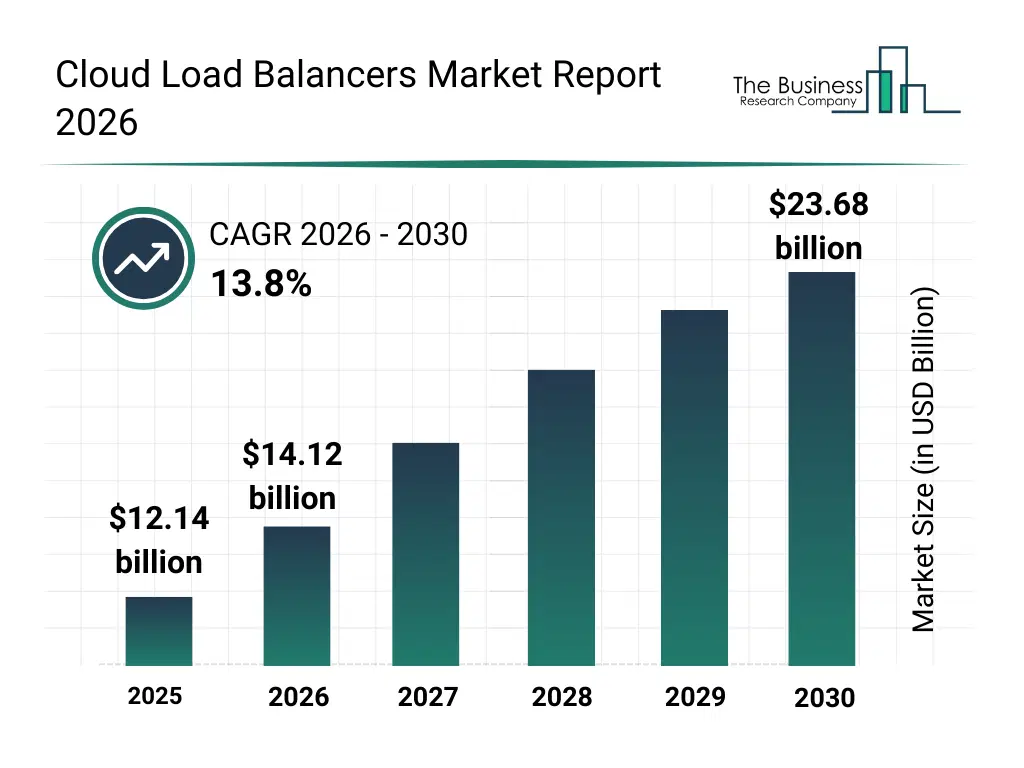
What Is The Cloud Load Balancers Market Size and Share 2026?
The cloud load balancers market size has grown rapidly in recent years. It will grow from $12.14 billion in 2025 to $14.12 billion in 2026 at a compound annual growth rate (CAGR) of 16.4%. The growth in the historic period can be attributed to growing demand for high availability applications, increasing adoption of cloud infrastructure, need for network optimization and traffic distribution, expansion of it and telecom services, rising enterprise reliance on multi-cloud environments.What Is The Cloud Load Balancers Market Growth Forecast?
The cloud load balancers market size is expected to see rapid growth in the next few years. It will grow to $23.68 billion in 2030 at a compound annual growth rate (CAGR) of 13.8%. The growth in the forecast period can be attributed to integration of AI and predictive traffic management, adoption of software-defined networking (sdn) load balancers, increasing focus on cybersecurity for load balancers, growth in hybrid and multi-cloud deployments, rising need for managed load balancing services. Major trends in the forecast period include hardware load balancer appliances, cloud-based load balancing software solutions, load balancer configuration and management services, multi-cloud and hybrid cloud deployment, load balancer security and monitoring services.
Global Cloud Load Balancers Market Segmentation
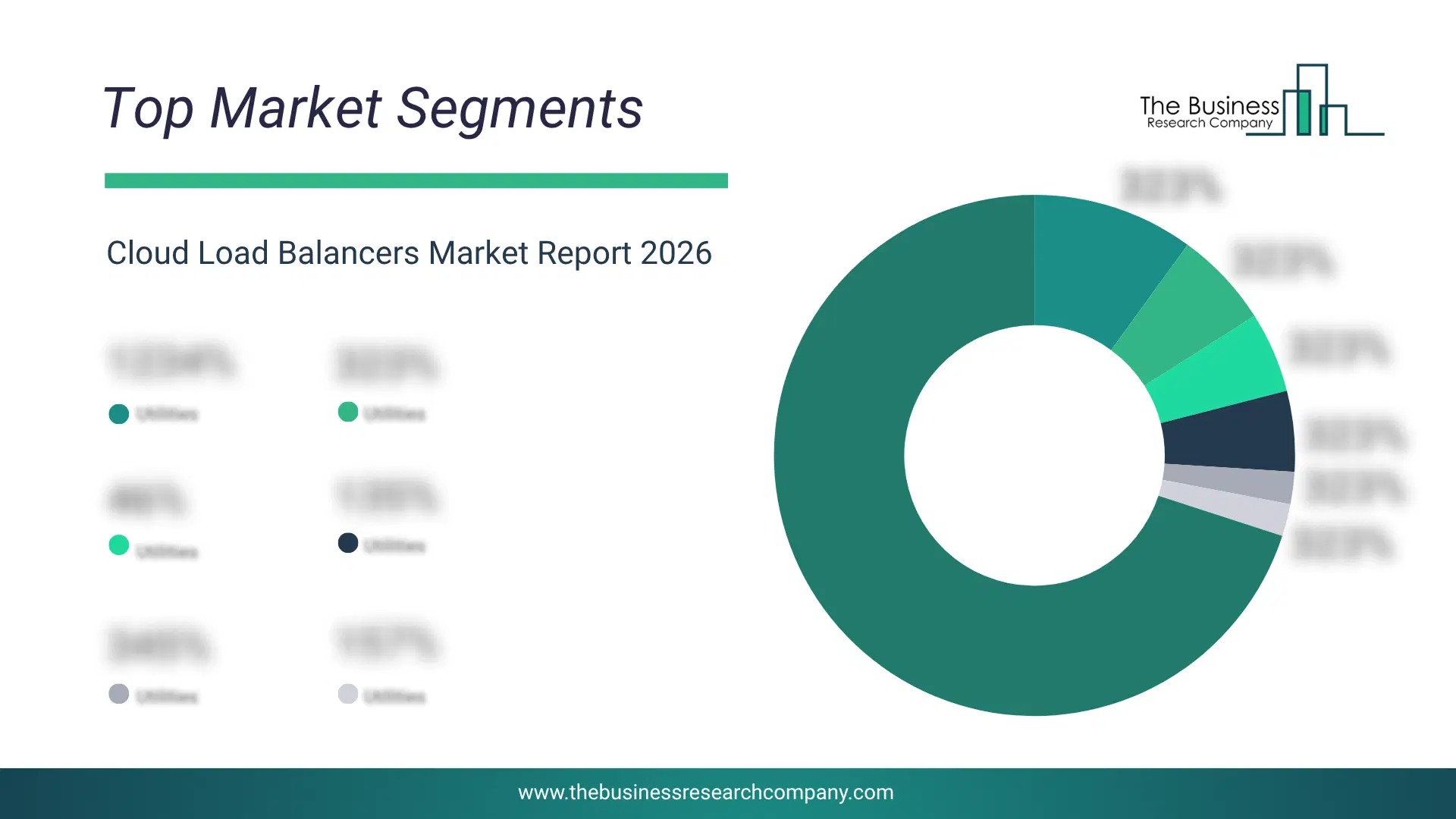
1) By Component: Hardware, Software, Services 2) By Organization Size: Large Scale, Small And Medium-sized Enterprises 3) By Vertical: Banking, Financial Services And Insurance (BFSI), Information technology (IT) And Telecom, Healthcare, Retail, Government And Defense, Other Verticals Subsegments: 1) By Hardware: Hardware Load Balancer Appliances, Dedicated Load Balancer Devices, Network Interface Cards (NICs) For Load Balancing, Hardware Acceleration For Load Balancers 2) By Software: Cloud-Based Load Balancing Software Solutions, Virtual Load Balancers, Application Delivery Controllers (ADC) Software, Software-Defined Networking (SDN) Load Balancers, Multi-Cloud Load Balancing Software. 3) By Services: Load Balancer Configuration And Management Services, Cloud Load Balancing Optimization Services, Load Balancer Security Services, Load Balancer Monitoring And Performance Tuning ServicesWhat Is The Driver Of The Cloud Load Balancers Market?
The increasing number of online gamers is expected to propel the growth of the cloud load balancers market going forward. Online gamers are individuals who participate in multiplayer video games over the internet, interacting with other players in virtual environments. The number of online gamers is growing due to the increasing popularity of online multiplayer games, advancements in blockchain-based technologies, and the rise of competitive gaming tournaments and esports. Cloud load balancers distribute traffic across online gaming platforms, guaranteeing low-latency connections, enhancing game performance, and evenly distributing the load during periods of high gaming activity. For instance, in May 2023, according to Uswitch Limited., a UK-based online comparison and switching service, the number of online gamers globally in 2022 reached 3.2 billion and is forecast to reach 5.7 billion by 2032, an increase of 44% from 2022. Therefore, the increasing number of online gamers is driving the growth of the cloud load balancers industry.Key Players In The Global Cloud Load Balancers Market
Major companies operating in the cloud load balancers market are Google LLC; Microsoft Corporation; Amazon Web Services Inc; Cisco Systems Inc; VMware Inc; Snapt Inc; Citrix Systems Inc; F5 Networks Inc; Array Networks Inc; Cloudflare Inc; DigitalOcean Inc; Barracuda Networks Inc; Radware Ltd; A10 Networks Inc; Scaleway Inc; Kemp Technologies Inc; Linode LLC; HAProxy Technologies LLC; NGINX Inc; Edgenexus Ltd; Loadbalancerorg Ltd; Total Uptime Technologies LLC; Zevenet SL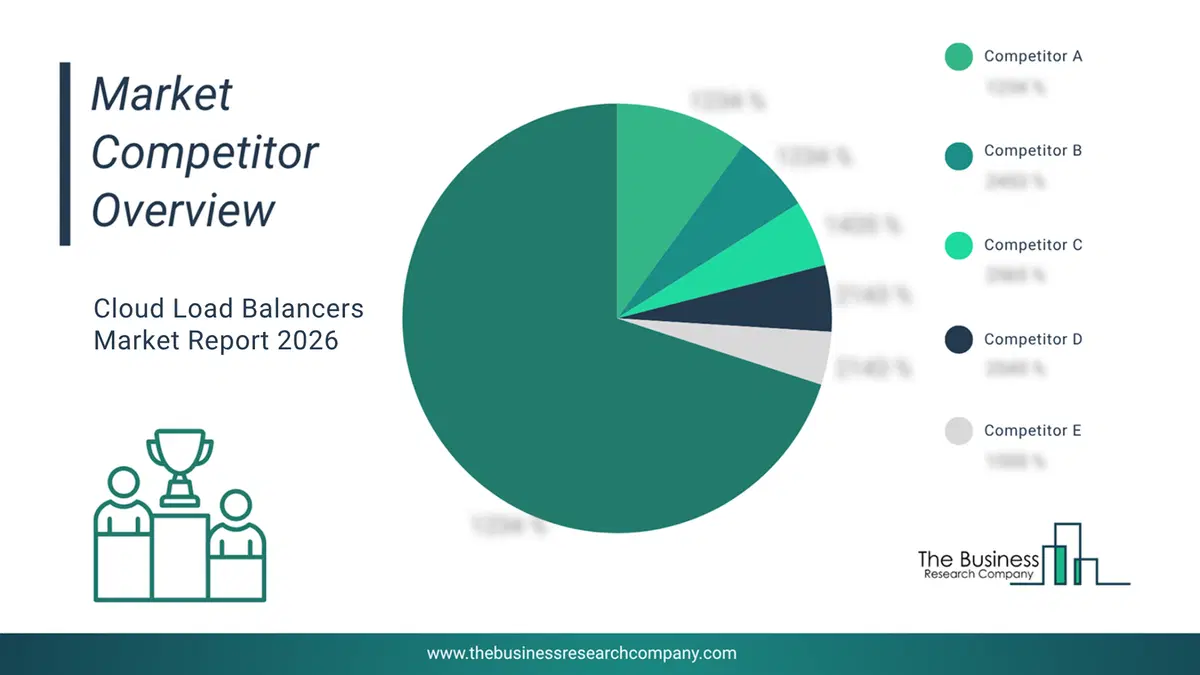
This chart is for illustrative purposes; the full report includes a detailed competitor analysis and comprehensive overview of the top 10 companies in the market.
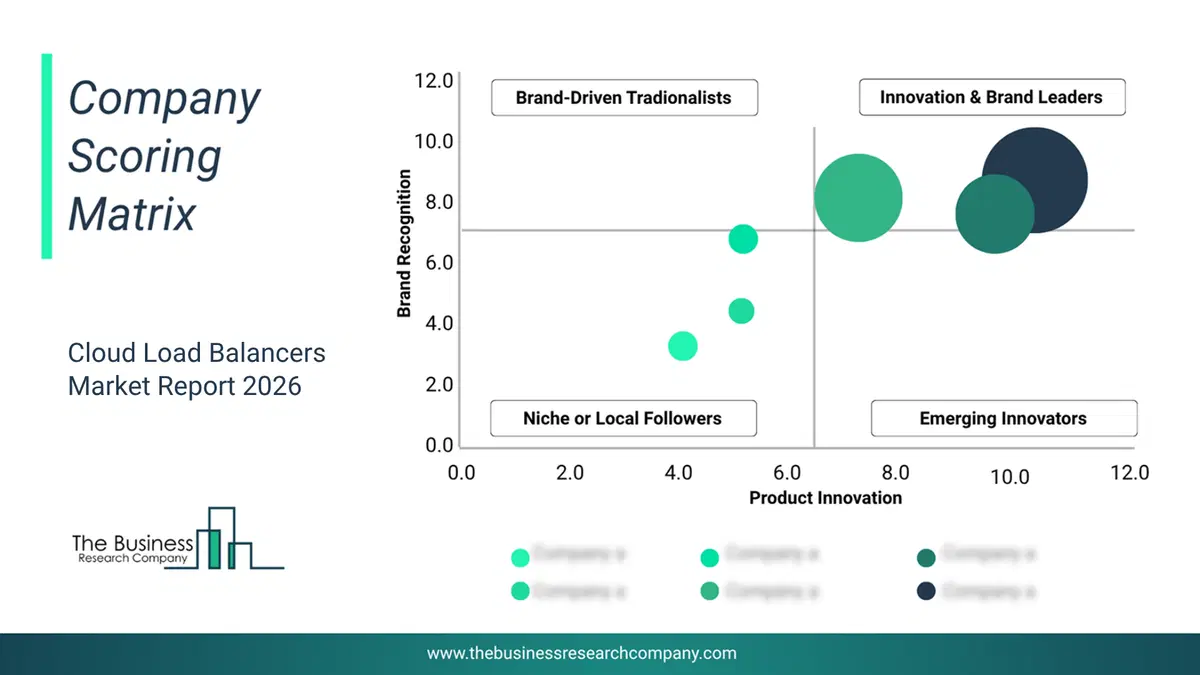
This chart maps companies by product innovation and brand strength, with bubble size indicating relative revenue, helping identify market leaders, challengers, and niche players. This is an illustrative chart; the full report provides a complete and accurate competitive analysis.
Global Cloud Load Balancers Market Trends and Insights
Major companies in the cloud load balancers market are focusing on developing advanced solutions, such as security-driven managed load balancers, to enhance secure connectivity, ensure application resilience, and strengthen their market position. Security-driven managed load balancers are cloud-based tools that manage traffic distribution while incorporating SSL/TLS encryption, DDoS mitigation, and advanced threat-inspection features to safeguard data and applications across distributed environments. For example, in November 2024, Broadcom Inc., a US-based technology company, announced significant enhancements to its VMware Avi Load Balancer at VMware Explore 2024 Barcelona, offering a twofold increase in scale for enterprise workloads, over threefold improvement in SSL performance, multi-availability-zone high-availability capabilities, and deeper integration with Kubernetes environments. The upgraded solution is designed to provide secure and efficient application delivery, helping enterprises optimize performance, strengthen cybersecurity, and improve traffic management in cloud infrastructures.What Are Latest Mergers And Acquisitions In The Cloud Load Balancers Market?
In April 2024, Commvault Systems, Inc., a US-based company that specializes in data protection and information management solutions, acquired Appranix for an undisclosed amount. This acquisition aims to enhance its capabilities in data protection and recovery, particularly in cloud environments. Appranixis is a US-based company that specializes in cloud disaster recovery and protection solutions providers, including load balancers.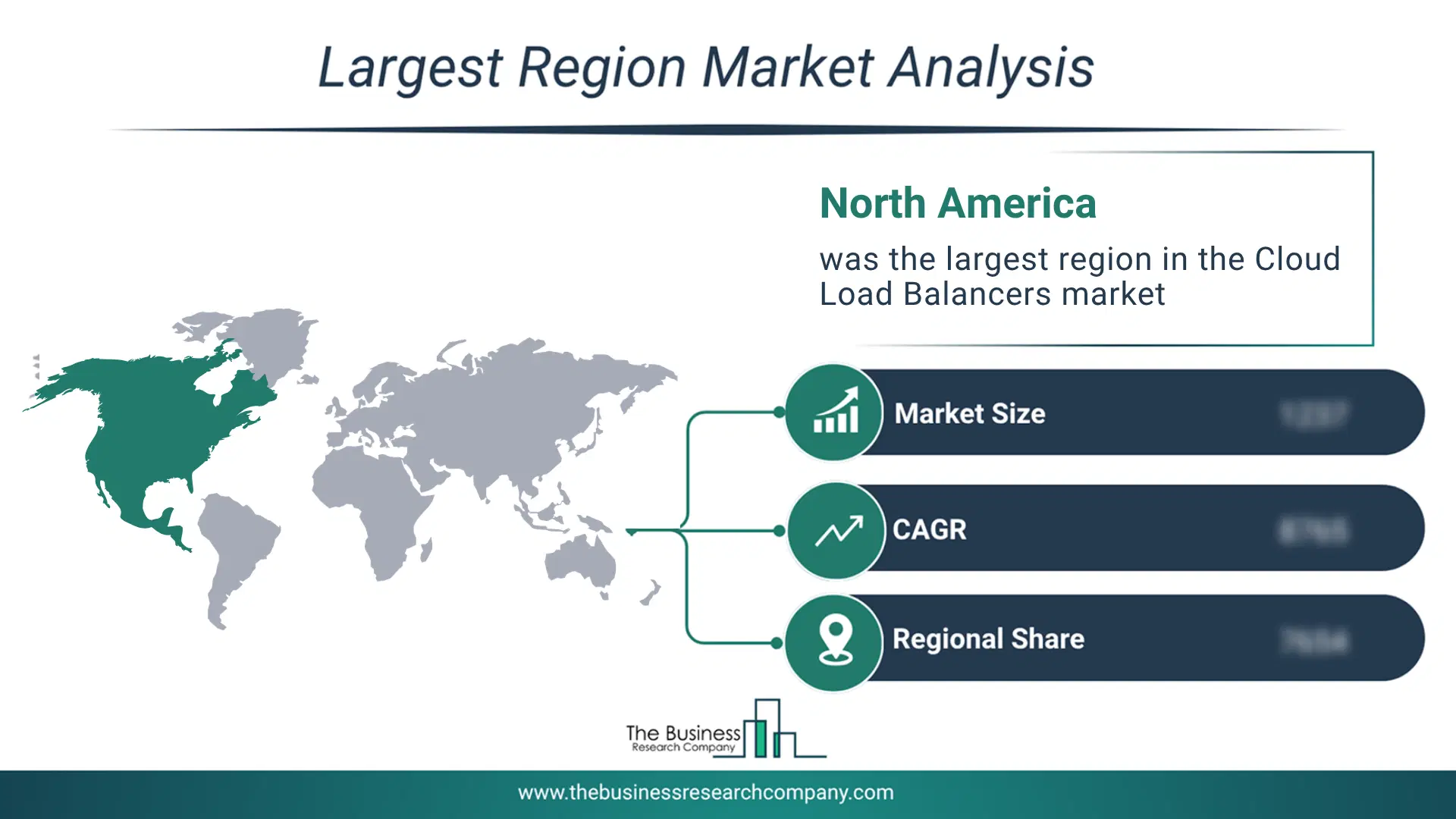
Regional Insights
North America was the largest region in the cloud load balancers market in 2025. The regions covered in this market report are Asia-Pacific, South East Asia, Western Europe, Eastern Europe, North America, South America, Middle East, Africa. The countries covered in this market report are Australia, Brazil, China, France, Germany, India, Indonesia, Japan, Taiwan, Russia, South Korea, UK, USA, Canada, Italy, SpainWhat Defines the Cloud Load Balancers Market?
The cloud load balancer market consists revenues earned by entities by providing services such as traffic distribution, SSL termination, auto-scaling integration, and API access. The market value includes the value of related goods sold by the service provider or included within the service offering. The cloud load balancer market also includes sales of application load balancers and network load balancers, which are essential components used in managing and optimizing network traffic distribution. Values in this market are ‘factory gate’ values, that is the value of goods sold by the manufacturers or creators of the goods, whether to other entities (including downstream manufacturers, wholesalers, distributors and retailers) or directly to end customers. The value of goods in this market includes related services sold by the creators of the goods.How is Market Value Defined and Measured?
The market value is defined as the revenues that enterprises gain from the sale of goods and/or services within the specified market and geography through sales, grants, or donations in terms of the currency (in USD unless otherwise specified). The revenues for a specified geography are consumption values that are revenues generated by organizations in the specified geography within the market, irrespective of where they are produced. It does not include revenues from resales along the supply chain, either further along the supply chain or as part of other products.
This chart presents market attractiveness based on a quantitative evaluation of growth, competition, strategic alignment, and risk, offering a clear view of opportunity areas for decision-making. This chart is for illustrative purposes; the full report contains the complete analysis.

This chart highlights the Total Addressable Market (TAM) by estimating the maximum revenue opportunity using an assumption-driven approach, supporting strategic planning and opportunity sizing across markets. The chart is illustrative; the full report provides a more comprehensive analysis.
What Key Data and Analysis Are Included in the Cloud Load Balancers Market Report 2026?
The cloud load balancers market research report is one of a series of new reports from The Business Research Company that provides market statistics, including industry global market size, regional shares, competitors with the market share, detailed market segments, market trends and opportunities, and any further data you may need to thrive in the cloud load balancers industry. The market research report delivers a complete perspective of everything you need, with an in-depth analysis of the current and future state of the industry.Cloud Load Balancers Market Report Forecast Analysis
| Report Attribute | Details |
|---|---|
| Market Size Value In 2026 | $14.12 billion |
| Revenue Forecast In 2030 | $23.68 billion |
| Growth Rate | CAGR of 13.8% from 2026 to 2030 |
| Base Year For Estimation | 2025 |
| Actual Estimates/Historical Data | 2020-2025 |
| Forecast Period | 2026 - 2030 |
| Market Representation | Revenue in USD Billion and CAGR from 2026 to 2030 |
| Segments Covered | Component, Organization Size, Vertical |
| Regional Scope | Asia-Pacific, Western Europe, Eastern Europe, North America, South America, Middle East, Africa |
| Country Scope | The Countries Covered In This Market Report Are Australia, Brazil, China, France, Germany, India, Indonesia, Japan, Taiwan, Russia, South Korea, Uk, Usa, Canada, Italy, Spain. |
| Key Companies Profiled | Google LLC, Microsoft Corporation, Amazon Web Services Inc, Cisco Systems Inc, VMware Inc, Snapt Inc, Citrix Systems Inc, F5 Networks Inc, Array Networks Inc, Cloudflare Inc, DigitalOcean Inc, Barracuda Networks Inc, Radware Ltd, A10 Networks Inc, Scaleway Inc, Kemp Technologies Inc, Linode LLC, HAProxy Technologies LLC, NGINX Inc, Edgenexus Ltd, Loadbalancerorg Ltd, Total Uptime Technologies LLC, Zevenet SL |
| Customization Scope | Request for Customization |
| Pricing And Purchase Options | Explore Purchase Options |