
Constrained Peptide Drugs Market Report 2026
Global Outlook – By Drug Type (Cyclic Peptides, Stapled Peptides, Multivalent Peptides), By Route Of Administration (Injectable, Intranasal, Transdermal, Oral), By Application (Oncology, Metabolic Disorders, Cardiovascular Diseases, Infectious Diseases, Neurological Disorders), By Distribution Channel (Direct Sales, Third-Party Distributors, Online Pharmacies, Retail Pharmacies), By End User (Hospitals, Pharmaceutical Companies, Research Laboratories, Specialty Clinics) – Market Size, Trends, Strategies, and Forecast to 2030
Constrained Peptide Drugs Market Overview
• Constrained Peptide Drugs market size has reached to $3.27 billion in 2025 • Expected to grow to $7.15 billion in 2030 at a compound annual growth rate (CAGR) of 16.9% • Growth Driver: Increasing Demand For Targeted Therapies Fueling The Growth Of The Market Due To Higher Precision And Reduced Side Effects • Market Trend: Membrane-Permeable Peptides Combine Biologic Precision With Oral Convenience • North America was the largest region in 2025.What Is Covered Under Constrained Peptide Drugs Market?
Constrained peptide drugs are peptides chemically modified to adopt a fixed, stable three-dimensional structure, often through cyclization or introduction of bridges. This constraint enhances their stability, binding affinity, and specificity to target proteins. Their primary purpose is to improve therapeutic efficacy by increasing resistance to degradation and enhancing target selectivity compared to linear peptides. The main drug types in the constrained peptide drugs are linear peptides, cyclic peptides, stapled peptides, and multivalent peptides. Linear peptides refer to chains of amino acids arranged in a straight (unbranched) sequence, without any cyclic or cross-linked structure. The various routes of administration include injectable, intranasal, transdermal, and oral methods, with applications spanning hospitals, biological research institutes, and others. These products are distributed through direct sales, third-party distributors, online pharmacies, and retail pharmacies and are used by hospitals, pharmaceutical companies, research laboratories, and specialty clinics.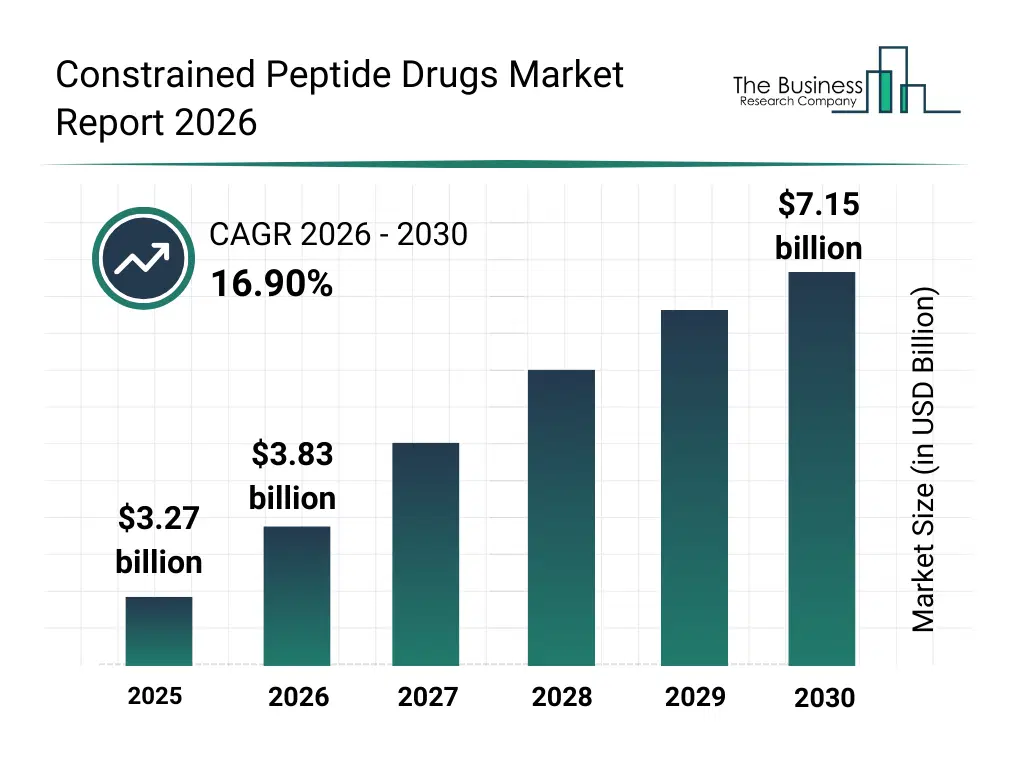
What Is The Constrained Peptide Drugs Market Size and Share 2026?
The constrained peptide drugs market size has grown rapidly in recent years. It will grow from $3.27 billion in 2025 to $3.83 billion in 2026 at a compound annual growth rate (CAGR) of 17.2%. The growth in the historic period can be attributed to limitations of small molecules, peptide synthesis advances, biologics competition, pharmaceutical r&d investment, academic research growth.What Is The Constrained Peptide Drugs Market Growth Forecast?
The constrained peptide drugs market size is expected to see rapid growth in the next few years. It will grow to $7.15 billion in 2030 at a compound annual growth rate (CAGR) of 16.9%. The growth in the forecast period can be attributed to precision therapeutics demand, ai-driven drug design, rare disease drug development, peptide delivery innovation, pharma pipeline expansion. Major trends in the forecast period include rising adoption of cyclic and stapled peptides, expansion of peptide drug pipelines, increased use in oncology and rare diseases, focus on enhanced drug stability, growth of targeted therapeutics.
Global Constrained Peptide Drugs Market Segmentation
1) By Drug Type: Cyclic Peptides, Stapled Peptides, Multivalent Peptides 2) By Route Of Administration: Injectable, Intranasal, Transdermal, Oral 3) By Application: Oncology, Metabolic Disorders, Cardiovascular Diseases, Infectious Diseases, Neurological Disorders 4) By Distribution Channel: Direct Sales, Third-Party Distributors, Online Pharmacies, Retail Pharmacies 5) By End User: Hospitals, Pharmaceutical Companies, Research Laboratories, Specialty Clinics Subsegments: 1) By Cyclic Peptides: Natural Cyclic Peptides, Synthetic Cyclic Peptides, Disulfide-Bridged Peptides, Head-To-Tail Cyclized Peptides 2) By Stapled Peptides: Alpha-Helix Stabilized Peptides, Hydrocarbon-Stapled Peptides, Double-Stapled Peptides, Backbone-Stapled Peptides 3) By Multivalent Peptides: Bivalent Peptides, Trivalent Peptides, Tetravalent Peptides, Peptide-Drug ConjugatesWhat Is The Driver Of The Constrained Peptide Drugs Market?
The increasing demand for targeted therapies is expected to propel the growth of the constrained peptide drugs market going forward. Targeted therapies refer to the medical treatments that specifically target and interfere with molecular pathways involved in the growth and spread of diseases. The rising demand for targeted therapies is due to their higher precision and reduced side effects compared to conventional treatments. Targeted therapies aid in constrained peptide drug development by focusing on specific molecular pathways, enhancing treatment precision. They improve drug efficacy and reduce side effects, making constrained peptides ideal candidates for targeted intervention in complex diseases. For instance, in December 2024, according to the American Society of Gene & Cell Therapy (ASGCT), a US-based non-profit medical and scientific organization, the Food and Drug Administration (FDA) approved six gene therapy products in 2023, up from five approvals in 2022. Therefore, the increasing demand for targeted therapies is driving growth in the constrained peptide drugs industry.Key Players In The Global Constrained Peptide Drugs Market
Major companies operating in the constrained peptide drugs market are Amgen Inc., Novo Nordisk A/S, Ipsen S.A., Sanofi S.A., Eli Lilly and Company, Roche Holding AG, Pfizer Inc., Takeda Pharmaceutical Company Limited, Johnson & Johnson, Bristol-Myers Squibb Company, Kymera Therapeutics Inc., Polyphor AG, Novartis Institutes for BioMedical Research (NIBR), Hoffmann-La Roche Ltd., Merck & Co. Inc., Almirall S.A., CSL Limited, Rhythm Pharmaceuticals Inc., Zogenix Inc., Ironwood Pharmaceuticals Inc.
This chart is for illustrative purposes; the full report includes a detailed competitor analysis and comprehensive overview of the top 10 companies in the market.
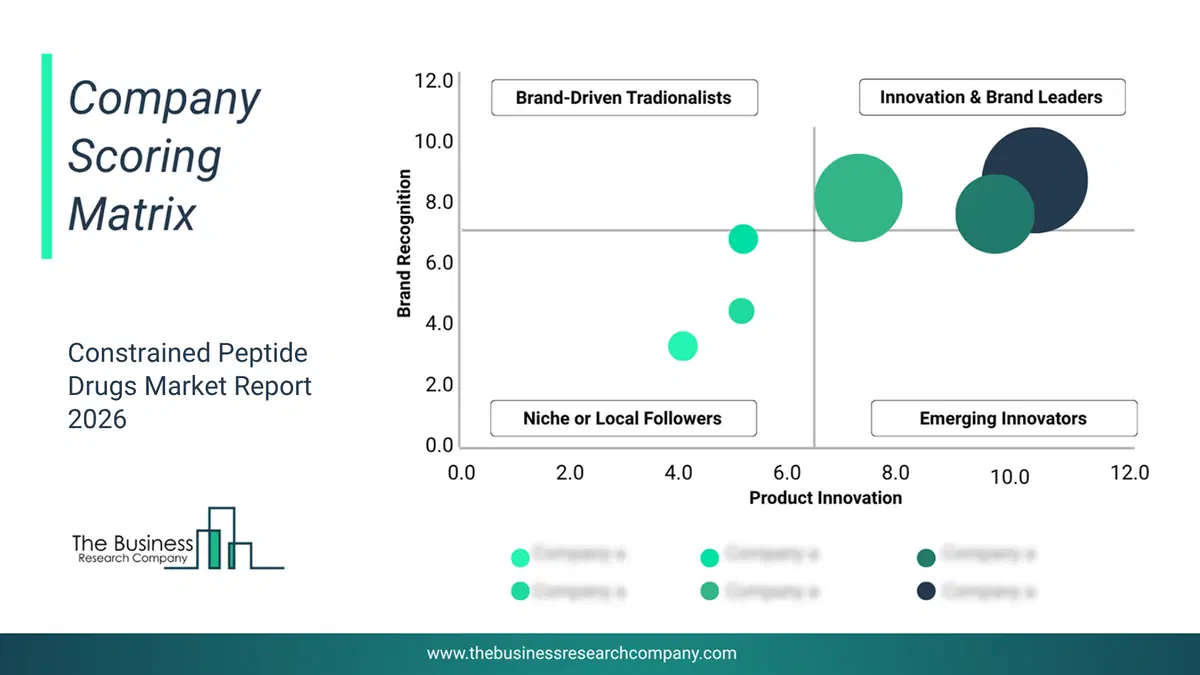
This chart maps companies by product innovation and brand strength, with bubble size indicating relative revenue, helping identify market leaders, challengers, and niche players. This is an illustrative chart; the full report provides a complete and accurate competitive analysis.
Global Constrained Peptide Drugs Market Trends and Insights
Major companies operating in the constrained peptide drugs market are focusing on developing advanced drug delivery solutions, such as oral macrocyclic peptides, to enhance bioavailability, improve patient compliance, and target previously untreatable conditions. Oral macrocyclic peptides refer to cyclic peptide-based drugs that are specifically engineered to be stable and absorbable when taken orally, rather than through injection. For instance, in February 2024, Insamo, a US-based biotechnology company, launched oral cyclic peptides. These are membrane-permeable, orally available macrocyclic peptides that combine the high specificity of biologics with the convenience of oral administration. Their platform leverages machine learning-driven molecular design, ultra-high-throughput molecular biology, and parallel synthetic chemistry to rapidly identify preclinical candidates with favorable pharmacological properties, even for challenging drug targets.What Are Latest Mergers And Acquisitions In The Constrained Peptide Drugs Market?
In March 2023, Ono Pharmaceutical Co. Ltd., a Japan-based pharmaceutical company, collaborated with PeptiDream Inc. to discover and develop novel macrocyclic constrained peptide drugs. This partnership aims to leverage PeptiDream’s proprietary Peptide Discovery Platform System (PDPS) to develop high-affinity macrocyclic peptides targeting difficult protein-protein interactions for innovative drug development. PeptiDream Inc. is a Japan-based biotech company specializing in the discovery and development of constrained peptide drugs.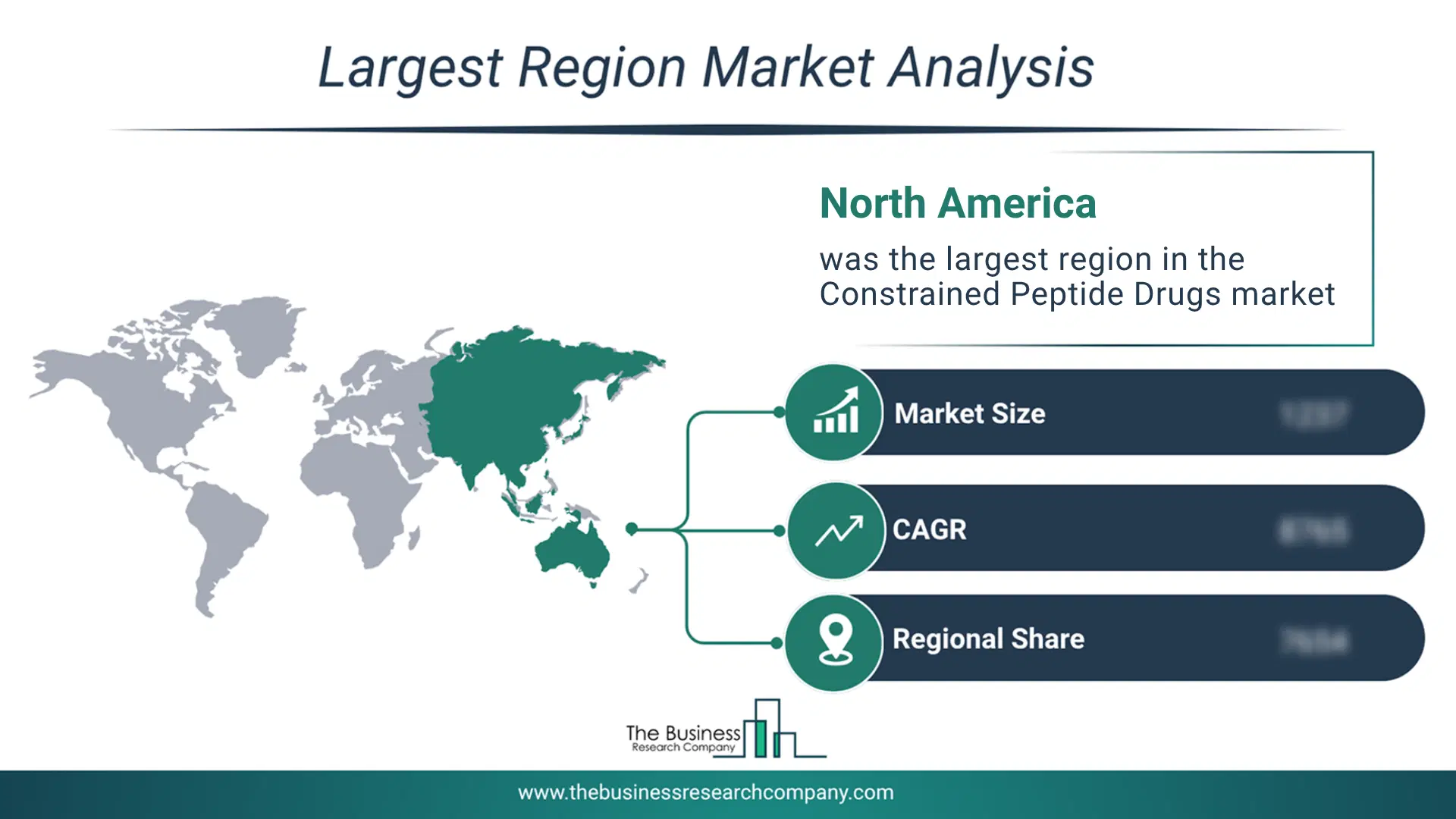
Regional Insights
North America was the largest region in the constrained peptide drugs market in 2025. The regions covered in this market report are Asia-Pacific, South East Asia, Western Europe, Eastern Europe, North America, South America, Middle East, Africa. The countries covered in this market report are Australia, Brazil, China, France, Germany, India, Indonesia, Japan, Taiwan, Russia, South Korea, UK, USA, Canada, Italy, Spain.What Defines the Constrained Peptide Drugs Market?
The constrained peptide drugs market consists of sales of stapled peptides, modified peptide hormone analogs and cyclotides, and engineered natural peptides. Values in this market are ‘factory gate’ values, that is, the value of goods sold by the manufacturers or creators of the goods, whether to other entities (including downstream manufacturers, wholesalers, distributors and retailers) or directly to end customers. The value of goods in this market includes related services sold by the creators of the goods.How is Market Value Defined and Measured?
The market value is defined as the revenues that enterprises gain from the sale of goods and/or services within the specified market and geography through sales, grants, or donations in terms of the currency (in USD unless otherwise specified). The revenues for a specified geography are consumption values that are revenues generated by organizations in the specified geography within the market, irrespective of where they are produced. It does not include revenues from resales along the supply chain, either further along the supply chain or as part of other products.
This chart presents market attractiveness based on a quantitative evaluation of growth, competition, strategic alignment, and risk, offering a clear view of opportunity areas for decision-making. This chart is for illustrative purposes; the full report contains the complete analysis.

This chart highlights the Total Addressable Market (TAM) by estimating the maximum revenue opportunity using an assumption-driven approach, supporting strategic planning and opportunity sizing across markets. The chart is illustrative; the full report provides a more comprehensive analysis.
What Key Data and Analysis Are Included in the Constrained Peptide Drugs Market Report 2026?
The constrained peptide drugs market research report is one of a series of new reports from The Business Research Company that provides market statistics, including industry global market size, regional shares, competitors with the market share, detailed market segments, market trends and opportunities, and any further data you may need to thrive in the constrained peptide drugs industry. The market research report delivers a complete perspective of everything you need, with an in-depth analysis of the current and future state of the industry.Constrained Peptide Drugs Market Report Forecast Analysis
| Report Attribute | Details |
|---|---|
| Market Size Value In 2026 | $3.83 billion |
| Revenue Forecast In 2030 | $7.15 billion |
| Growth Rate | CAGR of 17.2% from 2026 to 2030 |
| Base Year For Estimation | 2025 |
| Actual Estimates/Historical Data | 2020-2025 |
| Forecast Period | 2026 - 2030 |
| Market Representation | Revenue in USD Billion and CAGR from 2026 to 2030 |
| Segments Covered | Drug Type, Route Of Administration, Application, Distribution Channel, End User |
| Regional Scope | Asia-Pacific, Western Europe, Eastern Europe, North America, South America, Middle East, Africa |
| Country Scope | The countries covered in the report are Australia, Brazil, China, France, Germany, India, Indonesia, Japan, Taiwan, Russia, South Korea, UK, USA, Canada, Italy, Spain. |
| Key Companies Profiled | Major companies operating in the constrained peptide drugs market are <b> Amgen Inc., Novo Nordisk A/S, Ipsen S.A., Sanofi S.A., Eli Lilly and Company, Roche Holding AG, Pfizer Inc., Takeda Pharmaceutical Company Limited, Johnson & Johnson, Bristol-Myers Squibb Company, Kymera Therapeutics Inc., Polyphor AG, Novartis Institutes for BioMedical Research (NIBR), Hoffmann-La Roche Ltd., Merck & Co. Inc., Almirall S.A., CSL Limited, Rhythm Pharmaceuticals Inc., Zogenix Inc., Ironwood Pharmaceuticals Inc. </b> |
| Customization Scope | Request for Customization |
| Pricing And Purchase Options | Explore Purchase Options |