
Defense Geospatial Market Report 2026
Global Outlook – By Type (Surface Analysis, Network Analysis, Geo Visualization), By Technology (Geographic Information Systems (GIS), Remote Sensing, Photogrammetry, Light Detection And Ranging (LIDAR), Point Cloud Processing), By Application (Intelligence, Surveillance, And Reconnaissance (ISR), Command And Control (C,, Logistics And Supply Chain Management, Mission Planning And Execution, Training And Simulation), By End-User (Defense Forces, Government Agencies, Commercial Entities, Utilities, Non-Governmental Organizations (NGOs)) – Market Size, Trends, Strategies, and Forecast to 2030
Defense Geospatial Market Overview
• Defense Geospatial market size has reached to $133.95 billion in 2025 • Expected to grow to $218.23 billion in 2030 at a compound annual growth rate (CAGR) of 10.2% • Growth Driver: Surge In Adoption Of Cloud-based Defense Systems Fueling The Growth Of The Market Due To Demand For Faster Scalable And Adaptive Cybersecurity Solutions • Market Trend: Innovations In Intelligence Fusion And Automated Threat Detection Boost Defense Capabilities • North America was the largest region in 2025 and Asia-Pacific is the fastest growing region.What Is Covered Under Defense Geospatial Market?
Defense geospatial refers to the use of geographic information systems (GIS), satellite imagery, remote sensing, and spatial data analytics to support military and defense operations. It enables strategic planning, battlefield awareness, mission coordination, and threat detection. The technology integrates terrain, environmental, and location data for real-time decision-making. It plays a critical role in surveillance, reconnaissance, and operational effectiveness. The main types of defense geospatial include surface analysis, network analysis, and geo visualization. Surface analysis refers to the examination and interpretation of the Earth's surface features using spatial data to understand terrain, elevation, and land characteristics. The technologies are geographic information systems (GIS), remote sensing, photogrammetry, light detection and ranging (LIDAR), and point cloud processing. The applications are intelligence, surveillance, and reconnaissance (ISR), command and control (C2), logistics and supply chain management, mission planning and execution, and training and simulation, catering to end-users such as defense forces, government agencies, commercial entities, utilities, and non-governmental organizations (NGOs).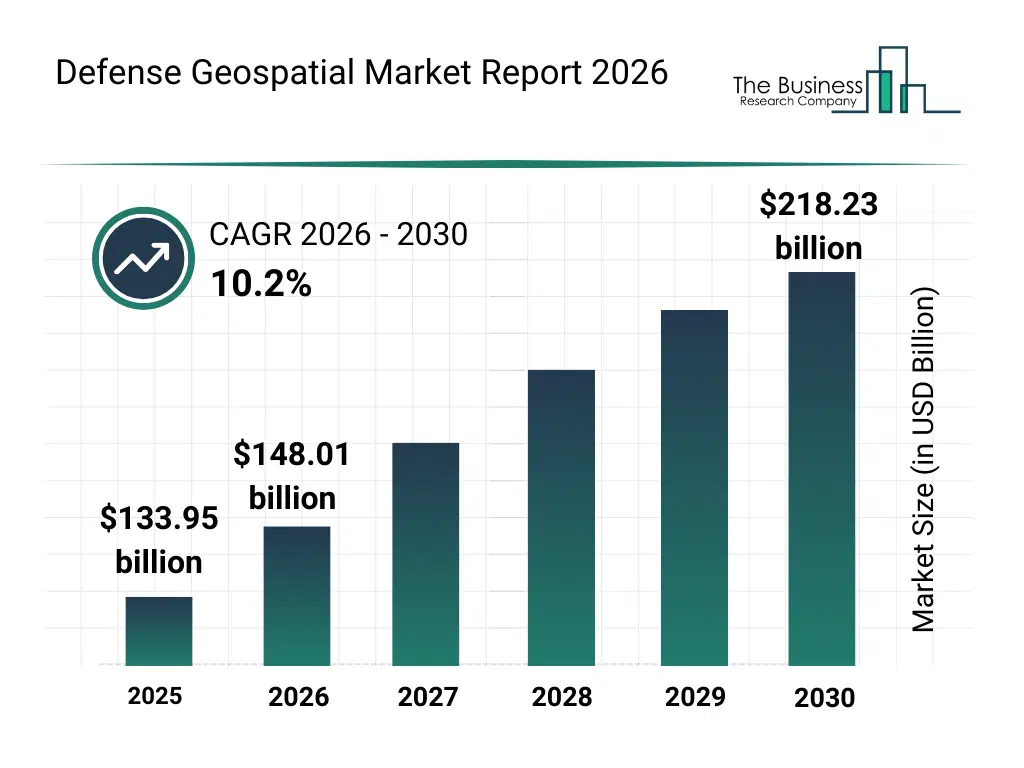
What Is The Defense Geospatial Market Size and Share 2026?
The defense geospatial market size has grown rapidly in recent years. It will grow from $133.95 billion in 2025 to $148.01 billion in 2026 at a compound annual growth rate (CAGR) of 10.5%. The growth in the historic period can be attributed to increasing use of gis and satellite imagery for battlefield awareness and mission planning, expansion of remote sensing technologies supporting reconnaissance and threat detection, development of digital terrain elevation data improving targeting and navigation accuracy, adoption of mapping tools and dashboards for real-time operational coordination, rising demand for force tracking and blue force monitoring systems in modern military operations.What Is The Defense Geospatial Market Growth Forecast?
The defense geospatial market size is expected to see rapid growth in the next few years. It will grow to $218.23 billion in 2030 at a compound annual growth rate (CAGR) of 10.2%. The growth in the forecast period can be attributed to growing integration of AI and machine learning for automated geospatial intelligence analysis, rising demand for high-resolution and persistent geospatial data from advanced satellite constellations, expansion of real-time 3d mapping and simulation capabilities for mission rehearsal, increasing adoption of cloud-based geospatial platforms enabling faster data sharing across defense units, development of multi-source fused geospatial intelligence systems supporting complex joint operations. Major trends in the forecast period include growing demand for real-time terrain intelligence, expansion of high-resolution satellite imagery integration, increased adoption of automated force tracking tools, rising deployment of multi-layer urban warfare mapping, integration of geospatial dashboards for mission command.
Global Defense Geospatial Market Segmentation
1) By Type: Surface Analysis, Network Analysis, Geo Visualization 2) By Technology: Geographic Information Systems (GIS), Remote Sensing, Photogrammetry, Light Detection And Ranging (LIDAR), Point Cloud Processing 3) By Application: Intelligence, Surveillance, And Reconnaissance (ISR), Command And Control (C2), Logistics And Supply Chain Management, Mission Planning And Execution, Training And Simulation 4) By End-User: Defense Forces, Government Agencies, Commercial Entities, Utilities, Non-Governmental Organizations (NGOs) Subsegments: 1) By Surface Analysis: Terrain Modeling, Elevation Mapping, Land Use Or Land Cover Analysis, Vegetation Analysis, Soil Analysis 2) By Network Analysis: Route Optimization, Connectivity Analysis, Logistics And Supply Chain Mapping, Infrastructure Network Analysis, Communication Network Planning 3) By Geo Visualization: 2D Mapping, 3D Mapping And Visualization, Real-time Data Visualization, Augmented Reality (AR) Visualization, Interactive Dashboards And Mapping ToolsWhat Is Driver Of The Defense Geospatial Market?
The increasing adoption of cloud-based defense systems is expected to propel the growth of the defense geospatial market going forward. Cloud-based defense systems refer to military or defense operations and technologies that utilize cloud computing for data storage, processing, and communication. The rise of adoption of cloud-based defense systems is due to people demanding faster, scalable, and more adaptive cybersecurity solutions. Cloud-based defense systems enable real-time mapping and analysis of threat environments and support faster decision-making and efficient resource deployment using cloud-integrated spatial intelligence. For instance, in 2024, according to the Thales Group, a France-based aerospace company, cloud security ranks as the second most critical security discipline (65%) and the leading emerging security concern (72%). Therefore, the increasing adoption of cloud-based defense systems is driving the growth of the defense geospatial industry.Key Players In The Global Defense Geospatial Market
Major companies operating in the defense geospatial market are Raytheon Technologies Corporation, Lockheed Martin Corporation, Airbus Group, Northrop Grumman Corporation, Collins Aerospace, BAE Systems plc, Thales Group, L3Harris Technologies Inc., Leidos Holdings Inc., Hexagon AB, Edge Group, Trimble Inc., Environmental Systems Research Institute Inc., Bentley Systems Incorporated, NV5 Global Inc., Advent International Corporation, BlackSky Technology Inc., Orbital Insight Inc., TerraGo Technologies Inc., MapLarge Inc.
This chart is for illustrative purposes; the full report includes a detailed competitor analysis and comprehensive overview of the top 10 companies in the market.
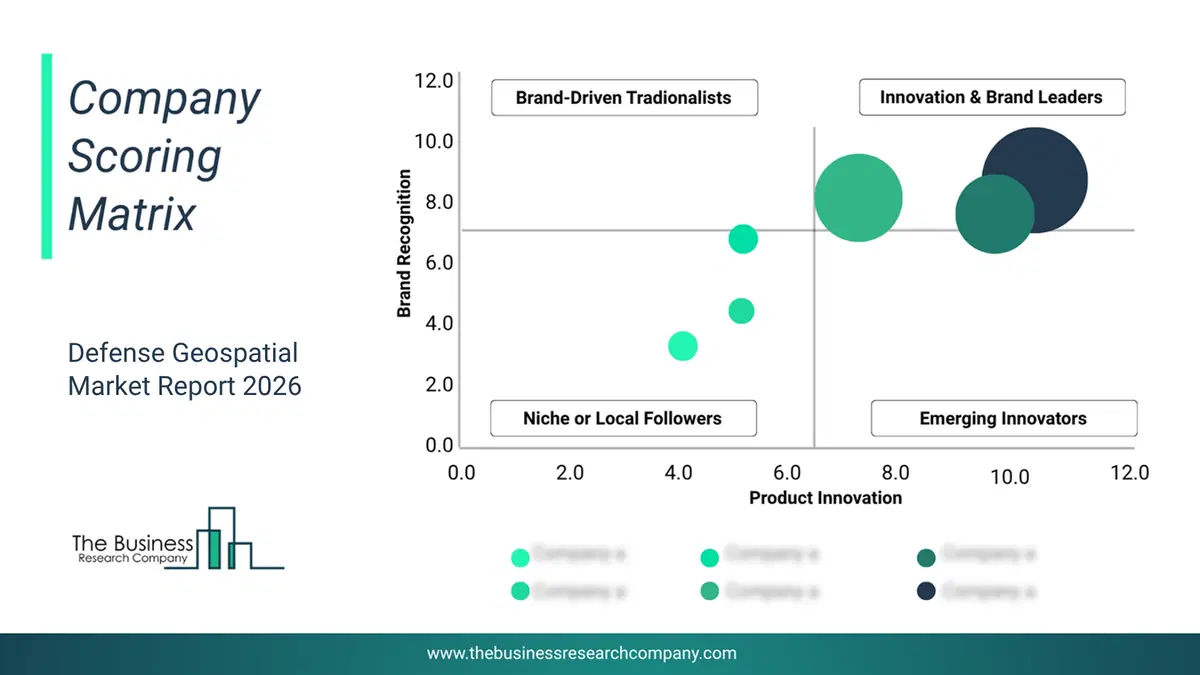
This chart maps companies by product innovation and brand strength, with bubble size indicating relative revenue, helping identify market leaders, challengers, and niche players. This is an illustrative chart; the full report provides a complete and accurate competitive analysis.
Global Defense Geospatial Market Trends and Insights
Major companies operating in the defense geospatial market are focusing on advancements in geospatial technologies such as multi-source intelligence fusion to enhance situational awareness, improve decision-making accuracy, and enable faster response times in complex operational environments. Multi-source intelligence fusion refers to the process of integrating data from multiple intelligence sources to create a comprehensive and actionable operational picture. For instance, in February 2025, Edge Group, a UAE-based aerospace and defense company, introduced TACTICA, an advanced AI-powered geospatial intelligence platform that integrates diverse data sources for enhanced situational awareness. It utilizes cutting-edge AI, including the falcon large language model, and it provides real-time operational insights to support decision-making in defense, security, and strategic fields. The platform features collaborative mission planning capabilities, facilitating seamless coordination among multiple agencies during operations. It also incorporates automated anomaly detection to swiftly identify threats within extensive geospatial data.What Are Latest Mergers And Acquisitions In The Defense Geospatial Market? NV5 Global Inc. Acquired Axim Geospatial LLC To Strengthen Geospatial Capabilities
In February 2023, NV5 Global Inc., a US-based company specializing in technology, conformity assessment, and consulting solutions, acquired Axim Geospatial LLC for an undisclosed amount. Through this acquisition, NV5 aims to expand its leadership in geospatial solutions by integrating Axim’s enterprise geographic information systems (GIS), cloud-managed services, and scalable geospatial data analytics. Axim Geospatial is a US-based company specializing in end-to-end geospatial services and solutions, including big data services, geomatics, and business solutions.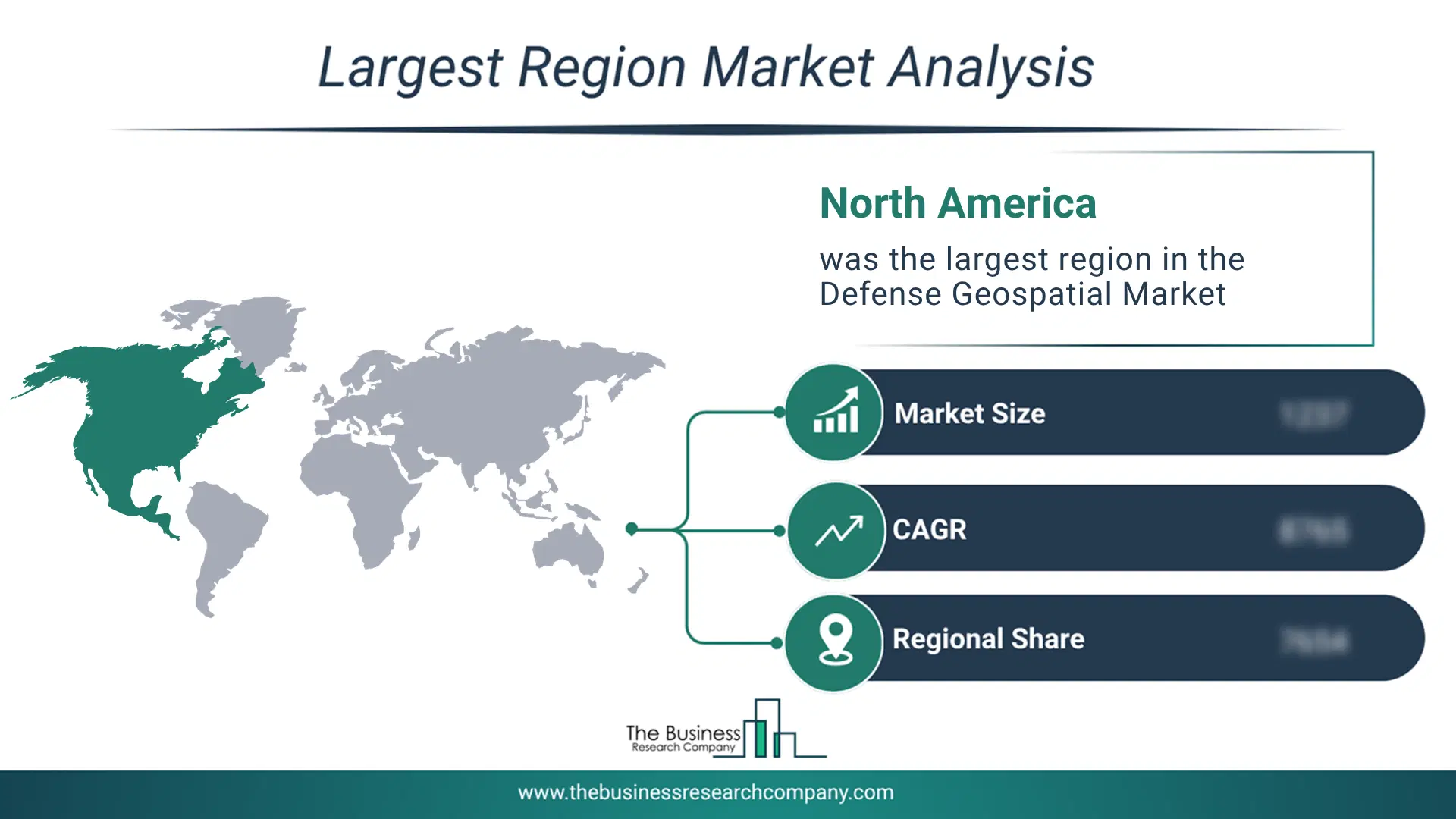
Regional Insights
North America was the largest region in the defense geospatial market in 2025. Asia-Pacific is expected to be the fastest-growing region in the forecast period. The regions covered in this market report are Asia-Pacific, South East Asia, Western Europe, Eastern Europe, North America, South America, Middle East, Africa. The countries covered in this market report are Australia, Brazil, China, France, Germany, India, Indonesia, Japan, Taiwan, Russia, South Korea, UK, USA, Canada, Italy, SpainWhat Defines the Defense Geospatial Market?
The defense geospatial market consists of revenues earned by entities by providing services such as targeting and fire support analysis, urban and infrastructure mapping, force tracking, and blue force monitoring. The market value includes the value of related goods sold by the service provider or included within the service offering. The defense geospatial market also includes sales of digital terrain elevation data, interactive dashboards, and mapping tools. Values in this market are ‘factory gate’ values, that is, the value of goods sold by the manufacturers or creators of the goods, whether to other entities (including downstream manufacturers, wholesalers, distributors, and retailers) or directly to end customers. The value of goods in this market includes related services sold by the creators of the goods.How is Market Value Defined and Measured?
The market value is defined as the revenues that enterprises gain from the sale of goods and/or services within the specified market and geography through sales, grants, or donations in terms of the currency (in USD unless otherwise specified). The revenues for a specified geography are consumption values that are revenues generated by organizations in the specified geography within the market, irrespective of where they are produced. It does not include revenues from resales along the supply chain, either further along the supply chain or as part of other products.
This chart presents market attractiveness based on a quantitative evaluation of growth, competition, strategic alignment, and risk, offering a clear view of opportunity areas for decision-making. This chart is for illustrative purposes; the full report contains the complete analysis.

This chart highlights the Total Addressable Market (TAM) by estimating the maximum revenue opportunity using an assumption-driven approach, supporting strategic planning and opportunity sizing across markets. The chart is illustrative; the full report provides a more comprehensive analysis.
What Key Data and Analysis Are Included in the Defense Geospatial Market Report 2026?
The defense geospatial market research report is one of a series of new reports from The Business Research Company that provides market statistics, including industry global market size, regional shares, competitors with the market share, detailed market segments, market trends and opportunities, and any further data you may need to thrive in the defense geospatial industry. The market research report delivers a complete perspective of everything you need, with an in-depth analysis of the current and future state of the industry.Defense Geospatial Market Report Forecast Analysis
| Report Attribute | Details |
|---|---|
| Market Size Value In 2026 | $148.01 billion |
| Revenue Forecast In 2030 | $218.23 billion |
| Growth Rate | CAGR of 10.2% from 2026 to 2030 |
| Base Year For Estimation | 2025 |
| Actual Estimates/Historical Data | 2020-2025 |
| Forecast Period | 2026 - 2030 |
| Market Representation | Revenue in USD Billion and CAGR from 2026 to 2030 |
| Segments Covered | Type, Technology, Application, End-User |
| Regional Scope | Asia-Pacific, Western Europe, Eastern Europe, North America, South America, Middle East, Africa |
| Country Scope | The countries covered in the defense geospatial market report are Australia, Brazil, China, France, Germany, India, Indonesia, Japan, Taiwan, Russia, South Korea, UK, USA, Canada, Italy, Spain |
| Key Companies Profiled | Raytheon Technologies Corporation, Lockheed Martin Corporation, Airbus Group, Northrop Grumman Corporation, Collins Aerospace, BAE Systems plc, Thales Group, L3Harris Technologies Inc., Leidos Holdings Inc., Hexagon AB, Edge Group, Trimble Inc., Environmental Systems Research Institute Inc., Bentley Systems Incorporated, NV5 Global Inc., Advent International Corporation, BlackSky Technology Inc., Orbital Insight Inc., TerraGo Technologies Inc., MapLarge Inc. |
| Customization Scope | Request for Customization |
| Pricing And Purchase Options | Explore Purchase Options |