
Defense Market Report 2026
Global Outlook – By Type (Air-Based Defense Equipment, Sea-Based Defense Equipment, Land-Based Defense Equipment, Defense Equipment Maintenance, Repair And Overhauling Services, Defense Support And Auxiliary Equipment), By Operation (Autonomous Defense Equipment, Manual), By Platform (Airborne, Land, Naval) – Market Size, Trends, Strategies, and Forecast to 2030
Defense Market Overview
• Defense market size has reached to $506.9 billion in 2025 • Expected to grow to $739.43 billion in 2030 at a compound annual growth rate (CAGR) of 8% • Growth Driver: Defense Expenditures Driving Growth In The Defense Market • Market Trend: Investment In Autonomous Fighter Jets In The Defense Equipment Manufacturing Market • Asia-Pacific was the largest region in 2025 and Western Europe is the fastest growing region.Market Gains By 2030 – Top Opportunities By Segment
Market Gain identifies the most promising market opportunities by highlighting the segments or products expected to generate the highest incremental revenue growth over the next five years.
What Is Covered Under Defense Market?
The defense refers to a range of activities including production of air-based, sea-based, and land-based military equipment, including support and auxiliary equipment such as radar, satellites, sonars, and other auxiliary equipment, or maintain, repair, and overhaul defense equipment. The main defense types are air-based defense equipment, sea-based defense equipment, land-based defense equipment, defense equipment maintenance, repair, and overhaul services, defense support, and auxiliary equipment. Air-based defense equipment includes support and auxiliary equipment for air-based defense, such as radar, satellites, sonar, and other auxiliary equipment. The various operations include autonomous defense equipment, manuals and involve various platforms such as airborne, land, and naval.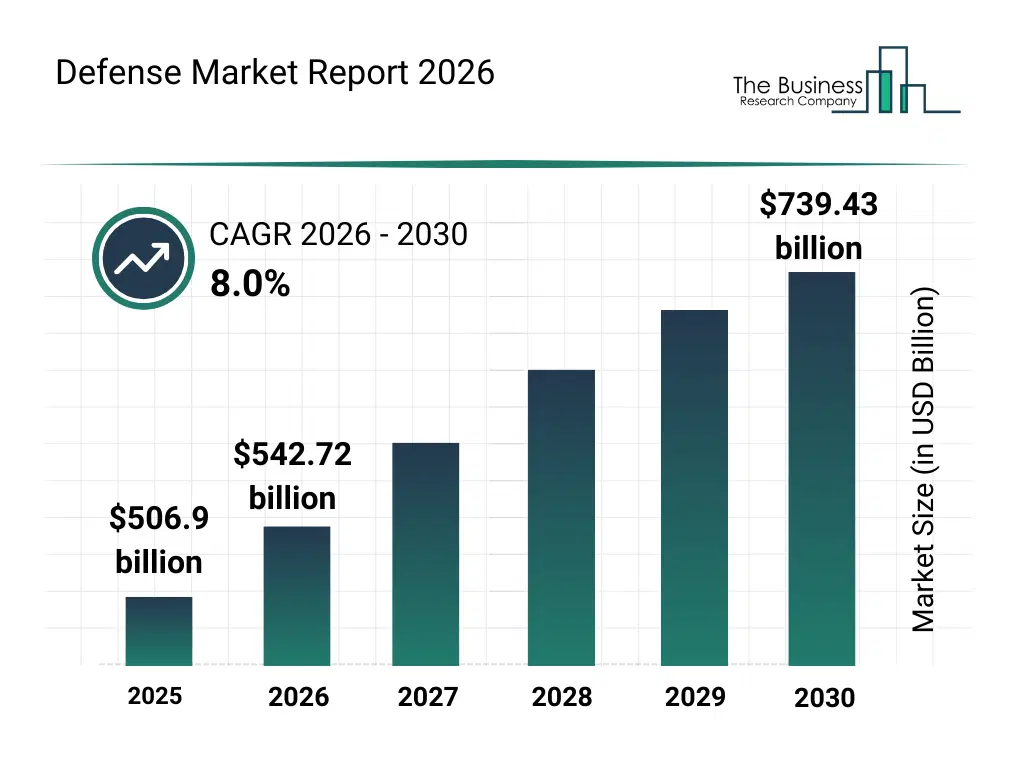
What Is The Defense Market Size and Share 2026?
The defense market size has grown strongly in recent years. It will grow from $506.9 billion in 2025 to $542.72 billion in 2026 at a compound annual growth rate (CAGR) of 7.1%. The growth in the historic period can be attributed to rising geopolitical tensions driving increased procurement of air-, sea-, and land-based defense equipment, expansion of military modernization programs across major nations, growth in demand for auxiliary systems such as radar, sonar, and satellites, increased investment in maintenance repair and overhaul (mro) for existing defense platforms, technological advancements improving performance and integration of multi-domain defense systems.What Is The Defense Market Growth Forecast?
The defense market size is expected to see strong growth in the next few years. It will grow to $739.43 billion in 2030 at a compound annual growth rate (CAGR) of 8.0%. The growth in the forecast period can be attributed to anticipated rise in defense spending supporting next-generation platform development, growing adoption of autonomous and unmanned defense systems across all domains, advancements in space-based defense capabilities including military satellites, increasing focus on integrated command-and-control and network-centric warfare systems, expansion of defense mro and support services driven by larger and older global fleets. Major trends in the forecast period include increased demand for multi-domain defense platforms, growth in modernization of land, air, and naval fleets, rising focus on long-range strike and missile defense systems, expansion of defense maintenance, repair & overhaul (mro) services, strengthening of indigenous defense manufacturing capabilities.
Global Defense Market Segmentation
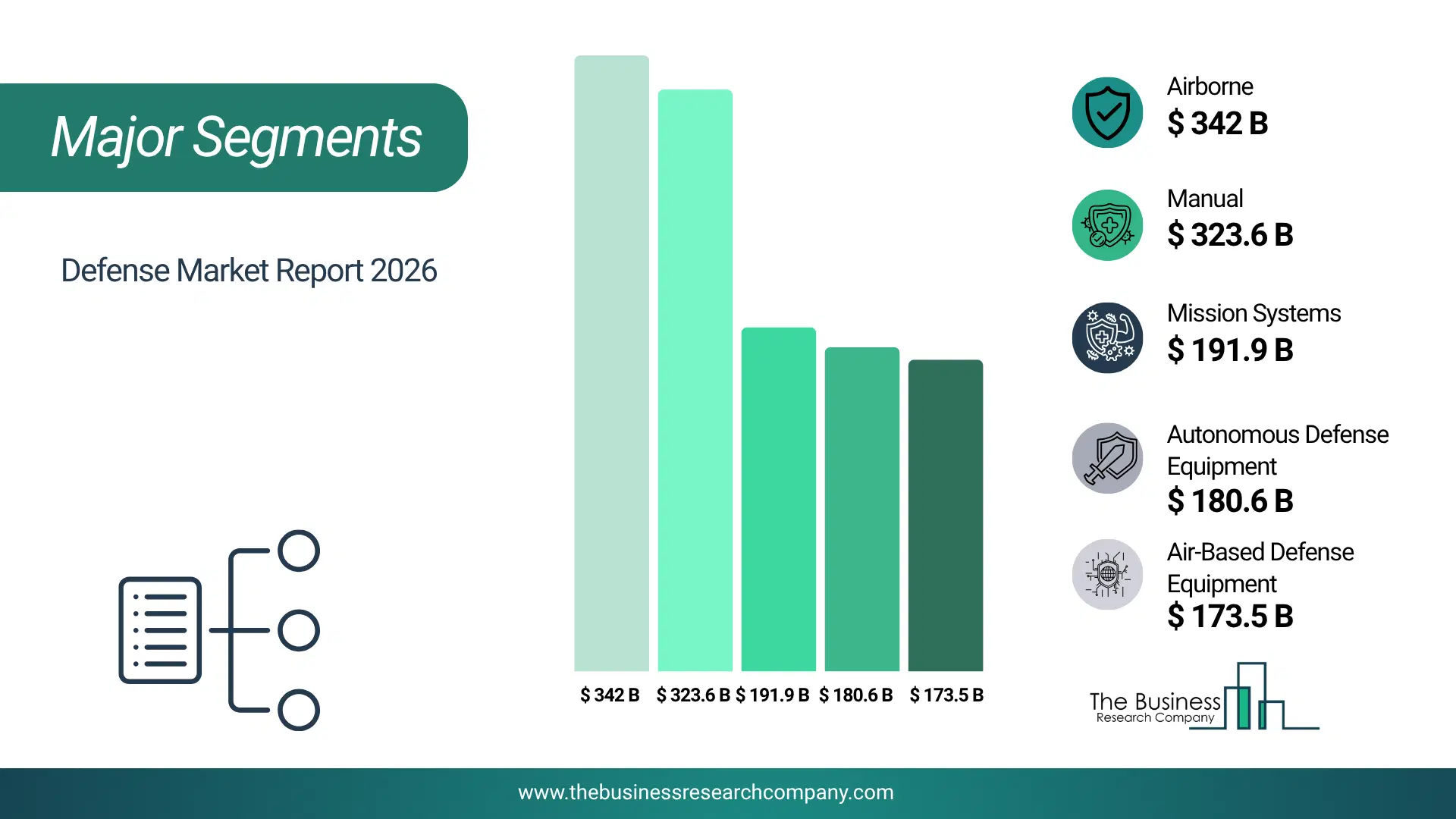
1) By Type: Air-Based Defense Equipment, Sea-Based Defense Equipment, Land-Based Defense Equipment, Defense Equipment Maintenance, Repair And Overhauling Services, defense support and auxiliary equipment 2) By Operation: Autonomous Defense Equipment, Manual 3) By Platform: Airborne, Land, Naval Subsegments: 1) By Air-Based Defense Equipment: Combat Aircraft, Unmanned Aerial Vehicles (UAVs) or Drones, Air Defense Systems, Helicopters, Surveillance And Reconnaissance Aircraft 2) By Sea-Based Defense Equipment: Naval Vessels, Amphibious Assault Ships, Maritime Patrol Aircraft, Naval Weapon Systems, Mine Countermeasure Vessels 3) By Land-Based Defense Equipment: Armored Vehicles, Artillery Systems, Infantry Fighting Vehicles (IFVs), Military Trucks and Logistics Vehicles, Ground-based Missile Systems 4) By Defense Equipment Maintenance: Scheduled Maintenance, Unscheduled Maintenance, Technical Support Services, Logistics Support, Fleet Management 5) By Repair and Overhauling Services: Component Repair, Engine Overhaul, Avionics Repair, Structural Repair, Systems Integration and Testing The top segments in the defense market will be: • Airborne will reach $342018.07 Million by 2025. • Manual will reach $323698.69 Million by 2025. • Mission Systems will reach $191902.57 Million by 2025. • Autonomous Defense Equipment will reach $180637.6 Million by 2025. • Air-Based Defense Equipment will reach $173581.02 Million by 2025.What Is Driver Of The Defense Market?
The increasing defense expenditures are expected to propel the growth of the defense market going forward. Defense expenditure is the amount of financial resources dedicated by a state to raising and maintaining an armed force or other methods essential for defense purposes. Defense expenditure provides funding for the defense industry, which includes the design, manufacturing, and maintenance of military equipment. For instance, in April 2024, according to the Stockholm International Peace Research Institute (SIPRI), a Sweden-based non-government organization, in 2023, global military spending reached $2,443 billion, up 6.8% in real terms from 2022. Therefore, increasing defense expenditure is driving the growth of the defense industry.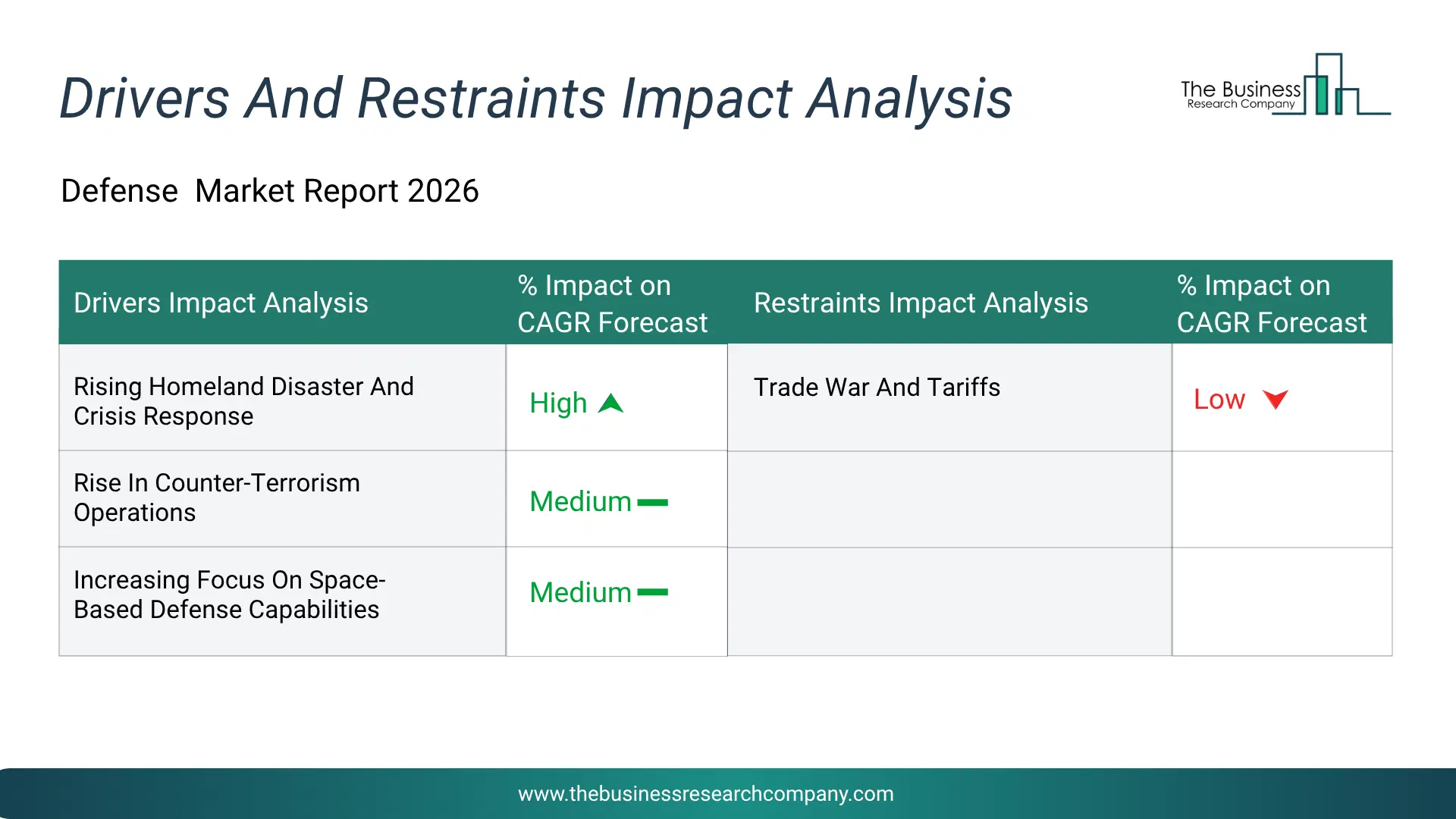
Infographic Chart Showing Key Market Drivers Analysis And Restraints For Defense Market
The chart presents an impact analysis of key drivers and restraints, quantifying their relative influence on the market's growth rate and helping assess the balance between growth enablers and limiting factors. This chart offers a high-level perspective; the full report contains more detailed insights.
How Will The Drivers Impact Growth In The Global Defense Market?
• Rising Homeland Disaster And Crisis Response (High) – The rising homeland disaster and crisis response will become a key driver of growth in the defense market by 2030. Rising homeland disasters and crises, including natural disasters, pandemics, terrorist threats and industrial accidents, are prompting governments to enhance disaster response and emergency preparedness capabilities. This is driving increased demand for defense-related equipment, technologies and services such as communication systems, surveillance drones, rescue vehicles and protective gear. Consequently, defense companies are experiencing higher procurement and investment opportunities, supporting growth in the defense market. As a result, the rising homeland disaster and crisis response is anticipated to contributing to a 2.4% annual growth in the market. • Rise In Counter-Terrorism Operations (Medium) – The rise in counter-terrorism operations will emerge as a major factor driving the expansion of the defense market by 2030. Counter-terrorism operations refer to coordinated actions by governments or security forces aimed at preventing, deterring and responding to terrorist activities to protect civilians, infrastructure and national security. Counter-terrorism initiatives drive increased procurement of specialized weapons, surveillance systems, armored vehicles, unmanned aerial vehicles and protective equipment, thereby enhancing defense sector sales. Consequently, the rise in counter-terrorism operations capabilities is projected to contributing to a 1.9% annual growth in the market. • Increasing Focus On Space-Based Defense Capabilities (Medium) – The increasing focus on space-based defense capabilities within digital manufacturing processes will serve as a key growth catalyst for the defense market by 2030. The increasing focus on space-based defense capabilities is driving the growth of the defense market because governments and militaries are investing heavily in satellites, space surveillance systems, missile detection and communication networks. These capabilities enhance national security, early warning systems and strategic deterrence. As a result, defense companies see higher demand for space launch services, satellite technology, ground control infrastructure and advanced research and development. Therefore, this increasing focus on space-based defense capabilities across digital manufacturing operations is projected to supporting to a 1.7% annual growth in the market. • Increasing Defense And Military Budgets (Medium) – The increasing defense and military budgets will become a significant driver contributing to the growth of the defense market by 2030. When governments increase defense spending, armed forces expand procurement of weapons, vehicles, aircraft, naval vessels and advanced technology systems. Higher budgets enable defense contractors to innovate and develop cutting-edge solutions, including drones, missile systems, cybersecurity platforms and AI-driven defense technologies. Consequently, the increasing defense and military budgets strategies is projected to contributing to a 1.4% annual growth in the market.How Will The Restraints Impact Growth In The Global Defense Market?
• Technological Complexity And Integration Challenges (High) – Technological Complexity And Integration Challenges will restrict the growth of the Defense market during the forecast period. Modern defense systems involve increasingly complex technologies that require sophisticated integration with existing platforms and networks. The complexity of integrating new defense technologies with legacy systems creates implementation challenges, cost overruns, and project delays. Integration difficulties can affect the adoption of advanced defense solutions and limit market growth. • Complex Regulatory And Compliance Requirements (Medium) – Complex Regulatory And Compliance Requirements will restrict the growth of the Defense market during the forecast period. Defense contracting and procurement are subject to extensive regulations covering security, export controls, and compliance standards. The complexity of regulatory requirements adds to development costs and project timelines. Compliance challenges can deter new entrants and limit the participation of smaller companies in the defense market. • Trade War And Tariffs (Medium) – Trade War And Tariffs will restrict the growth of the Defense market during the forecast period. Defense supply chains rely on global sourcing for components and materials, which can be disrupted by trade tensions and tariffs. Trade barriers increase procurement costs and can affect program schedules. International defense collaboration may also be impacted by trade disputes, limiting market opportunities and technology sharing.Key Players In The Global Defense Market
Major companies operating in the defense market are Lockheed Martin Corporation, Raytheon Technologies Corporation, Northrop Grumman Corp, General Dynamics, The Boeing Company, BAE Systems plc, L3Harris Technologies, Leonardo SpA, Thales Group, Huntington Ingalls Industries Inc, Excel Laser Technology Private Limited, Prakash Laser, Infrared Optics, Kalaimakal Systems Private Limited, Baoding Triangel Rsd Electronics Technology Limited, Beijing Be-Better Technology Co., Ltd, Shanghai Zhangjiagang Baorui Machinery Co., Ltd, Guangzhou Blixun Electronics Co., Ltd, Xi'an Lonn M&E Equipment Co., Ltd, General Atomics Aeronautical Systems, Elbit Systems Ltd, AeroVironment, China South Industries Group (CSGC), China Aerospace Science and Industry Corporation (CASIC), China North Industries Group Corporation Limited (Norinco), Changhe Aircraft Industries Corporation, Shenyang Aircraft Corporation, Babcock International, BMARC, BMT Group, CBI Explosives Industry Group, HSE Explosives, Chemring Energetics UK Ltd, Orica UK Ltd, CES Advanced Composites UK Ltd, Conjay Collectors Ammunition Company Ltd, Societe Suisse des Explosifs, SSE Group, BIAZZI SA, Almaz-Antey, United Aircraft Corporation, Tactical Missiles Corporation, Russian Helicopters, Uralvagonzavod, United Shipbuilding Corporation, Advanced Composites Solutions, AEL Sistemas, Aeromot, Agrale, Airship do Brasil, Telespazio, ARSAT, Airbus SE, Saudi Arabian Military Industries (SAMI), Advanced Electronics Company, Abu Dhabi Ship Building (ADSB), DragonFly Aerospace, Armscor, Atlantis Diesel Engines, Atlas Aircraft Corporation, OneWeb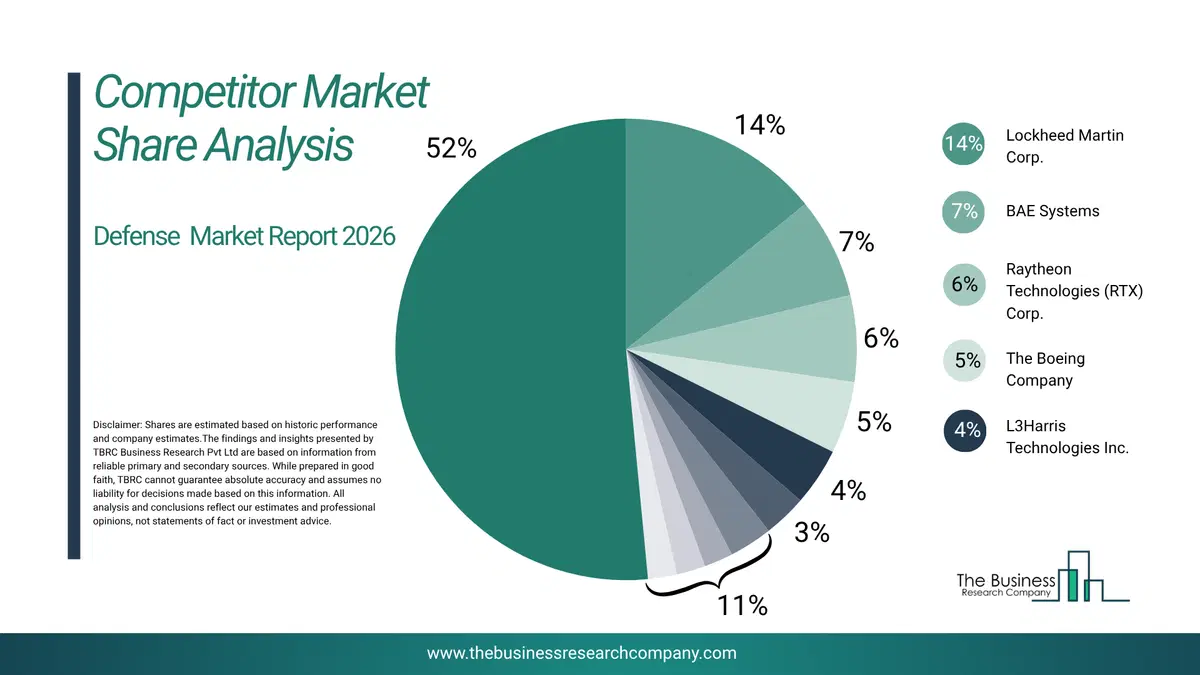
This chart is for illustrative purposes; the full report includes a detailed competitor analysis and comprehensive overview of the top 10 companies in the market.
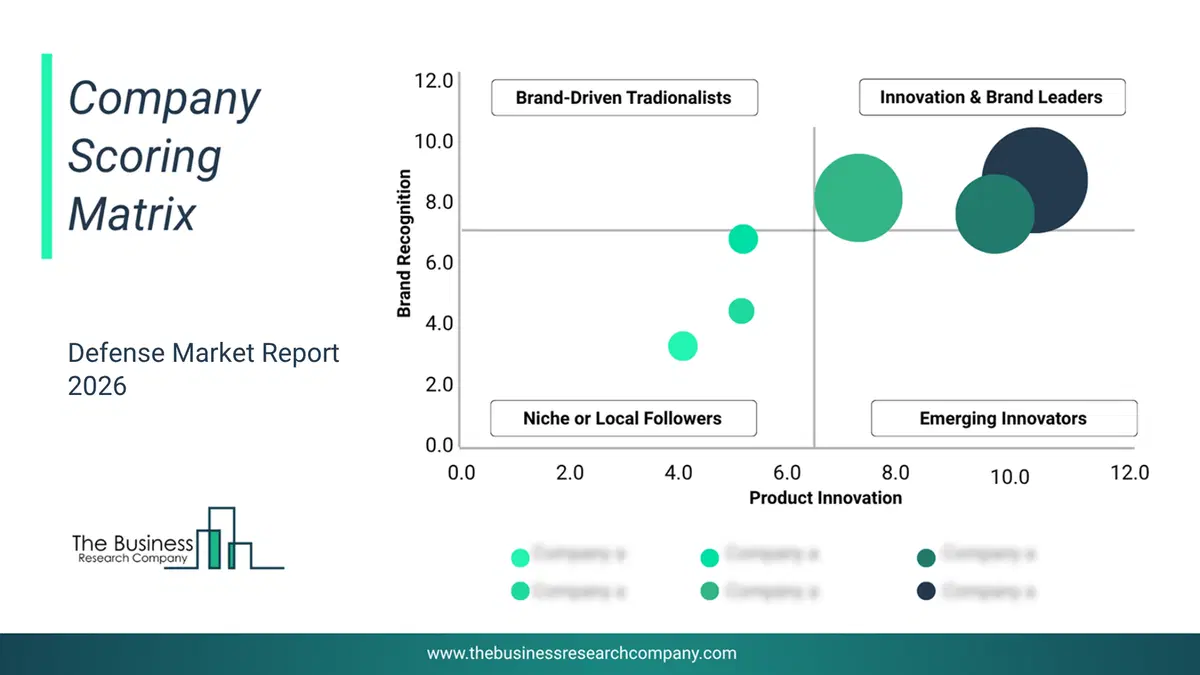
This chart maps companies by product innovation and brand strength, with bubble size indicating relative revenue, helping identify market leaders, challengers, and niche players. This is an illustrative chart; the full report provides a complete and accurate competitive analysis.
Global Defense Market Trends and Insights
Major companies in the air-based defense equipment manufacturing market are increasingly investing in the development of autonomous fighter jets. Autonomous fighter jets are jets that do not require human pilots to fly and can fly for longer periods of time. Autonomous jets are equipped with sensors to scan for potential threats and process more information at a given time. These jets are well equipped to collect intelligence about the enemy, block the electronic systems of enemy aircraft, and shoot down other threats in the air. Following the trend. For instance, In October 2024, Leonardo, an Italy-based multinational company specializing in aerospace, defense, and security launched BriteStorm. BriteStorm is designed to deliver stand-in jamming capabilities, functioning as an airborne disruptor against a range of enemy threats. Its adaptability allows it to be installed on multiple platforms and compatible with various UAV types, providing militaries with deployment flexibility. Furthermore, its digital deception techniques can counter advanced radar systems by generating ghost aircraft signatures, complicating adversaries' efforts to identify real threats.What Are Latest Mergers And Acquisitions In The Defense Market? Rheinmetall Acquired Loc Performance Products
In December 2024, Rheinmetall, a Germany-based defense company that specializes in military vehicle systems and components, acquired Loc Performance Products for $950 million. Rheinmetall's acquisition of Loc Performance Products strengthens its manufacturing capabilities in the United States and expands its footprint in military vehicle components. The integration of Rheinmetall’s advanced vehicle technologies with Loc Performance Products’ expertise aligns with Rheinmetall's strategy to enhance its global defense solutions. Loc Performance Products is a US-based manufacturer of military vehicle components.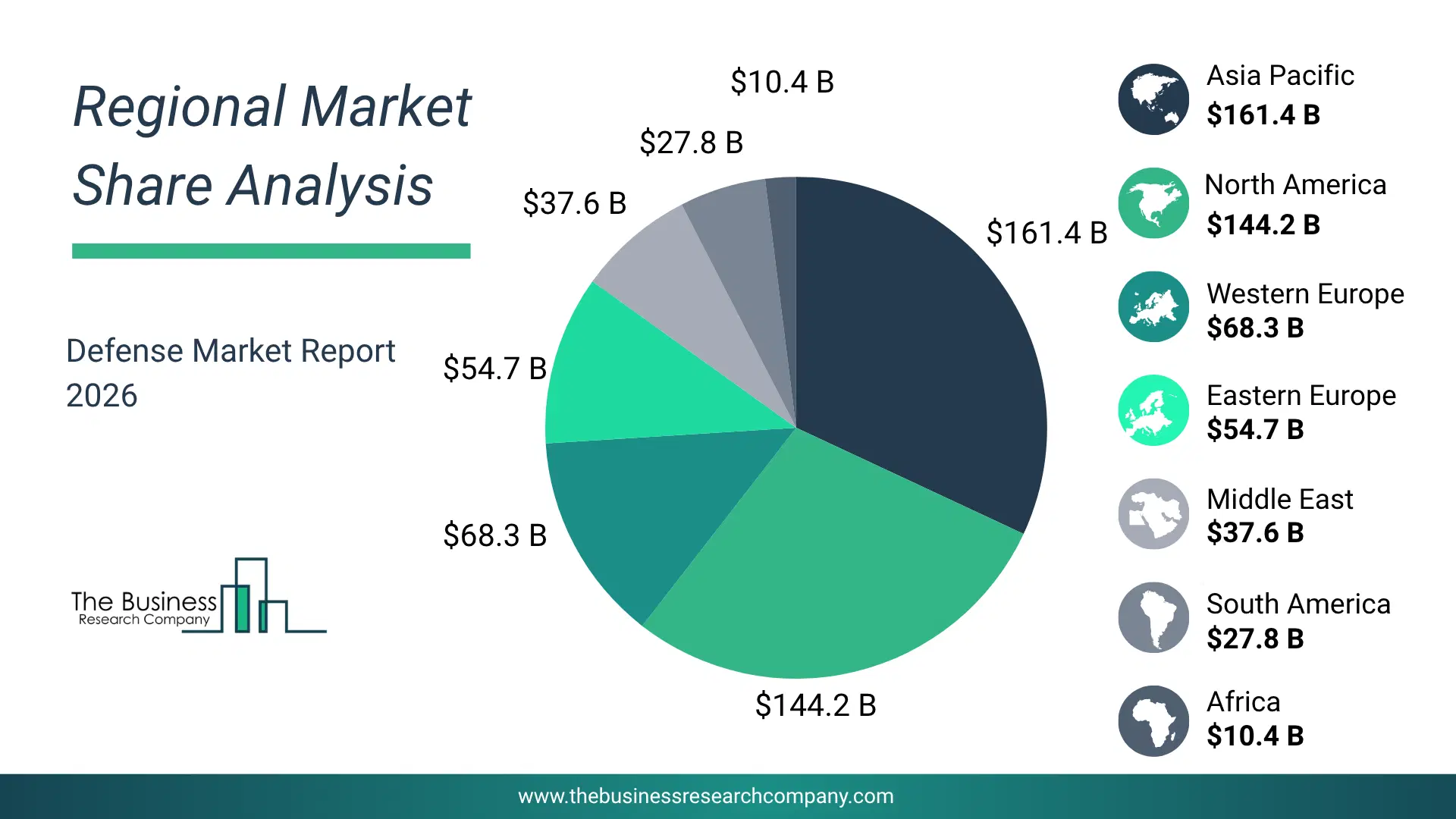
Regional Insights
Asia-Pacific was the largest region in the defense market in 2025. Western Europe is expected to be the fastest growing region in the forecast period. The regions covered in this market report are Asia-Pacific, South East Asia, Western Europe, Eastern Europe, North America, South America, Middle East, Africa. The countries covered in this market report are China, India, Japan, Australia, Indonesia, South Korea, Bangladesh, Thailand, Vietnam, Malaysia, Singapore, Philippines, Hong Kong, Taiwan, New Zealand, UK, Germany, France, Italy, Spain, Austria, Belgium, Denmark, Finland, Ireland, Netherlands, Norway, Portugal, Sweden, Switzerland, Russia, Czech Republic, Poland, Romania, Ukraine, USA, Canada, Mexico, Brazil, Chile, Argentina, Colombia, Peru, Saudi Arabia, Israel, Iran, Turkey, UAE, Egypt, Nigeria, South Africa.What Defines the Defense Market?
The defense market consists of sales of air-based, sea-based, and land-based defense equipment such as military aircraft, helicopter, satellites, and radars, as well as support services. Values in this market are ‘factory gate’ values, that is the value of goods sold by the manufacturers or creators of the goods, whether to other entities (including downstream manufacturers, wholesalers, distributors, and retailers) or directly to end customers. The value of goods in this market includes related services sold by the creators of the goods.How is Market Value Defined and Measured?
The market value is defined as the revenues that enterprises gain from the sale of goods and/or services within the specified market and geography through sales, grants, or donations in terms of the currency (in USD unless otherwise specified). The revenues for a specified geography are consumption values that are revenues generated by organizations in the specified geography within the market, irrespective of where they are produced. It does not include revenues from resales along the supply chain, either further along the supply chain or as part of other products.
This chart presents market attractiveness based on a quantitative evaluation of growth, competition, strategic alignment, and risk, offering a clear view of opportunity areas for decision-making. This chart is for illustrative purposes; the full report contains the complete analysis.

This chart highlights the Total Addressable Market (TAM) by estimating the maximum revenue opportunity using an assumption-driven approach, supporting strategic planning and opportunity sizing across markets. The chart is illustrative; the full report provides a more comprehensive analysis.
What Key Data and Analysis Are Included in the Defense Market Report 2026?
The defense market research report is one of a series of new reports from The Business Research Company that provides market statistics, including industry global market size, regional shares, competitors with the market share, detailed market segments, market trends and opportunities, and any further data you may need to thrive in the defense industry. The market research report delivers a complete perspective of everything you need, with an in-depth analysis of the current and future state of the industry.Defense Market Report Forecast Analysis
| Report Attribute | Details |
|---|---|
| Market Size Value In 2026 | $542.72 billion |
| Revenue Forecast In 2030 | $739.43 billion |
| Growth Rate | CAGR of 7.1% from 2026 to 2030 |
| Base Year For Estimation | 2025 |
| Actual Estimates/Historical Data | 2020-2025 |
| Forecast Period | 2026 - 2030 |
| Market Representation | Revenue in USD Billion and CAGR from 2026 to 2030 |
| Segments Covered | Type, Operation, Platform |
| Regional Scope | Asia-Pacific, Western Europe, Eastern Europe, North America, South America, Middle East, Africa |
| Country Scope | The countries covered in the report are Australia, Brazil, China, France, Germany, India, Indonesia, Japan, Taiwan, Russia, South Korea, UK, USA, Canada, Italy, Spain. |
| Key Companies Profiled | Lockheed Martin Corporation, Raytheon Technologies Corporation, Northrop Grumman Corp, General Dynamics, The Boeing Company, BAE Systems plc, L3Harris Technologies, Leonardo SpA, Thales Group, Huntington Ingalls Industries Inc, Excel Laser Technology Private Limited, Prakash Laser, Infrared Optics, Kalaimakal Systems Private Limited, Baoding Triangel Rsd Electronics Technology Limited, Beijing Be-Better Technology Co., Ltd, Shanghai Zhangjiagang Baorui Machinery Co., Ltd, Guangzhou Blixun Electronics Co., Ltd, Xi'an Lonn M&E Equipment Co., Ltd, General Atomics Aeronautical Systems, Elbit Systems Ltd, AeroVironment, China South Industries Group (CSGC), China Aerospace Science and Industry Corporation (CASIC), China North Industries Group Corporation Limited (Norinco), Changhe Aircraft Industries Corporation, Shenyang Aircraft Corporation, Babcock International, BMARC, BMT Group, CBI Explosives Industry Group, HSE Explosives, Chemring Energetics UK Ltd, Orica UK Ltd, CES Advanced Composites UK Ltd, Conjay Collectors Ammunition Company Ltd, Societe Suisse des Explosifs, SSE Group, BIAZZI SA, Almaz-Antey, United Aircraft Corporation, Tactical Missiles Corporation, Russian Helicopters, Uralvagonzavod, United Shipbuilding Corporation, Advanced Composites Solutions, AEL Sistemas, Aeromot, Agrale, Airship do Brasil, Telespazio, ARSAT, Airbus SE, Saudi Arabian Military Industries (SAMI), Advanced Electronics Company, Abu Dhabi Ship Building (ADSB), DragonFly Aerospace, Armscor, Atlantis Diesel Engines, Atlas Aircraft Corporation, OneWeb |
| Customization Scope | Request for Customization |
| Pricing And Purchase Options | Explore Purchase Options |