
Discount Department Stores Market Report 2026
Global Outlook – By Store Type (General Merchandise, Specialty Products), By Products (Clothing, Electronics, Groceries, Household Goods), By Distribution (Offline, Online) – Market Size, Trends, Strategies, and Forecast to 2030
Discount Department Stores Market Overview
• Discount Department Stores market size has reached to $503.2 billion in 2025 • Expected to grow to $749.85 billion in 2030 at a compound annual growth rate (CAGR) of 8.3% • Growth Driver: The Rise Of Online Retail Fuels Growth In Discount Department Stores • Market Trend: Expansion Of Discount Department Store Formats Enhances Customer Reach And Market Competitiveness • North America was the largest region in 2025 and Asia-Pacific is the fastest growing region.Market Gains By 2030 – Top Opportunities By Segment
Market Gain identifies the most promising market opportunities by highlighting the segments or products expected to generate the highest incremental revenue growth over the next five years.
What Is Covered Under Discount Department Stores Market?
Discount department stores are retail stores that offer a wide range of products at lower prices compared to traditional department stores. These stores focus on providing value to customers through discounted prices, often by offering fewer luxury or high-end brands and more budget-friendly options. The main types of stores in discount department stores include general merchandise and specialty products. General merchandise refers to a wide range of products that are typically sold in retail stores, encompassing various categories such as clothing, electronics, household items, toys, and personal care products. These products can be offered in various forms, including clothing, electronics, groceries, and household goods, and are distributed through both offline and online channels.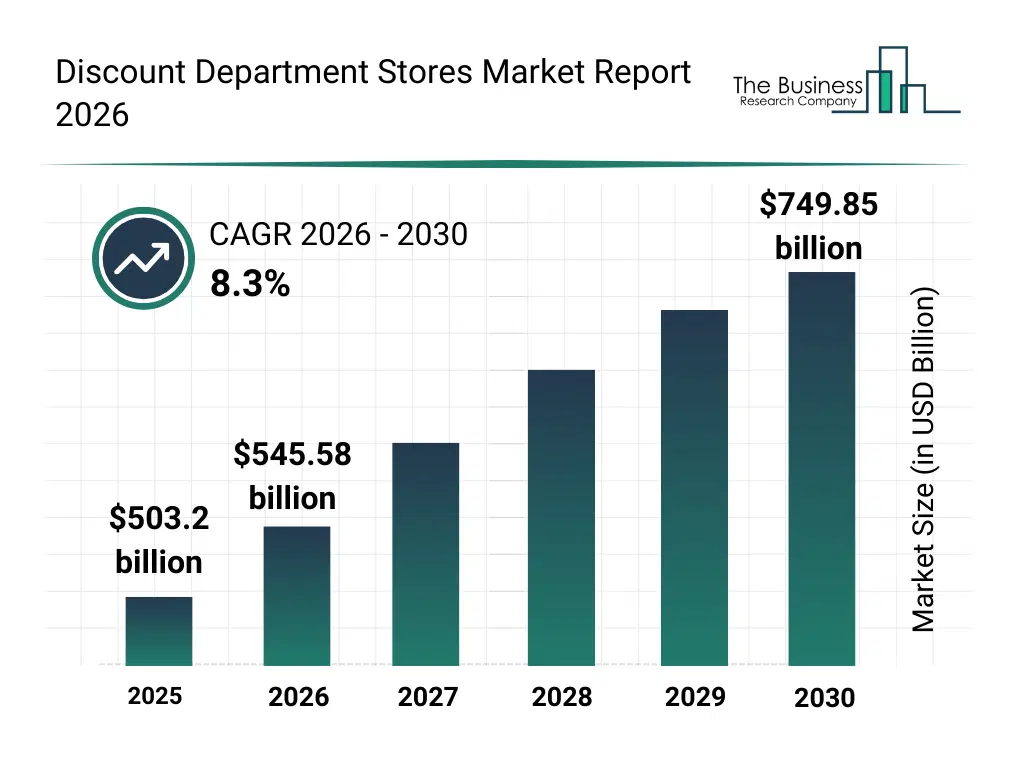
What Is The Discount Department Stores Market Size and Share 2026?
The discount department stores market size has grown strongly in recent years. It will grow from $503.2 billion in 2025 to $545.58 billion in 2026 at a compound annual growth rate (CAGR) of 8.4%. The growth in the historic period can be attributed to rise of big-box retail formats, consumer demand for affordable products, expansion of suburban retail locations, development of private label brands, increasing disposable income.What Is The Discount Department Stores Market Growth Forecast?
The discount department stores market size is expected to see strong growth in the next few years. It will grow to $749.85 billion in 2030 at a compound annual growth rate (CAGR) of 8.3%. The growth in the forecast period can be attributed to growth of e-commerce integration, adoption of AI-driven customer analytics, rise in sustainability-conscious consumers, expansion into emerging markets, increasing demand for contactless shopping experiences. Major trends in the forecast period include expansion of private label products, omnichannel retailing and integration, value-based pricing strategies, growing focus on everyday essentials, store layout optimization and experience enhancement.
Global Discount Department Stores Market Segmentation
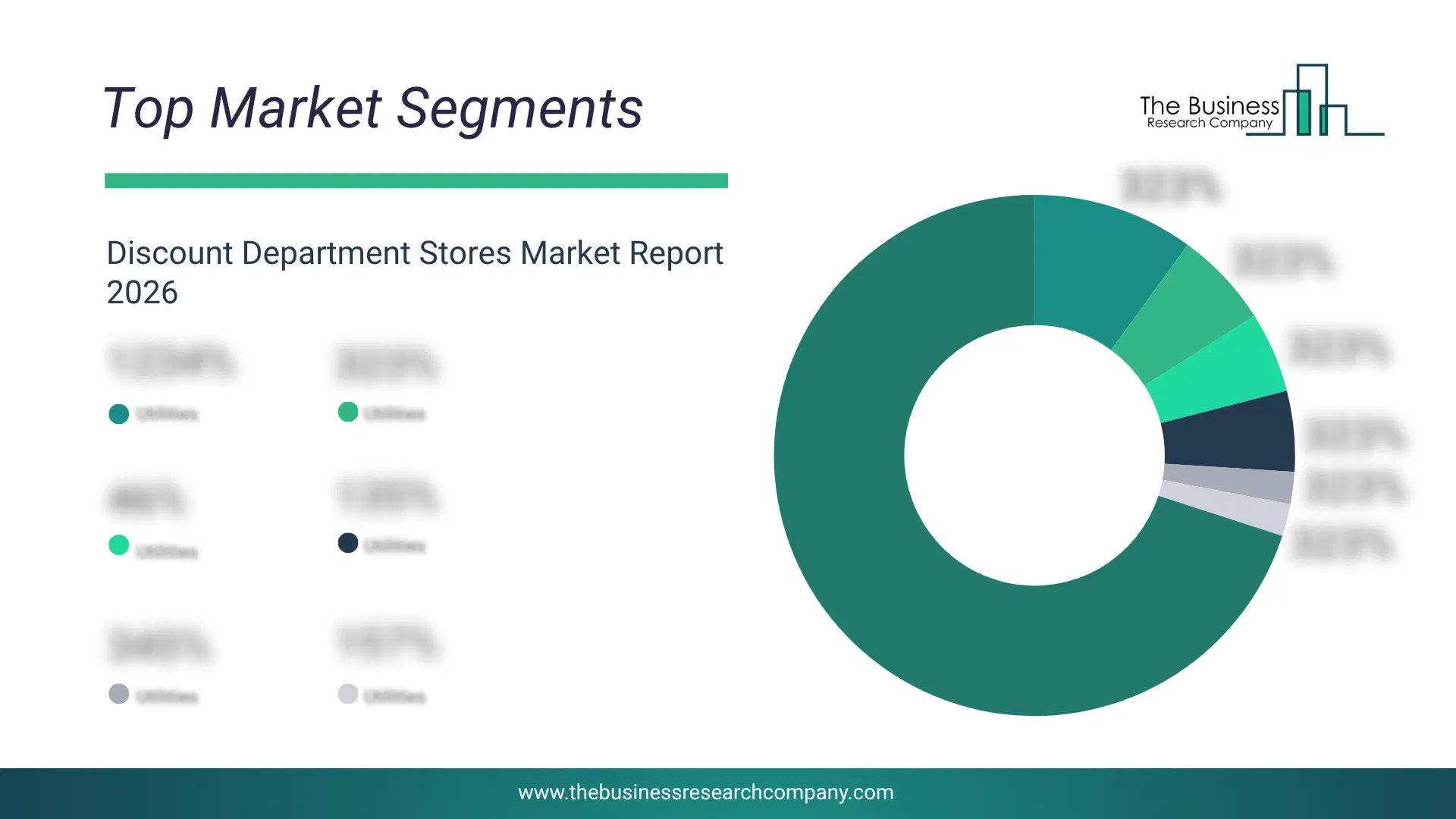
1) By Store Type: General Merchandise, Specialty Products 2) By Products: Clothing, Electronics, Groceries, Household Goods 3) By Distribution: Offline, Online Subsegments: 1) By General Merchandise: Apparel And Footwear, Household Goods And Appliances, Personal Care Products, Electronics And Accessories 2) By Specialty Products: Health And Wellness Products, Beauty And Cosmetics, Home Improvement And Furniture, Grocery And Food Items The top segments in the discount department stores market will be: • General Merchandise will reach $481.19 Billion by 2030. • Specialty Products will reach $275.04 Billion by 2030.What Is The Driver Of The Discount Department Stores Market?
The rise in online retail sales is expected to propel the growth of the discount department store market going forward. Online retail refers to the sale of goods and services over the internet, allowing customers to browse, select, and purchase items without visiting physical stores. The rise in online retail sales is due to the convenience of shopping from home, broader product selection, and competitive pricing, further supported by improved delivery services and technological advancements. Discount department stores boost online retail sales by attracting price-sensitive consumers with competitive pricing, frequent promotions, and various affordable products. For instance, in May 2024, according to the United States Census Bureau, a US-based government agency, U.S. retail e-commerce sales for the first quarter of 2024 reached $289.2 billion, marking a 2.1% (±0.7%) increase from the fourth quarter of 2023. Therefore, a rise in online retail sales is driving the growth of the discount department store industry.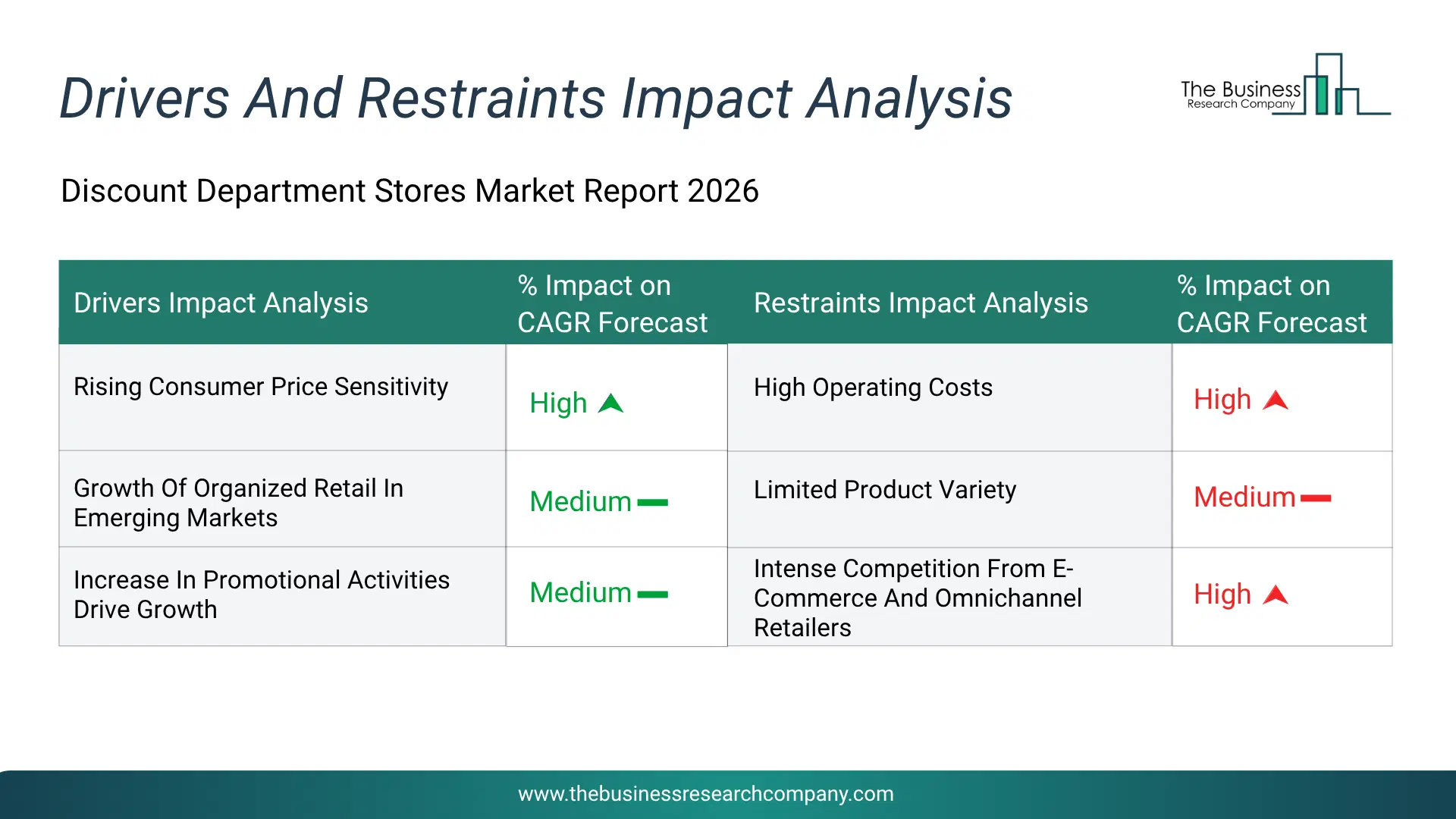
Infographic Chart Showing Key Market Drivers Analysis And Restraints For Discount Department Stores Market
The chart presents an impact analysis of key drivers and restraints, quantifying their relative influence on the market's growth rate and helping assess the balance between growth enablers and limiting factors. This chart offers a high-level perspective; the full report contains more detailed insights.
How Will The Drivers Impact Growth In The Global Discount Department Stores Market?
• Rising Consumer Price Sensitivity (High) – During the forecast period, the rising consumer price sensitivity is expected to become a key growth driver for the discount department stores market by 2030. Increasing inflationary pressures, economic uncertainties, and changing household spending patterns are encouraging consumers to prioritize affordable shopping options. Discount department stores provide access to a broad range of products including groceries, apparel, household goods, and personal care items at competitive prices, attracting value-focused customers. Retailers are strengthening pricing strategies and product assortments to maintain affordability while improving customer retention. This shift toward cost-conscious purchasing behavior is supporting steady market expansion. • Growth Of Organized Retail In Emerging Markets (Medium) – During the forecast period, the growth of organized retail in emerging markets is expected to emerge as a major factor driving the expansion of the discount department stores market by 2030. Rapid urban development, improving retail infrastructure, and increasing adoption of modern shopping formats are creating new opportunities for discount retailers. Organized retail chains enable better inventory management, efficient supply networks, and wider product availability, allowing companies to serve a larger consumer base. Growing preference for structured shopping environments and diverse product selections is further encouraging store expansion across developing regions. • Increase In Promotional Activities Drive Growth (Medium) – During the forecast period, the increase in promotional activities is expected to act as a key growth catalyst for the discount department stores market by 2030. Retailers are increasingly adopting seasonal campaigns, loyalty programs, bundled deals, cashback offers, and targeted discounts to improve customer engagement and purchasing frequency. These promotional strategies help attract price-conscious shoppers while strengthening brand recognition in a highly competitive retail environment. Enhanced marketing initiatives and customer-focused offers support higher store traffic and increased sales opportunities.How Will The Restraints Impact Growth In The Global Discount Department Stores Market?
• High Operating Costs (High) – During the forecast period, high operating costs act as a significant restraint on the discount department stores market because maintaining large retail spaces, managing extensive inventories, and employing a sizable workforce require substantial financial investment. Rising expenses related to rent, utilities, transportation, and labor can reduce profit margins for discount retailers that already operate on low-price business models. Increases in fuel and logistics costs further impact supply chain efficiency and overall operational expenses. To remain competitive, stores may find it difficult to pass these additional costs on to customers through higher prices. This can limit profitability and restrict expansion plans. Continuous cost pressures may also reduce investments in store upgrades and customer experience improvements. As a result, high operating costs can hinder the growth and sustainability of the market. • Limited Product Variety (Medium) – During the forecast period, limited product variety restrains the discount department dtores market by reducing its appeal to consumers seeking a broader selection of products and brands. Many discount retailers focus on fast-moving and high-demand items to maintain low prices and efficient inventory management. However, this approach can limit the availability of specialized, premium, or niche products that some customers prefer. Consumers may choose supermarkets, hypermarkets, or online platforms that offer a wider range of choices under one roof. Restricted product assortments can also reduce customer satisfaction and shopping frequency. The inability to cater to diverse consumer preferences may weaken competitive positioning in the retail sector. Consequently, limited product variety can slow customer acquisition and constrain overall market growth. • Intense Competition From E-Commerce And Omnichannel Retailers (Medium) – During the forecast period, intense competition from e-commerce and omnichannel retailers acts as a significant restraint on the discount department stores market because consumers are increasingly shifting toward online shopping platforms that offer greater convenience, wider product assortments, competitive pricing, and home delivery services. Digital retailers leverage advanced technologies such as personalized recommendations, dynamic pricing, and seamless mobile shopping experiences to attract and retain customers. Omnichannel retailers also integrate physical stores with online platforms, enabling services such as click-and-collect and same-day delivery, which enhance customer convenience. These evolving retail strategies intensify competition for traditional discount department stores, leading to reduced foot traffic and lower in-store sales. To remain competitive, retailers must invest heavily in digital transformation and omnichannel capabilities, increasing operational complexity and costs. Consequently, growing competition from e-commerce and omnichannel retailers can limit revenue growth and restrain the expansion of the discount department stores market.Key Players In The Global Discount Department Stores Market
Major companies operating in the discount department stores market are Walmart Inc, Costco Wholesale Corporation, Target Corporation, Dollar General Corporation, Dollar Tree Inc, Meijer Inc, Ross Stores Inc, Burlington Stores Inc, TJX Companies Inc, Big Lots Inc, Five Below Inc, Ollies Bargain Outlet Holdings Inc, Bealls Inc, Bi Mart Corporation, Kmart Corporation, Stein Mart Inc, Stage Stores Inc, Carrefour SA, Tesco PLC, Auchan Retail International, El Corte Ingles SA, Cencosud SA, Falabella SA, AEON Co Ltd, Pepco Group, B and M European Value Retail SA, Action BV, Miniso Group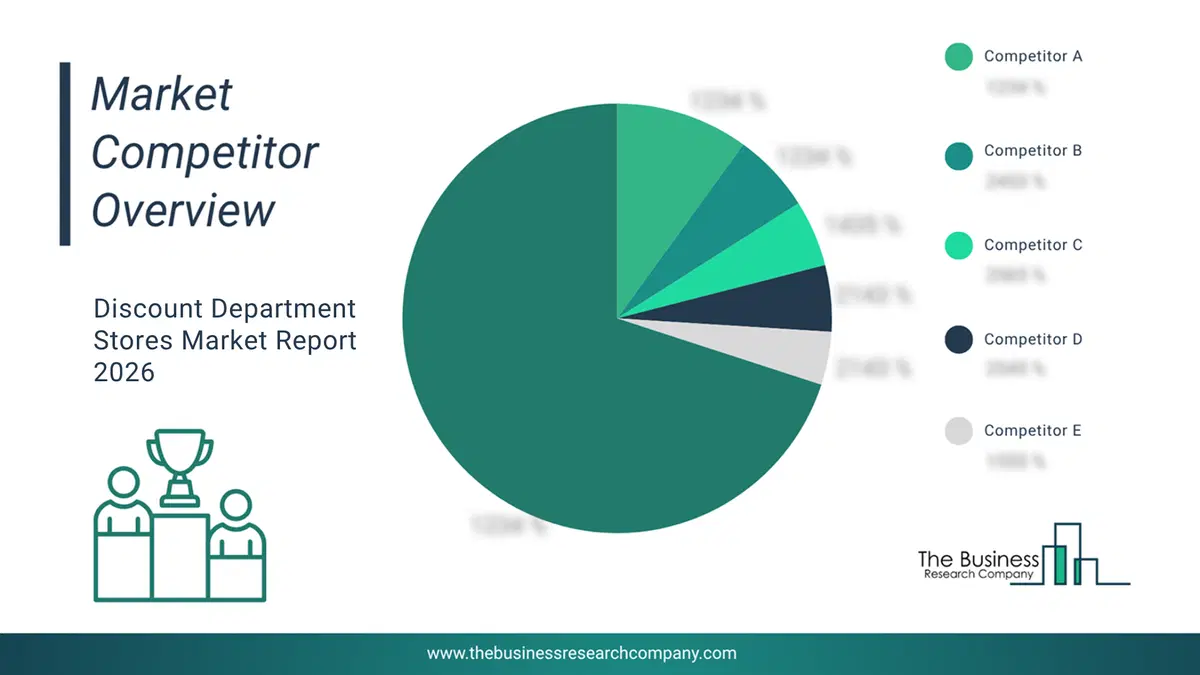
This chart is for illustrative purposes; the full report includes a detailed competitor analysis and comprehensive overview of the top 10 companies in the market.
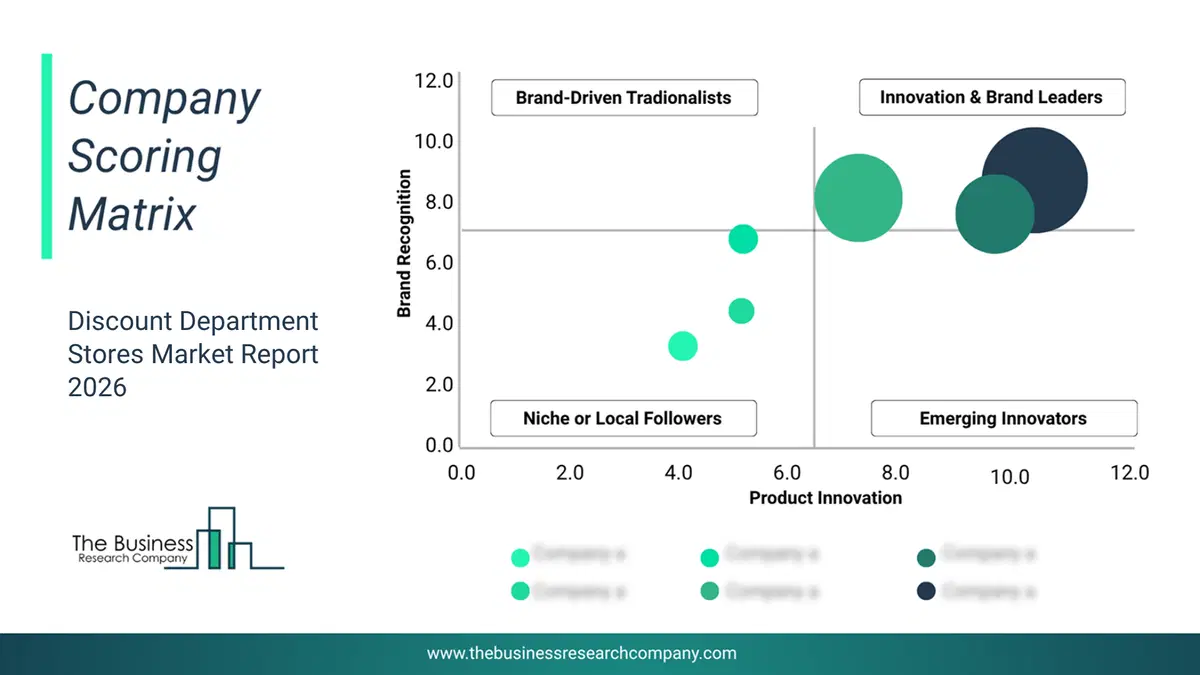
This chart maps companies by product innovation and brand strength, with bubble size indicating relative revenue, helping identify market leaders, challengers, and niche players. This is an illustrative chart; the full report provides a complete and accurate competitive analysis.
Global Discount Department Stores Market Trends and Insights
Major companies operating in the discount department store market are focusing on launching new store formats and increasing their physical presence to attract a broader customer base and strengthen competitive positioning. Fashion-oriented department stores refer to large retail establishments offering a wide range of apparel, footwear, and accessories from multiple brands to cater to diverse consumer preferences. For instance, in August 2023, Reliance Retail, an India-based private-sector retail conglomerate, launched Yousta, a youth-focused fashion retail store format, opening its first outlet in Hyderabad’s Sarath City Mall. The store is designed to engage younger, price-sensitive shoppers by offering contemporary fashion apparel and accessories priced largely under ₹999, coupled with tech-enabled layouts to enhance the shopping experience. This initiative complements Reliance’s broader department and discount store network and demonstrates how discount retailers are introducing innovative store concepts to expand reach, attract new customer segments, and enhance market competitiveness.What Are Latest Mergers And Acquisitions In The Discount Department Stores Market?
In July 2024, Saks Incorporated, a US-based department store acquired Neiman Marcus Group Inc. for $2.65 billion. This acquisition increase service offerings in the luxury retail sector, embrace technology innovation, achieve operational efficiencies, and consolidate market strength. Neiman Marcus Group Inc. is a US-based upscale department store chain that offer a wide range of products, including designer apparel, accessories, cosmetics, and home goods.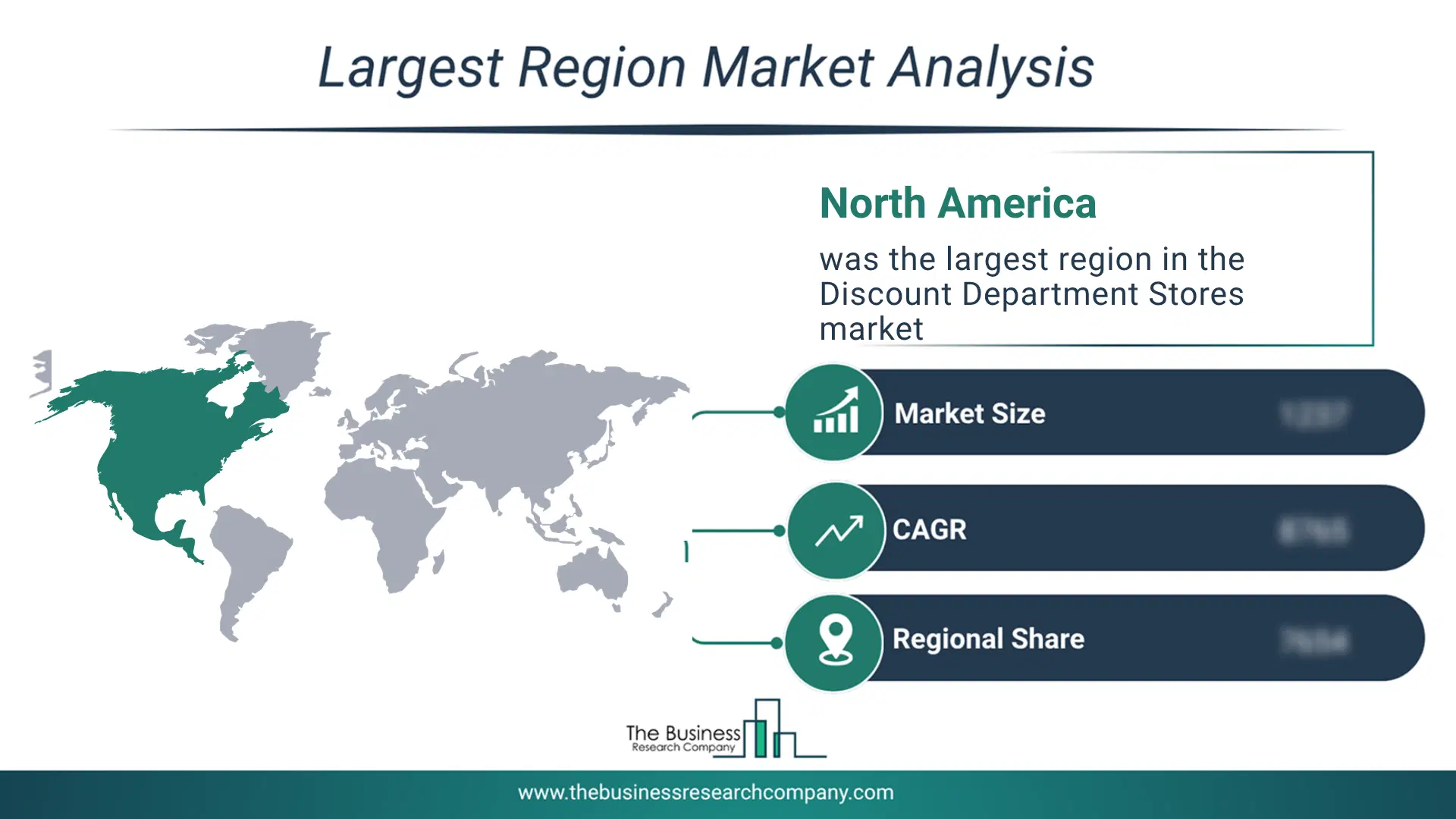
Regional Outlook
North America was the largest region in the discount department stores market in 2025. Asia-Pacific is expected to be the fastest-growing region in the forecast period. The regions covered in this market report are Asia-Pacific, South East Asia, Western Europe, Eastern Europe, North America, South America, Middle East and Africa. The countries covered in this market report are Australia; Brazil; China; France; Germany; India; Indonesia; Japan; Taiwan; Russia; South Korea; UK; USA; Canada; Italy; Spain.What Defines the Discount Department Stores Market?
The discount department stores market includes revenues earned by entities by providing services such as retail sales, extended warranties and services, product returns and exchanges, delivery services, personal shopping services, promotional sales events, and financing options for larger purchases. The market value includes the value of related goods sold by the service provider or included within the service offering. Only goods and services traded between entities or sold to end consumers are included.How is Market Value Defined and Measured?
The market value is defined as the revenues that enterprises gain from the sale of goods and/or services within the specified market and geography through sales, grants, or donations in terms of the currency (in USD unless otherwise specified). The revenues for a specified geography are consumption values that are revenues generated by organizations in the specified geography within the market, irrespective of where they are produced. It does not include revenues from resales along the supply chain, either further along the supply chain or as part of other products.
This chart presents market attractiveness based on a quantitative evaluation of growth, competition, strategic alignment, and risk, offering a clear view of opportunity areas for decision-making. This chart is for illustrative purposes; the full report contains the complete analysis.

This chart highlights the Total Addressable Market (TAM) by estimating the maximum revenue opportunity using an assumption-driven approach, supporting strategic planning and opportunity sizing across markets. The chart is illustrative; the full report provides a more comprehensive analysis.
What Key Data and Analysis Are Included in the Discount Department Stores Market Report 2026?
The discount department stores market research report is one of a series of new reports from The Business Research Company that provides market statistics, including industry global market size, regional shares, competitors with the market share, detailed market segments, market trends and opportunities, and any further data you may need to thrive in the discount department stores industry. The market research report delivers a complete perspective of everything you need, with an in-depth analysis of the current and future state of the industry.Discount Department Stores Market Report Forecast Analysis
| Report Attribute | Details |
|---|---|
| Market Size Value In 2026 | $30.32 billion |
| Revenue Forecast In 2030 | $35.75 billion |
| Growth Rate | CAGR of 4.6% from 2026 to 2030 |
| Base Year For Estimation | 2025 |
| Actual Estimates/Historical Data | 2020-2025 |
| Forecast Period | 2026 - 2030 |
| Market Representation | Revenue in USD Billion and CAGR from 2026 to 2030 |
| Segments Covered | Store Type, Products, Distribution |
| Regional Scope | Asia-Pacific, Western Europe, Eastern Europe, North America, South America, Middle East, Africa |
| Country Scope | The countries covered in the report are Australia, Brazil, China, France, Germany, India, ... |
| Key Companies Profiled | Walmart Inc, Costco Wholesale Corporation, Target Corporation, Dollar General Corporation, Dollar Tree Inc, Meijer Inc, Ross Stores Inc, Burlington Stores Inc, TJX Companies Inc, Big Lots Inc, Five Below Inc, Ollies Bargain Outlet Holdings Inc, Bealls Inc, Bi Mart Corporation, Kmart Corporation, Stein Mart Inc, Stage Stores Inc, Carrefour SA, Tesco PLC, Auchan Retail International, El Corte Ingles SA, Cencosud SA, Falabella SA, AEON Co Ltd, Pepco Group, B and M European Value Retail SA, Action BV, Miniso Group |
| Customization Scope | Request for Customization |
| Pricing And Purchase Options | Explore Purchase Options |