
Duty-Free Retailing Market Report 2026
Global Outlook – By Product Type (Perfume And Cosmetics, Electronics, Wine And Spirits, Food, Confectionery And Catering, Tobacco, Luxury Goods, Other Types), By Ownership (Corporate Chains, Independent Owners, Franchises), By Sales Channel (Airports, Cruise Liners, Railway Stations, Border, Down-Town And Hotel Shop) – Market Size, Trends, Strategies, and Forecast to 2030
Duty-Free Retailing Market Overview
• Duty-Free Retailing market size has reached to $43.67 billion in 2025 • Expected to grow to $65.78 billion in 2030 at a compound annual growth rate (CAGR) of 8.5% • Growth Driver: Surge In International Travel Drives Growth In Duty-Free Retailing Market • Market Trend: Strategic Partnerships In The Duty-Free Retail Market • Asia-Pacific was the largest region in 2025 and North America is the fastest growing region.Market Gains By 2030 – Top Opportunities By Segment
Market Gain identifies the most promising market opportunities by highlighting the segments or products expected to generate the highest incremental revenue growth over the next five years.
What Is Covered Under Duty-Free Retailing Market?
Duty-free retailing refers to the sale of goods to international travelers at locations such as airports, cruise terminals, and border crossings, where products are exempt from local taxes and duties. This allows travelers to purchase items such as electronics, and luxury goods at reduced prices compared to regular retail outlets, enhancing their shopping experience with savings and a diverse range of international brands. The main types of products in duty-free retailing are perfume and cosmetics, electronics, wine and spirits, food, confectionery and catering, tobacco, luxury goods, and other types. Perfume and cosmetics refer to products such as fragrances, skincare items, makeup, and beauty accessories sold without taxes at international travel hubs. The ownership is from corporate chains, independent owners, and franchises. The various sales channels include airports, cruise lines, railway stations, borders, downtown, and hotel shops.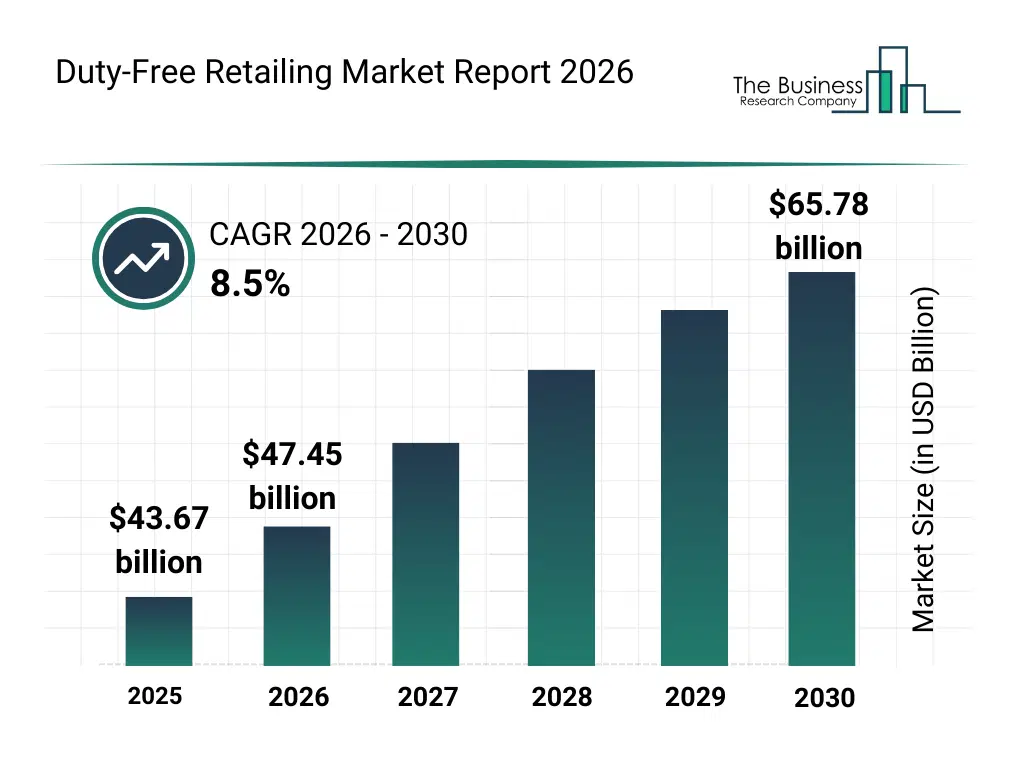
What Is The Duty-Free Retailing Market Size and Share 2026?
The duty-free retailing market size has grown strongly in recent years. It will grow from $43.67 billion in 2025 to $47.45 billion in 2026 at a compound annual growth rate (CAGR) of 8.7%. The growth in the historic period can be attributed to rising international travel, expansion of airport infrastructure, growth of global tourism, increasing luxury product consumption, emergence of branded duty-free stores.What Is The Duty-Free Retailing Market Growth Forecast?
The duty-free retailing market size is expected to see strong growth in the next few years. It will grow to $65.78 billion in 2030 at a compound annual growth rate (CAGR) of 8.5%. The growth in the forecast period can be attributed to adoption of digital payment and e-commerce platforms, integration of AI-powered customer analytics, rise of experiential retail, growth of cruise and border retail traffic, increased focus on sustainability and eco-friendly products. Major trends in the forecast period include increasing traveler demand for tax-free luxury products, expansion of airport retail spaces, growing popularity of personalized shopping experiences, rising integration of mobile payment solutions, diversification of product offerings across regions.
Global Duty-Free Retailing Market Segmentation
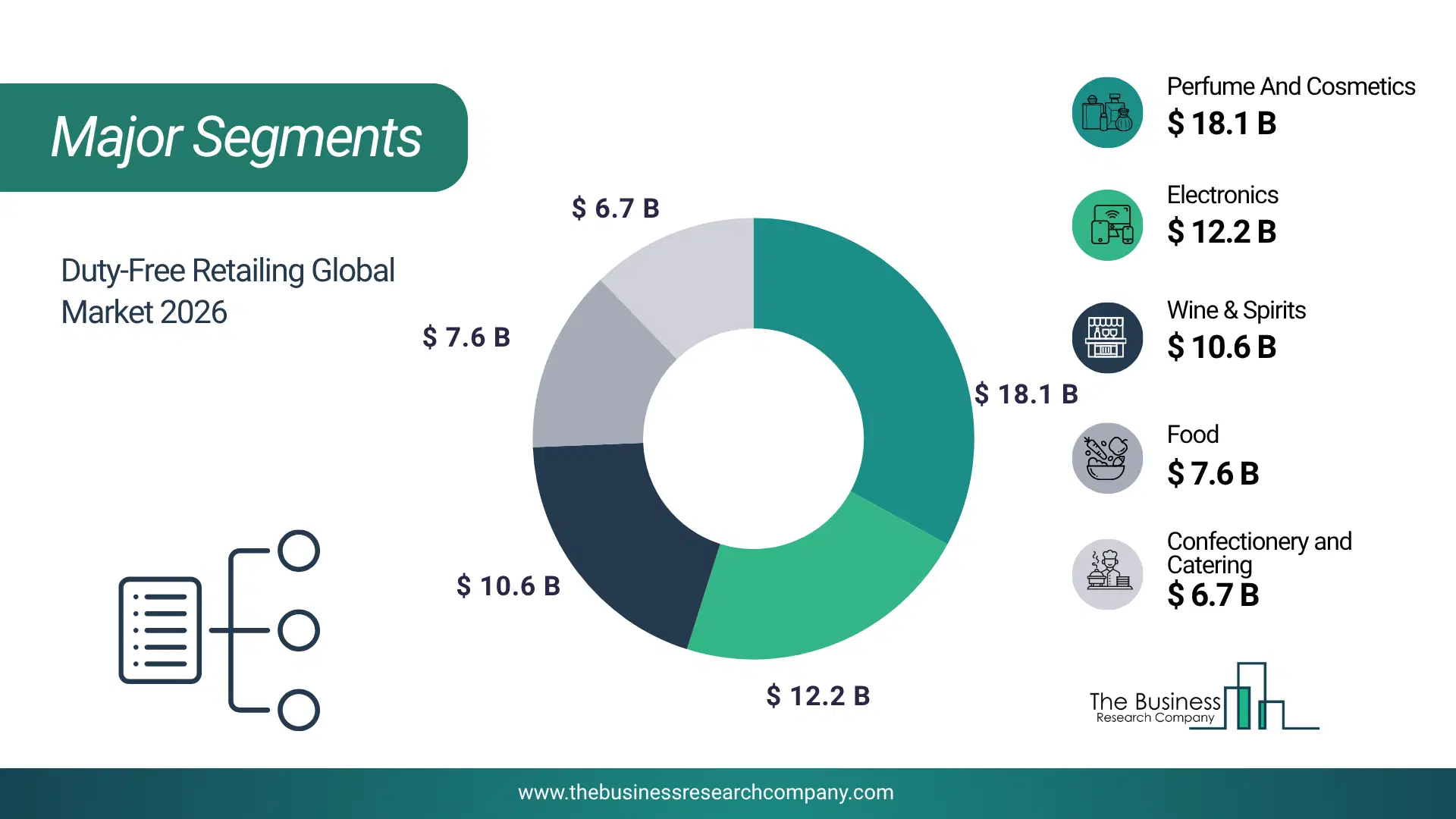
1) By Product Type: Perfume And Cosmetics, Electronics, Wine And Spirits, Food, Confectionery And Catering, Tobacco, Luxury Goods, Other Types 2) By Ownership: Corporate Chains, Independent Owners, Franchises 3) By Sales Channel: Airports, Cruise Liners, Railway Stations, Border, Down-Town And Hotel Shop Subsegments: 1) By Perfume And Cosmetics: Fragrances (Men's, Women's, Unisex), Skin Care Products, Hair Care Products, Makeup And Beauty Products, Bath And Body Products, Personal Care (Shaving, Deodorants) 2) By Electronics: Mobile Phones And Accessories, Laptops And Tablets, Headphones And Earphones, Cameras And Photography Equipment, Wearables (Smartwatches, Fitness Trackers), Travel Adapters And Chargers 3) By Wine And Spirits: Whiskey, Vodka, Gin, Rum, Wine (Red, White, Sparkling), Champagne, Liqueurs, Beer 4) By Food: Gourmet Snacks, Specialty Cheeses, Dried Fruits And Nuts, Sauces And Spices, Canned And Jarred Goods, International Delicacies 5) By Confectionery And Catering: Chocolate And Sweets, Candy, Biscuits And Cookies, Pastries And Cakes, Ice Cream And Frozen Desserts, Gift Hampers 6) By Tobacco: Cigarettes, Cigars, Smokeless Tobacco (Snuff, Chewing Tobacco), Electronic Cigarettes (E-Cigarettes), Tobacco Accessories (Lighters, Ashtrays) 7) By Luxury Goods: Designer Bags And Handbags, Luxury Watches, Fine Jewelry, Sunglasses, High-End Fashion Apparel, Luxury Footwear 8) By Other Types: Travel Accessories (Luggage, Travel Bags), Health And Wellness Products, Sports Equipment And Apparel, Home Décor And Gifts, Art And Collectibles The top segments in the duty-free retailing market will be: • Perfume And Cosmetics will reach $18.06 billion by 2030. • Electronics will reach $12.17 billion by 2030. • Wine & Spirits will reach $10.55 billion by 2030. • Food will reach $7.62 billion by 2030. • Confectionery and Catering will reach $6.67 billion by 2030.What Is The Driver Of The Duty-Free Retailing Market?
The surge in the international travel and tourism industry is expected to propel the growth of the duty-free retailing market going forward. The international travel and tourism industry is growing due to increased global connectivity, rising disposable incomes, and a growing desire for unique travel experiences. Duty-free retailing leverages international travel and tourism by offering tax-free goods at airports and border locations, attracting travelers seeking lower prices. For instance, in February 2024, according to the International Trade Administration, a US-based government resource, the overall number of international visitors to the United States is expected to rise to 77.7 million in 2024, an increase of 10.4 million, or 15.4%, from the 67.3 million visitors recorded in 2023. Therefore, the surge in the international travel and tourism industry is driving the growth of the duty-free retailing industry.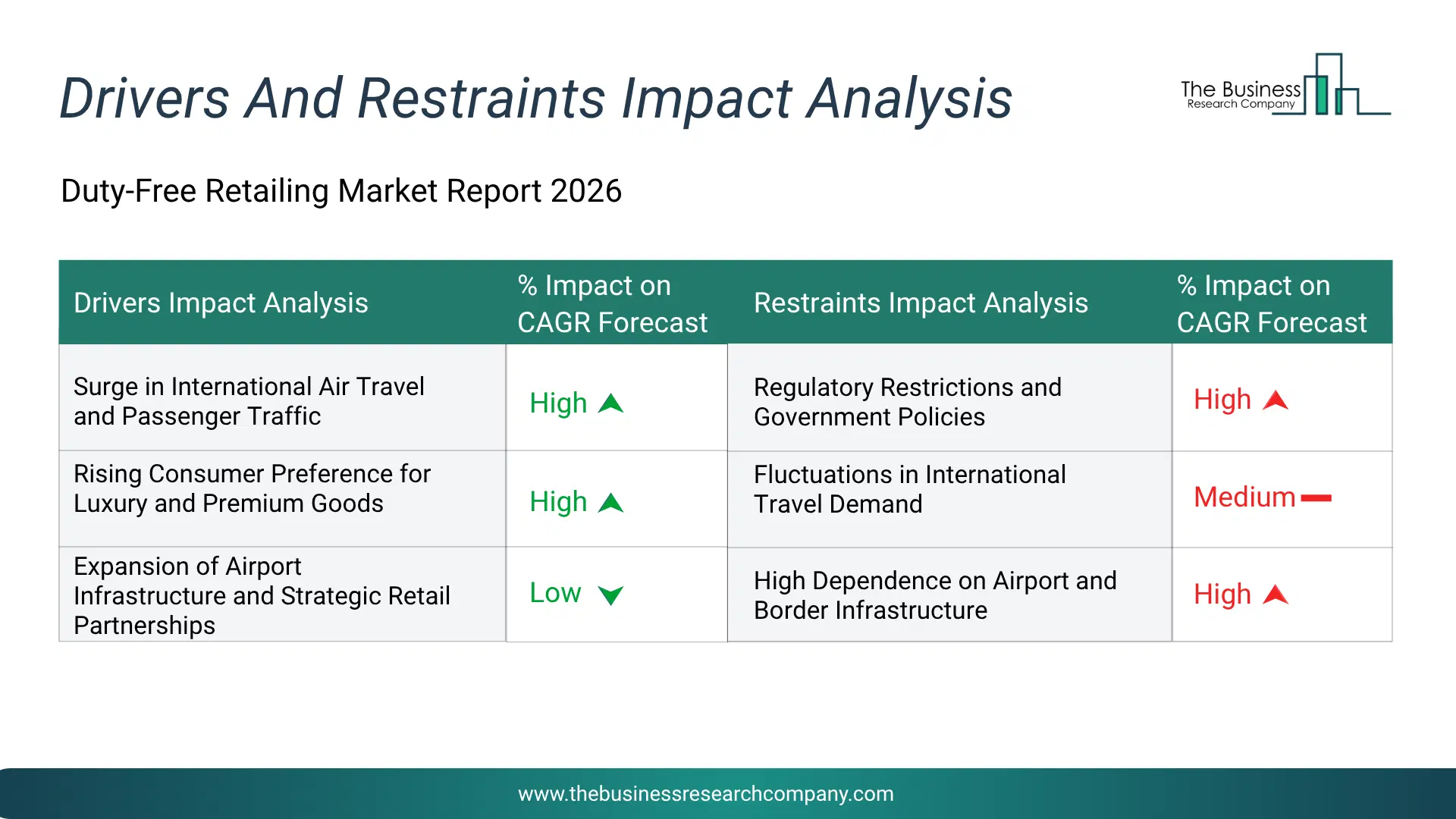
Infographic Chart Showing Key Market Drivers Analysis And Restraints For Duty-Free Retailing Market
The chart presents an impact analysis of key drivers and restraints, quantifying their relative influence on the market's growth rate and helping assess the balance between growth enablers and limiting factors. This chart offers a high-level perspective; the full report contains more detailed insights.
How Will The Drivers Impact Growth In The Global Duty-Free Retailing Market?
• Surge in International Air Travel and Passenger Traffic (High) – During the forecast period, the surge in international air travel and passenger traffic is expected to become a key growth driver for the duty -free retailing market by 2030. The rapid recovery and growth of global air travel and international passenger traffic is the primary driver of the duty -free retailing market. Airports and airlines are witnessing higher footfall, particularly in asia -pacific, europe, and the middle east, creating increased demand for luxury goods, cosmetics, alcohol, and confectionery products sold in duty -free outlets. Expansion of flight connectivity, tourism growth, and resumption of cross -border travel are further boosting sales opportunities, making passenger traffic the core growth engine of the market. • Rising Consumer Preference for Luxury and Premium Goods (High) – During the forecast period, the rising consumer preference for luxury and premium goods is expected to emerge as a major factor driving the expansion of the duty-free retailing market by 2030. Duty-free retailers are benefiting from a rising trend of luxury and premium product consumption among international travelers. Affluent passengers, brand-conscious millennials, and frequent flyers are increasingly purchasing high-end fashion, cosmetics, perfumes, and electronics at tax-free prices. Retailers are leveraging personalized promotions, experiential shopping, and digital catalogs to enhance customer engagement, making premium product demand a strong structural driver of market expansion. • Expansion of Airport Infrastructure and Strategic Retail Partnerships (Low) – During the forecast period, the expansion of airport infrastructure and strategic retail partnerships is expected to act as a key growth catalyst for the duty-free retailing market by 2030. The continuous development of airport terminals, lounges, and transit hubs is generating additional retail opportunities for duty-free operators. Strategic partnerships between retailers, airlines, and airport authorities allow better product placement, targeted promotions, and operational efficiency. The growth of multi-brand stores and integration of digital pre-ordering and pick-up services are further facilitating sales, positioning infrastructure expansion and collaboration as a key supporting growth driver.How Will The Restraints Impact Growth In The Global Duty-Free Retailing Market?
• Regulatory Restrictions and Government Policies (High) – During the forecast period, the regulatory restrictions and government policies act as a restraint for the duty-free retailing market because taxation structures, customs regulations, and airport retail policies vary significantly across different countries and regions. These inconsistencies create operational complexity for global retailers and limit expansion opportunities. Additionally, changes in duty-free allowances or import-export regulations can directly impact sales volumes and profitability, making long-term planning more difficult. • Fluctuations in International Travel Demand (Medium) – During the forecast period, the fluctuations in international travel demand act as a restraint because duty-free retailing is heavily dependent on passenger traffic in airports, seaports, and border crossings. Economic downturns, geopolitical tensions, pandemics, or changes in visa policies can sharply reduce travel volumes. This directly affects customer footfall and revenue generation, making the business highly vulnerable to external macroeconomic conditions. • High Dependence on Airport and Border Infrastructure (High) – During the forecast period, the high dependence on airport and border infrastructure acts as a restraint since duty-free retail operations are concentrated in specific travel hubs with limited retail space and high rental costs. Airports often control store locations and lease terms, reducing flexibility for retailers. Additionally, congestion and passenger flow limitations can restrict sales opportunities, impacting overall profitability and scalability.Key Players In The Global Duty-Free Retailing Market
Major companies operating in the duty-free retailing market are Qatar Airways, Lotte Corp., Lagardere SA, Avolta AG, SHINSEGAE INTERNATIONAL, China International Travel Service Co. LTD., Hyundai Department Store Group Co. Ltd., Gebr. Heinemann SE and Co. KG, Dubai Duty-Free, James Richardson Group, Duty-Free Americas Inc., DFS Group Ltd., Japan Airport Terminal Co. Ltd., Changi Airport Group Singapore Pte. Ltd., Duty Free Philippines Corp., 3Sixty Duty Free, Ever Rich Duty Free Shop, Flemingo International, King Power Group, Delhi Duty-Free Services Pvt. Ltd., Mumbai Duty-Free, The Shilla Duty free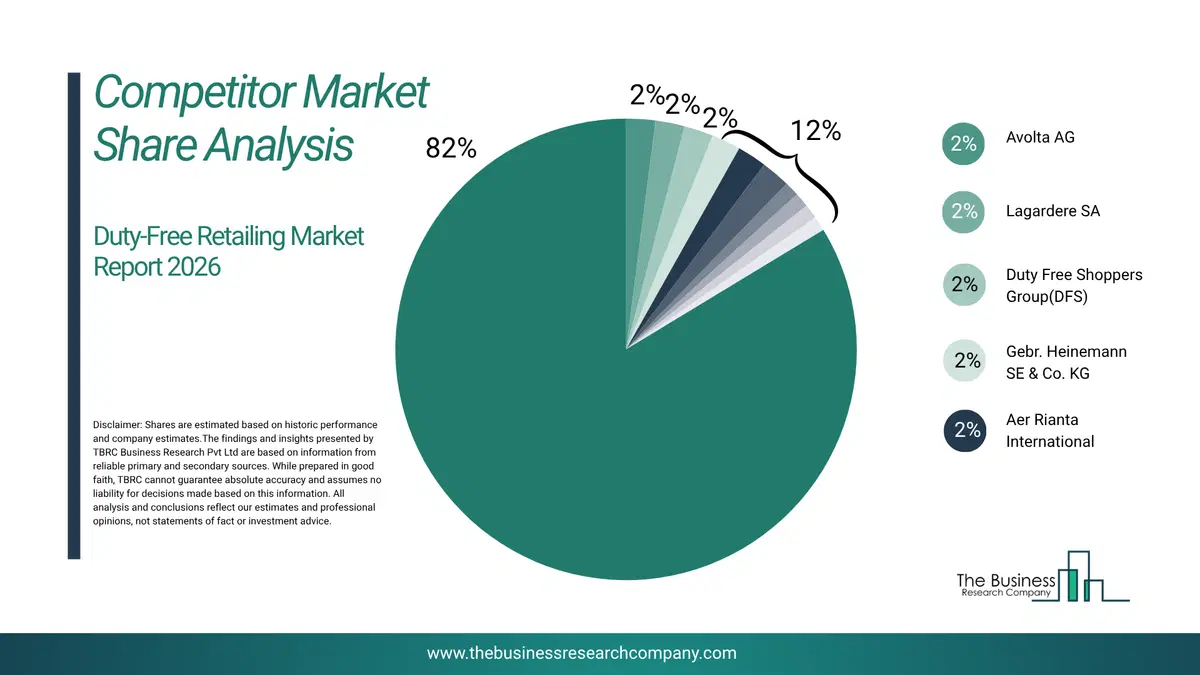
This chart is for illustrative purposes; the full report includes a detailed competitor analysis and comprehensive overview of the top 10 companies in the market.
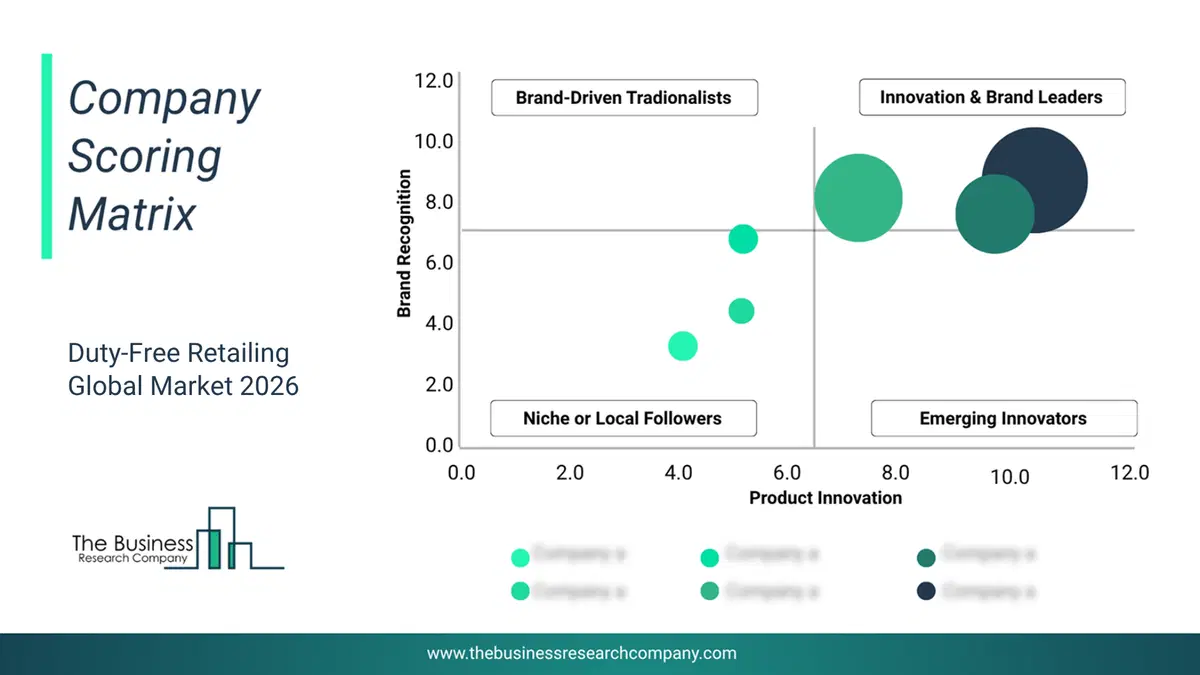
This chart maps companies by product innovation and brand strength, with bubble size indicating relative revenue, helping identify market leaders, challengers, and niche players. This is an illustrative chart; the full report provides a complete and accurate competitive analysis.
Global Duty-Free Retailing Market Trends and Insights
Major companies operating in the duty-free retailing market are adopting strategic partnership approaches to expand their reach and enhance customer experience. Strategic partnerships refer to a process in which companies leverage each other's strengths and resources to achieve mutual benefits and success. For instance, in May 2023, L’Occitane Group, a Switzerland-based manufacturer and retailer of beauty and wellness products, partnered with Dufry, a Switzerland-based travel retailer that operates duty-free and duty-paid shops and convenience stores to launch Sol de Janeiro. This recent travel retail initiative has leveraged both online and offline channels to increase the brand's visibility and connect with customers while promoting exclusive products to drive both sales and brand equity. The new 360° promotional strategy has also provided expanded touchpoints through the Red by Dufry VIP program, as well as in-store experiences.What Are Latest Mergers And Acquisitions In The Duty-Free Retailing Market?
In March 2024, Ospree International FZCO, a UAE-based duty-free retail company, acquired a 100% stake in Le Marche Duty-Free SAS (LMDF) for €5000 ($5,532). This strategic acquisition aims to bolster the company's presence and growth within the duty-free industry. Le Marche Duty-Free SAS (LMDF) is a France-based company that operates duty-free businesses.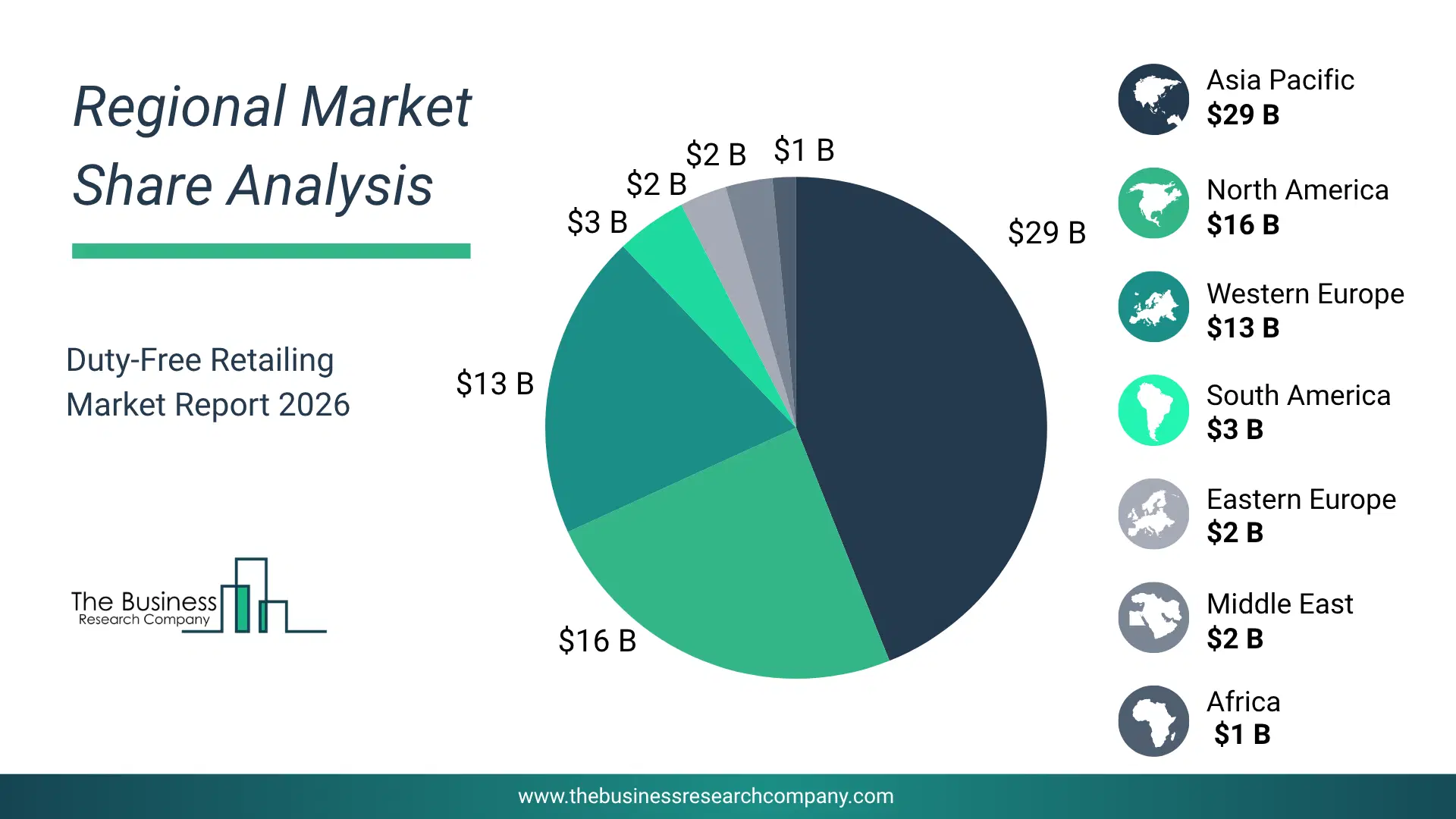
Regional Outlook
Asia-Pacific was the largest region in the duty-free retailing market in 2025. North America is expected to be the fastest-growing region in the forecast period. The regions covered in this market report are Asia-Pacific, South East Asia, Western Europe, Eastern Europe, North America, South America, Middle East and Africa. The countries covered in this market report are Australia; Brazil; China; France; Germany; India; Indonesia; Japan; Taiwan; Russia; South Korea; UK; USA; Canada; Italy; Spain.What Defines the Duty-Free Retailing Market?
The duty-free retailing market consists of revenues earned by entities by providing services such as tax-free shopping experiences, travel retail consultancy, and customer support at international airports and border crossings. The market value includes the value of related goods sold by the service provider or included within the service offering. The duty-free retailing market also includes sales of fashion apparel, watches, jewelry, and health and wellness products. Values in this market are ‘factory gate’ values, that is the value of goods sold by the manufacturers or creators of the goods, whether to other entities (including downstream manufacturers, wholesalers, distributors, and retailers) or directly to end customers. The value of goods in this market includes related services sold by the creators of the goods.How is Market Value Defined and Measured?
The market value is defined as the revenues that enterprises gain from the sale of goods and/or services within the specified market and geography through sales, grants, or donations in terms of the currency (in USD unless otherwise specified). The revenues for a specified geography are consumption values that are revenues generated by organizations in the specified geography within the market, irrespective of where they are produced. It does not include revenues from resales along the supply chain, either further along the supply chain or as part of other products.
This chart presents market attractiveness based on a quantitative evaluation of growth, competition, strategic alignment, and risk, offering a clear view of opportunity areas for decision-making. This chart is for illustrative purposes; the full report contains the complete analysis.

This chart highlights the Total Addressable Market (TAM) by estimating the maximum revenue opportunity using an assumption-driven approach, supporting strategic planning and opportunity sizing across markets. The chart is illustrative; the full report provides a more comprehensive analysis.
What Key Data and Analysis Are Included in the Duty-Free Retailing Market Report 2026?
The duty-free retailing market research report is one of a series of new reports from The Business Research Company that provides market statistics, including industry global market size, regional shares, competitors with the market share, detailed market segments, market trends and opportunities, and any further data you may need to thrive in the duty-free retailing industry. The market research report delivers a complete perspective of everything you need, with an in-depth analysis of the current and future state of the industry.Duty-Free Retailing Market Report Forecast Analysis
| Report Attribute | Details |
|---|---|
| Market Size Value In 2026 | $16.01 billion |
| Revenue Forecast In 2030 | $23.3 billion |
| Growth Rate | CAGR of 8.5% from 2026 to 2030 |
| Base Year For Estimation | 2025 |
| Actual Estimates/Historical Data | 2020-2025 |
| Forecast Period | 2026 - 2030 |
| Market Representation | Revenue in USD Billion and CAGR from 2026 to 2030 |
| Segments Covered | Product Type, Ownership, Sales Channel |
| Regional Scope | Asia-Pacific, Western Europe, Eastern Europe, North America, South America, Middle East, Africa |
| Country Scope | The countries covered in the report are Australia, Brazil, China, France, Germany, India, Indonesia, Japan, Taiwan, Russia, South Korea, UK, USA, Canada, Italy, Spain. |
| Key Companies Profiled | Qatar Airways, Lotte Corp., Lagardere SA, Avolta AG, SHINSEGAE INTERNATIONAL, China International Travel Service Co. LTD., Hyundai Department Store Group Co. Ltd., Gebr. Heinemann SE and Co. KG, Dubai Duty-Free, James Richardson Group, Duty-Free Americas Inc., DFS Group Ltd., Japan Airport Terminal Co. Ltd., Changi Airport Group Singapore Pte. Ltd., Duty Free Philippines Corp., 3Sixty Duty Free, Ever Rich Duty Free Shop, Flemingo International, King Power Group, Delhi Duty-Free Services Pvt. Ltd., Mumbai Duty-Free, The Shilla Duty free |
| Customization Scope | Request for Customization |
| Pricing And Purchase Options | Explore Purchase Options |