
Enterprise Imaging Information Technology (IT) Market Report 2026
Global Outlook – By Component (Hardware, Services, Software), By Modality (X-Ray, Magnetic Resonance Imaging (MRI), Computed Tomography (CT), Ultrasound, Nuclear Imaging, Endoscopy, Mammography, Fluoroscopy, Echocardiography, Other Modalities), By Deployment Mode (On-Premises, Cloud-Based, Hybrid), By Application (Diagnostics, Therapeutics, Clinical Research), By End-User (Hospitals, Diagnostic Centers, Clinics And Outpatient Setting, Pharmaceutical And Biotechnology Companies, Medtech Companies, Research And Academia, Other End-Users) – Market Size, Trends, Strategies, and Forecast to 2030
Enterprise Imaging Information Technology (IT) Market Overview
• Enterprise Imaging Information Technology (IT) market size has reached to $2.39 billion in 2025 • Expected to grow to $4.39 billion in 2030 at a compound annual growth rate (CAGR) of 12.9% • Growth Driver: Surge In medical imaging Procedures Fueling The Growth Of The Market Due To Rising Demand For Accurate Diagnosis And Chronic Disease Management • Market Trend: Innovative Cloud-Based Enterprise Imaging Solutions Driving Efficiency And Collaboration In Healthcare • North America was the largest region in 2025 and Asia-Pacific is the fastest growing region.What Is Covered Under Enterprise Imaging Information Technology (IT) Market?
Enterprise imaging information technology (IT) is a comprehensive collection of tools and techniques that enable healthcare organizations to centrally manage, store, and exchange a wide range of medical images across many departments and specialties. It allows the integration of imaging data into electronic health records (EHRs), enhancing clinician collaboration, informed decision-making, and patient care continuity and quality. The main types of components in enterprise imaging information technology (IT) are hardware, services, and software. Hardware refers to the physical devices and infrastructure that support the storage, management, and access of medical imaging data across an organization. It includes various modalities, such as X-ray, magnetic resonance imaging (MRI), computed tomography (CT), ultrasound, nuclear imaging, endoscopy, mammography, fluoroscopy, echocardiography, and others, and they are deployed through multiple deployment modes, including on-premises, cloud-based, and hybrid. It is applied in several applications, such as diagnostics, therapeutics, and clinical research, and used by a wide range of end users, including hospitals, diagnostic centers, clinics, and outpatient settings, pharmaceutical and biotechnology companies, medtech companies, research and academia, and others.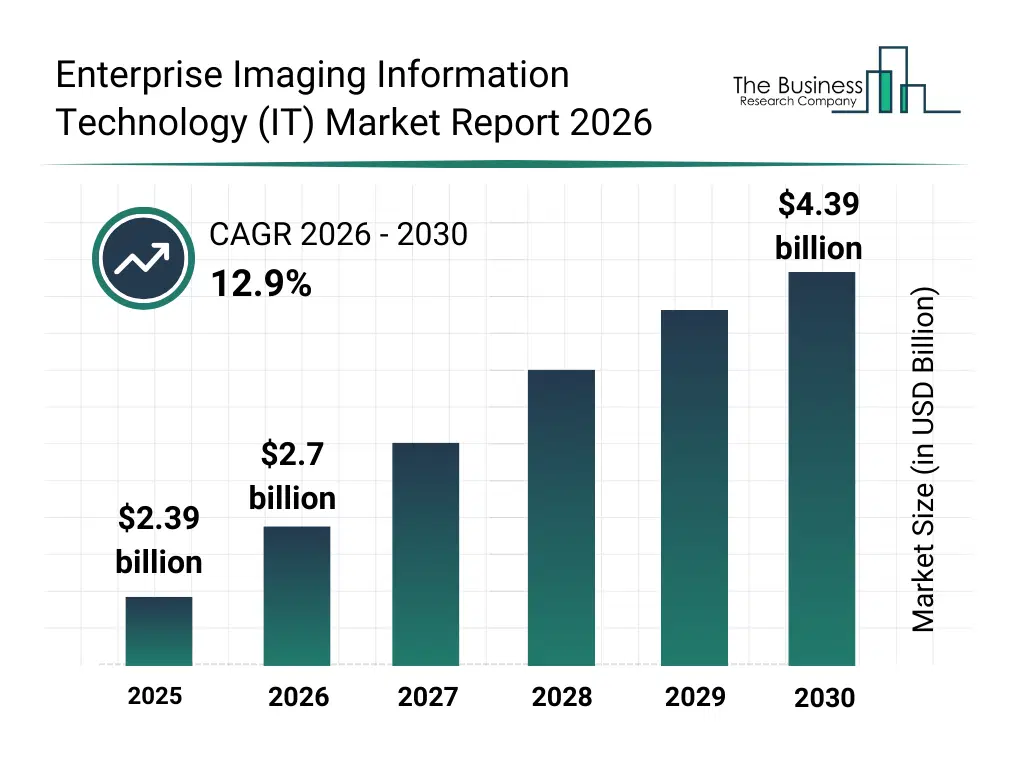
What Is The Enterprise Imaging Information Technology (IT) Market Size and Share 2026?
The enterprise imaging information technology (it) market size has grown rapidly in recent years. It will grow from $2.39 billion in 2025 to $2.7 billion in 2026 at a compound annual growth rate (CAGR) of 13.0%. The growth in the historic period can be attributed to growth in digital healthcare adoption, expansion of hospital imaging infrastructure, rising medical imaging volumes, adoption of electronic health records integration, increasing demand for diagnostic accuracy.What Is The Enterprise Imaging Information Technology (IT) Market Growth Forecast?
The enterprise imaging information technology (it) market size is expected to see rapid growth in the next few years. It will grow to $4.39 billion in 2030 at a compound annual growth rate (CAGR) of 12.9%. The growth in the forecast period can be attributed to expansion of telemedicine services, rising adoption of AI imaging tools, growth in cloud healthcare IT platforms, increasing healthcare digitization investments, demand for real time clinical collaboration. Major trends in the forecast period include cloud based medical image storage, AI driven imaging analytics, interoperable imaging data platforms, unified enterprise image repositories, remote diagnostic image access.
Global Enterprise Imaging Information Technology (IT) Market Segmentation
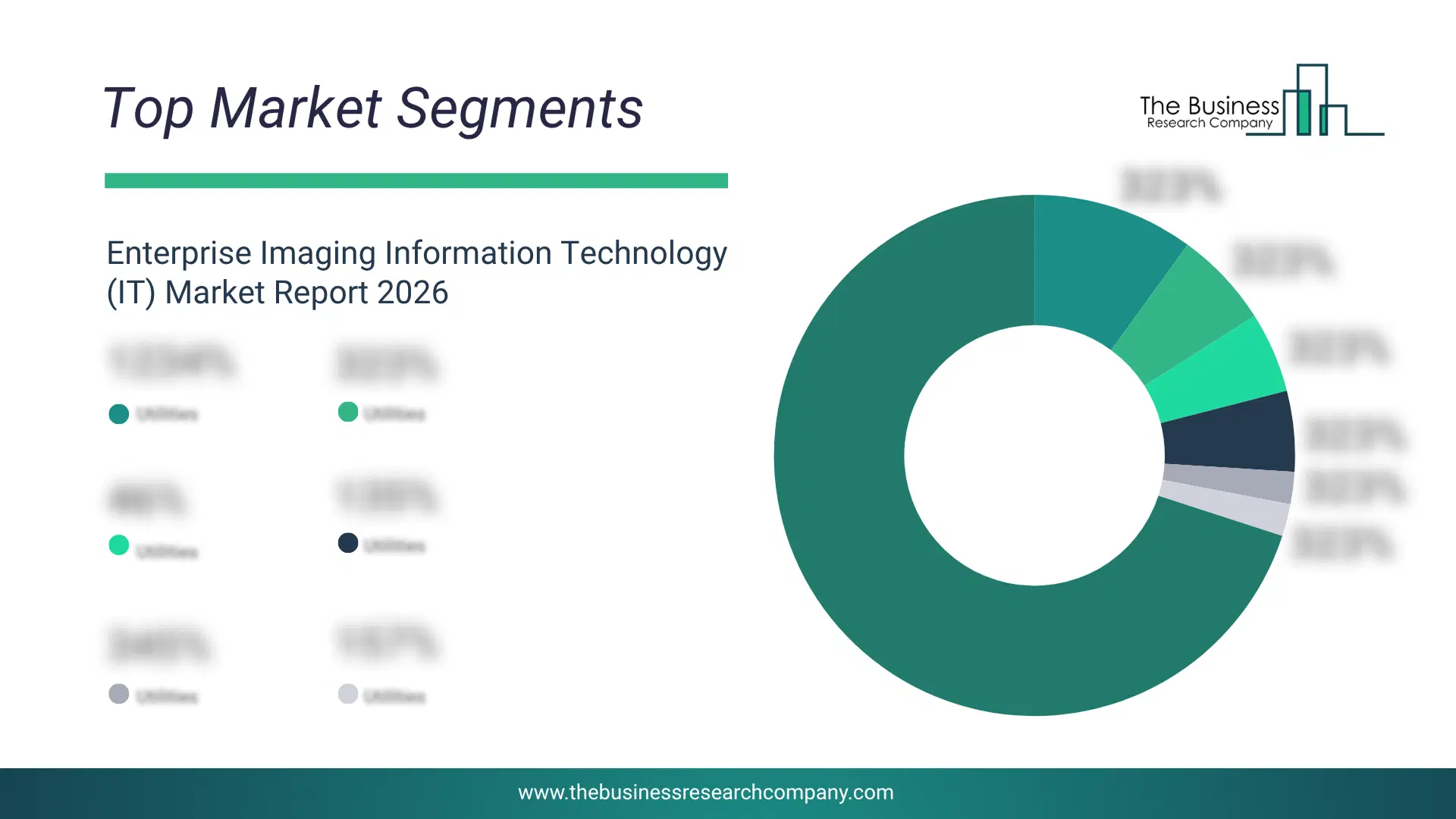
1) By Component: Hardware, Services, Software 2) By Modality: X-Ray, Magnetic Resonance Imaging (MRI), Computed Tomography (CT), Ultrasound, Nuclear Imaging, Endoscopy, Mammography, Fluoroscopy, Echocardiography, Other Modalities 3) By Deployment Mode: On-Premises, Cloud-Based, Hybrid 4) By Application: Diagnostics, Therapeutics, Clinical Research 5) By End-User: Hospitals, Diagnostic Centers, Clinics And Outpatient Setting, Pharmaceutical And Biotechnology Companies, Medtech Companies, Research And Academia, Other End-Users Subsegments: 1) By Hardware: Imaging Servers, Storage Systems, Workstations, Networking Equipment, Display Monitors 2) By Services: Implementation Services, Consulting Services, Support And Maintenance Services, Training And Education Services, Integration Services 3) By Software: Picture Archiving And Communication Systems, Vendor Neutral Archives, Radiology Information Systems, Imaging Analytics Software, Workflow Management SoftwareWhat Is The Driver Of The Enterprise Imaging Information Technology (IT) Market?
The growing volume of medical imaging procedures is expected to propel the growth of the enterprise imaging information technology (IT) market going forward. Medical imaging procedures refer to non-invasive techniques used to create detailed images of the body’s internal structures to aid in diagnosis, monitoring, and treatment planning. The volume of medical imaging procedures is growing as the increasing prevalence of chronic diseases drives greater demand for accurate diagnostic tools to enable timely detection, effective monitoring, and improved treatment outcomes. Enterprise imaging information technology enables centralized management of medical images from various modalities, allowing secure access, streamlining collaboration, and improving clinical decision-making. For instance, in March 2023, according to the NHS England, a UK-based government department, approximately 45.0 million imaging tests were performed in England in the year ending March 2023, representing a 2.2 percentage-point increase from 44.0 million in 2022. Therefore, the growing volume of medical imaging procedures is driving the growth of the enterprise imaging information technology (IT) industry.Key Players In The Global Enterprise Imaging Information Technology (IT) Market
Major companies operating in the enterprise imaging information technology (it) market are Optum Inc., Siemens Healthineers AG, Fujifilm Corporation, Koninklijke Philips N.V., Konica Minolta Inc., Cerner Corporation, Canon Medical Systems Corporation, Agfa-Gevaert N.V., Hyland Software Inc., Sectra Aktiebolag, Intelerad Medical Systems Incorporated, Pro Medicus Limited, INFINITT Healthcare Co. Ltd., Visage Imaging Inc., Novarad Corporation, Esaote S.p.A., Sclmage Inc., Medsynaptic Pvt. Ltd., Hermes Medical Solutions, Candelis Inc.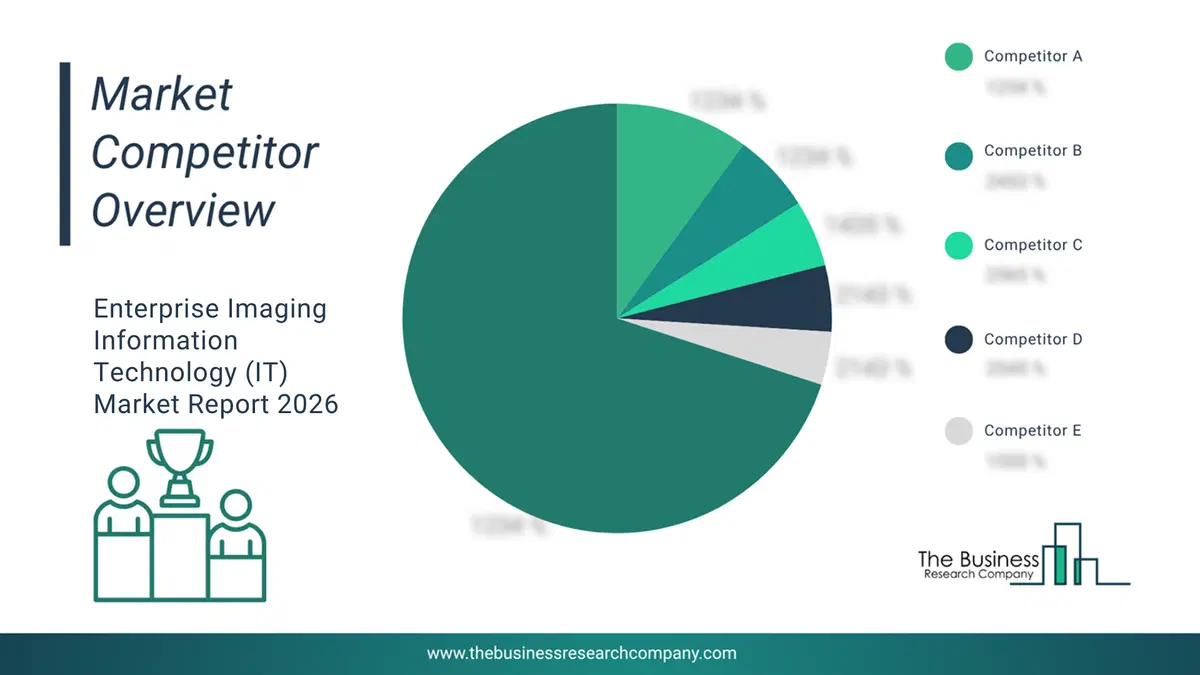
This chart is for illustrative purposes; the full report includes a detailed competitor analysis and comprehensive overview of the top 10 companies in the market.
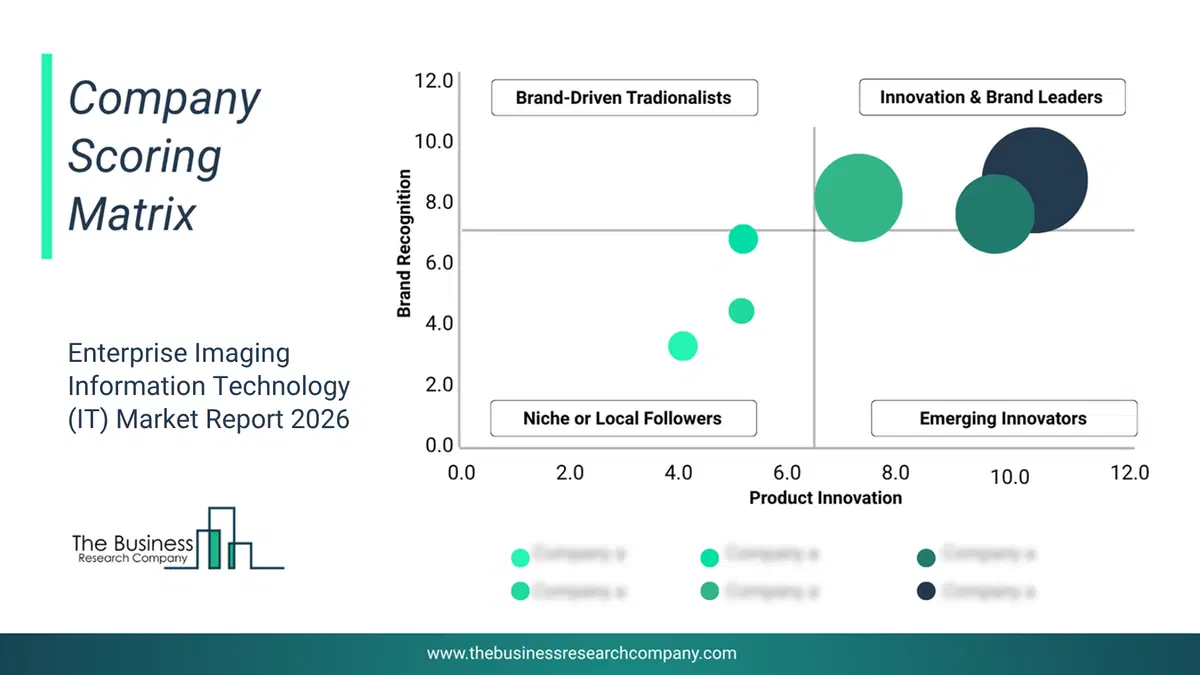
This chart maps companies by product innovation and brand strength, with bubble size indicating relative revenue, helping identify market leaders, challengers, and niche players. This is an illustrative chart; the full report provides a complete and accurate competitive analysis.
Global Enterprise Imaging Information Technology (IT) Market Trends and Insights
Major companies operating in the enterprise imaging information technology (IT) market are focusing on developing advanced solutions, such as cloud-based enterprise image management platforms, to enhance collaboration among healthcare providers and support secure image sharing across multiple facilities. A cloud-based enterprise image management platform refers to a platform that stores and organizes medical images on the cloud, enabling secure access, easy sharing, and reduced infrastructure costs for healthcare providers. For instance, in November 2024, Konica Minolta Healthcare Americas, Inc., a US-based medical imaging equipment company, introduced Exa Enterprise, a cloud-based enterprise imaging solution tailored for hospitals with up to 500 beds and large imaging centers. The platform is based on Amazon Web Services (AWS) HealthImaging and integrates a state-of-the-art PACS and RIS core with top-tier third-party technologies, including business intelligence, AI-driven workflow orchestration, vendor-neutral archive (VNA), and voice and reporting capabilities. This scalable, web-based solution strengthens data security, accelerates image access, and streamlines medical image management, ultimately improving clinical efficiency and patient care across diverse imaging specialties.What Are Latest Mergers And Acquisitions In The Enterprise Imaging Information Technology (IT) Market?
In April 2024, GE Healthcare Technologies, Inc., a US-based health technology company, acquired MIM Software Inc. for an undisclosed amount. Through this acquisition, GE Healthcare aims to greatly improve its precision care approach by adding advanced AI imaging tools and complete digital workflow solutions, which will help doctors make better decisions, boost efficiency, and improve patient results in many different areas and complex health issues. MIM Software Inc. is a US-based company that provides enterprise imaging information technology (IT) solutions.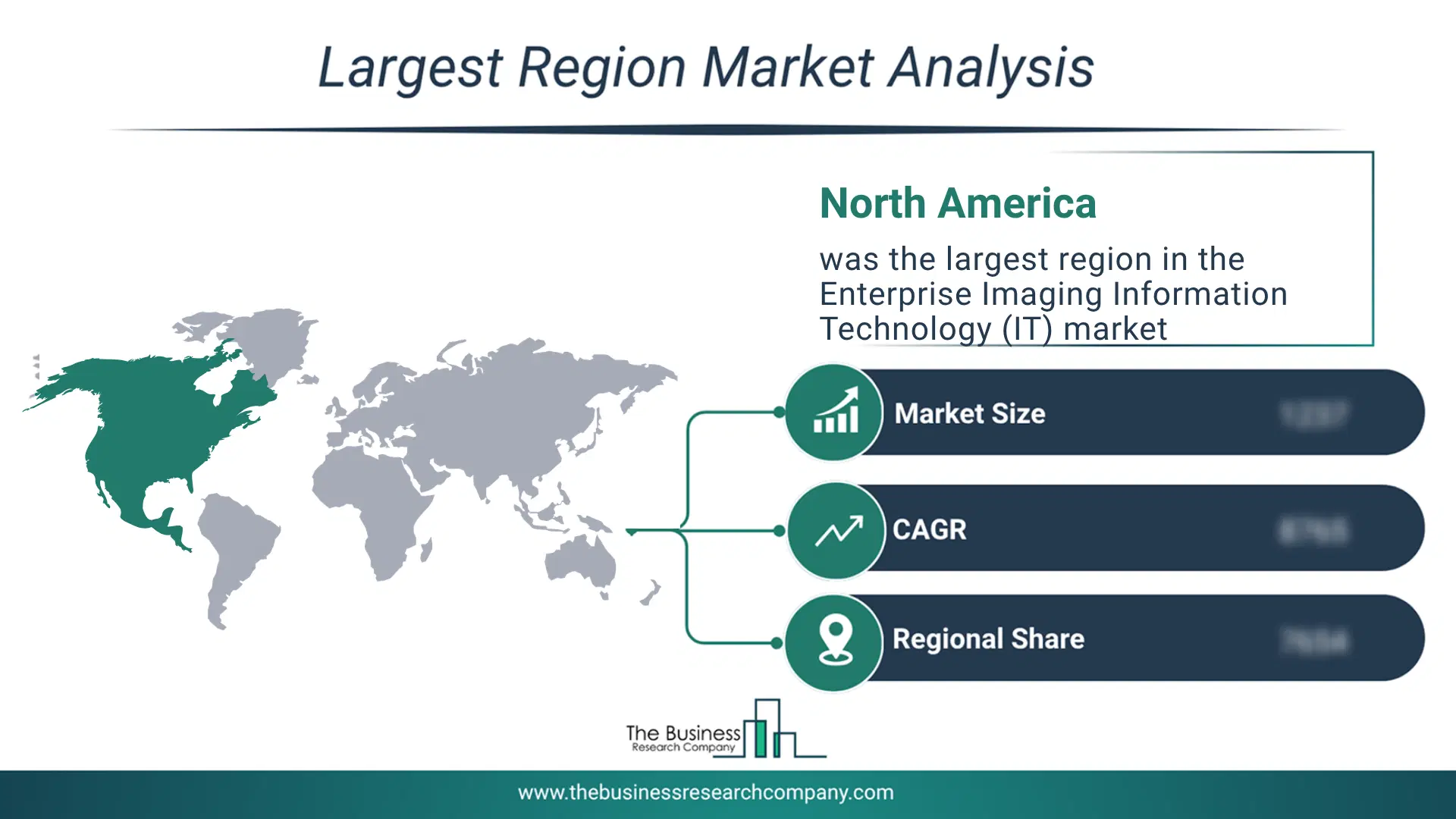
Regional Insights
North America was the largest region in the enterprise imaging information technology (IT) market in 2025. Asia-Pacific is expected to be the fastest-growing region in the forecast period. The regions covered in this market report are Asia-Pacific, South East Asia, Western Europe, Eastern Europe, North America, South America, Middle East, Africa. The countries covered in this market report are Australia, Brazil, China, France, Germany, India, Indonesia, Japan, Taiwan, Russia, South Korea, UK, USA, Canada, Italy, Spain.What Defines the Enterprise Imaging Information Technology (IT) Market?
The enterprise imaging information technology (IT) market consists of revenues earned by entities by providing services such as maintenance and technical support services, teleradiology and remote reporting services, data backup and disaster recovery services, security and compliance services, and clinical decision support. The market value includes the value of related goods sold by the service provider or included within the service offering. The enterprise imaging information technology (IT) market also includes sales of image exchange platforms, cloud-based imaging solutions, and three-dimensional (3D) visualization and advanced imaging tools. Values in this market are ‘factory gate’ values; that is, the value of goods sold by the manufacturers or creators of the goods, whether to other entities (including downstream manufacturers, wholesalers, distributors, and retailers) or directly to end customers. The value of goods in this market includes related services sold by the creators of the goods.How is Market Value Defined and Measured?
The market value is defined as the revenues that enterprises gain from the sale of goods and/or services within the specified market and geography through sales, grants, or donations in terms of the currency (in USD unless otherwise specified). The revenues for a specified geography are consumption values that are revenues generated by organizations in the specified geography within the market, irrespective of where they are produced. It does not include revenues from resales along the supply chain, either further along the supply chain or as part of other products.
This chart presents market attractiveness based on a quantitative evaluation of growth, competition, strategic alignment, and risk, offering a clear view of opportunity areas for decision-making. This chart is for illustrative purposes; the full report contains the complete analysis.

This chart highlights the Total Addressable Market (TAM) by estimating the maximum revenue opportunity using an assumption-driven approach, supporting strategic planning and opportunity sizing across markets. The chart is illustrative; the full report provides a more comprehensive analysis.
What Key Data and Analysis Are Included in the Enterprise Imaging Information Technology (IT) Market Report 2026?
The enterprise imaging information technology (it) market research report is one of a series of new reports from The Business Research Company that provides market statistics, including industry global market size, regional shares, competitors with the market share, detailed market segments, market trends and opportunities, and any further data you may need to thrive in the enterprise imaging information technology (it) industry. The market research report delivers a complete perspective of everything you need, with an in-depth analysis of the current and future state of the industry.Enterprise Imaging Information Technology (IT) Market Report Forecast Analysis
| Report Attribute | Details |
|---|---|
| Market Size Value In 2026 | $2.7 billion |
| Revenue Forecast In 2030 | $4.39 billion |
| Growth Rate | CAGR of 12.9% from 2026 to 2030 |
| Base Year For Estimation | 2025 |
| Actual Estimates/Historical Data | 2020-2025 |
| Forecast Period | 2026 - 2030 |
| Market Representation | Revenue in USD Billion and CAGR from 2026 to 2030 |
| Segments Covered | Component, Modality, Deployment Mode, Application, End-User |
| Regional Scope | Asia-Pacific, Western Europe, Eastern Europe, North America, South America, Middle East, Africa |
| Country Scope | The Countries Covered In This Market Report Are Australia, Brazil, China, France, Germany, India, Indonesia, Japan, Taiwan, Russia, South Korea, Uk, Usa, Canada, Italy, Spain. |
| Key Companies Profiled | Optum Inc., Siemens Healthineers AG, Fujifilm Corporation, Koninklijke Philips N.V., Konica Minolta Inc., Cerner Corporation, Canon Medical Systems Corporation, Agfa-Gevaert N.V., Hyland Software Inc., Sectra Aktiebolag, Intelerad Medical Systems Incorporated, Pro Medicus Limited, INFINITT Healthcare Co. Ltd., Visage Imaging Inc., Novarad Corporation, Esaote S.p.A., Sclmage Inc., Medsynaptic Pvt. Ltd., Hermes Medical Solutions, Candelis Inc. |
| Customization Scope | Request for Customization |
| Pricing And Purchase Options | Explore Purchase Options |