
Fencing Market Report 2026
Global Outlook – By Material (Plastic, Metal, Wood and Composite, Concrete), By Installation (Do It Yourself, Contractor), By Application (Residential, Agricultural, Industrial), By End Use (Government, Mining, Defens, Petrochemicals, Transport, Energy) – Market Size, Trends, Strategies, and Forecast to 2030
Fencing Market Overview
• Fencing market size has reached to $36.46 billion in 2025 • Expected to grow to $46.78 billion in 2030 at a compound annual growth rate (CAGR) of 5% • Growth Driver: Elevated Construction Activity Fuels Fencing Market Growth • Market Trend: Gregory Industries And Safence Form Strategic Partnership To Enhance Highway Safety Solutions • North America was the largest region in 2025.Market Gains By 2030 – Top Opportunities By Segment
Market Gain identifies the most promising market opportunities by highlighting the segments or products expected to generate the highest incremental revenue growth over the next five years.
What Is Covered Under Fencing Market?
Fencing refers to equipment used to restrict the crossing of an established boundary. In terms of design, weight, and structure, fencing differs from the wall. The fence is used for a variety of reasons, including security, theft prevention, and keeping children and pets in a contained area, as well as to improve the aesthetics of the property and border. The main materials used in fencing are plastic, metal, wood and composite, concrete. Plastic fencing refers to plastic fences made from synthetic materials. Compared to traditional wood fences, these materials are more robust, easier to maintain, and have a far longer lifespan. Fencing is applied on residential, agricultural, industrial sectors. Fencing is used by government, mining, defence, petrochemicals, transport, and energy industries.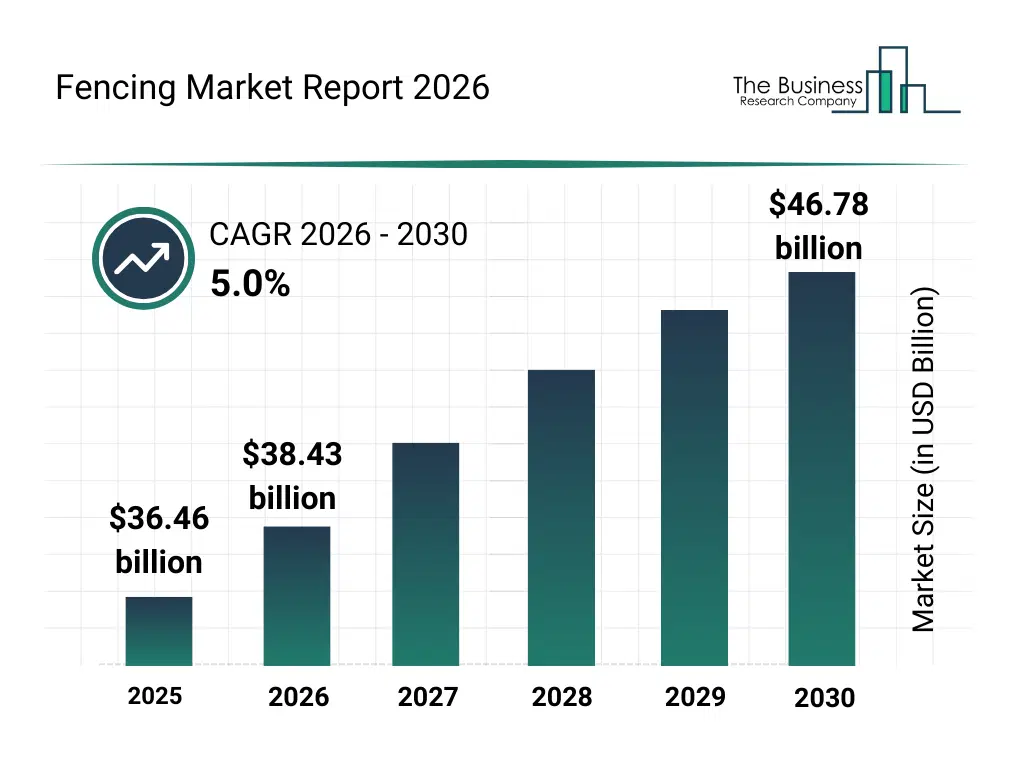
What Is The Fencing Market Size and Share 2026?
The fencing market size has grown strongly in recent years. It will grow from $36.46 billion in 2025 to $38.43 billion in 2026 at a compound annual growth rate (CAGR) of 5.4%. The growth in the historic period can be attributed to increasing demand for perimeter security, growth in agricultural land protection needs, rising use of metal fencing materials, expansion of residential property development, adoption of basic boundary fencing solutions.What Is The Fencing Market Growth Forecast?
The fencing market size is expected to see strong growth in the next few years. It will grow to $46.78 billion in 2030 at a compound annual growth rate (CAGR) of 5.0%. The growth in the forecast period can be attributed to rising preference for durable and low-maintenance fencing materials, growing adoption of smart and connected fencing systems, increasing infrastructure and industrial perimeter protection needs, expansion of decorative and aesthetic fencing options, advancements in composite and precast fencing technologies. Major trends in the forecast period include growing demand for security-oriented fencing solutions, rising adoption of low-maintenance and long-lasting fence materials, expansion of decorative and aesthetic fencing options, increased use of fencing in agricultural and perimeter protection, growth in precast and modular fencing installations.
Global Fencing Market Segmentation
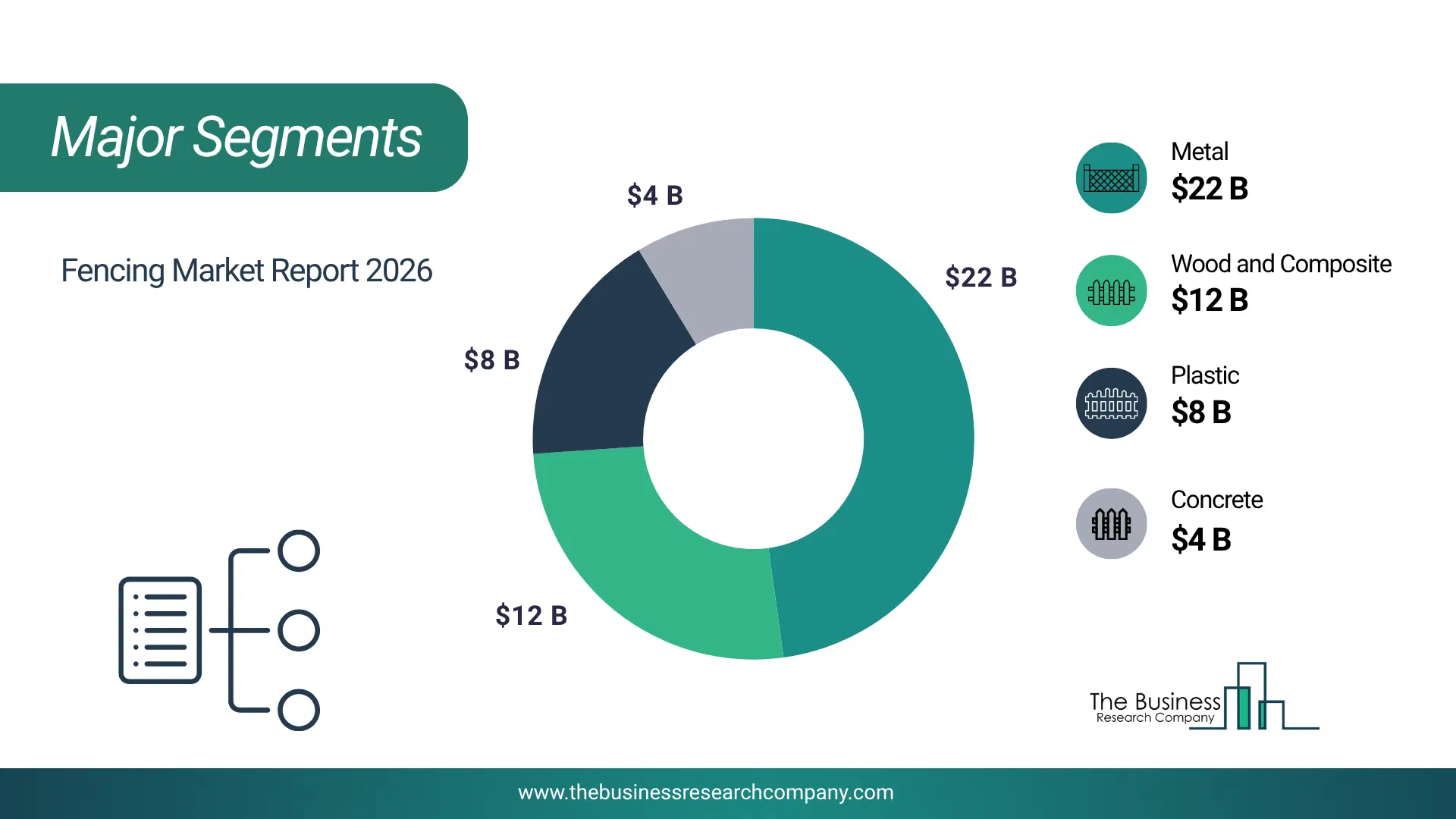
1) By Material: Plastic, Metal, Wood and Composite, Concrete 2) By Installation: Do It Yourself, Contractor 3) By Application: Residential, Agricultural, Industrial 4) By End Use: Government, Mining, Defens, Petrochemicals, Transport, Energy Subsegments: 1) By Plastic: Vinyl Fencing, PVC Fencing 2) By Metal: Chain Link Fencing, Aluminum Fencing, Steel Fencing 3) By Wood And Composite: Wooden Fencing, Composite Fencing 4) By Concrete: Precast Concrete Fencing, Cast-In-Place Concrete Fencing The top segments in the fencing market will be: • Metal will reach $22.13 Billion by 2030. • Wood and Composite will reach $12 Billion by 2030. • Plastic will reach $8.09 Billion by 2030. • Concrete will reach $4.13 Billion by 2030.What Is The Driver Of The Fencing Market?
The increase in construction activities is expected to propel the growth of the fencing market going forward. Construction is the process of putting together materials to create enormous structures. The construction industry is growing due to rapid urbanization, fueling demand for housing, infrastructure, and commercial developments driven by expanding cities and rising investments. Fencing is primarily used in construction activities to secure the site, prevent unauthorized access, enhance safety, and protect materials and equipment, ultimately ensuring a controlled and secure work environment. For instance, in June 2024, according to TST Europe AG, a Switzerland-based private company, in 2023, total construction spending reached $1.98 trillion, reflecting a 7.4% increase compared to the previous year, and this growth indicates a strong upward trend in the construction sector. Therefore, the increase in construction activities is fueling the growth of the fencing industry.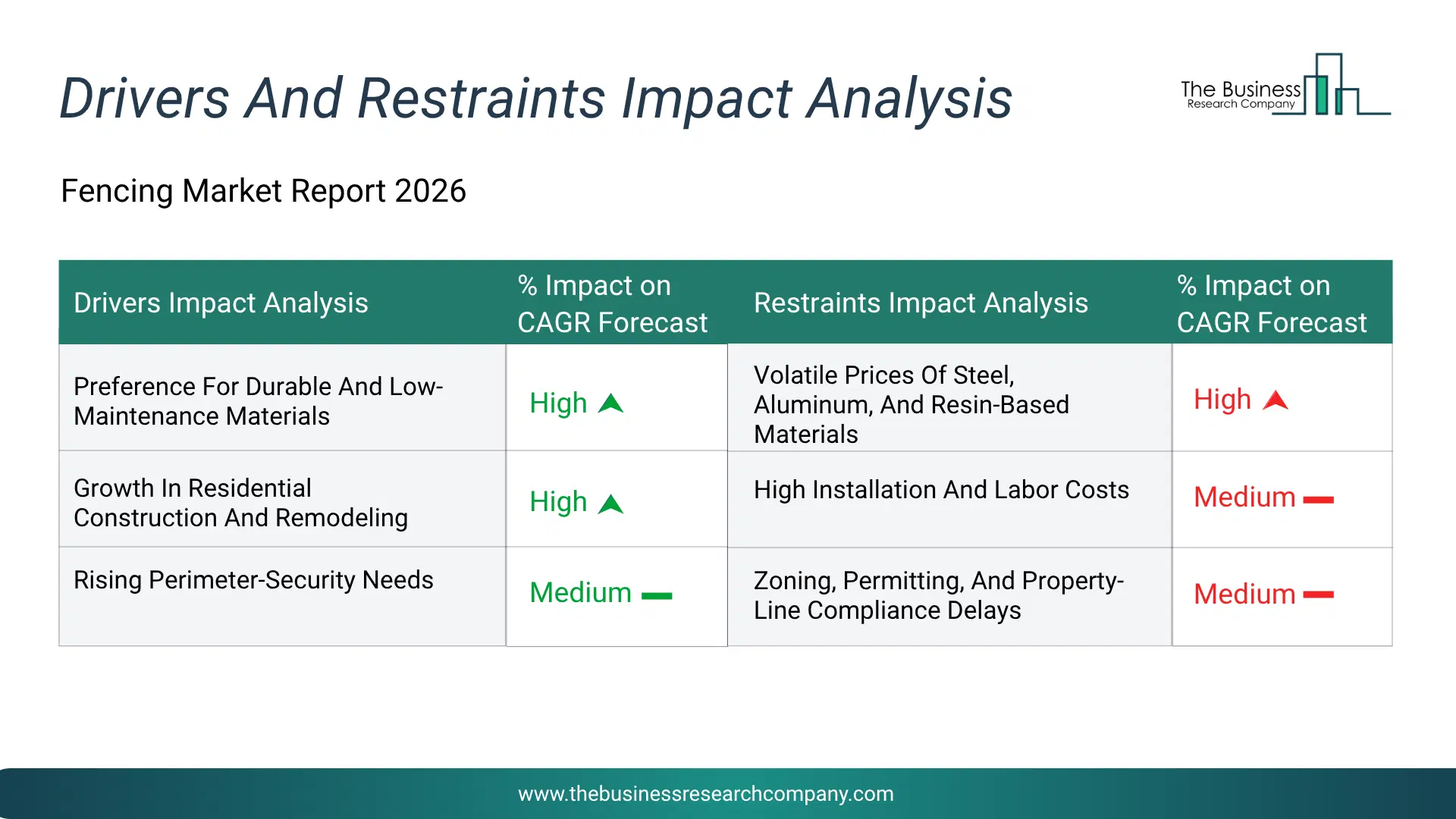
Infographic Chart Showing Key Market Drivers Analysis And Restraints For Fencing Market
The chart presents an impact analysis of key drivers and restraints, quantifying their relative influence on the market's growth rate and helping assess the balance between growth enablers and limiting factors. This chart offers a high-level perspective; the full report contains more detailed insights.
How Will The Drivers Impact Growth In The Global Fencing Market?
• Preference For Durable And Low-Maintenance Materials (High) – During the forecast period, the preference for durable and low-maintenance materials is expected to become a key growth driver for the fencing market by 2030. End users are increasingly adopting fencing solutions manufactured from galvanized steel, aluminum, vinyl, and composite materials that offer extended service life and reduced maintenance requirements. These materials provide enhanced resistance to corrosion, weather exposure, and physical wear, making them suitable for long-term deployment across diverse environments. Manufacturers are also introducing advanced coatings and treatment technologies to further improve product longevity and performance. This shift toward durable fencing solutions is strengthening market demand across multiple end-use sectors. • Growth In Residential Construction And Remodeling (High) – During the forecast period, the growth in residential construction and remodeling is expected to emerge as a major factor driving the expansion of the fencing market by 2030. Increasing development of new housing communities and renovation of existing properties is generating strong demand for fencing systems that enhance privacy, safety, and property aesthetics. Homeowners are investing in modern fencing designs to improve curb appeal and define property boundaries, while developers are incorporating fencing as a standard feature in residential projects. The growing popularity of outdoor living spaces is further supporting installation activity. • Rising Perimeter-Security Needs (Medium) – During the forecast period, the rising perimeter-security needs are expected to act as a key growth catalyst for the fencing market by 2030. Organizations across industrial facilities, transportation hubs, utility sites, and public infrastructure are strengthening physical security measures to safeguard assets and restrict unauthorized access. The increasing focus on risk mitigation and site protection is encouraging the adoption of high-performance fencing systems integrated with surveillance and access-control technologies. Demand is also growing for specialized fencing solutions capable of meeting stringent security standards in critical facilities.How Will The Restraints Impact Growth In The Global Fencing Market?
• Volatile Prices Of Steel, Aluminum, And Resin-Based Materials (High) – During the forecast period, the volatile prices of steel, aluminum, and resin-based materials act as a major restraint for the market. Fluctuations in raw material costs create uncertainty for manufacturers, making it difficult to maintain stable pricing strategies. These price variations are often influenced by global supply chain disruptions, geopolitical factors, and changes in demand-supply dynamics. As input costs rise unpredictably, profit margins for manufacturers are squeezed. This also leads to increased product prices, which can reduce affordability for end users. Smaller players in the market are particularly vulnerable to such fluctuations. Additionally, long-term project planning becomes challenging due to cost instability. Overall, this volatility slows down market growth and investment confidence. • High Installation And Labor Costs (High) – During the forecast period, the high installation and labor costs serve as a significant barrier to market growth. The overall cost of implementing solutions often goes beyond just material expenses, with labor charges forming a substantial portion. Skilled labor is required for proper installation, which increases the overall project cost. In many regions, labor shortages further drive up wages, adding to the financial burden. This can discourage potential customers, especially in price-sensitive markets, from adopting such solutions. Additionally, complex installation processes may require specialized tools and expertise. These factors collectively make projects less attractive from a cost-benefit perspective. As a result, high installation and labor costs limit market penetration and expansion. • Zoning, Permitting, And Property-Line Compliance Delays (Medium) – During the forecast period, the zoning, permitting, and property-line compliance delays pose regulatory challenges that restrain market growth. Before implementation, projects often need to go through multiple approval processes, which can be time-consuming. Variations in local regulations and unclear guidelines can further complicate the approval process. These delays can disrupt project timelines and increase overall costs. Property-line disputes and compliance requirements may also lead to redesign or modifications. For businesses, such uncertainties can affect planning and investment decisions. Additionally, prolonged waiting periods may discourage customers from proceeding with projects. Consequently, regulatory and compliance-related delays act as a bottleneck, slowing down overall market progress.Key Players In The Global Fencing Market
Major companies operating in the fencing market are Allied Tube & Conduit Corp, Ameristar Fence Products Incorporated, Bekaert Corporation, CertainTeed Corporation, Long Fence Company Inc., Poly Vinyl Creations Inc., Fortress Building Products, Master-Halco Inc., Stephens Pipe & Steel LLC, Jerith Manufacturing LLC, Pexco LLC, Betafence NV, Trex Company Inc., Barrette Outdoor Living Inc., Gregory Industries Inc., Wheatland Tube Company, AmeriFence Corporation, Merchants Metals, Royal Building Products, Dura Fence, Eastern Wholesale Fence Co. Inc., Illusions Vinyl Fence, Nationwide Industries Inc., Universal Forest Products Inc., Homestead Vinyl Products Inc., Country Estate Fence, Weatherables, Ply Gem Holdings Inc.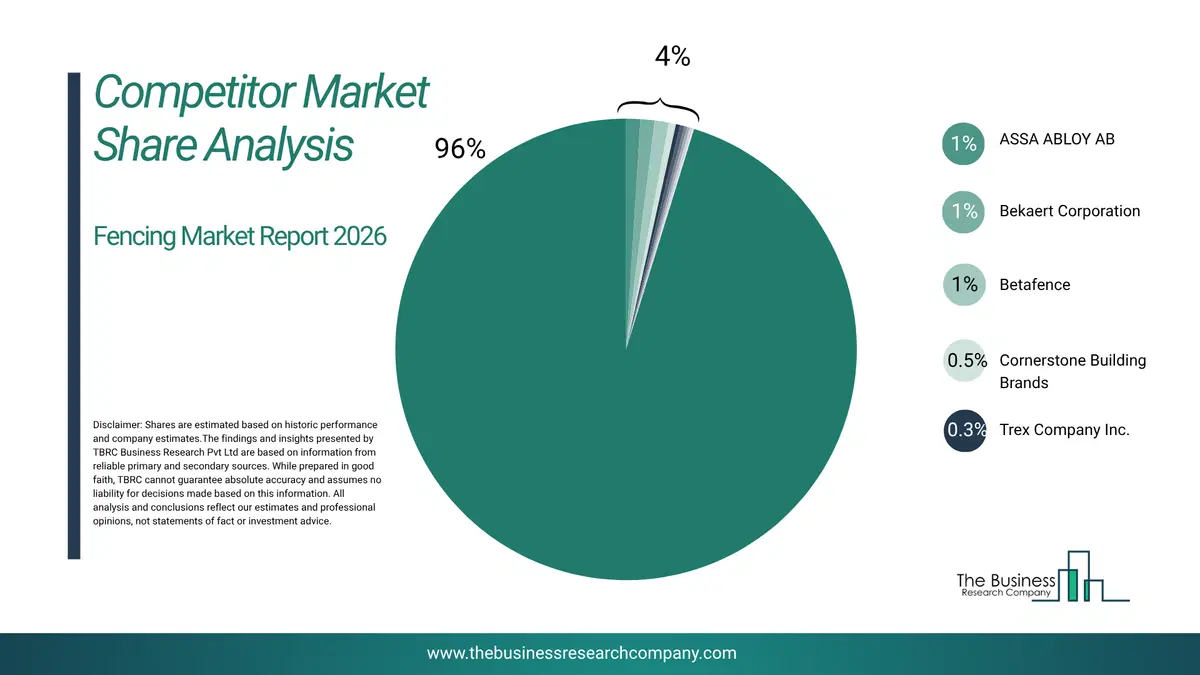
This chart is for illustrative purposes; the full report includes a detailed competitor analysis and comprehensive overview of the top 10 companies in the market.
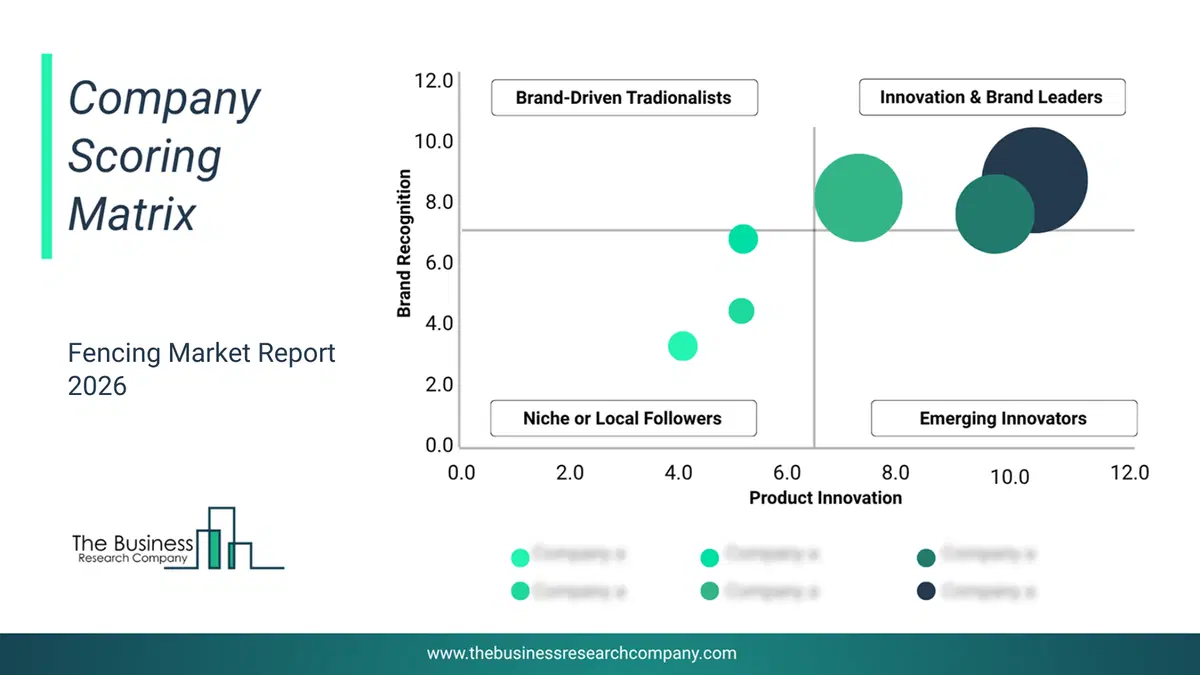
This chart maps companies by product innovation and brand strength, with bubble size indicating relative revenue, helping identify market leaders, challengers, and niche players. This is an illustrative chart; the full report provides a complete and accurate competitive analysis.
Global Fencing Market Trends and Insights
Major companies operating in the fencing market are forging strategic partnerships to offer comprehensive solutions and services. Strategic partnerships refer to a process in which companies leverage each other's strengths and resources to achieve mutual benefits and success. For instance, in March 2023, Gregory Industries, a US-based provider of quality highway safety products, partnered with Safence, a US-based high-tension cable barrier system. With this partnership, they will enhance Gregory’s ability to manufacture, sell, and distribute the existing Safence fencing cable barrier system product line throughout the United States and Canada, with plans to scale their distribution to keep more drivers safe around the world.What Are Latest Mergers And Acquisitions In The Fencing Market?
In October 2025, Harkness Capital Partners, a US-based provider of field and facility services, infrastructure, and industrial services, acquired Premier Fence for an undisclosed amount. With this acquisition, Harkness aims to expand its footprint in the commercial fencing, guardrail, and access-control systems market across the New England region. Premier Fence is a US-based provider of installation, repair, and maintenance services for fencing, guardrails, and gate/access control systems across commercial, municipal and residential markets.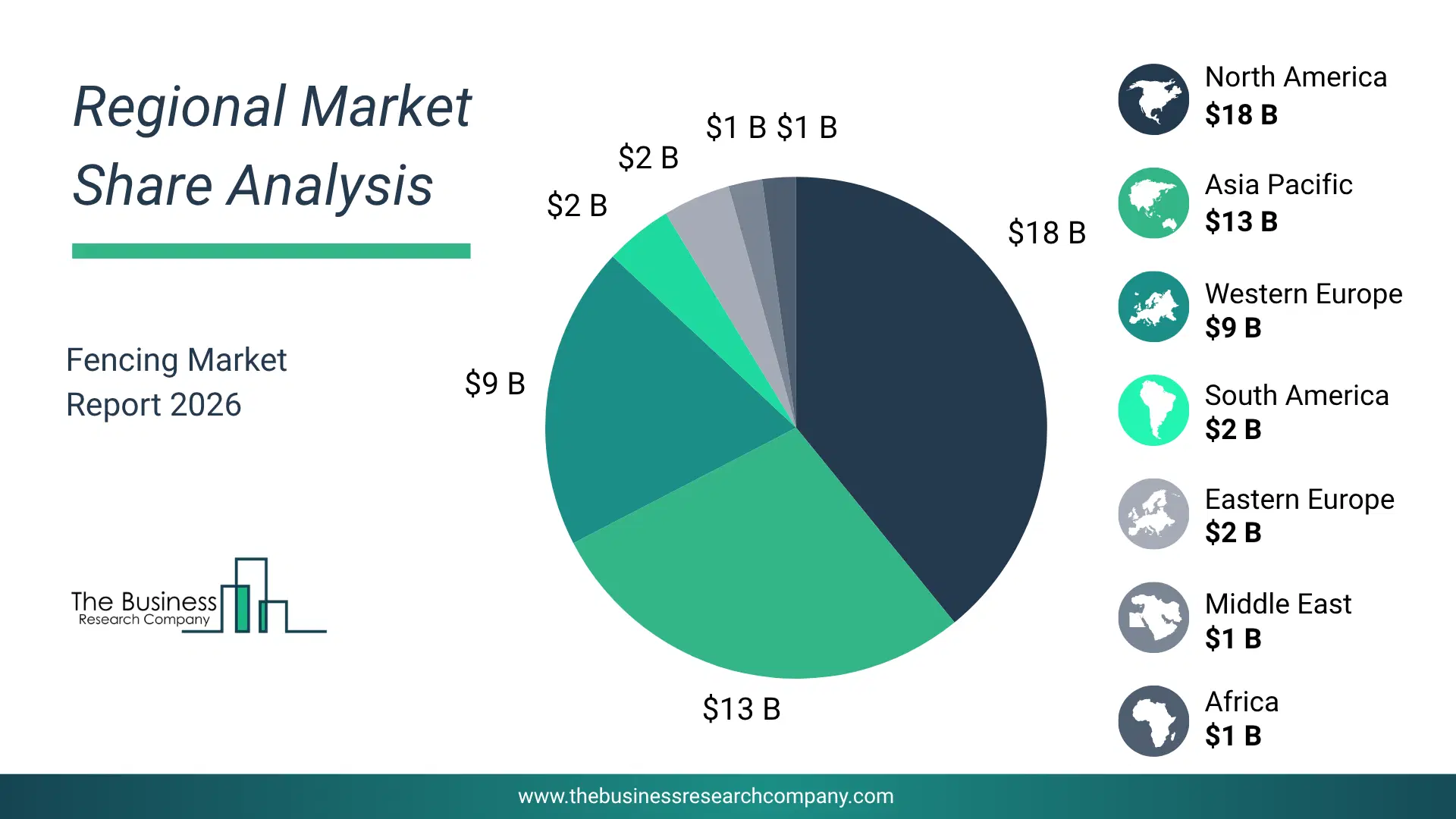
Regional Insights
North America was the largest region in the fencing market in 2025 and is also expected to be the fastest-growing region in the forecast period. The regions covered in this market report are Asia-Pacific, South East Asia, Western Europe, Eastern Europe, North America, South America, Middle East, Africa. The countries covered in this market report are Australia, Brazil, China, France, Germany, India, Indonesia, Japan, Taiwan, Russia, South Korea, UK, USA, Canada, Italy, Spain.What Defines the Fencing Market?
The fencing market consists of sales of brick wall fencing, chain linked fence and barbed wire fencing. Values in this market are ‘factory gate’ values, that is the value of goods sold by the manufacturers or creators of the goods, whether to other entities (including downstream manufacturers, wholesalers, distributors and retailers) or directly to end customers. The value of goods in this market includes related services sold by the creators of the goods.How is Market Value Defined and Measured?
The market value is defined as the revenues that enterprises gain from the sale of goods and/or services within the specified market and geography through sales, grants, or donations in terms of the currency (in USD unless otherwise specified). The revenues for a specified geography are consumption values that are revenues generated by organizations in the specified geography within the market, irrespective of where they are produced. It does not include revenues from resales along the supply chain, either further along the supply chain or as part of other products.
This chart presents market attractiveness based on a quantitative evaluation of growth, competition, strategic alignment, and risk, offering a clear view of opportunity areas for decision-making. This chart is for illustrative purposes; the full report contains the complete analysis.

This chart highlights the Total Addressable Market (TAM) by estimating the maximum revenue opportunity using an assumption-driven approach, supporting strategic planning and opportunity sizing across markets. The chart is illustrative; the full report provides a more comprehensive analysis.
What Key Data and Analysis Are Included in theFencing Market Report 2026?
The fencing market research report is one of a series of new reports from The Business Research Company that provides market statistics, including industry global market size, regional shares, competitors with the market share, detailed market segments, market trends and opportunities, and any further data you may need to thrive in the fencing industry. The market research report delivers a complete perspective of everything you need, with an in-depth analysis of the current and future state of the industry.Fencing Market Report Forecast Analysis
| Report Attribute | Details |
|---|---|
| Market Size Value In 2026 | $38.43 billion |
| Revenue Forecast In 2030 | $46.78 billion |
| Growth Rate | CAGR of 5.4% from 2026 to 2030 |
| Base Year For Estimation | 2025 |
| Actual Estimates/Historical Data | 2020-2025 |
| Forecast Period | 2026 - 2030 |
| Market Representation | Revenue in USD Billion and CAGR from 2026 to 2030 |
| Segments Covered | Material, Installation, Application, End Use |
| Regional Scope | Asia-Pacific, Western Europe, Eastern Europe, North America, South America, Middle East, Africa |
| Country Scope | The countries covered in the report are Australia, Brazil, China, France, Germany, India, Indonesia, Japan, Taiwan, Russia, South Korea, UK, USA, Canada, Italy, Spain. |
| Key Companies Profiled | Allied Tube & Conduit Corp, Ameristar Fence Products Incorporated, Bekaert Corporation, CertainTeed Corporation, Long Fence Company Inc., Poly Vinyl Creations Inc., Fortress Building Products, Master-Halco Inc., Stephens Pipe & Steel LLC, Jerith Manufacturing LLC, Pexco LLC, Betafence NV, Trex Company Inc., Barrette Outdoor Living Inc., Gregory Industries Inc., Wheatland Tube Company, AmeriFence Corporation, Merchants Metals, Royal Building Products, Dura Fence, Eastern Wholesale Fence Co. Inc., Illusions Vinyl Fence, Nationwide Industries Inc., Universal Forest Products Inc., Homestead Vinyl Products Inc., Country Estate Fence, Weatherables, Ply Gem Holdings Inc. |
| Customization Scope | Request for Customization |
| Pricing And Purchase Options | Explore Purchase Options |