
3D Virtual Fence Market Report 2026
Global Outlook – By Type (3D Virtual Cameras, 3D Video Motion Detection System), By Deployment (On-Premises, Cloud Based, Hybrid), By End-User (Logistics, Agriculture, Banking, Construction, Security) – Market Size, Trends, Strategies, and Forecast to 2030
3D Virtual Fence Market Overview
• 3D Virtual Fence market size has reached to $6.07 billion in 2025 • Expected to grow to $15.93 billion in 2030 at a compound annual growth rate (CAGR) of 21.4% • Growth Driver: Role Of 3D Virtual Fences In Mitigating Terrorism Risks And Enhancing Security • Market Trend: Advancements In AI-Powered Virtual Boundary Systems Enhance Safety And Perimeter Intelligence In Industrial Operations • North America was the largest region in 2025 and Asia-Pacific is the fastest growing region.What Is Covered Under 3D Virtual Fence Market?
3D virtual fence refers to a digital border or wall built in three dimensions using augmented reality (AR) or virtual reality (VR) technologies. They monitor movement and access within various zones and send real-time alerts during a breach. It allows users to restrict boundaries virtually. The main types of 3D virtual fences are 3D virtual cameras and 3D video motion detection systems. A 3D virtual camera refers to an imaging tool that allows images to simulate three dimensions as seen by human binocular vision in terms of depth perception. The various deployments are on-premises, cloud-based, and hybrid and are used by various end-users such as logistics, agriculture, banking, construction, and security.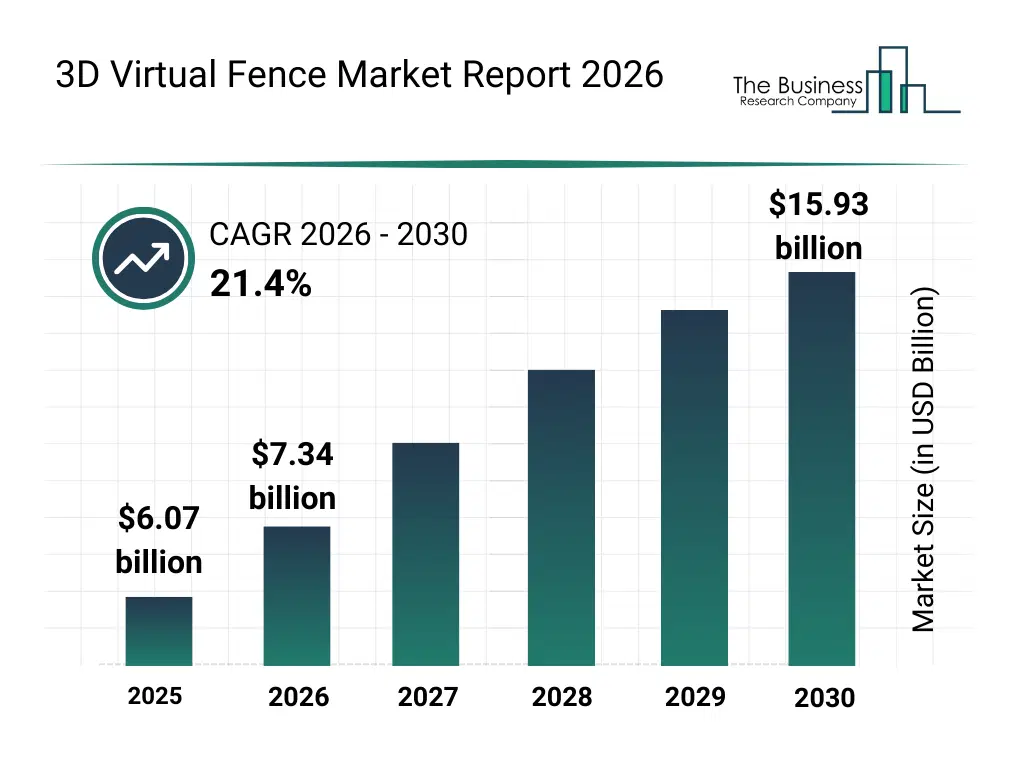
What Is The 3D Virtual Fence Market Size and Share 2026?
The 3D virtual fence market size has grown exponentially in recent years. It will grow from $6.07 billion in 2025 to $7.34 billion in 2026 at a compound annual growth rate (CAGR) of 20.9%. The growth in the historic period can be attributed to rising security concerns in logistics, increasing adoption of remote monitoring in agriculture, growing demand for smart city surveillance, rise in construction site safety regulations, increasing need for perimeter control in banking.What Is The 3D Virtual Fence Market Growth Forecast?
The 3D virtual fence market size is expected to see exponential growth in the next few years. It will grow to $15.93 billion in 2030 at a compound annual growth rate (CAGR) of 21.4%. The growth in the forecast period can be attributed to rising integration with ai-enabled analytics, increasing adoption in autonomous transport, growing use in smart infrastructure projects, rise in demand for hybrid deployment solutions, increasing regulatory compliance for digital security. Major trends in the forecast period include real-time boundary monitoring, virtual access control, predictive security alerts, remote surveillance integration, event-triggered notifications.
Global 3D Virtual Fence Market Segmentation
1) By Type: 3D Virtual Cameras, 3D Video Motion Detection System 2) By Deployment: On-Premises, Cloud Based, Hybrid 3) By End-User: Logistics, Agriculture, Banking, Construction, Security Subsegments: 1) By 3D Virtual Cameras: Fixed 3D Cameras, Pan-Tilt-Zoom (PTZ) 3D Cameras 2) By 3D Video Motion Detection System: Standalone Detection Systems, Integrated Detection SystemsWhat Is The Driver Of The 3D Virtual Fence Market?
The increasing risk of terrorism is expected to propel the growth of the 3D virtual fence market going forward. Terrorism refers to violent crimes committed by individuals, groups, or nations classified as foreign terrorist organizations or countries. The 3D virtual fence detects potential breaches and suspicious activities. It helps prevent terrorist attacks by creating a virtual boundary around a specific area, such as a building or a border, and uses cameras, sensors, and other devices to monitor the site for any suspicious activity. For instance, in June 2023, according to a report published by the United Nations High Commissioner for Refugees, a Switzerland-based agency of the UN tasked with assisting and defending refugees, globally, approximately 110 million people worldwide were forcibly displaced due to persecution, terrorism, conflict, violence, and human rights violations, there were 36.4 million refugees worldwide, including 30.5 million under UNHCR's mandate and 5.94 million Palestine refugees under UNRWA's mandate; additionally, there were 62.1 million internally displaced persons, 6.08 million asylum seekers, and 5.6 million Venezuelan refugees or individuals in need of international protection. around 90% of newly displaced individuals emerged from seven significant crises in countries such as Afghanistan, the Democratic Republic of the Congo, Myanmar, Somalia, Sudan, Ukraine, and various Latin American nations. Therefore, the increasing risk of terrorism is driving the growth of the 3D virtual fence industry.Key Players In The Global 3D Virtual Fence Market
Major companies operating in the 3D virtual fence market are Avigilon Corporation; Genetec Inc.; Bosch Security Systems Inc.; March Networks Corporation; IndigoVision Group plc; Controp Precision Technologies Ltd.; Senstar Corporation; Magal Security Systems Ltd.; D-Fend Solutions; Optex Co. Ltd.; SpotterRF; Robin Radar Systems; LIPS Corporation; Fiber SenSys Inc.; Sensofusion Oy; PureTech Systems; Rbtec Perimeter Security Systems; ACSE GmbH; FLIR Systems; Hikvision Digital Technology
This chart is for illustrative purposes; the full report includes a detailed competitor analysis and comprehensive overview of the top 10 companies in the market.
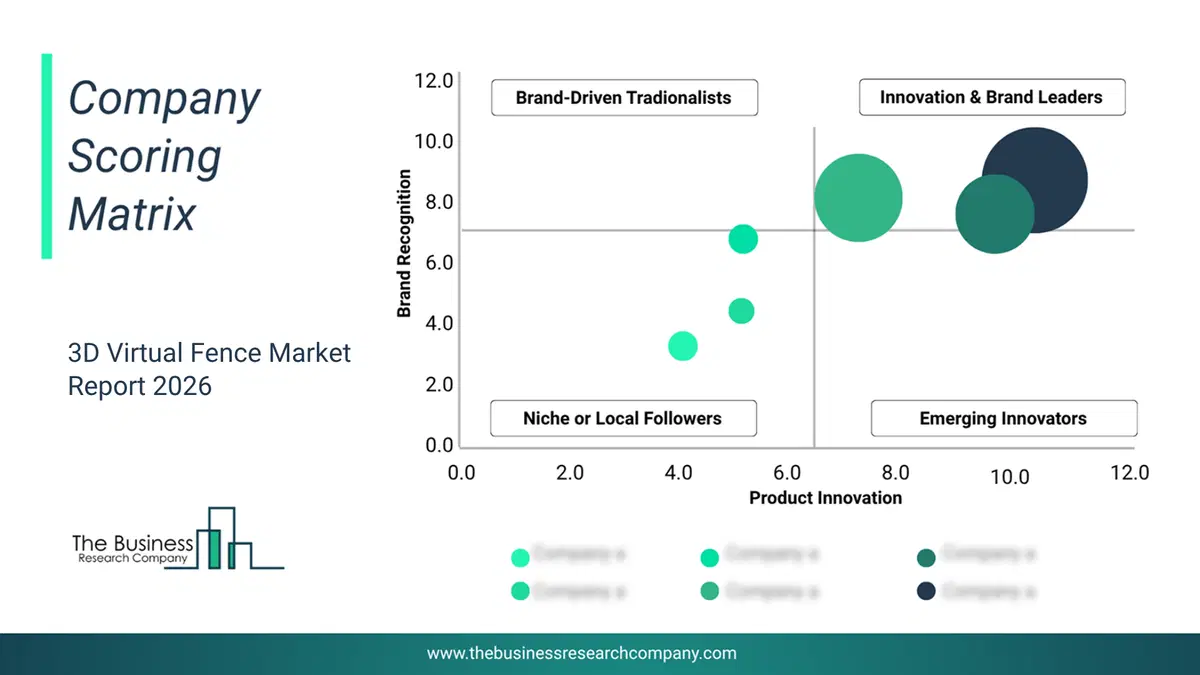
This chart maps companies by product innovation and brand strength, with bubble size indicating relative revenue, helping identify market leaders, challengers, and niche players. This is an illustrative chart; the full report provides a complete and accurate competitive analysis.
Global 3D Virtual Fence Market Trends and Insights
Major companies operating in the 3D virtual fence market are focusing on developing innovative solutions such as artificial intelligence (AI)-powered virtual safety fence systems to enhance workplace safety and streamline automated operations. Artificial intelligence (AI)-powered virtual safety fences use advanced 3D digital twin modeling, edge AI, and vision analytics to create dynamic safety zones around machinery and robots, offering a flexible alternative to traditional physical barriers that cannot adapt to changing workflows. For instance, in October 2025, Accenture plc, a U.S.-headquartered global professional services company, launched Physical AI Orchestrator, a cloud-based solution that enables manufacturers to build live digital twins of physical facilities and implement virtual safety fences. The system captures real-time video of human, vehicle, and robot movements at centimeter-level precision, simulates potential safety scenarios, and automatically stops or reroutes machinery when humans enter designated zones. Unique features include AI agents for simulation and instruction generation, reality capture for creating accurate 3D models, and integration with existing equipment for seamless deployment. Applications of the system include improving pedestrian safety in warehouses, reducing workplace accidents, and optimizing operational efficiency without physical infrastructure changes.What Are Latest Mergers And Acquisitions In The 3D Virtual Fence Market?
In March 2023, CrossControl AB, a Sweden-based industrial vehicle technology company, partnered with Mälardalen University to enhance situational awareness and operator response in off-highway vehicles. With this partnership, CrossControl and Mälardalen University aim to develop AI- and computer vision-based solutions for virtual fencing, hazard detection, and object recognition, enabling safer and more efficient operation of forklifts, cranes, tractors, and other industrial vehicles. Mälardalen University is a Sweden-based higher education institution specializing in technology and applied research.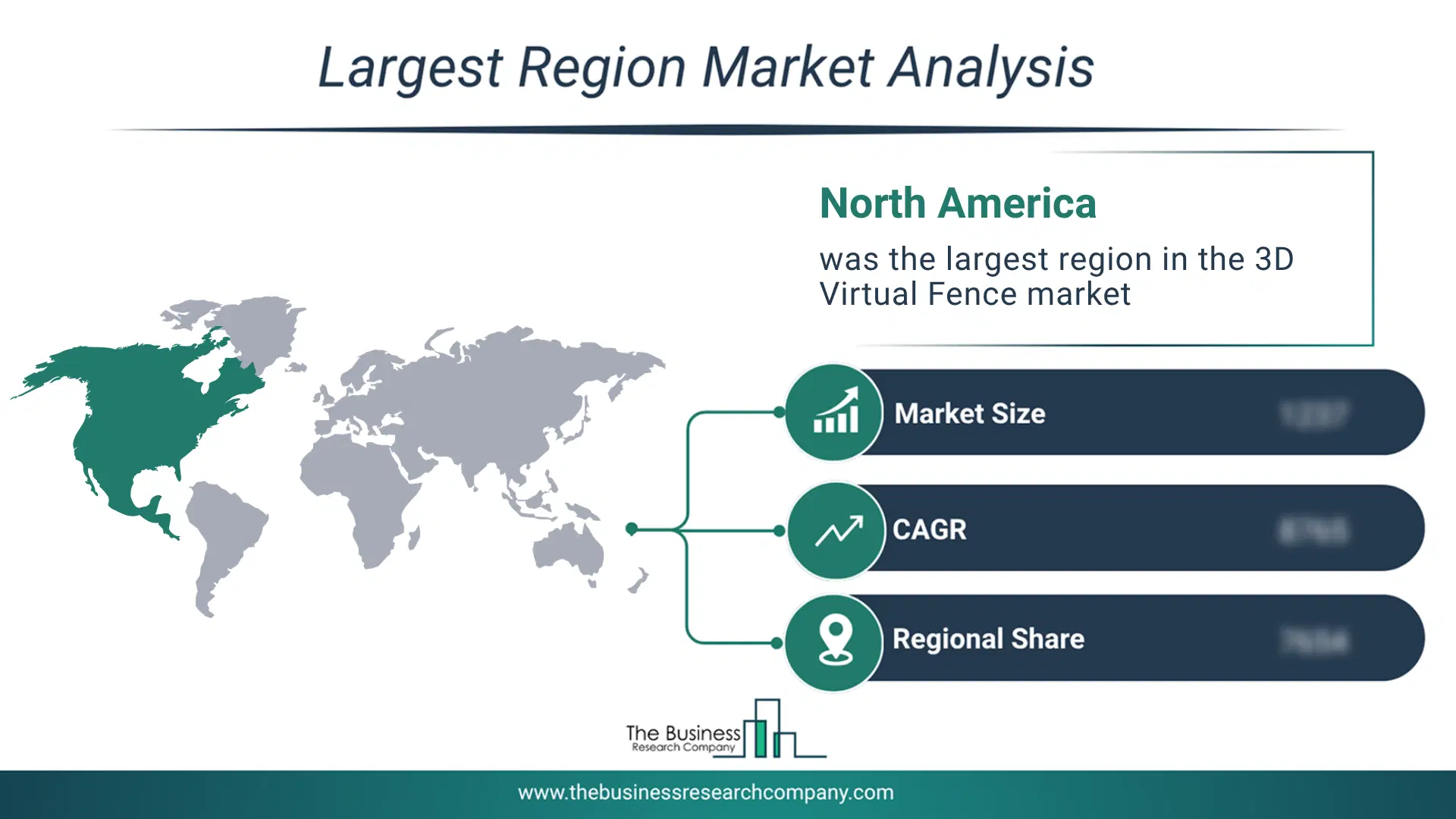
Regional Insights
North America was the largest region in the 3D virtual fence market in 2025. Asia-Pacific is expected to be the fastest-growing region in the forecast period. The regions covered in this market report are Asia-Pacific, South East Asia, Western Europe, Eastern Europe, North America, South America, Middle East, Africa. The countries covered in this market report are Australia, Brazil, China, France, Germany, India, Indonesia, Japan, Taiwan, Russia, South Korea, UK, USA, Canada, Italy, SpainWhat Defines the 3D Virtual Fence Market?
The 3D virtual fence market includes revenues earned by entities by providing services such as height range detection, monitoring and alert systems, security management, and data analysis. The market value includes the value of related goods sold by the service provider or included within the service offering. Only goods and services traded between entities or sold to end consumers are included. The 3D virtual fence market consists of sales of advanced cameras, sensors, and servers. Values in this market are ‘factory gate’ values, that is, the value of goods sold by the manufacturers or creators of the goods, whether to other entities (including downstream manufacturers, wholesalers, distributors, and retailers) or directly to end customers. The value of goods in this market includes related services sold by the creators of the goods.How is Market Value Defined and Measured?
The market value is defined as the revenues that enterprises gain from the sale of goods and/or services within the specified market and geography through sales, grants, or donations in terms of the currency (in USD unless otherwise specified). The revenues for a specified geography are consumption values that are revenues generated by organizations in the specified geography within the market, irrespective of where they are produced. It does not include revenues from resales along the supply chain, either further along the supply chain or as part of other products.
This chart presents market attractiveness based on a quantitative evaluation of growth, competition, strategic alignment, and risk, offering a clear view of opportunity areas for decision-making. This chart is for illustrative purposes; the full report contains the complete analysis.

This chart highlights the Total Addressable Market (TAM) by estimating the maximum revenue opportunity using an assumption-driven approach, supporting strategic planning and opportunity sizing across markets. The chart is illustrative; the full report provides a more comprehensive analysis.
What Key Data and Analysis Are Included in the 3D Virtual Fence Market Report 2026?
The 3d virtual fence market research report is one of a series of new reports from The Business Research Company that provides market statistics, including industry global market size, regional shares, competitors with the market share, detailed market segments, market trends and opportunities, and any further data you may need to thrive in the 3d virtual fence industry. The market research report delivers a complete perspective of everything you need, with an in-depth analysis of the current and future state of the industry.3D Virtual Fence Market Report Forecast Analysis
| Report Attribute | Details |
|---|---|
| Market Size Value In 2026 | $7.34 billion |
| Revenue Forecast In 2030 | $15.93 billion |
| Growth Rate | CAGR of 21.4% from 2026 to 2030 |
| Base Year For Estimation | 2025 |
| Actual Estimates/Historical Data | 2020-2025 |
| Forecast Period | 2026 - 2030 |
| Market Representation | Revenue in USD Billion and CAGR from 2026 to 2030 |
| Segments Covered | Type, Deployment, End-User |
| Regional Scope | Asia-Pacific, Western Europe, Eastern Europe, North America, South America, Middle East, Africa |
| Country Scope | The Countries Covered In This Market Report Are Australia, Brazil, China, France, Germany, India, Indonesia, Japan, Taiwan, Russia, South Korea, Uk, Usa, Canada, Italy, Spain. |
| Key Companies Profiled | Avigilon Corporation, Genetec Inc., Bosch Security Systems Inc., March Networks Corporation, IndigoVision Group plc, Controp Precision Technologies Ltd., Senstar Corporation, Magal Security Systems Ltd., D-Fend Solutions, Optex Co. Ltd., SpotterRF, Robin Radar Systems, LIPS Corporation, Fiber SenSys Inc., Sensofusion Oy, PureTech Systems, Rbtec Perimeter Security Systems, ACSE GmbH, FLIR Systems, Hikvision Digital Technology |
| Customization Scope | Request for Customization |
| Pricing And Purchase Options | Explore Purchase Options |