
Food And Beverages E-Commerce Market Report 2026
Global Outlook – By Type (Grocery Delivery And Pickup, Direct-to-Consumer (DTC) Products, Meal Kits And Fresh Ready-To-Eat Meals, Restaurant Meal Delivery), By Delivery Channel (Store Pick-Up, Home Delivery), By End Users (Households, Businesses) – Market Size, Trends, Strategies, and Forecast to 2030
Food And Beverages E-Commerce Market Overview
• Food And Beverages E-Commerce market size has reached to $765.23 billion in 2025 • Expected to grow to $1688.9 billion in 2030 at a compound annual growth rate (CAGR) of 17.2% • Growth Driver: The Surge In Smartphone Users Fuels Growth In Food And Beverages E-Commerce Market • Market Trend: Strategic Partnerships Drive Expansion Of Alcohol E Commerce Platforms • North America was the largest region in 2025 and Asia-Pacific is the fastest growing region.What Is Covered Under Food And Beverages E-Commerce Market?
The food and beverage (F&B) e-commerce refers to online sales of food and beverage and related services, primarily for household consumption. The food and beverage eCommerce comprises of processing raw food materials and beverages, packaging, distributing them, and having an online portal or application for their sales. The main types of food and beverage (F&B) e-commerce are grocery delivery and pickup, DTC products, meal kits, fresh ready-to-eat meals, and restaurant meal delivery. DTC products refer to the method of distributing a product directly to a consumer rather than using wholesalers as middlemen or limiting sales to retail outlets. The various delivery channels included are pick-up, home delivery that is used by households, and business end-users.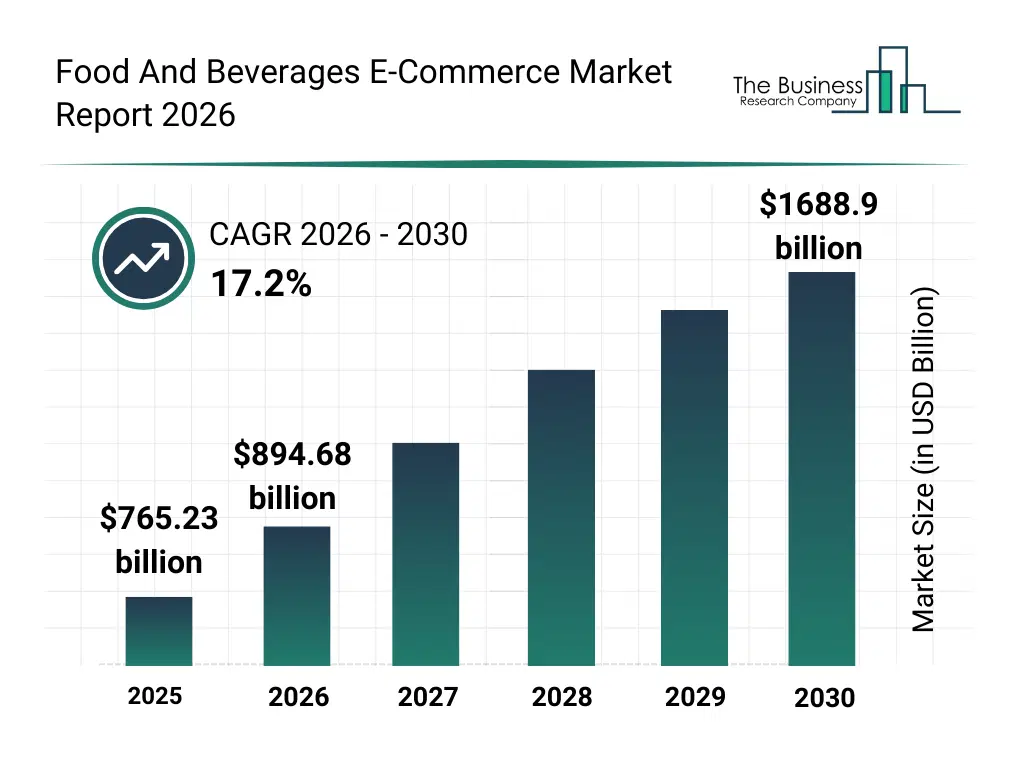
What Is The Food And Beverages E-Commerce Market Size and Share 2026?
The food and beverages e-commerce market size has grown rapidly in recent years. It will grow from $765.23 billion in 2025 to $894.68 billion in 2026 at a compound annual growth rate (CAGR) of 16.9%. The growth in the historic period can be attributed to growing internet penetration, increase in smartphone adoption, rising urban population, convenience-seeking consumer behavior, expansion of e-commerce platforms.What Is The Food And Beverages E-Commerce Market Growth Forecast?
The food and beverages e-commerce market size is expected to see rapid growth in the next few years. It will grow to $1688.9 billion in 2030 at a compound annual growth rate (CAGR) of 17.2%. The growth in the forecast period can be attributed to advancements in logistics infrastructure, growth in subscription-based models, integration of ai and analytics for personalized offerings, expansion into tier-2 and tier-3 cities, increasing demand for sustainable packaging. Major trends in the forecast period include increasing adoption of online grocery shopping, growth of direct-to-consumer (dtc) food brands, rising popularity of meal kit services, expansion of same-day and contactless delivery options, rising focus on health-conscious and specialty diet products.
Global Food And Beverages E-Commerce Market Segmentation
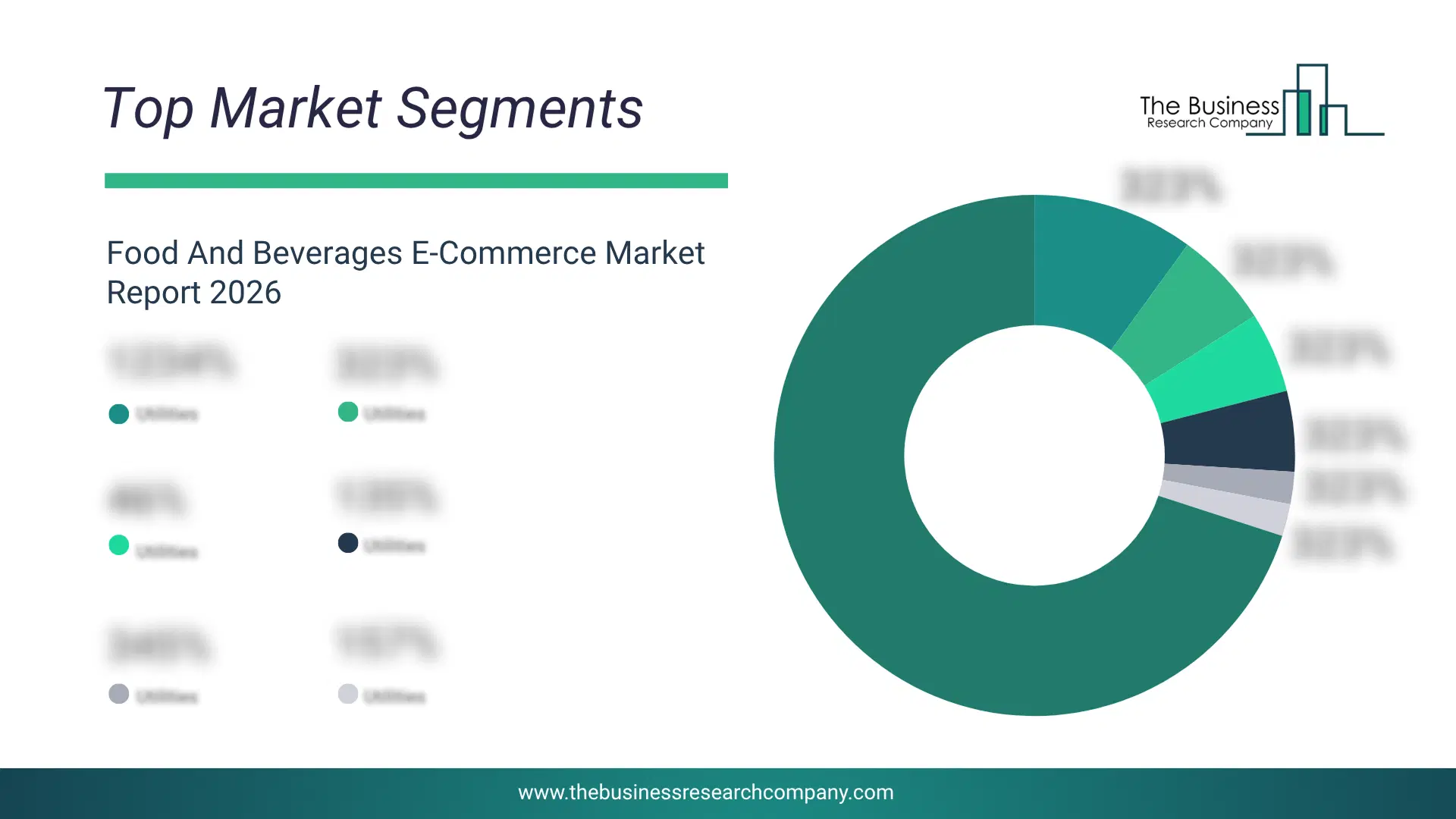
1) By Type: Grocery Delivery And Pickup, Direct-to-Consumer (DTC) Products, Meal Kits And Fresh Ready-To-Eat Meals, Restaurant Meal Delivery 2) By Delivery Channel: Store Pick-Up, Home Delivery 3) By End Users: Households, Businesses Subsegments: 1) By Grocery Delivery And Pickup: Online Grocery Delivery Services, Click And Collect Services, Subscription-Based Grocery Delivery, Same-Day Delivery Services 2) By Direct-to-Consumer (DTC) Products: Organic And Specialty Foods, Packaged Snacks And Beverages, Health And Wellness Products, Frozen and Prepared Meals 3) By Meal Kits And Fresh Ready-To-Eat Meals: Meal Kit Delivery Services, Pre-Portioned Ingredient Kits, Fresh Prepared Meals for Delivery, Specialty Diet Meal Kits 4) By Restaurant Meal Delivery: On-Demand Food Delivery Services, Restaurant Partnerships For Delivery, Multi-Restaurant Delivery Platforms, Subscription-Based Restaurant Delivery ServicesWhat Is The Driver Of The Food And Beverages E-Commerce Market?
The increase in smartphone users is expected to propel the growth of food and beverage (F&B) e-commerce market going forward. Smartphones are internet-enabled devices that allow consumers to access online food ordering platforms, browse menus, compare prices, and complete secure digital payments through mobile applications. The demand for smartphone-based shopping is increasing as consumers prefer convenient, time-saving purchasing options that can be accessed anytime and anywhere. Food and beverage e-commerce platforms leverage smartphones to offer real-time order tracking, personalized recommendations, and app-based promotions. This enhances consumer convenience, reduces reliance on physical stores, and supports the expansion of mobile-driven F&B online sales globally. For instance, in October 2023, according to the Global System for Mobile Communications Association (GSMA), a UK-based global industry organisation, 54% of the global population, some 4.3 billion people, owned a smartphone. Therefore, an increase in smartphone users and internet penetration is driving growth in food & beverages e-commerce market.What Is The Driver Of The Food And Beverages E-Commerce Market?
Growing consumption of functional and ready-to-eat food products is expected to propel the growth of the food and beverages e-commerce market going forward. Functional foods are products that provide health benefits beyond basic nutrition when consumed as part of a regular diet. Food and beverage e-commerce platforms provide convenient access to functional foods, promoting a healthier lifestyle through online shopping. For instance, in April 2024, Agriculture and Agri-Food Canada, a Canada-based government agency published that ready meals which is a ready-to-eat (RTE) food reached sales of $3.19 billion (Can$4.4 billion) in 2023 and the price of ready meals was $6,633.65 million (Can$9,147.9 million) in 2023, an increase from $6,362.2 million (Can$ 8,773.6 million) in 2022. Therefore, the growing consumption of functional food products is driving the food and beverages e-commerce industry.Key Players In The Global Food And Beverages E-Commerce Market
Major companies operating in the food and beverages e-commerce market are Walmart Inc, Amazon.com Inc, Koninklijke Ahold Delhaize NV, Alibaba Group Holding Limited, Target Corporation, The Kroger Company, Bigbasket, Swiggy, Zomato, Meituan, Woolworths Group Limited, AEON Co Ltd, Seven and i Holdings Co Ltd, Carrefour SA, Auchan Retail, Tesco plc, J Sainsbury plc, REWE Group, Migros Cooperative, Coop Group Switzerland, Mercadona SA, Coles Group Limited, Loblaw Companies Limited, Sobeys Inc, Cencosud SA, Majid Al Futtaim Group, Lulu Group International, HelloFresh SE, Rohlik Group, Jumia Technologies AG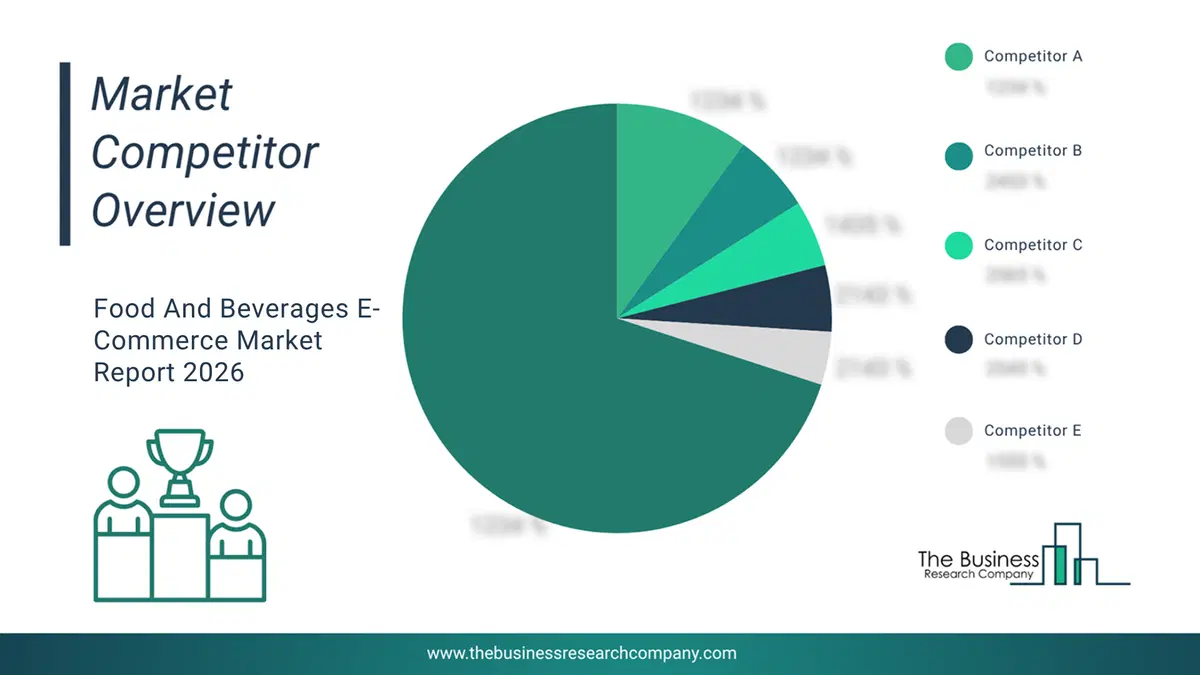
This chart is for illustrative purposes; the full report includes a detailed competitor analysis and comprehensive overview of the top 10 companies in the market.
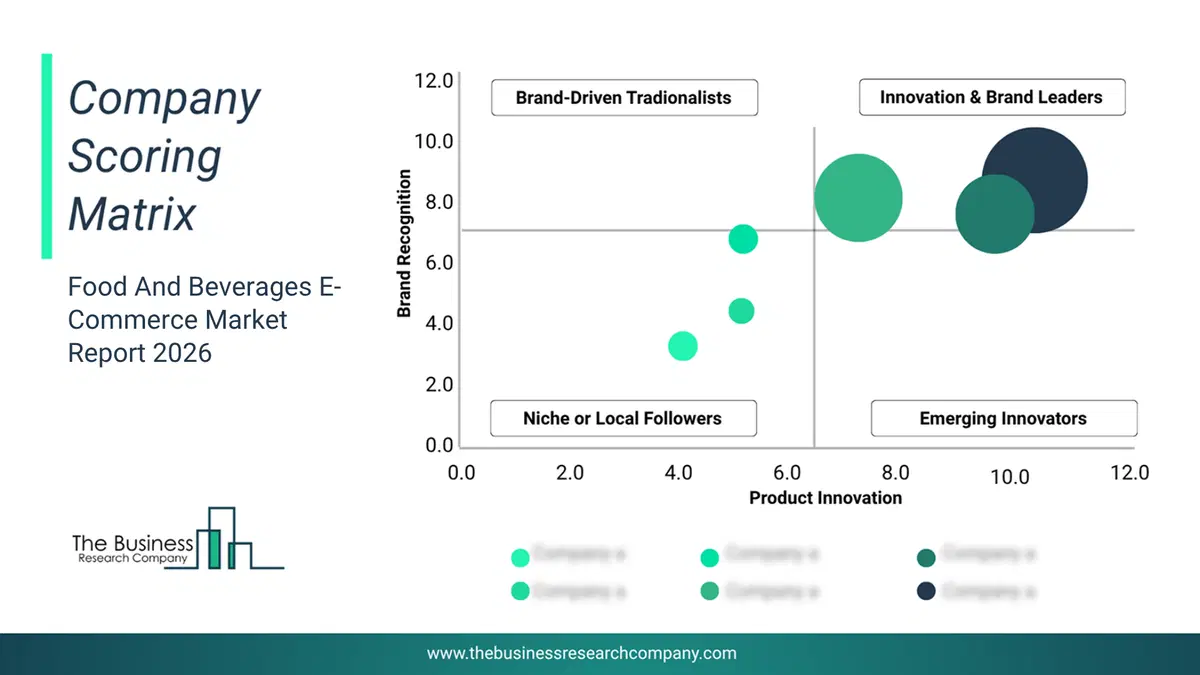
This chart maps companies by product innovation and brand strength, with bubble size indicating relative revenue, helping identify market leaders, challengers, and niche players. This is an illustrative chart; the full report provides a complete and accurate competitive analysis.
Global Food And Beverages E-Commerce Market Trends and Insights
Major companies operating in the food and beverages e commerce market are focusing on strategic collaborations to expand product offerings, reach new customer segments, and enhance supply chain efficiency. Strategic partnerships in this context refer to agreements between e commerce platforms and retail or grocery brands that enable wider distribution and improved digital access to beverages. For instance, in June 2024, DoorDash, a U.S.-based on-demand delivery platform, expanded its partnerships with multiple retail and grocery brands to grow its alcohol e commerce reach, resulting in a more than 60 % increase in the number of liquor stores available on its platform across the U.S. This collaboration enabled DoorDash to offer on-demand beer, wine, and spirits delivery from a broader range of merchants, including select Food Lion, Giant Food, Stop & Shop, and other liquor store partners, while providing participating brands with enhanced visibility and new customer segments through both delivery access and retail media solutions.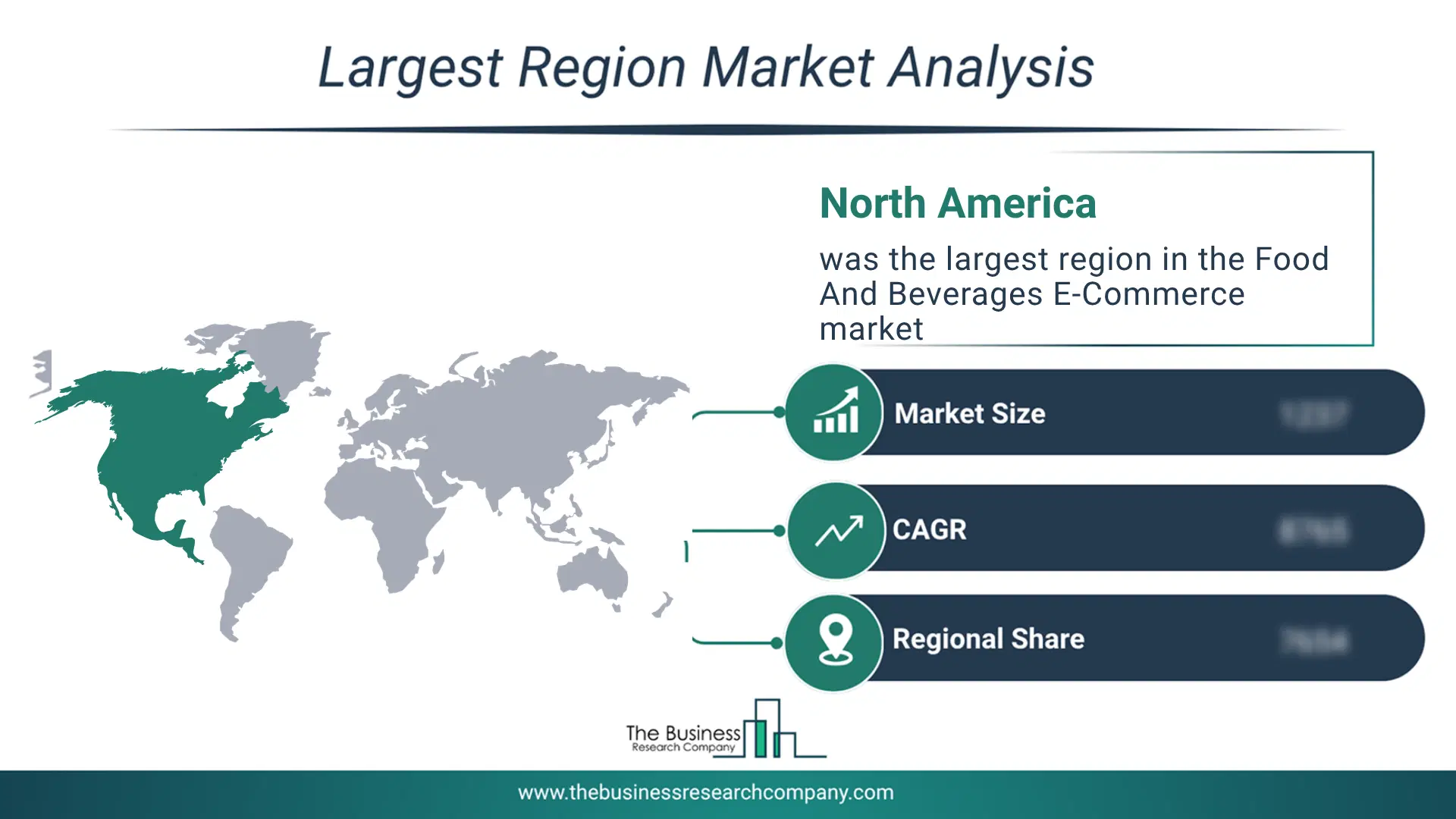
Regional Outlook
North America was the largest region in the food and beverage (F&B) e-commerce market in 2025. Asia-Pacific was the second-largest region in the global food and beverage (F&B) e-commerce market share. The regions covered in this market report are Asia-Pacific, South East Asia, Western Europe, Eastern Europe, North America, South America, Middle East and Africa. The countries covered in this market report are Australia; Brazil; China; France; Germany; India; Indonesia; Japan; Taiwan; Russia; South Korea; UK; USA; Canada; Italy; Spain.What Defines the Food And Beverages E-Commerce Market?
The food and beverage (F&B) e-commerce market includes revenues earned by entities by fresh, prepared, and packaged foods and alcoholic and non-alcoholic beverages. The market value includes the value of related goods sold by the service provider or included within the service offering. Only goods and services traded between entities or sold to end consumers are included.How is Market Value Defined and Measured?
The market value is defined as the revenues that enterprises gain from the sale of goods and/or services within the specified market and geography through sales, grants, or donations in terms of the currency (in USD unless otherwise specified). The revenues for a specified geography are consumption values that are revenues generated by organizations in the specified geography within the market, irrespective of where they are produced. It does not include revenues from resales along the supply chain, either further along the supply chain or as part of other products.
This chart presents market attractiveness based on a quantitative evaluation of growth, competition, strategic alignment, and risk, offering a clear view of opportunity areas for decision-making. This chart is for illustrative purposes; the full report contains the complete analysis.

This chart highlights the Total Addressable Market (TAM) by estimating the maximum revenue opportunity using an assumption-driven approach, supporting strategic planning and opportunity sizing across markets. The chart is illustrative; the full report provides a more comprehensive analysis.
What Key Data and Analysis Are Included in the Food And Beverages E-Commerce Market Report 2026?
The food and beverages e-commerce market research report is one of a series of new reports from The Business Research Company that provides market statistics, including industry global market size, regional shares, competitors with the market share, detailed market segments, market trends and opportunities, and any further data you may need to thrive in the food and beverages e-commerce industry. The market research report delivers a complete perspective of everything you need, with an in-depth analysis of the current and future state of the industry.Food And Beverages E-Commerce Market Report Forecast Analysis
| Report Attribute | Details |
|---|---|
| Market Size Value In 2026 | $398.08 billion |
| Revenue Forecast In 2030 | $577.22 billion |
| Growth Rate | CAGR of 8.3% from 2026 to 2030 |
| Base Year For Estimation | 2025 |
| Actual Estimates/Historical Data | 2020-2025 |
| Forecast Period | 2026 - 2030 |
| Market Representation | Revenue in USD Billion and CAGR from 2026 to 2030 |
| Segments Covered | Type, Delivery Channel, End Users |
| Regional Scope | Asia-Pacific, Western Europe, Eastern Europe, North America, South America, Middle East, Africa |
| Country Scope | The countries covered in the report are Australia, Brazil, China, France, Germany, India, Indonesia, Japan, Taiwan, Russia, South Korea, UK, USA, Canada, Italy, Spain. |
| Key Companies Profiled | Walmart Inc, Amazon.com Inc, Koninklijke Ahold Delhaize NV, Alibaba Group Holding Limited, Target Corporation, The Kroger Company, Bigbasket, Swiggy, Zomato, Meituan, Woolworths Group Limited, AEON Co Ltd, Seven and i Holdings Co Ltd, Carrefour SA, Auchan Retail, Tesco plc, J Sainsbury plc, REWE Group, Migros Cooperative, Coop Group Switzerland, Mercadona SA, Coles Group Limited, Loblaw Companies Limited, Sobeys Inc, Cencosud SA, Majid Al Futtaim Group, Lulu Group International, HelloFresh SE, Rohlik Group, Jumia Technologies AG |
| Customization Scope | Request for Customization |
| Pricing And Purchase Options | Explore Purchase Options |