
Food Blenders And Mixers Market Report 2026
Global Outlook – By Type (High Shear Mixer, Shaft Mixer, Screw Mixer And Blender, Double Cone Blender, Ribbon Blender, Planetary Mixer, Other Types), By Technology (Batch Mixing, Continuous Mixing), By Mode Of Operation (Automatic, Semi-Automatic), By Application (Bakery, Dairy, Beverage, Confectionary, Other Applications), By End-User (Household, Commercial) – Market Size, Trends, Strategies, and Forecast to 2030
Food Blenders And Mixers Market Overview
• Food Blenders And Mixers market size has reached to $9.59 billion in 2025 • Expected to grow to $13.18 billion in 2030 at a compound annual growth rate (CAGR) of 6.5% • Growth Driver: Rising Demand For Bakery Products Drives Growth In The Food Blenders And Mixers Market • Market Trend: Stovekraft Launches Pigeon Nutri Mixer 900 India's First All-In-One Kitchen Appliance • Europe was the largest region in 2025 and Asia-Pacific is the fastest growing region.What Is Covered Under Food Blenders And Mixers Market?
Food blenders and mixers refer to kitchen appliances used to combine, blend, and emulsify food ingredients into a uniform mixture. They are used for blending soups, pureeing fruits and vegetables, mixing dough, and preparing smoothies and sauces. These tools save time and ensure uniform results in food preparation. The main types of food blenders and mixers are high shear mixers, shaft mixers, screw mixers and blenders, double cone blenders, ribbon blenders, planetary mixers, and others. High-shear mixers refer to the devices that help immiscible mixtures having components of the same or distinct phases be emulsified, homogenized, dispersed, ground, and/or dissolved. They are manufactured with several technologies, such as batch mixing and continuous mixing in automatic mode, semi-automatic mode of operations. This are applied in bakery, dairy, beverage, confectionery, and others for household and commercial purposes.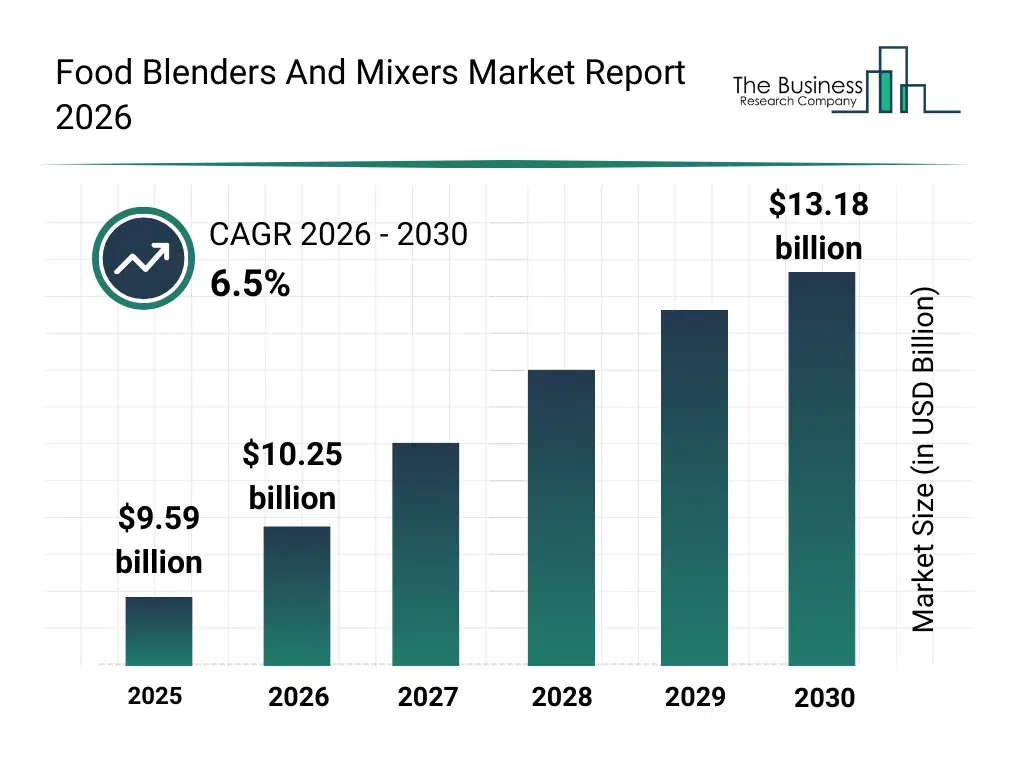
What Is The Food Blenders And Mixers Market Size and Share 2026?
The food blenders and mixers market size has grown strongly in recent years. It will grow from $9.59 billion in 2025 to $10.25 billion in 2026 at a compound annual growth rate (CAGR) of 6.8%. The growth in the historic period can be attributed to growth in commercial food preparation activities, increasing demand for processed food products, rising adoption of industrial kitchen equipment, availability of standardized mixing solutions, expansion of foodservice establishments.What Is The Food Blenders And Mixers Market Growth Forecast?
The food blenders and mixers market size is expected to see strong growth in the next few years. It will grow to $13.18 billion in 2030 at a compound annual growth rate (CAGR) of 6.5%. The growth in the forecast period can be attributed to increasing investments in commercial kitchens, rising demand for precision food preparation, expansion of automated food production lines, growing focus on energy-efficient appliances, increasing adoption of smart kitchen equipment. Major trends in the forecast period include increasing adoption of energy-efficient mixing equipment, rising demand for high-capacity commercial mixers, growing use of automated batch mixing systems, expansion of continuous mixing technologies, enhanced focus on product consistency.Tariff Impact On Food Blenders And Mixers Market
Tariffs are affecting the food blenders and mixers market by increasing costs of imported motors, stainless steel components, electronic controllers, and precision blades used in both commercial and industrial equipment. Commercial kitchens and food processing facilities in North America and Europe are most impacted due to reliance on imported high-performance mixers, while Asia-Pacific manufacturers face higher export costs. These tariffs are increasing equipment prices and delaying replacement cycles. However, they are also encouraging domestic manufacturing of mixers, local sourcing of components, and development of modular and cost-optimized blending solutions for regional markets.
Global Food Blenders And Mixers Market Segmentation
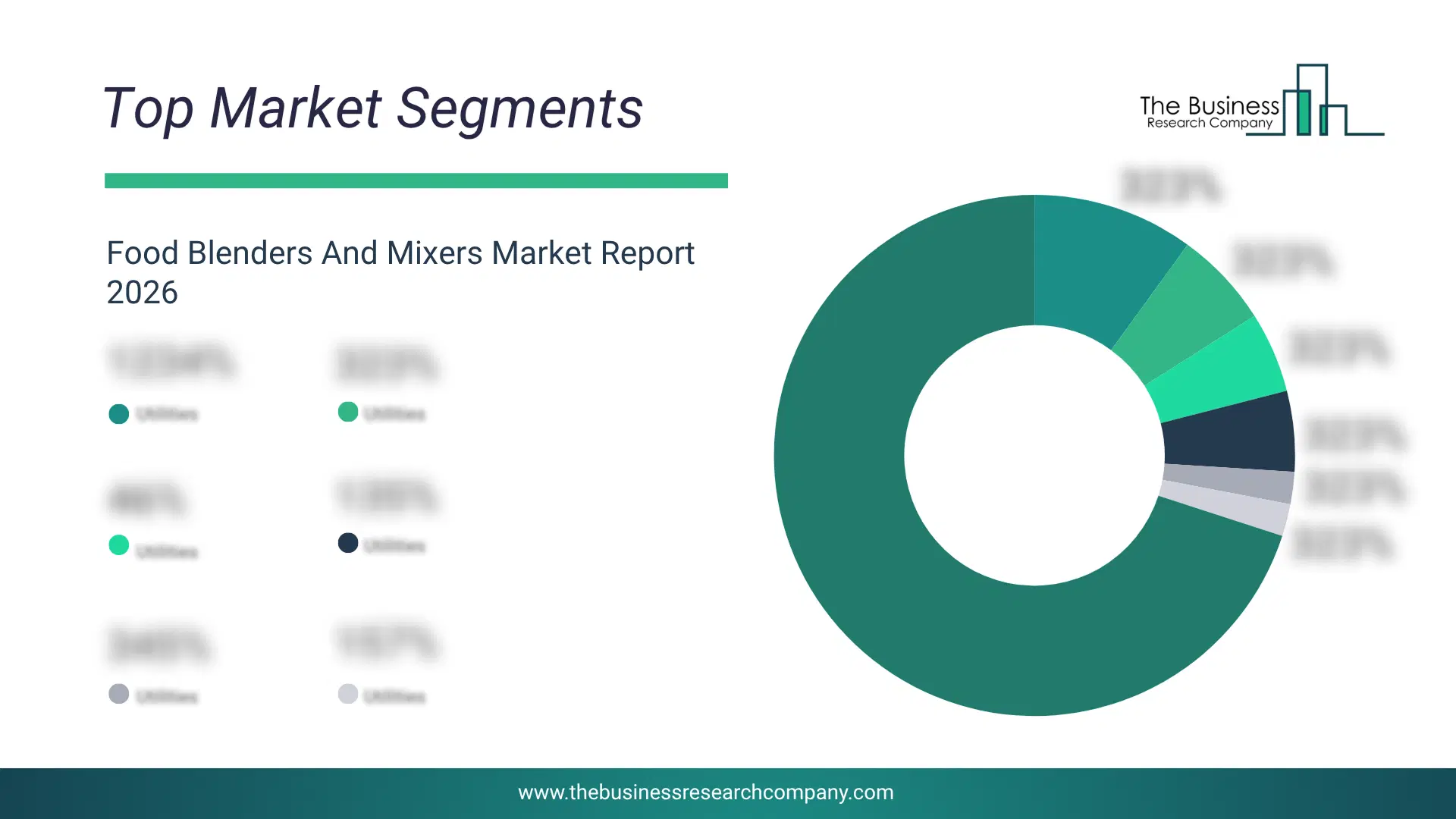
1) By Type: High Shear Mixer, Shaft Mixer, Screw Mixer And Blender, Double Cone Blender, Ribbon Blender, Planetary Mixer, Other Types 2) By Technology: Batch Mixing, Continuous Mixing 3) By Mode Of Operation: Automatic, Semi-Automatic 4) By Application: Bakery, Dairy, Beverage, Confectionary, Other Applications 5) By End-User: Household, Commercial Subsegments: 1) By High Shear Mixer: Batch Rotor-Stator Mixer, Batch High Shear Emulsifier 2) By Shaft Mixer: Fixed Shaft Mixer, Portable Shaft Mixer 3) By Screw Mixer And Blender: Horizontal Screw Mixer, Vertical Screw Mixer 5) By Double Cone Blender: Static Double Cone Blender, Dynamic Double Cone Blender 5) By Ribbon Blender: Horizontal Ribbon Blender, Vertical Ribbon Blender 6) By Planetary Mixer: Bench Top Planetary Mixer, Large Scale Planetary Mixer 7) By Other Types: Paddle Mixer, Drum Mixer, Colloid MillWhat Is The Driver Of The Food Blenders And Mixers Market?
Rising demand for bakery products is expected to propel the growth of the food blenders and mixers market going forward. Bakery products refer to a wide range of food items that are baked in an oven, such as bread, cakes, pastries, cookies, muffins, croissants, and bagels. Food blenders and mixers play a vital role in the preparation of bakery products by providing efficient and consistent mixing, blending, and kneading of ingredients. For instance, in February 2024, according to the report published by Agriculture and Agri-Food Canada, a department of the Government of Canada, in 2023, retail sales of baked goods in the U.S. increased to $86,641.3 million, up from $82,933.7 million in 2022, reflecting a growth of approximately 4.3%. Therefore, rising demand for bakery products is driving the growth of the food blenders and mixers industry.Key Players In The Global Food Blenders And Mixers Market
Major companies operating in the food blenders and mixers market are Whirlpool Corporation, Tetra Laval International S.A., Electrolux AB, GEA Group AG, Alfa Laval AB, Sulzer AG, John Bean Technologies Corporation, Hobart Corporation, Breville Group, Hamilton Beach Brands Inc., Smeg S.p.A, Hosokawa Micron Corporation, EKATO Holding GmbH, Buhler Holding AG, Vitamix Corporation, Braun GmbH, Vollrath Company LLC, Blendtec, Kenwood Limited, Dualit Limited, Omega Products Inc., Robot Coupe USA, Amixon GmBH, Admix Inc., Biro Manufacturing Company, Ninja Kitchen, Charles Ross & Son Company, TechnoSilos AP, Globe Equipment Company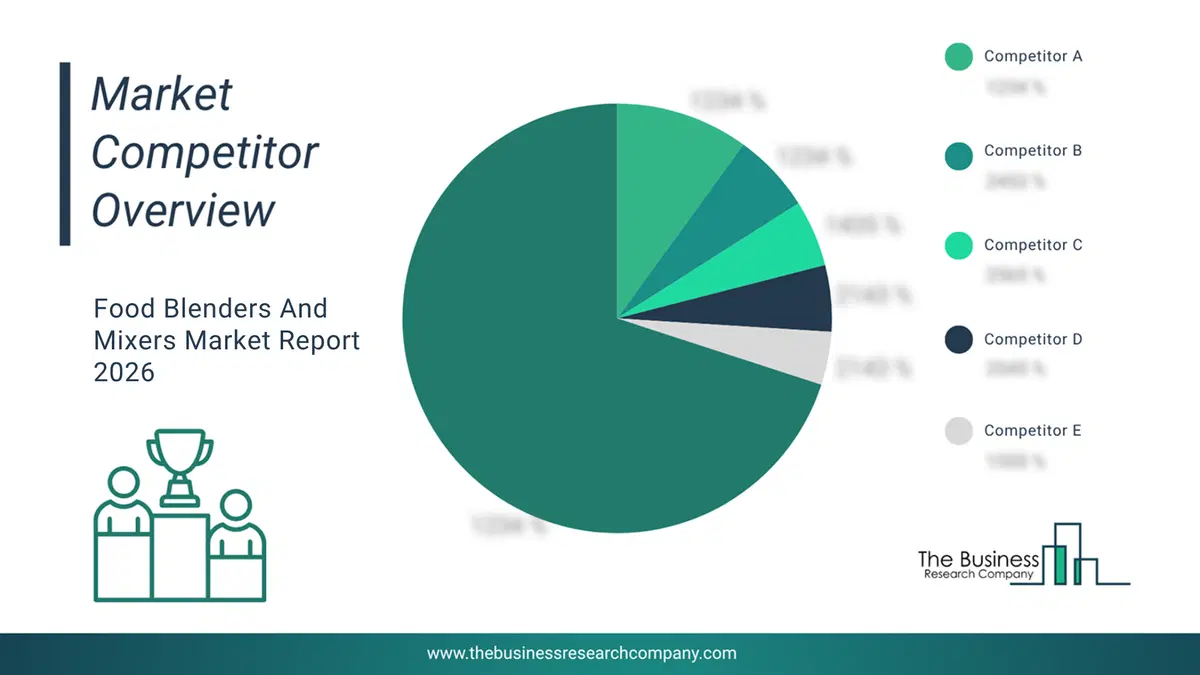
This chart is for illustrative purposes; the full report includes a detailed competitor analysis and comprehensive overview of the top 10 companies in the market.
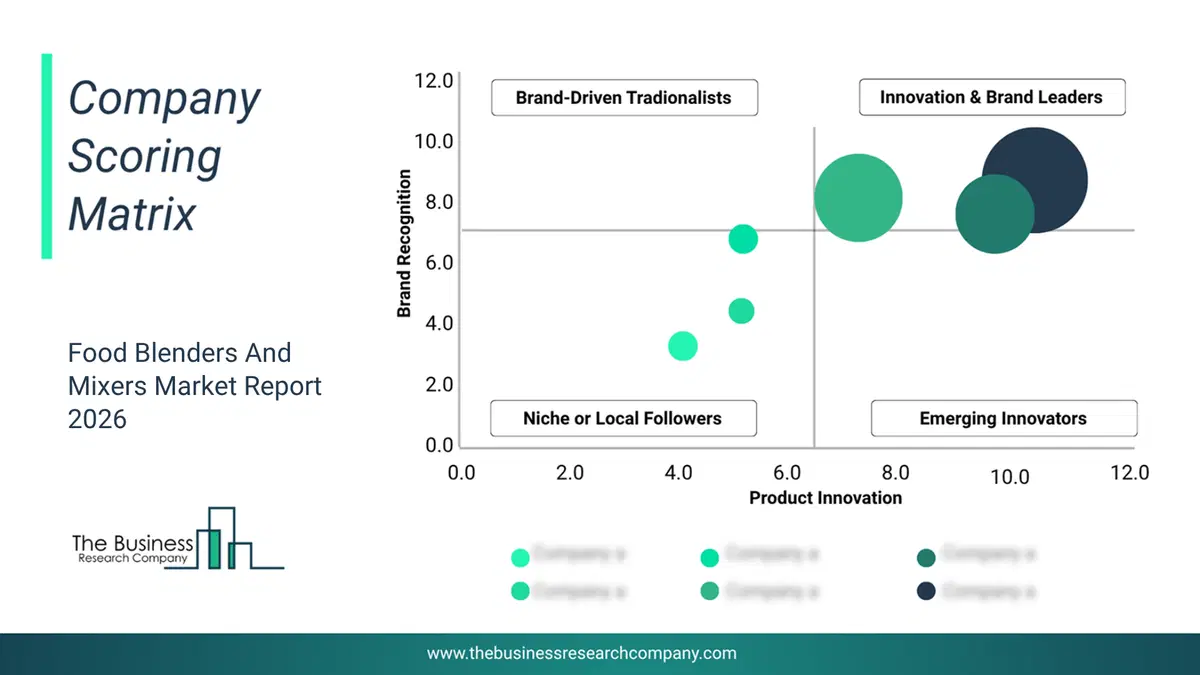
This chart maps companies by product innovation and brand strength, with bubble size indicating relative revenue, helping identify market leaders, challengers, and niche players. This is an illustrative chart; the full report provides a complete and accurate competitive analysis.
Global Food Blenders And Mixers Market Trends and Insights
Major companies operating in the food blender and mixer market are focusing on product development and launches such as all-in-one mixing, juicing, boiling, and grinding systems to sustain their position in the market. An all-in-one, juicing, boiling, and grinding system refers to a kitchen appliance or device that combines multiple functions into a single unit. For instance, in October 2023, Stovekraft, an India-based company that operates in the kitchen appliance sector and also manufactures a wide range of kitchen products, including cookware and kitchen appliances, launched the Pigeon Nutri Mixer 900, marking India's first all-in-one mixing, juicing, boiling, and grinding system. This innovative kitchen appliance, crafted in India, is designed to streamline cooking processes by consolidating the functionalities of various kitchen appliances into a single device. The Pigeon Nutri Mixer 900 aims to offer users convenience and versatility, allowing them to perform mixing, juicing, blending, and grinding tasks with a single appliance. This Made in India solution reflects Stovekraft's commitment to innovation in kitchen appliances, providing consumers with an efficient and multifunctional cooking companion.What Are Latest Mergers And Acquisitions In The Food Blenders And Mixers Market?
In January 2024, The Legacy Companies LLC, a US-based consumer products and food‑service equipment manufacturer, acquired the kitchen countertop appliance and smallwares product lines of Kalorik International NV for an undisclosed amount. With this acquisition, The Legacy Companies aimed to expand its brand portfolio and strengthen its presence in the countertop appliance market, leveraging Kalorik’s reputation to enhance its product innovation and cross‑sell opportunities. Kalorik International NV is a US-based company that specializes in providing electric kitchen countertop appliances and non‑electric kitchenware and utensils for home cooking and food preparation.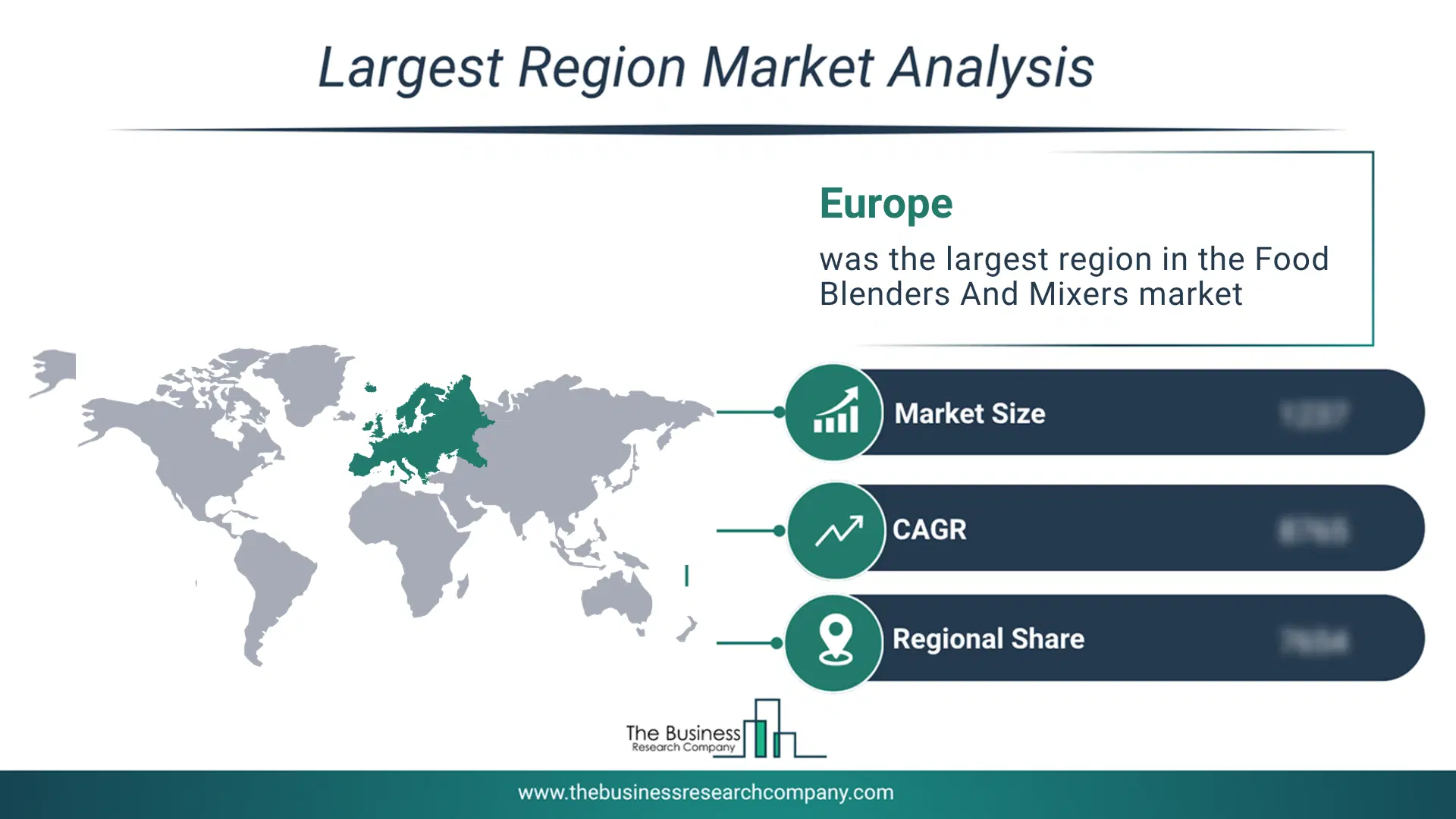
Regional Outlook
Europe was the largest region in the food blenders and mixers market in 2025. Asia-Pacific is expected to be the fastest-growing region in the forecast period. The regions covered in this market report are Asia-Pacific, South East Asia, Western Europe, Eastern Europe, North America, South America, Middle East, Africa The countries covered in this market report are Australia, Brazil, China, France, Germany, India, Indonesia, Japan, Taiwan, Russia, South Korea, UK, USA, Canada, Italy, Spain.What Defines the Food Blenders And Mixers Market?
The food blenders and mixers market consist of revenues earned by entities by providing tumble blending, vacuum mixing, emulsification, solids, and liquid injection manifold technologies. The market value includes the value of related goods sold by the service provider or included within the service offering. The food blenders and mixers market also includes sales of agitators and propellers. Values in this market are ‘factory gate’ values, that is the value of goods sold by the manufacturers or creators of the goods, whether to other entities (including downstream manufacturers, wholesalers, distributors, and retailers) or directly to end customers. The value of goods in this market includes related services sold by the creators of the goods.How is Market Value Defined and Measured?
The market value is defined as the revenues that enterprises gain from the sale of goods and/or services within the specified market and geography through sales, grants, or donations in terms of the currency (in USD unless otherwise specified). The revenues for a specified geography are consumption values that are revenues generated by organizations in the specified geography within the market, irrespective of where they are produced. It does not include revenues from resales along the supply chain, either further along the supply chain or as part of other products.
This chart presents market attractiveness based on a quantitative evaluation of growth, competition, strategic alignment, and risk, offering a clear view of opportunity areas for decision-making. This chart is for illustrative purposes; the full report contains the complete analysis.

This chart highlights the Total Addressable Market (TAM) by estimating the maximum revenue opportunity using an assumption-driven approach, supporting strategic planning and opportunity sizing across markets. The chart is illustrative; the full report provides a more comprehensive analysis.
What Key Data and Analysis Are Included in the Food Blenders And Mixers Market Report 2026?
The food blenders and mixers market research report is one of a series of new reports from The Business Research Company that provides market statistics, including industry global market size, regional shares, competitors with the market share, detailed market segments, market trends and opportunities, and any further data you may need to thrive in the food blenders and mixers industry. The market research report delivers a complete perspective of everything you need, with an in-depth analysis of the current and future state of the industry.Food Blenders And Mixers Market Report Forecast Analysis
| Report Attribute | Details |
|---|---|
| Market Size Value In 2026 | $10.25 billion |
| Revenue Forecast In 2030 | $13.18 billion |
| Growth Rate | CAGR of 6.5% from 2026 to 2030 |
| Base Year For Estimation | 2025 |
| Actual Estimates/Historical Data | 2020-2025 |
| Forecast Period | 2026 - 2030 |
| Market Representation | Revenue in USD Billion and CAGR from 2026 to 2030 |
| Segments Covered | Type, Technology, Mode Of Operation, Application, End-User |
| Regional Scope | Asia-Pacific, Western Europe, Eastern Europe, North America, South America, Middle East, Africa |
| Key Companies Profiled | Whirlpool Corporation, Tetra Laval International S.A., Electrolux AB, GEA Group AG, Alfa Laval AB, Sulzer AG, John Bean Technologies Corporation, Hobart Corporation, Breville Group, Hamilton Beach Brands Inc., Smeg S.p.A, Hosokawa Micron Corporation, EKATO Holding GmbH, Buhler Holding AG, Vitamix Corporation, Braun GmbH, Vollrath Company LLC, Blendtec, Kenwood Limited, Dualit Limited, Omega Products Inc., Robot Coupe USA, Amixon GmBH, Admix Inc., Biro Manufacturing Company, Ninja Kitchen, Charles Ross & Son Company, TechnoSilos AP, Globe Equipment Company |
| Customization Scope | Request for Customization |
| Pricing And Purchase Options | Explore Purchase Options |