
Food Cold Chain Market Report 2026
Global Outlook – By Type Of Cold Chain (Refrigerated Transportation, Cold Storage, Ice Cream Logistics, Temperature-Controlled Warehousing), By Technology (Blast Freezing, Vapor Compression, Programmable Logic Controller (PLC), Evaporating Cooling, Cryogenic Systems, Other Technologies), By Distribution Channel (Direct Sales, Distributors And Wholesalers, Online Sales, Third-Party Logistics Providers (3PL)), By Application (Fruits And Vegetables, Dairy And Frozen Desserts, Fish, Meat, And Seafood, Bakery And Confectionery, Other Applications) – Market Size, Trends, Strategies, and Forecast to 2030
Food Cold Chain Market Overview
• Food Cold Chain market size has reached to $215.95 billion in 2025 • Expected to grow to $342.09 billion in 2030 at a compound annual growth rate (CAGR) of 9.6% • Growth Driver: The Increasing Preference For Online Grocery Shopping Is Fueling The Growth Of The Market Due To Convenient Doorstep Delivery • Market Trend: Advancements In Integrated Cold Chain Hubs For Enhanced Supply Chain Efficiency • North America was the largest region in 2025 and Asia-Pacific is the fastest growing region.What Is Covered Under Food Cold Chain Market?
The food cold chain is a temperature-managed logistics system that ensures perishable food items remain safe and fresh from the point of production until they reach the consumer. It maintains consistent low temperatures during handling, storage, and transportation to prevent spoilage, bacterial growth, and loss of quality. The main types of food cold chains include refrigerated transportation, cold storage, ice cream logistics, and temperature-controlled warehousing. Refrigerated transportation is the movement of perishable foods in insulated vehicles or containers fitted with mechanical refrigeration or equivalent equipment to keep specified temperatures throughout the journey. It uses various technologies such as blast freezing, vapor compression, programmable logic controller (PLC), evaporating cooling, cryogenic systems, and others and is distributed through direct sales, distributors and wholesalers, online sales, and third-party logistics providers (3PL). It is applied for fruits and vegetables, dairy and frozen desserts, fish, meat, and seafood, bakery and confectionery, and others by several end-users, including the food and beverage industry, pharmaceutical companies, retail chains, food processing companies, and restaurants and catering services.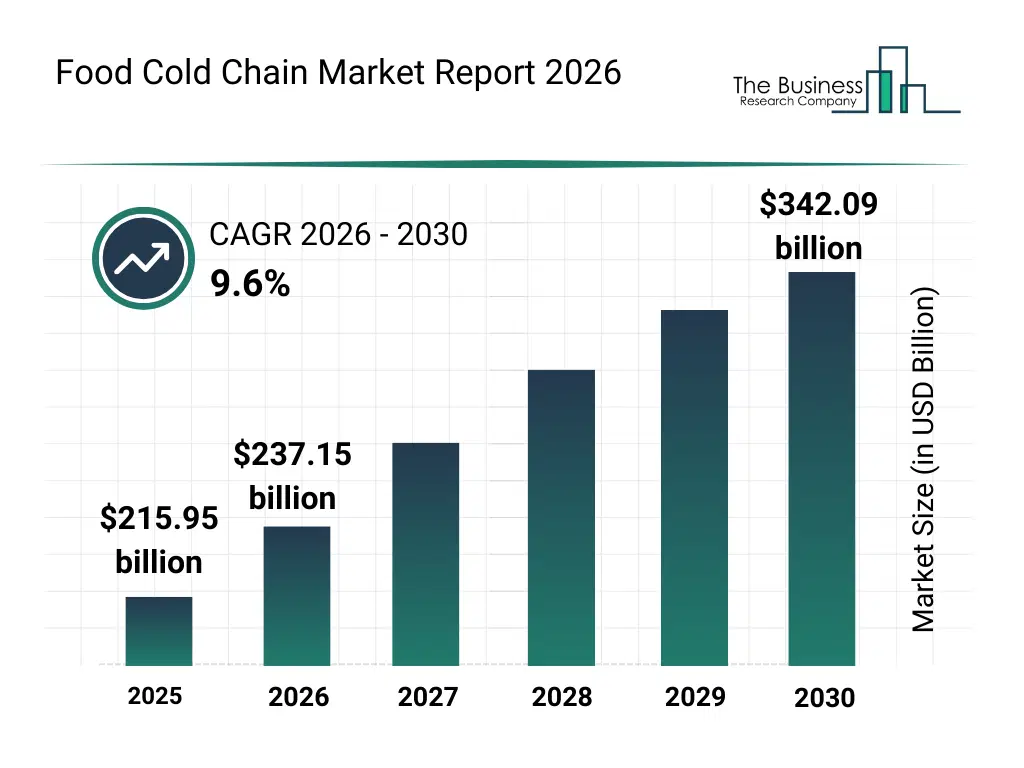
What Is The Food Cold Chain Market Size and Share 2026?
The food cold chain market size has grown strongly in recent years. It will grow from $215.95 billion in 2025 to $237.15 billion in 2026 at a compound annual growth rate (CAGR) of 9.8%. The growth in the historic period can be attributed to expansion of frozen and processed food consumption, growth of organized food retail, increasing demand for year-round food availability, development of refrigerated transport infrastructure, rising food safety regulations.What Is The Food Cold Chain Market Growth Forecast?
The food cold chain market size is expected to see strong growth in the next few years. It will grow to $342.09 billion in 2030 at a compound annual growth rate (CAGR) of 9.6%. The growth in the forecast period can be attributed to increasing growth of online grocery delivery, rising investments in cold storage infrastructure, expansion of pharmaceutical-grade cold chains for food, growing focus on carbon-neutral logistics, increasing adoption of smart cold chain technologies. Major trends in the forecast period include increasing deployment of iot-based temperature monitoring, rising demand for multi-temperature warehousing, growing adoption of energy-efficient refrigeration systems, expansion of last-mile cold chain logistics, enhanced focus on food safety compliance.
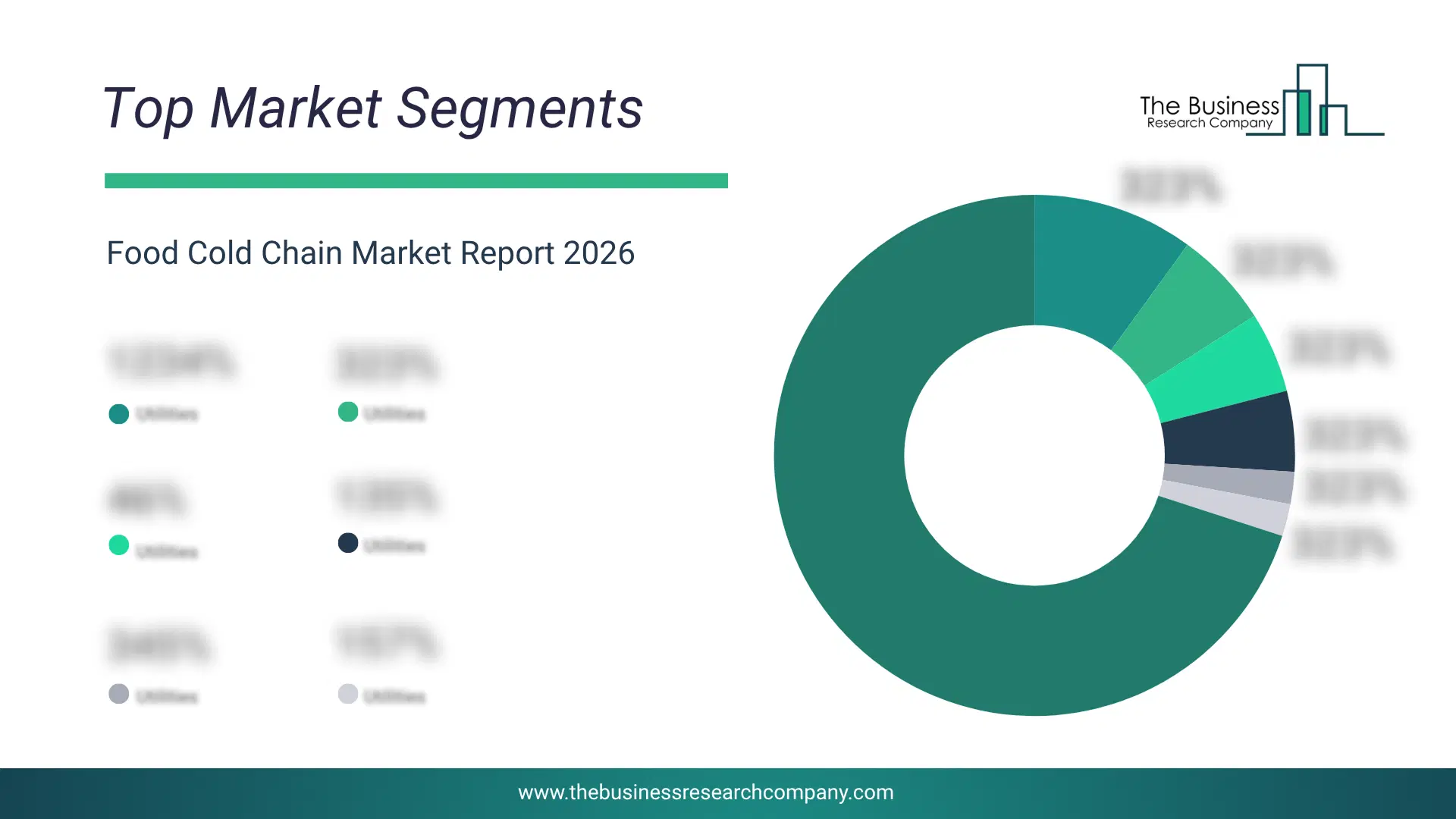
Global Food Cold Chain Market Segmentation
1) By Type Of Cold Chain: Refrigerated Transportation, Cold Storage, Ice Cream Logistics, Temperature-Controlled Warehousing 2) By Technology: Blast Freezing, Vapor Compression, Programmable Logic Controller (PLC), Evaporating Cooling, Cryogenic Systems, Other Technologies 3) By Distribution Channel: Direct Sales, Distributors And Wholesalers, Online Sales, Third-Party Logistics Providers (3PL) 4) By Application: Fruits And Vegetables, Dairy And Frozen Desserts, Fish, Meat, And Seafood, Bakery And Confectionery, Other Applications Subsegments: 1) By Refrigerated Transportation: Road Transport, Rail Transport, Sea Transport, Air Transport, Last-Mile Delivery, Intermodal Transport 2) By Cold Storage: Chilled Storage, Frozen Storage, Deep-Freeze Storage, Controlled Atmosphere Storage, Blast Freezing Rooms 3) By Ice Cream Logistics: Hardening And Blast Freezing, Deep-Freeze Storage, Frozen Line-Haul Transport, Frozen Last-Mile Delivery, Temperature-Validated Packaging, Store Replenishment Distribution 4) By Temperature-Controlled Warehousing: Public Refrigerated Warehousing, Contract Refrigerated Warehousing, Multi-Temperature Warehousing, Bonded Cold Warehousing, Cross-Dock Warehousing, Online Grocery Fulfillment WarehousingWhat Is The Driver Of The Food Cold Chain Market?
The increasing preference for online grocery shopping is expected to propel the growth of the food cold chain market going forward. Online grocery shopping refers to buying perishable and ambient food items through websites or mobile apps with delivery or click-and-collect fulfillment. The shift towards online grocery shopping is due to the time-saving convenience of doorstep delivery. The preference for online grocery shopping creates a need for food cold chain systems, as consistent temperature control is essential to keep perishable products such as fruits, vegetables, dairy, and meat fresh and safe during storage, transport, and delivery. For instance, in August 2025, according to the Singapore Department of Statistics, a Singapore-based government's data portal, the online share of supermarkets and hypermarkets sales rose within 2023 from 11.3% (Jan 2023) to 13.4% (Feb 2023) and 13.6% (Mar 2023) demonstrating rising e-grocery engagement within the category. Therefore, the increasing preference for online grocery shopping is driving the growth of the food cold chain industry.Key Players In The Global Food Cold Chain Market
Major companies operating in the food cold chain market are DHL Supply Chain, DSV A/S, XPO Logistics Inc., Nichirei Logistics Group, Americold Logistics LLC, NewCold Advanced Cold Logistics, ColdEX Logistics Pvt. Ltd., Celcius Logistics Pvt. Ltd., Crystal Logistic Cool Chain Ltd., Rinac Pvt. Ltd., Interstate Cold Storage, Siddhi Cold Chain Pvt. Ltd., ColdStar Logistics Pvt. Ltd., ALC Cold Chain Logistics Pvt. Ltd., WareIQ Solutions Pvt. Ltd., Indicold Private Ltd., Reefer Express Pvt. Ltd., Arihant Cold Storage Pvt. Ltd., Godamwale Cold Storage Pvt. Ltd., Kaveri Cold Chain Logistics Pvt. Ltd.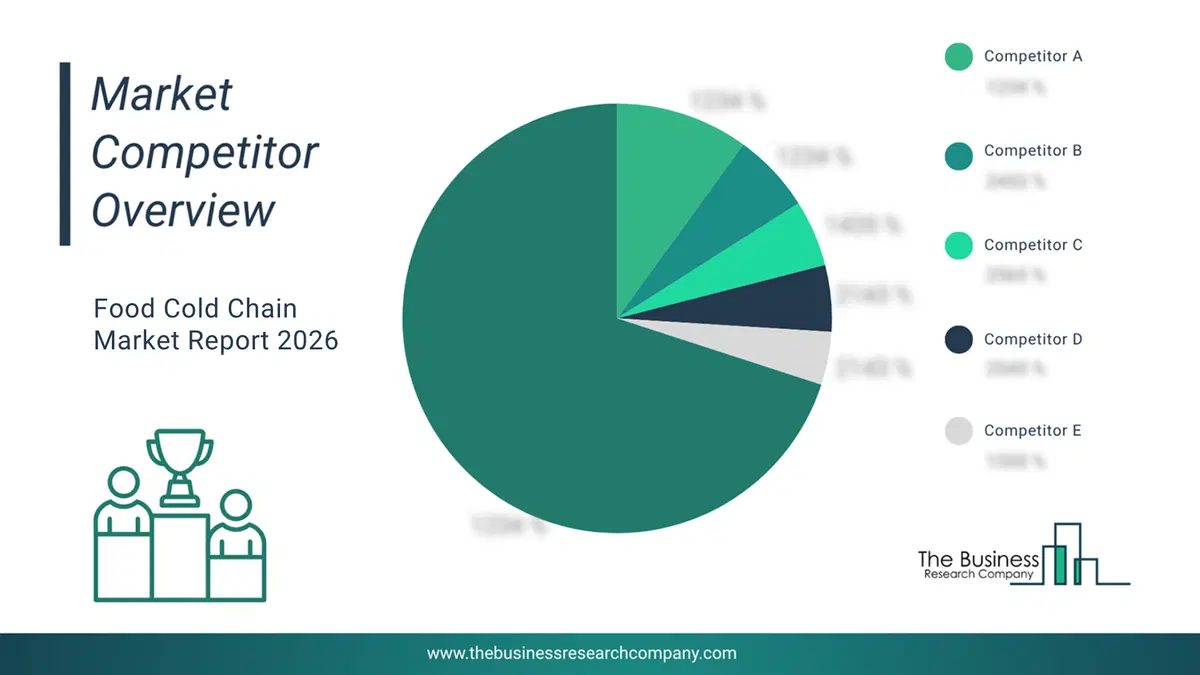
This chart is for illustrative purposes; the full report includes a detailed competitor analysis and comprehensive overview of the top 10 companies in the market.
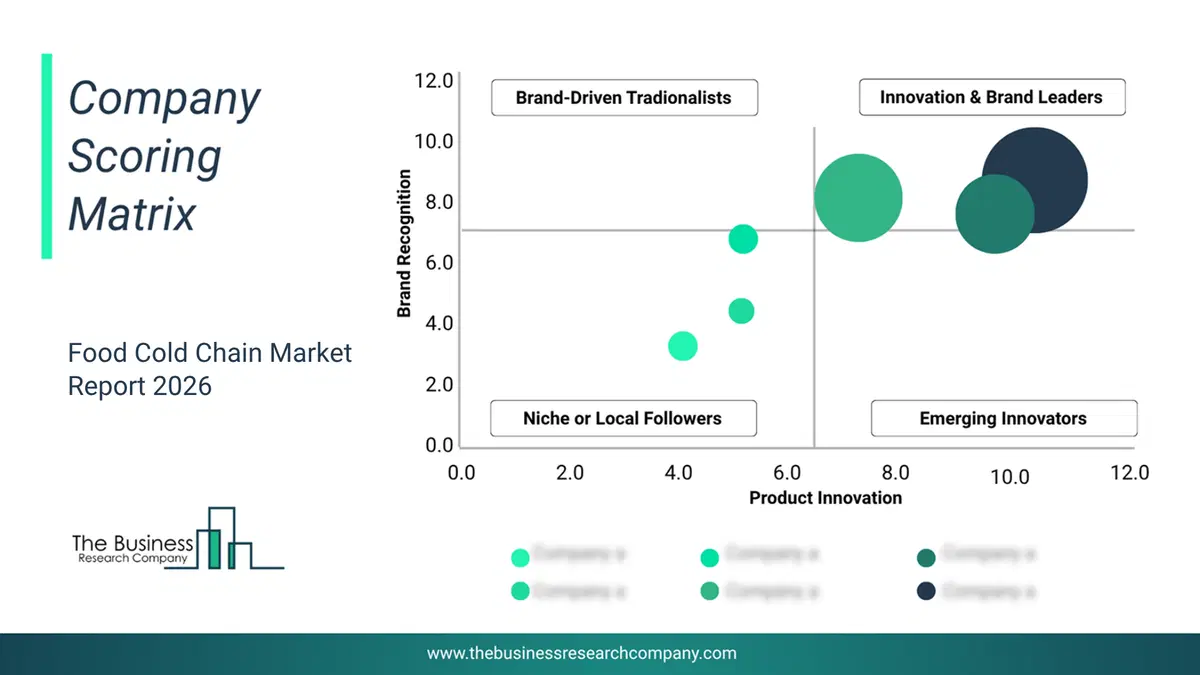
This chart maps companies by product innovation and brand strength, with bubble size indicating relative revenue, helping identify market leaders, challengers, and niche players. This is an illustrative chart; the full report provides a complete and accurate competitive analysis.
Global Food Cold Chain Market Trends and Insights
Major companies operating in the food cold chain market are focusing on developing cold chain infrastructure, to enhance efficiency, reduce transit time, and ensure temperature-controlled handling of perishable goods throughout the supply chain. Cold chain infrastructure is the organized system of temperature-regulated storage facilities, transport equipment, and monitoring technologies that ensure perishable goods remain safe and fresh from production to final delivery. For instance, in July 2025, Maersk A/S, a Denmark-based logistics company, launched its Integrated Packing and Cold Storage Hub in Olmos, Peru. The Olmos site operates as an advanced fruit logistics hub designed to optimize the region’s export operations. It combines core logistics activities such as processing, cold storage, and depot warehousing within Maersk’s global supply chain network. The hub also delivers additional services, including container depot management, inland refrigerated transport, and on-site customs processing, to ensure a fully integrated and efficient customer experience.What Are Latest Mergers And Acquisitions In The Food Cold Chain Market?
In November 2023, Newcold B.V., a Netherlands-based cold chain logistics company, acquired E Karras Refrigerated Transport Pty. Ltd. for an undisclosed amount. Through this acquisition, Newcold B.V. aims to enhance its integrated service offerings in Australia by combining its advanced warehousing capabilities with Karras’s expertise in refrigerated transport and logistics. E Karras Refrigerated Transport Pty. Ltd. is an Australia-based provider of critical cold chain solutions for food and beverage products.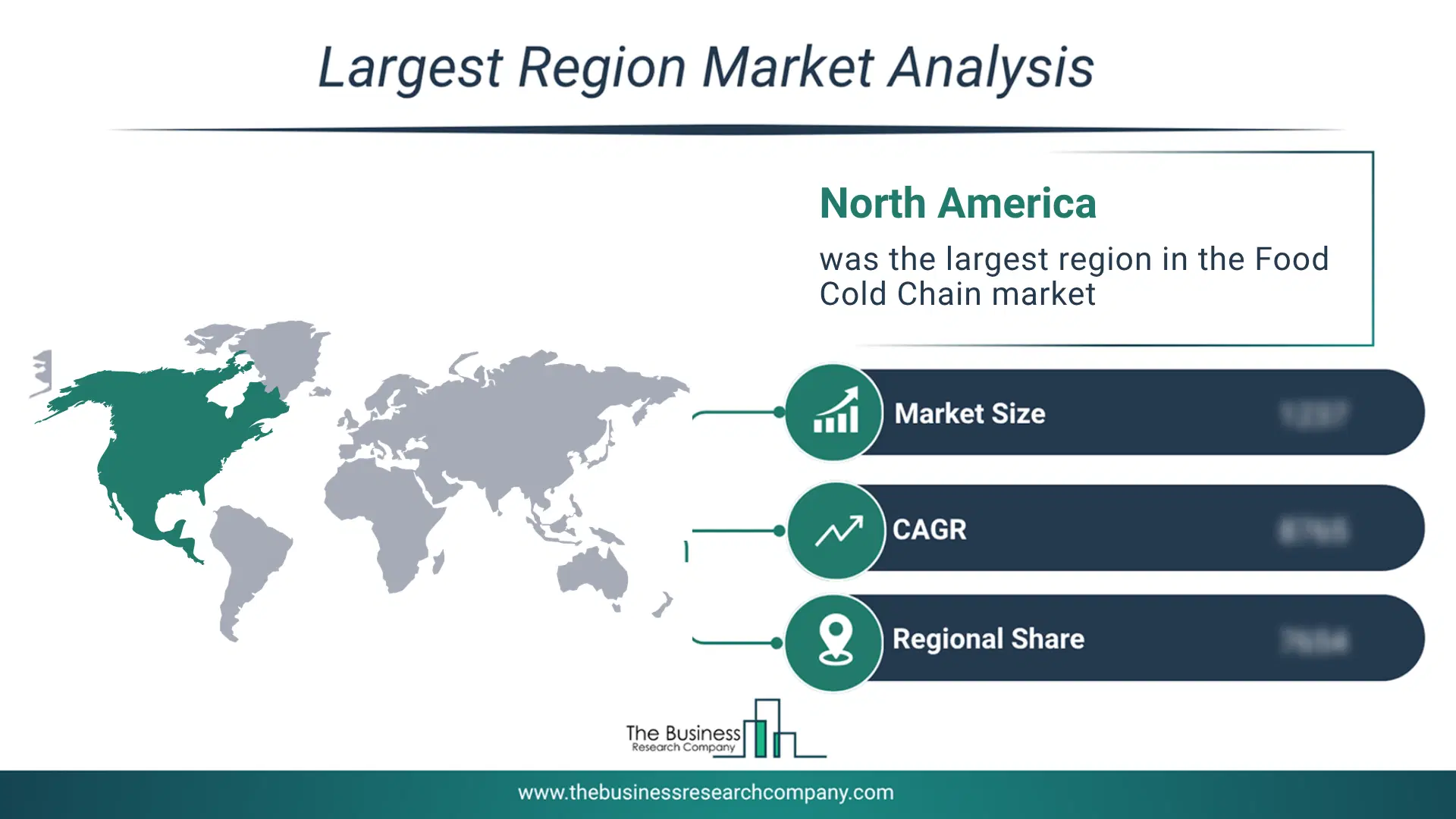
Regional Outlook
North America was the largest region in the food cold chain market in 2025. Asia-Pacific is expected to be the fastest-growing region in the forecast period. The regions covered in this market report are Asia-Pacific, South East Asia, Western Europe, Eastern Europe, North America, South America, Middle East and Africa. The countries covered in this market report are Australia, Brazil, China, France, Germany, India, Indonesia, Japan, Taiwan, Russia, South Korea, UK, USA, Italy, Spain, CanadaWhat Defines the Food Cold Chain Market?
The food cold chain market consists of revenues earned by entities by providing services such as inventory management, quality inspection, cross-docking operations, and product labeling. The market value includes the value of related goods sold by the service provider or included within the service offering. The food cold chain market also includes sales of refrigerated storage units, insulated containers, cold storage racks, thermal packaging materials, and refrigerated display cabinets. Values in this market are ‘factory gate’ values, that is the value of goods sold by the manufacturers or creators of the goods, whether to other entities (including downstream manufacturers, wholesalers, distributors and retailers) or directly to end customers. The value of goods in this market includes related services sold by the creators of the goods.How is Market Value Defined and Measured?
The market value is defined as the revenues that enterprises gain from the sale of goods and/or services within the specified market and geography through sales, grants, or donations in terms of the currency (in USD unless otherwise specified). The revenues for a specified geography are consumption values that are revenues generated by organizations in the specified geography within the market, irrespective of where they are produced. It does not include revenues from resales along the supply chain, either further along the supply chain or as part of other products.
This chart presents market attractiveness based on a quantitative evaluation of growth, competition, strategic alignment, and risk, offering a clear view of opportunity areas for decision-making. This chart is for illustrative purposes; the full report contains the complete analysis.

This chart highlights the Total Addressable Market (TAM) by estimating the maximum revenue opportunity using an assumption-driven approach, supporting strategic planning and opportunity sizing across markets. The chart is illustrative; the full report provides a more comprehensive analysis.
What Key Data and Analysis Are Included in the Food Cold Chain Market Report 2026?
The food cold chain market research report is one of a series of new reports from The Business Research Company that provides market statistics, including industry global market size, regional shares, competitors with the market share, detailed market segments, market trends and opportunities, and any further data you may need to thrive in the food cold chain industry. The market research report delivers a complete perspective of everything you need, with an in-depth analysis of the current and future state of the industry.Food Cold Chain Market Report Forecast Analysis
| Report Attribute | Details |
|---|---|
| Market Size Value In 2026 | $237.15 billion |
| Revenue Forecast In 2030 | $342.09 billion |
| Growth Rate | CAGR of 9.8% from 2026 to 2030 |
| Base Year For Estimation | 2025 |
| Actual Estimates/Historical Data | 2020-2025 |
| Forecast Period | 2026 - 2030 |
| Market Representation | Revenue in USD Billion and CAGR from 2026 to 2030 |
| Segments Covered | Type Of Cold Chain, Technology, Distribution Channel, Application |
| Regional Scope | Asia-Pacific, Western Europe, Eastern Europe, North America, South America, Middle East, Africa |
| Country Scope | The countries covered in the report are Australia, Brazil, China, France, Germany, India, Indonesia, Japan, Taiwan, Russia, South Korea, UK, USA, Canada, Italy, Spain. |
| Key Companies Profiled | DHL Supply Chain, DSV A/S, XPO Logistics Inc., Nichirei Logistics Group, Americold Logistics LLC, NewCold Advanced Cold Logistics, ColdEX Logistics Pvt. Ltd., Celcius Logistics Pvt. Ltd., Crystal Logistic Cool Chain Ltd., Rinac Pvt. Ltd., Interstate Cold Storage, Siddhi Cold Chain Pvt. Ltd., ColdStar Logistics Pvt. Ltd., ALC Cold Chain Logistics Pvt. Ltd., WareIQ Solutions Pvt. Ltd., Indicold Private Ltd., Reefer Express Pvt. Ltd., Arihant Cold Storage Pvt. Ltd., Godamwale Cold Storage Pvt. Ltd., Kaveri Cold Chain Logistics Pvt. Ltd. |
| Customization Scope | Request for Customization |
| Pricing And Purchase Options | Explore Purchase Options |