
GI Stool Testing Market Report 2026
Global Outlook – By Type (Immunoassay Test, Molecular Diagnostic Test, Chromatography-Based Test, Microbiological Culture Test, Enzyme-Linked Immunosorbent Assay (ELISA)), By Sample Type (Fecal Samples, Serum Samples), By Equipment (Automated Analyzers, Benchtop Instruments, Portable Devices), By Application (Diagnosis Of Gastrointestinal Disorders, Screening For Colorectal Cancer, Monitoring Of Inflammatory Bowel Disease (IBD), Detection Of Gastrointestinal Infections, Evaluation Of Digestive Health ), By End User (Hospital, Diagnostic Centre And Laboratory, Academic Institution, Research Centre Organization, Homecare, Other End Users) - Market Size, Trends, Strategies, and Forecast to 2030
GI Stool Testing Market Overview
• GI Stool Testing market size has reached to $1.41 billion in 2025 • Expected to grow to $1.99 billion in 2030 at a compound annual growth rate (CAGR) of 7.1% • Growth Driver: The Growing Prevalence Of Gastrointestinal Disorders Driving The Expansion Of The Market Due To Rising Health Concerns And Diagnostic Needs • Market Trend: Advancements In Diagnostic Testing As Companies Focus On Comprehensive Tests For Enhanced Accuracy And Early Disease Detection • North America was the largest region in 2025 and Asia-Pacific is the fastest growing region.What Is Covered Under GI Stool Testing Market?
Gastrointestinal (GI) stool testing refers to the analysis of stool samples to assess gastrointestinal health and detect infections, digestive disorders, and inflammatory conditions. It helps identify microbial imbalances, digestive enzyme deficiencies, and markers of gut inflammation. This non-invasive diagnostic method supports early disease detection and personalized treatment planning. The main GI stool testing types are immunoassay test, molecular diagnostic test, chromatography-based test, microbiological culture test, and enzyme-linked immunosorbent assay (ELISA). An immunoassay test refers to a diagnostic technique that utilizes antibodies to detect specific antigens or proteins in stool samples. It uses both fecal and serum samples and various types of equipment, including automated analyzers, benchtop instruments, and portable devices. It is applied for the diagnosis of gastrointestinal disorders, screening for colorectal cancer, monitoring of inflammatory bowel disease (IBD), detection of gastrointestinal infections, and evaluation of digestive health by various end users such as hospitals, diagnostic centers and laboratories, academic institutions, research center organizations, home homecare, and others.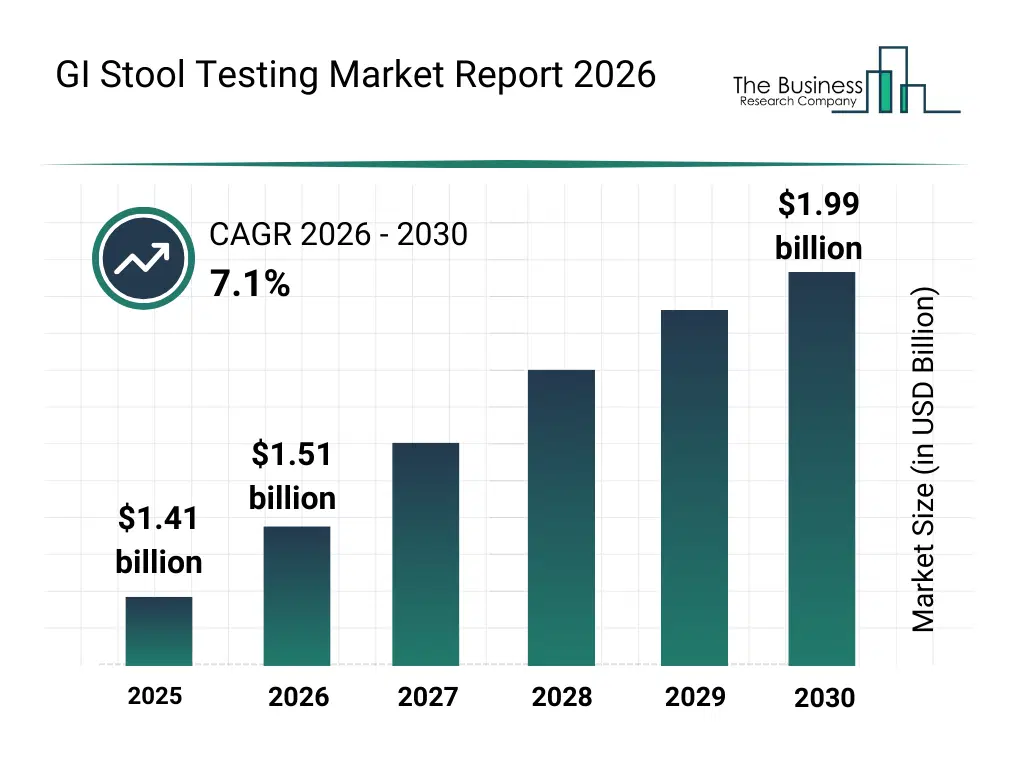
What Is The GI Stool Testing Market Size and Share 2026?
The gi stool testing market size has grown strongly in recent years. It will grow from $1.41 billion in 2025 to $1.51 billion in 2026 at a compound annual growth rate (CAGR) of 7.4%. The growth in the historic period can be attributed to growth in gastrointestinal disorders, advances in diagnostic laboratories, early microbiology testing, rising colorectal cancer screening, healthcare awareness.What Is The GI Stool Testing Market Growth Forecast?
The gi stool testing market size is expected to see strong growth in the next few years. It will grow to $1.99 billion in 2030 at a compound annual growth rate (CAGR) of 7.1%. The growth in the forecast period can be attributed to expansion of personalized gut health testing, growth of home diagnostics, integration of ai-based analysis, preventive healthcare adoption, rising digestive health awareness. Major trends in the forecast period include growing demand for non-invasive diagnostics, rising adoption of microbiome-based testing, increased use of molecular diagnostic methods, expansion of home-based stool testing kits, improved early detection of gi disorders.
Global GI Stool Testing Market Segmentation
1) By Type: Immunoassay Test, Molecular Diagnostic Test, Chromatography-Based Test, Microbiological Culture Test, Enzyme-Linked Immunosorbent Assay (ELISA) 2) By Sample Type: Fecal Samples, Serum Samples 3) By Equipment: Automated Analyzers, Benchtop Instruments, Portable Devices 4) By Application: Diagnosis Of Gastrointestinal Disorders, Screening For Colorectal Cancer, Monitoring Of Inflammatory Bowel Disease (IBD), Detection Of Gastrointestinal Infections, Evaluation Of Digestive Health 5) By End User: Hospital, Diagnostic Centre And Laboratory, Academic Institution, Research Centre Organization, Homecare, Other End Users Subsegments: 1) By Immunoassay Test: Rapid Immunoassay, Lateral Flow Assay, Fluorescent Immunoassay 2) By Molecular Diagnostic Test: Polymerase Chain Reaction (PCR), Nucleic Acid Amplification Test (NAAT), Next-Generation Sequencing (NGS) 3) By Chromatography-Based Test: Gas Chromatography (GC), Liquid Chromatography (LC), Thin-Layer Chromatography (TLC) 4) By Microbiological Culture Test: Aerobic Culture, Anaerobic Culture, Selective Media Culture 5) By Enzyme-Linked Immunosorbent Assay (ELISA): Direct ELISA, Indirect ELISA, Sandwich ELISA, Competitive ELISAWhat Are The Drivers Of The GI Stool Testing Market?
The increasing prevalence of gastrointestinal disorders is expected to propel the growth of the GI stool testing market going forward. Gastrointestinal disorders refer to conditions affecting the digestive system, including the stomach, intestines, and related organs, causing symptoms such as nausea, diarrhea, constipation, and abdominal pain. The rise in gastrointestinal disorders is largely due to poor dietary habits, as increased consumption of processed foods, high sugar intake, and low-fiber diets disrupt gut microbiota, weaken digestive health, and contribute to conditions such as acid reflux, irritable bowel syndrome (IBS), and inflammatory bowel disease (IBD). GI stool testing is required for gastrointestinal disorders to detect infections, inflammation, or digestive imbalances, as it helps identify pathogens (bacteria, viruses, parasites), markers of gut inflammation, and digestive enzyme deficiencies, enabling accurate diagnosis and targeted treatment. For instance, in September 2024, the Centers for Disease Control and Prevention, a US-based government agency, reported that between 2024 and 2025, NoroSTAT-participating states reported 1,676 norovirus outbreaks, marking a significant rise from the 729 outbreaks recorded during the same period last season. Therefore, the increasing prevalence of gastrointestinal disorders drives the growth of the GI stool testing industry. The increasing penetration of healthcare infrastructure is expected to propel the growth of the GI stool testing market going forward. Healthcare infrastructure refers to the physical, technological, and organizational facilities required to deliver medical services, including hospitals, clinics, equipment, and digital health systems. The rise in healthcare infrastructures is driven by a growing population and aging demographics, as increasing life expectancy and higher disease prevalence demand more hospitals, clinics, and advanced medical facilities to ensure adequate healthcare access and improved patient outcomes. The expansion of healthcare infrastructures enhances the accessibility and accuracy of GI stool testing, as improved laboratory facilities, advanced diagnostic technologies, and better-trained medical professionals enable faster, more precise detection of gastrointestinal disorders, leading to timely treatment and better patient outcomes. For instance, in November 2024, according to The Health Foundation, a UK-based independent charity, the Department of Health and Social Care (DHSC) spending is projected to rise from $227.6 billion in 2023/24 to $238.6 billion in 2024/25 and $250.6 billion in 2025/26, indicating an average annual real-term growth of 3.3%. Therefore, the increasing penetration of healthcare infrastructure drives the growth of the GI stool testing industry.Key Players In The Global GI Stool Testing Market
Major companies operating in the gi stool testing market are Thermo Fisher Scientific Inc., Abbott Laboratories Inc., Hologic Inc., Biomerieux SA, Bio‑Rad Laboratories Inc., Meridian BioScience Inc., Diasorin SPA, ELITechGroup, Genova Diagnostics Inc., US BioTek Laboratories LLC, Doctor's Data Inc., Diagnostic Solutions Laboratory LLC, Functional Medical Institute Pvt. Ltd., Walk‑In Lab LLC, ScheBo Biotech AG, Qiagen NV, Roche Diagnostics, Siemens Healthineers, QuidelOrtho Corporation, Biohit Oyj, Exact Sciences Corporation
This chart is for illustrative purposes; the full report includes a detailed competitor analysis and comprehensive overview of the top 10 companies in the market.
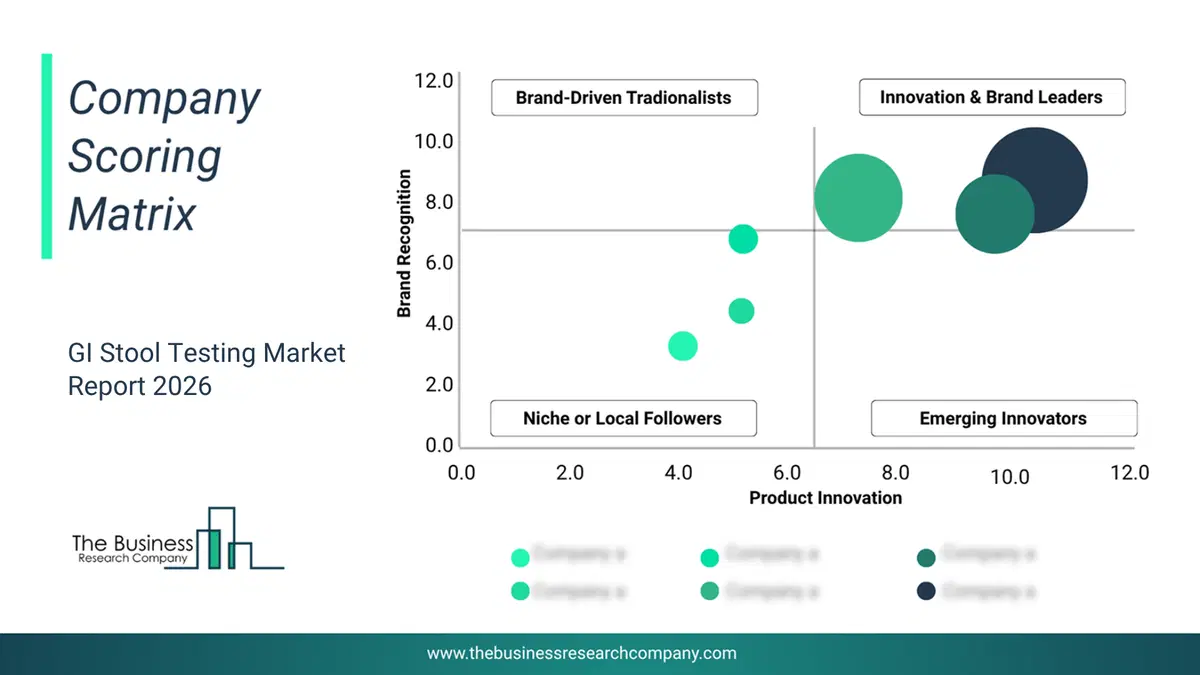
This chart maps companies by product innovation and brand strength, with bubble size indicating relative revenue, helping identify market leaders, challengers, and niche players. This is an illustrative chart; the full report provides a complete and accurate competitive analysis.
Global GI Stool Testing Market Trends and Insights
Major companies operating in the GI stool testing market are focusing on advanced testing technologies, such as comprehensive diagnostic tests, to improve accuracy, speed, and early disease detection. A comprehensive diagnostic test is an advanced medical tool that evaluates multiple health parameters simultaneously, offering a thorough assessment of a condition. For instance, in November 2024, EmeritusDX, a US-based diagnostics company, launched GI Detect, a comprehensive diagnostic test developed to support healthcare providers in identifying gastrointestinal disorders. This cutting-edge test utilizes a single stool swab to detect 26 bacteria, viruses, and parasites associated with digestive system disruptions. With a 24-hour turnaround time, GI Detect enables fast and informed clinical decision-making. In addition to broad pathogen detection, the test also screens for Helicobacter pylori and its virulence factors VacA, cagA, and babA as well as common gastrointestinal parasites such as Cryptosporidium, Entamoeba histolytica, and Giardia lamblia. This comprehensive approach ensures accurate and timely diagnosis of gastrointestinal infections.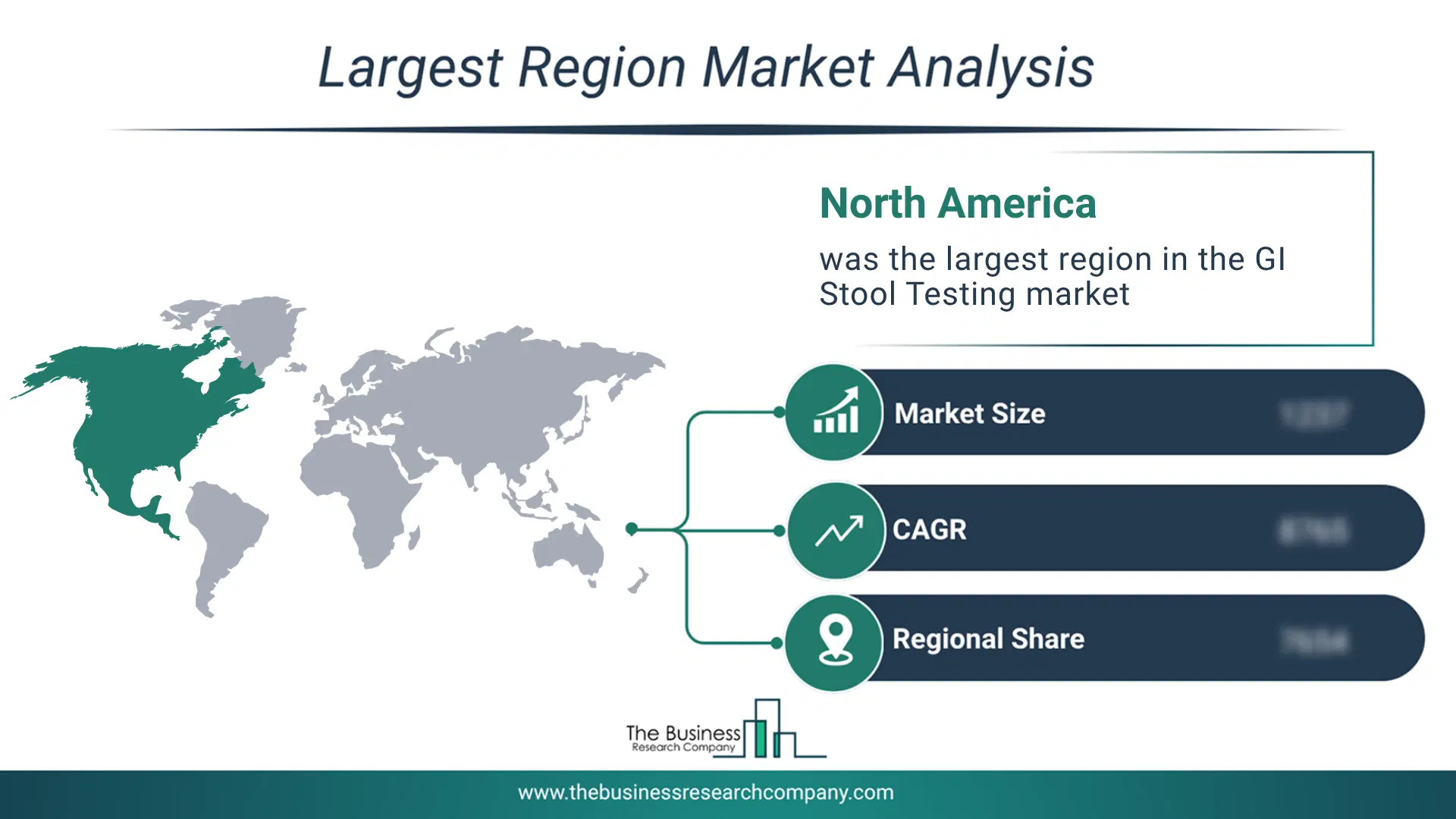
Regional Outlook
North America was the largest region in the GI stool testing market in 2025. Asia-Pacific is expected to be the fastest-growing region in the forecast period. The regions covered in this market report are Asia-Pacific, South East Asia, Western Europe, Eastern Europe, North America, South America, Middle East, Africa. The countries covered in this market report are Australia, Brazil, China, France, Germany, India, Indonesia, Japan, Taiwan, Russia, South Korea, UK, USA, Canada, Italy, Spain.What Defines the GI Stool Testing Market?
The GI stool testing market consists of revenues earned by entities by providing services such as microbiome analysis, pathogen detection, colorectal cancer screening, digestive health assessment, and inflammatory marker testing. The market value includes the value of related goods sold by the service provider or included within the service offering. The GI stool testing market also includes sales of stool test kits, reagent solutions, sample collection devices, diagnostic analyzers, and laboratory consumables. Values in this market are ‘factory gate’ values, that is, the value of goods sold by the manufacturers or creators of the goods, whether to other entities (including downstream manufacturers, wholesalers, distributors, and retailers) or directly to end customers. The value of goods in this market includes related services sold by the creators of the goods.How is Market Value Defined and Measured?
The market value is defined as the revenues that enterprises gain from the sale of goods and/or services within the specified market and geography through sales, grants, or donations in terms of the currency (in USD unless otherwise specified). The revenues for a specified geography are consumption values that are revenues generated by organizations in the specified geography within the market, irrespective of where they are produced. It does not include revenues from resales along the supply chain, either further along the supply chain or as part of other products.
This chart presents market attractiveness based on a quantitative evaluation of growth, competition, strategic alignment, and risk, offering a clear view of opportunity areas for decision-making. This chart is for illustrative purposes; the full report contains the complete analysis.

This chart highlights the Total Addressable Market (TAM) by estimating the maximum revenue opportunity using an assumption-driven approach, supporting strategic planning and opportunity sizing across markets. The chart is illustrative; the full report provides a more comprehensive analysis.
What Key Data and Analysis Are Included in the GI Stool Testing Market Report 2026?
The gi stool testing market research report is one of a series of new reports from The Business Research Company that provides market statistics, including industry global market size, regional shares, competitors with the market share, detailed market segments, market trends and opportunities, and any further data you may need to thrive in the gi stool testing industry. The market research report delivers a complete perspective of everything you need, with an in-depth analysis of the current and future state of the industry.GI Stool Testing Market Report Forecast Analysis
| Report Attribute | Details |
|---|---|
| Market Size Value In 2026 | $1.51 billion |
| Revenue Forecast In 2030 | $1.99 billion |
| Growth Rate | CAGR of 7.1% from 2026 to 2030 |
| Base Year For Estimation | 2025 |
| Actual Estimates/Historical Data | 2020-2025 |
| Forecast Period | 2026 - 2030 |
| Market Representation | Revenue in USD Billion and CAGR from 2026 to 2030 |
| Segments Covered | Type, Sample Type, Equipment, Application, End User |
| Regional Scope | Asia-Pacific, Western Europe, Eastern Europe, North America, South America, Middle East, Africa |
| Country Scope | The countries covered in the report are Australia, Brazil, China, France, Germany, India, Indonesia, Japan, Taiwan, Russia, South Korea, UK, USA, Canada, Italy, Spain |
| Key Companies Profiled | Thermo Fisher Scientific Inc., Abbott Laboratories Inc., Hologic Inc., Biomerieux SA, Bio‑Rad Laboratories Inc., Meridian BioScience Inc., Diasorin SPA, ELITechGroup, Genova Diagnostics Inc., US BioTek Laboratories LLC, Doctor's Data Inc., Diagnostic Solutions Laboratory LLC, Functional Medical Institute Pvt. Ltd., Walk‑In Lab LLC, ScheBo Biotech AG, Qiagen NV, Roche Diagnostics, Siemens Healthineers, QuidelOrtho Corporation, Biohit Oyj, Exact Sciences Corporation |
| Customization Scope | Request for Customization |
| Pricing And Purchase Options | Explore Purchase Options |