
Hemoglobin Testing Market Report 2026
Global Outlook – By Product (Reagents And Consumables, Equipment), By Technology (Spectrophotometry, Chromatography, Biosensor-Based, Electrochemical-Based), By End User (Hospitals, Clinics, Laboratories, Home Care Settings, Blood Banks, Other End Users) – Market Size, Trends, Strategies, and Forecast to 2030
Hemoglobin Testing Market Overview
• Hemoglobin Testing market size has reached to $2.79 billion in 2025 • Expected to grow to $4.28 billion in 2030 at a compound annual growth rate (CAGR) of 9% • Growth Driver: Surging Prevalence Of Chronic Disorders Fuels Growth In The Hemoglobin Testing Market • Market Trend: Innovations In The Hemoglobin Testing Market • Asia-Pacific was the largest region and fastest growing region.What Is Covered Under Hemoglobin Testing Market?
Hemoglobin testing is a medical procedure that measures the amount of hemoglobin in the blood. Hemoglobin is a protein present in red blood cells that transports oxygen from the lungs to the tissues and organs of the body. The main types of products in hemoglobin testing are reagents and consumables and equipment. The reagents and consumables segment in the hemoglobin testing market refers to the various chemical reagents and consumable products that are used in the process of hemoglobin testing. It uses various technologies such as chromatography, immunoassay, spectrophotometry, and others, and is utilized in various applications such as hospitals, clinics, laboratories, home care settings, blood banks, and others.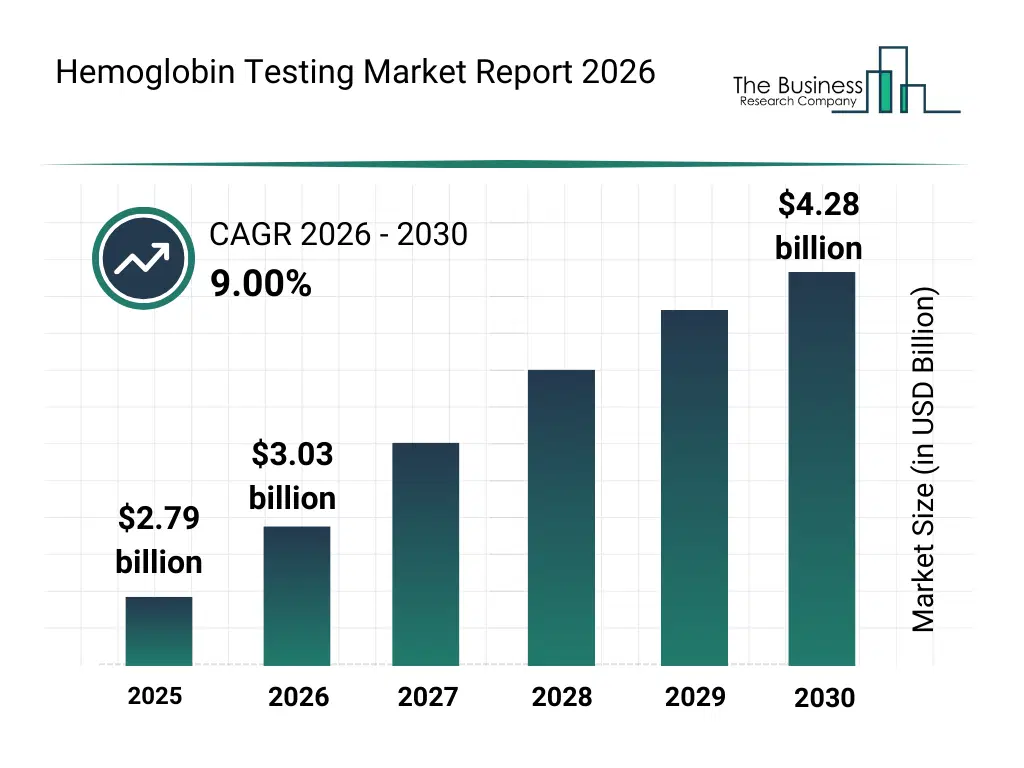
What Is The Hemoglobin Testing Market Size and Share 2026?
The hemoglobin testing market size has grown strongly in recent years. It will grow from $2.79 billion in 2025 to $3.03 billion in 2026 at a compound annual growth rate (CAGR) of 8.7%. The growth in the historic period can be attributed to expansion of routine blood testing practices, growth in anemia screening programs, increasing hospital diagnostic workloads, availability of cost-effective testing kits, rising public health initiatives.What Is The Hemoglobin Testing Market Growth Forecast?
The hemoglobin testing market size is expected to see strong growth in the next few years. It will grow to $4.28 billion in 2030 at a compound annual growth rate (CAGR) of 9.0%. The growth in the forecast period can be attributed to increasing demand for decentralized diagnostics, rising adoption of home testing devices, expansion of digital health monitoring, growing focus on early disease detection, continuous innovation in diagnostic accuracy. Major trends in the forecast period include increasing adoption of point-of-care hemoglobin testing, rising use of portable hemoglobin analyzers, growing demand for rapid blood screening, expansion of home-based diagnostic testing, enhanced focus on preventive health screening.
Global Hemoglobin Testing Market Segmentation
1) By Product: Reagents And Consumables, Equipment 2) By Technology: Spectrophotometry, Chromatography, Biosensor-Based, Electrochemical-Based 3) By End User: Hospitals, Clinics, Laboratories, Home Care Settings, Blood Banks, Other End Users Subsegments: 1) By Reagents And Consumables: Hemoglobin Testing Kits, Control Solutions, Test Strips, Quality Control Products 2) By Equipment: Hemoglobin Meters, Analyzers, Point-Of-Care DevicesWhat Is The Driver Of The Hemoglobin Testing Market?
A rising prevalence of chronic disorders such as diabetes is expected to propel the growth of hemoglobin testing. Diabetes is a chronic condition that arises when the pancreas does not create enough insulin or when the body does not utilize the insulin that is produced adequately. Hemoglobin A1c tests (HbA1c) are used to monitor glucose levels in diabetic patients and are recommended by the American Diabetes Association as a viable option for fasting blood glucose for diabetes diagnosis. For instance, in November 2022, according to the US Census Bureau, a US-based department of the Federal Statistical System, more than 34 million Americans have diabetes, with an additional 88 million at risk. Additionally, in December 2021, according to the IDF Diabetes Atlas 10th edition published by the International Diabetes Federation, a Belgium-based global diabetes community, diabetes afflicted 536,000 individuals in 2021, and by 2030, it is predicted to climb to 642,800. By 2045, it will reach 783,700 individuals globally. Therefore, the rising prevalence of chronic disorders such as anemia and diabetes will drive the hemoglobin testing devices market.Key Players In The Global Hemoglobin Testing Market
Major companies operating in the hemoglobin testing market are Abbott Laboratories Inc, F Hoffmann La Roche Ltd, Danaher Corporation, Thermo Fisher Scientific Inc, Bio Rad Laboratories Inc, Sysmex Corporation, Siemens Healthineers AG, Mindray Medical International Limited, Nihon Kohden Corporation, EKF Diagnostics Holdings plc, ARKRAY Inc, Nova Biomedical Corporation, Beckman Coulter Inc, Radiometer A S, DiaSys Diagnostic Systems GmbH, Erba Diagnostics Inc, Tosoh Corporation, ACON Laboratories Inc, Diazyme Laboratories Inc, Humasis Co Ltd, BioMedomics Inc, NanoEntek Inc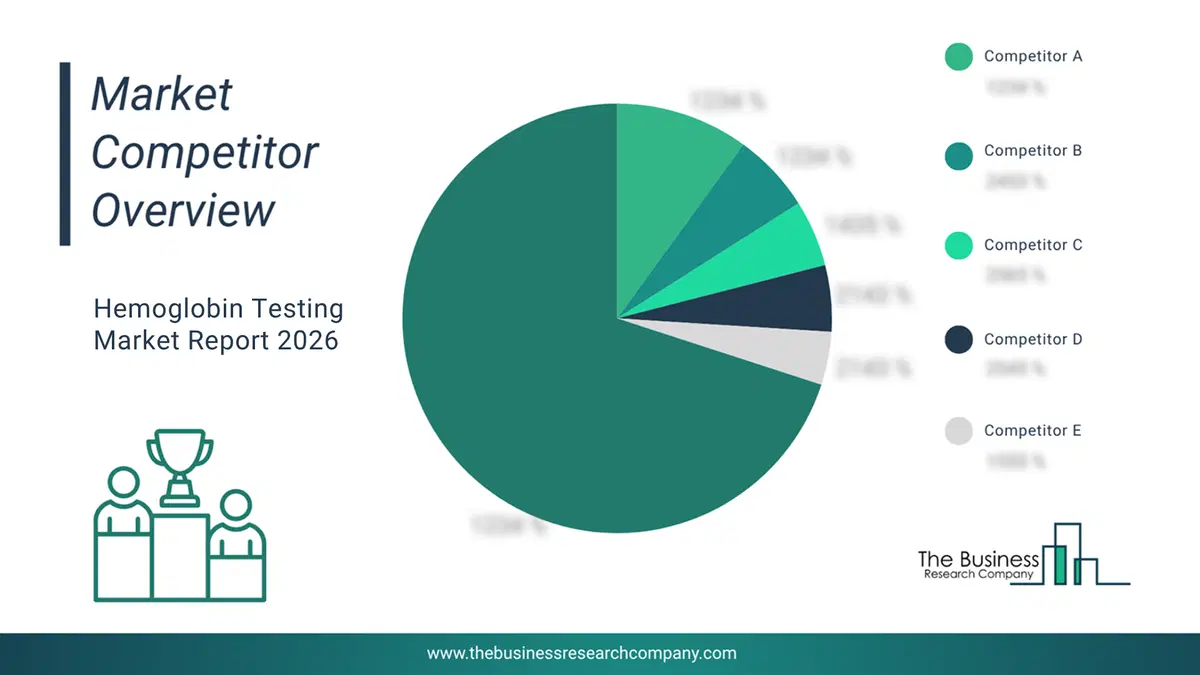
This chart is for illustrative purposes; the full report includes a detailed competitor analysis and comprehensive overview of the top 10 companies in the market.
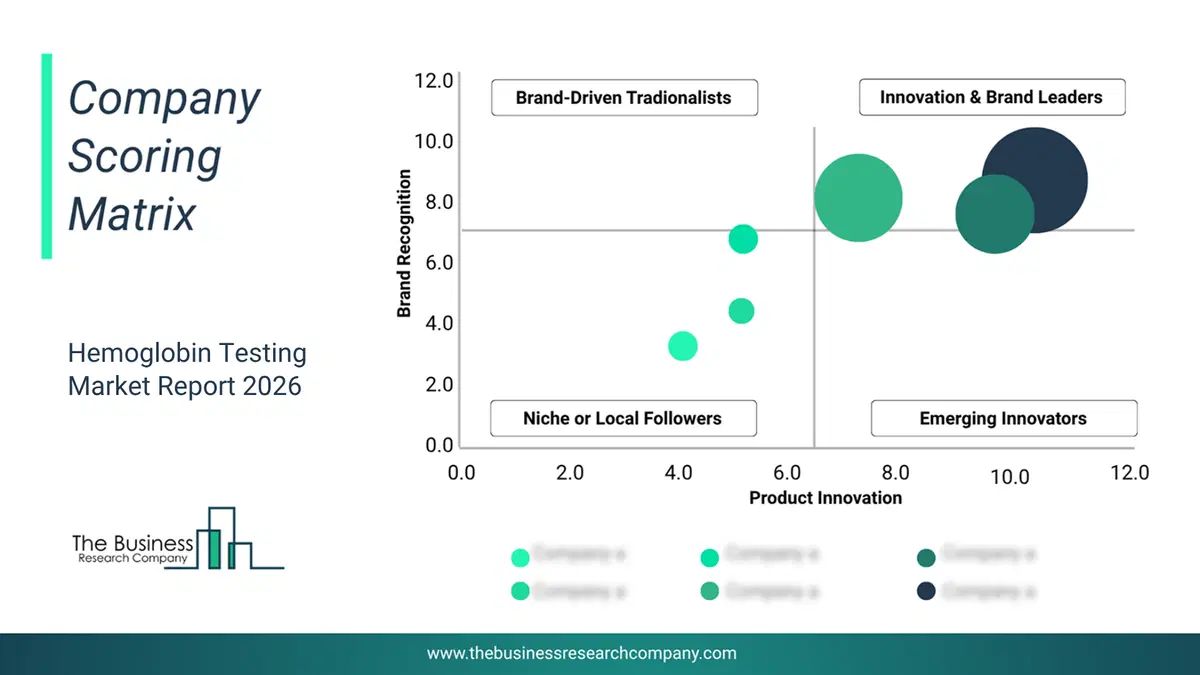
This chart maps companies by product innovation and brand strength, with bubble size indicating relative revenue, helping identify market leaders, challengers, and niche players. This is an illustrative chart; the full report provides a complete and accurate competitive analysis.
Global Hemoglobin Testing Market Trends and Insights
Major companies operating in the hemoglobin testing market are developing innovative fingerstick blood test solutions, to empower patients with the ability to monitor their hemoglobin levels conveniently at home, facilitate early detection of anemia, and improve overall management of their healthInnovative fingerstick blood test solutions refer to advanced methods that allow for quick and easy collection of blood samples through a simple finger prick, enabling efficient and less invasive diagnostic testing. For instance, in February 2024, Sanguina Inc., a US-based health technology company, launched AnemoCheck Home, the first FDA-cleared home hemoglobin test kit. AnemoCheck Home is an innovative testing solution designed to provide users with accurate hemoglobin readings using a simple finger prick. This user-friendly kit includes all necessary components, such as a testing device and instructions, allowing individuals to easily perform the test without the need for a laboratory visit. AnemoCheck Home not only enables patients to monitor their hemoglobin levels regularly but also facilitates early detection of potential health issues like anemia.What Are Latest Mergers And Acquisitions In The Hemoglobin Testing Market?
In July 2024, F. Hoffmann-La Roche Ltd., a Switzerland based biotechnology and diagnostics leader, acquired LumiraDx for an undisclosed amount. With this acquisition, Roche aims to expand its decentralized testing capabilities and increase global access to primary care diagnostics, especially in low- and middle-income settings. LumiraDx Ltd is a UK-based company that provides hemoglobin testing specifically through its HbA1c test.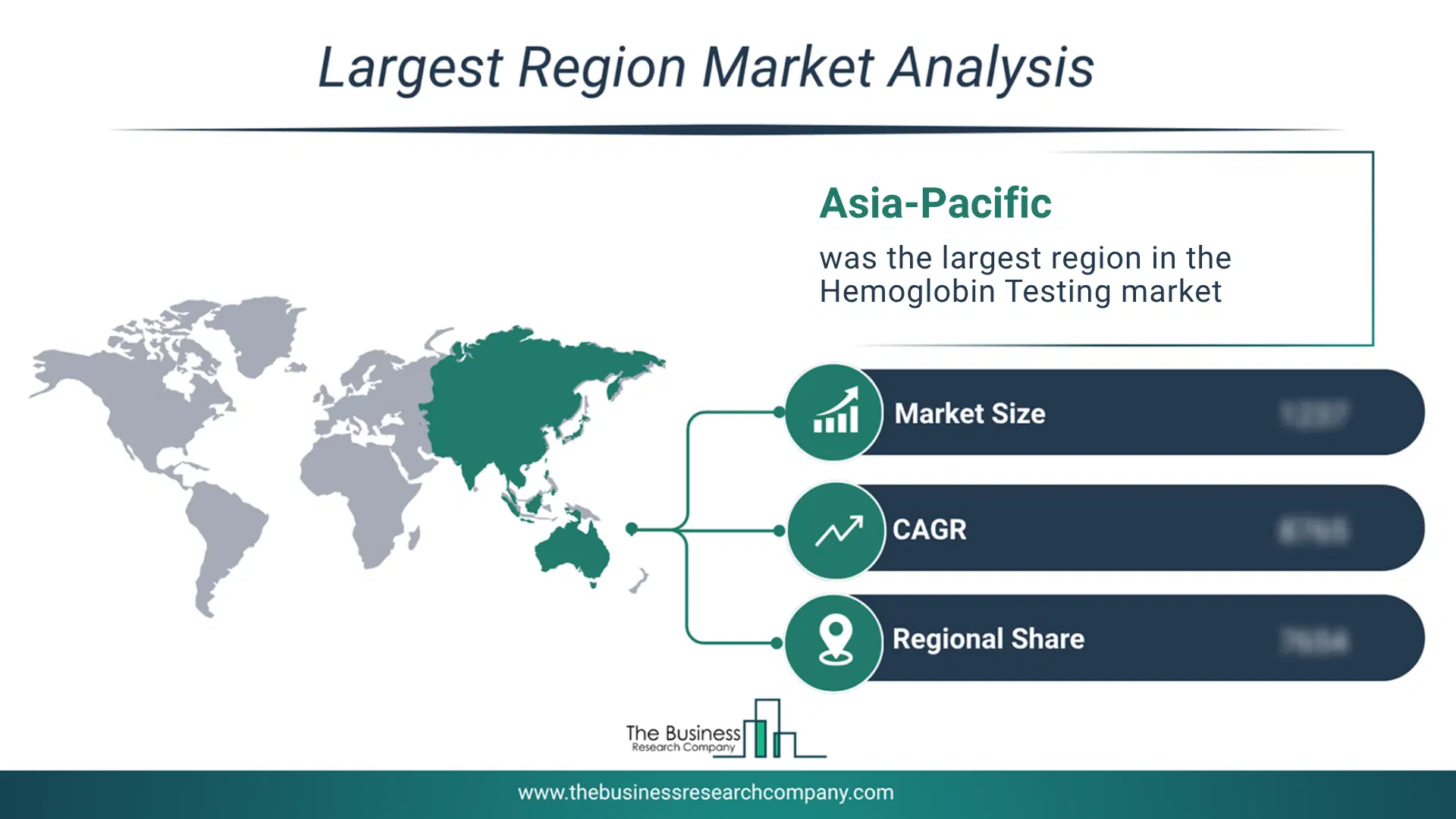
Regional Outlook
Asia-Pacific was the largest regions in the hemoglobin testing market in 2025. Asia-Pacific is expected to be the fastest-growing region in the global hemoglobin testing market report during the forecast period. The regions covered in this market report are Asia-Pacific, South East Asia, Western Europe, Eastern Europe, North America, South America, Middle East, Africa. The countries covered in this market report are Australia, Brazil, China, France, Germany, India, Indonesia, Japan, Taiwan, Russia, South Korea, UK, USA, Canada, Italy, SpainWhat Defines the Hemoglobin Testing Market?
The hemoglobin testing market consists of revenues earned by entities by providing services such as hemoglobin-cyanide, vanzetti's azide methemoglobin, reagent-less, non-invasive methods, and hemoglobin electrophoresis. The market value includes the value of related goods sold by the service provider or included within the service offering. Only goods and services traded between entities or sold to end consumers are included.How is Market Value Defined and Measured?
The market value is defined as the revenues that enterprises gain from the sale of goods and/or services within the specified market and geography through sales, grants, or donations in terms of the currency (in USD unless otherwise specified). The revenues for a specified geography are consumption values that are revenues generated by organizations in the specified geography within the market, irrespective of where they are produced. It does not include revenues from resales along the supply chain, either further along the supply chain or as part of other products.
This chart presents market attractiveness based on a quantitative evaluation of growth, competition, strategic alignment, and risk, offering a clear view of opportunity areas for decision-making. This chart is for illustrative purposes; the full report contains the complete analysis.

This chart highlights the Total Addressable Market (TAM) by estimating the maximum revenue opportunity using an assumption-driven approach, supporting strategic planning and opportunity sizing across markets. The chart is illustrative; the full report provides a more comprehensive analysis.
What Key Data and Analysis Are Included in the Hemoglobin Testing Market Report 2026?
The hemoglobin testing market research report is one of a series of new reports from The Business Research Company that provides market statistics, including industry global market size, regional shares, competitors with the market share, detailed market segments, market trends and opportunities, and any further data you may need to thrive in the hemoglobin testing industry. The market research report delivers a complete perspective of everything you need, with an in-depth analysis of the current and future state of the industry.Hemoglobin Testing Market Report Forecast Analysis
| Report Attribute | Details |
|---|---|
| Market Size Value In 2026 | $3.03 billion |
| Revenue Forecast In 2030 | $4.28 billion |
| Growth Rate | CAGR of 9% from 2026 to 2030 |
| Base Year For Estimation | 2025 |
| Actual Estimates/Historical Data | 2020-2025 |
| Forecast Period | 2026 - 2030 |
| Market Representation | Revenue in USD Billion and CAGR from 2026 to 2030 |
| Segments Covered | Product, Technology, End User |
| Regional Scope | Asia-Pacific, Western Europe, Eastern Europe, North America, South America, Middle East, Africa |
| Country Scope | The countries covered in the report are Australia, Brazil, China, France, Germany, India, Indonesia, Japan, Taiwan, Russia, South Korea, UK, USA, Canada, Italy, Spain. |
| Key Companies Profiled | Abbott Laboratories Inc, F Hoffmann La Roche Ltd, Danaher Corporation, Thermo Fisher Scientific Inc, Bio Rad Laboratories Inc, Sysmex Corporation, Siemens Healthineers AG, Mindray Medical International Limited, Nihon Kohden Corporation, EKF Diagnostics Holdings plc, ARKRAY Inc, Nova Biomedical Corporation, Beckman Coulter Inc, Radiometer A S, DiaSys Diagnostic Systems GmbH, Erba Diagnostics Inc, Tosoh Corporation, ACON Laboratories Inc, Diazyme Laboratories Inc, Humasis Co Ltd, BioMedomics Inc, NanoEntek Inc |
| Customization Scope | Request for Customization |
| Pricing And Purchase Options | Explore Purchase Options |