
Battery Cell Tab Laser Welding Market Report 2026
Global Outlook – By Technology (Fiber Laser Welding, Neodymium-Doped Yttrium Aluminum Garnet (Nd (YAG) Laser Welding, Other Technologies), By Cell Type (Prismatic, Cylindrical, Pouch), By Application (Automotive Batteries, Consumer Electronics, Industrial Batteries, Energy Storage Systems, Other Applications), By End-User (Original Equipment Manufacturers (OEMs), Battery Manufacturers, Other End-Users) – Market Size, Trends, Strategies, and Forecast to 2030
Battery Cell Tab Laser Welding Market Overview
• Battery Cell Tab Laser Welding market size has reached to $1.46 billion in 2025 • Expected to grow to $2.31 billion in 2030 at a compound annual growth rate (CAGR) of 9.5% • Growth Driver: Rising Adoption Of Electric Vehicles Driving Market Growth Due To Increasing Consumer Demand, Government Incentives, And Expanding Charging Infrastructure • Market Trend: Advancements In Dual-Beam Laser Technology Enhance Speed, Precision, And Reliability In Battery Tab Welding • Asia-Pacific was the largest region in 2025 and Europe is the fastest growing region.What Is Covered Under Battery Cell Tab Laser Welding Market?
Battery cell tab laser welding is a precision process that uses a focused laser beam to fuse metal tabs on battery cells. It provides strong electrical and mechanical bonds while minimizing heat distortion, preventing damage to sensitive internal components, and ensuring long-term reliability of the cells. The method enables high welding speed, accuracy, and consistent quality in battery production, making it ideal for large-scale manufacturing and advanced energy storage applications. The main technology types of battery cell tab laser welding are fiber laser welding, neodymium-doped yttrium aluminum garnet (Nd:YAG) laser welding, carbon dioxide (CO₂) laser welding, and others. Fiber laser welding is a high-precision, energy-efficient joining process that uses a focused fiber-generated laser beam to create deep, clean, and consistent welds with minimal heat distortion. It includes various cell types such as prismatic, cylindrical, and pouch. These technologies are used for applications including automotive batteries, consumer electronics, industrial batteries, and energy storage systems, among others, and are utilized by end-users such as original equipment manufacturers (OEMs), battery manufacturers, and others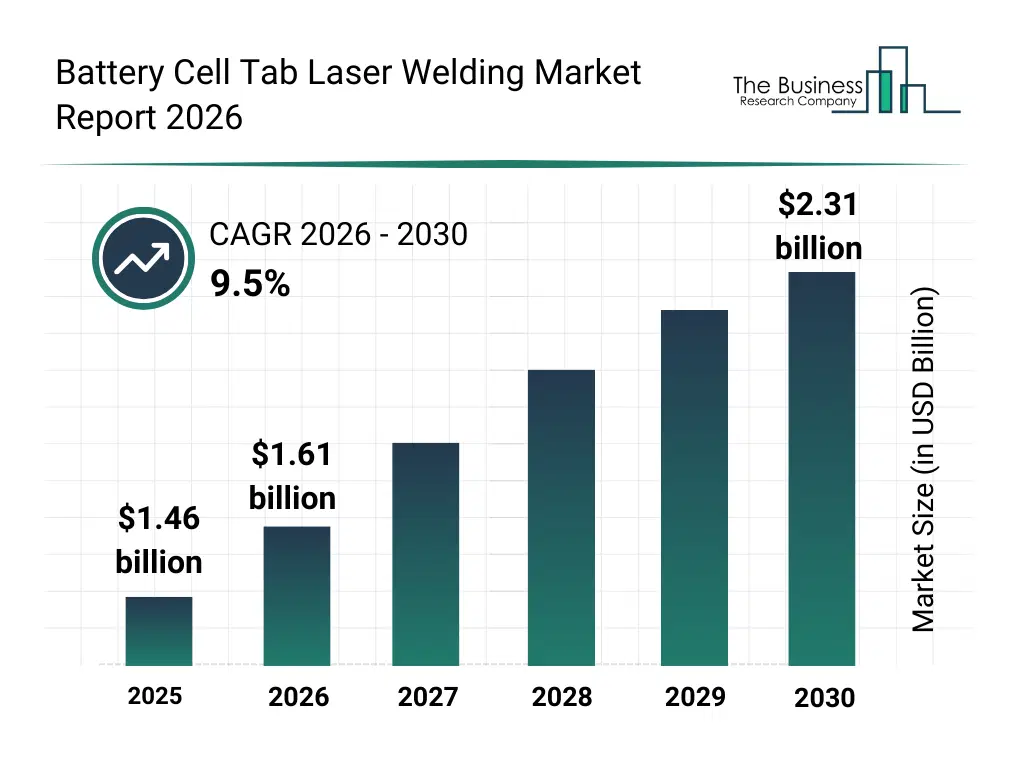
What Is The Battery Cell Tab Laser Welding Market Size and Share 2026?
The battery cell tab laser welding market size has grown strongly in recent years. It will grow from $1.46 billion in 2025 to $1.61 billion in 2026 at a compound annual growth rate (CAGR) of 9.8%. The growth in the historic period can be attributed to expansion of lithium-ion battery manufacturing, rising demand for reliable cell interconnections, increasing investments in battery production automation, growth of consumer electronics battery assembly, adoption of laser welding in precision manufacturing.What Is The Battery Cell Tab Laser Welding Market Growth Forecast?
The battery cell tab laser welding market size is expected to see strong growth in the next few years. It will grow to $2.31 billion in 2030 at a compound annual growth rate (CAGR) of 9.5%. The growth in the forecast period can be attributed to scaling up of electric vehicle battery gigafactories, rising demand for high-energy-density cells, increasing focus on battery safety and reliability, expansion of stationary energy storage manufacturing, growing integration of ai-based process control. Major trends in the forecast period include increasing adoption of high-speed fiber laser welding, rising demand for precision battery tab joining, growing integration of automated inline welding systems, expansion of welding applications in large-scale battery plants, enhanced focus on thermal damage minimization.Tariff Impact On Battery Cell Tab Laser Welding Market
Tariffs are significantly impacting the battery cell tab laser welding market by increasing the cost of imported laser sources, optical components, precision motion systems, and advanced control electronics used in welding equipment manufacturing. Automotive battery production hubs in Asia-Pacific, Europe, and North America are most affected, as many high-performance laser systems and components are sourced internationally. These tariffs are raising capital expenditure requirements for battery manufacturers and slowing equipment procurement cycles. At the same time, tariffs are encouraging localized laser system assembly, regional supplier development, and innovation in cost-optimized welding technologies to support domestic battery manufacturing ecosystems.
Global Battery Cell Tab Laser Welding Market Segmentation
1) By Technology: Fiber Laser Welding, Neodymium-Doped Yttrium Aluminum Garnet (Nd:YAG) Laser Welding, Other Technologies 2) By Cell Type: Prismatic, Cylindrical, Pouch 3) By Application: Automotive Batteries, Consumer Electronics, Industrial Batteries, Energy Storage Systems, Other Applications 4) By End-User: Original Equipment Manufacturers (OEMs), Battery Manufacturers, Other End-Users Subsegments: 1) By Fiber Laser Welding: Continuous Wave Fiber Laser Welding, Pulsed Fiber Laser Welding, High-Power Fiber Laser Welding, Precision Fiber Laser Welding 2) By Neodymium-Doped Yttrium Aluminum Garnet (Nd:YAG) Laser Welding: Pulsed Neodymium-Doped Yttrium Aluminum Garnet (Nd:YAG) Laser Welding, Continuous Wave Neodymium-Doped Yttrium Aluminum Garnet (Nd:YAG) Laser Welding, Micro-Spot Neodymium-Doped Yttrium Aluminum Garnet (Nd:YAG) Laser Welding, Dual-Beam Neodymium-Doped Yttrium Aluminum Garnet (Nd:YAG) Laser Welding 3) By Other Technologies: Diode Laser Welding, Green Laser Welding, Ultrashort Pulse Laser Welding, Blue Laser WeldingWhat Is The Driver Of The Battery Cell Tab Laser Welding Market?
The rising adoption of electric vehicles (EVs) is expected to propel the growth of the battery cell tab laser welding market going forward. Electric vehicles are automobiles powered by electric motors using energy stored in rechargeable batteries instead of traditional internal combustion engines. The growing adoption of electric vehicles is due to government incentives and declining battery prices, as supportive policies such as tax credits and manufacturer price reductions make EVs more affordable and accessible to consumers. Battery cell tab laser welding supports electric vehicles (EVs) by enabling precise, high-strength, and efficient connections between battery cells, enhancing electrical conductivity, thermal stability, and overall battery pack reliability, ultimately improving EV performance, safety, and energy efficiency. For instance, in January 2024, according to the U.S. Department of Energy, a US-based government agency, in December 2023, plug-in electric vehicles accounted for 9.8% of all light-duty vehicle sales, up from 7.8% in December 2022. Throughout 2023, plug-in vehicles consistently made up at least 8% of monthly sales, whereas in 2022 their share ranged between 5.5% and 7.8%. Therefore, the rising adoption of electric vehicles is driving the growth of the battery cell tab laser welding industry.Key Players In The Global Battery Cell Tab Laser Welding Market
Major companies operating in the battery cell tab laser welding market are TRUMPF Group, Panasonic Corporation, Amada Miyachi America Inc., Han’s Laser Technology Group Co. Ltd., HGTECH Co. Ltd., IPG Photonics Corporation, Jenoptik AG, Chutian Laser Group Co. Ltd., Wuhan Golden Laser Co. Ltd., Wuhan Huagong Laser Engineering Co. Ltd., Sisma S.p.A., LaserStar Technologies Corporation, Daihen Corporation, Coherent Corp., EO Technics Co. Ltd., Shenzhen Sunlaser Technology Co. Ltd., Shenzhen Superwave Laser Technology Co. Ltd., HGLaser Engineering Co. Ltd., Jiangsu Bochuang Laser Technology Co. Ltd., Wuhan Raycus Laser Technologies Co. Ltd., Shenzhen Hanwei Laser Equipment Co. Ltd.
This chart is for illustrative purposes; the full report includes a detailed competitor analysis and comprehensive overview of the top 10 companies in the market.
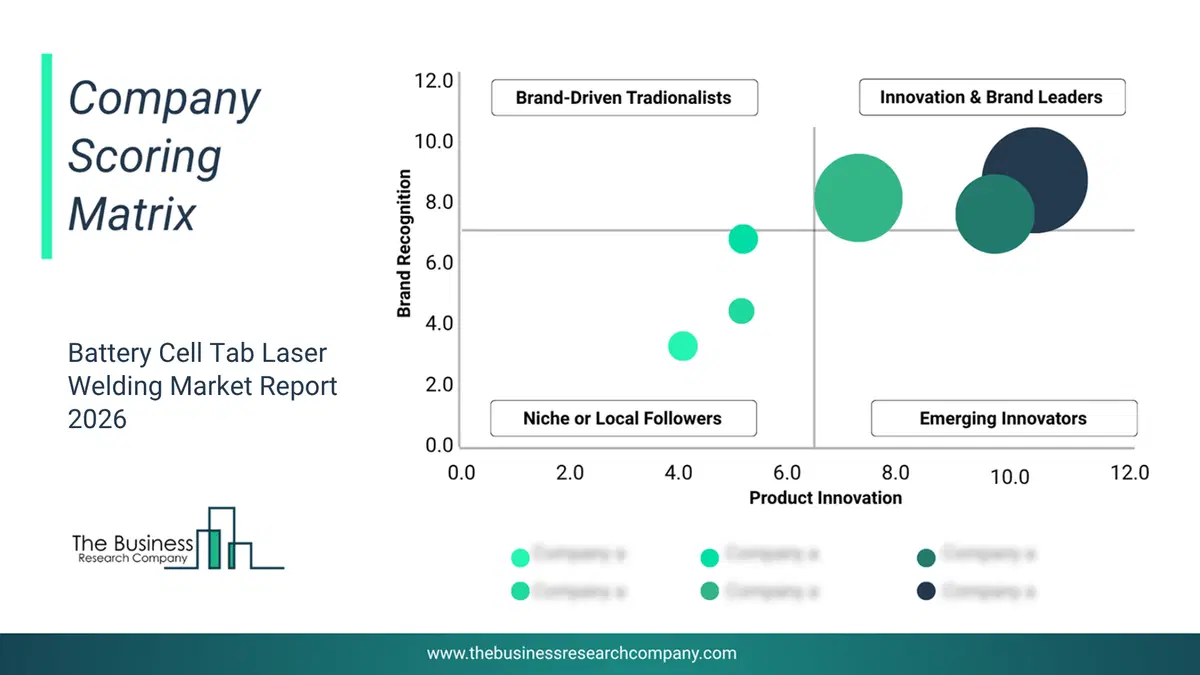
This chart maps companies by product innovation and brand strength, with bubble size indicating relative revenue, helping identify market leaders, challengers, and niche players. This is an illustrative chart; the full report provides a complete and accurate competitive analysis.
Global Battery Cell Tab Laser Welding Market Trends and Insights
Major companies operating in the battery cell tab laser welding market are focusing on leveraging innovative technologies such as dual-beam lasers to increase welding speed, improve precision, and ensure defect-free battery connections. Dual-beam lasers combine a high-power core beam with a secondary beam, helping stabilize the weld pool, reduce defects such as spatter, cracking, and porosity, and enable faster, more precise welding of battery tabs, while improving overall efficiency and consistency in high-volume battery production. For instance, in September 2023, IPG Photonics Corporation, a US-based manufacturing company, launched a new Adjustable Mode Beam (AMB) dual-beam laser capable of delivering 3 kW single-mode core power, specifically designed for battery welding applications. The technology enables spatter-free welding at speeds up to twice as fast as conventional lasers while maintaining high precision and consistent weld quality. Integrated into automated solutions such as IPG’s EV-Cube and LaserCell platforms, it supports efficient, high-volume production of cylindrical, prismatic, and pouch battery cells. The laser utilizes a secondary ring beam to stabilize the weld pool, minimizing common welding defects such as cracking, porosity, and uneven material flow, and ensuring more reliable and durable battery connections.What Are Latest Mergers And Acquisitions In The Battery Cell Tab Laser Welding Market?
In July 2025, RMA Sp. z o.o., a Poland-based industrial laser systems manufacturing company, partnered with RAYLASE GmbH to deliver high-speed, precise laser welding solutions for battery cell tabs and busbars. With this partnership, RMA and RAYLASE aim to develop high-speed, precise, and scalable laser welding solutions for battery cell tabs and busbars, combining robust automation with advanced beam steering technology, while ensuring ease of integration, consistent weld quality, and adaptability to future battery designs and production demands. RAYLASE GmbH is a Germany-based manufacturing company that specializes in providing battery cell tab laser welding.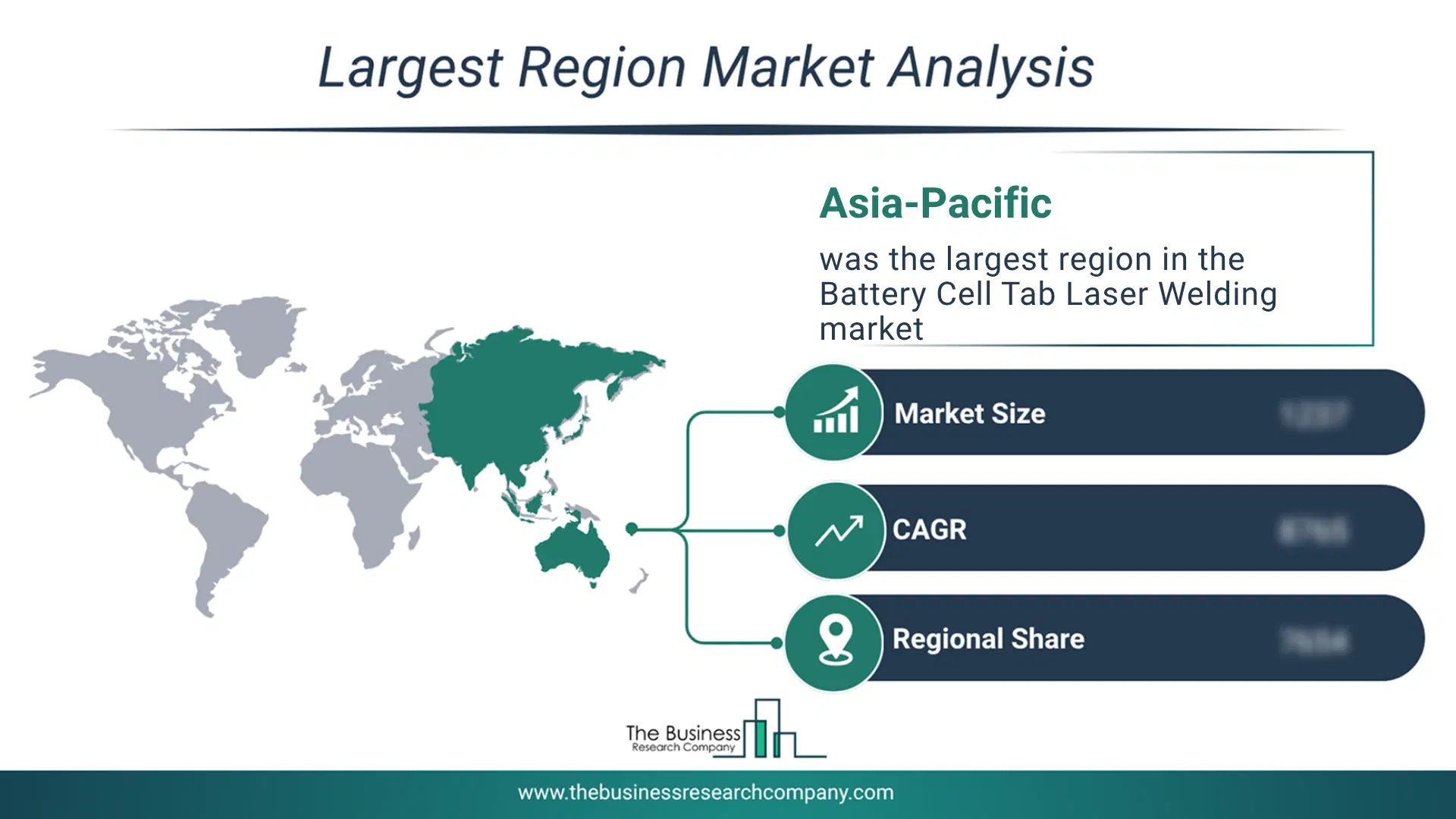
Regional Outlook
Asia-Pacific was the largest region in the battery cell tab laser welding market in 2025. Europe is expected to be the fastest-growing region in the forecast period. The regions covered in this market report are Asia-Pacific, South East Asia, Western Europe, Eastern Europe, North America, South America, Middle East, Africa The countries covered in this market report are Australia, Brazil, China, France, Germany, India, Indonesia, Japan, Taiwan, Russia, South Korea, UK, USA, Canada, Italy, Spain.What Defines the Battery Cell Tab Laser Welding Market?
The battery cell tab laser welding market consists of sales of laser welding machines, laser power sources, welding heads, optical lenses, and cooling systems. Values in this market are ‘factory gate’ values, that is, the value of goods sold by the manufacturers or creators of the goods, whether to other entities (including downstream manufacturers, wholesalers, distributors, and retailers) or directly to end customers. The value of goods in this market includes related services sold by the creators of the goods.How is Market Value Defined and Measured?
The market value is defined as the revenues that enterprises gain from the sale of goods and/or services within the specified market and geography through sales, grants, or donations in terms of the currency (in USD unless otherwise specified). The revenues for a specified geography are consumption values that are revenues generated by organizations in the specified geography within the market, irrespective of where they are produced. It does not include revenues from resales along the supply chain, either further along the supply chain or as part of other products.
This chart presents market attractiveness based on a quantitative evaluation of growth, competition, strategic alignment, and risk, offering a clear view of opportunity areas for decision-making. This chart is for illustrative purposes; the full report contains the complete analysis.

This chart highlights the Total Addressable Market (TAM) by estimating the maximum revenue opportunity using an assumption-driven approach, supporting strategic planning and opportunity sizing across markets. The chart is illustrative; the full report provides a more comprehensive analysis.
What Key Data and Analysis Are Included in the Battery Cell Tab Laser Welding Market Report 2026?
The battery cell tab laser welding market research report is one of a series of new reports from The Business Research Company that provides market statistics, including industry global market size, regional shares, competitors with the market share, detailed market segments, market trends and opportunities, and any further data you may need to thrive in the battery cell tab laser welding industry. The market research report delivers a complete perspective of everything you need, with an in-depth analysis of the current and future state of the industry.Battery Cell Tab Laser Welding Market Report Forecast Analysis
| Report Attribute | Details |
|---|---|
| Market Size Value In 2026 | $1.61 billion |
| Revenue Forecast In 2030 | $2.31 billion |
| Growth Rate | CAGR of 9.5% from 2026 to 2030 |
| Base Year For Estimation | 2025 |
| Actual Estimates/Historical Data | 2020-2025 |
| Forecast Period | 2026 - 2030 |
| Market Representation | Revenue in USD Billion and CAGR from 2026 to 2030 |
| Segments Covered | Technology, Cell Type, Application, End-User |
| Regional Scope | Asia-Pacific, Western Europe, Eastern Europe, North America, South America, Middle East, Africa |
| Key Companies Profiled | TRUMPF Group, Panasonic Corporation, Amada Miyachi America Inc., Han’s Laser Technology Group Co. Ltd., HGTECH Co. Ltd., IPG Photonics Corporation, Jenoptik AG, Chutian Laser Group Co. Ltd., Wuhan Golden Laser Co. Ltd., Wuhan Huagong Laser Engineering Co. Ltd., Sisma S.p.A., LaserStar Technologies Corporation, Daihen Corporation, Coherent Corp., EO Technics Co. Ltd., Shenzhen Sunlaser Technology Co. Ltd., Shenzhen Superwave Laser Technology Co. Ltd., HGLaser Engineering Co. Ltd., Jiangsu Bochuang Laser Technology Co. Ltd., Wuhan Raycus Laser Technologies Co. Ltd., Shenzhen Hanwei Laser Equipment Co. Ltd. |
| Customization Scope | Request for Customization |
| Pricing And Purchase Options | Explore Purchase Options |