
Glufosinate Market Report 2026
Global Outlook – By Crop Type (Genetically Modified Crops, Conventional Crops), By Formulation (Aqueous Suspension, Liquid, Suspension Concentrate, Soluble (Liquid) Concentrate, Other Formulations), By Application (Agricultural, Oilseeds And Pulses, Grains And Cereals, Other Applications) – Market Size, Trends, Strategies, and Forecast to 2035
Glufosinate Market Overview
• Glufosinate market size has reached to $2.75 billion in 2025 • Expected to grow to $4.36 billion in 2030 at a compound annual growth rate (CAGR) of 9.7% • Growth Driver: Growing Agriculture Sector Fuels Growth In The Glufosinate Market • Market Trend: BASF Launches Isomer-Resolved Glufosinate Formulation to Enhance Weed Control and Sustainability • North America was the largest region in 2025 and Asia-Pacific is the fastest growing region.Market Gains By 2030 – Top Opportunities By Segment
Market Gain identifies the most promising market opportunities by highlighting the segments or products expected to generate the highest incremental revenue growth over the next five years.
What Is Covered Under Glufosinate Market?
Glufosinate is a broad-spectrum herbicide that has caused glyphosate to exert huge selection pressure on weed populations. It is a nonselective foliar herbicide used for broadcast burndown applications of canola, corn, sweet corn, soybeans, and sugar beet before planting or before emergence. The main glufosinate market crop types are genetically modified crops and conventional crops. GM crops are plants that have been genetically engineered to change their DNA sequences to give a desirable attribute. The various formulations are aqueous suspension, liquid, suspension concentrate, soluble (liquid) concentrate, and others applied in non-agricultural, agricultural, oilseeds and pulses, grains and cereals, fruits and vegetables, and others.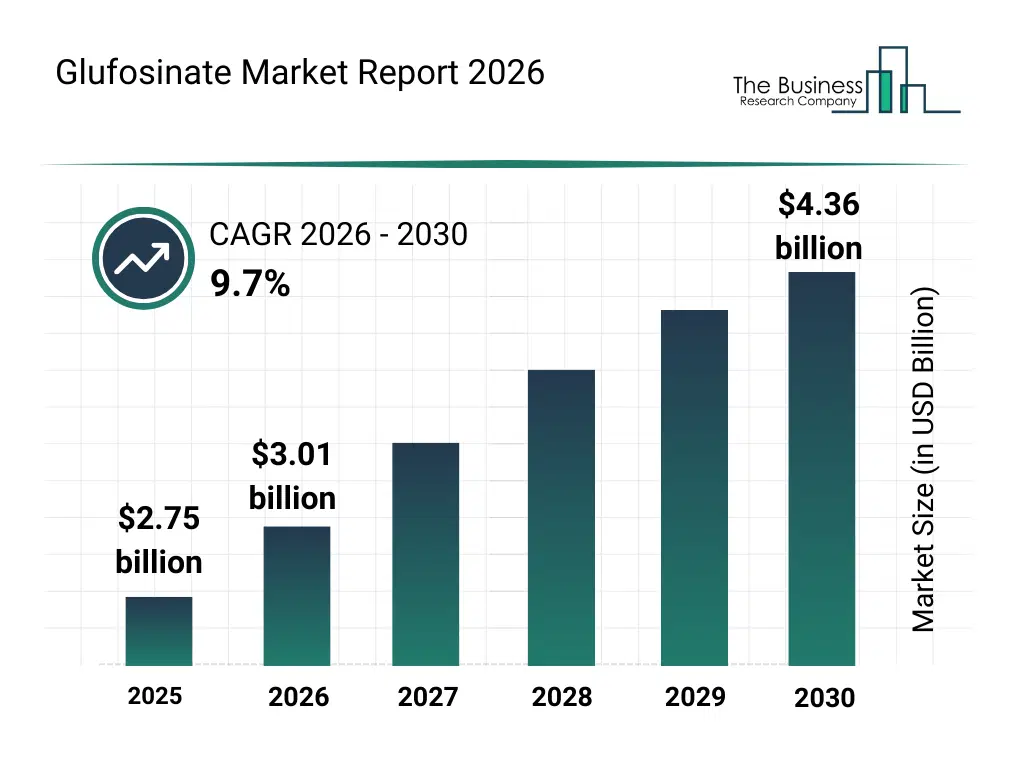
What Is The Glufosinate Market Size and Share 2026?
The glufosinate market size has grown strongly in recent years. It will grow from $2.75 billion in 2025 to $3.01 billion in 2026 at a compound annual growth rate (CAGR) of 9.6%. The growth in the historic period can be attributed to rising herbicide-resistant weed populations, expansion of commercial crop farming, increasing adoption of chemical weed control, availability of non-selective herbicide formulations, growth of large-scale agriculture.What Is The Glufosinate Market Growth Forecast?
The glufosinate market size is expected to see strong growth in the next few years. It will grow to $4.36 billion in 2030 at a compound annual growth rate (CAGR) of 9.7%. The growth in the forecast period can be attributed to increasing regulatory pressure on glyphosate use, rising demand for effective weed management solutions, expansion of genetically modified crop cultivation, growing focus on sustainable herbicide practices, increasing investments in agrochemical innovation. Major trends in the forecast period include increasing adoption as an alternative to glyphosate, rising use in weed resistance management, growing demand for broad-spectrum herbicides, expansion of pre-plant burndown applications, enhanced focus on crop-specific herbicide programs.

Global Glufosinate Market Segmentation
1) By Crop Type: Genetically Modified Crops, Conventional Crops 2) By Formulation: Aqueous Suspension, Liquid, Suspension Concentrate, Soluble (Liquid) Concentrate, Other Formulations 3) By Application: Agricultural, Oilseeds And Pulses, Grains And Cereals, Other Applications Subsegments: 1) By Genetically Modified Crops: Soybeans, Corn, Canola, Cotton, Other genetically modified crops 2) By Conventional Crops: Wheat, Rice, Barley, Sugar beet, Other conventional crops The top segments in the glufosinate market will be: • Agricultural will reach $2067.9 Million by 2025. • Genetically Modified Crops will reach $1836.2 Million by 2025. • Soluble (Liquid) Concentrate will reach $1110.9 Million by 2025. • Conventional Crops will reach $896.7 Million by 2025. • Non-agricultural Applications will reach $665 Million by 2025.What Is The Driver Of The Glufosinate Market?
The growing agriculture sector is expected to boost the growth of the glufosinate market going forward. The agriculture sector, also known as the agricultural sector or agribusiness, encompasses all activities related to the cultivation of land, raising crops, and rearing animals to produce food, raw materials, and other agricultural products. The agriculture sector is growing due to an increasing population driving higher food demand, supportive government policies providing essential subsidies and incentives, and advancements in climate-resilient agriculture that help farmers adapt to changing environmental conditions. Glufosinate effectively controls a broad range of weeds, including glyphosate-resistant types, helping crops grow healthily by reducing competition for nutrients, sunlight, and water. For instance, in January 2025, according to the The United States Department of Agriculture, a US-based federal executive department, in 2024, U.S. agricultural exports rose by $1.8 billion, marking a 1% increase compared to 2023. Therefore, the growing agriculture sector is driving the growth of the glufosinate industry.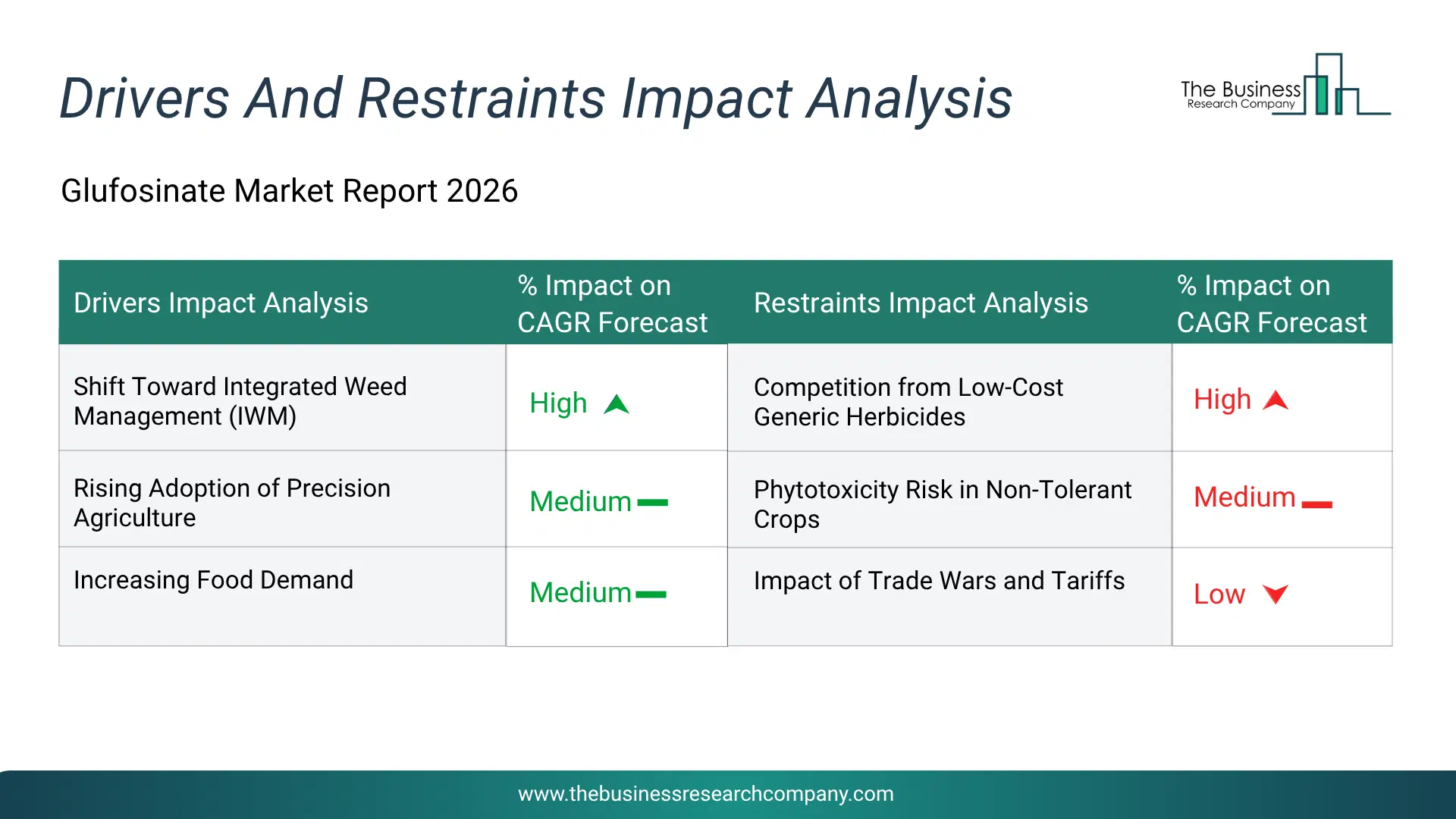
Infographic Chart Showing Key Market Drivers Analysis And Restraints For Glufosinate Market
The chart presents an impact analysis of key drivers and restraints, quantifying their relative influence on the market's growth rate and helping assess the balance between growth enablers and limiting factors. This chart offers a high-level perspective; the full report contains more detailed insights.
How Will The Drivers Impact Growth In The Global Glufosinate Market?
• Shift Toward Integrated Weed Management (IWM) (High) – The shift toward integrated weed management (IWM) will become a key driver of growth in the glufosinate market by 2030. Farmers are increasingly moving away from sole reliance on single-mode-of-action herbicides toward diversified weed control strategies that combine chemical, cultural, mechanical and biological methods. This transition is driven by rising concerns over herbicide resistance and the need to maintain long-term field productivity and sustainability. Glufosinate plays an important role within IWM programs due to its broad-spectrum activity and compatibility with rotation and tank-mix strategies. Its use alongside other herbicides and agronomic practices helps improve overall weed control effectiveness and delays resistance development. As IWM adoption expands globally, demand for flexible and multi-utility herbicides like glufosinate is expected to increase steadily. As a result, the shift toward integrated weed management (IWM) is anticipated to contributing to a 2.0% annual growth in the market. • Rising Adoption of Precision Agriculture (Medium) – The rising adoption of precision agriculture will emerge as a major factor driving the expansion of the glufosinate market by 2030. Farmers are increasingly utilizing GPS-enabled equipment, drone spraying systems and data-driven crop monitoring tools to optimize input use and improve field efficiency. This shift enables more targeted application of herbicides, reducing waste and enhancing weed control accuracy. Glufosinate benefits from this trend due to its compatibility with precision spraying technologies and its effectiveness in site-specific weed management programs. Additionally, precision agriculture helps minimize environmental impact by optimizing dosage and application timing. As adoption expands globally, demand for efficient and adaptable herbicides like glufosinate is expected to increase. Consequently, the rising adoption of precision agriculture is projected to contributing to a 1.5% annual growth in the market. • Increasing Food Demand (Medium) – The increasing food demand will serve as a key growth catalyst for the glufosinate market by 2030. Rising population levels, urbanization and changing dietary patterns are significantly increasing the need for higher agricultural output. This is placing greater pressure on farmers to maximize crop yields and reduce losses caused by weed infestations. Glufosinate-based herbicides help improve productivity by providing effective broad-spectrum weed control, particularly in high-value and large-scale cropping systems. Its use supports efficient crop protection, ensuring healthier plant growth and better yield stability. As food security concerns intensify worldwide, the demand for effective herbicide solutions like glufosinate is expected to rise steadily. Therefore, this increasing food demand is projected to supporting to a 1.0% annual growth in the market. • Rising Use in Specialty Crops and Orchards (Low) – The rising use in specialty crops and orchards will become a significant driver contributing to the growth of the glufosinate market by 2030. Farmers cultivating high-value crops such as fruits, nuts, grapes and vegetables are increasingly seeking effective weed control solutions that do not compromise crop quality. Glufosinate is gaining preference due to its non-selective, fast-acting properties and suitability for directed or inter-row application. Its limited soil residual activity also makes it well-suited for sensitive cropping systems where crop safety is critical. Additionally, growers are adopting it as part of integrated weed management programs to maintain orchard hygiene and improve productivity. As demand for specialty crops continues to grow globally, the use of glufosinate in these applications is expected to expand steadily. Consequently, the rising use in specialty crops and orchards is projected to contributing to a 0.5% annual growth in the market.How Will The Restraints Impact Growth In The Global Glufosinate Market?
• Competition from Low-Cost Generic Herbicides (High) – Competition from low-cost generic herbicides is expected to restrain market growth during the forecast period. It creates operational, financial, regulatory, or commercial challenges that can increase costs, delay projects, reduce investments, or discourage purchasing decisions depending on the market. These challenges can reduce product adoption, affect business confidence, and limit the ability of companies to expand efficiently across key regions. This can reduce operational efficiency, delay expansion plans, and affect the ability of companies to achieve sustainable business growth. • Phytotoxicity Risk in Non-Tolerant Crops (Medium) – During the forecast period, phytotoxicity risk in non-tolerant crops is likely to limit market expansion. It creates operational, financial, regulatory, or commercial challenges that can increase costs, delay projects, reduce investments, or discourage purchasing decisions depending on the market. These challenges can reduce product adoption, affect business confidence, and limit the ability of companies to expand efficiently across key regions. As a result, businesses may face increased cost pressures, slower commercial adoption, and reduced revenue opportunities. • Impact of Trade Wars and Tariffs (Medium) – The market is expected to face challenges due to impact of trade wars and tariffs over the forecast period. It creates operational, financial, regulatory, or commercial challenges that can increase costs, delay projects, reduce investments, or discourage purchasing decisions depending on the market. These challenges can reduce product adoption, affect business confidence, and limit the ability of companies to expand efficiently across key regions. This may discourage new investments, delay strategic expansion initiatives, and weaken the overall competitive position of market participants.Key Players In The Global Glufosinate Market
Major companies operating in the glufosinate market are BASF SE, Bayer AG, Corteva, Inc., UPL Limited, Nufarm Limited, ADAMA Ltd., Syngenta Group, Sumitomo Chemical Co., Ltd., FMC Corporation, Sinon Corporation, Lier Chemical Co., Ltd., Jiangsu Sevencontinent Green Chemical Co., Ltd., Anhui Huaxing Chemical Industry Co., Ltd., Zhejiang Yongnong Chemical Co., Ltd., Hebei Veyong Bio-Chemical Co., Ltd., Nantong Jiangshan Agrochemical And Chemicals Co., Ltd., Jiangsu Yangnong Chemical Co., Ltd., Jiangxi Zhonghe Chemical Co., Ltd., Shandong Weifang Rainbow Chemical Co., Ltd., Rotam CropSciences Ltd.
This chart is for illustrative purposes; the full report includes a detailed competitor analysis and comprehensive overview of the top 10 companies in the market.

This chart maps companies by product innovation and brand strength, with bubble size indicating relative revenue, helping identify market leaders, challengers, and niche players. This is an illustrative chart; the full report provides a complete and accurate competitive analysis.
Global Glufosinate Market Trends and Insights
Major companies operating in the glufosinate herbicide market are focusing on developing technological advancements such as Glu-L technology to enhance weed control efficacy, crop safety, and environmental sustainability. Glu-L technology improves the herbicidal activity and selectivity of glufosinate-based formulations, enabling broader application across diverse crops. For instance, in August 2023, BASF, a Germany-based global chemical company, launched Liberty ULTRA, the first herbicide in the United States based on Glu-L technology. The product provides effective weed management, supports sustainable agriculture practices, and addresses the growing demand for high-performance, environmentally responsible herbicides.What Are Latest Mergers And Acquisitions In The Glufosinate Market?
In September 2024, UPL Ltd., an India-based global agrochemical company, completed the full acquisition of PT Excel Meg Indo for $6.85 million. With this acquisition, UPL aims to strengthen its presence in the Indonesian agrochemical market, expand its crop protection portfolio, enhance operational synergies, and drive long-term growth in the Asia-Pacific region. PT Excel Meg Indo is an Indonesia-based company engaged in the production and distribution of crop protection solutions.
Regional Insights
North America was the largest region in the gulfosinate market in 2025. The regions covered in this market report are Asia-Pacific, South East Asia, Western Europe, Eastern Europe, North America, South America, Middle East, Africa The countries covered in this market report are Australia, Brazil, China, France, Germany, India, Indonesia, Japan, Taiwan, Russia, South Korea, UK, USA, Canada, Italy, SpainWhat Defines the Glufosinate Market?
The glufosinate market consists of sales of L-glufosinate ammonium (active) and D-glufosinate ammonium (inactive). Values in this market are ‘factory gate’ values, that is the value of goods sold by the manufacturers or creators of the goods, whether to other entities (including downstream manufacturers, wholesalers, distributors and retailers) or directly to end customers. The value of goods in this market includes related services sold by the creators of the goods.How is Market Value Defined and Measured?
The market value is defined as the revenues that enterprises gain from the sale of goods and/or services within the specified market and geography through sales, grants, or donations in terms of the currency (in USD unless otherwise specified). The revenues for a specified geography are consumption values that are revenues generated by organizations in the specified geography within the market, irrespective of where they are produced. It does not include revenues from resales along the supply chain, either further along the supply chain or as part of other products.
This chart presents market attractiveness based on a quantitative evaluation of growth, competition, strategic alignment, and risk, offering a clear view of opportunity areas for decision-making. This chart is for illustrative purposes; the full report contains the complete analysis.

This chart highlights the Total Addressable Market (TAM) by estimating the maximum revenue opportunity using an assumption-driven approach, supporting strategic planning and opportunity sizing across markets. The chart is illustrative; the full report provides a more comprehensive analysis.
What Key Data and Analysis Are Included in the Glufosinate Market Report 2026?
The glufosinate market research report is one of a series of new reports from The Business Research Company that provides market statistics, including industry global market size, regional shares, competitors with the market share, detailed market segments, market trends and opportunities, and any further data you may need to thrive in the glufosinate industry. The market research report delivers a complete perspective of everything you need, with an in-depth analysis of the current and future state of the industry.Glufosinate Market Report Forecast Analysis
| Report Attribute | Details |
|---|---|
| Market Size Value In 2026 | $3.01 billion |
| Revenue Forecast In 2035 | $4.36 billion |
| Growth Rate | CAGR of 9.6% from 2026 to 2035 |
| Base Year For Estimation | 2025 |
| Actual Estimates/Historical Data | 2020-2025 |
| Forecast Period | 2026 - 2030 - 2035 |
| Market Representation | Revenue in USD Billion and CAGR from 2026 to 2035 |
| Segments Covered | Crop Type, Formulation, Application |
| Regional Scope | Asia-Pacific, Western Europe, Eastern Europe, North America, South America, Middle East, Africa |
| Country Scope | The countries covered in the report are Australia, Brazil, China, France, Germany, India, ... |
| Key Companies Profiled | BASF SE, Bayer AG, Corteva, Inc., UPL Limited, Nufarm Limited, ADAMA Ltd., Syngenta Group, Sumitomo Chemical Co., Ltd., FMC Corporation, Sinon Corporation, Lier Chemical Co., Ltd., Jiangsu Sevencontinent Green Chemical Co., Ltd., Anhui Huaxing Chemical Industry Co., Ltd., Zhejiang Yongnong Chemical Co., Ltd., Hebei Veyong Bio-Chemical Co., Ltd., Nantong Jiangshan Agrochemical And Chemicals Co., Ltd., Jiangsu Yangnong Chemical Co., Ltd., Jiangxi Zhonghe Chemical Co., Ltd., Shandong Weifang Rainbow Chemical Co., Ltd., Rotam CropSciences Ltd. |
| Customization Scope | Request for Customization |
| Pricing And Purchase Options | Explore Purchase Options |