
Glycol Market Report 2026
Global Outlook – By Type (Ethylene Glycol, Propylene Glycol), By Application (Antifreeze And Coolants, Polyester Fiber Production, PET Bottles And Packaging, Solvents And Humectants, Dehydrating Agent, Chemical Intermediates), By End User (Automotive And Transportation, Packaging, Textile, Other End-Users ) – Market Size, Trends, Strategies, and Forecast to 2030
Glycol Market Overview
• Glycol market size has reached to $44.93 billion in 2025 • Expected to grow to $65.28 billion in 2030 at a compound annual growth rate (CAGR) of 7.8% • Growth Driver: Expanding Automotive Industry Fuels Increased Demand For Glycol • Market Trend: Adoption Of Sustainable Pet Glycol (PETG) Resin In The Glycol Market • Asia-Pacific was the largest region in 2025 and Asia-Pacific is the fastest growing region.What Is Covered Under Glycol Market?
Glycol refers to any group of alcohol-related chemical compounds employed as antifreeze (i.e., a liquid that lowers the freezing point of water). Glycol can absorb and release significant amounts of heat without changing temperature. The primary function of glycol is to keep the systems cold without freezing. The main types of glycols are ethylene glycol, propylene glycol, and others. Ethylene glycol is a member of the glycol family of chemical compounds and is a liquid that is tasteless, colorless, and hardly viscous. Glycol is used in several applications, such as antifreeze and coolants, polyester fiber production, PET bottles and packaging, solvents and humectants, dehydrating agents, and chemical intermediates, and is used by various end-users, including automotive and transportation, packaging, food and beverage, cosmetics, textiles, and others.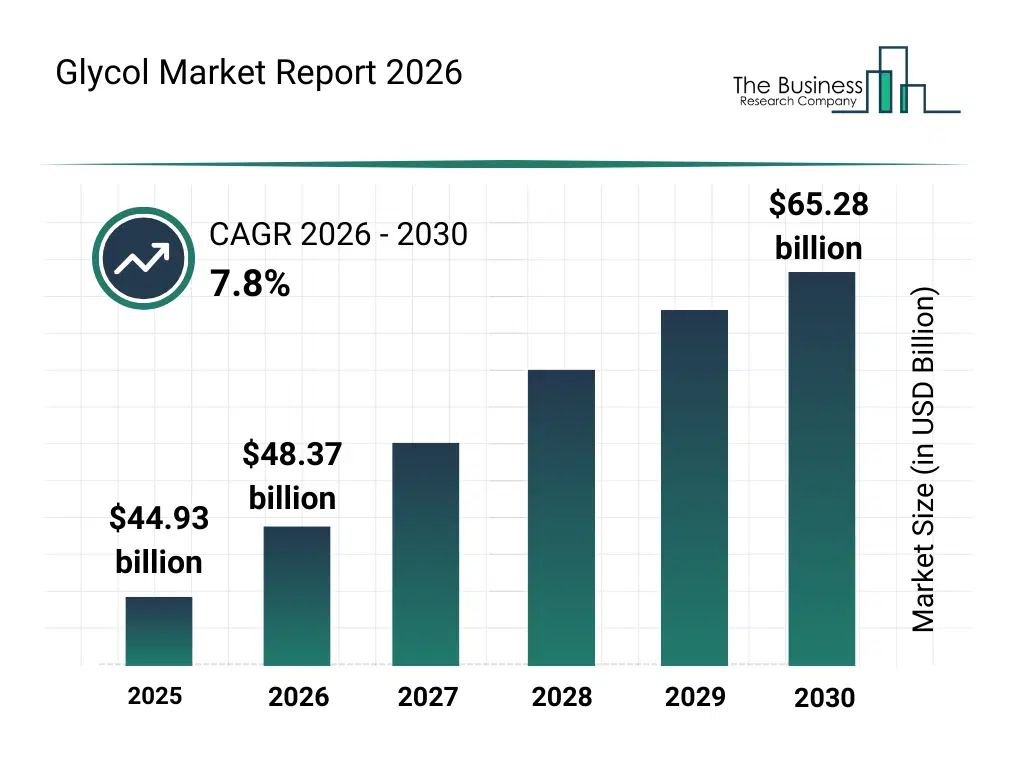
What Is The Glycol Market Size and Share 2026?
The glycol market size has grown strongly in recent years. It will grow from $44.93 billion in 2025 to $48.37 billion in 2026 at a compound annual growth rate (CAGR) of 7.7%. The growth in the historic period can be attributed to expansion of automotive production volumes, growth of polyester fiber manufacturing, increasing demand for refrigeration systems, rising use of glycols in chemical intermediates, availability of large-scale petrochemical production.What Is The Glycol Market Growth Forecast?
The glycol market size is expected to see strong growth in the next few years. It will grow to $65.28 billion in 2030 at a compound annual growth rate (CAGR) of 7.8%. The growth in the forecast period can be attributed to increasing electric vehicle thermal management needs, rising demand for sustainable packaging materials, expansion of bio-based chemical manufacturing, growing use in data center cooling systems, increasing focus on energy-efficient heat transfer fluids. Major trends in the forecast period include increasing demand for automotive antifreeze and coolants, rising use in pet packaging and polyester fibers, growing adoption of bio-based glycols, expansion of industrial heat transfer applications, enhanced focus on high-purity glycol grades.
Global Glycol Market Segmentation
1) By Type: Ethylene Glycol, Propylene Glycol 2) By Application: Antifreeze And Coolants, Polyester Fiber Production, PET Bottles And Packaging, Solvents And Humectants, Dehydrating Agent, Chemical Intermediates 3) By End User: Automotive And Transportation, Packaging, Textile, Other End-Users Subsegments: 1) By Ethylene Glycol: Monoethylene Glycol (MEG), Diethylene Glycol (DEG), Triethylene Glycol (TEG) 2) By Propylene Glycol: Industrial Grade Propylene Glycol, Food Grade Propylene Glycol, Pharmaceutical Grade Propylene GlycolWhat Is The Driver Of The Glycol Market?
The expanding automotive industry is expected to propel the growth of the glycol market going forward. The automotive industry refers to the industry that is involved in the development, production, marketing, and sale of motor vehicles, such as automobiles, trucks, motorcycles, and other vehicles. Glycol is frequently used as a vital ingredient in engine coolants and antifreeze formulas in the automobile sector. It assists in controlling engine temperature by reducing overheating in warm weather and preventing freezing in cold weather. For instance, in March 2024, according to the European Automobile Manufacturers' Association, a Belgium-based vehicle industry association, the EU car market expanded robustly in 2023 by 13.9% when compared to 2022, reaching a volume of 10.5 million units. Therefore, the expanding automotive industry is driving the growth of the glycol industry.Key Players In The Global Glycol Market
Major companies operating in the glycol market are BASF, Dow, SABIC, Shell Chemicals, ExxonMobil Chemical, Sinopec, LG Chem, LyondellBasell, Formosa Plastics, INEOS, Reliance Industries, Mitsubishi Chemical Group, Sumitomo Chemical, Eastman Chemical, Huntsman, Lanxess, Arkema, Wanhua Chemical, Celanese, Chevron Phillips Chemical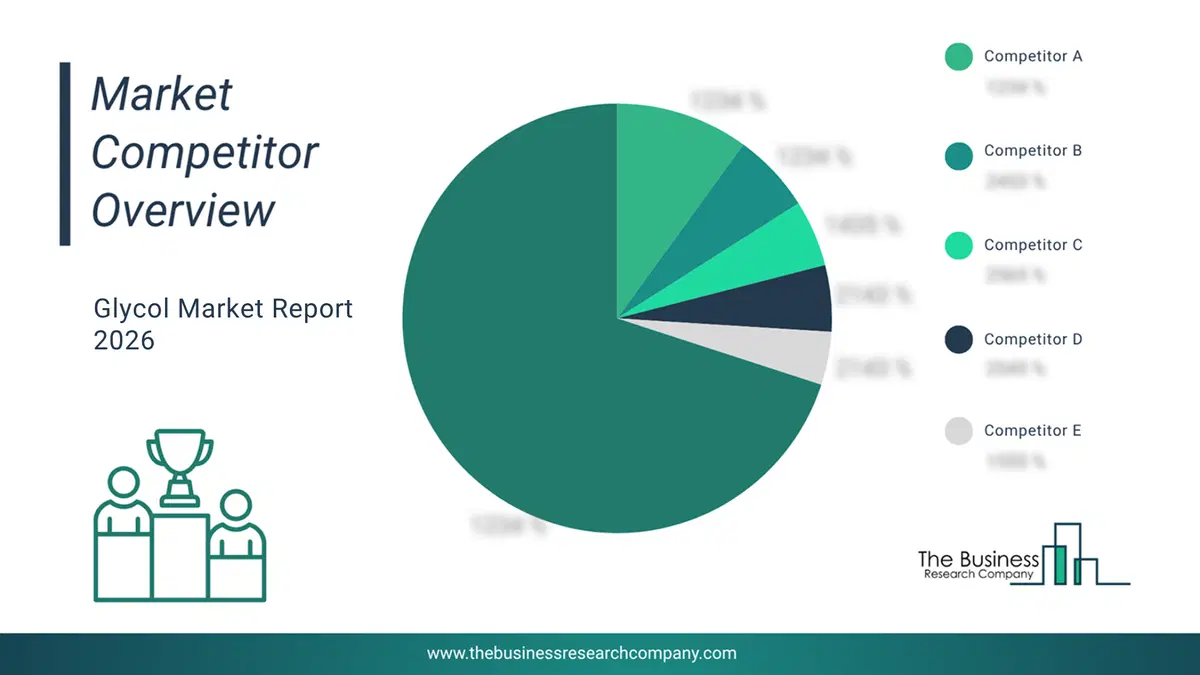
This chart is for illustrative purposes; the full report includes a detailed competitor analysis and comprehensive overview of the top 10 companies in the market.
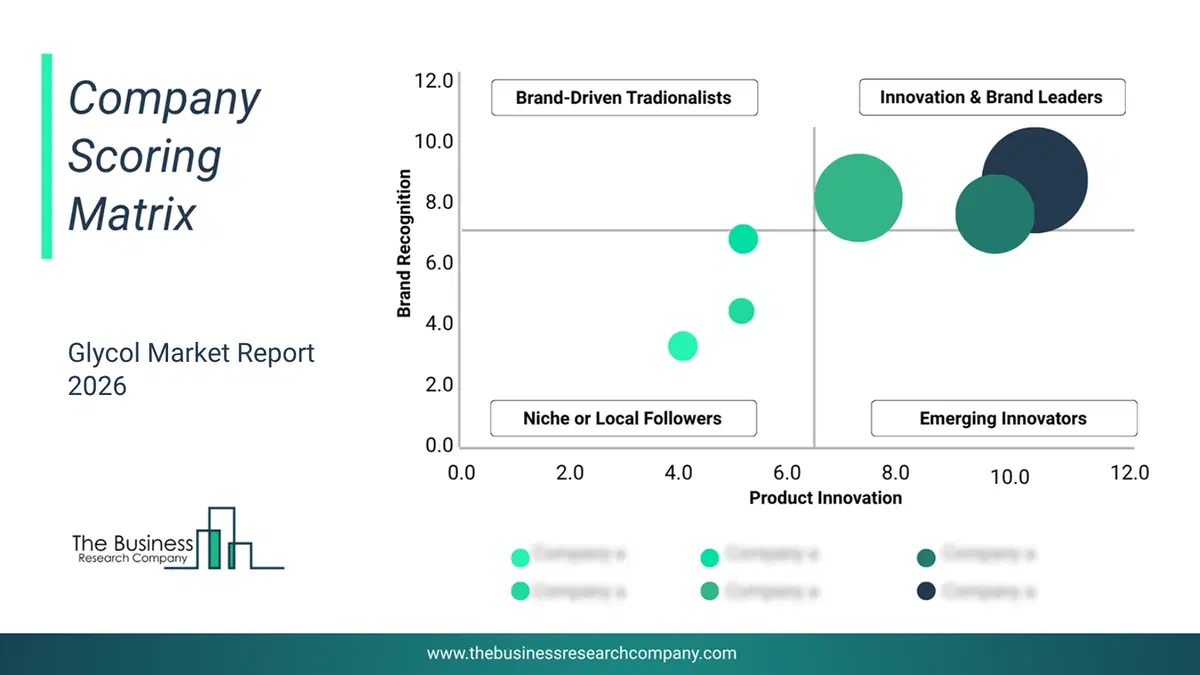
This chart maps companies by product innovation and brand strength, with bubble size indicating relative revenue, helping identify market leaders, challengers, and niche players. This is an illustrative chart; the full report provides a complete and accurate competitive analysis.
Global Glycol Market Trends and Insights
Major companies operating in the glycol market are adopting strategic partnerships approach to use PET glycol (PETG) resin that accelerates the introduction of renewable materials into plastic applications. Strategic partnerships refer to a process in which companies leverage each other's strengths and resources to achieve mutual benefits and success. For instance, in June 2023, UPM Biochemicals GmbH, a Germany-based chemical company, partnered with Selenis NA, a US-based plastics resin manufacturer company. With this partnership, they aim to produce sustainable PETG (polyethylene terephthalate glycol) using forest-sourced materials from Germany into plastic packaging applications to reduce carbon emissions.What Are Latest Mergers And Acquisitions In The Glycol Market?
In July 2024, Technip Energies, a France-based petrochemical technology company, acquired Shell for an undisclosed amount. Through this acquisition, Technip Energies aims to enhance the commercialization of its Bio-2-Glycols technology for producing bio-based Mono Ethylene Glycol (MEG) from glucose, allowing for the development of sustainable polyester solutions that replace fossil-based feedstocks. Shell is a Netherlands-based energy company involved in oil and gas exploration.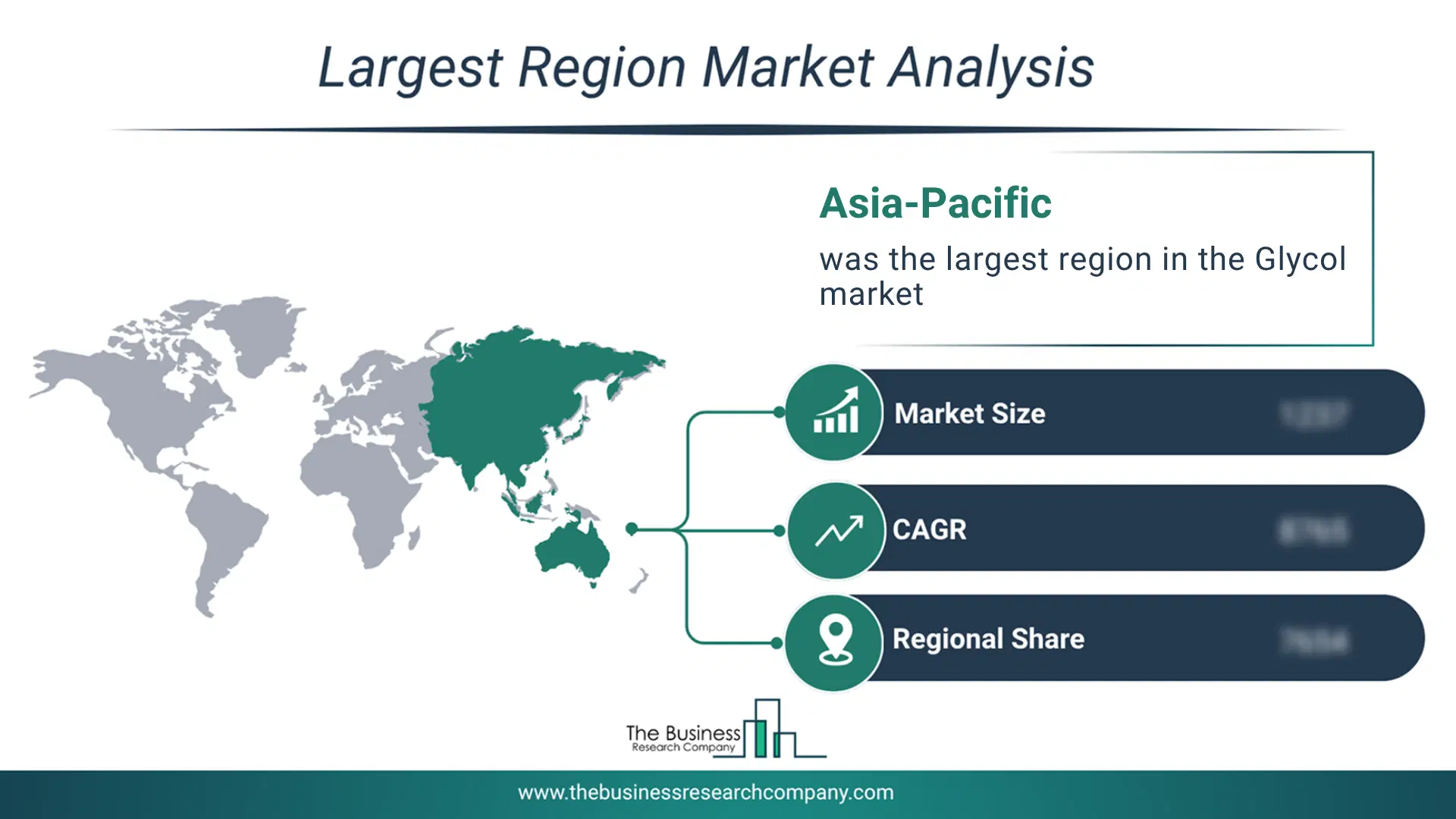
Regional Insights
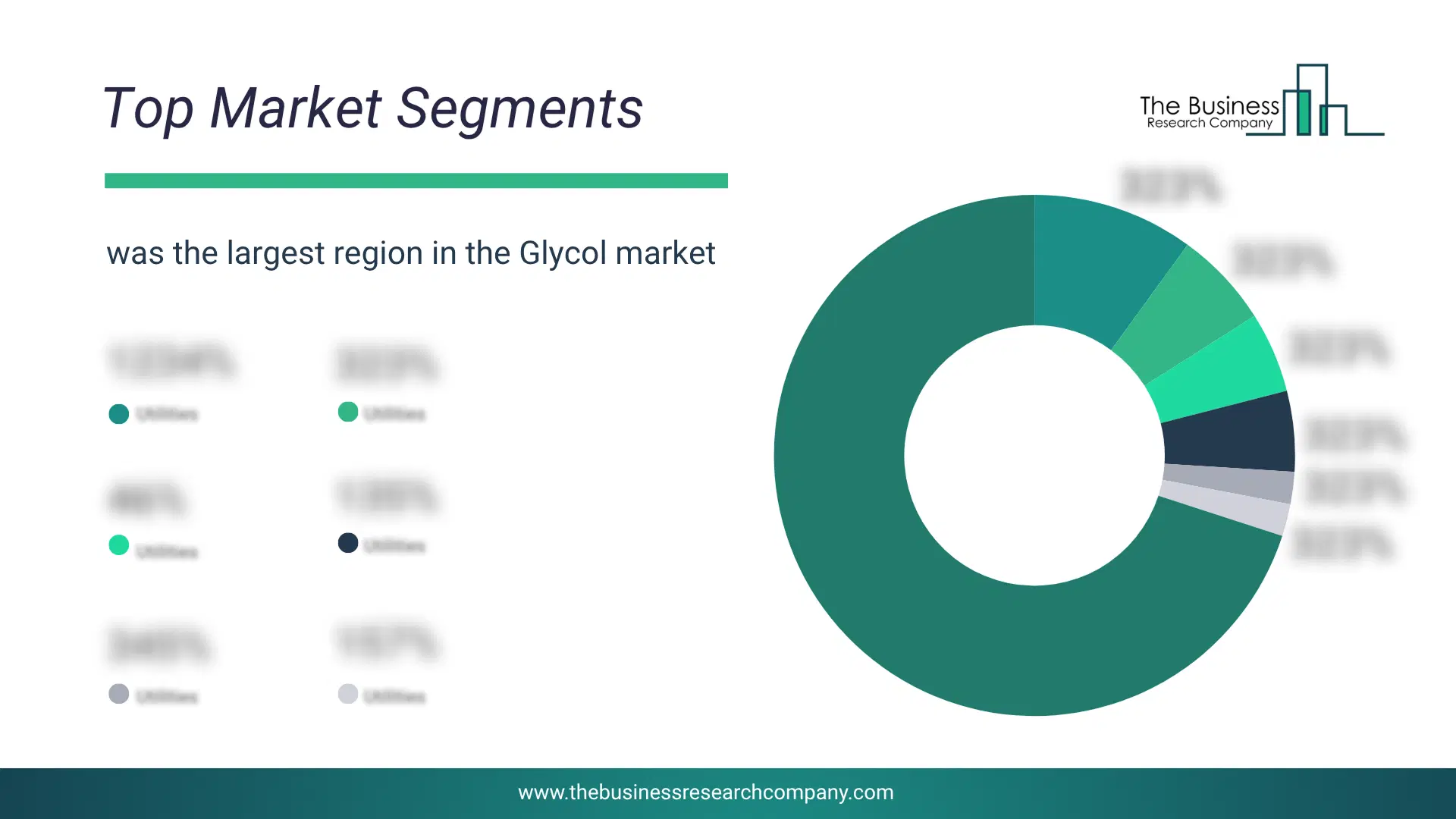
Asia-Pacific was the largest region in the glycol market in 2025, and is expected to be the fastest-growing region in the forecast period. The regions covered in this market report are Asia-Pacific, South East Asia, Western Europe, Eastern Europe, North America, South America, Middle East, Africa The countries covered in this market report are Australia, Brazil, China, France, Germany, India, Indonesia, Japan, Taiwan, Russia, South Korea, UK, USA, Canada, Italy, SpainWhat Defines the Glycol Market?
The glycol market consists of sales of hydraulic brake fluids, certain stamp pad inks, ballpoint pens, solvents, paints, plastics, films, and cosmetics. Values in this market are ‘factory gate’ values, that is the value of goods sold by the manufacturers or creators of the goods, whether to other entities (including downstream manufacturers, wholesalers, distributors and retailers) or directly to end customers. The value of goods in this market includes related services sold by the creators of the goods.How is Market Value Defined and Measured?
The market value is defined as the revenues that enterprises gain from the sale of goods and/or services within the specified market and geography through sales, grants, or donations in terms of the currency (in USD unless otherwise specified). The revenues for a specified geography are consumption values that are revenues generated by organizations in the specified geography within the market, irrespective of where they are produced. It does not include revenues from resales along the supply chain, either further along the supply chain or as part of other products.
This chart presents market attractiveness based on a quantitative evaluation of growth, competition, strategic alignment, and risk, offering a clear view of opportunity areas for decision-making. This chart is for illustrative purposes; the full report contains the complete analysis.

This chart highlights the Total Addressable Market (TAM) by estimating the maximum revenue opportunity using an assumption-driven approach, supporting strategic planning and opportunity sizing across markets. The chart is illustrative; the full report provides a more comprehensive analysis.
What Key Data and Analysis Are Included in the Glycol Market Report 2026?
The glycol market research report is one of a series of new reports from The Business Research Company that provides market statistics, including industry global market size, regional shares, competitors with the market share, detailed market segments, market trends and opportunities, and any further data you may need to thrive in the glycol industry. The market research report delivers a complete perspective of everything you need, with an in-depth analysis of the current and future state of the industry.Glycol Market Report Forecast Analysis
| Report Attribute | Details |
|---|---|
| Market Size Value In 2026 | $48.37 billion |
| Revenue Forecast In 2030 | $65.28 billion |
| Growth Rate | CAGR of 7.7% from 2026 to 2030 |
| Base Year For Estimation | 2025 |
| Actual Estimates/Historical Data | 2020-2025 |
| Forecast Period | 2026 - 2030 |
| Market Representation | Revenue in USD Billion and CAGR from 2026 to 2030 |
| Segments Covered | Type, Application, End User |
| Regional Scope | Asia-Pacific, Western Europe, Eastern Europe, North America, South America, Middle East, Africa |
| Country Scope | The countries covered in this market report are Australia, Brazil, China, France, Germany, India, Indonesia, Japan, Taiwan, Russia, South Korea, UK, USA, Canada, Italy, Spain |
| Key Companies Profiled | BASF, Dow, SABIC, Shell Chemicals, ExxonMobil Chemical, Sinopec, LG Chem, LyondellBasell, Formosa Plastics, INEOS, Reliance Industries, Mitsubishi Chemical Group, Sumitomo Chemical, Eastman Chemical, Huntsman, Lanxess, Arkema, Wanhua Chemical, Celanese, Chevron Phillips Chemical |
| Customization Scope | Request for Customization |
| Pricing And Purchase Options | Explore Purchase Options |