

Heterogeneous Integration Market Report 2026
Global Outlook – By Component ( Advanced Manufacturing And Multi-Chip Integration, Integrated Photonics, Integrated Power Electronics, Microelectromechanical Systems (MEMS) And Sensor Integration, 5G, Radio Frequency (RF) And Analog Mixed Signal ), By Design ( Co-Design, Modeling And Simulation ), By End-User ( Semiconductor And Electronics, Information Technology (IT) And Telecommunications, Automotive And Transportation, Healthcare And Life Sciences, Manufacturing And Industrial, Aerospace And Defense, Other End Users) – Market Size, Trends, Strategies, and Forecast to 2030
Heterogeneous Integration Market Overview
• Heterogeneous Integration market size has reached to $1.03 billion in 2025 • Expected to grow to $3.92 billion in 2030 at a compound annual growth rate (CAGR) of 30.5% • Growth Driver: Surge In IoT Adoption Fueling The Growth Of The Market Due To Increased Demand For Connectivity And Automation • North America was the largest region in 2025 and Asia-Pacific is the fastest growing region.What Is Covered Under Heterogeneous Integration Market?
Heterogeneous integration refers to the process of combining diverse components such as chips, sensors, and actuators, often fabricated with different materials and technologies, into a single system or package to enhance functionality and performance. It enables advanced applications in electronics, such as AI, 5G, IoT, and high-performance computing, by overcoming limitations of traditional monolithic integration. The main components of heterogeneous integration are advanced manufacturing and multi-chip integration, integrated photonics, integrated power electronics, microelectromechanical systems (MEMS) and sensor integration, 5G, and radio frequency (RF) and analog mixed signal. Advanced manufacturing utilizes cutting-edge technologies to produce precise, high-performance products efficiently, while multi-chip integration integrates several chips into one package to boost performance, reduce size, and enhance functionality. The various designs involved are co-design and modeling and simulation and are used by several end users, such as semiconductor and electronics, information technology (IT) and telecommunications, automotive and transportation, healthcare and life sciences, manufacturing and industrial, aerospace and defense, and others.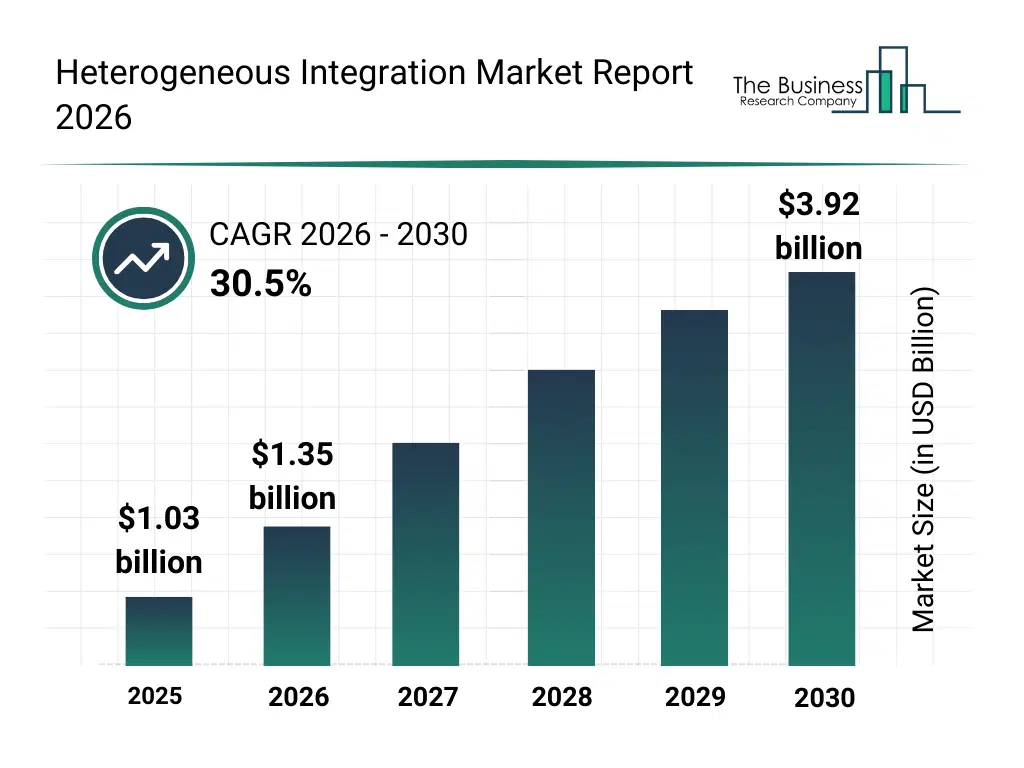
What Is The Heterogeneous Integration Market Size 2026 And Growth Rate?
The heterogeneous integration market size has grown exponentially in recent years. It will grow from $1.03 billion in 2025 to $1.35 billion in 2026 at a compound annual growth rate (CAGR) of 30.8%. The growth in the historic period can be attributed to rise of semiconductor miniaturization, demand for high-performance computing, adoption of advanced packaging, growth in consumer electronics, initial integration of sensors and actuators.What Is The Heterogeneous Integration Market Growth Forecast?
The heterogeneous integration market size is expected to see exponential growth in the next few years. It will grow to $3.92 billion in 2030 at a compound annual growth rate (CAGR) of 30.5%. The growth in the forecast period can be attributed to expansion of ai-driven applications, proliferation of 5g and iot devices, demand for automotive electronics, growth in healthcare and life sciences applications, increase in aerospace and defense electronics. Major trends in the forecast period include heterogeneous system optimization, multi-material chip integration, advanced packaging techniques, thermal management solutions, high-density electronics integration.
Global Heterogeneous Integration Market Segmentation
1) By Component: Advanced Manufacturing And Multi-Chip Integration, Integrated Photonics, Integrated Power Electronics, Microelectromechanical Systems (MEMS) And Sensor Integration, 5G, Radio Frequency (RF) And Analog Mixed Signal 2) By Design: Co-Design, Modeling And Simulation 3) By End-User: Semiconductor And Electronics, Information Technology (IT) And Telecommunications, Automotive And Transportation, Healthcare And Life Sciences, Manufacturing And Industrial, Aerospace And Defense, Other End Users Subsegments: 1) By Advanced Manufacturing And Multi-Chip Integration: 2.5D And 3D Packaging, Fan-Out Wafer-Level Packaging (FOWLP), System-In-Package (SiP) 2) By Integrated Photonics: Silicon Photonics, Optical Interconnects, Photonic Integrated Circuits (PICs) 3) By Integrated Power Electronics: Wide Bandgap Semiconductors (SiC, GaN), Power Modules, Smart Power ICs 4) By Microelectromechanical Systems (MEMS) And Sensor Integration: Inertial Sensors, Pressure And Environmental Sensors, BioMEMS And Microfluidic Devices 5) By 5G: mmWave Antennas, Beamforming Technologies, 5G Baseband And RF Integration 6) By Radio Frequency (RF) And Analog Mixed Signal: RF Front-End Modules, Mixed-Signal ASICs, High-Frequency Amplifiers And FiltersWhat Is The Driver Of The Heterogeneous Integration Market?
The rise in adoption of IoT devices is expected to drive the growth of the heterogeneous integration market going forward. IoT devices are connected objects equipped with sensors and software that communicate via the internet, enabling data sharing and automation across various applications like homes, industries, and healthcare. The increased adoption of IoT devices is primarily due to the growing demand for connectivity, automation, and data-driven decision-making across various industries. Heterogeneous integration enhances IoT devices by enabling the seamless integration of diverse components like sensors, processors, and communication modules into compact, energy-efficient systems, ensuring higher performance and multifunctionality to meet the demands of connected applications. For instance, in 2024, Ericsson, a Sweden-based network and telecommunications company, reported that the total number of cellular IoT connections approached 4 billion and is projected to grow at a CAGR of around 11%, surpassing 7 billion by 2030. Therefore, the rise in adoption of IoT devices is driving the growth of the heterogeneous integration industry.What Is The Driver Of The Heterogeneous Integration Market?
The increase in demand for smartphones is expected to drive the growth of the heterogeneous integration market going forward. A smartphone is a mobile device that integrates calling, messaging, internet access, and app functionality, all controlled via a touchscreen. Smartphone adoption is rising due to lower costs, improved technology, widespread internet availability, and increased use of mobile apps for daily activities. Heterogeneous integration enhances smartphones by enabling the seamless integration of diverse components, such as processors, sensors, and memory, into a compact design, leading to improved performance, energy efficiency, and advanced functionalities in modern devices. For instance, in November 2024, Electroiq, a US-based data-driven company, reported that in 2023, about 70% of the global population owned a smartphone, and many people use more than one device; total smartphone subscriptions surpassed 7 billion, and this number is expected to climb to nearly 8 billion by 2028. Therefore, the increase in demand for smartphones is driving the growth of the heterogeneous integration industry.Key Players In The Global Heterogeneous Integration Market
Major companies operating in the heterogeneous integration market are Samsung Electronics Co. Ltd., Taiwan Semiconductor Manufacturing Company Limited (TSMC), Intel Corporation, International Business Machines Corporation, Qualcomm Incorporated, Broadcom Inc., Micron Technology Inc., Hewlett Packard Enterprise Company, NVIDIA Corporation, Applied Materials Inc., Advanced Micro Devices Inc., ASE Technology Holding Co. Ltd., STMicroelectronics NV, Analog Devices Inc., GlobalFoundries Inc., EV Group, SkyWater Technology Inc., Micross Components Inc., Etron Technology, Silicon Austria Labs GmbH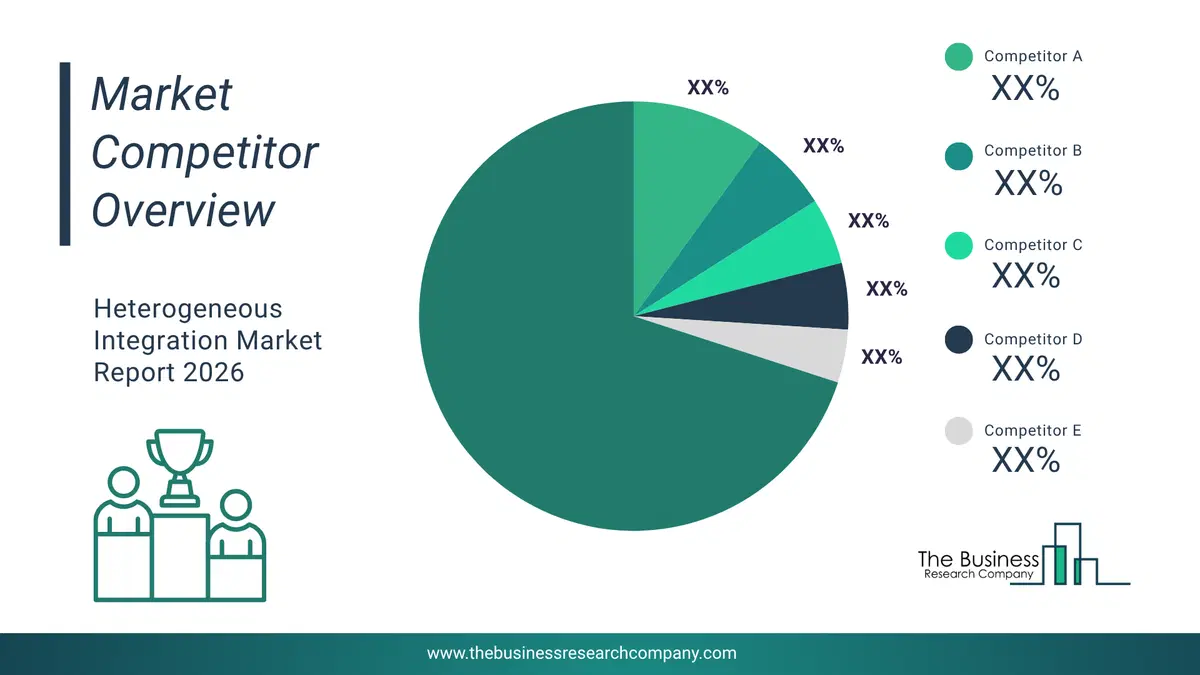
This chart is for illustrative purposes; the full report includes a detailed competitor analysis and comprehensive overview of the top 10 companies in the market.
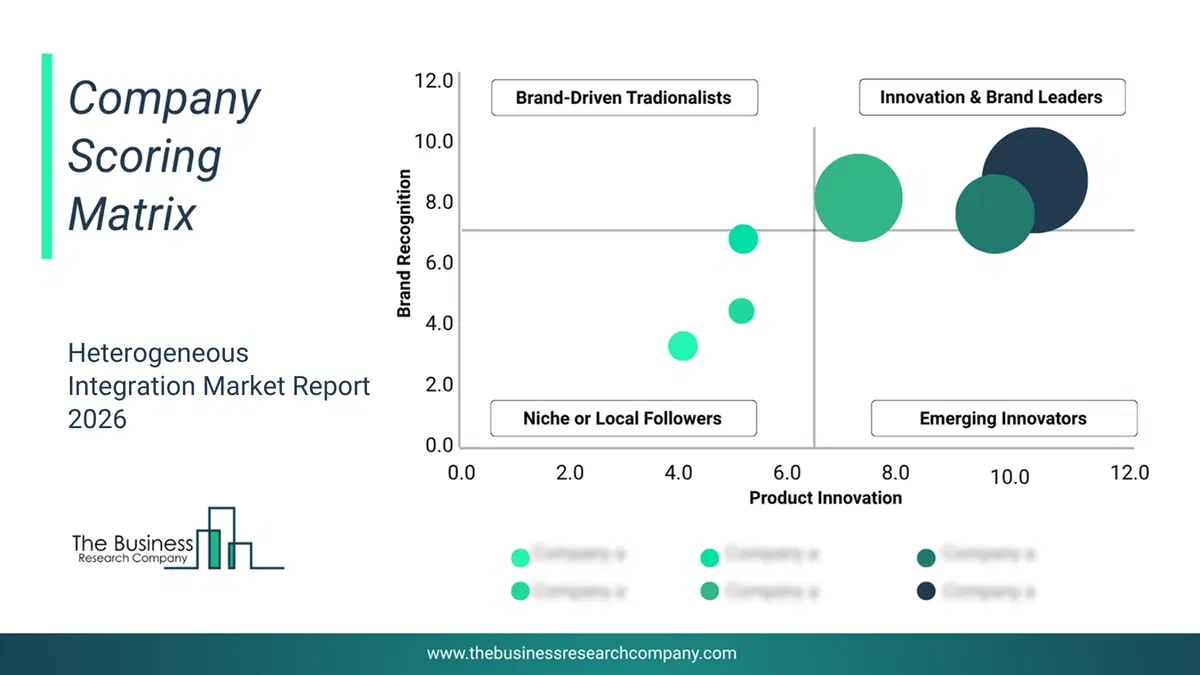
This chart maps companies by product innovation and brand strength, with bubble size indicating relative revenue, helping identify market leaders, challengers, and niche players. This is an illustrative chart; the full report provides a complete and accurate competitive analysis.
What Are Latest Mergers And Acquisitions In The Heterogeneous Integration Market?
In October 2024, Amkor Technology Inc., a US-based semiconductor manufacturing company, partnered with Taiwan Semiconductor Manufacturing Company Limited (TSMC). This collaboration strengthens the US semiconductor supply chain by bringing advanced packaging closer to domestic production, reducing reliance on overseas operations. Taiwan Semiconductor Manufacturing Company is a Taiwan-based semiconductor manufacturing company that specializes in packaging technologies.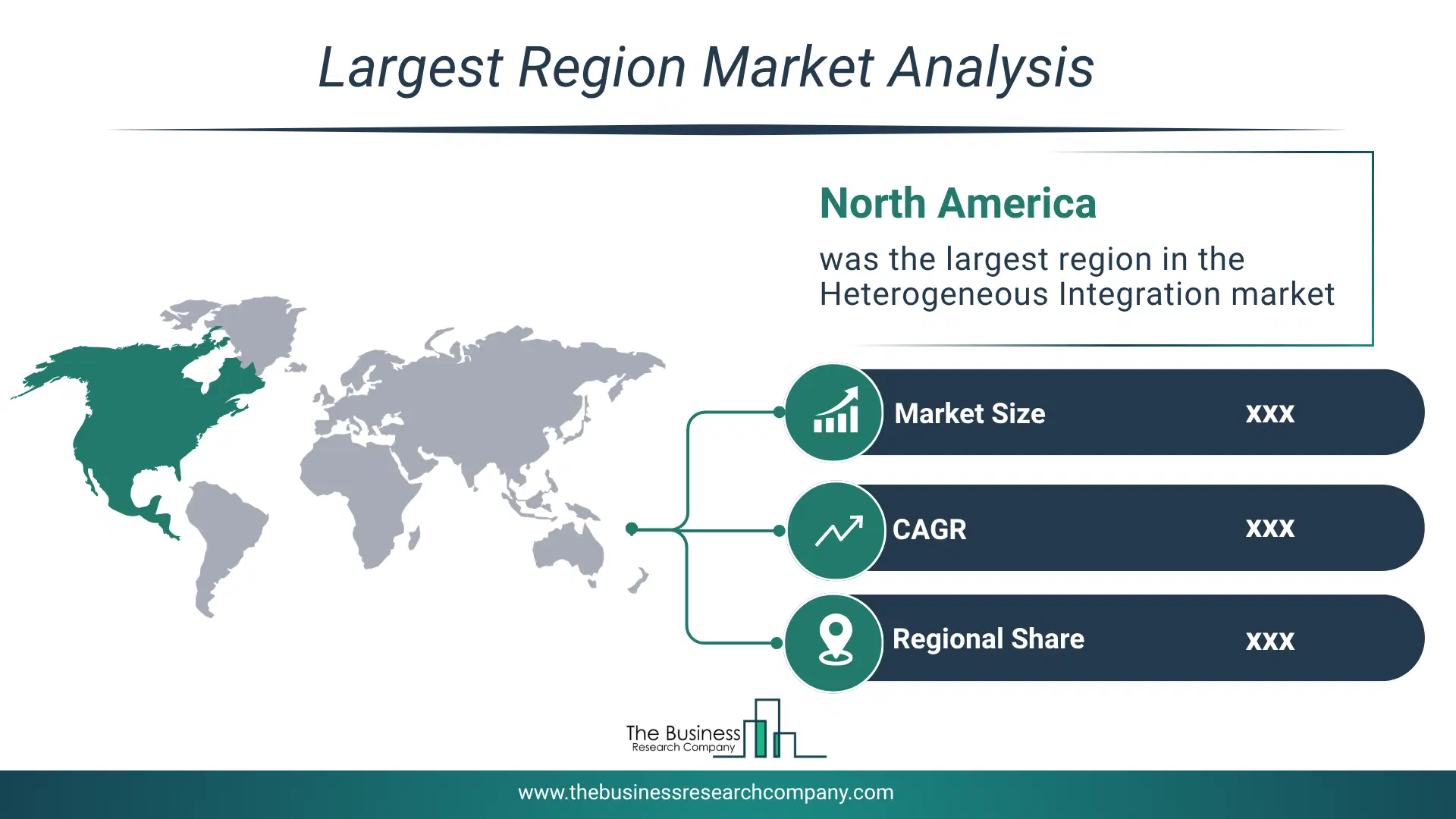
Regional Outlook
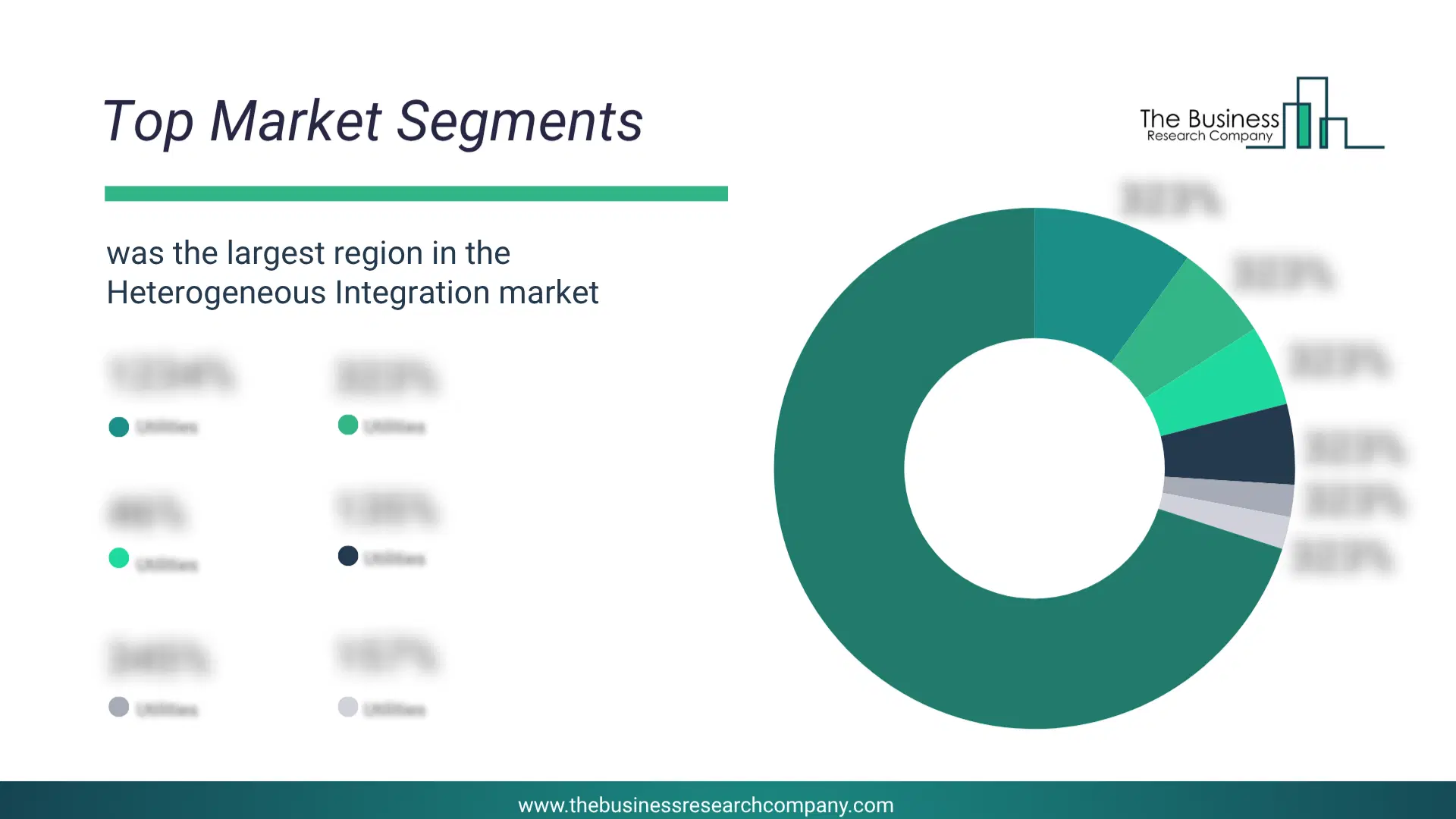
North America was the largest region in the heterogeneous integration market in 2025. Asia-Pacific is expected to be the fastest-growing region in the forecast period. The regions covered in this market report are Asia-Pacific, South East Asia, Western Europe, Eastern Europe, North America, South America, Middle East, Africa. The countries covered in this market report are Australia, Brazil, China, France, Germany, India, Indonesia, Japan, Taiwan, Russia, South Korea, UK, USA, Canada, Italy, Spain.What Defines the Heterogeneous Integration Market?
The heterogeneous integration market includes revenues earned by entities by providing services such as interposer and substrate development, testing and validation, and system-on-chip (SoC) integration. The market value includes the value of related goods sold by the service provider or included within the service offering. Only goods and services traded between entities or sold to end consumers are included. The heterogeneous integration market consists of sales of integrated circuits (ICs), system-in-package (SiP), motion sensors, memory modules, and power management ICs. Values in this market are ‘factory gate’ values, that is the value of goods sold by the manufacturers or creators of the goods, whether to other entities (including downstream manufacturers, wholesalers, distributors and retailers) or directly to end customers. The value of goods in this market includes related services sold by the creators of the goods.How is Market Value Defined and Measured?
The market value is defined as the revenues that enterprises gain from the sale of goods and/or services within the specified market and geography through sales, grants, or donations in terms of the currency (in USD unless otherwise specified). The revenues for a specified geography are consumption values that are revenues generated by organizations in the specified geography within the market, irrespective of where they are produced. It does not include revenues from resales along the supply chain, either further along the supply chain or as part of other products.
This chart presents market attractiveness based on a quantitative evaluation of growth, competition, strategic alignment, and risk, offering a clear view of opportunity areas for decision-making. This chart is for illustrative purposes; the full report contains the complete analysis.

This chart highlights the Total Addressable Market (TAM) by estimating the maximum revenue opportunity using an assumption-driven approach, supporting strategic planning and opportunity sizing across markets. The chart is illustrative; the full report provides a more comprehensive analysis.
What Key Data and Analysis Are Included in the Heterogeneous Integration Market Report 2026?
The heterogeneous integration market research report is one of a series of new reports from The Business Research Company that provides market statistics, including industry global market size, regional shares, competitors with the market share, detailed market segments, market trends and opportunities, and any further data you may need to thrive in the heterogeneous integration industry. The market research report delivers a complete perspective of everything you need, with an in-depth analysis of the current and future state of the industry.Heterogeneous Integration Market Report Forecast Analysis
| Report Attribute | Details |
|---|---|
| Market Size Value In 2026 | $1.35 billion |
| Revenue Forecast In 2030 | $3.92 billion |
| Growth Rate | CAGR of 30.5% from 2026 to 2030 |
| Base Year For Estimation | 2025 |
| Actual Estimates/Historical Data | 2020-2025 |
| Forecast Period | 2026 - 2030 |
| Market Representation | Revenue in USD Billion and CAGR from 2026 to 2030 |
| Segments Covered | Component, Design, End-User |
| Regional Scope | Asia-Pacific, Western Europe, Eastern Europe, North America, South America, Middle East, Africa |
| Country Scope | The countries covered in the report are Australia, Brazil, China, France, Germany, India, Indonesia, Japan, Taiwan, Russia, South Korea, UK, USA, Canada, Italy, Spain. |
| Key Companies Profiled | Samsung Electronics Co. Ltd., Taiwan Semiconductor Manufacturing Company Limited (TSMC), Intel Corporation, International Business Machines Corporation, Qualcomm Incorporated, Broadcom Inc., Micron Technology Inc., Hewlett Packard Enterprise Company, NVIDIA Corporation, Applied Materials Inc., Advanced Micro Devices Inc., ASE Technology Holding Co. Ltd., STMicroelectronics NV, Analog Devices Inc., GlobalFoundries Inc., EV Group, SkyWater Technology Inc., Micross Components Inc., Etron Technology, Silicon Austria Labs GmbH |
| Customization Scope | Request for Customization |
| Pricing And Purchase Options | Explore Purchase Options |