
High Frequency Trading Market Report 2026
Global Outlook – By Execution Type (Direct Market Access (DMA), Algorithmic Execution, High-Speed Trading Systems, Dark Pools, Brokerage Execution), By Trading Strategy (Algorithmic Trading, Statistical Arbitrage, Market Making, Trend Following, Mean Reversion), By Deployment (Cloud, On Premise), By Technology And Infrastructure (Low Latency Systems, Colocation Services, Cloud Computing, Data Feeds, Network And Connectivity Solutions), By End Use (Investment Banks, Hedge Funds, Personal Investor, Other End Uses) – Market Size, Trends, Strategies, and Forecast to 2030
High Frequency Trading Market Overview
• High Frequency Trading market size has reached to $13.38 billion in 2025 • Expected to grow to $21.46 billion in 2030 at a compound annual growth rate (CAGR) of 9.9% • Growth Driver: Increasing Adoption Of Cloud Computing Fueling The Growth Of The Market Due To Scalability And Low-Latency Infrastructure • Market Trend: Next-Gen Platforms Reshape Digital Asset Trading With Speed And Transparency • North America was the largest region in 2025 and Asia-Pacific is the fastest growing region.What Is Covered Under High Frequency Trading Market?
High frequency trading (HFT) is a type of algorithmic trading that uses powerful computers to execute a large number of orders at extremely high speeds, often in milliseconds or microseconds. It relies on complex algorithms, low-latency networks, and real-time market data. High-frequency trading capitalizes on small price discrepancies across markets or within short timeframes to generate profits. The main execution types of high-frequency trading include direct market access (DMA), algorithmic execution, high-speed trading systems, dark pools, and brokerage execution. Direct market access (DMA) is a service that allows traders, usually institutional or professional, to place orders directly on the exchange’s order book without manual intervention from a traditional broker. Various trading strategies, such as algorithmic trading, statistical arbitrage, market making, trend following, and mean reversion, can be deployed either on the cloud or on-premises. Several technologies and infrastructures support these strategies, including low-latency systems, colocation services, cloud computing, data feeds, and network and connectivity solutions. These services cater to end users such as banks, hedge funds, and individual investors.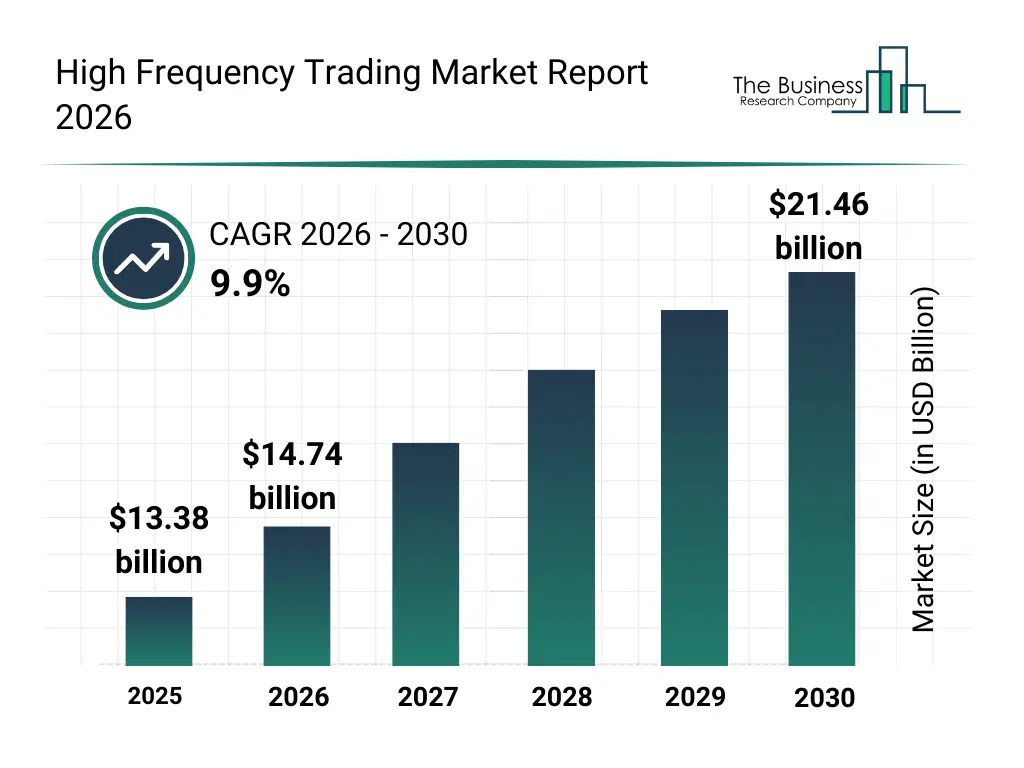
What Is The High Frequency Trading Market Size and Share 2026?
The high frequency trading market size has grown rapidly in recent years. It will grow from $13.38 billion in 2025 to $14.74 billion in 2026 at a compound annual growth rate (CAGR) of 10.2%. The growth in the historic period can be attributed to growth of electronic trading platforms, increased market liquidity, expansion of algorithmic trading adoption, availability of high-speed market data feeds, early investments in low-latency infrastructure.What Is The High Frequency Trading Market Growth Forecast?
The high frequency trading market size is expected to see strong growth in the next few years. It will grow to $21.46 billion in 2030 at a compound annual growth rate (CAGR) of 9.9%. The growth in the forecast period can be attributed to increasing regulatory sophistication, rising competition for speed advantages, expansion of cloud-based trading architectures, growing demand for alternative data usage, continued advancements in network and connectivity technologies. Major trends in the forecast period include increasing adoption of ultra-low latency trading infrastructure, rising use of ai-driven trading algorithms, expansion of colocation and proximity hosting services, growing deployment of fpga-based trading systems, enhanced focus on real-time data analytics.
Global High Frequency Trading Market Segmentation
1) By Execution Type: Direct Market Access (DMA), Algorithmic Execution, High-Speed Trading Systems, Dark Pools, Brokerage Execution 2) By Trading Strategy: Algorithmic Trading, Statistical Arbitrage, Market Making, Trend Following, Mean Reversion 3) By Deployment: Cloud, On Premise 4) By Technology And Infrastructure: Low Latency Systems, Colocation Services, Cloud Computing, Data Feeds, Network And Connectivity Solutions 5) By End Use: Investment Banks, Hedge Funds, Personal Investor, Other End Uses Subsegments: 1) By Direct Market Access (DMA): Sponsored DMA, Naked DMA, Broker-Assisted DMA, Smart Order Routing DMA, Co-Located DMA Access 2) By Algorithmic Execution: Volume Weighted Average Price (Vwap) Algorithms, Time Weighted Average Price (TWAP) Algorithms, Implementation Shortfall Algorithms, Percentage Of Volume (POV) Algorithms, Iceberg Orders, Sniper And Stealth Algorithms 3) By High-Speed Trading Systems: Low-Latency Trading Platforms, FPGA-Based Trading Systems, Co-Location Services, Microwave And Radio Frequency Transmission Systems, Ultra-Low Latency Data Feeds 4) By Dark Pools: Broker-Dealer Owned Dark Pools, Agency Broker And Exchange-Owned Dark Pools, Independent And Consortium Dark Pools, Crossing Networks, Conditional Order Books 5) By Brokerage Execution: Full-Service Brokerage Execution, Discount Brokerage Execution, Prime Brokerage Execution, Electronic Communication Networks (ECNs), Hybrid Execution ServicesWhat Is The Driver Of The High Frequency Trading Market?
The increasing adoption of cloud computing is expected to propel the growth of the high frequency trading market going forward. Cloud computing refers to delivering computing resources like storage, servers, and software over the internet, enabling scalable, on-demand access without physical infrastructure. The increasing adoption of cloud computing is due to scalability and flexibility, as they allow businesses to easily adjust resources on demand without heavy upfront infrastructure costs. Cloud computing enhances high-frequency trading by providing scalable and low-latency infrastructure, making it ideal for executing complex trading algorithms. It reduces operational costs by enabling real-time data processing and rapid deployment, improving trading speed and efficiency. For instance, in December 2023, according to Eurostat, a Luxembourg-based government agency, 45.2 % of EU enterprises bought cloud computing services in 2023, mostly for hosting their e-mail systems, storing files in electronic form and office software. Therefore, the increasing adoption of cloud computing is driving the growth of the high-frequency trading market.Key Players In The Global High Frequency Trading Market
Major companies operating in the high frequency trading market are Latour Trading LLC, Susquehanna International Group LLP, Jane Street Group LLC, Two Sigma Investments LP, Jump Trading LLC, Citadel Securities LLC, Optiver Holding B.V., DRW Holdings LLC, Tower Research Capital LLC, Hudson River Trading LLC, XTX Markets Limited, Akuna Capital LLC, Tibra Capital Pty Limited, Allston Trading LLC, Global Trading Systems LLC, RSJ Algorithmic Trading A.S, Headlands Technologies LLC, Teza Technologies LLC, Quantlab Financial LLC, Tradebot Systems Inc., Bluefin Trading LLC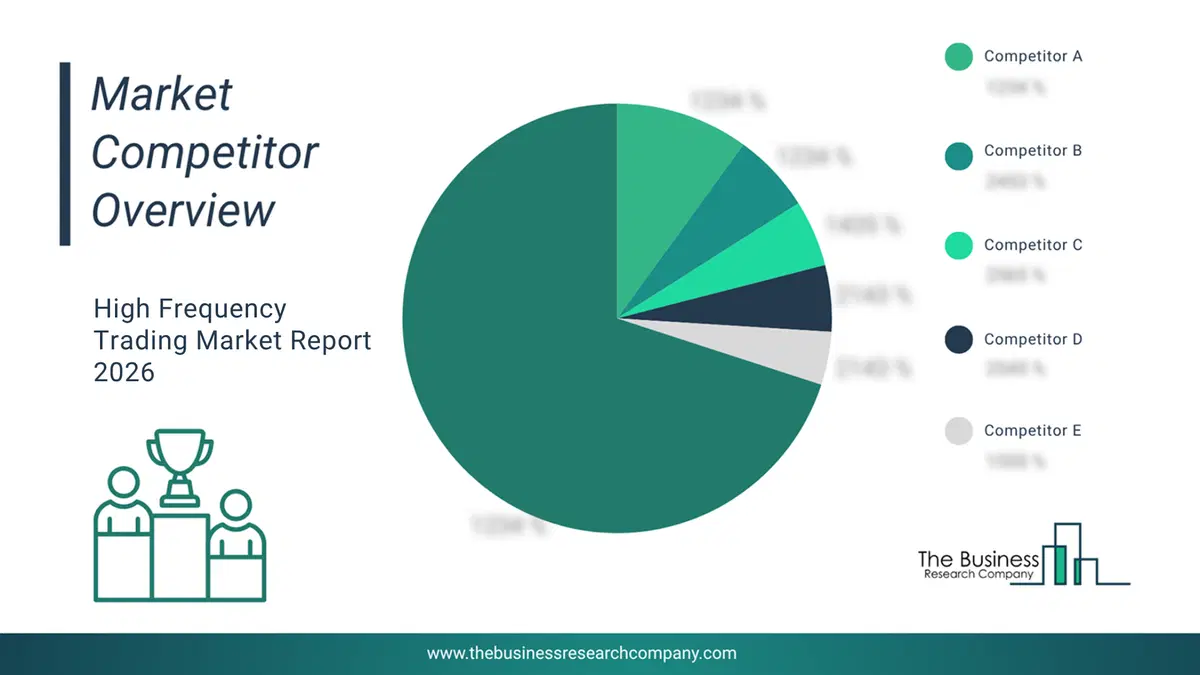
This chart is for illustrative purposes; the full report includes a detailed competitor analysis and comprehensive overview of the top 10 companies in the market.
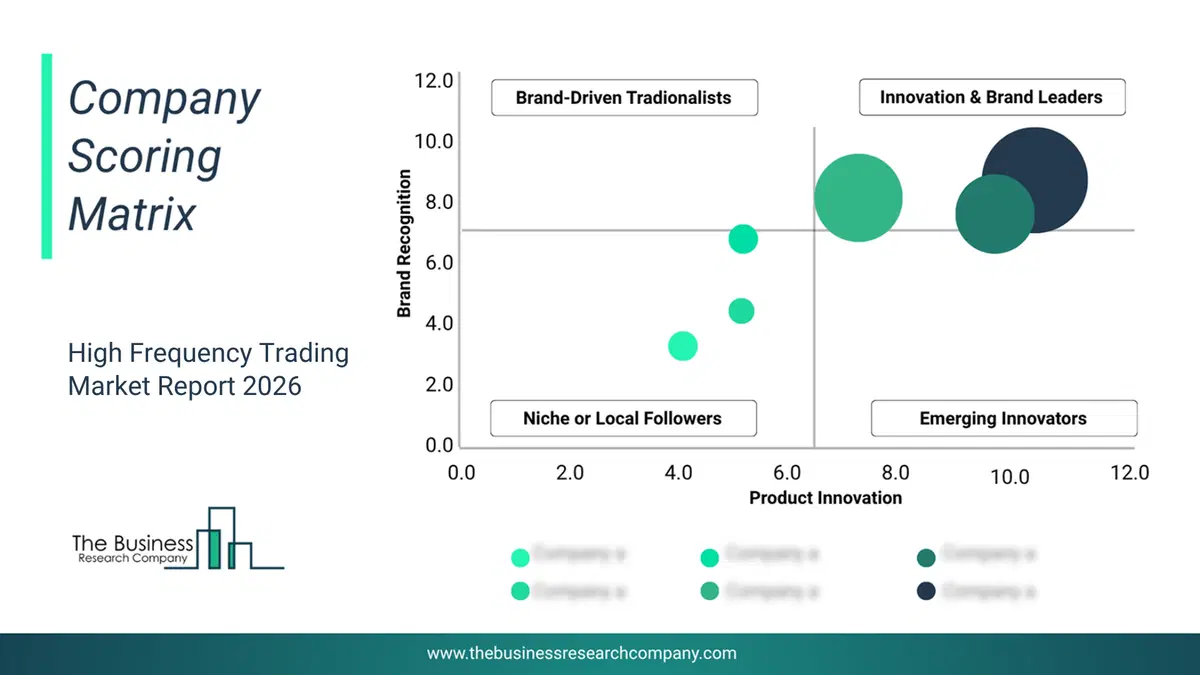
This chart maps companies by product innovation and brand strength, with bubble size indicating relative revenue, helping identify market leaders, challengers, and niche players. This is an illustrative chart; the full report provides a complete and accurate competitive analysis.
Global High Frequency Trading Market Trends and Insights
Major companies operating in the high frequency trading (HFT) market are focusing on developing technologically advanced solutions, such as institutional-grade decentralized exchange platforms, to enable ultra-fast, secure, and transparent trading across digital assets. Institutional-grade decentralized exchange platforms are advanced trading systems designed to meet the performance, security, and compliance standards required by professional and institutional investors while enabling peer-to-peer trading without intermediaries. For instance, in July 2025, Bluefin Payment Systems LLC, a US-based system software company, launched Bluefin v2, also known as Bluefin Pro, an institutional-grade high-frequency trading platform built on the Sui blockchain. Bluefin V2 combines centralized exchange performance with decentralized infrastructure, enabling sub-second order execution, high throughput, and low fees. It utilizes off-chain order books and on-chain settlement to optimize speed and reliability, supporting professional traders seeking scalable and transparent DeFi solutions. The platform also includes advanced risk controls and supports multiple liquidity pools, making it suitable for complex trading strategies.What Are Latest Mergers And Acquisitions In The High Frequency Trading Market?
In October 2023, MarketAxess Holdings Inc., a US-based international financial technology company, acquired Pragma LLC for an undisclosed amount. With this acquisition, MarketAxess aims to enhance its algorithmic trading capabilities and expand its artificial intelligence-driven execution solutions across fixed income, equities, and FX markets. Pragma LLC is a US-based trading tech company offering low-latency execution solutions for high-frequency trading.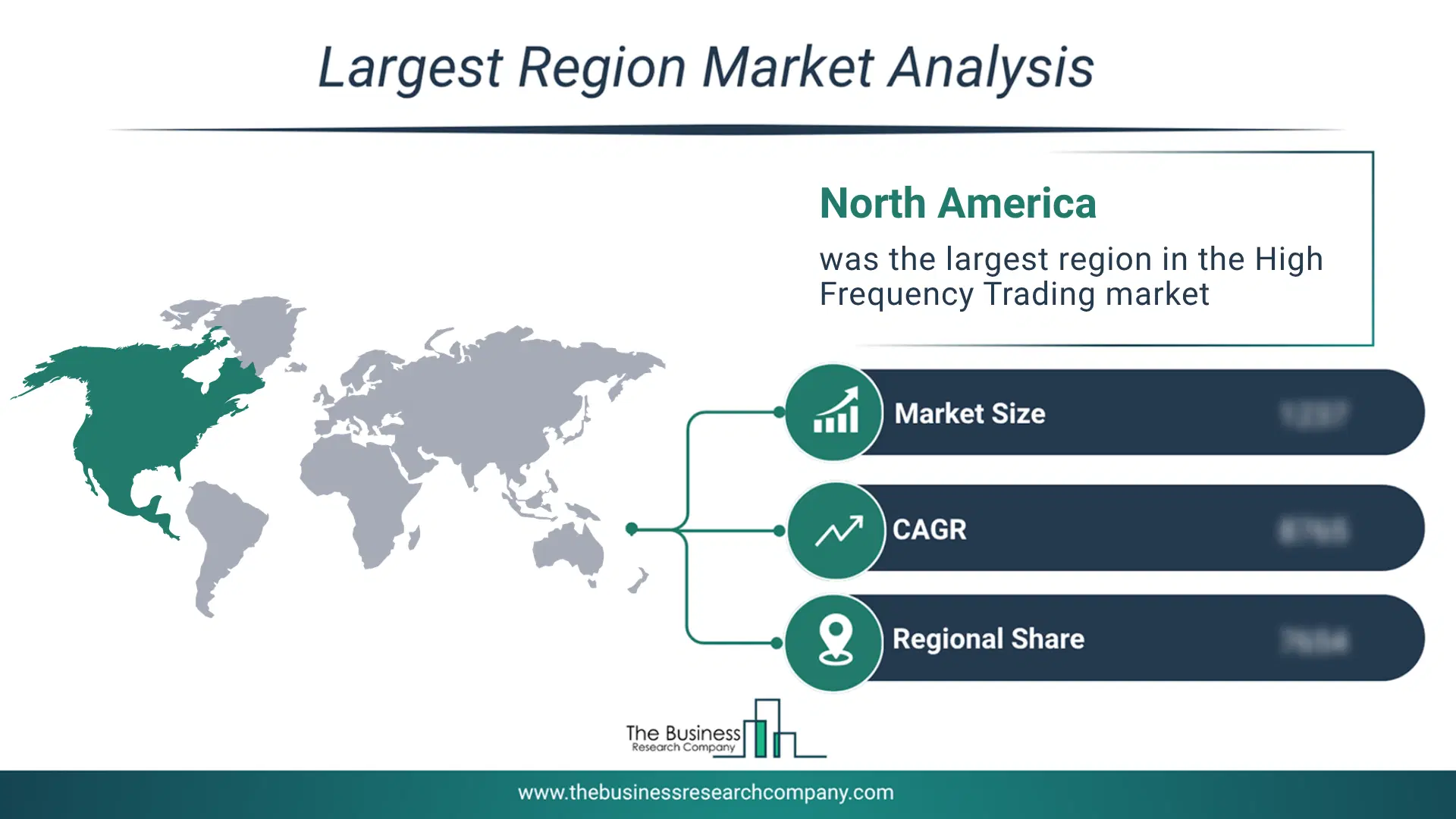
Regional Outlook
North America was the largest region in the high frequency trading market in 2025. Asia-Pacific is expected to be the fastest-growing region in the forecast period. The regions covered in this market report are Asia-Pacific, South East Asia, Western Europe, Eastern Europe, North America, South America, Middle East, Africa. The countries covered in this market report are Australia, Brazil, China, France, Germany, India, Indonesia, Japan, Taiwan, Russia, South Korea, UK, USA, Canada, Italy, Spain.What Defines the High Frequency Trading Market?
The high frequency trading market consists of revenues earned by entities by providing services such as arbitrage strategies, proprietary trading, colocation services, data feed services, smart order routing, and dark pool trading. The market value includes the value of related goods sold by the service provider or included within the service offering. The high-frequency trading market also includes sales of high-speed network infrastructure, field-programmable gate arrays, direct market access tools, trade execution management systems, and back testing and simulation tools. Values in this market are ‘factory gate’ values, that is, the value of goods sold by the manufacturers or creators of the goods, whether to other entities (including downstream manufacturers, wholesalers, distributors, and retailers) or directly to end customers. The value of goods in this market includes related services sold by the creators of the goods.How is Market Value Defined and Measured?
The market value is defined as the revenues that enterprises gain from the sale of goods and/or services within the specified market and geography through sales, grants, or donations in terms of the currency (in USD unless otherwise specified). The revenues for a specified geography are consumption values that are revenues generated by organizations in the specified geography within the market, irrespective of where they are produced. It does not include revenues from resales along the supply chain, either further along the supply chain or as part of other products.
This chart presents market attractiveness based on a quantitative evaluation of growth, competition, strategic alignment, and risk, offering a clear view of opportunity areas for decision-making. This chart is for illustrative purposes; the full report contains the complete analysis.

This chart highlights the Total Addressable Market (TAM) by estimating the maximum revenue opportunity using an assumption-driven approach, supporting strategic planning and opportunity sizing across markets. The chart is illustrative; the full report provides a more comprehensive analysis.
What Key Data and Analysis Are Included in the High Frequency Trading Market Report 2026?
The high frequency trading market research report is one of a series of new reports from The Business Research Company that provides market statistics, including Market Report 2026?global market size, regional shares, competitors with the market share, detailed market segments, market trends and opportunities, and any further data you may need to thrive in the high frequency trading Market Report 2026? The market research report delivers a complete perspective of everything you need, with an in-depth analysis of the current and future state of the Market Report 2026?High Frequency Trading Market Report Forecast Analysis
| Report Attribute | Details |
|---|---|
| Market Size Value In 2026 | $14.74 billion |
| Revenue Forecast In 2030 | $21.46 billion |
| Growth Rate | CAGR of 10.2% from 2026 to 2030 |
| Base Year For Estimation | 2025 |
| Actual Estimates/Historical Data | 2020-2025 |
| Forecast Period | 2026 - 2030 |
| Market Representation | Revenue in USD Billion and CAGR from 2026 to 2030 |
| Segments Covered | Execution Type, Trading Strategy, Deployment, Technology And Infrastructure, End Use |
| Regional Scope | Asia-Pacific, Western Europe, Eastern Europe, North America, South America, Middle East, Africa |
| Country Scope | The countries covered in the report are Australia, Brazil, China, France, Germany, India, Indonesia, Japan, Taiwan, Russia, South Korea, UK, USA, Canada, Italy, Spain. |
| Key Companies Profiled | Latour Trading LLC, Susquehanna International Group LLP, Jane Street Group LLC, Two Sigma Investments LP, Jump Trading LLC, Citadel Securities LLC, Optiver Holding B.V., DRW Holdings LLC, Tower Research Capital LLC, Hudson River Trading LLC, XTX Markets Limited, Akuna Capital LLC, Tibra Capital Pty Limited, Allston Trading LLC, Global Trading Systems LLC, RSJ Algorithmic Trading A.S, Headlands Technologies LLC, Teza Technologies LLC, Quantlab Financial LLC, Tradebot Systems Inc., Bluefin Trading LLC |
| Customization Scope | Request for Customization |
| Pricing And Purchase Options | Explore Purchase Options |