

Home Shopping Market Report 2026
Global Outlook – By Product Type (Groceries, Apparels And Accessories, Footwear, Personal And Beauty Care, Furniture And Home Décor, Electronic Goods, Other Product Types), By Payment Mode (Card Payments, Digital Wallets, Bank Transfers, Cash Payments, Other Payment Modes), By Market Type (Teleshopping, E-Commerce And Mobile Shopping, Other Market Types) – Market Size, Trends, Strategies, and Forecast to 2030
Home Shopping Market Overview
• Home Shopping market size has reached to $5223.55 billion in 2025 • Expected to grow to $9815.58 billion in 2030 at a compound annual growth rate (CAGR) of 13.5% • Growth Driver: The Role Of Increasing E-Commerce Activities In Propelling The Home Shopping Market • Market Trend: Technological Advancements In Home Shopping With Immersive Digital Shopping Experience • Asia-Pacific was the largest region and fastest growing region.Market Gains By 2030 – Top Opportunities By Segment
Market Gain identifies the most promising market opportunities by highlighting the segments or products expected to generate the highest incremental revenue growth over the next five years.
What Is Covered Under Home Shopping Market?
Home shopping refers to the practice of purchasing goods and services from home, typically through television networks, online retailers, or catalogs. It offers convenience, a wide range of products, and often competitive pricing, catering to the growing demand for ease and efficiency in shopping. The main product types of home shopping are groceries, apparel and accessories, footwear, personal and beauty care, furniture and home décor, electronic goods, and others. Groceries are food and household items that are typically purchased from a grocery store or supermarket. The various payment modes include card payments, digital wallets, bank transfers, cash payments, and others. These are used by various market types such as teleshopping, e-commerce, and mobile shopping, and among others.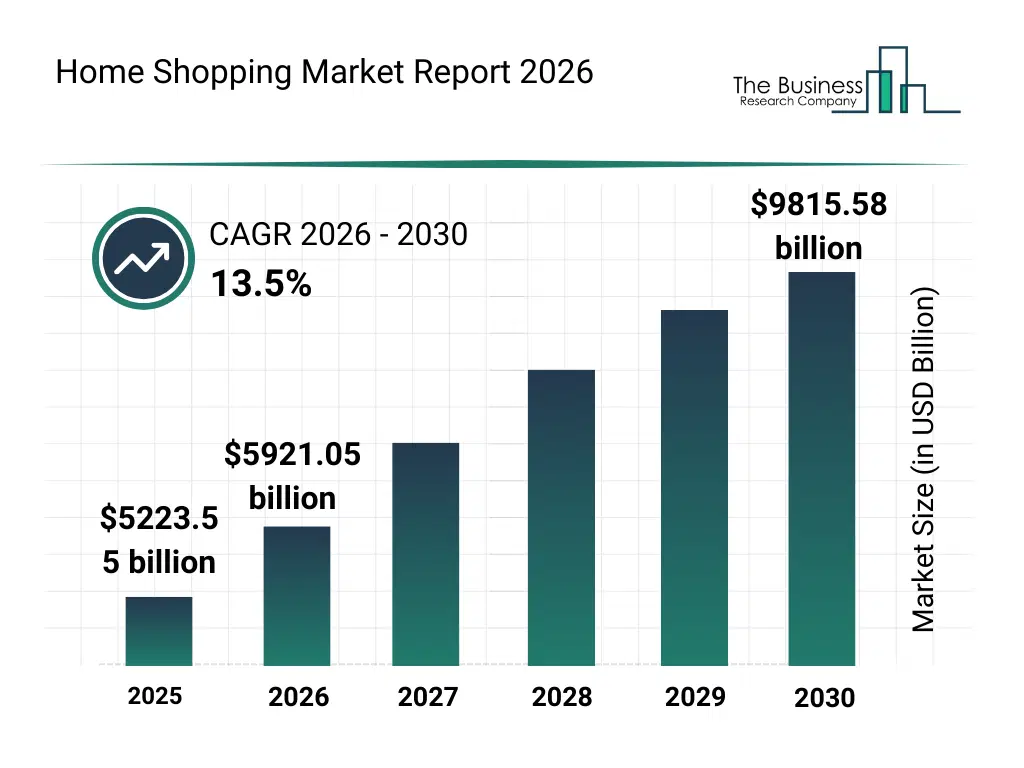
What Is The Home Shopping Market Size and Share 2026?
The home shopping market size has grown rapidly in recent years. It will grow from $5223.55 billion in 2025 to $5921.05 billion in 2026 at a compound annual growth rate (CAGR) of 13.4%. The growth in the historic period can be attributed to increasing television penetration, growth of catalog-based shopping, rise in household disposable income, expansion of retail distribution networks, early adoption of credit/debit card payments.What Is The Home Shopping Market Growth Forecast?
The home shopping market size is expected to see rapid growth in the next few years. It will grow to $9815.58 billion in 2030 at a compound annual growth rate (CAGR) of 13.5%. The growth in the forecast period can be attributed to rise in smartphone and internet penetration, growth of e-commerce platforms, adoption of AI-driven recommendation engines, increasing demand for convenience shopping, expansion of urban consumer base. Major trends in the forecast period include growth of subscription-based shopping models, increasing adoption of same-day and express delivery, rising demand for personalized recommendations, expansion of private label products in home shopping, enhanced mobile app and website user experience.
Global Home Shopping Market Segmentation
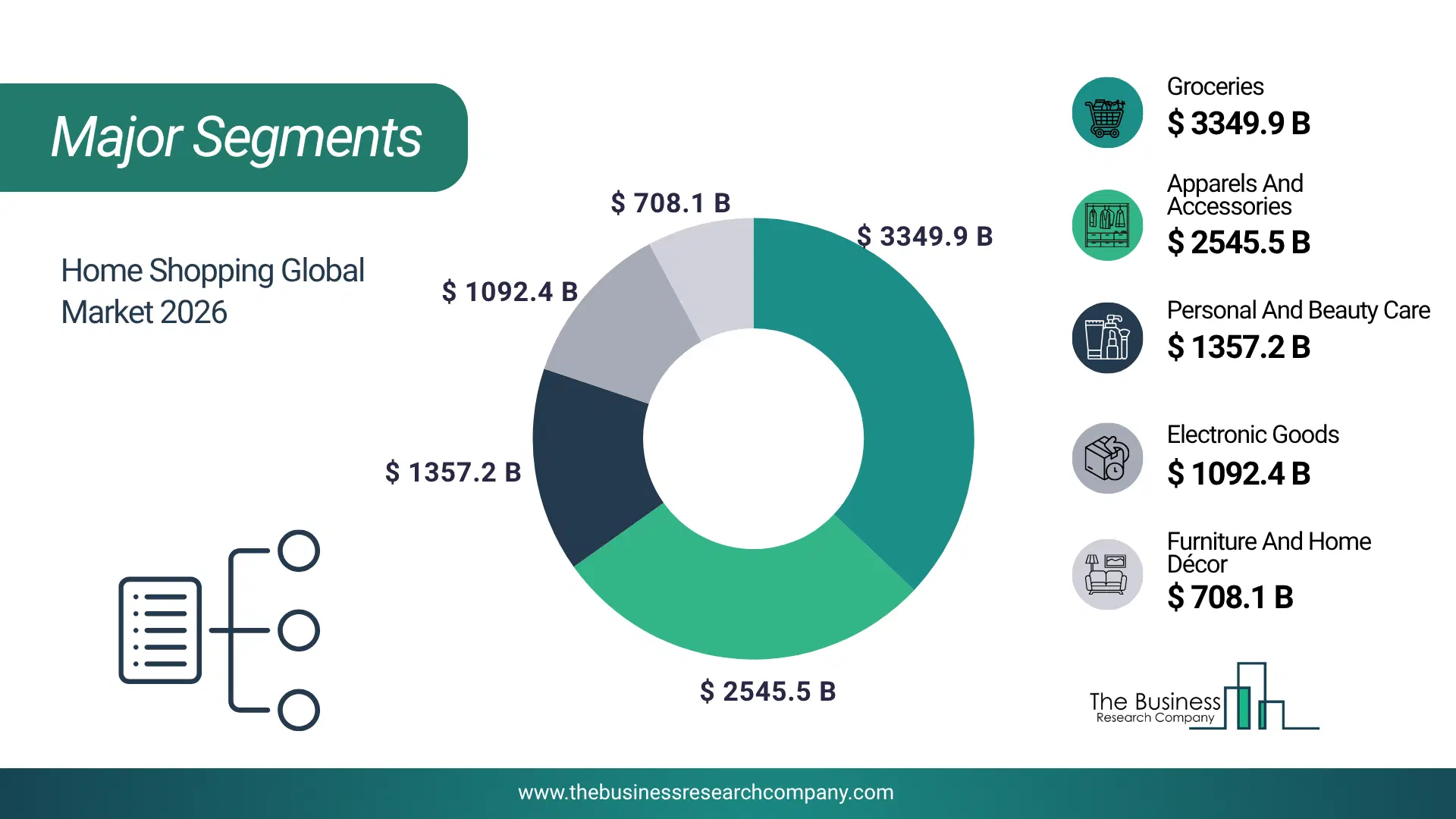
1) By Product Type: Groceries, Apparels And Accessories, Footwear, Personal And Beauty Care, Furniture And Home Décor, Electronic Goods, Other Product Types 2) By Payment Mode: Card Payments, Digital Wallets, Bank Transfers, Cash Payments, Other Payment Modes 3) By Market Type: Teleshopping, E-Commerce And Mobile Shopping, Other Market Types Subsegments: 1) By Groceries: Fresh Food, Packaged Food, Beverages 2) By Apparels And Accessories: Men’s Apparel, Women’s Apparel, Kids’ Apparel, Jewelry and Watches 3) By Footwear: Men’s Footwear, Women’s Footwear, Sports and Casual Footwear 4) By Personal And Beauty Care: Skincare, Haircare, Cosmetics, Personal Hygiene 5) By Furniture And Home Décor: Living Room Furniture, Bedroom Furniture, Kitchen & Dining Furniture, Home Accessories, Decorative Items 6) By Electronic Goods: Consumer Electronics, Home Appliances, Gadgets and Wearables 7) By Other Product Types: Sports and Fitness Equipment, Books and Stationery, Pet Supplies, Toys and Games The top segments in the home shopping market will be: • Groceries will reach $3349.93 billion by 2030. • Apparels And Accessories will reach $2545.55 billion by 2030. • Personal And Beauty Care will reach $1357.19 billion by 2030. • Electronic Goods will reach $1092.45 billion by 2030. • Furniture And Home Décor will reach $708.08 billion by 2030.What Is The Driver Of The Home Shopping Market?
The increasing e-commerce activities are expected to propel the growth of the home shopping market going forward. E-commerce, also known as electronic commerce, refers to the buying and selling goods and services over the internet. The increasing e-commerce activities are due to the widespread availability of high-speed internet, improved logistics and shipping solutions, and increasing secure and efficient online payment gateways. E-commerce platforms can offer a superior and convenient shopping experience, attract a broader customer base, and optimize their operations for growth and efficiency. For instance, in February 2024, according to the United States Census Bureau, a US-based government agency, total e-commerce sales were $1,118.7 billion in 2023, an increase of 7.6% (±1.2%) from 2022. Therefore, the increasing e-commerce activities drive the home shopping industry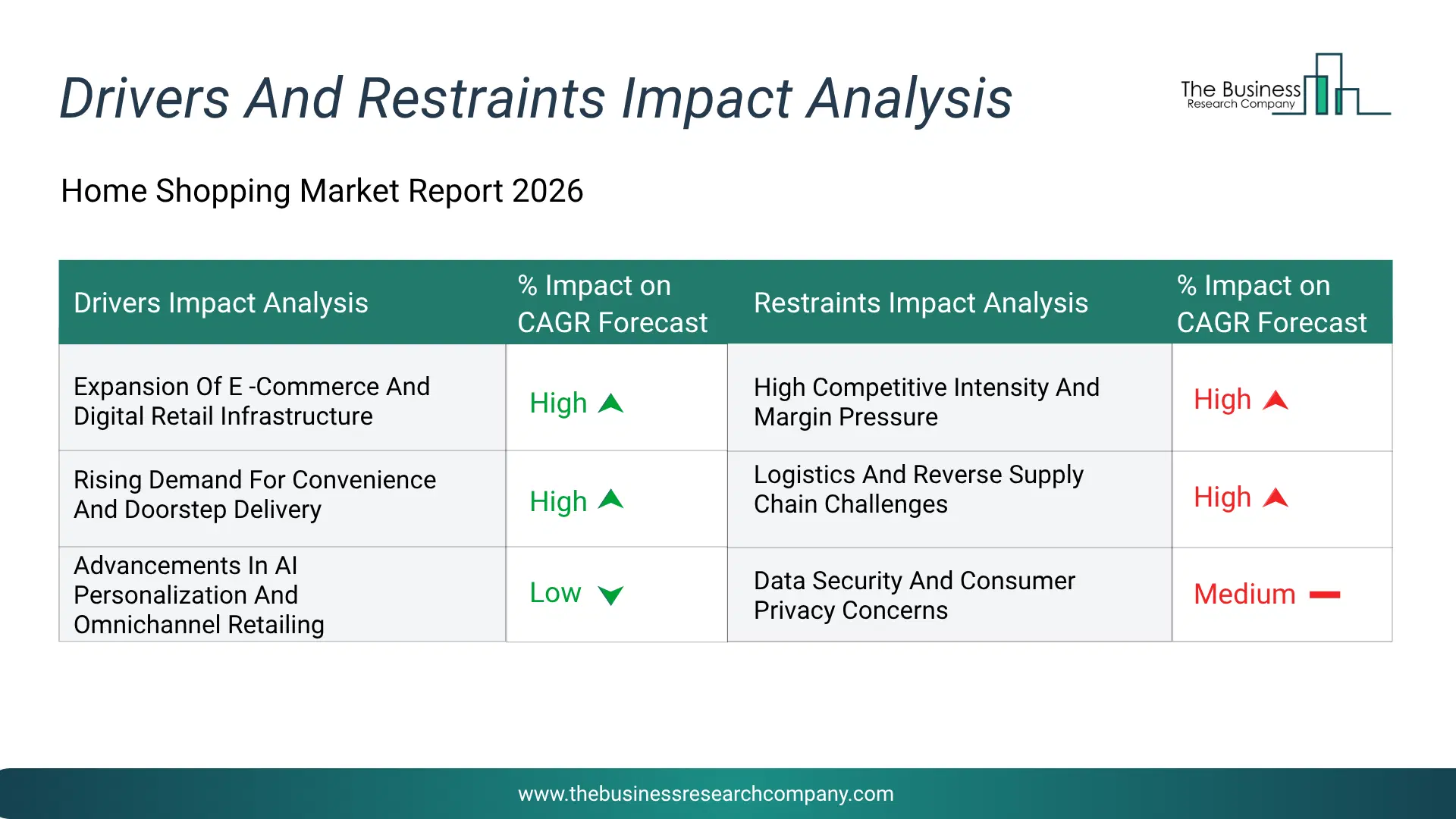
Infographic Chart Showing Key Market Drivers Analysis And Restraints For Home Shopping Market
The chart presents an impact analysis of key drivers and restraints, quantifying their relative influence on the market's growth rate and helping assess the balance between growth enablers and limiting factors. This chart offers a high-level perspective; the full report contains more detailed insights.
How Will The Drivers Impact Growth In The Global Home Shopping Market?
• Expansion Of E -Commerce And Digital Retail Infrastructure (High) – During the forecast period, the expansion of e -commerce and digital retail infrastructure is expected to become a key growth driver for the home shopping market by 2030. The continuous growth of e -commerce penetration and digital retail adoption is a primary driver for the home shopping market. Increasing internet accessibility, smartphone usage, and digital payment integration have made remote purchasing more convenient than ever. Consumers prefer browsing and ordering products from home due to time savings, wider product selection, and competitive pricing. As online retail ecosystems mature across developed and emerging economies, home shopping continues to gain structural momentum. • Rising Demand For Convenience And Doorstep Delivery (High) – During the forecast period, the rising demand for convenience and doorstep delivery is expected to emerge as a major factor driving the expansion of the home shopping market by 2030. Changing consumer lifestyles and increasing demand for convenience significantly accelerate market growth. Urbanization, dual-income households, and time-constrained consumers are driving preference for doorstep delivery across groceries, apparel, electronics, and personal care products. Subscription services and recurring delivery models further enhance customer retention. As convenience becomes a key purchasing determinant, home shopping platforms continue expanding their consumer base. • Advancements In AI Personalization And Omnichannel Retailing (Low) – During the forecast period, the advancements in ai personalization and omnichannel retailing is expected to act as a key growth catalyst for the home shopping market by 2030. Technological advancements in ai-driven personalization, recommendation engines, and omnichannel integration further stimulate market expansion. Retailers are leveraging data analytics to offer personalized product suggestions, targeted promotions, and seamless cross-platform shopping experiences. Integration of live commerce, mobile apps, and social media platforms enhances engagement and conversion rates. Continuous innovation in logistics tracking and customer service strengthens consumer trust and repeat purchases.How Will The Restraints Impact Growth In The Global Home Shopping Market?
• High Competitive Intensity And Margin Pressure (High) – During the forecast period, the intense competition and pricing pressures act as major restraints in the home shopping market. The presence of multiple online retailers, marketplaces, and discount-driven strategies compresses profit margins. Frequent promotional campaigns and free delivery offers increase operational costs. Smaller players may struggle to sustain competitive pricing while maintaining service quality. • Logistics And Reverse Supply Chain Challenges (High) – During the forecast period, the logistics challenges and return management complexities also restrain market growth. Efficient last-mile delivery, reverse logistics, and inventory management require significant infrastructure investment. High return rates, especially in categories like apparel and electronics, increase operational costs. Supply chain disruptions and delivery delays can impact customer satisfaction and brand loyalty. • Data Security And Consumer Privacy Concerns (Medium) – During the forecast period, the data security and consumer privacy concerns act as a restraint for the home shopping market by reducing consumer trust in online transactions and digital payment systems. Increasing incidents of data breaches, identity theft, and payment fraud make customers cautious while sharing personal and financial information. This forces companies to invest heavily in cybersecurity infrastructure and compliance measures, increasing operational costs. Additionally, strict data protection regulations add further complexity to business operations. Overall, these concerns can slow down customer adoption and limit the growth of the home shopping market.Key Players In The Global Home Shopping Market
Major companies operating in the home shopping market are Walmart Inc., Amazon.com Inc., JD.com Inc., Alibaba Group Holding Limited, Majid Al Futtaim, eBay Inc., Flipkart Private Limited, HSE Home Shopping GmbH, Croma, Vaibhav Global Limited, Meesho, Naaptol Company, Shop LC, Hammacher Schlemmer, American Swan, ShopHQ, HomeShop18, Ubuy, Koovs PLC, Tata Cliq, Planet Shopping, Sears, Roebuck and Co.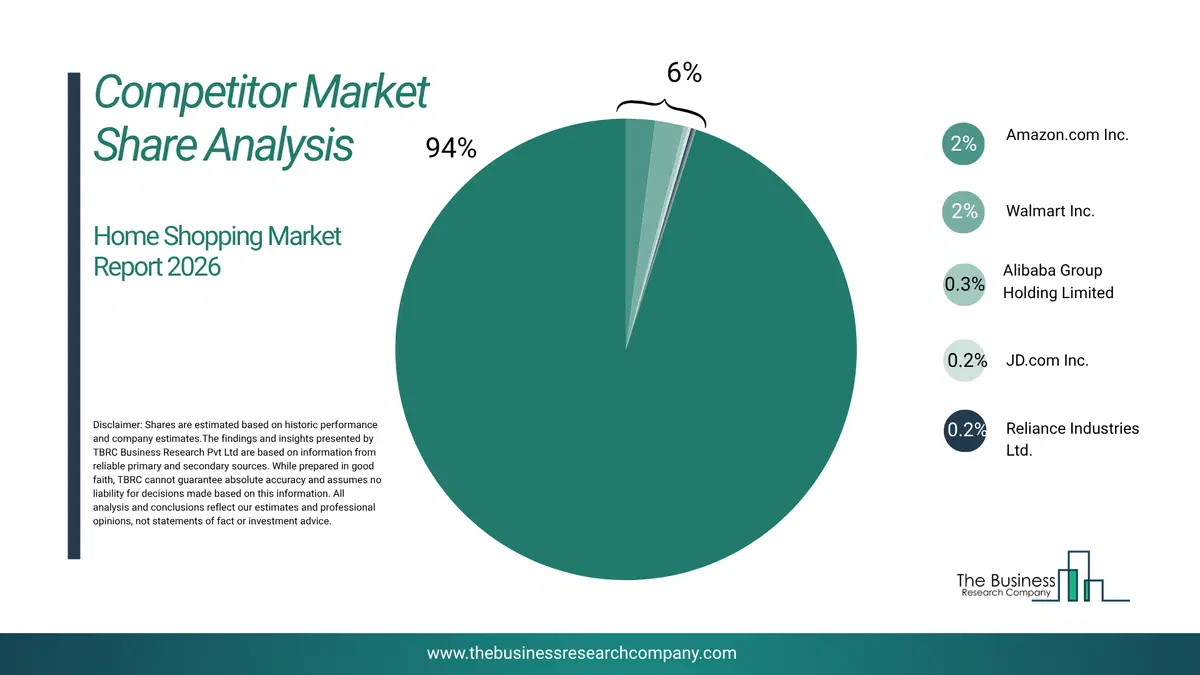
This chart is for illustrative purposes; the full report includes a detailed competitor analysis and comprehensive overview of the top 10 companies in the market.
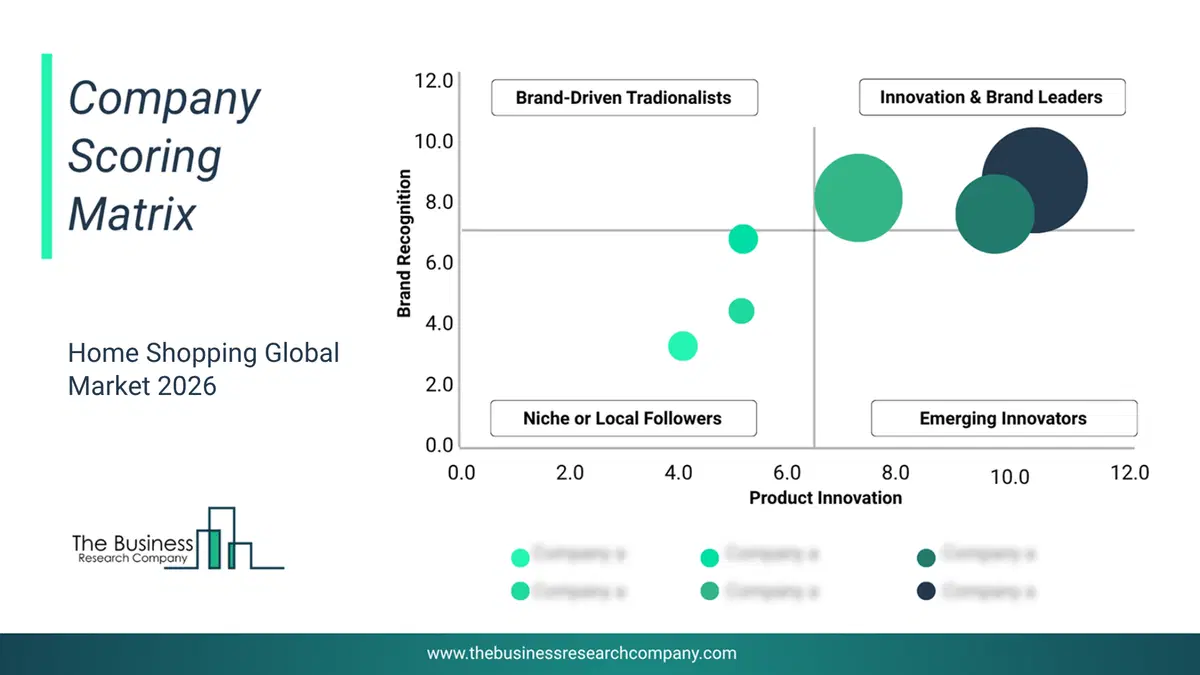
This chart maps companies by product innovation and brand strength, with bubble size indicating relative revenue, helping identify market leaders, challengers, and niche players. This is an illustrative chart; the full report provides a complete and accurate competitive analysis.
Global Home Shopping Market Trends and Insights
Major companies operating in the home shopping market are focused on technological advancements, such as immersive digital shopping experiences, to explore and buy products from the comfort of their homes. An immersive digital shopping experience is a multi-sensory experience that combines various interactions to create intuitive and emotional value for the user. This type of experience can be presented through different interfaces, including flat screens, natural interfaces (voice, spatial, gesture-based, auditory, or olfactory), and extended reality (3D, augmented, virtual, or mixed reality) technologies. For instance, in May 2024, Walmart, a US-based retail corporation operating a hypermarket chain, launched Walmart Realm, an immersive digital shopping platform. It lets customers explore virtual environments themed around various styles and product categories. Walmart Realm includes influencer-led virtual shops, gamification elements such as mini-games and collectible rewards, and partnerships with content designers and platform providers such as Sawhorse and Emperia.What Are Latest Mergers And Acquisitions In The Home Shopping Market?
In August 2023, Peloton, a US-based exercise equipment and media company, partnered with Amazon to sell its exercise equipment and accessories on Amazon's online marketplace. This partnership is significant for both companies, as it allows Peloton to reach a broader audience and Amazon to offer high-quality fitness products to its customers. Amazon is a US-based technology company providing various home shopping options through its online stores and platforms.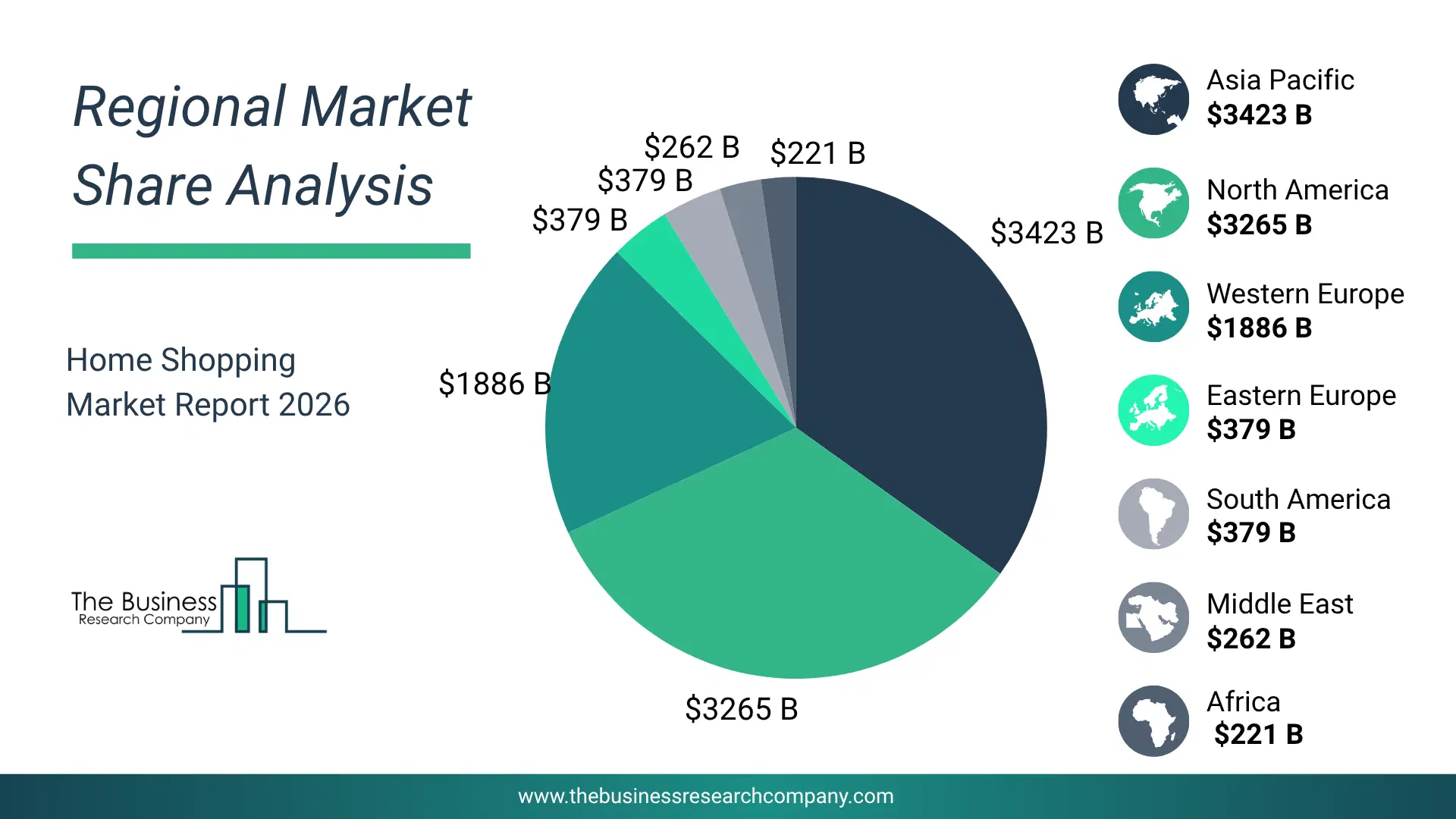
Regional Outlook
Asia-Pacific was the largest region in the home shopping market in 2025. Asia-Pacific is expected to be the fastest-growing region in the forecast period. The regions covered in this market report are Asia-Pacific, South East Asia, Western Europe, Eastern Europe, North America, South America, Middle East and Africa. The countries covered in this market report are Australia; Brazil; China; France; Germany; India; Indonesia; Japan; Taiwan; Russia; South Korea; UK; USA; Canada; Italy; Spain.What Defines the Home Shopping Market?
The home shopping market includes revenues earned by entities by providing services such as mobile shopping apps, direct selling, and telemarketing. The market value includes the value of related goods sold by the service provider or included within the service offering. Only goods and services traded between entities or sold to end consumers are included.How is Market Value Defined and Measured?
The market value is defined as the revenues that enterprises gain from the sale of goods and/or services within the specified market and geography through sales, grants, or donations in terms of the currency (in USD unless otherwise specified). The revenues for a specified geography are consumption values that are revenues generated by organizations in the specified geography within the market, irrespective of where they are produced. It does not include revenues from resales along the supply chain, either further along the supply chain or as part of other products.
This chart presents market attractiveness based on a quantitative evaluation of growth, competition, strategic alignment, and risk, offering a clear view of opportunity areas for decision-making. This chart is for illustrative purposes; the full report contains the complete analysis.

This chart highlights the Total Addressable Market (TAM) by estimating the maximum revenue opportunity using an assumption-driven approach, supporting strategic planning and opportunity sizing across markets. The chart is illustrative; the full report provides a more comprehensive analysis.
What Key Data and Analysis Are Included in the Home Shopping Market Report 2026?
The home shopping market research report is one of a series of new reports from The Business Research Company that provides market statistics, including industry global market size, regional shares, competitors with the market share, detailed market segments, market trends and opportunities, and any further data you may need to thrive in the home shopping industry. The market research report delivers a complete perspective of everything you need, with an in-depth analysis of the current and future state of the industry.Home Shopping Market Report Forecast Analysis
| Report Attribute | Details |
|---|---|
| Market Size Value In 2026 | $30.5 billion |
| Revenue Forecast In 2030 | $35.31 billion |
| Growth Rate | CAGR of 3.2% from 2026 to 2030 |
| Base Year For Estimation | 2025 |
| Actual Estimates/Historical Data | 2020-2025 |
| Forecast Period | 2026 - 2030 |
| Market Representation | Revenue in USD Billion and CAGR from 2026 to 2030 |
| Segments Covered | Product Type, Payment Mode, Market Type |
| Regional Scope | Asia-Pacific, Western Europe, Eastern Europe, North America, South America, Middle East, Africa |
| Country Scope | The countries covered in the report are Australia, Brazil, China, France, Germany, India, Indonesia, Japan, Taiwan, Russia, South Korea, UK, USA, Canada, Italy, Spain. |
| Key Companies Profiled | Walmart Inc., Amazon.com Inc., JD.com Inc., Alibaba Group Holding Limited, Majid Al Futtaim, eBay Inc., Flipkart Private Limited, HSE Home Shopping GmbH, Croma, Vaibhav Global Limited, Meesho, Naaptol Company, Shop LC, Hammacher Schlemmer, American Swan, ShopHQ, HomeShop18, Ubuy, Koovs PLC, Tata Cliq, Planet Shopping, Sears, Roebuck and Co. |
| Customization Scope | Request for Customization |
| Pricing And Purchase Options | Explore Purchase Options |