
In-Vehicle Infotainment Market Report 2026
Global Outlook – By Component ( Software, Hardware, Services), By Services ( Entertainment Services, Navigation Services, Communication Services, Vehicle Diagnostics Services, Other Services), By Vehicle Type ( Passenger Car, Commercial Vehicles), By Fitting ( OE (Original Equipment) Fitted, Aftermarket) – Market Size, Trends, Strategies, and Forecast to 2030
In-Vehicle Infotainment Market Overview
• In-Vehicle Infotainment market size has reached to $25.99 billion in 2025 • Expected to grow to $42.88 billion in 2030 at a compound annual growth rate (CAGR) of 10.5% • Growth Driver: High-End Luxury Car Sales Boost In-Vehicle Infotainment Market • Market Trend: Advancements In Automotive-Grade System-On-Chip (SoC) Technology Enhance Performance And Connectivity In In-Vehicle Infotainment (IVI) Systems • North America was the largest region in 2025 and Asia-Pacific is the fastest growing region.Market Gains By 2030 – Top Opportunities By Segment
Market Gain identifies the most promising market opportunities by highlighting the segments or products expected to generate the highest incremental revenue growth over the next five years.
What Is Covered Under In-Vehicle Infotainment Market?
In-vehicle infotainment refers to an electronic system that combines entertainment and information delivery to drivers and passengers. They also include support software applications. The main components of in-vehicle infotainment are software, hardware, and services. Software is a computer operating system that enables the control of the flow of data between application programs. These are used to provide various services including entertainment services, navigation services, communication services, vehicle diagnostics services, and others for passenger cars, and commercial vehicles, including fittings by the original equipment manufacturer and aftermarket.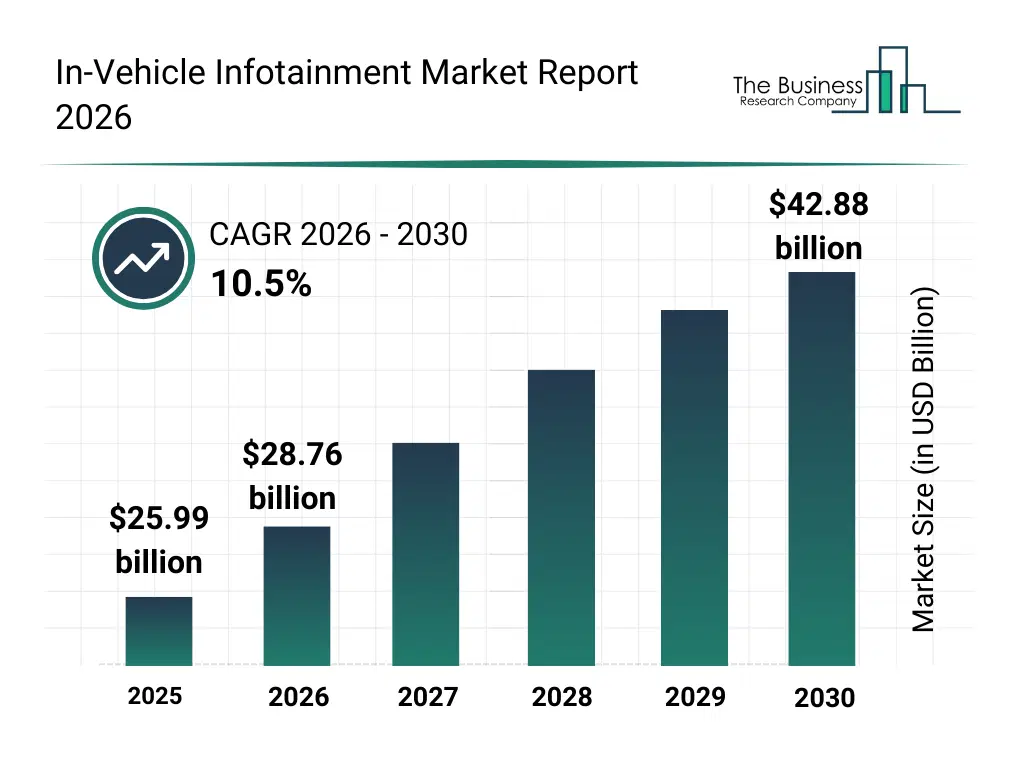
What Is The In-Vehicle Infotainment Market Size 2026 And Growth Rate?
The in-vehicle infotainment market size has grown rapidly in recent years. It will grow from $25.99 billion in 2025 to $28.76 billion in 2026 at a compound annual growth rate (CAGR) of 10.7%. The growth in the historic period can be attributed to increase in automotive digitalization, rise in adoption of smartphones for in car connectivity, growth in passenger car sales, increase in demand for navigation and entertainment systems, early advancements in touchscreen and audio technologies.What Is The In-Vehicle Infotainment Market Growth Forecast?
The in-vehicle infotainment market size is expected to see rapid growth in the next few years. It will grow to $42.88 billion in 2030 at a compound annual growth rate (CAGR) of 10.5%. The growth in the forecast period can be attributed to rising integration of advanced sensor based infotainment, growing adoption of connected car services, increasing development of AI powered infotainment features, rising focus on over the air updates, growing demand for premium in cabin experience. Major trends in the forecast period include increasing use of AI driven personalized in-vehicle infotainment features, rising adoption of autonomous mobility enhancing infotainment integration, growth in connected vehicle ecosystems with real time data services, advancement in cybersecure and cloud enabled infotainment platforms, rising demand for immersive ar vr based in-cabin experiences.
Global In-Vehicle Infotainment Market Segmentation
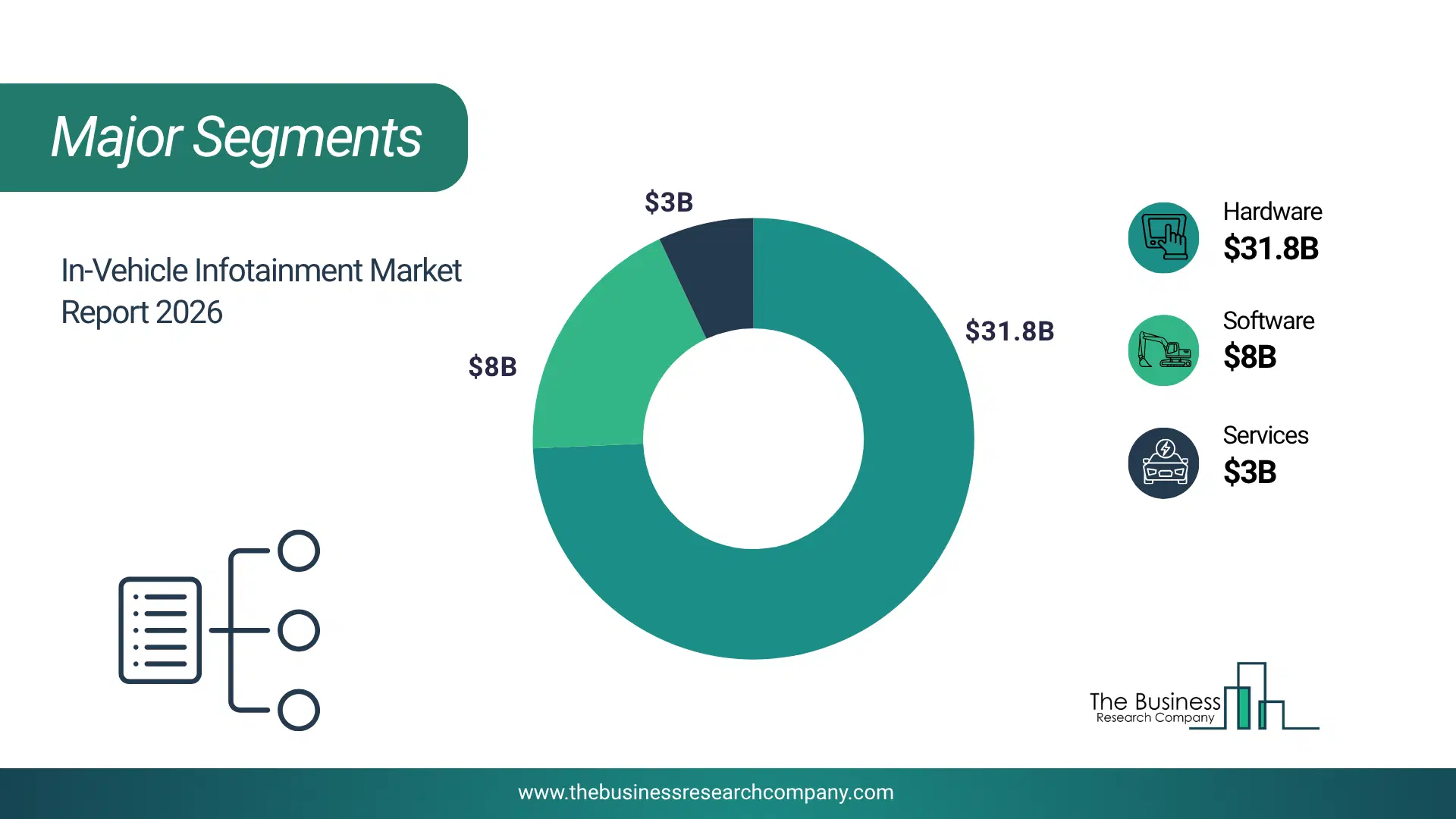
1) By Component: Software, Hardware, Services 2) By Services: Entertainment Services, Navigation Services, Communication Services, Vehicle Diagnostics Services, Other Services 3) By Vehicle Type: Passenger Car, Commercial Vehicles 4) By Fitting: OE (Original Equipment) Fitted, Aftermarket Subsegments: 1) By Software: Operating Systems, Application Software, Middleware, Connectivity Software 2) By Hardware: Displays (Touchscreen, Instrument Cluster), Audio Systems (Speakers, Amplifiers), Control Units (Microcontrollers, Processors), Connectivity Modules (Bluetooth, Wi-Fi) 3) By Services: Navigation Services, Content Services (Streaming, Music), Software Updates and Upgrades, Customer Support Services The top segments in the in-vehicle infotainment market will be: • Hardware will reach $31.74 billion by 2030. • Software will reach $7.99 billion by 2030. • Services will reach $2.92 billion by 2030.What Is The Driver Of The In-Vehicle Infotainment Market?
The increasing sales of high-end luxury cars are expected to propel the in-vehicle infotainment market growth going forward. Luxury cars refer to cars that are manufactured by luxury automakers with high-end performance capabilities, lavish interiors, and safety and technology features that are not available in lower-priced cars. Luxury cars are equipped with the latest and advanced infotainment systems to provide advanced vehicle safety and security. Thus, an increase in the sale of luxury cars will help in the growth of the market. For instance, in January 2024, according to the BMW Group, a Germany-based manufacturing company, in the fourth quarter of 2023, BMW Group's sales increased by 10.3% compared to the previous year, reaching 718,778 units. Therefore, the increase in the sales of high-end luxury cars is driving the growth of the in-vehicle infotainment industry.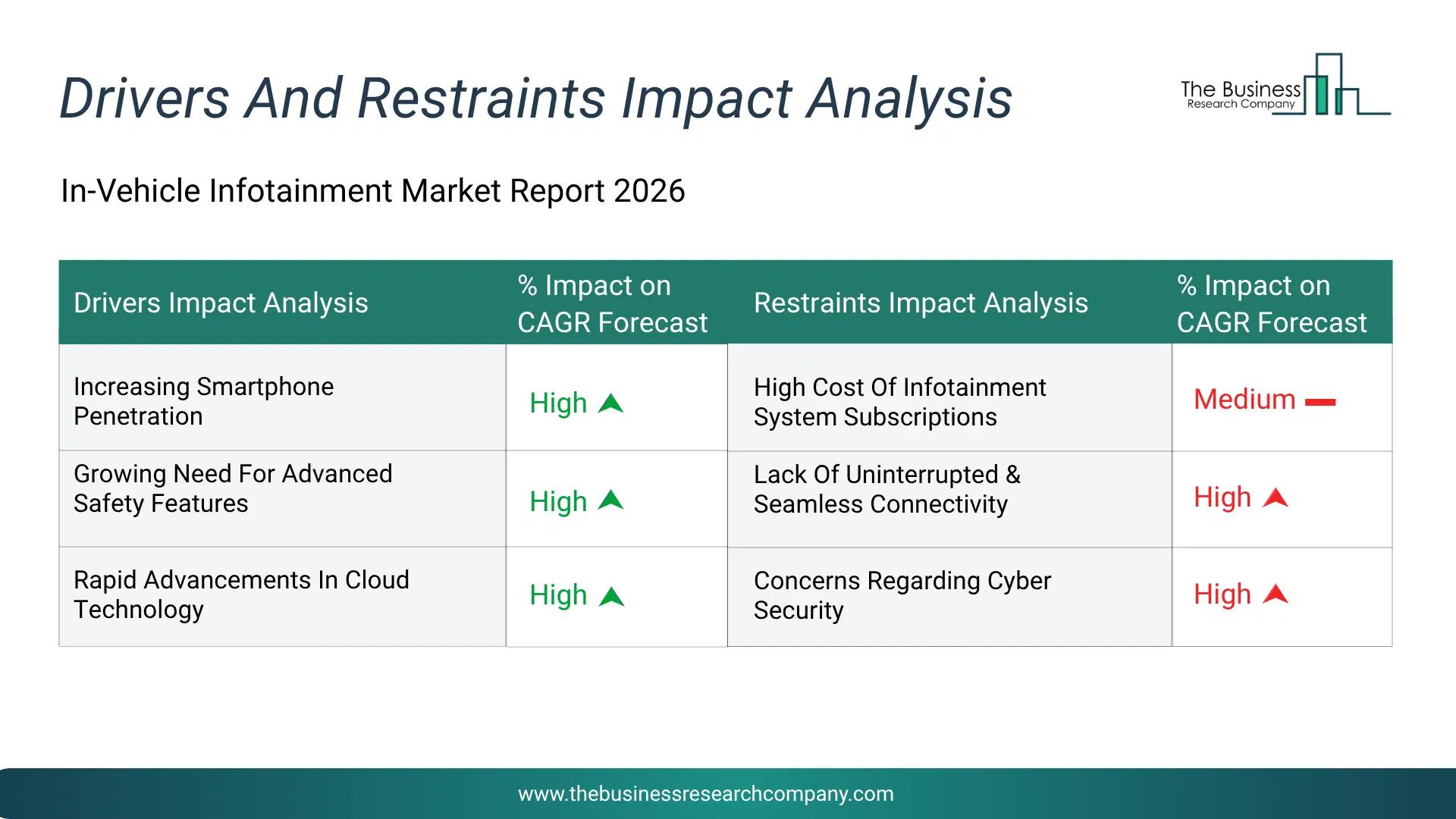
Infographic Chart Showing Key Market Drivers Analysis And Restraints For In-Vehicle Infotainment Market
The chart presents an impact analysis of key drivers and restraints, quantifying their relative influence on the market's growth rate and helping assess the balance between growth enablers and limiting factors. This chart offers a high-level perspective; the full report contains more detailed insights.
How Will The Drivers Impact Growth In The Global In-Vehicle Infotainment Market?
• Increasing Smartphone Penetration (High) – During the forecast period, the increasing smartphone penetration is expected to become a key growth driver for the in -vehicle infotainment market by 2030. Consumers are increasingly demanding seamless smartphone integration features such as apple carplay, android auto, and app -based services within vehicle infotainment systems. This trend is driving automakers to enhance connectivity, enable real -time content access, and support personalized user profiles. The growing reliance on smartphones for navigation, communication, and entertainment is accelerating the integration of advanced infotainment interfaces. • Growing Need For Advanced Safety Features (High) – During the forecast period, the growing need for advanced safety features is expected to emerge as a major factor driving the expansion of the in-vehicle infotainment market by 2030. Infotainment systems are increasingly integrated with advanced driver assistance systems (adas), enabling features such as real-time alerts, driver monitoring displays, navigation-based safety warnings, and emergency communication systems. Automakers are leveraging infotainment platforms to enhance driver awareness and support safer driving experiences. Regulatory focus on vehicle safety and increasing consumer demand for intelligent safety solutions are further supporting this trend. • Rapid Advancements In Cloud Technology (High) – During the forecast period, rapid advancements in cloud technology are expected to act as a key growth catalyst for the in-vehicle infotainment market by 2030. Cloud-based platforms enable over-the-air (ota) updates, real-time data synchronization, remote diagnostics, and scalable infotainment services across connected vehicles. Automakers and technology providers are increasingly adopting cloud infrastructure to deliver continuous feature enhancements, personalized content, and subscription-based services. This shift toward cloud-enabled infotainment ecosystems is improving system flexibility, reducing development cycles, and enhancing user experience.How Will The Restraints Impact Growth In The Global In-Vehicle Infotainment Market?
• High Cost Of Infotainment System Subscriptions (Medium) – During the forecast period, the high cost of infotainment system subscriptions acts as a restraint by increasing the overall ownership expense for consumers. Many advanced features such as real-time navigation, premium connectivity, and streaming services require recurring annual payments. Price-sensitive buyers, especially in emerging markets, may avoid activating or renewing these services. This reduces the revenue potential for service providers and limits widespread adoption of premium infotainment features. As a result, subscription-related costs slow market expansion despite technological advancements. • Lack Of Uninterrupted & Seamless Connectivity (High) – During the forecast period, the lack of uninterrupted and seamless connectivity restrains market growth by affecting user experience and system reliability. Infotainment systems depend heavily on stable internet connections for navigation, cloud services, and streaming functions. In regions with weak network infrastructure, performance disruptions reduce consumer satisfaction. Connectivity issues can also limit real-time updates and smart vehicle functionalities. Consequently, inconsistent network coverage discourages adoption and hampers the full potential of connected infotainment solutions. • Concerns Regarding Cyber Security (High) – During the forecast period, the concerns regarding cyber security significantly restrain the in-vehicle infotainment market due to increasing risks of data breaches and hacking. Connected infotainment systems collect and transmit sensitive user data, including location and personal information. Vulnerabilities in software or network connections may expose vehicles to cyberattacks, compromising safety and privacy. Consumers and regulators demand stricter data protection standards, increasing compliance costs for manufacturers. These security challenges create hesitation among buyers and add complexity to system deployment, limiting market growth.Key Players In The Global In-Vehicle Infotainment Market
Major companies operating in the in-vehicle infotainment market are Panasonic Corporation, Alpine Electronics Inc., Pioneer Corporation, Harman International Industries Inc., Bose Corporation, Sony Corporation, Clarion Co. Ltd., Continental AG, Visteon Corporation, Denso Corporation, Garmin Ltd., TomTom International BV, Robert Bosch GmbH, Mitsubishi Electric Corporation, Fujitsu Ten Ltd., Magneti Marelli S.p.A., Kenwood Corporation, Delphi Automotive PLC, Valeo SA, HyundAI Mobis Co., Ltd., JVC Kenwood Corporation, Aptiv PLC, NXP Semiconductors NV, NVIDIA Corporation, Texas Instruments Incorporated, Apple Inc., Google LLC, Amazon.com, Inc., LG Electronics Inc., Qualcomm Technologies, Inc.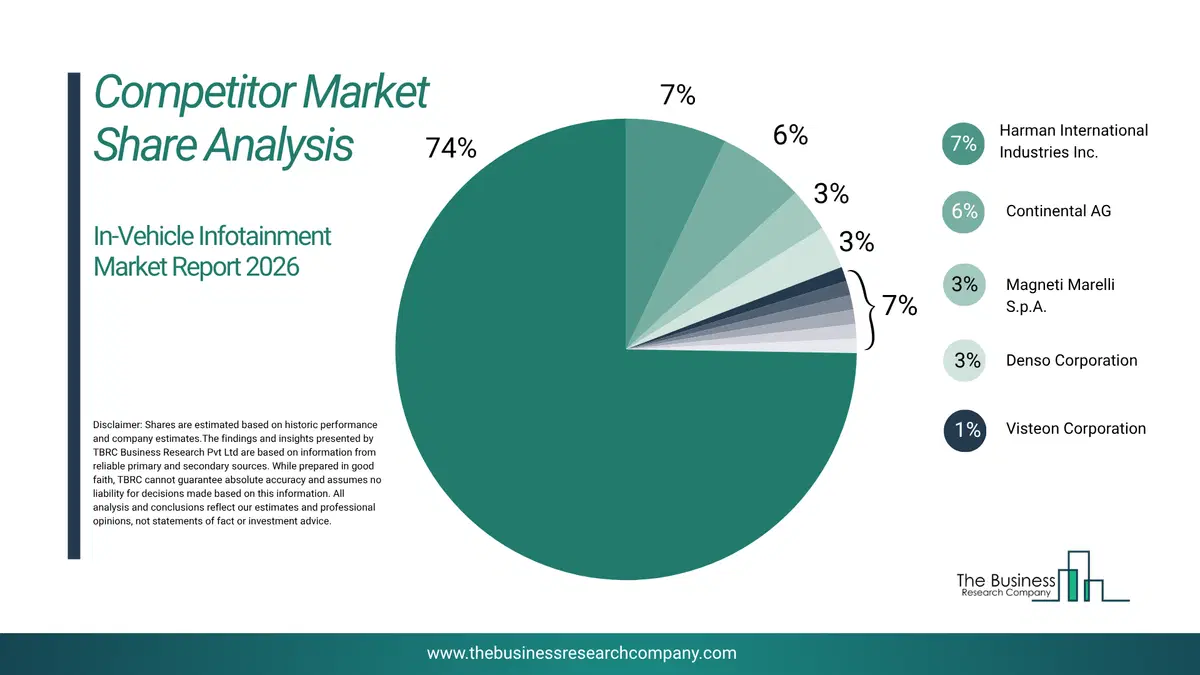
This chart is for illustrative purposes; the full report includes a detailed competitor analysis and comprehensive overview of the top 10 companies in the market.
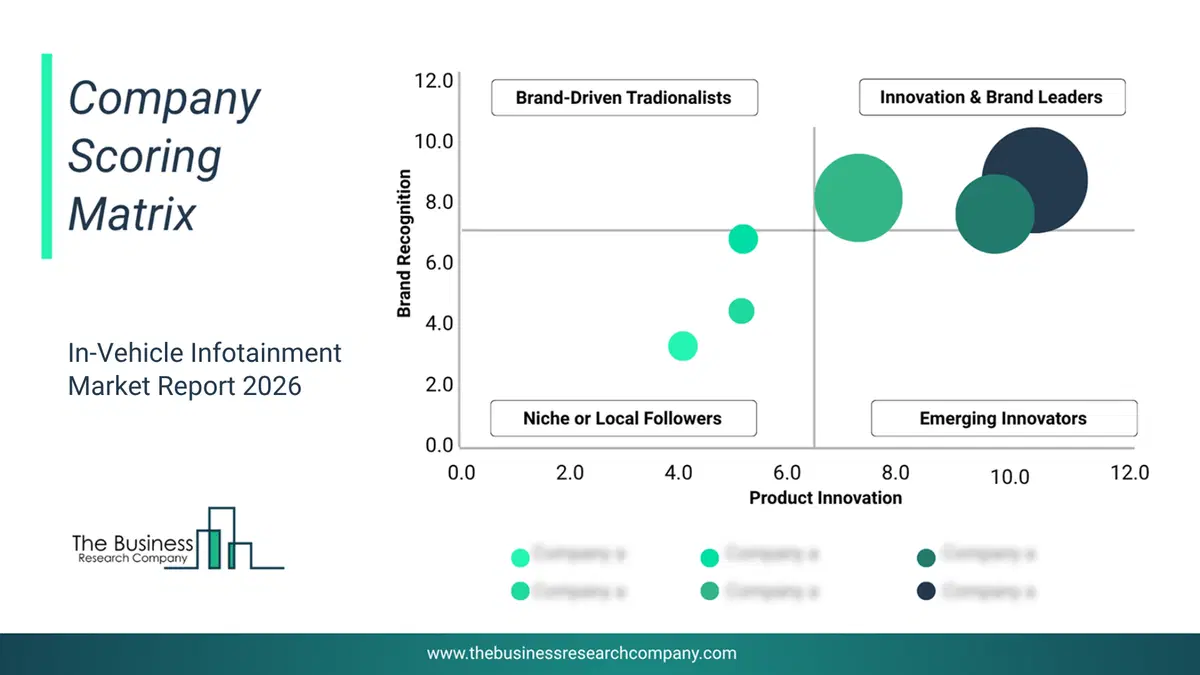
This chart maps companies by product innovation and brand strength, with bubble size indicating relative revenue, helping identify market leaders, challengers, and niche players. This is an illustrative chart; the full report provides a complete and accurate competitive analysis.
Global In-Vehicle Infotainment Market Trends and Insights
Major companies operating in the in-vehicle infotainment (IVI) market are focusing on developing advanced automotive-grade system-on-chip (SoC) processors to deliver high-performance, seamless, and connected in-car experiences. Automotive SoCs integrate multiple computing functions such as CPU, GPU, AI accelerators, and connectivity modules into a single chip, enabling faster processing, reduced power consumption, and superior multimedia performance compared to traditional architectures. For instance, in June 2023, Samsung Electronics, a South Korea-based semiconductor and electronics company, launched the Exynos Auto V920, a next-generation automotive SoC designed for IVI systems. The Exynos Auto V920 features a multi-core CPU and GPU, supports advanced AI functionalities, enhances graphics rendering, and enables integration with connected car platforms, infotainment applications, and digital cockpits. Its compact architecture simplifies system design while providing high reliability and energy efficiency, making it ideal for modern IVI systems that demand immersive user experiences and robust computational capabilities.What Are Latest Mergers And Acquisitions In The In-Vehicle Infotainment Market?
In September 2025, Qualcomm Technologies, Inc., a US-based provider of hardware and software solutions for in-vehicle infotainment (IVI) systems, partnered with HARMAN International to advance generative AI to redefine in-cabin intelligence and personalization. With this collaboration, Qualcomm and HARMAN aimed to accelerate intelligent, connected in‑vehicle infotainment (IVI) and cockpit solutions by combining Qualcomm’s Snapdragon automotive compute platforms with HARMAN’s market‑ready automotive product portfolio. HARMAN International is a US-based provider of automotive systems, connected car technologies, audio and visual solutions, and services for OEMs and consumers.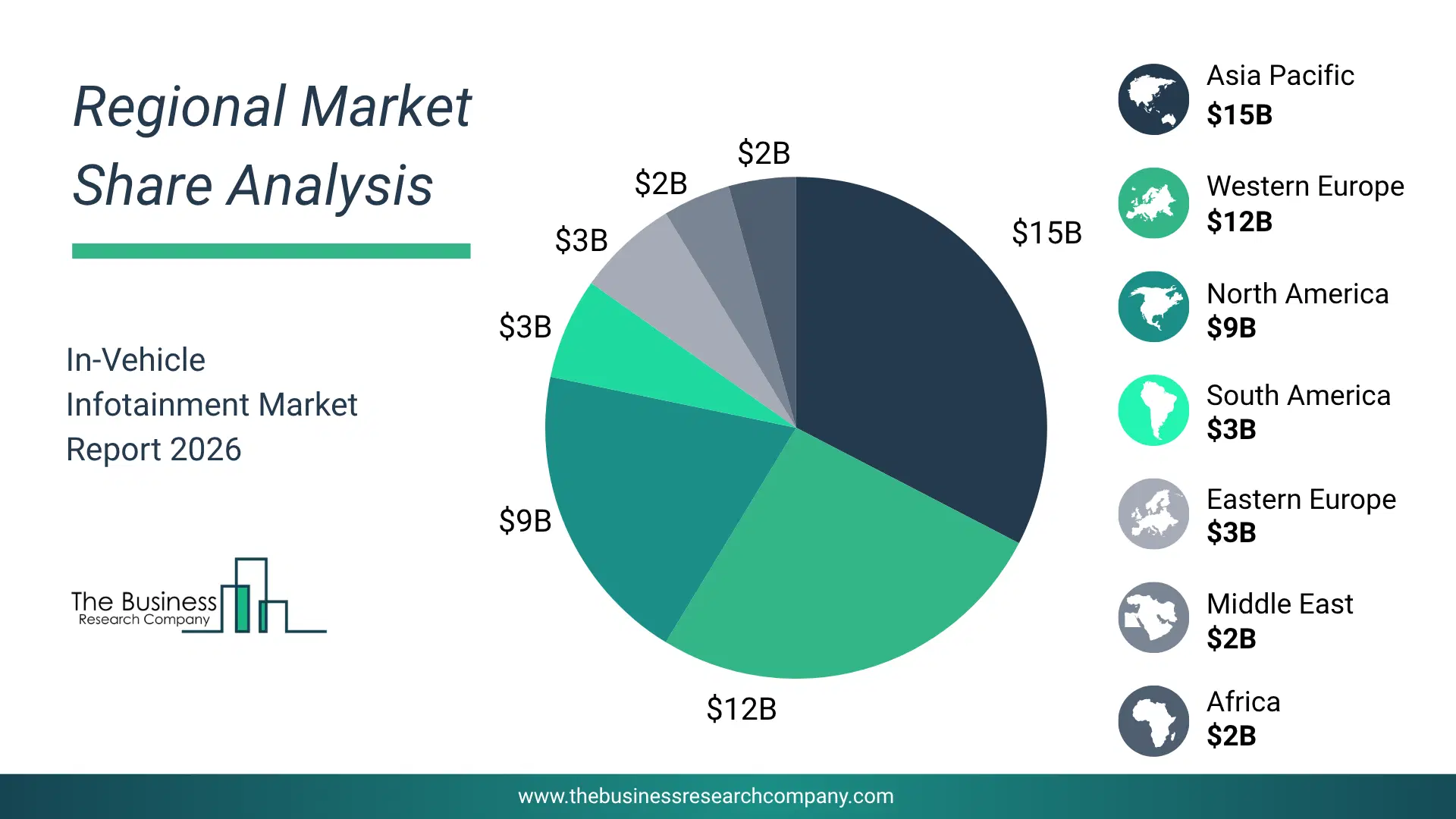
Regional Outlook
North America was the largest region in the in-vehicle infotainment market in 2025. Asia-Pacific is expected to be the fastest-growing region in the forecast period. The regions covered in this market report are Asia-Pacific, South East Asia, Western Europe, Eastern Europe, North America, South America, Middle East, Africa. The countries covered in this market report are Australia, Brazil, China, France, Germany, India, Indonesia, Japan, Taiwan, Russia, South Korea, UK, USA, Canada, Italy, Spain.What Defines the In-Vehicle Infotainment Market?
The in-vehicle infotainment market consists of revenues earned by entities by providing audio, video and information services in automobiles. The market value includes the value of related goods sold by the service provider or included within the service offering. The in-vehicle infotainment market also includes sales of radio, multimedia, navigation, and connectivity devices which used in providing In-vehicle infotainment services. Values in this market are ‘factory gate’ values, that is the value of goods sold by the manufacturers or creators of the goods, whether to other entities (including downstream manufacturers, wholesalers, distributors and retailers) or directly to end customers. The value of goods in this market includes related services sold by the creators of the goods.How is Market Value Defined and Measured?
The market value is defined as the revenues that enterprises gain from the sale of goods and/or services within the specified market and geography through sales, grants, or donations in terms of the currency (in USD unless otherwise specified). The revenues for a specified geography are consumption values that are revenues generated by organizations in the specified geography within the market, irrespective of where they are produced. It does not include revenues from resales along the supply chain, either further along the supply chain or as part of other products.
This chart presents market attractiveness based on a quantitative evaluation of growth, competition, strategic alignment, and risk, offering a clear view of opportunity areas for decision-making. This chart is for illustrative purposes; the full report contains the complete analysis.

This chart highlights the Total Addressable Market (TAM) by estimating the maximum revenue opportunity using an assumption-driven approach, supporting strategic planning and opportunity sizing across markets. The chart is illustrative; the full report provides a more comprehensive analysis.
What Key Data and Analysis Are Included in the In-Vehicle Infotainment Market Report 2026?
The in-vehicle infotainment market research report is one of a series of new reports from The Business Research Company that provides market statistics, including industry global market size, regional shares, competitors with the market share, detailed market segments, market trends and opportunities, and any further data you may need to thrive in the in-vehicle infotainment industry. The market research report delivers a complete perspective of everything you need, with an in-depth analysis of the current and future state of the industry.In-Vehicle Infotainment Market Report 2026 Market Report Forecast Analysis
| Report Attribute | Details |
|---|---|
| Market Size Value In 2026 | $28.76 billion |
| Revenue Forecast In 2030 | $42.88 billion |
| Growth Rate | CAGR of 10.5% from 2026 to 2030 |
| Base Year For Estimation | 2025 |
| Actual Estimates/Historical Data | 2020-2025 |
| Forecast Period | 2026 - 2030 |
| Market Representation | Revenue in USD Billion and CAGR from 2026 to 2030 |
| Segments Covered | Component, Services, Vehicle Type, Fitting |
| Regional Scope | Asia-Pacific, Western Europe, Eastern Europe, North America, South America, Middle East, Africa |
| Country Scope | The countries covered in the report are Australia, Brazil, China, France, Germany, India, ... |
| Key Companies Profiled | Panasonic Corporation, Alpine Electronics Inc., Pioneer Corporation, Harman International Industries Inc., Bose Corporation, Sony Corporation, Clarion Co. Ltd., Continental AG, Visteon Corporation, Denso Corporation, Garmin Ltd., TomTom International BV, Robert Bosch GmbH, Mitsubishi Electric Corporation, Fujitsu Ten Ltd., Magneti Marelli S.p.A., Kenwood Corporation, Delphi Automotive PLC, Valeo SA, HyundAI Mobis Co., Ltd., JVC Kenwood Corporation, Aptiv PLC, NXP Semiconductors NV, NVIDIA Corporation, Texas Instruments Incorporated, Apple Inc., Google LLC, Amazon.com, Inc., LG Electronics Inc., Qualcomm Technologies, Inc. |
| Customization Scope | Request for Customization |
| Pricing And Purchase Options | Explore Purchase Options |