
Infrastructure Securitization Market Report 2026
Global Outlook – By Type (Public Infrastructure, Private Infrastructure), By Investor Type (Institutional Investors, Pension Funds), By Asset Class (Transportation, Energy, Water And Wastewater, Telecommunications, Social Infrastructure, Other Asset Classes), By Application (Construction Industry, Utilities, Transportation) – Market Size, Trends, Strategies, and Forecast to 2030
Infrastructure Securitization Market Overview
• Infrastructure Securitization market size has reached to $270.23 billion in 2025 • Expected to grow to $487.59 billion in 2030 at a compound annual growth rate (CAGR) of 12.6% • Growth Driver: Surge In Growing Large-Scale Infrastructure Projects Driving the Growth Of The Market Due To Government Funding And Urbanization-Driven Development • Market Trend: Asset Monetization Strategies Drive Sustainable Infrastructure Growth • North America was the largest region in 2025 and Asia-Pacific is the fastest growing region.Market Gains By 2030 – Top Opportunities By Segment
Market Gain identifies the most promising market opportunities by highlighting the segments or products expected to generate the highest incremental revenue growth over the next five years.
What Is Covered Under Infrastructure Securitization Market?
Infrastructure securitization refers to the process of converting future cash flows from infrastructure projects such as toll roads, power plants, or airports into tradable financial securities. It enables project developers to raise capital from financial markets without relying entirely on debt or equity, while providing investors with access to relatively stable, long-term returns linked to infrastructure assets. The main types of infrastructure securitization are public infrastructure and private infrastructure. Public infrastructure refers to the financial process of pooling revenue-generating public infrastructure assets and converting them into tradable securities to raise capital for development, maintenance, or expansion. Investors typically include institutional investors and retail investors with asset classes comprising transportation, energy, water and wastewater, telecommunications, social infrastructure, and others. It is used for various applications such as construction industry, utilities, and transportation.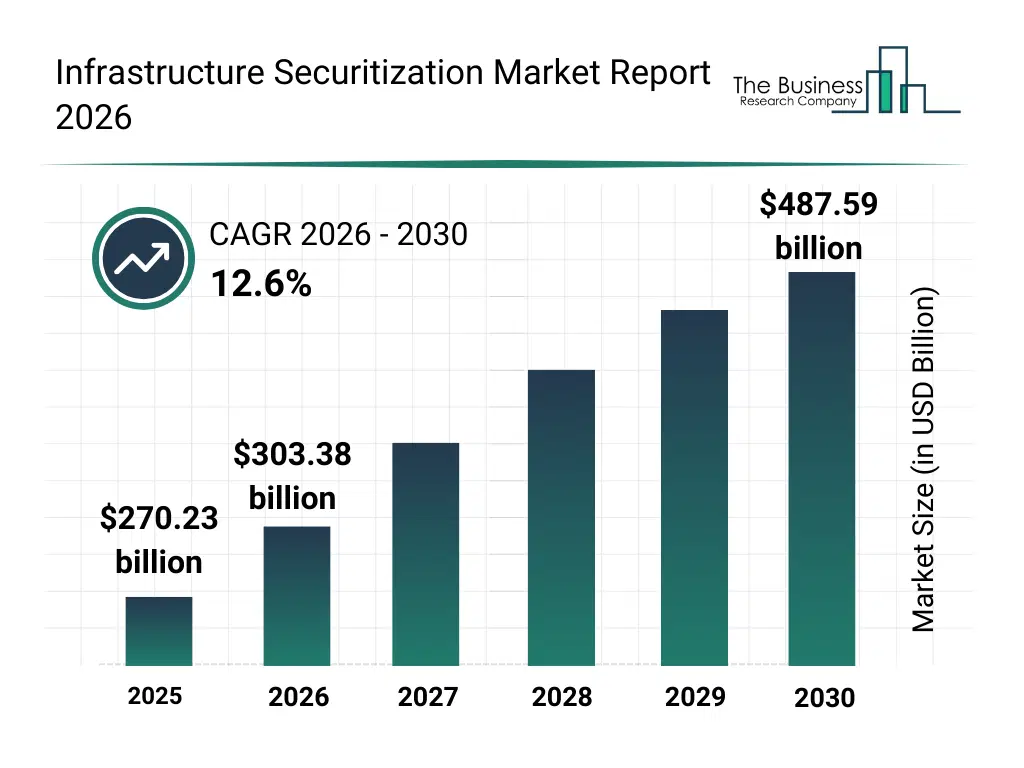
What Is The Infrastructure Securitization Market Size and Share 2026?
The infrastructure securitization market size has grown rapidly in recent years. It will grow from $270.23 billion in 2025 to $303.38 billion in 2026 at a compound annual growth rate (CAGR) of 12.3%. The growth in the historic period can be attributed to increasing infrastructure funding requirements, development of capital market instruments for infrastructure, growing participation of institutional investors, expansion of toll road and utility projects, maturation of project finance frameworks.What Is The Infrastructure Securitization Market Growth Forecast?
The infrastructure securitization market size is expected to see rapid growth in the next few years. It will grow to $487.59 billion in 2030 at a compound annual growth rate (CAGR) of 12.6%. The growth in the forecast period can be attributed to increasing investments in sustainable infrastructure, rising demand for diversified investment products, expansion of smart infrastructure projects, growing role of private capital in public assets, increasing financial innovation in asset securitization. Major trends in the forecast period include increasing adoption of infrastructure-backed securities, rising use of structured finance instruments, growing demand for long-term yield assets, expansion of public-private financing models, enhanced focus on cash flow predictability.
Global Infrastructure Securitization Market Segmentation
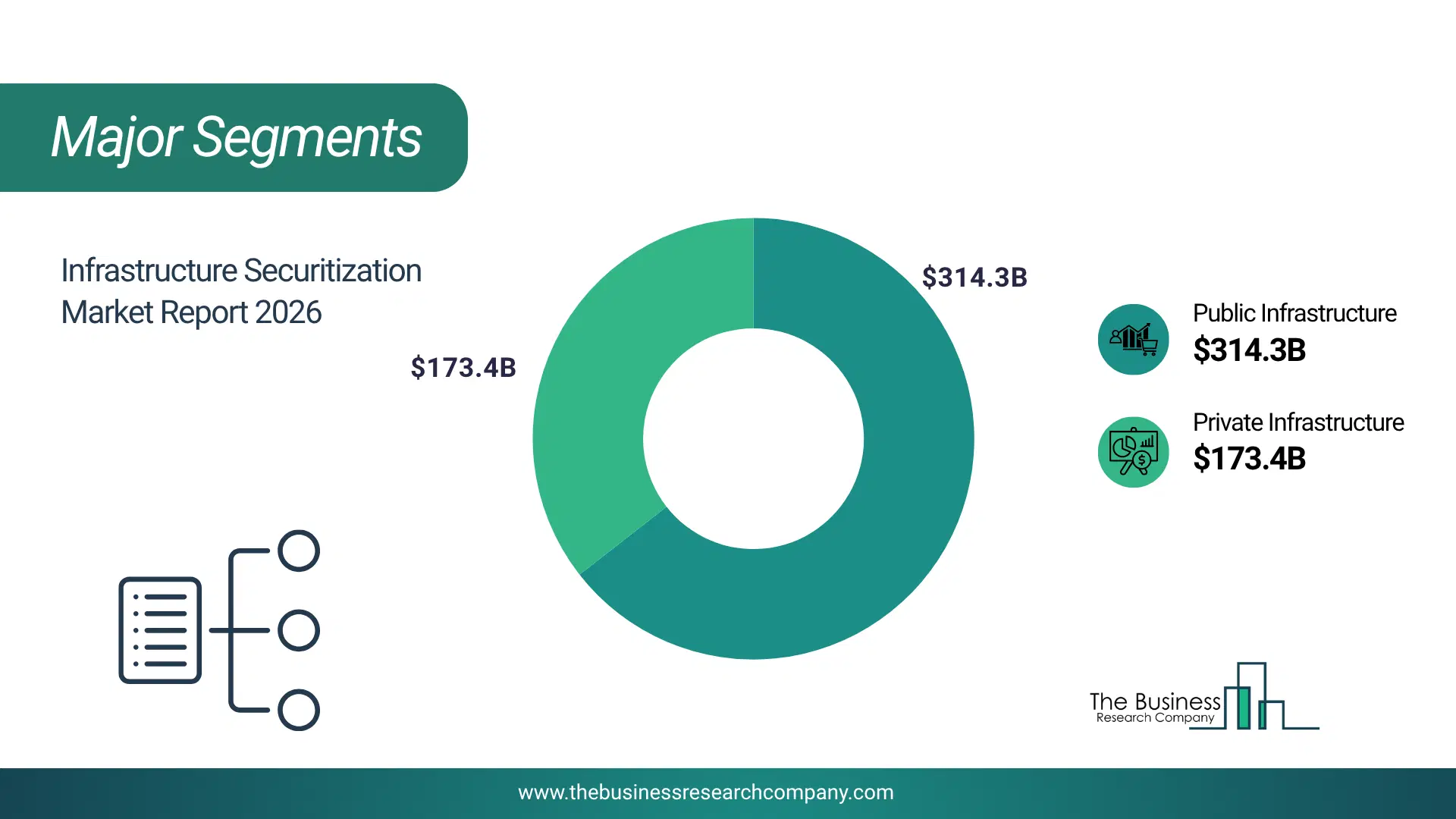
1) By Type: Public Infrastructure, Private Infrastructure 2) By Investor Type: Institutional Investors, Pension Funds 3) By Asset Class: Transportation, Energy, Water And Wastewater, Telecommunications, Social Infrastructure, Other Asset Classes 4) By Application: Construction Industry, Utilities, Transportation Subsegments: 1) By Public Infrastructure: Transportation Infrastructure, Energy Infrastructure, Water And Waste Management Infrastructure, Social Infrastructure 2) By Private Infrastructure: Commercial Real Estate, Industrial Facilities, Renewable Energy Projects, Telecommunication Networks The top segments in the infrastructure securitization market will be: • Public Infrastructure will reach $314.25 billion by 2030. • Private Infrastructure will reach $173.34 billion by 2030.What Are The Drivers Of The Infrastructure Securitization Market?
The growing large-scale infrastructure projects are expected to propel the growth of the infrastructure securitization market going forward. Large-scale infrastructure projects refer to extensive and capital-intensive construction or development initiatives, such as highways, airports, power plants, and urban transit systems, designed to support economic growth and public services. Large-scale infrastructure projects are rising due to increasing urbanisation, as growing populations demand expanded transportation, utilities, and public facilities to support city development. Infrastructure securitization enables the pooling of revenue-generating assets into tradable securities, providing large-scale infrastructure projects with access to substantial, long-term financing while spreading risk among investors and accelerating project development. For instance, in January 2025, according to the State Council Information Office of the People’s Republic of China, a China-based government agency, fixed-asset investment in China’s railway sector is projected to reach 590 billion yuan (approximately $82.08 billion) in 2025, with around 2,600 km of new rail lines expected to become operational during the year. The total operational length of the country’s railway network is forecasted to grow from 162,000 km at the end of 2024 to 180,000 km by 2030. Therefore, the growing large-scale infrastructure projects are driving the growth of the infrastructure securitization industry. The growing large-scale infrastructure projects are expected to propel the growth of the infrastructure securitization market going forward. Large-scale infrastructure projects refer to extensive and capital-intensive construction or development initiatives, such as highways, airports, power plants, and urban transit systems, designed to support economic growth and public services. Large-scale infrastructure projects are rising due to increasing urbanisation, as growing populations demand expanded transportation, utilities, and public facilities to support city development. Infrastructure securitization enables the pooling of revenue-generating assets into tradable securities, providing large-scale infrastructure projects with access to substantial, long-term financing while spreading risk among investors and accelerating project development. For instance, in January 2025, according to the State Council Information Office of the People’s Republic of China, a China-based government agency, fixed-asset investment in China’s railway sector is projected to reach 590 billion yuan (approximately $82.08 billion) in 2025, with around 2,600 km of new rail lines expected to become operational during the year. The total operational length of the country’s railway network is forecasted to grow from 162,000 km at the end of 2024 to 180,000 km by 2030. Therefore, the growing large-scale infrastructure projects are driving the growth of the infrastructure securitization industry.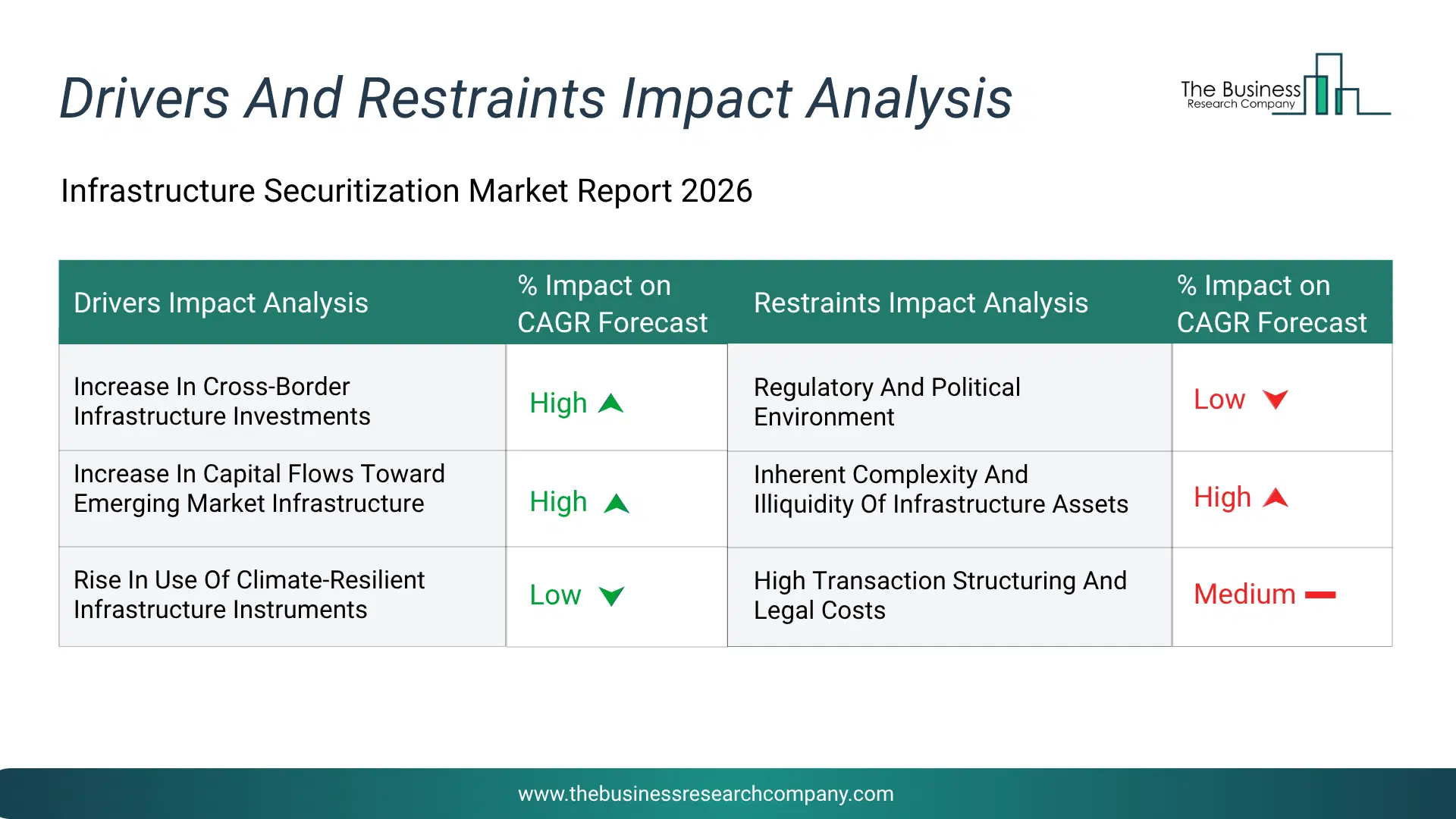
Infographic Chart Showing Key Market Drivers Analysis And Restraints For Infrastructure Securitization Market
The chart presents an impact analysis of key drivers and restraints, quantifying their relative influence on the market's growth rate and helping assess the balance between growth enablers and limiting factors. This chart offers a high-level perspective; the full report contains more detailed insights.
How Will The Drivers Impact Growth In The Global Infrastructure Securitization Market?
• Increase In Cross-Border Infrastructure Investments (High) – During the forecast period, the increase in cross-border infrastructure investments is expected to become a key growth driver for the infrastructure securitization market by 2030. Rising cross-border investments are significantly fuelling demand for securitization, as global investors increasingly seek diversified exposure to infrastructure assets across multiple regions. This trend enhances portfolio diversification, reduces reliance on domestic capital sources, and helps mitigate country-specific risks, strengthening the overall resilience of investment portfolios. It also creates new opportunities to structure innovative, risk-adjusted securities tailored to the preferences of international investors. • Increase In Capital Flows Toward Emerging Market Infrastructure (High) – During the forecast period, the increase in capital flows toward emerging market infrastructure is expected to emerge as a major factor driving the expansion of the infrastructure securitization market by 2030. Emerging markets continue to face substantial infrastructure gaps, and securitization offers an efficient and scalable mechanism to channel global funds into critical development projects. By converting predictable future cash flows, such as toll revenues, utility payments, or power tariffs, into tradable securities, securitization helps lower financing risks, improve capital efficiency, and enhance project bankability. This approach attracts long-term institutional investors seeking stable returns, supports the mobilization of patient capital, and contributes to the achievement of sustainable development goals by enabling broader access to essential infrastructure and services across these regions. • Rise In Use Of Climate-Resilient Infrastructure Instruments (Low) – During the forecast period, the rise in use of climate-resilient infrastructure instruments is expected to act as a key growth catalyst for the infrastructure securitization market by 2030. With climate change risks intensifying, investors are increasingly favoring green and climate-resilient securitization structures that support environmentally responsible financing. These instruments align closely with esg (environmental, social, and governance) objectives, appealing to sustainability-focused institutional and retail investors. They also help expand the investor base, improve access to long-term capital, and enable governments and corporates to secure stable funding for renewable energy, clean transportation, water management, and climate-adaptive infrastructure projects.How Will The Restraints Impact Growth In The Global Infrastructure Securitization Market?
• Regulatory And Political Environment (Low) – During the forecast period, the infrastructure securitization market is highly sensitive to government regulations, approvals, and political stability. Changes in policy frameworks, legal uncertainties, or sudden political decisions can disrupt cash flow projections and investor confidence. Since infrastructure projects often span decades, long-term political risks amplify uncertainties. Heavy regulatory scrutiny also raises compliance costs and delays deal execution. • Inherent Complexity And Illiquidity Of Infrastructure Assets (High) – During the forecast period, the infrastructure assets like toll roads, power plants, or airports are long-gestation, capital-intensive, and not easily tradable. Their illiquidity makes it difficult for investors to exit or adjust positions quickly, reducing the appeal for institutional investors. Structuring securitization deals for such assets requires specialized expertise and extensive due diligence, making transactions costly and time-consuming. • High Transaction Structuring And Legal Costs (Medium) – During the forecast period, the high transaction structuring and legal costs act as a restraint for the infrastructure securitization market by increasing the overall expense of creating and managing securitized asset deals. Complex deal structures require extensive legal documentation, credit analysis, and compliance verification, which significantly raise advisory and underwriting fees. These elevated costs reduce profitability for issuers and can discourage smaller players from participating in securitization transactions.Key Players In The Global Infrastructure Securitization Market
Major companies operating in the infrastructure securitization market are Brookfield Asset Management, Blackstone Group, Global Infrastructure Partners, KKR & Co. Inc., Apollo Global Management Inc., Ares Management Corp., Goldman Sachs Infrastructure Partners, Morgan Stanley, JP Morgan Chase Co., AXA Investment Managers, Mitsubishi UFJ Financial Group MUFG, Stonepeak Infrastructure Partners, Macquarie Group, Allianz Global Investors, Brookfield Infrastructure Partners, IFM Investors, Ardian, Partners Group, TIAA, Sumitomo Mitsui Financial Group SMFG, Crédit Agricole Corporate and Investment Bank, Citi Infrastructure Investors, HSBC Global Asset Management, Morgan Stanley Infrastructure Partners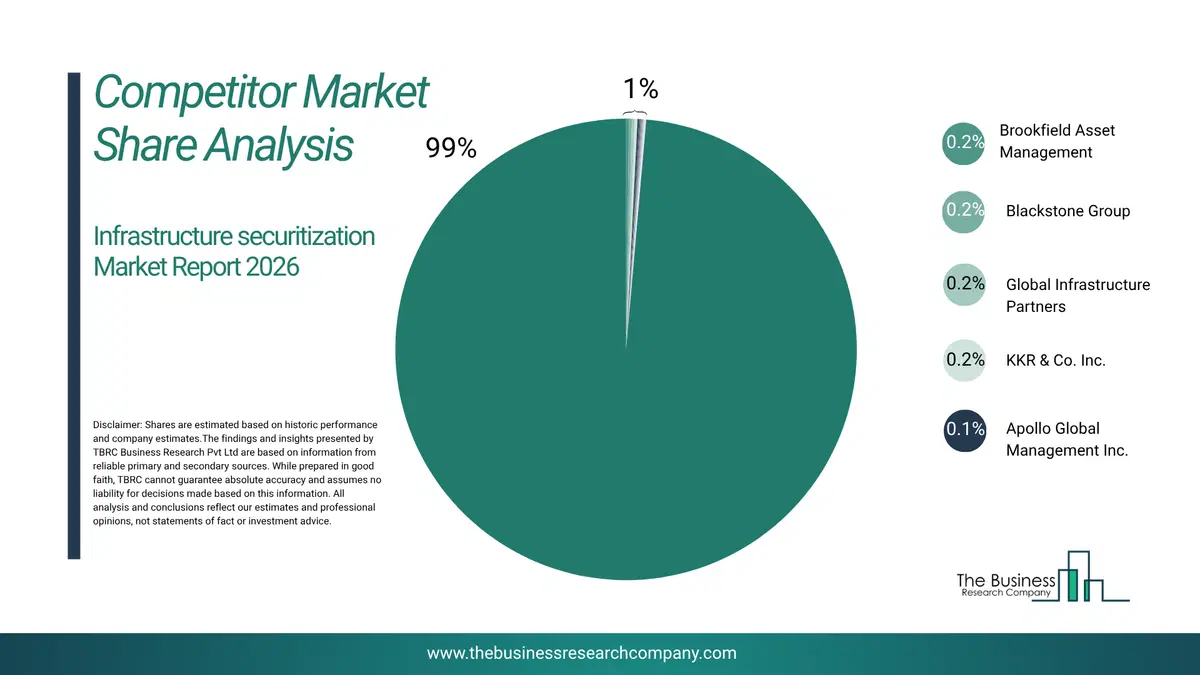
This chart is for illustrative purposes; the full report includes a detailed competitor analysis and comprehensive overview of the top 10 companies in the market.
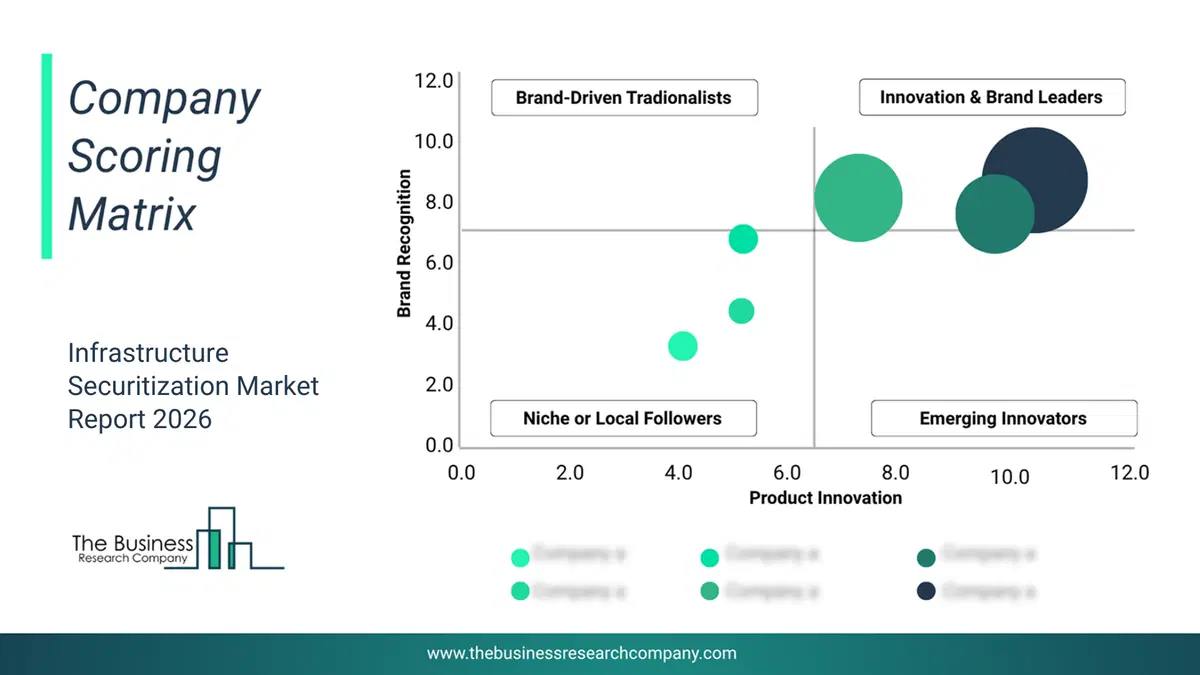
This chart maps companies by product innovation and brand strength, with bubble size indicating relative revenue, helping identify market leaders, challengers, and niche players. This is an illustrative chart; the full report provides a complete and accurate competitive analysis.
Global Infrastructure Securitization Market Trends and Insights
Major companies operating in the infrastructure securitization market are focusing on developing innovative solutions, such as infrastructure investment trusts (InvITs), to channel private investments into large-scale infrastructure projects while offering regular returns to investors. Infrastructure investment trusts (InvITs) are investment vehicles that pool funds from investors to finance and manage income-generating infrastructure projects, providing regular returns while enabling private participation in large-scale infrastructure. For instance, in July 2025, the National Highways Authority of India, an India-based government agency, launched the asset monetization strategy for the road sector to unlock value from highway assets and attract private investment. The strategy focuses on maximizing the value of operational highway assets, promoting transparency, and enhancing market development through models such as toll-operate-transfer, infrastructure investment trusts, and securitization. Its objectives include mobilizing private capital, easing fiscal pressures, and providing a structured framework for consistent revenue generation and sustainable infrastructure growth. It includes a pipeline of assets identified for monetization and a framework for transparent valuation, enabling efficient capital recycling for future infrastructure expansion.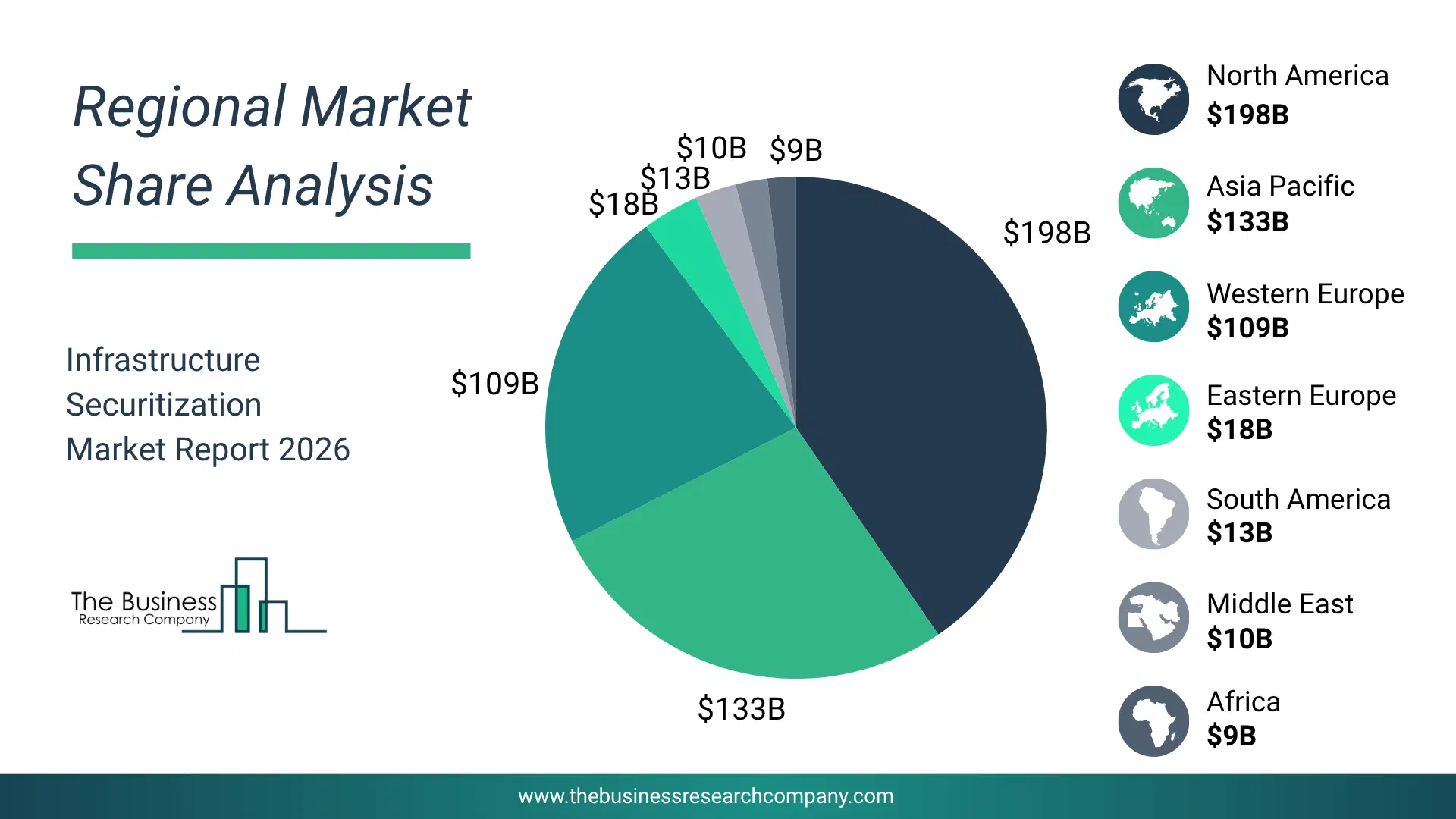
Regional Outlook
North America was the largest region in the infrastructure securitization market in 2025. Asia-Pacific is expected to be the fastest-growing region in the forecast period. The regions covered in this market report are Asia-Pacific, South East Asia, Western Europe, Eastern Europe, North America, South America, Middle East, Africa. The countries covered in this market report are Australia, Brazil, China, France, Germany, India, Indonesia, Japan, Taiwan, Russia, South Korea, UK, USA, Canada, Italy, Spain.What Defines the Infrastructure Securitization Market?
The infrastructure securitization market includes revenues earned by entities through issuance of infrastructure-backed securities, debt financing and bond structuring services, credit enhancement and risk management, secondary market trading and investment services, and credit enhancement services. The market value includes the value of related goods sold by the service provider or included within the service offering. Only goods and services traded between entities or sold to end consumers are included.How is Market Value Defined and Measured?
The market value is defined as the revenues that enterprises gain from the sale of goods and/or services within the specified market and geography through sales, grants, or donations in terms of the currency (in USD unless otherwise specified). The revenues for a specified geography are consumption values that are revenues generated by organizations in the specified geography within the market, irrespective of where they are produced. It does not include revenues from resales along the supply chain, either further along the supply chain or as part of other products.
This chart presents market attractiveness based on a quantitative evaluation of growth, competition, strategic alignment, and risk, offering a clear view of opportunity areas for decision-making. This chart is for illustrative purposes; the full report contains the complete analysis.

This chart highlights the Total Addressable Market (TAM) by estimating the maximum revenue opportunity using an assumption-driven approach, supporting strategic planning and opportunity sizing across markets. The chart is illustrative; the full report provides a more comprehensive analysis.
What Key Data and Analysis Are Included in the Infrastructure Securitization Market Report 2026?
The infrastructure securitization market research report is one of a series of new reports from The Business Research Company that provides market statistics, including Market Report 2026?global market size, regional shares, competitors with the market share, detailed market segments, market trends and opportunities, and any further data you may need to thrive in the infrastructure securitization Market Report 2026? The market research report delivers a complete perspective of everything you need, with an in-depth analysis of the current and future state of the Market Report 2026?Infrastructure Securitization Market Report Forecast Analysis
| Report Attribute | Details |
|---|---|
| Market Size Value In 2026 | $303.38 billion |
| Revenue Forecast In 2030 | $487.59 billion |
| Growth Rate | CAGR of 12.6% from 2026 to 2030 |
| Base Year For Estimation | 2025 |
| Actual Estimates/Historical Data | 2020-2025 |
| Forecast Period | 2026 - 2030 |
| Market Representation | Revenue in USD Billion and CAGR from 2026 to 2030 |
| Segments Covered | Type, Investor Type, Asset Class, Application |
| Regional Scope | Asia-Pacific, Western Europe, Eastern Europe, North America, South America, Middle East, Africa |
| Country Scope | The countries covered in the report are Australia, Brazil, China, France, Germany, India, ... |
| Key Companies Profiled | Brookfield Asset Management, Blackstone Group, Global Infrastructure Partners, KKR & Co. Inc., Apollo Global Management Inc., Ares Management Corp., Goldman Sachs Infrastructure Partners, Morgan Stanley, JP Morgan Chase Co., AXA Investment Managers, Mitsubishi UFJ Financial Group MUFG, Stonepeak Infrastructure Partners, Macquarie Group, Allianz Global Investors, Brookfield Infrastructure Partners, IFM Investors, Ardian, Partners Group, TIAA, Sumitomo Mitsui Financial Group SMFG, Crédit Agricole Corporate and Investment Bank, Citi Infrastructure Investors, HSBC Global Asset Management, Morgan Stanley Infrastructure Partners |
| Customization Scope | Request for Customization |
| Pricing And Purchase Options | Explore Purchase Options |