
Insurance Fraud Detection Market Report 2026
Global Outlook – By Component (Solution, Services), By Organization Size (Small And Medium-Sized Enterprises (SMEs), Large Enterprises), By Deployment Type (On-Premises, Cloud), By Application (Claims Fraud, Identity Theft, Payment And Billing Fraud, Money Laundering), By End User (Insurance Companies, Agents And Brokers, Insurance Intermediaries, Other End Users) – Market Size, Trends, Strategies, and Forecast to 2030
Insurance Fraud Detection Market Overview
• Insurance Fraud Detection market size has reached to $9.05 billion in 2025 • Expected to grow to $27.66 billion in 2030 at a compound annual growth rate (CAGR) of 25% • Growth Driver: Surge in Insurance Fraud Driving Growth of the Insurance Fraud Detection Market • Market Trend: Technological Advancements Drive The Evolution Of Insurance Fraud Detection Market • North America was the largest region in 2025 and Asia-Pacific is the fastest growing region.What Is Covered Under Insurance Fraud Detection Market?
The insurance fraud detection is an identification and prevention method of fraudulent activities related to money or insurance. Numerous software-based solutions are used to analyze historic patterns and incidents to predict future occurrences. Insurance fraud detection is generally used by organizations for fraud analytics, authentication, governance, risk, and compliance to safeguard databases and identify vulnerabilities. The main deployment types of insurance fraud detection are on-premises and cloud. On-premises insurance fraud detection refers to software that is implemented and activated on computers on the premises of the individual or using the software, instead of at a distant facility such as a server farm or cloud. The various components of insurance fraud detection include solutions, and services that are used by small and medium-sized enterprises (SMEs), and large enterprises. The applications of insurance fraud detection are claims fraud, identity theft, payment and billing fraud, and money laundering that are used across various end-users such as insurance companies, insurance intermediaries, agents and brokers, and other end-users.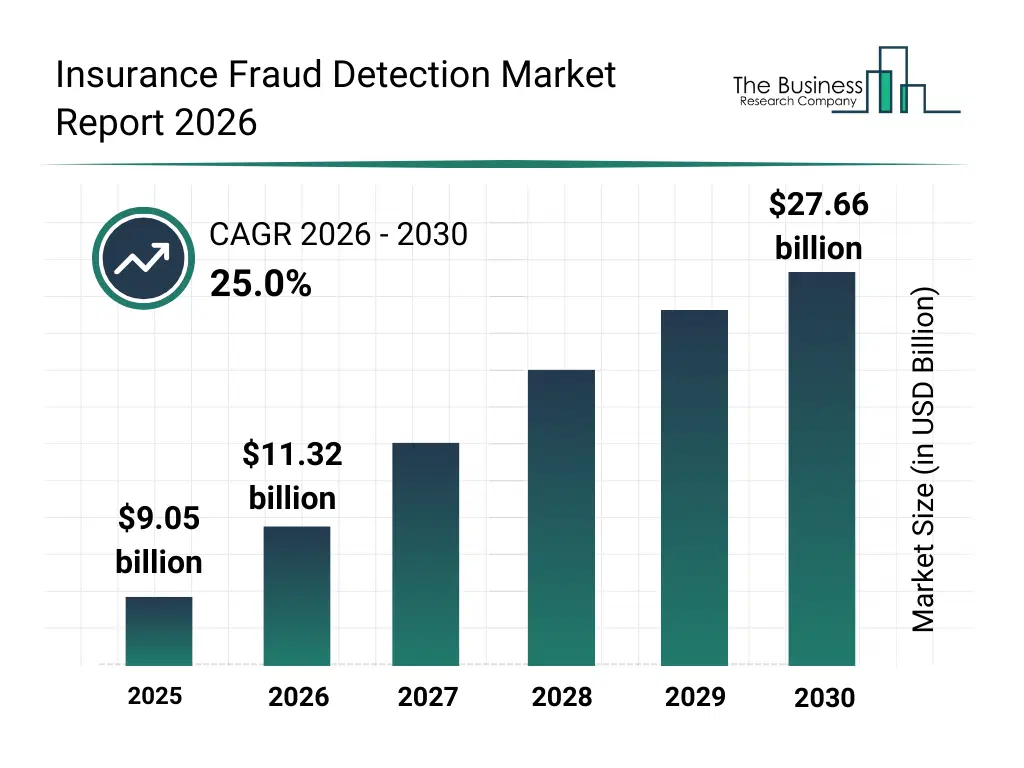
What Is The Insurance Fraud Detection Market Size and Share 2026?
The insurance fraud detection market size has grown exponentially in recent years. It will grow from $9.05 billion in 2025 to $11.32 billion in 2026 at a compound annual growth rate (CAGR) of 25.1%. The growth in the historic period can be attributed to increasing volume of digital insurance transactions, rising incidence of fraudulent claims, expansion of online insurance channels, growing regulatory scrutiny, adoption of data-driven fraud prevention tools.What Is The Insurance Fraud Detection Market Growth Forecast?
The insurance fraud detection market size is expected to see exponential growth in the next few years. It will grow to $27.66 billion in 2030 at a compound annual growth rate (CAGR) of 25.0%. The growth in the forecast period can be attributed to increasing investments in ai-powered fraud detection, rising demand for real-time fraud analytics, expansion of cloud-based fraud platforms, growing focus on cross-channel fraud prevention, increasing integration of advanced authentication technologies. Major trends in the forecast period include increasing deployment of predictive fraud analytics, rising use of identity verification technologies, growing integration of ai-based detection engines, expansion of real-time fraud monitoring systems, enhanced focus on regulatory compliance.
Global Insurance Fraud Detection Market Segmentation
1) By Component: Solution, Services 2) By Organization Size: Small And Medium-Sized Enterprises (SMEs), Large Enterprises 3) By Deployment Type: On-Premises, Cloud 4) By Application: Claims Fraud, Identity Theft, Payment And Billing Fraud, Money Laundering 5) By End User: Insurance Companies, Agents And Brokers, Insurance Intermediaries, Other End Users Subsegments: 1) By Solution: Fraud Analytics, Authentication Solutions, Governance, Risk, and Compliance (GRC) Solutions, Identity Verification Solutions, Predictive Analytics 2) By Services: Managed Services, Professional Services, Consulting Services, Training and Support Services, System Integration ServicesWhat Is The Driver Of The Insurance Fraud Detection Market?
The increasing incidence of insurance fraud is expected to propel the growth of the insurance fraud detection market going forward. Insurance fraud involves deliberately deceiving an insurer often through exaggerated or entirely false claims to obtain money or coverage unlawfully, leaving honest policyholders and insurers bearing the cost. Fraud-detection technologies help identify and stop these schemes by analysing data, spotting anomalies, and flagging suspicious activities. For instance, in June 2023, the Insurance Fraud Enforcement Department (IFED) of the City of London Police, a US-based specialist police unit, reported a 61 % increase in opportunistic insurance-fraud cases for the period March 2022 to April 2023 compared with the previous period. Therefore, the surge in several insurance frauds is contributing to the growth of the insurance fraud detection industry.Key Players In The Global Insurance Fraud Detection Market
Major companies operating in the insurance fraud detection market are ACI Worldwide Inc.; BAE Systems PLC; BRIDGEi2i Analytics Solutions Pvt. Ltd.; Datawalk Inc.; DXC Technology Co.; Experian PLC; Fair Isaac Corp.; Fiserv Inc.; FRISS Inc.; International Business Machines Corporation; iovation Inc.; Kount Inc.; RELX Group; Oracle Corp.; SAP SE; SAS Institute Inc.; Scorto Inc.; TransUnion LLC; Wipro Ltd.; Accenture plc; Equifax Inc.; Perceptiviti Inc.; Shift Technology S.A.; Verisk Analytics Inc.; Mody Data Solution Pvt. Ltd.; Pixalate Inc.; Skopenow Inc.; Sigma Insights Inc.; Fraud Guard LLC
This chart is for illustrative purposes; the full report includes a detailed competitor analysis and comprehensive overview of the top 10 companies in the market.
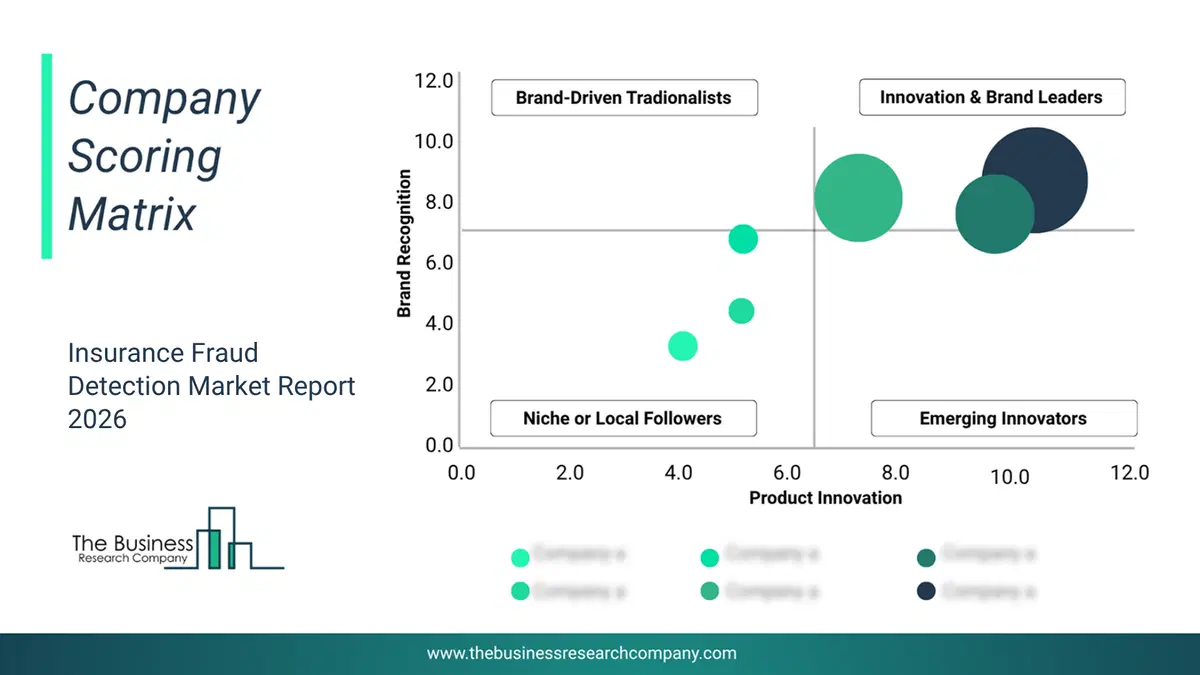
This chart maps companies by product innovation and brand strength, with bubble size indicating relative revenue, helping identify market leaders, challengers, and niche players. This is an illustrative chart; the full report provides a complete and accurate competitive analysis.
Global Insurance Fraud Detection Market Trends and Insights
Major companies operating in the insurance fraud detection market are focusing on developing advanced solutions, such as artificial intelligence (AI)-powered fraud detection tools, to enhance claim monitoring accuracy, reduce false positives, and improve the identification of fraudulent activities. artificial intelligence (AI)-powered fraud detection tools refer to advanced systems that use artificial intelligence and large datasets to detect suspicious patterns, generate alerts, and support investigators in identifying potential fraud with greater precision. For instance, in June 2024, Clara Analytics Inc., a US-based software company, launched CLARA Fraud, an AI-driven fraud detection solution that leverages extensive workers’ compensation datasets to improve visibility into suspicious claims. The solution provides data-backed reasons for Special Investigation Unit (SIU) referrals and helps claims professionals investigate fraud confidently, uncovering fraudulent activities across millions of claims while minimizing false positives.What Are Latest Mergers And Acquisitions In The Insurance Fraud Detection Market?
In February 2025, LexisNexis Risk Solutions, a US-based provider of data analytics, identity verification and risk assessment solutions, acquired IDVerse for an undisclosed amount. With this acquisition, LexisNexis aimed to enhance its document-authentication and deep-fake detection capabilities in the insurance sector. IDVerse is an UK-based provider of artificial intelligence (AI)-powered document authentication and fraud detection solutions.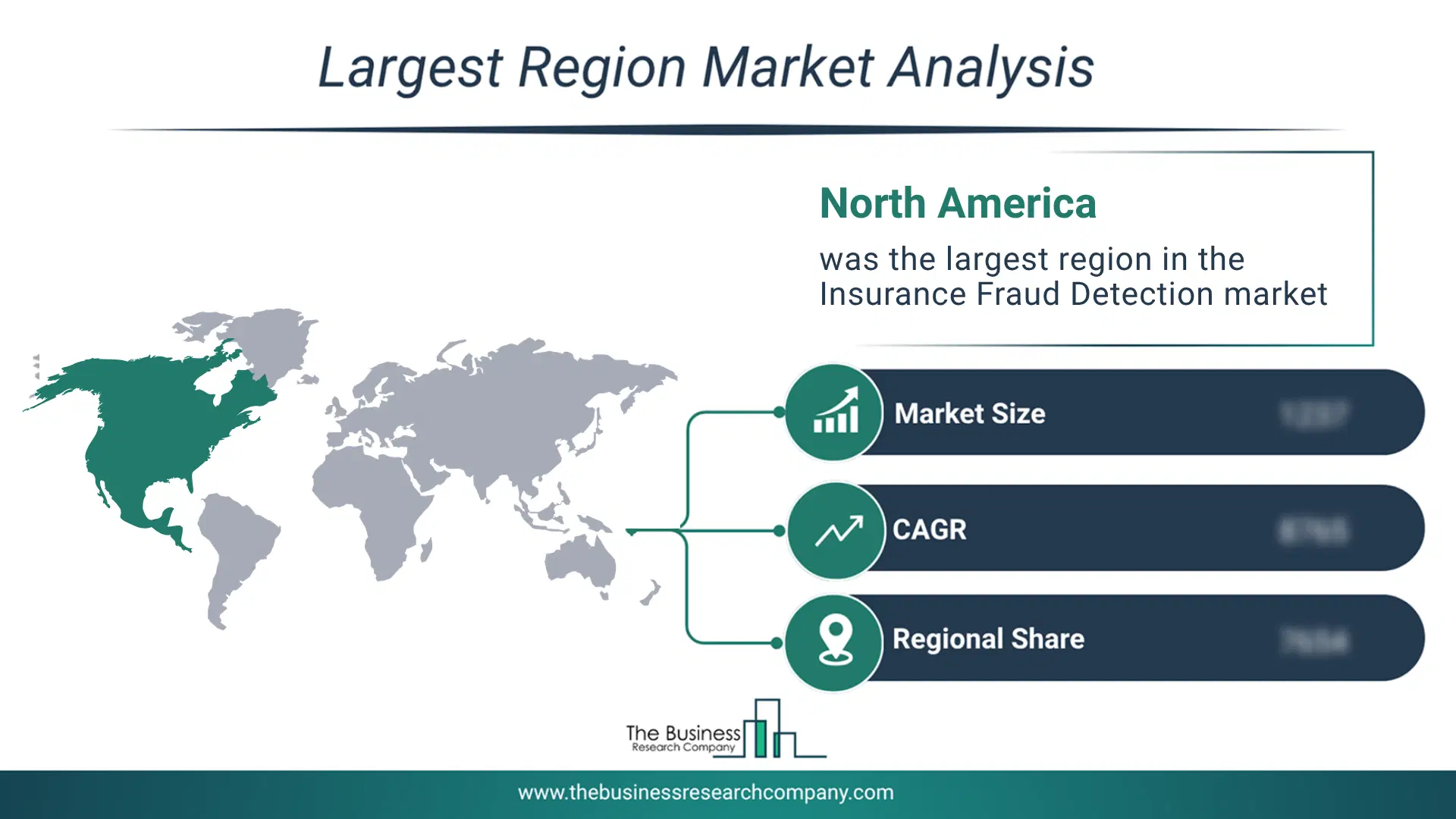
Regional Insights
North America was the largest region in the insurance fraud detection market in 2025.Asia-Pacific is expected to be the fastest-growing region in the forecast period. The regions covered in this market report are Asia-Pacific, South East Asia, Western Europe, Eastern Europe, North America, South America, Middle East, Africa. The countries covered in this market report are Australia, Brazil, China, France, Germany, India, Indonesia, Japan, Taiwan, Russia, South Korea, UK, USA, Canada, Italy, SpainWhat Defines the Insurance Fraud Detection Market?
The insurance fraud detection includes revenues earned by entities by statistical data analysis services, multi-layered process, behavioral biometrics services, adaptive and predictive analytics services. The market value includes the value of related goods sold by the service provider or included within the service offering. Only goods and services traded between entities or sold to end consumers are included.How is Market Value Defined and Measured?
The market value is defined as the revenues that enterprises gain from the sale of goods and/or services within the specified market and geography through sales, grants, or donations in terms of the currency (in USD unless otherwise specified). The revenues for a specified geography are consumption values that are revenues generated by organizations in the specified geography within the market, irrespective of where they are produced. It does not include revenues from resales along the supply chain, either further along the supply chain or as part of other products.
This chart presents market attractiveness based on a quantitative evaluation of growth, competition, strategic alignment, and risk, offering a clear view of opportunity areas for decision-making. This chart is for illustrative purposes; the full report contains the complete analysis.

This chart highlights the Total Addressable Market (TAM) by estimating the maximum revenue opportunity using an assumption-driven approach, supporting strategic planning and opportunity sizing across markets. The chart is illustrative; the full report provides a more comprehensive analysis.
What Key Data and Analysis Are Included in the Insurance Fraud Detection Market Report 2026?
The insurance fraud detection market research report is one of a series of new reports from The Business Research Company that provides market statistics, including industry global market size, regional shares, competitors with the market share, detailed market segments, market trends and opportunities, and any further data you may need to thrive in the insurance fraud detection industry. The market research report delivers a complete perspective of everything you need, with an in-depth analysis of the current and future state of the industry.Insurance Fraud Detection Market Report Forecast Analysis
| Report Attribute | Details |
|---|---|
| Market Size Value In 2026 | $11.32 billion |
| Revenue Forecast In 2030 | $27.66 billion |
| Growth Rate | CAGR of 25% from 2026 to 2030 |
| Base Year For Estimation | 2025 |
| Actual Estimates/Historical Data | 2020-2025 |
| Forecast Period | 2026 - 2030 |
| Market Representation | Revenue in USD Billion and CAGR from 2026 to 2030 |
| Segments Covered | Component, Organization Size, Deployment Type, Application, End User |
| Regional Scope | Asia-Pacific, Western Europe, Eastern Europe, North America, South America, Middle East, Africa |
| Country Scope | The Countries Covered In This Market Report Are Australia, Brazil, China, France, Germany, India, Indonesia, Japan, Taiwan, Russia, South Korea, Uk, Usa, Canada, Italy, Spain. |
| Key Companies Profiled | ACI Worldwide Inc., BAE Systems PLC, BRIDGEi2i Analytics Solutions Pvt. Ltd., Datawalk Inc., DXC Technology Co., Experian PLC, Fair Isaac Corp., Fiserv Inc., FRISS Inc., International Business Machines Corporation, iovation Inc., Kount Inc., RELX Group, Oracle Corp., SAP SE, SAS Institute Inc., Scorto Inc., TransUnion LLC, Wipro Ltd., Accenture plc, Equifax Inc., Perceptiviti Inc., Shift Technology S.A., Verisk Analytics Inc., Mody Data Solution Pvt. Ltd., Pixalate Inc., Skopenow Inc., Sigma Insights Inc., Fraud Guard LLC |
| Customization Scope | Request for Customization |
| Pricing And Purchase Options | Explore Purchase Options |