
Interventional Oncology Devices Market Report 2026
Global Outlook – By Product (Embolization Devices, Ablation Devices, Support Devices), By procedure (Thermal Tumor Ablation, Non-Thermal Tumor Ablation, Transcatheter Arterial Chemoembolization (TACE), Transcatheter Arterial Radioembolization (TARE), Selective Internal Radiation Therapy (SIRT), Transcatheter Arterial Embolization (TAE), Bland Embolization), By Cancer Type (Liver Cancer, Kidney Cancer, Lung Cancer, Bone Cancer, Other Cancer Types) – Market Size, Trends, Strategies, and Forecast to 2030
Interventional Oncology Devices Market Overview
• Interventional Oncology Devices market size has reached to $2.5 billion in 2025 • Expected to grow to $3.5 billion in 2030 at a compound annual growth rate (CAGR) of 7% • Growth Driver: High Prevalence Of Cancer Driving The Growth Of Interventional Oncology Devices Market • Market Trend: Argon Medical's SuperCore Advantage In Interventional Oncology • North America was the largest region in 2025 and Asia-Pacific is the fastest growing region.What Is Covered Under Interventional Oncology Devices Market?
Interventional oncology devices refer to medical tools and technologies used to diagnose and treat cancer through minimally invasive procedures. They are used to target tumors directly, delivering treatments like ablation or embolization while minimizing damage to surrounding healthy tissue. The main products of interventional oncology devices are embolization devices, ablation devices, and support devices. Embolization devices are intended for the embolization of the blood vessels of a variety of tumors. The interventional oncology devices are used to perform procedures such as thermal tumor ablation, non-thermal tumor ablation, transcatheter arterial chemoembolization (TACE), transcatheter arterial radioembolization (TARE), or selective internal radiation therapy (SIRT), and transcatheter arterial embolization (TAE), or bland embolization, that are used to treat cancer types such as liver cancer, kidney cancer, lung cancer, bone cancer, and others.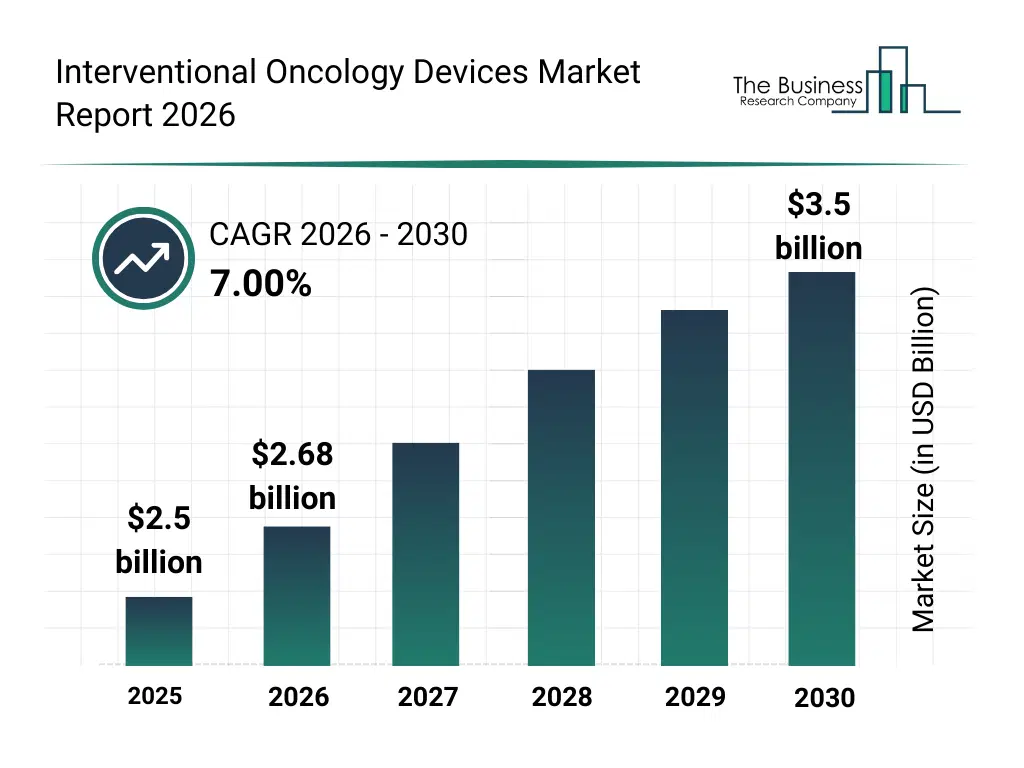
What Is The Interventional Oncology Devices Market Size and Share 2026?
The interventional oncology devices market size has grown strongly in recent years. It will grow from $2.5 billion in 2025 to $2.68 billion in 2026 at a compound annual growth rate (CAGR) of 7.1%. The growth in the historic period can be attributed to increasing cancer incidence rates, expansion of interventional radiology practices, improvements in imaging technologies, growing adoption of minimally invasive oncology treatments, availability of specialized oncology centers.What Is The Interventional Oncology Devices Market Growth Forecast?
The interventional oncology devices market size is expected to see strong growth in the next few years. It will grow to $3.5 billion in 2030 at a compound annual growth rate (CAGR) of 7.0%. The growth in the forecast period can be attributed to increasing demand for targeted cancer therapies, rising investments in precision oncology, expansion of outpatient cancer treatment settings, growing adoption of combination interventional therapies, technological advancements in ablation and embolization devices. Major trends in the forecast period include increasing adoption of image-guided tumor ablation devices, rising use of minimally invasive cancer treatments, growing deployment of embolization therapies, expansion of precision oncology procedures, enhanced integration of advanced imaging support systems.
Global Interventional Oncology Devices Market Segmentation
1) By Product: Embolization Devices, Ablation Devices, Support Devices 2) By procedure: Thermal Tumor Ablation, Non-Thermal Tumor Ablation, Transcatheter Arterial Chemoembolization (TACE), Transcatheter Arterial Radioembolization (TARE), Selective Internal Radiation Therapy (SIRT), Transcatheter Arterial Embolization (TAE), Bland Embolization 3) By Cancer Type: Liver Cancer, Kidney Cancer, Lung Cancer, Bone Cancer, Other Cancer Types Subsegments: 1) By Embolization Devices: Embolic Agents, Catheters For Embolization, Delivery Systems For Embolic Agents 2) By Ablation Devices: Radiofrequency Ablation Devices, Microwave Ablation Devices, Cryoablation Devices, Laser Ablation Devices 3) By Support Devices: Imaging Guidance Systems, Access Devices, Fluid Management SystemsWhat Is The Driver Of The Interventional Oncology Devices Market?
The high prevalence of cancer is expected to propel the growth of the interventional oncology devices market going forward. Cancer refers to a group of diseases characterized by the uncontrolled growth and spread of abnormal cells in the body. These abnormal cells can form masses or tumors. The high prevalence of cancer boosts the demand for interventional oncology devices, as these are used in the diagnosis, treatment, and management of cancer, which helps with early detection, staging, and monitoring. For instance, in July 2024, according to the Australian Institute of Health and Welfare, an Australia-based government agency, in Australia the number of cancer cases diagnosed increased from 160,570 in 2022 to 164,694 in 2023, reflecting a notable rise over the year. This upward trend highlights the growing prevalence of cancer within the country. Therefore, the high prevalence of cancer is driving the growth of the interventional oncology devices industry.Key Players In The Global Interventional Oncology Devices Market
Major companies operating in the interventional oncology devices market are Boston Scientific Corporation, Terumo Corporation, Siemens Healthineers, Sirtex Medical Limited, AngioDynamics Inc., Viant Medical, Medtronic plc, Olympus Corporation, Koninklijke Philips, Quantum Surgical, Profound Medical, Intuitive Surgical Inc, Cook Medical LLC, EDAP TMS S.A, Varian Medical Systems Inc, Heraeus Medical, ABLbio, Bioavlee, Mediceena International, LifeTech Scientific Corporation
This chart is for illustrative purposes; the full report includes a detailed competitor analysis and comprehensive overview of the top 10 companies in the market.
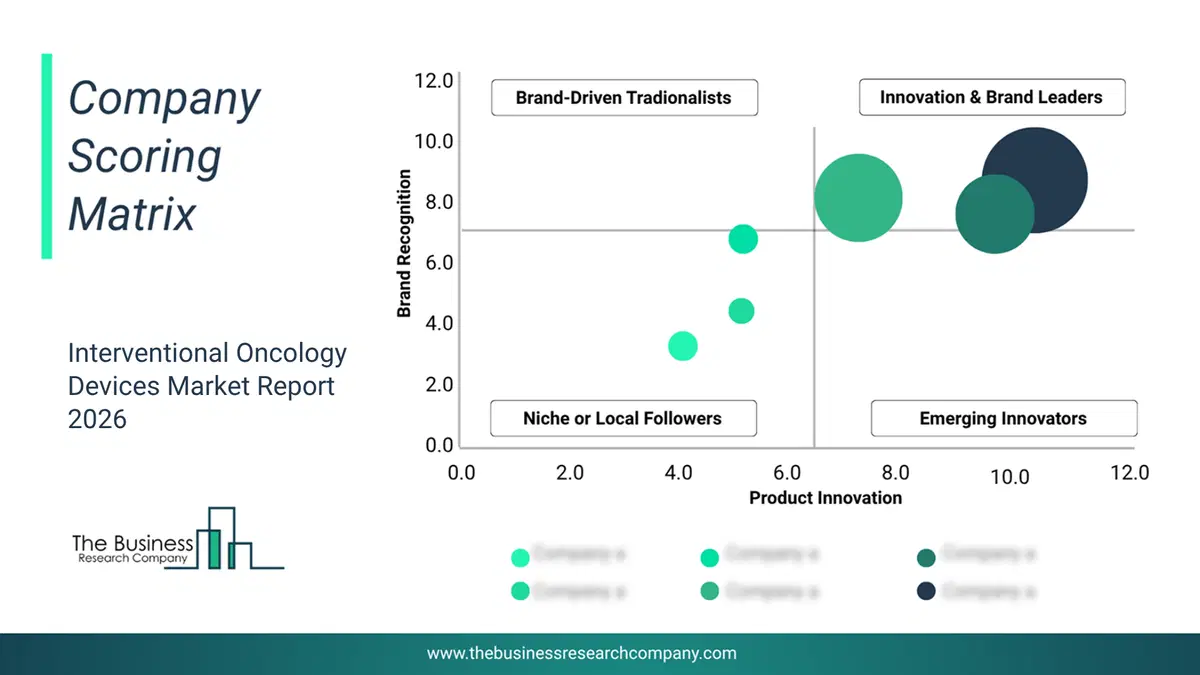
This chart maps companies by product innovation and brand strength, with bubble size indicating relative revenue, helping identify market leaders, challengers, and niche players. This is an illustrative chart; the full report provides a complete and accurate competitive analysis.
Global Interventional Oncology Devices Market Trends and Insights
Major companies operating in the interventional oncology devices market are focusing on technologies, such as tissue volume, to enhance diagnostic accuracy and treatment efficacy in oncology procedures. Tissue volume refers to the amount of biological tissue collected during a biopsy procedure. Larger tissue volumes can provide more comprehensive samples, improving the accuracy of diagnoses and the effectiveness of treatment planning. For instance, in June 2023, Argon Medical, a US-based medical device company, launched the SuperCore Advantage semi-automatic biopsy. The SuperCore Advantage can collect up to 35% more samples than leading competitors, which reduces the need for multiple passes during biopsies. This feature is crucial for obtaining adequate tissue samples for accurate diagnosis.What Are Latest Mergers And Acquisitions In The Interventional Oncology Devices Market?
In May 2024, Siemens Healthineers, a Germany-based provider of devices and imaging systems that support interventional oncology, partnered with University Hospitals to advance precision care through innovation and integrated clinical excellence. The partnership aims to enhance oncology, cardiovascular, and neurovascular outcomes by jointly advancing theranostics, novel MR technologies, and next-generation patient care solutions. University Hospitals is a US-based healthcare system.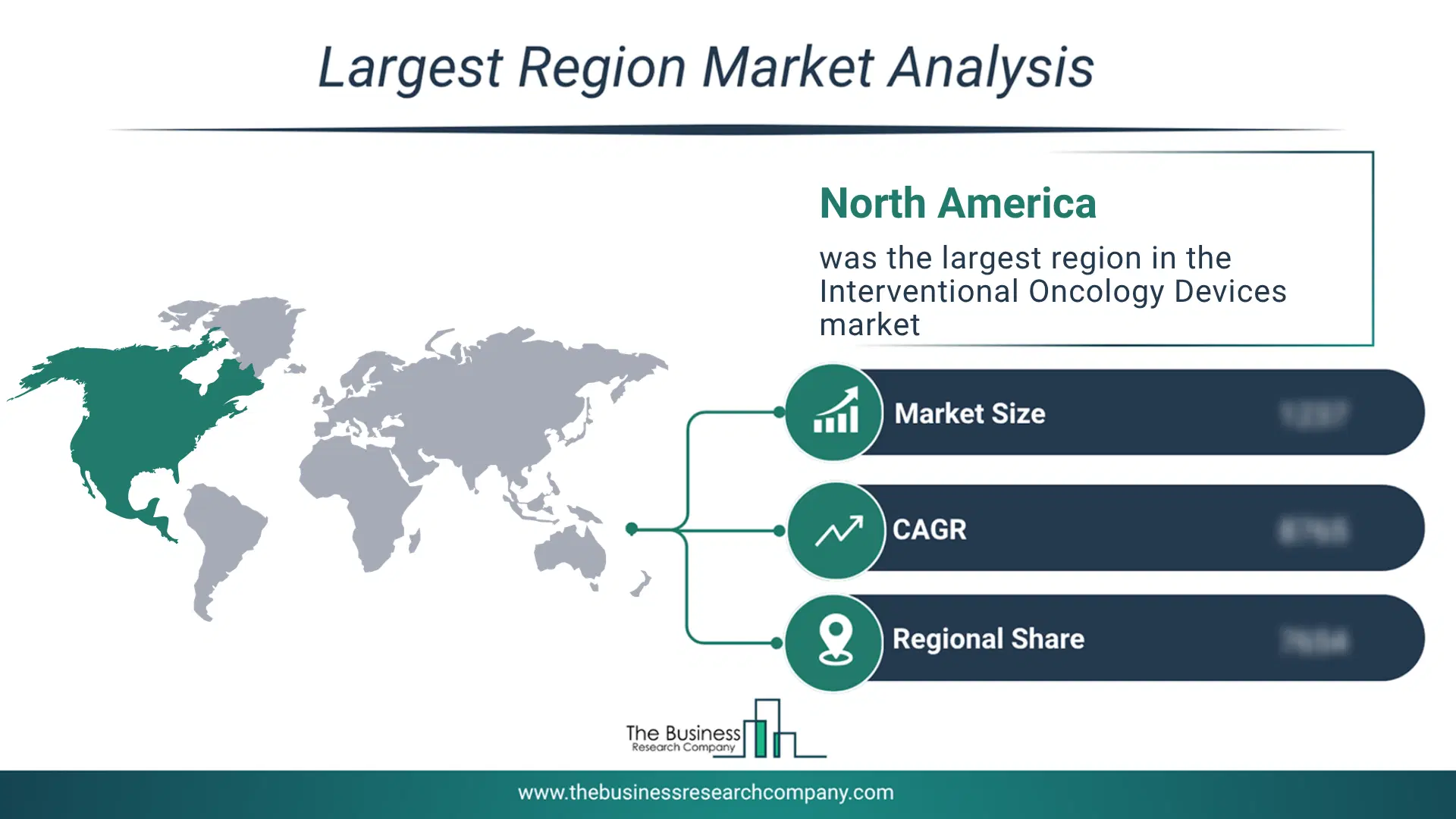
Regional Outlook
North America was the largest region in the interventional oncology devices market in 2025. Asia-Pacific is expected to be the fastest-growing region in the forecast period. The regions covered in this market report are Asia-Pacific, South East Asia, Western Europe, Eastern Europe, North America, South America, Middle East, Africa. The countries covered in this market report are Australia, Brazil, China, France, Germany, India, Indonesia, Japan, Taiwan, Russia, South Korea, UK, USA, Canada, Italy, SpainWhat Defines the Interventional Oncology Devices Market?
The interventional oncology devices market consists of sales of embolization devices, ablation devices, and support devices. Values in this market are factory gate values, that is the value of goods sold by the manufacturers or creators of the goods, whether to other entities (including downstream manufacturers, wholesalers, distributors, and retailers) or directly to end customers. The value of goods in this market includes related services sold by the creators of the goods.How is Market Value Defined and Measured?
The market value is defined as the revenues that enterprises gain from the sale of goods and/or services within the specified market and geography through sales, grants, or donations in terms of the currency (in USD unless otherwise specified). The revenues for a specified geography are consumption values that are revenues generated by organizations in the specified geography within the market, irrespective of where they are produced. It does not include revenues from resales along the supply chain, either further along the supply chain or as part of other products.
This chart presents market attractiveness based on a quantitative evaluation of growth, competition, strategic alignment, and risk, offering a clear view of opportunity areas for decision-making. This chart is for illustrative purposes; the full report contains the complete analysis.

This chart highlights the Total Addressable Market (TAM) by estimating the maximum revenue opportunity using an assumption-driven approach, supporting strategic planning and opportunity sizing across markets. The chart is illustrative; the full report provides a more comprehensive analysis.
What Key Data and Analysis Are Included in the Interventional Oncology Devices Market Report 2026?
The interventional oncology devices market research report is one of a series of new reports from The Business Research Company that provides market statistics, including industry global market size, regional shares, competitors with the market share, detailed market segments, market trends and opportunities, and any further data you may need to thrive in the interventional oncology devices industry. The market research report delivers a complete perspective of everything you need, with an in-depth analysis of the current and future state of the industry.Interventional Oncology Devices Market Report Forecast Analysis
| Report Attribute | Details |
|---|---|
| Market Size Value In 2026 | $2.68 billion |
| Revenue Forecast In 2030 | $3.5 billion |
| Growth Rate | CAGR of 7% from 2026 to 2030 |
| Base Year For Estimation | 2025 |
| Actual Estimates/Historical Data | 2020-2025 |
| Forecast Period | 2026 - 2030 |
| Market Representation | Revenue in USD Billion and CAGR from 2026 to 2030 |
| Segments Covered | Product, procedure, Cancer Type |
| Regional Scope | Asia-Pacific, Western Europe, Eastern Europe, North America, South America, Middle East, Africa |
| Country Scope | The countries covered in the report are Australia, Brazil, China, France, Germany, India, Indonesia, Japan, Taiwan, Russia, South Korea, UK, USA, Canada, Italy, Spain. |
| Key Companies Profiled | Boston Scientific Corporation, Terumo Corporation, Siemens Healthineers, Sirtex Medical Limited, AngioDynamics Inc., Viant Medical, Medtronic plc, Olympus Corporation, Koninklijke Philips, Quantum Surgical, Profound Medical, Intuitive Surgical Inc, Cook Medical LLC, EDAP TMS S.A, Varian Medical Systems Inc, Heraeus Medical, ABLbio, Bioavlee, Mediceena International, LifeTech Scientific Corporation |
| Customization Scope | Request for Customization |
| Pricing And Purchase Options | Explore Purchase Options |