
Low Borosilicate Glass Bottle Market Report 2026
Global Outlook – By Product Type (Clear, Amber, Other Types), By Capacity (Small, Medium, Large), By Distribution Channel (Specialty Stores, B2B Direct Sales), By Application (Pharmaceuticals, Food And Beverages, Cosmetics And Personal Care, Chemicals, Other Applications) – Market Size, Trends, Strategies, and Forecast to 2030
Low Borosilicate Glass Bottle Market Overview
• Low Borosilicate Glass Bottle market size has reached to $1.27 billion in 2025 • Expected to grow to $1.82 billion in 2030 at a compound annual growth rate (CAGR) of 7.5% • Growth Driver: Rising Demand For Pharmaceutical And Cosmetic Products Fueling The Growth Of The Market Due To Need For Chemically Stable And Durable Packaging • Market Trend: Advancements In Next-Generation Borosilicate Glass For Evolving Pharmaceutical Needs • North America was the largest region in 2025 and Asia-Pacific is the fastest growing region.What Is Covered Under Low Borosilicate Glass Bottle Market?
A low borosilicate glass bottle is a container made from glass that contains a lower percentage of boron trioxide compared to high borosilicate glass, offering good thermal and chemical resistance. It is commonly used for packaging pharmaceuticals, laboratory reagents, and food products due to its durability, clarity, and cost-effectiveness. The main types of products in low borosilicate glass bottles are clear, amber, and others. Clear low borosilicate glass bottles are made from low borosilicate glass with high transparency, allowing full visibility of the contents inside. These are used for various capacities, including small, medium, and large, that are distributed through various distribution channels such as online stores, supermarkets or hypermarkets, specialty stores, and other distribution channels, and are used by various applications such as food and beverages, cosmetics and personal care, chemicals, and others.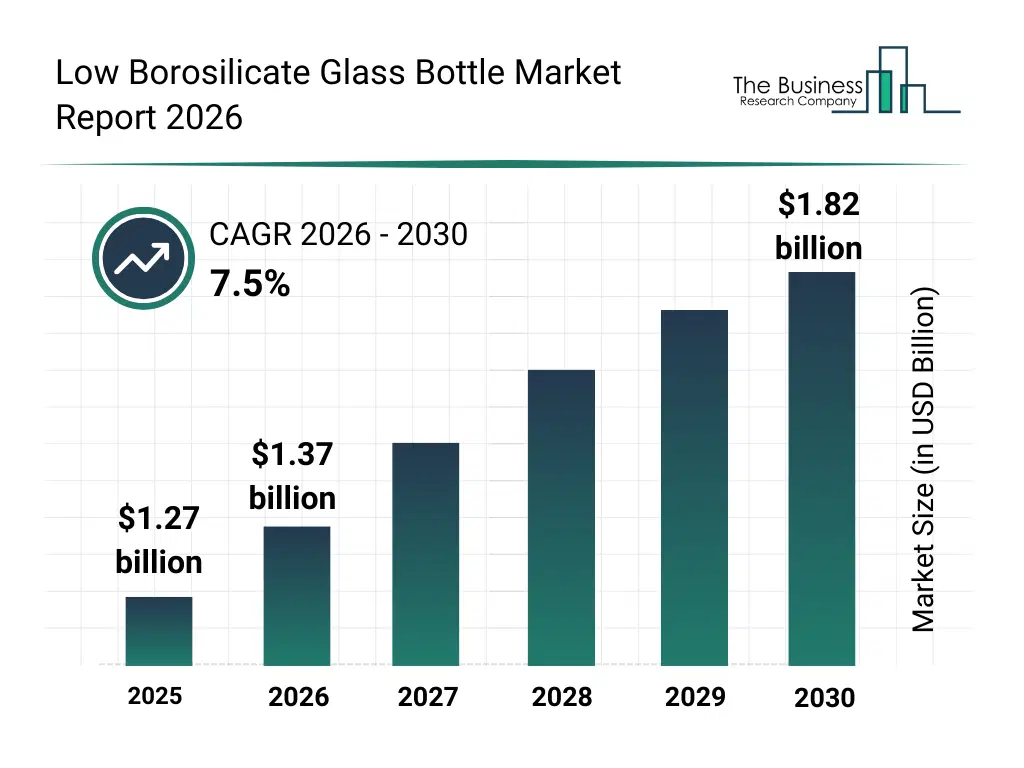
What Is The Low Borosilicate Glass Bottle Market Size and Share 2026?
The low borosilicate glass bottle market size has grown strongly in recent years. It will grow from $1.27 billion in 2025 to $1.37 billion in 2026 at a compound annual growth rate (CAGR) of 7.5%. The growth in the historic period can be attributed to growth of pharmaceutical packaging industry, increasing use of glass over plastics for chemical resistance, expansion of food and beverage packaging, rising awareness about product safety and quality, adoption of low borosilicate glass for laboratory and industrial uses.What Is The Low Borosilicate Glass Bottle Market Growth Forecast?
The low borosilicate glass bottle market size is expected to see strong growth in the next few years. It will grow to $1.82 billion in 2030 at a compound annual growth rate (CAGR) of 7.5%. The growth in the forecast period can be attributed to increasing demand from cosmetic and personal care industries, growing adoption in e-commerce packaging, rising preference for sustainable and recyclable packaging, expansion of online retail and specialty stores, innovation in ultra-clear and custom-colored glass bottles. Major trends in the forecast period include rising use of low borosilicate glass bottles in pharmaceuticals, increasing adoption in food and beverage packaging, growth in cosmetics and personal care applications, expansion of amber and colored glass bottle offerings, rising demand for customizable and specialty glass bottles.
Global Low Borosilicate Glass Bottle Market Segmentation
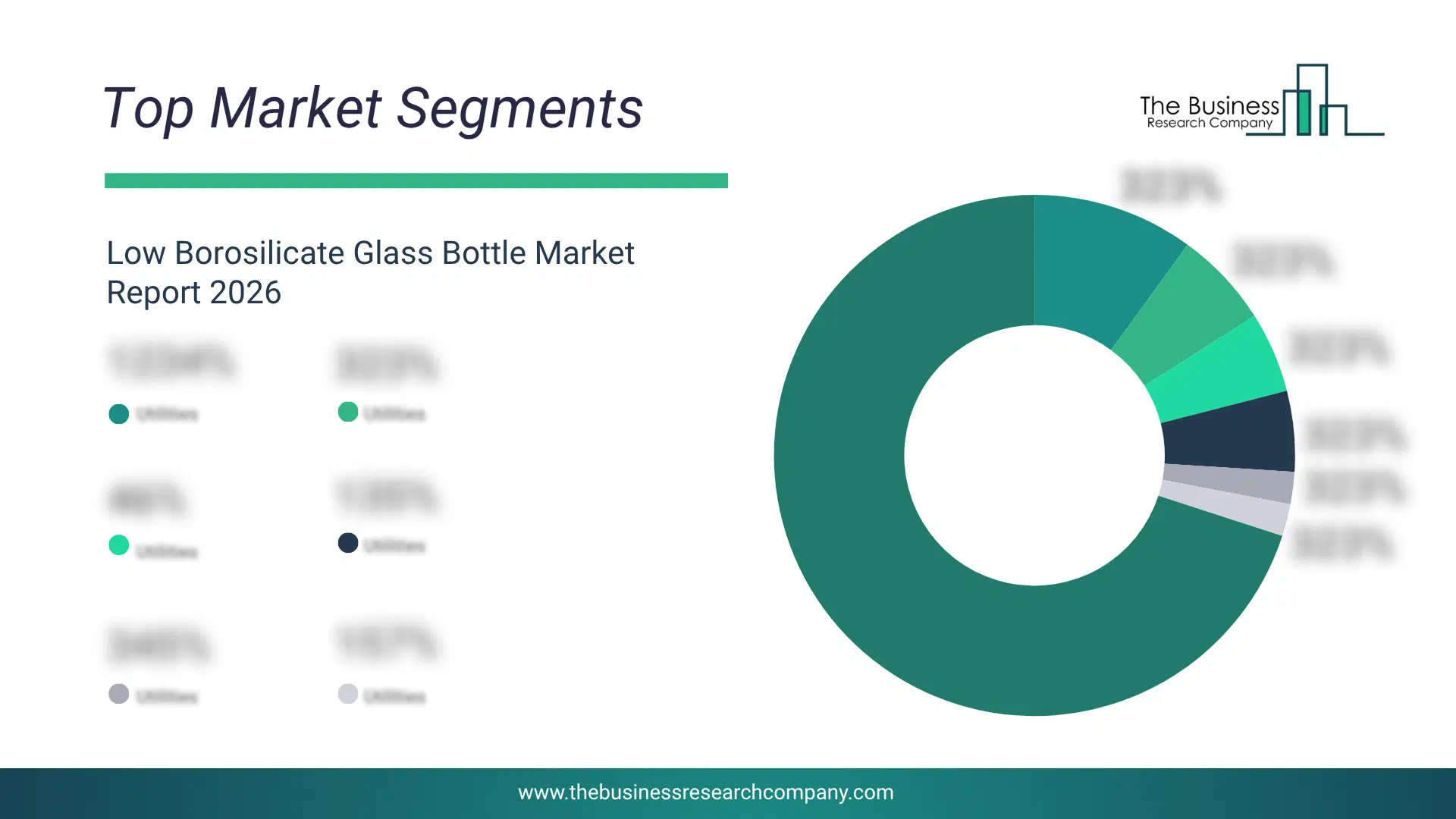
1) By Product Type: Clear, Amber, Other Types 2) By Capacity: Small, Medium, Large 3) By Distribution Channel: Specialty Stores, B2B Direct Sales 4) By Application: Pharmaceuticals, Food And Beverages, Cosmetics And Personal Care, Chemicals, Other Applications Subsegments: 1) By Clear Low Borosilicate Glass Bottles: Standard Clear Glass Bottles, Ultra-Clear Glass Bottles 2) By Amber Low Borosilicate Glass Bottles: Standard Amber Glass Bottles, Dark Amber Glass Bottles 3) By Other Types: Green Low Borosilicate Glass Bottles, Blue Low Borosilicate Glass Bottles, Frosted Low Borosilicate Glass Bottles, Custom Color Low Borosilicate Glass BottlesWhat Is The Driver Of The Low Borosilicate Glass Bottle Market?
The rising demand for pharmaceutical and cosmetic products is expected to propel the growth of the low borosilicate glass bottle market going forward. Pharmaceutical and cosmetic products refer to substances used for medical treatment or enhancing personal appearance, with pharmaceuticals targeting health conditions and cosmetics aimed at improving aesthetic appeal. The demand for pharmaceutical and cosmetic products is rising due to growing consumer awareness about personal grooming and appearance, driven largely by social media influence and beauty trends. Low borosilicate glass bottles are ideal for pharmaceutical and cosmetic products as they preserve the stability and purity of sensitive formulations by offering excellent chemical resistance and thermal durability. For instance, in April 2025, according to Eurostat, a European Union government statistical office, pharmaceutical exports from the EU increased from $172.7 billion (€157 billion) in 2023 to $213.4 billion (€194 billion) in 2024, marking a 13.5% rise compared to the previous year. Therefore, the rising demand for pharmaceutical and cosmetic products is driving the growth of the low borosilicate glass bottle industry.Key Players In The Global Low Borosilicate Glass Bottle Market
Major companies operating in the low borosilicate glass bottle market report are Corning Incorporated, SCHOTT AG, Gerresheimer AG, Stevanato Group SpA, SGD Pharma, Bormioli Pharma SpA, Nipro Corporation, Kavalierglass AS, DWK Life Sciences GmbH, AGI glaspac, Hindusthan National Glass and Industries Limited, Xuzhou Hualian Glass Co Ltd, Pegasus Glass Inc, Ameri Glass Bottle, Glassco Laboratory Equipment Pvt Ltd, Goel Scientific Glass Works Ltd, Haers Drinkware, Ardagh Group, Vetropack Group, Verallia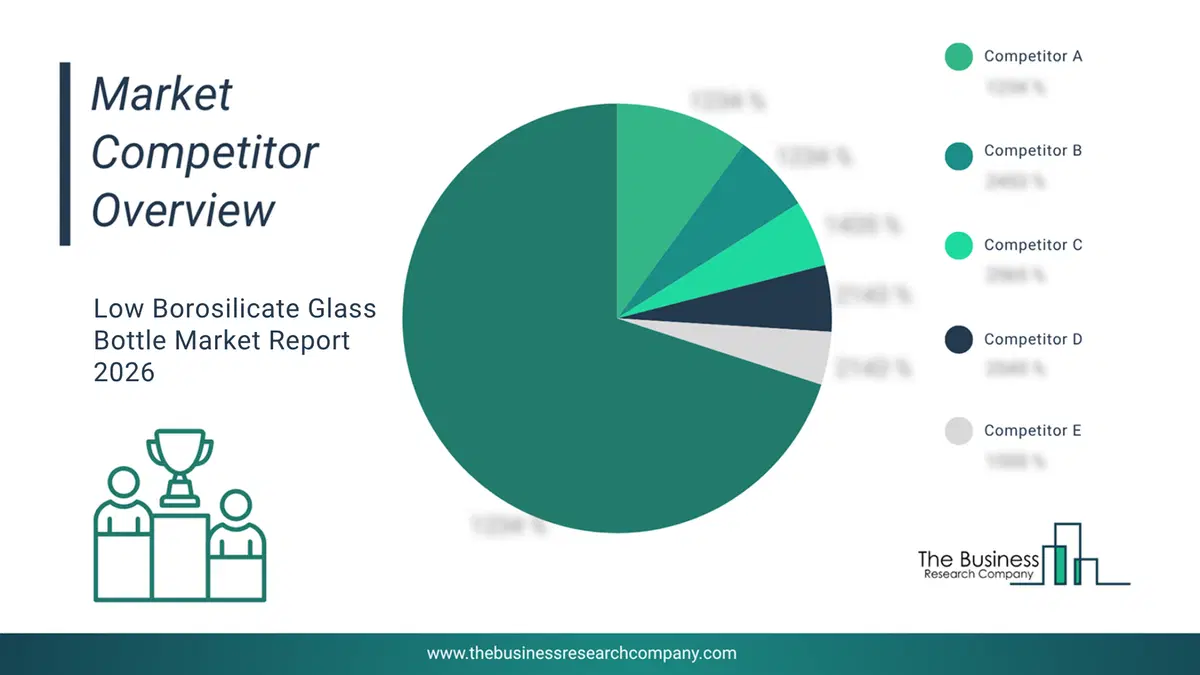
This chart is for illustrative purposes; the full report includes a detailed competitor analysis and comprehensive overview of the top 10 companies in the market.
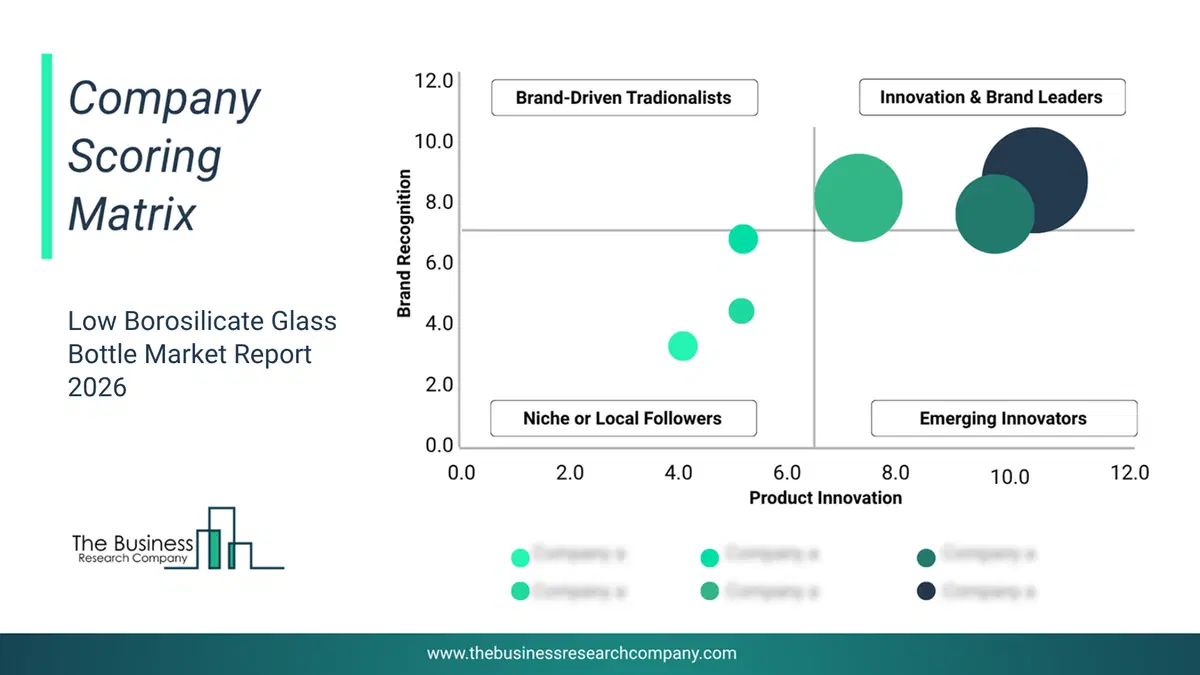
This chart maps companies by product innovation and brand strength, with bubble size indicating relative revenue, helping identify market leaders, challengers, and niche players. This is an illustrative chart; the full report provides a complete and accurate competitive analysis.
Global Low Borosilicate Glass Bottle Market Trends and Insights
Major companies operating in the low borosilicate glass bottle market are focusing on developing advanced solutions, such as next-generation type I borosilicate glass tubing, to enhance future needs of the pharma industry. Next-generation Type I borosilicate glass refers to an advanced form of traditional Type I borosilicate glass, engineered with improved performance characteristics. For instance, in October 2023, SCHOTT AG, a US-based manufacturing company, launched FIOLAX Pro, an advanced Type I borosilicate glass tubing developed to address the changing requirements of the pharmaceutical industry. This next-generation product supports the rising demand for complex drug formulations, greater sustainability, and digital integration. It features enhanced chemical resistance, an improved extractables and leachables profile, and superior hydrolytic durability, making it well-suited for the secure storage of diverse pharmaceutical substances. Additionally, it is free from heavy metals, ensuring compatibility with sensitive and cutting-edge therapeutics.What Are Latest Mergers And Acquisitions In The Low Borosilicate Glass Bottle Market?
In April 2023, Borosil Limited, an India-based glassware company, acquired Goel Scientific Glass Works for an undisclosed amount. Through this acquisition, Borosil aims to expand its Scientific and Industrial Products (SIP) business by adding a complementary product portfolio, leveraging its brand and distribution channels for import substitution, and entering the fast-growing industrial glass process systems market with world-class, India-made products at competitive value. Goel Scientific Glass Works is an India-based manufacturer of low borosilicate glass bottles.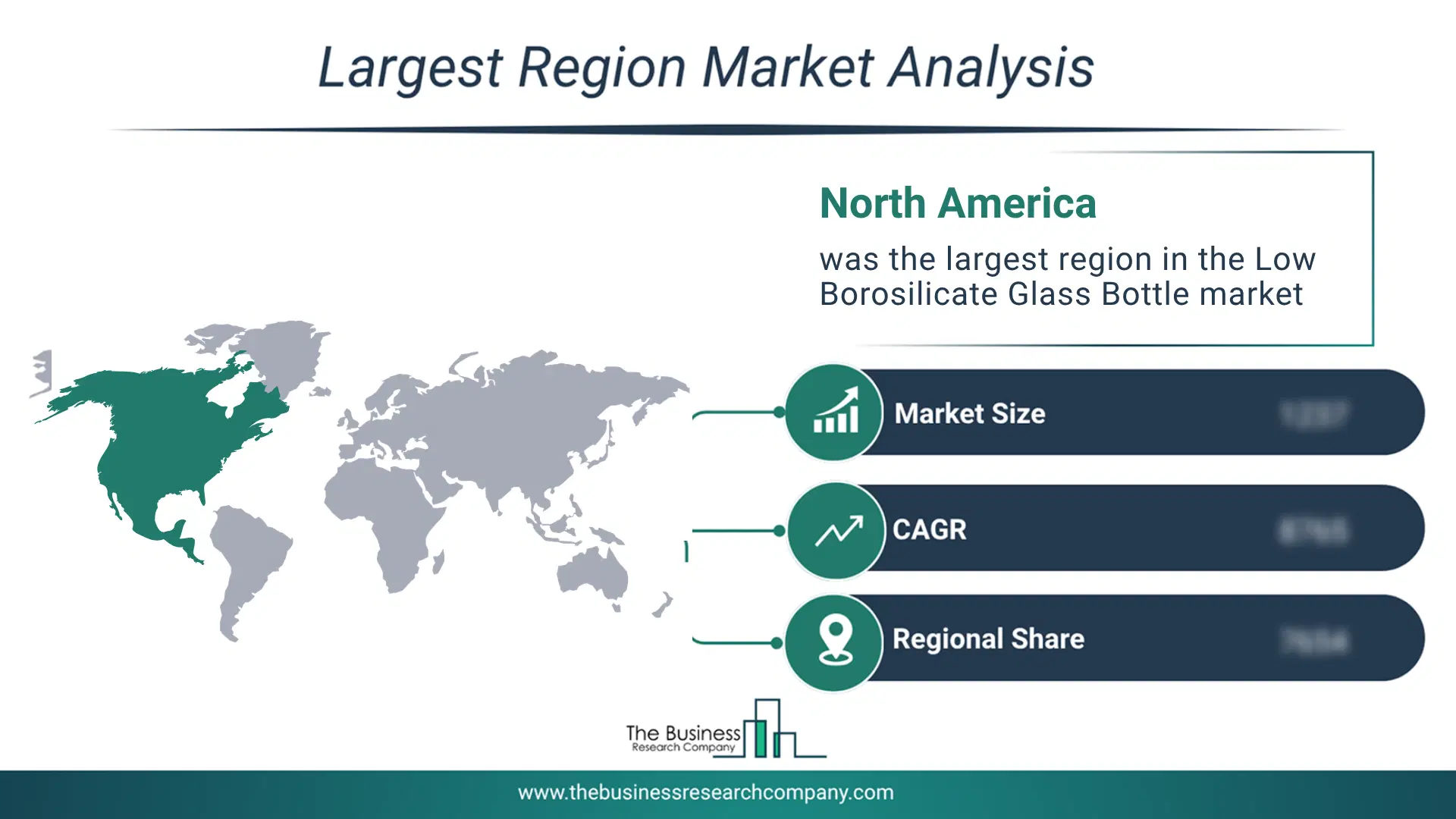
Regional Outlook
North America was the largest region in the low borosilicate glass bottle market in 2025. Asia-Pacific is expected to be the fastest-growing region in the forecast period. The regions covered in the low borosilicate glass bottle market are Asia-Pacific, South East Asia, Western Europe, Eastern Europe, North America, South America, Middle East, Africa. The countries covered in the low borosilicate glass bottle market are Australia, Brazil, China, France, Germany, India, Indonesia, Japan, Taiwan, Russia, South Korea, UK, USA, Canada, Italy, Spain.What Defines the Low Borosilicate Glass Bottle Market?
The low borosilicate glass bottle market consists of sales of pharmaceutical bottles, laboratory bottles, cosmetic packaging, food and beverage bottles, and specialty bottles. Values in this market are ‘factory gate’ values, that is, the value of goods sold by the manufacturers or creators of the goods, whether to other entities (including downstream manufacturers, wholesalers, distributors, and retailers) or directly to end customers. The value of goods in this market includes related services sold by the creators of the goods.How is Market Value Defined and Measured?
The market value is defined as the revenues that enterprises gain from the sale of goods and/or services within the specified market and geography through sales, grants, or donations in terms of the currency (in USD unless otherwise specified). The revenues for a specified geography are consumption values that are revenues generated by organizations in the specified geography within the market, irrespective of where they are produced. It does not include revenues from resales along the supply chain, either further along the supply chain or as part of other products.
This chart presents market attractiveness based on a quantitative evaluation of growth, competition, strategic alignment, and risk, offering a clear view of opportunity areas for decision-making. This chart is for illustrative purposes; the full report contains the complete analysis.

This chart highlights the Total Addressable Market (TAM) by estimating the maximum revenue opportunity using an assumption-driven approach, supporting strategic planning and opportunity sizing across markets. The chart is illustrative; the full report provides a more comprehensive analysis.
What Key Data and Analysis Are Included in the Low Borosilicate Glass Bottle Market Report 2026?
The low borosilicate glass bottle market research report is one of a series of new reports from The Business Research Company that provides market statistics, including Market Report 2026?global market size, regional shares, competitors with the market share, detailed market segments, market trends and opportunities, and any further data you may need to thrive in the low borosilicate glass bottle Market Report 2026? The market research report delivers a complete perspective of everything you need, with an in-depth analysis of the current and future state of the Market Report 2026?Low Borosilicate Glass Bottle Market Report Forecast Analysis
| Report Attribute | Details |
|---|---|
| Market Size Value In 2026 | $1.37 billion |
| Revenue Forecast In 2030 | $1.82 billion |
| Growth Rate | CAGR of 7.5% from 2026 to 2030 |
| Base Year For Estimation | 2025 |
| Actual Estimates/Historical Data | 2020-2025 |
| Forecast Period | 2026 - 2030 |
| Market Representation | Revenue in USD Billion and CAGR from 2026 to 2030 |
| Segments Covered | Product Type, Capacity, Distribution Channel, Application |
| Regional Scope | Asia-Pacific, Western Europe, Eastern Europe, North America, South America, Middle East, Africa |
| Country Scope | The countries covered in the report are Australia, Brazil, China, France, Germany, India, Indonesia, Japan, Taiwan, Russia, South Korea, UK, USA, Canada, Italy, Spain. |
| Key Companies Profiled | Corning Incorporated, SCHOTT AG, Gerresheimer AG, Stevanato Group SpA, SGD Pharma, Bormioli Pharma SpA, Nipro Corporation, Kavalierglass AS, DWK Life Sciences GmbH, AGI glaspac, Hindusthan National Glass and Industries Limited, Xuzhou Hualian Glass Co Ltd, Pegasus Glass Inc, Ameri Glass Bottle, Glassco Laboratory Equipment Pvt Ltd, Goel Scientific Glass Works Ltd, Haers Drinkware, Ardagh Group, Vetropack Group, Verallia |
| Customization Scope | Request for Customization |
| Pricing And Purchase Options | Explore Purchase Options |