
Low Intensity Sweeteners Market Report 2026
Global Outlook – By Type (D-Tagatose, Sorbitol, Maltitol, Xylitol, Mannitol, Erythritol, Allulose), By Form (Dry, Liquid), By Application (Food, Beverages, Pharmaceutical And Personal Care Products) – Market Size, Trends, Strategies, and Forecast to 2030
Low Intensity Sweeteners Market Overview
• Low Intensity Sweeteners market size has reached to $2.29 billion in 2025 • Expected to grow to $3.13 billion in 2030 at a compound annual growth rate (CAGR) of 6.4% • Growth Driver: Health-Conscious Consumers Drive Growth In The Low-Intensity Sweetener Market • Market Trend: Innovation In Low-Calorie Sweeteners Enhancing Flavor And Functionality • North America was the largest region in 2025 and Asia-Pacific is the fastest growing region.What Is Covered Under Low Intensity Sweeteners Market?
Low intensity sweetener is a type of substance that is added to food to give it a basic sweetness taste. Low Intensity Sweeteners are sugar substitutes that are low in calories or zero in calories while still providing a sweet taste. The consumption of low intensity sweeteners keeps the insulin level unaffected and differs these from the high-intensity sweeteners. The main types of low-intensity sweeteners include D-tagatose, sorbitol, maltitol, xylitol, mannitol, erythritol, and allulose. D-Tagatose is used as a partial or full replacement for other nutritive sweeteners such as sugar, corn syrup, and others that can be found in drinks, yogurt, creams, and dietetic sweets. D-Tagatose (D-tag) is a fructose isomer that is around 90% sweeter than sucrose. The various forms of low-intensity sweeteners are dry and liquid and are used for applications in food, beverages, and pharmaceutical and personal care products.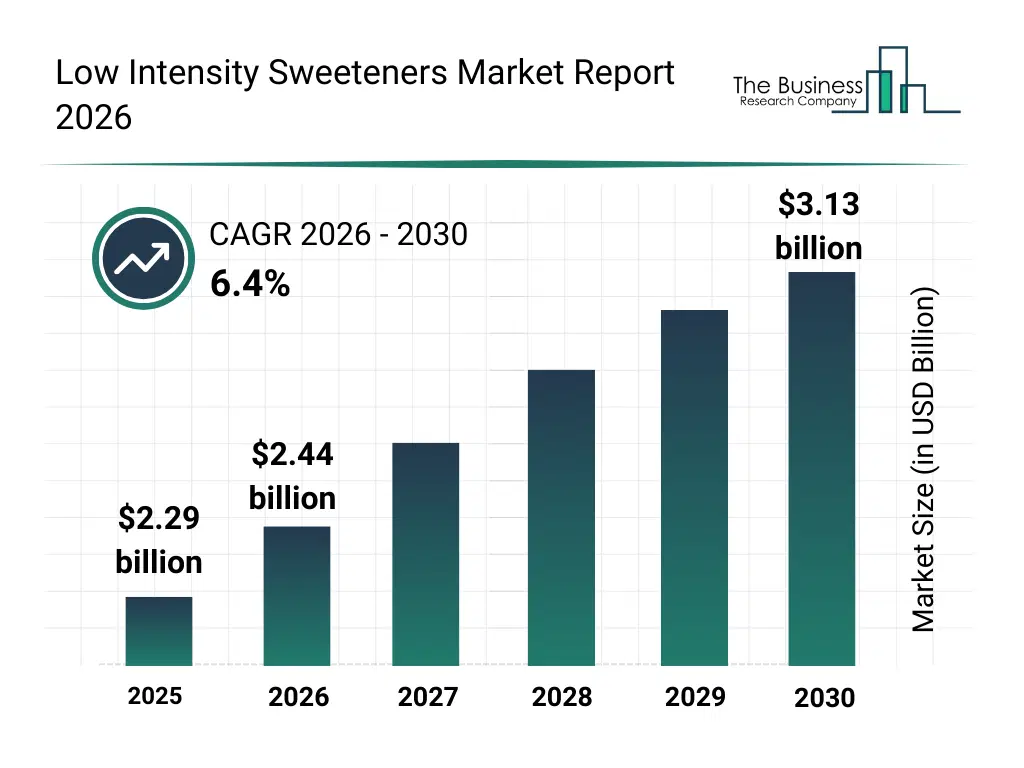
What Is The Low Intensity Sweeteners Market Size and Share 2026?
The low intensity sweeteners market size has grown strongly in recent years. It will grow from $2.29 billion in 2025 to $2.44 billion in 2026 at a compound annual growth rate (CAGR) of 6.4%. The growth in the historic period can be attributed to rising health awareness related to sugar intake, increasing diabetic population, expansion of sugar-free confectionery, availability of natural sweetener sources, growth in processed food consumption.What Is The Low Intensity Sweeteners Market Growth Forecast?
The low intensity sweeteners market size is expected to see strong growth in the next few years. It will grow to $3.13 billion in 2030 at a compound annual growth rate (CAGR) of 6.4%. The growth in the forecast period can be attributed to increasing demand for diabetic-friendly foods, rising focus on weight management products, expansion of natural and plant-based sweeteners, growing regulatory support for sugar reduction, increasing R&D in alternative sweeteners. Major trends in the forecast period include increasing demand for low-calorie sugar alternatives, rising use of polyols in functional foods, growing adoption in pharmaceutical formulations, expansion of clean-label sweetener applications, enhanced focus on glycemic control.
Global Low Intensity Sweeteners Market Segmentation
1) By Type: D-Tagatose, Sorbitol, Maltitol, Xylitol, Mannitol, Erythritol, Allulose 2) By Form: Dry, Liquid 3) By Application: Food, Beverages, Pharmaceutical And Personal Care Products Subsegments: 1) By D-Tagatose: Applications In Dairy Products, Confectionery 2) By Sorbitol: Food And Beverages, Pharmaceuticals, Personal Care Products 3) By Maltitol: Sugar-Free Confectionery, Baked Goods, Ice Cream 4) By Xylitol: Oral Care Products, Sugar-Free Gum, Baked Goods 5) By Mannitol: Pharmaceuticals, Food Products, Nutraceuticals 6) By Erythritol: Beverages, Baked Goods, Confectionery 7) By Allulose: Beverage Applications, Bakery Products, Sauces And DressingsWhat Is The Driver Of The Low Intensity Sweeteners Market?
Growing consumer inclination towards low-calorie foods is expected to propel the growth of the low-intensity sweetener market. The rising consumer awareness of health and wellness in relation to healthier food and beverage products, as well as a preference for low-calorie foods and a healthy diet, is driving the growth of the market. For instance, in January 2024, according to a report published by Food Navigator Europe, a France-based daily news service, approximately 33% of adults in the UK and Ireland eat at least five servings of fruits and vegetables daily, in contrast to 30% in the Netherlands, 20% in France, 11% in Germany, and only 2% in Romania. Therefore, growing consumer inclination towards low-calorie and healthy foods is expected to propel the growth of the low-intensity sweetener market.Key Players In The Global Low Intensity Sweeteners Market
Major companies operating in the low intensity sweeteners market are Ingredion Incorporated, Roquette Frères S A, Tate & Lyle plc, Archer Daniels Midland Company, Cargill, Südzucker AG, Gulshan Polyols Limited, Hylen Co Ltd, Shandong Saigo Group Corporation, Fooding Group Limited, Mitsui Sugar Co Ltd, Bonumose Inc, ZuChem Inc, Gadot Biochemical Industries Ltd, Samyang Corporation, Baolingbao Biology Co Ltd, Shandong Futaste Co Ltd, Jungbunzlauer, Tereos, Zhucheng Dongxiao Biotechnology Co Ltd
This chart is for illustrative purposes; the full report includes a detailed competitor analysis and comprehensive overview of the top 10 companies in the market.
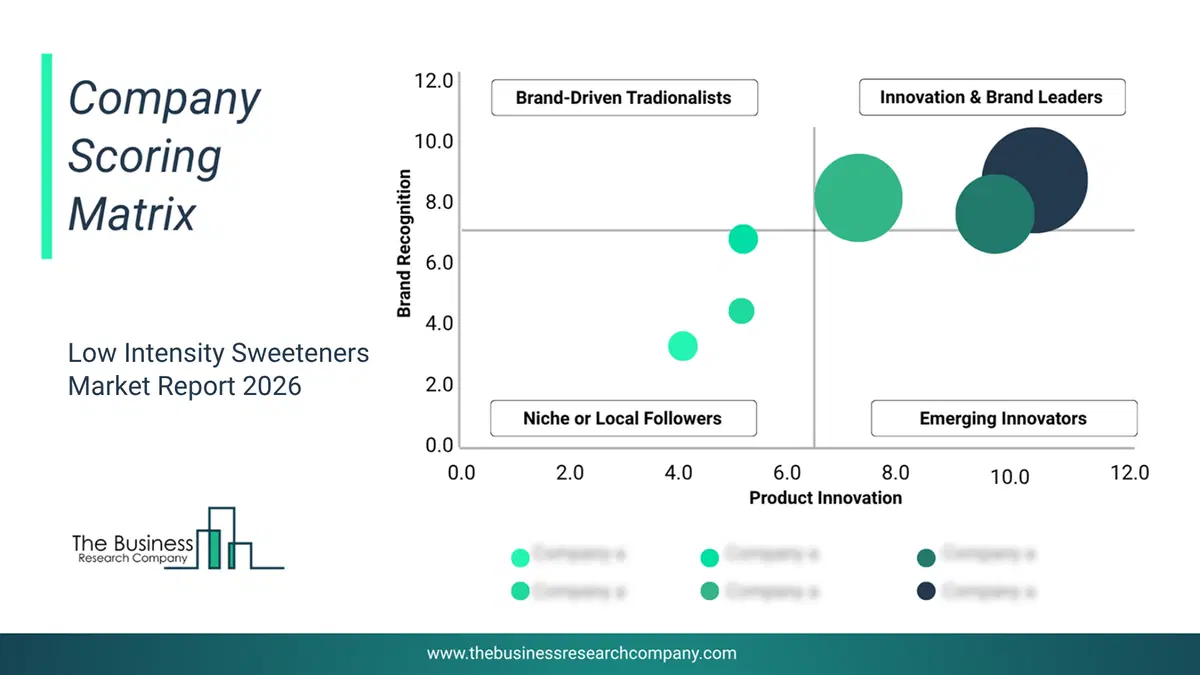
This chart maps companies by product innovation and brand strength, with bubble size indicating relative revenue, helping identify market leaders, challengers, and niche players. This is an illustrative chart; the full report provides a complete and accurate competitive analysis.
Global Low Intensity Sweeteners Market Trends and Insights
Major companies in the low-intensity sweeteners market are actively developing advanced low-calorie sweeteners to provide better taste, functionality, and formulation flexibility across food and beverage products. For instance, in April 2024, according to Ingredion, a US-based ingredient solutions company, the company launched a breakthrough stevia solution, offering an improved sugar-like taste and superior sweetness profile compared to conventional stevia extracts. This solution provides clean-label, zero-calorie sweetness with minimal aftertaste, enabling manufacturers to reduce sugar content without compromising flavor, mouthfeel, or overall product quality. The launch reflects the broader industry trend of innovating sweetener formulations to meet rising consumer demand for healthier, low-calorie, and natural alternatives, while maintaining the sensory experience and functional performance of traditional sugar in a wide range of applications.What Are Latest Mergers And Acquisitions In The Low Intensity Sweeteners Market?
In December 2024, Tate & Lyle, a UK-based ingredient solutions provider for food and beverages, entered into a strategic partnership with BioHarvest Sciences to co-develop next-generation plant-based bioactive ingredients. With this partnership, Tate & Lyle aimed to leverage BioHarvest’s innovative plant-cell-based “Botanical Synthesis” platform to co-develop next-generation plant-derived low-calorie and low-intensity sweeteners, enhancing its product portfolio and addressing growing consumer demand for natural, sustainable sugar-reduction solutions. BioHarvest Sciences is a Canada-based biotech firm specializing in plant-cell-based technology for botanical ingredient production.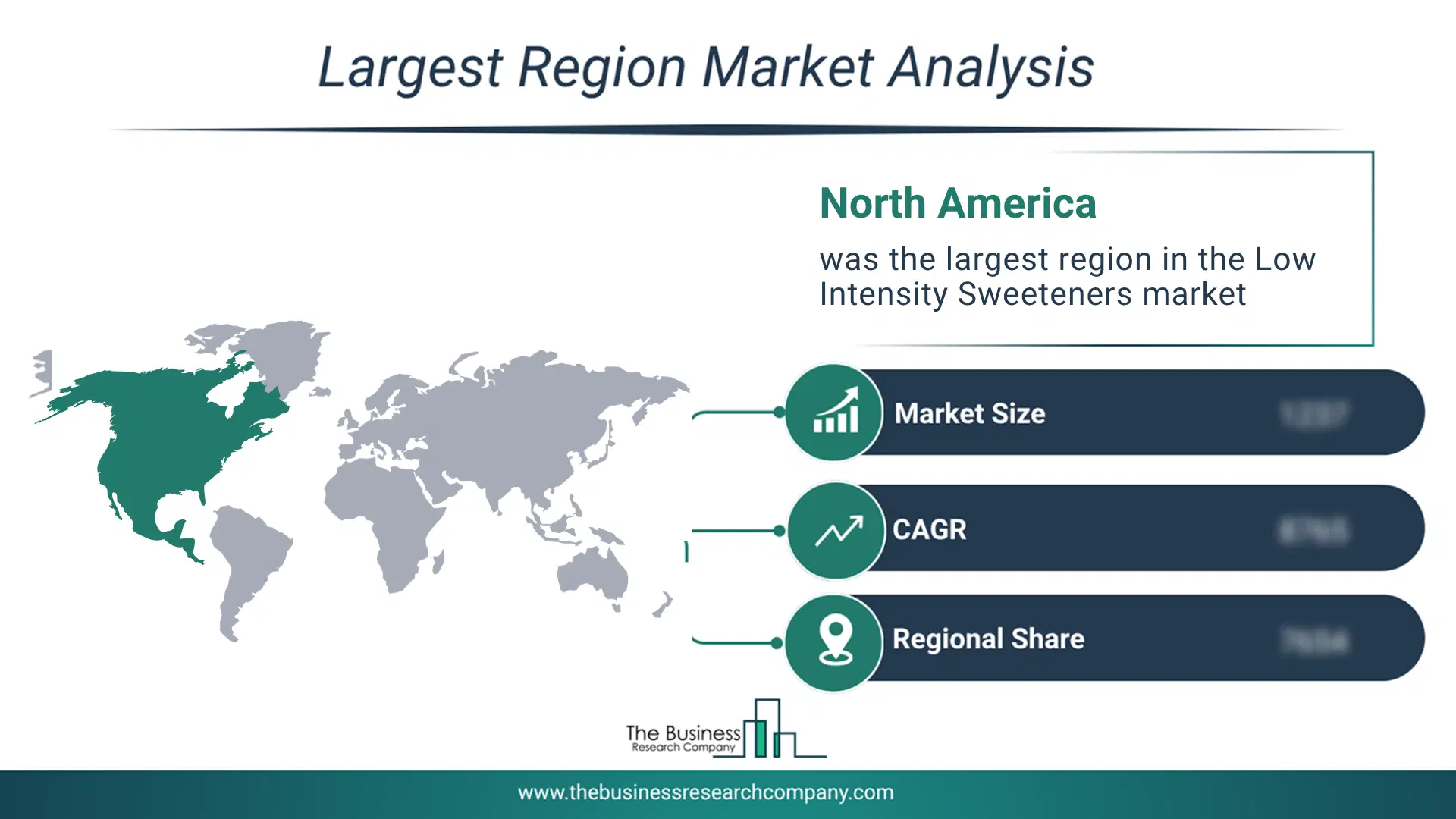
Regional Outlook
North America will be the largest region in the low-intensity sweeteners market share in 2025. Asia-Pacific is expected to be the fastest-growing region in the forecast period. The regions covered in this market report are Asia-Pacific, South East Asia, Western Europe, Eastern Europe, North America, South America, Middle East and Africa. The countries covered in this market report are Australia, Brazil, China, France, Germany, India, Indonesia, Japan, Taiwan, Russia, South Korea, UK, USA, Italy, Spain, CanadaWhat Defines the Low Intensity Sweeteners Market?
The low intensity sweetener market consists of sales of frozen desserts, yogurt, candies, baked goods, chewing gum, breakfast cereals, gelatins, and puddings. Values in this market are ‘factory gate’ values, that is the value of goods sold by the manufacturers or creators of the goods, whether to other entities (including downstream manufacturers, wholesalers, distributors and retailers) or directly to end customers. The value of goods in this market includes related services sold by the creators of the goods.How is Market Value Defined and Measured?
The market value is defined as the revenues that enterprises gain from the sale of goods and/or services within the specified market and geography through sales, grants, or donations in terms of the currency (in USD unless otherwise specified). The revenues for a specified geography are consumption values that are revenues generated by organizations in the specified geography within the market, irrespective of where they are produced. It does not include revenues from resales along the supply chain, either further along the supply chain or as part of other products.
This chart presents market attractiveness based on a quantitative evaluation of growth, competition, strategic alignment, and risk, offering a clear view of opportunity areas for decision-making. This chart is for illustrative purposes; the full report contains the complete analysis.

This chart highlights the Total Addressable Market (TAM) by estimating the maximum revenue opportunity using an assumption-driven approach, supporting strategic planning and opportunity sizing across markets. The chart is illustrative; the full report provides a more comprehensive analysis.
What Key Data and Analysis Are Included in the Low Intensity Sweeteners Market Report 2026?
The low intensity sweeteners market research report is one of a series of new reports from The Business Research Company that provides market statistics, including industry global market size, regional shares, competitors with the market share, detailed market segments, market trends and opportunities, and any further data you may need to thrive in the low intensity sweeteners industry. The market research report delivers a complete perspective of everything you need, with an in-depth analysis of the current and future state of the industry.Low Intensity Sweeteners Market Report Forecast Analysis
| Report Attribute | Details |
|---|---|
| Market Size Value In 2026 | $2.44 billion |
| Revenue Forecast In 2030 | $3.13 billion |
| Growth Rate | CAGR of 6.4% from 2026 to 2030 |
| Base Year For Estimation | 2025 |
| Actual Estimates/Historical Data | 2020-2025 |
| Forecast Period | 2026 - 2030 |
| Market Representation | Revenue in USD Billion and CAGR from 2026 to 2030 |
| Segments Covered | Type, Form, Application |
| Regional Scope | Asia-Pacific, Western Europe, Eastern Europe, North America, South America, Middle East, Africa |
| Country Scope | The countries covered in the report are Australia, Brazil, China, France, Germany, India, Indonesia, Japan, Taiwan, Russia, South Korea, UK, USA, Canada, Italy, Spain. |
| Key Companies Profiled | Ingredion Incorporated, Roquette Frères S A, Tate & Lyle plc, Archer Daniels Midland Company, Cargill, Südzucker AG, Gulshan Polyols Limited, Hylen Co Ltd, Shandong Saigo Group Corporation, Fooding Group Limited, Mitsui Sugar Co Ltd, Bonumose Inc, ZuChem Inc, Gadot Biochemical Industries Ltd, Samyang Corporation, Baolingbao Biology Co Ltd, Shandong Futaste Co Ltd, Jungbunzlauer, Tereos, Zhucheng Dongxiao Biotechnology Co Ltd |
| Customization Scope | Request for Customization |
| Pricing And Purchase Options | Explore Purchase Options |