
Luxury Skincare Market Report 2026
Global Outlook – By Types (Facial Care, Body Care), By Distribution Channel (Specialty Stores, Online Stores, Other Distribution Channels), By Applications (For Men, For Women) – Market Size, Trends, Strategies, and Forecast to 2035
Luxury Skincare Market Overview
• Luxury Skincare market size has reached to $26.05 billion in 2025 • Expected to grow to $37.46 billion in 2030 at a compound annual growth rate (CAGR) of 7.5% • Growth Driver: Surging Cosmetic Usage Propels Expansion in the Luxury Skincare Market • Market Trend: Major Companies Drive Profitability with Innovations Such As AI Skin Advisor in the Luxury Skincare Market • North America was the largest region in 2025.Market Gains By 2030 – Top Opportunities By Segment
Market Gain identifies the most promising market opportunities by highlighting the segments or products expected to generate the highest incremental revenue growth over the next five years.
What Is Covered Under Luxury Skincare Market?
Luxury skincare refers to a category of high-end, premium-quality skincare products and treatments that are designed to provide an exclusive and indulgent experience for consumers. Luxury skincare products are primarily high priced and used to address specific skin concerns, preventing and reversing signs of aging. The main types of luxury skincare are facial care and body care. Facial care refers to a category of skincare products designed specifically for the care and maintenance of the skin on the face. The various distribution channels involved are hypermarkets and supermarkets, specialty stores, online stores, and other distribution channels that can be used to sell these products to men and women.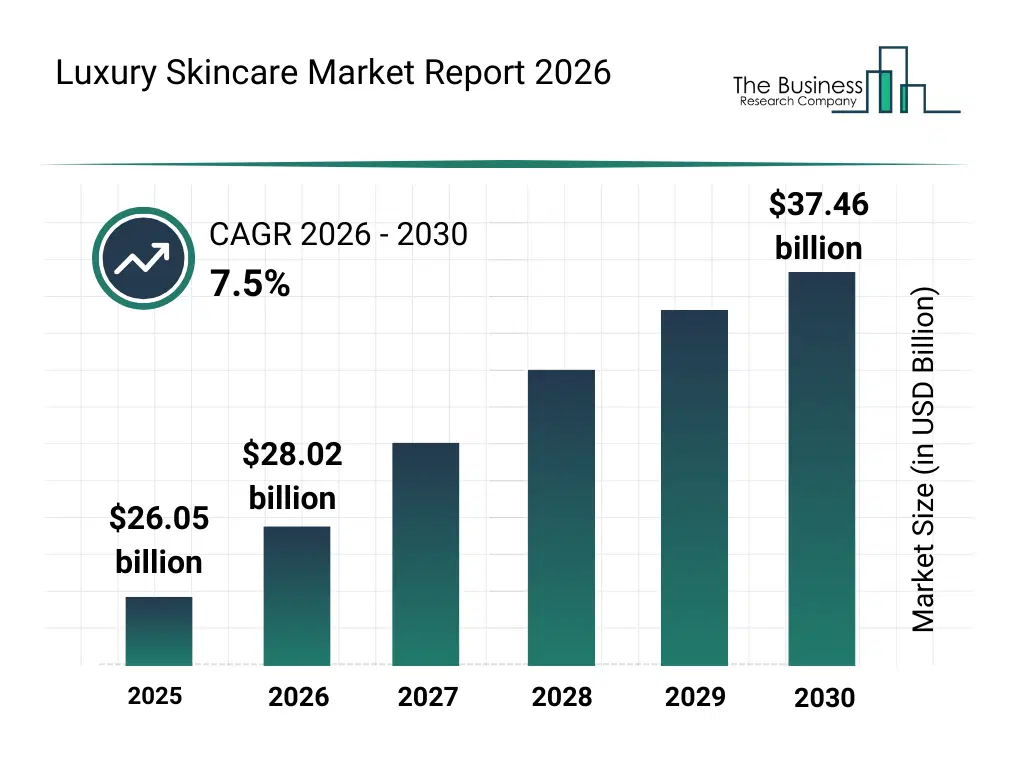
What Is The Luxury Skincare Market Size and Share 2026?
The luxury skincare market size has grown strongly in recent years. It will grow from $26.05 billion in 2025 to $28.02 billion in 2026 at a compound annual growth rate (CAGR) of 7.6%. The growth in the historic period can be attributed to rising premium beauty spending, increasing skincare awareness, early adoption of luxury cosmetic brands, growing facial care importance, rising disposable income.What Is The Luxury Skincare Market Growth Forecast?
The luxury skincare market size is expected to see strong growth in the next few years. It will grow to $37.46 billion in 2030 at a compound annual growth rate (CAGR) of 7.5%. The growth in the forecast period can be attributed to growing demand for anti aging solutions, increasing luxury personal care preference, rising premium skincare investments, expansion of luxury retail channels, growing focus on youthful appearance maintenance. Major trends in the forecast period include increasing demand for premium anti aging skincare, rising preference for high end beauty and skin treatment products, growing focus on advanced skin nourishment and rejuvenation, expansion of luxury beauty consumption among affluent consumers, strengthening inclination toward premium self care experiences.

Global Luxury Skincare Market Segmentation
1) By Types: Facial Care, Body Care 2) By Distribution Channel: Specialty Stores, Online Stores, Other Distribution Channels 3) By Applications: For Men, For Women Subsegments: 1) By Facial Care: Anti-Aging Products, Moisturizers And Serums, Cleansers And Exfoliators, Eye Care Products, Face Masks 2) By Body Care: Body Lotions And Creams, Body Scrubs And Exfoliators, Bath Oils and Gels, Hand And Foot Care, Anti-Cellulite Products The top segments in the luxury skincare market will be: • Facial Care will reach $18954.4 Million by 2025. • For Women will reach $15925.3 Million by 2025. • Specialty Stores will reach $10655.9 Million by 2025. • Online Stores will reach $9200.4 Million by 2025. • Body Care will reach $7104.8 Million by 2025.What Is The Driver Of The Luxury Skincare Market?
The increasing use of cosmetics is expected to propel the growth of the luxury skincare market. Cosmetics refer to a diverse range of products applied to the body, face, hair, or nails to enhance or alter appearance. Cosmetics integrate and commonly use luxury skincare to offer high-end formulations enriched with premium ingredients, advanced technologies, and specialized benefits, providing consumers with a pampering and effective skincare experience that aligns with the pursuit of indulgence, quality, and superior results in beauty routines. For instance, in September 2023, according to the American Society of Plastic Surgeons (ASPS), a US-based plastic surgery specialty organization, there were 4, 715, 716 cosmetic procedures performed using botulinum toxin type A (including Botox, Dysport, and Xeomin) in 2023, reflecting a 6% increase from the previous year. Dermal fillers also saw significant use, with 3, 441, 534 procedures performed, up 4% from 2022. Therefore, the increasing use of cosmetics is driving the growth of the luxury skincare industry.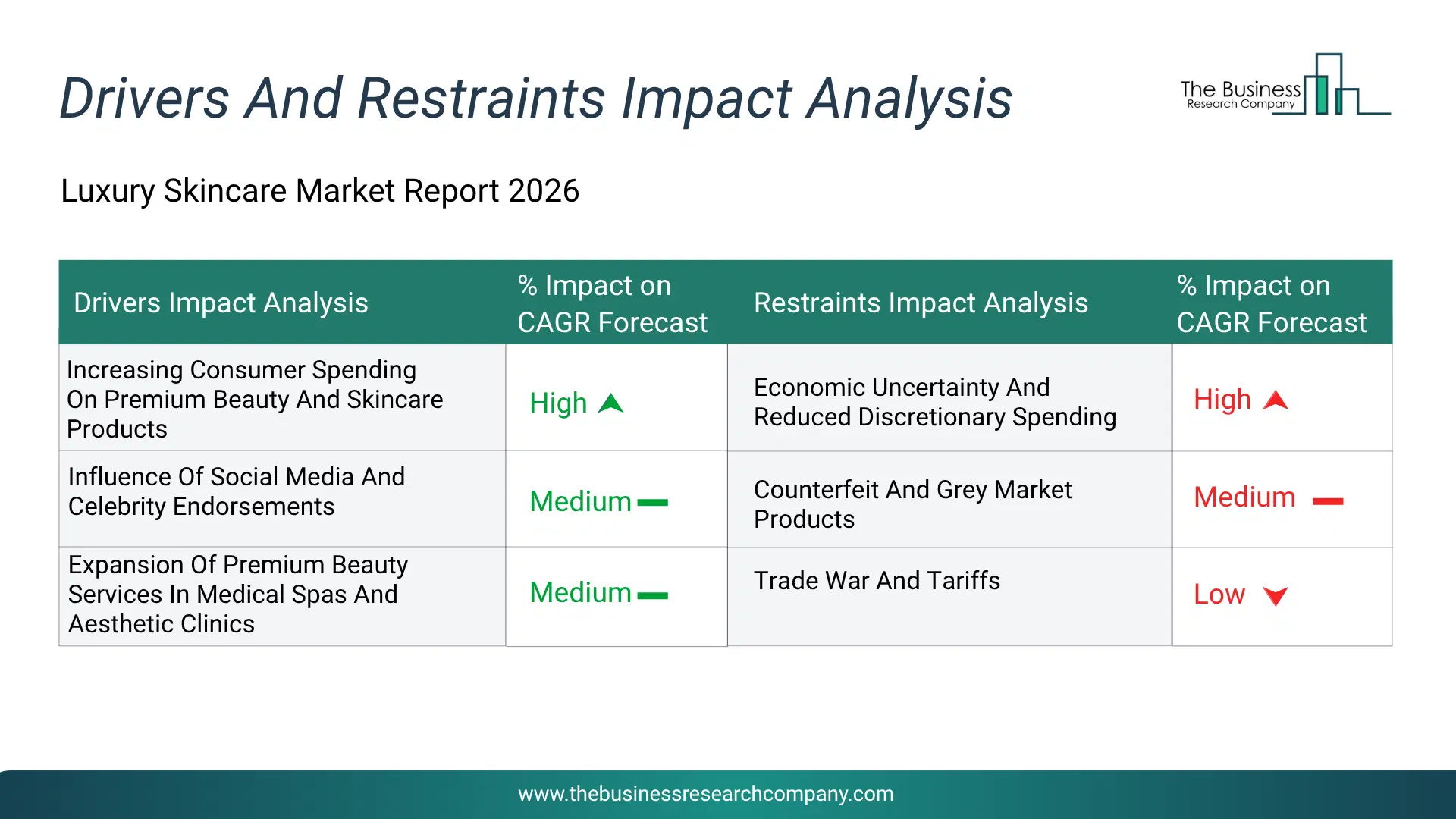
Infographic Chart Showing Key Market Drivers Analysis And Restraints For Luxury Skincare Market
The chart presents an impact analysis of key drivers and restraints, quantifying their relative influence on the market's growth rate and helping assess the balance between growth enablers and limiting factors. This chart offers a high-level perspective; the full report contains more detailed insights.
How Will The Drivers Impact Growth In The Global Luxury Skincare Market?
• Increasing Consumer Spending On Premium Beauty And Skincare Products (High) – The increasing consumer spending on premium beauty and skincare products will become a key driver of growth in the luxury skincare market by 2030. Increasing disposable incomes, evolving beauty standards, and greater awareness of advanced skincare solutions are encouraging consumers to invest in high-quality and specialized products. Demand for anti-aging creams, serums, organic formulations, and dermatologist-backed skincare solutions is growing, particularly among urban and affluent consumers. In addition, the influence of social media, celebrity endorsements, and beauty influencers is accelerating consumer preference for luxury skincare brands. The expansion of e-commerce platforms and premium retail channels is further improving product accessibility and supporting market growth globally. As a result, the increasing consumer spending on premium beauty and skincare products is anticipated to contributing to a 2.0% annual growth in the market. • Influence Of Social Media And Celebrity Endorsements (Medium) – The influence of social media and celebrity endorsements will emerge as a major factor driving the expansion of the luxury skincare market by 2030. Beauty influencers, celebrities, and skincare experts on platforms such as Instagram, YouTube, and TikTok are significantly shaping consumer purchasing behaviour by promoting premium skincare brands and products. Their recommendations enhance brand visibility, build consumer trust, and create strong demand for luxury skincare solutions. In addition, digital marketing campaigns, product reviews, and viral beauty trends are encouraging consumers to adopt high-end skincare routines. Luxury skincare companies are increasingly collaborating with celebrities and influencers to strengthen brand positioning, expand customer reach, and drive sales growth globally. Consequently, the influence of social media and celebrity endorsements is projected to contributing to a 1.8% annual growth in the market. • Expansion Of Premium Beauty Services In Medical Spas And Aesthetic Clinics (Medium) – The expansion of premium beauty services in medical spas and aesthetic clinics will serve as a key growth catalyst for the luxury skincare market by 2030. Increasing consumer preference for professional skincare treatments, anti-aging procedures, and personalized beauty solutions is driving demand for high-end skincare products used in these facilities. Medical spas and aesthetic clinics are increasingly offering advanced treatments such as chemical peels, laser therapies, and skin rejuvenation procedures that require premium skincare formulations for enhanced results. In addition, rising awareness regarding skin health, growing disposable incomes, and the increasing availability of technologically advanced aesthetic services are encouraging consumers to spend more on luxury skincare products and treatments globally. Therefore, this expansion of premium beauty services in medical spas and aesthetic clinics is projected to supporting to a 1.5% annual growth in the market. • Expansion Of Experiential Luxury Beauty Retail Concepts (Medium) – The expansion of experiential luxury beauty retail concepts will become a significant driver contributing to the growth of the luxury skincare market by 2030. Luxury skincare brands are increasingly investing in immersive retail experiences, including personalized consultations, interactive product demonstrations, skincare diagnostics, and premium in-store services, to strengthen customer engagement and brand loyalty. These experiential retail formats enhance consumer satisfaction by offering customized beauty solutions and exclusive shopping experiences. In addition, the integration of advanced technologies such as artificial intelligence-based skin analysis and virtual consultations is improving customer interaction and purchasing decisions. The growing presence of flagship stores, beauty lounges, and concept boutiques is further supporting the demand for premium skincare products globally. Consequently, the expansion of experiential luxury beauty retail concepts is projected to contributing to a 1.0% annual growth in the market.How Will The Restraints Impact Growth In The Global Luxury Skincare Market?
• Economic Uncertainty And Reduced Discretionary Spending (High) – Economic uncertainty and reduced discretionary spending is expected to restrain market growth during the forecast period. It creates operational, financial, regulatory, or commercial challenges that can increase costs, delay projects, reduce investments, or discourage purchasing decisions depending on the market. These challenges can reduce product adoption, affect business confidence, and limit the ability of companies to expand efficiently across key regions. This can reduce operational efficiency, delay expansion plans, and affect the ability of companies to achieve sustainable business growth. • Counterfeit And Grey Market Products (Medium) – During the forecast period, counterfeit and grey market products is likely to limit market expansion. It creates operational, financial, regulatory, or commercial challenges that can increase costs, delay projects, reduce investments, or discourage purchasing decisions depending on the market. These challenges can reduce product adoption, affect business confidence, and limit the ability of companies to expand efficiently across key regions. As a result, businesses may face increased cost pressures, slower commercial adoption, and reduced revenue opportunities. • Trade War And Tariffs (Medium) – The market is expected to face challenges due to trade war and tariffs over the forecast period. It creates operational, financial, regulatory, or commercial challenges that can increase costs, delay projects, reduce investments, or discourage purchasing decisions depending on the market. These challenges can reduce product adoption, affect business confidence, and limit the ability of companies to expand efficiently across key regions. This may discourage new investments, delay strategic expansion initiatives, and weaken the overall competitive position of market participants.Key Players In The Global Luxury Skincare Market
Major companies operating in the luxury skincare market report are Johnson & Johnson Services Inc., Christian Dior SE, LVMH Moët Hennessy Louis Vuitton SE, Procter & Gamble Company, Unilever plc, L'Oréal S.A., Henkel AG & Co. KGaA, Colgate-Palmolive Company, The Estée Lauder Companies Inc., Chanel S.A., Kao Corporation, Shiseido Co. Ltd., Coty Inc., Valmont Group, Amorepacific Corporation, Mary Kay Inc., Avon Products Inc., Kose Corporation, Revlon Inc., Beiersdorf AG, Sisley S.A., Guerlain S.A., Augustinus Bader GmbH & Co. KG, Lancôme Paris, Tatcha LLC, Tata Harper Skincare, Natura Bissé International S.A., Natura & Co., Sunday Riley Modern Skincare LLC
This chart is for illustrative purposes; the full report includes a detailed competitor analysis and comprehensive overview of the top 10 companies in the market.

This chart maps companies by product innovation and brand strength, with bubble size indicating relative revenue, helping identify market leaders, challengers, and niche players. This is an illustrative chart; the full report provides a complete and accurate competitive analysis.
Global Luxury Skincare Market Trends and Insights
Major companies operating in the luxury skincare market are focusing on advances in innovation and technology for luxury skincare, such as AI Skin Advisor to increase their profitability in the market. AI Skin Advisor provides a personalized skincare routine to customers by analyzing their skin. For instance, in January 2023, Bulldog Skincare Limited, a US-based manufacturer of skincare products, launched the new AI Skin Advisor. This innovative AI tool enables male users to increase their virtual engagement in skin analysis, which provides personalized skincare tips in less than a minute. The tool streamlines the process of selecting the best skincare products in order to make the skincare journey more enjoyable and approachable for men. The Bulldog UK website offers it for purchase, and it was created in collaboration with Revieve, a producer of digital brand experiences and self-diagnostic tools.What Are Latest Mergers And Acquisitions In The Luxury Skincare Market?
In August 2023, L'Oréal S.A., a France-based personal care company, acquired Aesop Pty Ltd. for an undisclosed amount. With this acquisition, Loreal looks forward to expanding its footprint in China by offering a wide range of luxury skincare products and aims to increase its presence in China's natural beauty and high-end product space in the upcoming years, as Aesop has a presence in approximately 400 Chinese stores. Aesop Pty Ltd. is an Australia-based luxury skincare product manufacturing company.
Regional Outlook
North America was the largest region in the luxury skincare market in 2025. The regions covered in this market report are Asia-Pacific, South East Asia, Western Europe, Eastern Europe, North America, South America, Middle East, Africa. The countries covered in this market report are Australia, Brazil, China, France, Germany, India, Indonesia, Japan, Taiwan, Russia, South Korea, UK, USA, Canada, Italy, SpainWhat Defines the Luxury Skincare Market?
The luxury skincare market consists of sales of products such as anti-aging products, moisturizers, makeup removers, night creams, and serums. Values in this market are ‘factory gate’ values, that is the value of goods sold by the manufacturers or creators of the goods, whether to other entities (including downstream manufacturers, wholesalers, distributors, and retailers) or directly to end customers. The value of goods in this market includes related services sold by the creators of the goods.How is Market Value Defined and Measured?
The market value is defined as the revenues that enterprises gain from the sale of goods and/or services within the specified market and geography through sales, grants, or donations in terms of the currency (in USD unless otherwise specified). The revenues for a specified geography are consumption values that are revenues generated by organizations in the specified geography within the market, irrespective of where they are produced. It does not include revenues from resales along the supply chain, either further along the supply chain or as part of other products.
This chart presents market attractiveness based on a quantitative evaluation of growth, competition, strategic alignment, and risk, offering a clear view of opportunity areas for decision-making. This chart is for illustrative purposes; the full report contains the complete analysis.

This chart highlights the Total Addressable Market (TAM) by estimating the maximum revenue opportunity using an assumption-driven approach, supporting strategic planning and opportunity sizing across markets. The chart is illustrative; the full report provides a more comprehensive analysis.
What Key Data and Analysis Are Included in the Luxury Skincare Market Report 2026?
The luxury skincare market research report is one of a series of new reports from The Business Research Company that provides market statistics, including industry global market size, regional shares, competitors with the market share, detailed market segments, market trends and opportunities, and any further data you may need to thrive in the luxury skincare industry. The market research report delivers a complete perspective of everything you need, with an in-depth analysis of the current and future state of the industry.Luxury Skincare Market Report Forecast Analysis
| Report Attribute | Details |
|---|---|
| Market Size Value In 2026 | $28.02 billion |
| Revenue Forecast In 2035 | $37.46 billion |
| Growth Rate | CAGR of 7.6% from 2026 to 2035 |
| Base Year For Estimation | 2025 |
| Actual Estimates/Historical Data | 2020-2025 |
| Forecast Period | 2026 - 2030 - 2035 |
| Market Representation | Revenue in USD Billion and CAGR from 2026 to 2035 |
| Segments Covered | Types, Distribution Channel, Applications |
| Regional Scope | Asia-Pacific, Western Europe, Eastern Europe, North America, South America, Middle East, Africa |
| Country Scope | The countries covered in the report are Australia, Brazil, China, France, Germany, India, ... |
| Key Companies Profiled | Johnson & Johnson Services Inc., Christian Dior SE, LVMH Moët Hennessy Louis Vuitton SE, Procter & Gamble Company, Unilever plc, L'Oréal S.A., Henkel AG & Co. KGaA, Colgate-Palmolive Company, The Estée Lauder Companies Inc., Chanel S.A., Kao Corporation, Shiseido Co. Ltd., Coty Inc., Valmont Group, Amorepacific Corporation, Mary Kay Inc., Avon Products Inc., Kose Corporation, Revlon Inc., Beiersdorf AG, Sisley S.A., Guerlain S.A., Augustinus Bader GmbH & Co. KG, Lancôme Paris, Tatcha LLC, Tata Harper Skincare, Natura Bissé International S.A., Natura & Co., Sunday Riley Modern Skincare LLC |
| Customization Scope | Request for Customization |
| Pricing And Purchase Options | Explore Purchase Options |